← Mayim Bialik's Breakdown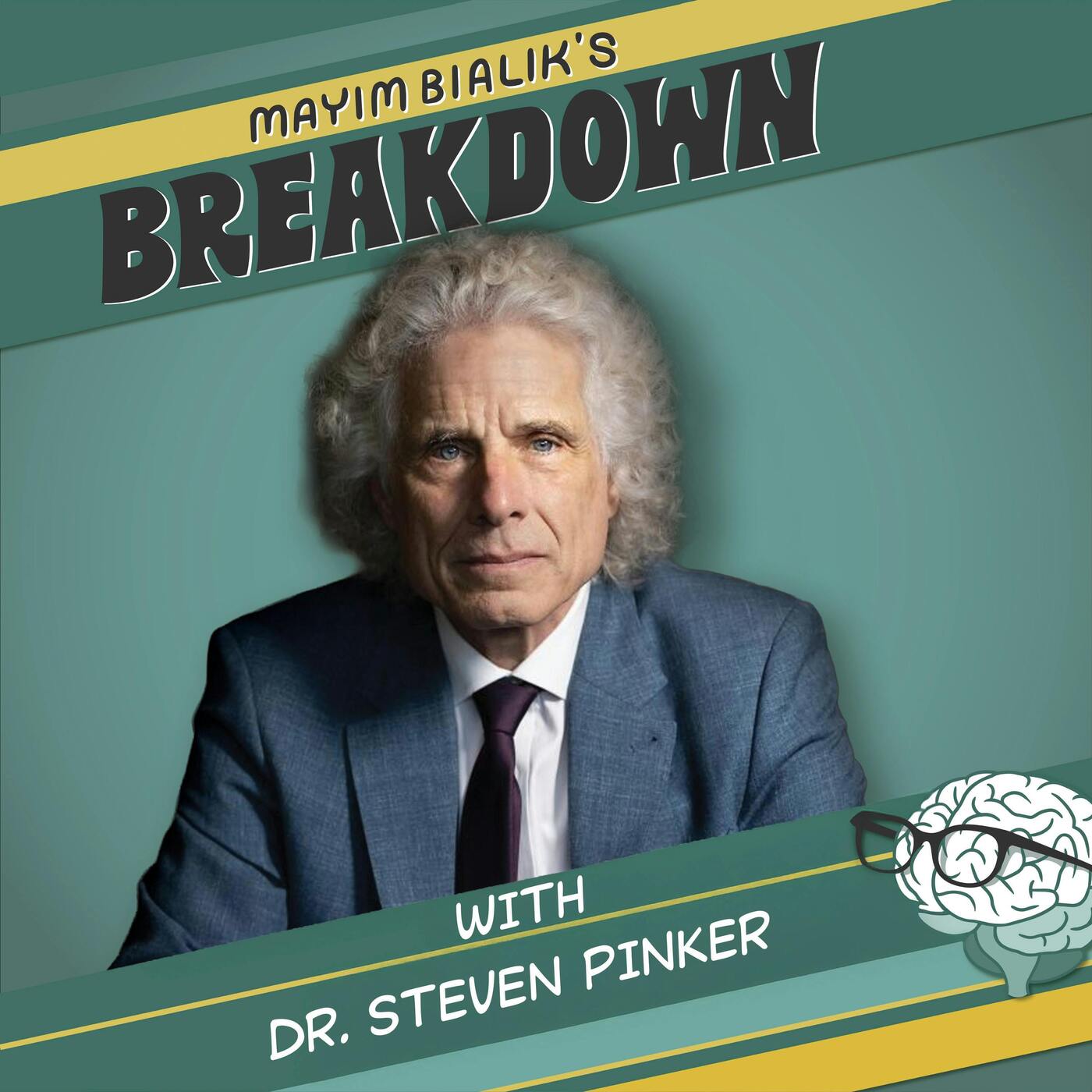
Mayim Bialik's Breakdown
The Rise of Cancel Culture, Distrust in Science & Misinformation: Dr. Steven Pinker Reveals The Hidden Psychology That Threatens Society.
00:53:57
Loading summary
Transcript92 lines
- [00:00]
Steven Pinker
If you undermine the basis for objective truth, the dictator can put forward his version of truth, and there's no question about trying to prove him right or wrong. When science becomes too politically correct, too woke, it ceases to earn respect as a truth seeking institution. A lot of the Trump administration blows off science.
- [00:23]
Mayim Bialik
Dr. Steven Pinker is the Johnstone professor
- [00:26]
Jonathan Cohen
of Psychology at Harvard University and the
- [00:28]
Mayim Bialik
world's most influential thinker on the mind
- [00:31]
Jonathan Cohen
and the biggest problem facing humanity.
- [00:33]
Steven Pinker
Our norms are enforced by common knowledge, but it's vulnerable to being punctured if someone flouts it in a public form.
- [00:43]
Mayim Bialik
Cancel culture in which a person's career and reputation are destroyed for legally protected and often innocuous speech that someone managed to find offensive.
- [00:52]
Steven Pinker
In the old days, we had, of course, you know, public hangings and burnings of the state, but social media kind of provide the equivalent.
- [00:59]
Mayim Bialik
No matter what side of the political divide you're on, that's disturbing.
- [01:03]
Steven Pinker
People feel the need to prop up a norm by punishing it in public. That's what dictators do all over the world.
- [01:10]
Mayim Bialik
President Trump has introduced this concept of I hold truth. Don't trust journalists, don't trust the journalists that I don't trust.
- [01:18]
Steven Pinker
It's not so much that I can prove things that are true. It's rather flooding the zone with shit. We have institutions like science, democracy, universities, journalism. It's crucial to safeguard the reputation of science by making it a political.
- [01:43]
Mayim Bialik
Hi, I'm Mayim Bialik.
- [01:44]
Jonathan Cohen
And I'm Jonathan Cohen.
- [01:46]
Mayim Bialik
And welcome to our Breakdown. Our guest today is one of the world's most influential thinkers about language and the mind and human progress. We're going to talk about truth, honesty. We're going to talk about how shared knowledge shapes society. Dr. Steven Pinker is the Johnstone professor of Psychology at Harvard University. He's won so many prizes for his teaching and his research. He's written 12 books. His latest book, When Everyone Knows that Everyone Knows Common Knowledge and the Mysteries of Money, Power and Everyday Life. We're going to talk about how what people believe and what people think other people believe has larger implications than many of us realize. We're going to talk about what causes violence, meaning what kind of communication and information transmission causes violence? Do we have free will? And what does it mean that so many of us have lost trust in our institutions and many of us are doubting aspects of scientific research in ways that are very dangerous for society in general? Also, how do we solve some of the biggest problems that we have, such as health care? How do some countries adopt Dictatorships because they want simple answers to complicated questions. We're also going to take a deep dive into the topics that we talk about so much here, but from kind of a different lens. Dr. Pinker is a strict materialist and this is probably our first ever toe to toe debate about if consciousness or extra sensory perception even exists. Dr. Pinker has some very, very strong and very firmly held belie about the nature of consciousness, the human mind and mystical and transcendental experiences. And I decide that I will challenge him on all of his well held beliefs as he challenges me on the ones that I have formed here with all of you.
- [03:43]
Jonathan Cohen
Check us out on substack where we release content not released anywhere else. And you can connect with the Breaker community as well as with Mayim and I on our Friday lives.
- [03:54]
Mayim Bialik
Everybody take a deep breath and let's welcome Dr. Steven Pinker to the breakdown. Break it down.
- [04:01]
Steven Pinker
Thank you.
- [04:02]
Mayim Bialik
We have many questions of a variety. It's like a cornucopia of Dr. Pinker is what we kind of were gathering. We wonder if maybe we can start with the concept that obviously is a huge component of when everyone knows that everyone knows. What is the notion of common knowledge and how does it apply to sort of the basis of social interactions?
- [04:27]
Steven Pinker
Yeah. So common knowledge is the state where I know something, you know it, I know that you know it, you know that I know it, I know that you know that I know it, and so on ad infinitum. Which sounds like it's impossible that your head would explode trying to think through the various layers of I know that she knows that I know that she knows. But it's, I think we experience it when we just have the sense that something is public or out there or self evident or conspicuous. As opposed to the state where everyone knows something but you don't know that everyone else knows it or that anyone else knows it. Even if everyone does know it, you don't know that they know it. The reason that that matters is that common knowledge is necessary for coordination for two or more people being on the same page and doing something that is in both their interests. But that doesn't work if only one of them is doing it. And it doesn't matter what it is as long as it's the same thing. So just an obvious example is a rendezvous. It's not enough to, if you're coordinating a rendezvous without a cell phone, it's not enough to guess, well, I know she likes Starbucks, so I'll go meet her at Starbucks because she might know that I like Pete's, so she'll go to Pete's, and she might even think, well, he knows that I like Starbucks, so I'll go to Starbucks after all. And I think, well, yeah, but I better not go to Starbucks, because she knows I like Pete's, and so she'll go to Pete's. So it's nothing short of common knowledge. That is, each one knowing that the other one knows, and so on gets them on the same page. Now, that's a simple example, but the point of the book is that there are lots of not as simple examples, and they explain both how we get along in society on large scales. So another simple example is driving on the right as opposed to driving on the left. There's nothing wrong with driving on the left. They do in England. But what's really important is that everyone knows that everyone else is going to drive on the right and so on. Or using paper currency. Why do I accept a. A green piece of paper in exchange for something of value? Well, because I know other people will accept it because they know that still other people will accept it, you know, as long as you. But as long as the common knowledge doesn't dissolve, which it can in, say, cases of hyperinflation, where the currency can become worthless when people stop believing in it. Our social relationships are matters of common knowledge. What makes two people friends? It's not as if they sign a contract, but each one knows that the other one knows that the first one knows the other one knows that they're friends, and that's what makes them friends, or lovers or a supervisor and a subordinate or transaction partners. I suggest that we ratify our relationships by common knowledge generators, that is, signals that are kind of out there, that when we express them, we know that other people can see that and they know that we can know that they see that things like blurting something out, eye contact, blushing, crying, all are ways of solidifying our various relationships. And conversely, sometimes we don't want to change a relationship. And that's when we. We try to keep things out of common knowledge with euphemism and innuendo and, you know, hinting and, you know, hope she'll catch my drift, pretending not to see the elephant in the room. I think that all of those phenomena are cases where we want to protect some relationship against some signal that might challenge them. And so we keep things out of common knowledge. Okay, that's a short version of the. The idea.
- [08:07]
Mayim Bialik
No, that's very helpful. And one of, I think, the most common examples in popular Culture of this. If you're of a certain age and you watch the Princess Bride, there is this very famous poison scene where Wesley and Vicini are in this battle of wits, right? And there's poison in one of the cups, and he has to guess which it is. And what ensues is this. Absolutely ridiculous. But it feels like very like you kind of conversation of, I. You think that I'm gonna think that you're gonna put the poison in this one, and therefore it must be in the other. But you also know that I would think that. So anyway, I thought of that when you were talking about that. But how do we have relationships with others if there is, you know, kind of a protection of common knowledge, either in the form of white lies, the form of privacy, or even the form of outright lies?
- [09:04]
Steven Pinker
Yeah, and I'm kicking myself that I didn't include that scene in the book, because it's a great example. It's an example of what, to use a little bit of jargon, is something's called recursive mentalizing. Mentalizing just means kind of mind reading, trying to get in someone else's head. Recursive mentalizing is you get inside someone else's head as they're trying to get into your head or some other person's head. So it's like taking mind reading to another level, reading the mind of a mind reader. But, yeah, I think a lot of. But you put your finger on it, that a lot of our. The tensions, the intrigues, the stuff of comedies, of manners and situation comedies and dramas. A lot of fiction is letting us kind of as spectators play at working out who's thinking what about what someone else is thinking. Now, in real life, it does lead to challenges like, you know, I got to say something, but how do I do it without coming off like a jerk or without offending the person? Will it, you know, will she notice? And so a lot of our politeness, tact, savoir faire, is how do you say something without insulting someone? Or how do you float a proposition like a. Like a sexual. Come on. Where. If you're platonic friends, or even worse, if, you know, someone supervises the other, they may be interested, but if they aren't, it could have big consequences. It could blow up the. You know, the friendship or lead to sexual harassment charges. And that's when people, I think, resort to sly innuendo, like, well, it's no longer very sly, but, you know, want to come up for Netflix and chill. At least that started out as a kind of euphemism or threats or bribes. If you were to try to bribe your way into a crowded restaurant by slipping a 50 to the maitre d, you probably wouldn't say, if I give you 50, will you allow me to jump the queue and seat me immediately? In fact, we know this because I talk about an article by a writer who was given that assignment by his editor. What you'd say is, gee, is there any way to shorten my wait? I was wondering if you might have a cancellation. So yes, a lot of the drama of social life is either putting things out in common knowledge or trying to keep them out of common knowledge.
- [11:39]
Mayim Bialik
Yeah, I'm laughing because you know, what you just described is also the ability of someone to be smooth in social situations. Or not. I always joke and this feels like a good joke, but because you're both Canadian, I feel like Jonathan could get anything that he wanted or needed at a restaurant because he just has a way about him. And it's not that it's sneaky. He's just very charismatic. He's very even handed, he's very well tempered. And for me, I'm like trying to force a round peg into a square hole like every time I get out of the car.
- [12:13]
Jonathan Cohen
This episode is sponsored by Wandering Jews, an open door media brand.
- [12:18]
Mayim Bialik
If you've ever found yourself feeling like you have more questions than answers, you're in good company. The Jewish people have been like that for thousands of years. Wondering Jews with Michal and Noam is a podcast where two of today's most dynamic Jewish voices, Michal Bittone and Noam Weissman, dig into the biggest questions about life through a Jewish lens. It's the kind of conversation where you'll laugh, learn something new, and probably shout in disagreement at least once. Michal and Noam tackle the tough topics like anti Semitism in America, what happens after we die, and the future of religion with guests like Bret Stephens, Michael Rapman Port and Sarah Hurwitz. And this past month, in honor of Jewish American Heritage Month, they've been celebrating some of the Jewish lives and institutions that have shaped American life, from food to music and comedy. Thoughtful, joyful, and always honest. That's Wondering Jews with Michal and Noam, a production of Unpacked. Find it on your favorite podcast app or on YouTube and make sure to hit subscribe. Check out Wondering Jews with Michal and Noam podcast and subscribe at Unpacked Bio nmx.
- [13:20]
Jonathan Cohen
My Imbalax breakdown is supported by Bioptimizers.
- [13:23]
Mayim Bialik
You know, I struggled to get good quality Sleep and I just assumed it was stress. But as I learned during perimenopause and menopause, your hormones shift in a way that affects your magnesium levels. And low magnesium, it makes everything harder. Not just sleep, focus, mood, your tolerance for stress. That's why I have added Magnesium Breakthrough bye bye optimizers to my nightly routine. It's a blend of seven different forms of magnesium designed to support relaxation and overall sleep quality. Try it. See if you wake up more rested and refreshed. You've got nothing to lose and a lot to gain. Bio Optimizers offers a 365 day, no questions asked money back guarantee. Magnesium Breakthrough is a huge breakthrough to improve hormonal balance, to help with focus, decrease brain fog, improve sleep hygiene. Overall, Bioptimizers makes it very easy. Jonathan, what do they get when they go to bioptimizers.com breaker and use the code breaker?
- [14:15]
Jonathan Cohen
You get 15% off your entire order and a free bottle of Masymes Bioptimizer's
- [14:20]
Mayim Bialik
best selling digestive enzyme that'll be added to your order automatically when you use our exclusive code.
- [14:25]
Jonathan Cohen
That's a $20 product, free on top of your discount already.
- [14:30]
Mayim Bialik
This is a limited time offer and while supplies last, you can't get it on Amazon, you can't get it in stores. This offer exists in one place. Our link, our code. That's it. So maybe you were already thinking about it. This is the sign. Go to buyoptimizers.com breaker use the code breaker. Grab it before it's gone. Make 2026 the year. Finally start sleeping again. You know, we talk a lot about people who kind of relate differently. We talk a lot about people on the spectrum, we talk about some of the features of people who are on the autism spectrum and there often is a lack of concern in the same way as there is in the kind of neurotypical population about what other people think of you. So can you talk a little bit about some of the subtleties of how important important it is for us to think about what other people think of us and what happens when people function differently?
- [15:23]
Steven Pinker
Yes. Well, being on the spectrum, or what we might used to say, being kind of socially obtuse or awkward or dense and not socially skilled often consists of general. The central cognitive difference is difficulty in mentalizing in so called theory of mind, where the theory refers to the intuitive theory of what's going on in someone else's mind. In the extreme case of autism, there may be a complete inability to conceive that other people have Minds, they're robots, they're wind up dolls. With people on the spectrum, it just comes a little less naturally. And indeed, one of the manifestations of being on the spectrum is taking things literally that are intended as hints, indirectness. Like a friend who said he called us, called home and his son on the autistic son picked up the phone and he said, is your mother free? And he said, yes. He didn't connect the dots like, well, dad's really asking to put mom on the phone. And a lot of politeness consists of indicating the prerequisites to some action rather than barking a command. Where people with fully functioning theory of mind, mentalizing social skill realize, oh, the only reason he's mentioning that is that he wants me to do something. He's not giving me an order. So if I say, if you could pass the guacamole, that would be awesome. Now, when you think of it, that doesn't make a whole lot of sense. It would literally be inspiring of awe. And why are you sort of commenting on hypotheticals? It's because you don't want to say to your friend or to an acquaintance, give me the damn guacamole. And treat them as if they're some kind of underling. And so what politeness consists of is avoiding there is the requirement you really do want the damn guacamole. You don't want to be delivering imperatives or commands at someone as if they're your servant. And so by saying something that is relevant to what you want, they can connect the dots. And that's what is often impaired in people on the spectrum.
- [17:54]
Mayim Bialik
Jonathan, why am I laughing?
- [17:56]
Jonathan Cohen
I find this very frustrating.
- [17:58]
Steven Pinker
I knew it.
- [17:59]
Mayim Bialik
I knew it.
- [18:01]
Jonathan Cohen
I'm like, be direct but nice about it. It's not that, hey, might you want. I find it passive aggressive when people communicate in that way. And I actually would much prefer them to be direct and say, please pass the guacamole. Like it. It's up to me to say if I'm. If I'm unable to do that or not. I just find the whole notion of, like, I can understand it. In restaurants, there's things that don't need to be said, but I think it gets taken way too far where people are dancing around what would otherwise be a direct request.
- [18:37]
Steven Pinker
Well, we have to calibrate the level of directness if you're. You don't want to be barking commands at people, you know, as if they're your flunkies. You know, on the other hand, if there's a problem of Being kind of, you know, slick smooth, as mine put it, oleaginous, or just so many layers of formality and politeness, you feel like saying, you know, cut the crap and get to the point. And that's. Sometimes cultural clashes come that way. Different cultures, you know, maybe, you know, Canadian, Miami. You're not from New York, right? You're from California.
- [19:10]
Mayim Bialik
My, My parents are New Yorkers, so they raised me as they should be there.
- [19:14]
Steven Pinker
Well, there you go. So New Yorkers tend to be a little blunter than average Canadians, more polite. And then you have cultures like Japan, where often an American business person would say, I just, you know, we just can never get down to settle the deal. Or, or, or, or, or Arab countries. So there. But in addition, even within a culture, we all calibrate with others, like, are they trying too hard? Or there is the problem that if you're too indirect, it might go over the hearer's head. And again, this can be the subject of comedy. I cite a well known episode from Seinfeld called Coffee in which George's date says, you want to come up for coffee? And he says, oh, no, the caffeine would keep me up. I got to get to work the next morning. And he kind of goes home and slaps himself in the forehead and laments to Jerry and Elaine, oh, my God, coffee doesn't mean coffee. Coffee means sex. I actually said this to her. I said, coffee will keep me up. People that's as stupid as me don't deserve to live. So that illustrates the opposite danger, that if it's too indirect, then your hearer may not catch your drift.
- [20:26]
Mayim Bialik
You've been at this for a long time. You've made an entire career out of understanding a lot of these intricacies, both kind of linguistically and in terms of how we structure, really, words and relationships and interactions. And we live in a culture of social media, right? We live in this culture where people are trying to understand things in very small snippets with very little nuance, very little context. And some of the stuff that you're, that you're talking about is kind of entertained in very, I don't want to say pedestrian ways, but in very sort of fun ways. Right. And there's a lot of sort of accusations thrown around, around about the way people interact. And I wonder from your perspective, if you can give us, I don't know, any, any sort of insight into, you know, is it helpful to, to be able to label people? Right. She's a people pleaser. He's a narcissist. You know, I'm codependent. Are these important terms for us to understand in a larger context? Are they helpful and what does it say about sort of the way that we want to understand how other people interact?
- [21:38]
Steven Pinker
Yeah, so a bunch of issues there. I do in the book talk about social media, especially in the context of this phenomenon of the shaming mob, the cancellation, where the outrage mob, where people, this strange phenomenon where someone will say something often quite innocent, that it seems like people deliberately take in the most offensive way they can imagine for the purpose of piling on them and shaming them. The, the famous case was about 10 years ago. Justine Saccko, the publicist who just wise cracked on a live tweeting on a trip. She made a, a tasteless joke that people, you know, misinterpreted as, as racist on a trip to Africa. And you know, her life was ruined. People were just delighting in ruining her life.
- [22:31]
Mayim Bialik
I think that you said this is likely the first case. Right.
- [22:35]
Steven Pinker
I've heard that said. Yeah, it may not be the first,
- [22:37]
Mayim Bialik
but it says that it's said to have inaugurated 21st century cancel culture in which a person's career and reputation are destroyed for legally protected and often innocuous speech that someone managed to find offensive. But it's not just the people being critical of the joke that she made, which indeed, as you said, was a very poor joke. But the next thing that happened was everybody kind of being so delighted that this woman's life was going to be destroyed. Right. There's these kind of two levels to it.
- [23:10]
Steven Pinker
Yes. So I mean, this is a woman who tweeted on and she just like one wise crack after another. And at one point she said, going to Africa, hope I don't get aids. Haha. I don't have to worry, I'm white now. This was not a, you know, she obviously did not believe that only Africans can get HIV aids. In context, it was clear that she wasn't gloating, she was impersonating an oblivious tourist. She was kind of satirizing racism and obliviousness, not engaging in it. But of course you take something out of context and if it's ironic, the irony can go over people's heads almost deliberately in this case because I think there was such a hunger to publicly shame someone and social media makes that so easy that people piled on and took an almost sadistic glee in the fact that between the time she took off and the time she landed, her life would be ruined, which it was. So anyway, I looked at what's going on there. And I'm in academia, and it's a real problem that in academia, where no one's infallible, no one's omniscient. I mean, in everyday life, too, of course. But the whole point is you're trying to kind of get at the truth, and some people are going to be wrong. And if you say something and then everyone tries to ruin your career, that's not an environment in which you can collectively try to figure out what's going on. So the question that I took up is what's going on in people's heads that they delight in publicly shaming someone. And what I suggest is that we all have norms, kind of social and moral norms that aren't, you know, they're not enforced by the police. It's not like Big brother is eavesdropping 24 7, and you're immediately going to
- [25:06]
Mayim Bialik
be, you know, the United Kingdom has a few very, very disturbing cases of people being arrested for tweets. But that aside, yes, indeed.
- [25:14]
Steven Pinker
So maybe, maybe we're. We're going there or they're going there. But in general, our norms are kind of enforced by common knowledge, that is everyone. What makes something a norm? Well, everyone knows that. Everyone knows that it's a norm, which means that it only kind of levitates in midair through everyone knowing that everyone else knows it. But it's vulnerable to being punctured if someone flouts it in a public form in common knowledge. And therefore, people feel the need to prop up a norm by punishing it, again, has to be in public. It's not just that you disincentivize the person, but everyone has to see that person being punished. In the old days, we had, of course, you know, public hangings and crucifixions and burnings at the stake and disembowelment and pillories and stocks. But social media kind of provide the equivalent in that anything can go. You have a sense that anything can go, can go viral in the trending column. You see what's going viral. And that is a kind of a platform for publicly shaming someone that you feel has challenged a norm. And as a kind of defender of the moral order, you yourself, as the punisher, can get some social creds, some brownie points, again in public. So without realizing it, the social media platforms invited this public stocks or pillory. And I talk about how, again, going back to literature and fiction, that this just human temptation to pile on a designated victim is something that plays out over and over. Again, it drove the, at least the Salem witch trials, at least as Arthur Miller recounted them in the, in the Crucible, the Darkness at Noon by Arthur Kessler, the Stalin show trials. And notice that show trial. The trial as a show conveys the idea that you are tormenting someone on a public stage and that's what is necessary to prop up some kind of norm.
- [27:26]
Mayim Bialik
What's going on with this notion of sort of policing thought and policing information. I wonder if you can talk a little bit about what happens when the moral order is not agreed upon.
- [27:43]
Steven Pinker
Yes, so I talk about that. When everyone knows it, everyone knows. But it was also a focus in my previous book, Rationality, which addressed your question. Because we have this paradox in talking about human beings as, you know, supposedly rational animals. Namely, you know, obviously we're capable of rationality. You know, we invented, you know, vaccines, smartphones and got to the moon and you know, all this amazing stuff, DNA and evolution and brain science. But you know, as you say, we, you know, we also people swallow conspiracy theories and fake news, quack cures. And I suggest that when comes it like the, the way we're wired is we're very rational when it comes to our day to day life. You know, just keeping, you know, food in the fridge, getting the kids to school on time. And you kind of have to be, because reality is unforgiving. I mean, and you know, the laws of logic, you know, they're laws, you can't, you can't pretend they don't exist if you want to keep yourself clothed and fed. But when we are also interested in kind of big cosmic questions. What causes disease? What causes the drives? History? What are people in power really up to? Where, you know, for most of human history and prehistory, you just couldn't know. We like to think, we moderns, we kind of people who like to think of ourselves as, you know, rational and scientific, think, well, you know, you got responsible journalists, you got scientists, you got, you know, fact checking, you've got encyclopedias, you know, you've got government agencies that keep records. In principle, there are ways of answering these questions. But our gut feeling is you can't know. You can believe anything you want. And so what you ought to believe is the most inspiring, uplifting myth. The thing that you think that, you know, the kids should believe, that people should believe that make our side, makes our side look good and the other side looks stupid and evil. And that's what people kind of glom onto when it comes to these big beliefs about these big, big questions outside your immediate day to day life. And so what I think puzzles people like us is kind of plugged into the mainstream of journalism and science and so on is how could people believe such nonsense? And the answer is, people don't sense that there is any truth that you can find out. What you should believe is what is the best story.
- [30:22]
Mayim Bialik
That's disturbing though, no matter what side of the political divide you're on. You know, President Trump has absolutely introduced this concept of I hold truth. Don't trust journalists, don't trust the journalists that I don't trust. Like, it's getting very, very sticky.
- [30:39]
Steven Pinker
You know, another way of putting it is, you know, I, I, this is a really important phenomenon. I agree, is it's not, it isn't so much that I can prove things that are true. It's rather what his advisor Steve Bannon said admiringly is, and I assume I could say this on your podcast, flooding the Zone with shit. That is, they don't even care whether they're credible or not. The idea is there's so much nonsense and falsehoods floating out there that people kind of give up and they say there's no way to find out what's really true. You know, objectively true or false. I may as well go with the charismatic leader. That's what dictators do all over the world. Hannah Arendt originally pointed that out that if you kind of undermine the basis for objective truth, then the dictator can put forward his version of truth. And there's no question about trying to prove him right or wrong. There is no right or wrong. May as well believe what our dear leader wants us to believe.
- [31:39]
Jonathan Cohen
And there's a systematic attack on anyone who may offer what would have previously been understood as the truth.
- [31:48]
Steven Pinker
Exactly. Universities, science, journalism, especially establishment outlets, you try to undermine those. And that's the best we can do. We're not. God doesn't reveal the truth to us, us mortals. We kind of muddle along the best we can with journalism and science and data gatherers and so on. What makes any of us confident that we can get to the truth? Well, these institutions kind of have to establish their credibility as kind of disinterested pursuers of truth. Universities have to convince people, well, if we're wrong, we have ways of finding out. Here's how we try to establish what's true. We do experiments, we do archival research. Likewise with journalists. If there are errors, we publish corrections, we have editors, we have fact checkers. When that fails, when people, people don't think that there's any Greater basis for science or journalism or record keeping or government public servants. You know, that's when they're open to anything. I mean, oh, I can believe this, the people who with white coats. But you know, they're just, you know, one tribe. I'm just as happy to believe some
- [33:17]
Jonathan Cohen
social media influencer Mayim Bialix Breakdown is supported by Bioptimizers.
- [33:23]
Mayim Bialik
I struggled to get good quality sleep and I just thought like, ugh, it's stressful. But I learned during perimenopause and menopause, your hormones shift and it affects your magnesium levels. Low magnesium makes everything harder. Not just sleep, but focus, mood, stress tolerance. That's why we added Magnesium Breakthrough by Bioptimizers to our nightly routine. It's a blend of seven different forms of magnesium designed to support relaxation and overall sleep quality. Try it. See if you wake up more rested and refreshed, you've got nothing to lose and a lot to gain. BIOptimizers offers a 365 day, no questions asked money back guarantee. Magnesium Breakthrough is a fantastic way to improve that hormonal imbalance that especially happens with magnesium. And then you have better focus, you have better sleep hygiene in general. Bioptimizers makes it so easy. Here's what you get when you go to bioptimizers.com breaker and use the code breaker. 15 off your entire order and a free bottle of Mass Times. That's Bioptimizer's best selling digestive enzyme added to your order automatically when you use our exclusive code. That's a 20 product free on top of your discount. This is a limited time offer. While supplies last. You cannot get this on Amazon. You can't get it in stores. The offer exists in one place. Our link, our code. That's it. So if you were already thinking about trying it, this is the sign. Go to buyoptimizers.com breaker. Use the code breaker. Grab it before it's gone.
- [34:47]
Jonathan Cohen
Make 2026, the year you finally start sleeping again this summer.
- [34:53]
Mayim Bialik
Don't squeeze in.
- [34:55]
Steven Pinker
Spread out. Find homes big enough for you.
- [34:58]
Mayim Bialik
Your whole guest list on vrbo, from
- [35:00]
Steven Pinker
family reunions to trips with friends.
- [35:02]
Mayim Bialik
VRBO has spacious summer stays for every group size and budget. That's vacation rentals done right. Start exploring on VRBO and book your next day. Now.
- [35:22]
Jonathan Cohen
I think it's a very dangerous place. What you're talking about, about the erosion of trusted institutions. And at the same time, the erosion of truth has come from a real systemic problem. You know, for example, you know, Andrew Huberman was just on Bill Maher, a couple weeks ago, as I know, you were. Different episodes. And Andrew quoted a unnamed neuroscientist who he says is one of the top doctors in America who believes that 50% of academic information in medical textbooks is known to be untrue.
- [36:04]
Mayim Bialik
That's a really bad statistic with an
- [36:06]
Jonathan Cohen
incalculable amount of potential cost to human health. Now, I can't verify that, but that's coming from someone who doesn't seem to have anything specific to gain by that level of attack on, on medical institutions, education for future doctors. But like, all of a sudden you're like, well, that's, that's a pretty significant shot across the bow towards already eroding trust in institutions.
- [36:35]
Steven Pinker
Well, you know, no, I mean, I don't know if it's 50%. I believe that it's 50% in terms of 50% of what's in the journals. I actually quote in rationality a physicist who says 90% of what's in the journals is false. 90% of what's in the textbooks is true. Because the textbooks have a longer time horizon. They can wait until the various fads and the study that came out this morning has settled down. Let's say it is true that 50% of what's in the textbooks is false. What percentage of what you hear on social media is false? It's much more than 50%. It's probably more like 99%. The thing is, we're all fallible. None of us is omniscient. We aren't born knowing the truth about really hard problems like what causes disease. The fact that we know more than zero is amazing. And so even if it is 50%, we say, wow, 50%, that's way better than 1% of true things or 0%, which is what we come into the world knowing. You know, science is hard, medicine is hard, journalism is hard. You have to. The truth isn't broadcast, you know, in booming voice from the heavens. We've got to kind of claw our way to finding the truth. In cases where data are often very noisy and messy and misleading. And the trust in institutions has to come from the fact we don't have any right to think that we know the truth about really big, difficult questions like what causes a depression or what causes a pandemic. It's really, really hard. And so the people who are struggling to find it let's, you know, check their work, let them justify what they come to. They're going to be wrong. That doesn't mean that they're wasting their time, of course they're going to be wrong. We're all wrong.
- [38:28]
Jonathan Cohen
Your approach is actually the right one. Is that amazing? Couldn't it be fantastic if we know 50% and we're fallible and we're going to make mistakes and we have to expand research. But the, the. I think the challenge comes in where most people don't approach it like that. They approach it in defense of the institution where this is science and you don't question it, you don't have an open mind to continue to understand that science is an expanding field whereby it is a methodology to understand the truth. It's not a finite and finished set of knowledge. And that, you know, the medical institutions in the past, and I think it's changing, have come and presented the information that they have as this is the only way to think about it and anything else is outside of that and actually extremely destructive and you know, at the tail end, idiotic. Now, of course they're defending against that 99 of information that is absolutely untrue and there needs to be some filtering mechanism. But I think what people are pushing back against and again leading to this very murky water where you can't figure out what is true and not. Is the approach of these institutions to say they don't come at it with your open mindedness, to say there's a lot that we're still discovering.
- [39:43]
Steven Pinker
Yes. No, I think that any source, any claimant to authority has to be prepared to show their work and to acknowledge their fallibility. That is, this is the, you know, this was a big issue during COVID when it appeared, you know, out of the blue. No one had any idea how it was spread. It was natural that some of the early advisories would turn out to be obsolete. As we learned more and more, there was a problem when it was both coercive and unjustified. That is, if there weren't good reasons for it other than saying, as best we can tell, this measure will protect against the worst and it's worth paying the price given our set, our state of ignorance. But we might have to revise it as we come to learn more. So I think that is vital. But it's also, I think it's important not to try to blame every problem on some kind of villainy, some kind of evil, bad people. And likewise, when it comes to going back to the processed food and here I think that our current Secretary of Health and Human Services is not doing the country a favor by implying that if any ingredient has a chemical formula that must Mean it is bad. That is if you have trouble pronouncing it because as we know, everything has a chemical formula. Lettuce. If you listed all the ingredients in lettuce, every one of them would have a multi syllabic name. That's how you describe chemistry and so to say you look at the ingredients and you can't pronounce something. That's a really poor basis for giving public health advice. I think also a conspiracy theory where it's the medical establishment and the food companies that have been lying to us that ultra processed foods are, that Cheetos are healthy. No one has ever said Cheetos are healthy. The thing is Cheetos are really delicious. It's hard to get, you have kids, it's hard to get them out of the hands of a kid once they've tasted it because they are yummy. My grandson eats bright blue crunchy things out of a bag. I have no idea what they are. I'm sure they're not terribly good for him, but it's a real struggle to keep him away from them once he sees them. And the food companies sell us things that are, are really delicious and addictive. They're giving us what we want. The challenge is to get people collectively to try to not succumb to the temptation of eating the most delicious food in any quantity, anytime, and to have the right nudges and incentives so that the taxes, the policies will tend to steer people into healthier choices without there being, you know, food police. So it's a, I think it's a tougher problem than scientists have lied to us saying that Cheetos are healthy. They never did. I remember back in the 70s, there was opposition to foods with chemical ingredients way back then. It was a problem then, it's a problem now. And the basic problem is that when you have an advanced economy, companies get really good at giving people stuff they want and stuff you want may not be good for you. That's a real tough problem how you, in a free society and in a society of abundance and affluence, you get people to do things that are good for them despite all the temptations. At least that's the way I would look at it.
- [43:25]
Jonathan Cohen
I think also, you know, how do you get out of the incentive, the incentives of these companies getting them into school lunches and them being agreed to and the nefarious actions that you can embed these and they are like, yes, I agree with your point about chemical manufacturing, but also these have been engineered to hijack hunger signals and to make us want to overeat by having the perfect combination of the fats and sugars. I think it's also interesting to look at the clampdown, tying it back to the thought police earlier, where there's two examples of where people are continually still being monitored for what they're saying in a way that is. Is dangerous. Right. We, we sort of went to the woke police who were clamping down on everything, and then we pushed back against that. And then you get the flip side where you have potentially horrendous speech that you, you don't want to have. You don't want to have people coming at that are horrifically racist and causing harm. But there was recently the example in the UK where someone was arrested for tweets and the risk to being able to speak publicly, or in Russia where people were arrested for holding blank signs. Can you talk about sort of the fear of not being able to speak out and being controlled by either thought police or group Think?
- [44:57]
Steven Pinker
Yes. Right. So I'm, as a US Immigrant, I'm actually very proud of the fact that the United States has such robust protections of free speech in the First Amendment. And the law is you can't be arrested for saying something racist or for hate speech. People can criticize you, they can attack you, they can indicate why what you're saying should not have been said, but the government can't arrest you for it. And I think that's a really good thing, because as soon as you have the ability to arrest people for speech that can be weaponized, I can just say, well, what you just said is hate speech. Even if you're just a, you know, a scientist and looking at. At data of different statistics for different groups, it's just a way of shutting down any speech you don't like, if you have the ability to criminalize a speech based on its content. But going back to the, you know, what's happening in Russia and previously what happened in the Soviet Union, I do tell a joke because it is about common knowledge of the. A guy handing out leaflets in Red Square. This is under the Soviet Union. And you know, of course, the KGB arrest him. They bring him back to headquarters only to discover that he's handing out blank sheets of paper. They demand, what is the meaning of this? And he says, what's there to say? It's so obvious. Now, the point of the joke was he was generating common knowledge. He was being subversive, because by handing out blank sheets of paper that everyone was accepting, he was conveying the Information that everyone knows what you know, namely, you're disgruntled by the oppressiveness and inefficiency of the communist system. You, because you'd be punished if you said it out loud, you keep it to yourself. You have no way of knowing whether anyone else feels the same way or even if you suspect they all feel the same way. You don't know that any of them know that anyone else feels the same way. And so anything that can generate common knowledge, namely, it's not just me, it's not just everyone else. But now we all know that. We all know that the regime is oppressive. That's what dictatorships fear. And indeed, that's what can lead to regime change. When people show up in a public demonstration, everyone can see everyone else seeing everyone else. That allows them to coordinate and to potentially overpower the regime, because no regime has the firepower to intimidate every single last one of their citizens. The government is small compared to the populace. What they can do is intimidate any individual from being the first to stand up, because they can pick them off. If everyone somehow manages to stand up at the same time, they can overpower the regime. They can only do that through common knowledge. So that's why freedom of assembly is a sacred right in democracies. Freedom of speech, freedom of the press. That's why autocrats are so terrified of it, because they know. That's why they say the pen is mightier than the sword.
- [48:05]
Jonathan Cohen
So what happened in Russia recently? I don't know the exact example. Someone was arrested for a blank sign. Do we know any other information about this?
- [48:14]
Steven Pinker
Oh, there's the. More than once. Yeah, they get arrested for holding a blank sign or for doing things like, you know, there's a kind of cat and mouse game between authorities and dissidents where the dissidents try to figure out how they can generate common knowledge without actually running afoul of a law. So they do things like they. Everyone programs their cell phone to go off in unison. That happened in Belarus. And the people who organize that, the government tried to arrest them. People tie tin cans to the tails of stray cats. They wear buckets over their heads. Things that are meaningless in terms of their content, but have the function of trying to generate enough common knowledge, that is, when you see other people doing it in public, you're saying, gee, it's not just me. We all hate the regime.
- [49:10]
Mayim Bialik
So in terms of, you know, this. This notion of an expansion of a freedom of speech, you know, I do think it's. It's worth kind of highlighting this. So it was actually a comedy writer who was arrested in. In the UK And I believe it was directly in relation to posts that he made on X. And they. They said that he was inciting violence. And, you know, this is something that used to be sort of a distinction between how do you know when something is free speech or when it is hate speech. Right. Or when it is an incitement to violence. But the definition has gotten very broad. He. He posted something about things that he feels about transgender people, which I think many of us would argue are distasteful. But he was literally questioned for three tweets from last April. Obviously, it's a very, you know, disturbing notion. Where is this. Where is this line, you know, as we enter this kind of time, between freedom of speech, incitement to violence just because other people tend to become violent in ways that they didn't used to. When I say something they don't like, like, does that mean that my speech automatically becomes an incitement to violence?
- [50:37]
Steven Pinker
Well, in the United States, it's pretty clear that unless you have incitement to imminent lawless activity, that is, you say, you know, go out there and storm.
- [50:54]
Mayim Bialik
Let's storm the White House.
- [50:56]
Steven Pinker
Let's storm. Well, ironically, or let's storm Congress. That wouldn't be a bad example, ironically, because it did incite a violent mob. That is arguably speech that would not have been protected by the First Amendment. But just because I can imagine. Well, you know, he said something. I can imagine someone listening to that, and maybe that would make them go out and do something that you can't criminalize, because anyone can imagine anything that anyone says indirectly causing someone to commit violence. So it's a way of shutting up anyone you don't like, as we see is happening in England. So if someone says, well, I don't think it's such a great idea for natal men to compete in women's sports, and you say, oh, geez. Well, that's going to lead to violence against transgender people. That would mean that no one can disagree with the current orthodoxy. If you can say, well, so I can imagine a case in which it would cause someone to commit violence. And that's why the First Amendment protects speech. Also, there are cases in which you might say that we should have a demonstration. We should oppose this. People should protect themselves against hate crimes. And again, the human mind can always imagine ways in that criticism could result in violence. Or you might say, we should depose Maduro in Venezuela for the benefit of the Venezuelan People that's arguing for a kind of violence or Israel should try to eliminate Hamas. All of those are arguments for a certain kind of violence. You can't criminalize the expression of those opinions because some of those might be justified. So there's the narrow carve out for kind of treating people kind of appealing to their emotions and kind of causing them to do something right now. Almost as if you're bypassing their rational faculties and egging them on at a primitive mob level. That can be criminalized, though, as you point out, ironically, the one blatant case, namely Trump telling the rally to attack the Congress probably was not protected. But short of that, you really want to allow people to make arguments, and if they're bad arguments, point out why they're bad arguments.
- [53:27]
Jonathan Cohen
Do you think that we're gaining more or less common knowledge these days, where half the country thinks January 6th was a day of peace and love and the other half think that his tweets may have incited violence?
- [53:42]
Steven Pinker
Well, they are. I mean, they're different pools of common knowledge. I think it's harder to have a nationwide common knowledge, but it's, you know, unfortunately, all too common knowledge within the MAGA culture and the. Compared to the now. The thing is, I don't want to romanticize the past because we often didn't know what the whole population thought. They didn't have social media. They couldn't express themselves who, you know, a lot of times people thought things in private, even back then, especially women. Yes, indeed, that's exactly right. And so now, you know, for better or worse, social media makes it so that where we know what people think, it's often horrifying what they think.
- [54:31]
Mayim Bialik
Well, we, we know what the people on social media think.
- [54:36]
Steven Pinker
True, yes. Right.
- [54:37]
Mayim Bialik
Yeah.
- [54:38]
Steven Pinker
Which is not the same as people.
- [54:39]
Mayim Bialik
Right.
- [54:40]
Steven Pinker
There was, you know, there was an awful lot of. There's always been a lot of conspiratorial thinking in the, in the, in the populace. So someone did a study of conspiracy theory thinking, as indicated in letters to the editor of major papers, where some newspapers have archives of the letters that have been submitting, submitted going back a century. So that's a case. It was kind of the closest equivalent to social media in the day because anyone could write a letter to the editor. What he found was that the level of conspiracy thinking really hasn't changed in more than a century. Just that the letters, the green ink letters that were sent to a paper that they filed and never published, you know, you didn't hear about it at the time. Now, they'd say it on, you know, X or whatever, and we do hear about it. But there's conspiracy things, of course, you know, most obviously against the Jews, the various Jewish conspiracies, but also against Catholics, against communists, against, you know, Freemasons, the Pope and the papacy and unions. There are all kinds of cabals that people thought about, wrote about.
- [56:00]
Jonathan Cohen
No, I think it's interesting that the. Of the notion that the conspiratorial theory thinking has generally stayed the same. It's interesting, obviously, very hard to. To gauge only by the letters, because those letters also were written only by people who could write the letters, educated enough to get them in. So there's probably even more people in. In different pockets. I don't know if you know how this research is verified, but, you know, the idea is that we're becoming more tribalistic where the common knowledge is being reinforced. It's easier to reinforce pockets of common knowledge, harder to bridge those gaps and create a larger systemic understanding of. Of where the country should go and how to get there.
- [56:52]
Steven Pinker
Yeah, I mean, there is. There's certainly evidence that there's increasing polarization, especially negative polarization, that is thinking that the other side is, you know, evil and stupid. There's still. Most people are still in the middle, but the more people are at the extremes and each one thinks the worse of the other. So that's been, I think, pretty well documented.
- [57:18]
Mayim Bialik
We're going to hit pause here. Part two of our conversation with Dr. Pinker is really going to heat up as we talk about the politicization of science and where politics ends and science begins. How do we keep them separate? We're also going to talk about some of the consequences of the defunding of academic research and what it means for our general understanding of truth. We're going to talk about profit and medication, and it's going to get explosive.
- [57:44]
Jonathan Cohen
Explosive isn't too big a word. Mime goes toe to toe with Dr. Pinker on the nature of reality itself. We talk about consciousness, extrasensory abilities, and the nature of understanding what is true, what is not. And does it matter if believing something that may not be scientifically validated in the way that Dr. Pinker believes it needs to be. But if it benefits your health.
- [58:10]
Steven Pinker
Health.
- [58:10]
Jonathan Cohen
Is that a negative?
- [58:11]
Mayim Bialik
You'll have to tune in to part two to find out. So please check out part two of our conversation with Dr. Steven Pinker. From our breakdown to the one we hope you never have. We'll see you next time.
- [58:21]
Steven Pinker
It's Maya Bialik's. Breakdown. She's gonna break it down for you. She's got a neuroscience PhD or two now. She's gonna break down. It's a breakdown. She's gonna break it down.