← Mayim Bialik's Breakdown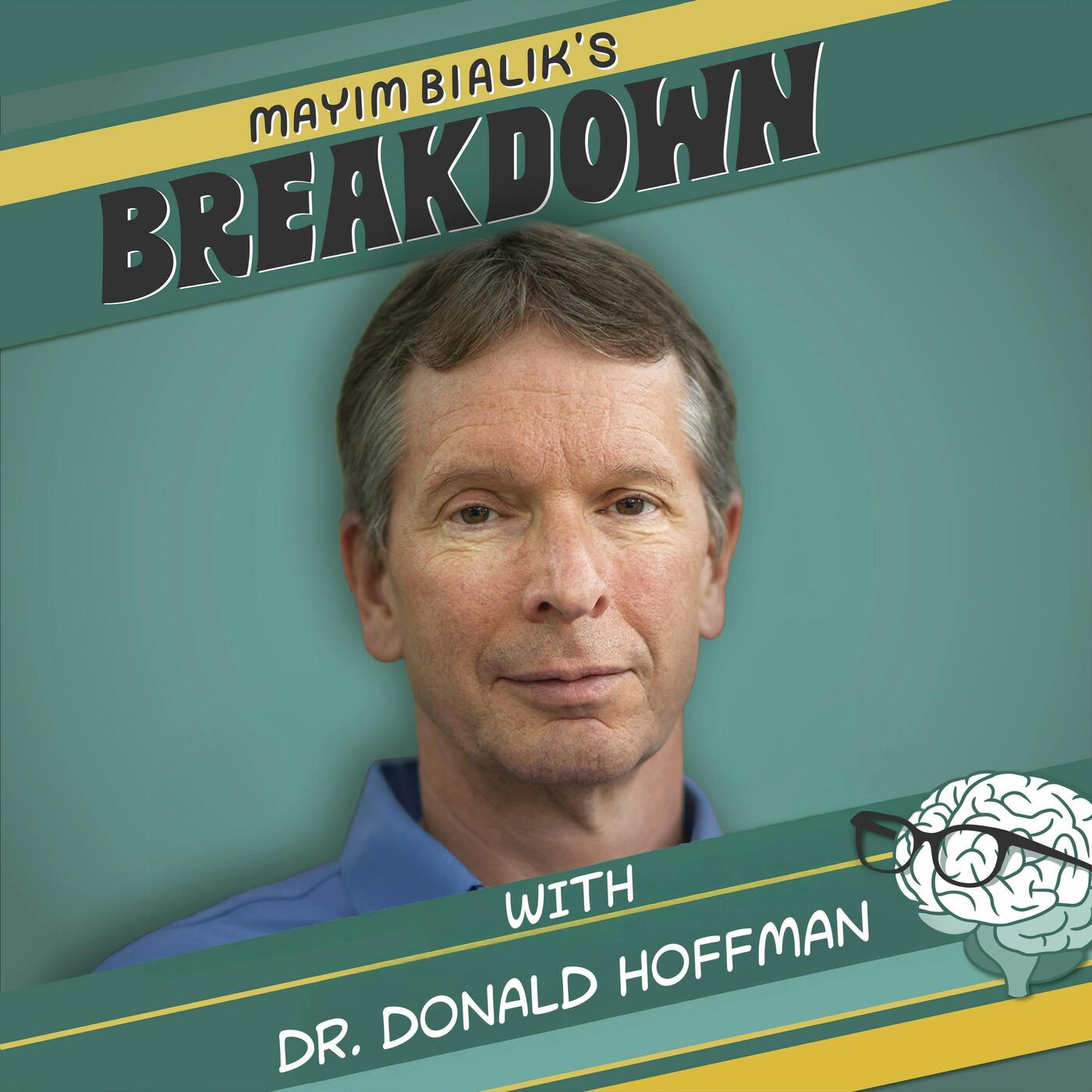
Mayim Bialik's Breakdown
How Consciousness Creates Our Reality. Why Science & Spirituality Can’t Explain Reality and the Scientific Breakthrough That Could Change Life As We Know it.
00:53:02
Loading summary
Transcript83 lines
- [00:00]
A
Mind Breakdown is supported by Helix Sleep.
- [00:04]
B
Spring is in the air and so are all of the allergens that come with it. Spring allergens means you need more sleep, but there are a ton of factors that can prevent us from getting a good night's rest. Night sweats, back pain, feeling the person next to you when they roll over a million times. We were so excited to hear that Helix wanted to partner with us. I've had my Helix mattress for about five years now and I have been sleeping so much better. Jonathan and also our kids love their Helix mattresses and all of those issues. Night sweats, back pain, motion transfer. Those things are significantly better with a Helix mattress. Helix delivers your mattress right to your door, which is so much fun. With free shipping in the US they have a 120 night sleep trial and limited lifetime warranty. Plus they're happy with Helix Guarantee Rest easy with seamless returns and exchanges. The Happy with Helix guarantee offers a risk free customer first experience designed to ensure that you're completely satisfied with your new Mattress. Go to helixsleep do for 27% off site wide. That's helixsleep.com breakdown for 27% off site wide helixsleep.com breakdown everything you see inside
- [01:11]
C
of space time is your construction from the consciousness point of view. Spacetime isn't fundamental. It's just a VR headset. The brain is giving us some clues about how the headset is being generated. There's some deeper reality. It's up to each of us to take off our own headset.
- [01:27]
B
Dr. Donald Hoffman is a cognitive science professor from MIT. He has spent his career exploring how we perceive reality and trick ourselves into believing this is all there is, when in fact there is a lot more. And we know that it's there.
- [01:44]
C
We're at this interesting intersection where high energy theoretical physics is now saying there's something beyond space time. And what is it?
- [01:51]
B
The hardest thing that many laypeople have to decide is do I believe in science or do I believe in God? Is there a place where those two things literally meet?
- [02:01]
C
The technologies that we should eventually evolve are going to be mind boggling. Once you know how to program the headset, you make the laws of the headset and you can change them.
- [02:11]
A
Could this technology allow me to download a language? Could it allow me to regrow a
- [02:15]
C
limb in the Matrix? Right. Neo will all of a sudden download something into I know Kung Fu. I'm not saying I know how to do it. I'm saying I don't see a principled obstruction Ultimately, who are you? You are the infinite consciousness looking through a very, very small headset. You've go from infinity to just a few trillion experiences, but you are that infinite consciousness.
- [02:37]
B
I love when people accidentally prove God.
- [02:40]
A
But is there a risk with unlocking this capability?
- [02:43]
C
Absolutely. Once you have that kind of power, you're playing God. Wow.
- [02:54]
B
Hi, I'm YMB Alec.
- [02:55]
A
And I'm Jonathan Cohen.
- [02:56]
B
And welcome to our breakdown. Or maybe not. Maybe it's just a perception. Today we're going to be talking about the potential breakdown of everything that we perceive as real. And you might be thinking, gosh, that sounds really heady. Very meta. Guess what? It's not. What if we were to propose to you that everything that you experience as your reality is a headset that can be taken off in very specific ways? And what if we were to tell you that there's a mathematical explanation for why that actually might be the best description of the reality that we're all experiencing?
- [03:42]
A
We're speaking today to someone who is working on software and technology that can truly change the nature of reality and how we all perceive it, including what that means for medicine and time travel and our Overall well being.
- [04:01]
B
Dr. Donald Hoffman holds a Ph.D. from MIT. He's a professor emeritus of cognitive sciences, and he has written over a hundred scientific papers, three books. His latest book, the Case Against How Evolution Hid the Truth From Our Eyes, is a really, really incredible exploration of what we perceive, how we got to the place where we perceive what we do, and how easy it is to trick ourselves into believing this is all there is, when in fact, there is a lot more. And we know that it's there. Physics knows that it's there. Neuroscience knows that it's there. Mystics know that it's there. But it's really the kind of information that Jonathan and I are so excited to share with you because reality truly is an illusion. And Dr. Hoffman is going to explain how we can better understand that and how it can change the way we lead our lives.
- [05:01]
A
Right. Before we get to the episode, I'm going to ask a very, very quick favor. Please, wherever you're listening or watching, press subscribe. Right now, here at Miami Alex Breakdown, we are doing our very best to bring you the cutting edge of the intersection of science and spirituality. We are learning so much from these amazing guests and it helps to be able to bring you more episodes. We cannot thank you enough for being here, for listening week after week, and we are so excited to bring you more episodes like this to help change your life. So Take a moment, subscribe and onto the episode.
- [05:43]
B
Without further ado, let's welcome Dr. Donald Hoffman to the breakdown. Break it down.
- [05:49]
C
Very, very good. Thank you.
- [05:51]
B
You know, I think that the most powerful and, and gripping component of your book is literally in the preface. And what, what you tell us is that this book offers you the red pill. This is the red pill. This is the book that allows you to say, what if I submit to the notion that everything that I see and perceive and interpret is actually a projection of some sort, and we're going to need you to explain what is being projected, who's projecting it, why does it matter, and how does it change our lives?
- [06:34]
A
Simple questions. Simple questions.
- [06:37]
C
Absolutely. Absolutely.
- [06:38]
B
You are an esteemed academic and professor and thinker and you didn't need to write the case against reality, but you chose to. And we'd like to know why. What do you feel people are missing?
- [06:52]
C
Well, there is an interesting revolution happening in science right now. It's quite stunning. The assumption that space and time are fundamental or their combination, space time is fundamental, has been a very valuable and useful foundational idea for many, many decades. Centuries, actually. High energy theoretical physicists, though, have realized that spacetime cannot be fundamental. It falls apart at the Planck scale. So we know exactly where it ceases to make sense. It doesn't make sense at 10 to the -33 centimeters and 10 to the -43 seconds. So it's not that, you know, some cognitive scientist is saying we need to think out of the box. I'm just listening to what the physicists are saying, the high energy theoretical physicists, and they're saying we need to find a new framework that's outside of space time and they're going after it. Right, there's the European Research council has a 10 million euro initiative on these positive geometries beyond space time that the physicists are now studying. So it's not like some maverick cognitive scientist is the first to say, hey, it's over for space time. No, I'm cheering on what the high energy theoretical physicists have been saying for quite a while. But I'm saying, you know, we need to look outside of physical categories, perhaps now space time kinds of categories. And that's hard to do. I mean, this is requiring real big leaps. So what the physicists are finding are these positive geometries. They're just static objects. They're like monoliths outside of space time and their shapes and volumes code for particle interactions inside spacetime. Remarkably, they actually give you the probabilities for various kinds of particle interactions. But why, you know, is anybody's guess about why these things are doing that and so forth. So we don't have a good framework of what's outside of spacetime. I mean, that's the big question. If space time isn't fundamental first, what could that possibly mean? What could possibly be outside of space time? That's the first question most of us go, space time is the foundation of reality. What are you even talking about? So the physicists are saying whatever space time is, it falls apart at the blank scale. So we have to find something outside of space time. And it's anybody's guess what it is. Now, spiritual traditions, of course, have been there for thousands of years. They've been saying spacetime is not, or space and time are the final reality. There's something well beyond space and time. And they've had techniques like meditation and so forth to, to help you to sort of transcend the notion of space time. But so both sides have had a piece of the puzzle. The physicalists, the scientists have had the rigor of mathematical models, and the spiritual people have had the idea that space and time aren't fundamental, that there's something deeper than that. But they've not had any mathematical tools. They've only had intuitive tools and so forth. And we can see this coming together historically with Galileo and the church, right? So here we have the clashing of the two world approaches where the church, the Catholic Church at the time, said that they had the authority of miracles and that everybody should submit because they had the authority of miracles. And Galileo was saying, no, I've got mathematics and experiments, and mathematics and experiments overrule whatever you might claim on your authority. And so there's been this division ever since, right? Because, you know, the church put Galileo under house arrest. He died under house arrest. And he was forced to recant his scientific views about the Earth not being the center of the universe. Well, you know, in retrospect, the church agreed they were wrong and they apologized, right? So. But it took four centuries or something like that for them to apologize. But science and spirituality really diverged then, and we've seen them go separate paths. And for a while it was sort of, you know, important to diverge because you really needed to establish something separate from authority. You needed to have math and experiments. But now we're at this interesting intersection where high energy theoretical physics is now saying, oh, now we agree that there's something beyond spacetime, and what is it we're finding these positive geometries, these obelisks but what do they mean? And the spiritual traditions still don't have any mathematical tools. So here's the position we're in. It seems like science has one part of the puzzle. We have mathematical models and we have experiments. This is how you make progress and really understanding things. The spiritual traditions say we understand that there's something beyond space time. And the physicists are now saying yeah, I think there is something beyond space time. How can we try to put these two pictures together? So that's where science is right now and where spirituality is. So to summarize, the spiritual traditions are outside of space time but there's no math and there's no experiments. Now someone might say well yeah, there are experiments looking for like anomalous phenomena and so forth. And yeah, I have friends who are scientists who are looking for psi phenomena and so forth. But any hard nosed scientist is going to say experiments without a theory aren't going to move me very much. If you are doing these psi experiments and you're finding these anomalous results, I want you to first give me a theory that predicts the exact values of the anomalous results that you're getting. Otherwise what can I say except maybe you made a mistake. If you have a theory that predicts something to the, you know, eight decimal places and you get that eight decimal place result and the other then the scientific theories around can't do it and a couple other labs replicate you, then of course scientists are going to pay attention. Right, that, that. But just to say I've got something that doesn't fit in, they're not going to pay attention. So what the spiritual traditions and those thinking outside of space time idealists for example, have lacked is a rigorous mathematical model that makes testable predictions from outside of space time. And what the physicalists understand now is we have to go beyond space time. And they're doing rigorous mathematical models but they don't know what they mean. These are positive geometries, but who ordered them? Right, it's who ordered this? I wanted to get the best of both. I want to use absolute hard nosed mathematical models and experiments from the scientific side, no nonsense, but I want to step outside of space time and take the idea that consciousness is fundamental quite seriously. So that means no hand wave. Give me a mathematical model of conscious experience, period. And with that mathematical model give me exactly how space time can arise again. Precisely. So how does Einstein's Minkowski space, the flat space time of Einstein come out of this? Or how does the curved spacetime of Einstein come out of this in general relativity. And how does quantum mechanics come out of this? Because when space time is doomed, so is quantum theory. Quantum fields, for example, are defined over spacetime. So just not enough to say, oh yeah, so we're going to go quantum on this. That's not enough. When you go quantum, you're still stuck with spacetime. Quantum fields are defined over space time. And if you're in non quantum field theory, if you're just doing standard Schrodinger revolution, then you've got time as a parameter, an explicit parameter. And so you're stuck in time. So it's not enough to say we're going quantum, that that gets you not out of space time. So we have to really think out of the box. Right? So space time is doomed. This is. Now I'm quoting physicists like Nima Arkani Hamed and David Gross. So this is not just a cognitive scientist saying this. I'm just quoting some high energy theoretical physicists who say spacetime is doomed. And they'll say explicitly that means quantum theory isn't fundamental either. So we have to go outside of space time and quantum theory together. And that doesn't. So many of the in the spiritual traditions who are trying to go to the next step are still holding on to quantum theory. And I'm saying you hold on to quantum theory, you're holding on to a dead horse. This is, you've got to go beyond quantum theory.
- [15:57]
A
My Ambulix breakdown is supported by bio optimizers.
- [16:00]
B
I struggled to get good quality sleep and I just thought like, ugh, it's stress. But I learned during perimenopause and menopause, your hormones shift and it affects your magnesium levels. Low magnesium makes everything harder. Not just sleep, but focus. Mood, stress tolerance. That's why we added Magnesium Breakthrough by Bioptimizers to our nightly routine. It's a blend of seven different forms of magnesium designed to support relaxation and overall sleep quality. Try it. See if you wake up more rested and refreshed, you've got nothing to lose and a lot to gain. BIOptimizers offers a 365 day, no questions asked money back guarantee. Magnesium Breakthrough is a fantastic way to improve that hormonal imbalance that especially happens with magnesium. And then you have better focus, you have better sleep hygiene in general. Bioptimizers makes it so easy. Here's what you get when you go to bioptimizers.com breaker and use the code breaker. 15% off your entire order and a free bottle of mass times that's bioptimizer's best selling digestive enzyme added to your order automatically when you use our exclusive code. That's a $20 product, free on top of your discount. This is a limited time offer while supplies last. You cannot get this on Amazon. You can't get it in stores. The offer exists in one place. Our link, our code. That's it. So if you were already thinking about trying it, this is the sign. Go to buyoptimizers.com breaker. Use the code breaker. Grab it before it's gone.
- [17:25]
A
Make 2026 the year you finally start sleeping again. Mind Bialix Breakdown is supported by Bioptimizers.
- [17:32]
B
You know, I struggled to get good quality sleep and I just assumed it was stress. But as I learned during perimenopause and menopause, your hormones shift in a way that affects your magnesium levels. And low magnesium, it makes everything harder. Not just sleep, focus, mood, your tolerance for stress. That's why I have added Magnesium Breakthrough bye bye Optimizers to my nightly routine. It's a blend of seven different forms of magnesium designed to support relaxation and overall sleep quality. Try it. See if you wake up more rested and refreshed. You've got nothing to lose and a lot to gain. BIOptimizers offers a 365 day no questions asked money back guarantee. Magnesium Breakthrough is a huge breakthrough to improve hormonal balance, to help with focus, decrease brain fog, improve sleep hygiene. Overall, Bioptimizers makes it very easy. Jonathan, what do they get when they go to bioptimizers.com breaker and use the code breaker?
- [18:25]
A
You get 50% off your entire order and a free bottle of MAS, Bioptimizer's
- [18:30]
B
best selling digestive enzyme that'll be added to your order automatically when you use our exclusive code.
- [18:35]
A
That's a $20 product, free on top of your discount already.
- [18:40]
B
This is a limited time offer and while supplies last, you can't get it on Amazon, you can't get it in stores. This offer exists in one place. Our link, our code. That's it. So maybe you were already thinking about it. This is the sign. Go to bioptimizers.com breaker use the code breaker. Grab it before it's gone. Make 2026 the year you finally start sleeping again.
- [18:59]
C
In my book, the Case Against Reality, I'm proposing that the first step is to understand that spacetime, from the consciousness point of view, spacetime is just a headset. There's some reality outside of spacetime and, and it's being filtered through a headset so if that's the case, then there are certain things that we should expect. We should expect that objects don't exist when they're not perceived. Right. If you're. And the reason for that is the following. Suppose that you're playing a virtual reality game like Grand Theft Auto and you see in front of you a red Mustang that you're chasing, for example. Well, there is no red Mustang in the supercomputer that's running the game. Right. If you look inside, there's diodes and resistors and voltages and so forth. There's no red Mustang in there at all. So where is that red Mustang? Where does it exist? I certainly see it. So I'm looking, I see a red Mustang. If I turn my headset that way, I no longer see it. That's because I'm no longer rendering it. The pixels on my screen are no longer rendering something that I see as a Mustang, a red Mustang in front of me. So. But you can say, but every time you look back, you'll see it. Absolutely. Every time you look back you'll see it. And the other players, if it's a multiplayer game, they'll all say, well, you know, Don, look away from the red Mustang. I look away, I can still see it. Don, that proves that the red Mustang is really there. No, it just means that you're rendering it in your headset when I'm not rendering it in mine. So what I'm. The first metaphor I propose in my book, basically is to say, if you're having a hard time imagining what it could possibly mean, that spacetime isn't fundamental, here's the metaphor that will really help you. Think of it as a VR headset. Everything that you're seeing is a VR headset. And all the reasons that you might give for why it couldn't possibly be the case that I'm creating everything I see, just take it into a VR set context and ask your question there. And you realize that all the things that you think are drop dead proofs that you're seeing reality as it is just are not. So that's the real simple thing. So that's one of the big things I do in my book is to just really help people to grasp with the virtual reality metaphor how it could be that when I'm not looking at the moon, you see the moon, and yet the moon doesn't exist when it's not perceived. Right? So that really bothered Einstein. Einstein said, do you really believe the moon doesn't exist when it's not perceived. And most of us think that's a drop dead stopping question for this whole approach. And the idea then is just simple. I render my moon when I look, and you render your moon when you look. And whatever reality is, it's not a moon. That's just your headset representation. Just like there's no red Mustang in the supercomputer. You render the red Mustang when you see it and you don't render it when you don't. So that's the first step. It's a baby step, but it's the first step. I'm not yet talking about a scientific theory. I'm just trying to take the first baby step to get over the idea that this is impossible. You have to be nuts to even think this way. So we have to get over that hurdle before we can actually get into. Here's how you build a scientific theory.
- [22:28]
B
What did we do before there was Grand Theft Auto to use as a metaphor for reality? I'm thinking of all of the years before we had virtual reality, before we even had, you know, this kind of video game world that was constructed. There's no better metaphor. And we had Dr. Rizwan Verk on and, you know, he basically said, this is a simulation. Right. If you look at all of it like a simulation, that is the perfect metaphor. But it's so interesting, you know, the millennia that it took, right, for us to get to this moment when we can actually use an example that people can grab onto to present some of the most sophisticated ideas in modern science. So I first wanted to give a shout out to virtual reality.
- [23:14]
C
Right. Well, it's a good question. Plato was trying to grapple with this very idea. And he used the best metaphor he had at the time, which was not VR, of course it was. He had the. His allegory of the cave.
- [23:28]
B
That's right.
- [23:28]
C
And the idea was that what we're seeing is just shadows of objects cast. You know, so there's a fire going on and there's objects behind the fire, and they're casting their shadows on the wall. And that's what you see are the shadows of objects. So we're not seeing reality, we're seeing the shadows of reality.
- [23:43]
B
I've heard some people tell the allegory of the cave tale with the people being chained inside the cave. They are. They are chained to the reality of the cave. And all they see is their perception and their interpretation of shadows on the wall. However, what I would hold is that people like you, Donald Hoffman, are saying, we can release those Chains. And we can step outside of that cave now and we can peer at the things that Plato only suggested that we could entertain. And for me, that's the largest revolution in science that we're able to experience right now as humans.
- [24:23]
C
That's right. So we can unchain ourselves. Now spiritual traditions have said that over millennia. They've said, well, you can unchain yourself with meditation and rituals and so for prayer and things like that. And that's good. And now I think we'll find in science we'll find new ways to unchain ourselves, like theoretically, to say we can actually go outside of space time with mathematics and theories that make predictions and make new technologies so that we actually no longer are hand waving about it. We're saying, you know, this new technology is because something is beyond space time.
- [25:00]
B
Which is the reason Thomas Campbell says he does not have any interest in psychedelic drugs. He's like the greatest drug is, is the understanding that we have, even when completely sober of the both the limits and the expansiveness of our perception and our reality.
- [25:16]
A
What does it mean for someone in their everyday life to be chained to a false reality or to their perception? What does it look like to be stuck in that way? If I'm trying to make this applicable to someone who's like, okay, I understand the concept, I understand the VR. I've heard a little bit about the fact that everything is either a simulation or a projection. What does that mean to me if I'm just going about my daily life?
- [25:45]
C
Well, there's an emotional way of thinking about that and also an intellectual way. And I can maybe just briefly talk about on an emotional sense. I think I am my body, right? Because I think that objects in space time are real, that they exist even when they're not perceived. So this is where it gets very personal. When I say the moon doesn't exist unless you perceive it. That also holds for your own body. Your body exists when you perceive it and it doesn't exist when it's not perceived. So that's where now people start to say, okay, this is getting very, very weird. But that's where it's going to go. It leads to everything you see inside of space. Time is your construction. None of it exists apart from your experiences. So on a personal level, to the extent that you're identified with your body, and by the way, I am. So this is a very, very deep psychological and emotional kind of attachment. And people who are in the mystical traditions will say that usually it takes many, many decades of intense Meditation to let go of the illusion that the chain, to use your Plato's phrase, the chain to our own body. So that's. So that's. I chose that one because that's right there on your face. Everybody's chained to their bodies. I am chained to my body. And very, very few people escape those chains. And so to the extent that I'm afraid about dying, for example, I'm in those chains. And so I will confess, I'm chained. Right? So on an emotional level, I'm chained. Intellectually, the chain is not being able to think what could possibly be beyond spacetime. It's like I've actually given a talk where brilliant physicists or scientists that I know will ask me, what in the world are you even talking about? I can't even imagine what you're talking about. Something beyond spacetime. Spacetime is reality. What could you possibly mean? So that's an intellectual chain to not even be able to think outside of spacetime. But, but again, high energy theoretical physicists are doing that now.
- [28:00]
B
Well, I, I wonder, I wonder if you can sort of give us a little bit of a, you know, a primer here. When you talk about space, I think most people think like, oh, the stars, like, or maybe the Milky Way galaxy and, oh, I've heard that there are other galaxies. And when we talk about time, we think generally of a linear progression from birth to death and all of the things that we can perceive in that linear timeline. When you talk about space time and you talk about it being fundamental, what does that mean practically?
- [28:38]
C
Right. So, so to say that space time is fundamental is to say that there is this physical world that we've seen that came into existence maybe 13.8 billion years ago at the Big Bang. And there was no consciousness to begin with, presumably at the Big Bang, there was just high energies at high temperatures, right? And this thing is expanded and cooled down and it's been going for all these billions of years and it's now, you know, as far as we can see, it's many tens of billions of light years across, at least what we can see. Perhaps it goes off to infinity and maybe it cycles, maybe it collapses, and maybe there's some kind of expansion and contraction and so forth. But that's the whole story. Now. There is a multiverse kind of take on it. Maybe there's a bunch of different kinds of quote unquote, space times that have different dimensions and different properties and so forth. So there's that kind of possibility. But what we're saying now in the high energy theoretical physics is the very notion of space time itself has no operational meaning. That means there are no experiments that you can do with it at beyond the Planck scale. All experiments are no longer sensible. So this is a really fundamental sense in which it no longer exists. I can say why. So suppose that you're trying to measure something that's really, really small, right? So you need to have a good microscope. And the smaller it is, the more powerful your microscope will needs to be. And what that means is you're using smaller and smaller wavelengths of light or some kind of radiation. But I'll say light, but physicists use all kinds of radiation. It has to have smaller and smaller wavelengths if you're going to resolve finer and finer details. And that's fine. In quantum theory, that's perfectly fine. You can just keep going smaller and smaller. But relativity theory is the problem as you. Einstein told us that mass and energy are the same thing. And quantum theory tells us that energy is proportional to the frequency. The smaller the wavelength, the higher the energy. So as we're using smaller, smaller wavelengths in more and more powerful microscopes, the energy is going up and the energy density is going up because it's concentrated in a small area. And Einstein tells us, well, that means you're concentrating mass in a small area. And at some point the mass density is so high that you create a black hole and you actually destroy the very thing you're trying to observe. And this happens at 10 to the minus 33 centimeters and 10 to the minus 40 or 10 to the minus 43 seconds. And for me, that's very shallow. That's only 10 to the minus 33. It's not 10 to the minus 33 trillion centimeters. It's just 10 to the minus 33 centimeters. So we have a pretty cheap headset. The headset resolution only goes down to 10 to the minus 33cm and then it falls apart. So it really is, we're reaching in some sense, the resolution limits of this space time VR headset. And we actually know where it is now. That's the power, by the way, of science. And this is a really important thing about science. Einstein starts off with the assumption that spacetime is fundamental. That's one of the fundamental ideas. And he gives us all this mathematics and quantum theory as well. Assuming that the quantum fields are defined over spacetime, you put them together and they tell you the fundamental assumptions that we used to build. These theories aren't the final word. That is what's so beautiful about science. They say, let's assume for sake of argument that spacetime is fundamental, then we will prove that spacetime is not fundamental and that it falls apart at exactly 10 to the minus 33, or roughly 10 to the minus 33 centimeters, 10 to the minus 43 seconds. That's the way wonderful science works. It says we always start with assumptions. Like let's assume Einstein said, let me assume that the speed of light is the same in all inertial frames and there's no special inertial frame. And then we get the structure of space time coming up. So we start with the set of assumptions, but we know that we don't have a theory of everything because we started with assumptions and we're not explaining our assumptions. So every scientific theory starts with a miracle or some miracles. We call them our assumptions, but they're the miracles of the theory. And what we say in science is, if you grant me these miracles, then I'll explain all this other wonderful stuff. And it works. All the technology that we're using right now to talk with each other via the Internet and so forth, wouldn't hear, wouldn't be here without quantum theory and Einstein's theories. They're beautiful theories, they work. But what's really powerful about them is they tell us where they stop. They say our fundamental assumptions of space and time that we built the whole theory on, those very assumptions aren't true and they fall apart at 10 to the -33 centimeters. That's not self refutation. That is beautiful science telling us what we knew had to be the case, that your assumptions aren't the final word.
- [33:54]
B
Well, and I think the application of this is then everything that we construct, like if I'm thinking of lay people, right, I'm thinking of people who are not operating at high level, nuclear physicist level, and they're not operating from the perspective of cognitive science or even from the perspective of philosophy, right? Like Bernardo Castro. When, when, when we operate in the world, you know, the hardest thing that many laypeople have to decide is do I believe in science or do I believe in God, right? And this, this conversation kind of places us squarely in the middle of it because what we see is that science already knows the limits of what we can know and religion already knows the limits of what we can know. But the question is, is there a place where those two things literally meet? And your answer is absolutely. And it comes from a place that is legitimate and respectable from a scientific perspective, as well as gratifying and satisfying and also beautiful from this kind of spiritual Notion, right?
- [35:13]
C
Yes. So I should, I should go in that direction now, but before I go there, because it's an important distinction. Many simulation theories, what they'll say is that this isn't the reality. This is just a virtual reality from some program. There's some programmer at a different level of reality who's coding up some fancy thing in their computer. And you and me and this whole world, we're seeing this just a VR in that. But then that programmer herself is just the virtual thing of some lower level program. And this turtles all the way down until you finally get to some base level. And I disagree with that. So at the base level, there's a physical space time first. So none of these simulation theories say, at the very base I'm going to have something beyond spacetime. They say, no, there's some physical space time. The second thing they're assuming is that the computer programming can create consciousness at the next level, so that your consciousness is the result of computer programming of some computer function. And I deny both. So my point of view is superficially like the simulation kind of theories, but it has very, very deep differences. Computers cannot create consciousness de novo from just the computational. No one has any idea how that can be. And I claim it can't be done. And if you're assuming that the fundamental simulation is at the base level in a space time, then you're violating what the physicists are telling us, the high energy physicists are telling us. So I wanted to make a clean distinction between what I'm saying and the simulation theory.
- [36:51]
A
This episode is sponsored by Wondering Jews, an Open Door media brand.
- [36:56]
B
If you've ever found yourself feeling like you have more questions than answers, you're in good company. The Jewish people have been like that for thousands of years. Wandering Jews with Michal and Noam is a podcast where two of today's most dynamic Jewish voices, Michal Bittone and Noam Weissman, dig into the biggest questions about life through a Jewish lens. It's the kind of conversation where you'll laugh, learn something new, and probably shout in disagreement at least once. Michal and Noam tackle the tough topics like anti Semitism in America, what happens after we die, and the future of religion. With guests like Bret Stephens, Michael Rapoport and Sarah Hurwitz. And this past month, in honor of Jewish American Heritage Month, they've been celebrating some of the Jewish lives and institutions that have shaped American life, from food to music and comedy. Thoughtful, joyful and always honest. That's Wondering Jews with Michal and Noam A production of Unpacked. Find it on your favorite podcast app or on YouTube and make sure to hit subscribe. Check out Wondering Jews with Michal and Noam podcast and subscribe@unpacked.Bio NMX. There's so much conversation right now that many of us don't know if we should be listening to or not about AI, about technology, about this fusion. You know, for those of us who are parents, we thought that the hardest thing we'd have to decide was, should my kid use CHAT GPT to do their homework? And now the questions are, are we as humans more comfortable with communicating with an AI friend or an AI therapist than with another human? As artists, many of us are curious where our place is in a world where we're being told as actors, we are necessarily not needed in certain ways as writers, you know, ChatGPT can do things that I can't as a writer. You know, I think many people are sort of feeling confused. You know, are there special pockets of our conscious experience that we cannot leave to AI?
- [39:00]
C
Great. Yeah, it's a good question. So the, the current AIs are these large language models. And I, I use them. I use chatgpt and Perplexity and so forth, and, and they're very, very helpful. But I also know how to ask them questions that reveal that they're dumber than cucumbers.
- [39:17]
B
Give me an example.
- [39:19]
C
They don't understand what they're doing. They get confused. And I actually have to, when I'm having them edit manuscripts, they will do like, bloopers all the time. Bloopers that I wouldn't expect, you know, a high school student to do. And I'll get these bloopers. And I have to sometimes have to go have them go four or five iterations before I get something that I finally say is free of dumb, dumb errors. So what they're good at is finding correlations. They're really good at. They can read lots of material and find correlations. And that's what I use them for, is that. I mean, before I had to do literature searches myself, and it was very, very hard. And they've done all the literature search, but that's not intelligence. That's just mass memory. Right. And then good searching procedures. Now there are new approaches. There's an active inference kind of approach that Carl Friston and others are doing, which would be a next generation of artificial intelligences, which I think are going to get closer to what we might call intelligence than large language models. Large language models are just correlation devices. Effectively. And they're very, very useful and I'm paying for them, so I'm for it. But I'm not too worried about them being smarter than me. I am impressed that they have more memory than me, but that's not a big deal. We sort of knew computers could do that for a long, long time.
- [40:36]
B
Well, yeah, I'm actually trying to think of all the times in my life that someone's been like, you're so smart. And usually I just say no. I'm just holding a lot of information. You know, I'm, I'm making a lot of associations or like, I really love words and grammar. So if you ask me the difference between two words that many people would subtly interchange, I've got a really deep understanding of. Nope, those words are not the same thing. But you know, what makes me me, what makes me a conscious person, what makes me able to generate emotional intelligence and connections, you know, those are not things that I plan to outsource.
- [41:10]
C
Right, right. And I don't think we have to worry about AIs being conscious in that, in that kind of sense that, as I said earlier with the simulation theory, I, I don't think that computational systems can de novo give rise to consciousness. This is just not right now. They can give rise to behaviors that, that we enjoy, that are helpful and intelligent in certain ways. That's perfectly fine. But creating, I'll put it this way. There is no scientific theory to date at all that can say for any specific conscious experience, like the taste of mint or the smell of chocolate or something that what specific computational procedure must give rise to that experience? So if Anybody says that AIs can be conscious, just ask them the very, very simple question. Okay, we have trillions of conscious experiences. It should be like shooting fish in a barrel. Pick one and give me your theory. Tell me exactly how a computer or some physical system could give rise to that conscious experience. This is now where I'm interested in science, not hand wave. If you think that's true, give me a mathematically precise account of one conscious experience. And I will tell you, I know the field, I know the players. They're my friends and colleagues. They're brilliant. And they can't give you a single one. Not because they're dumb, it's because it can't be done. It's just simply the case that conscious experiences do not arise out of physical processes. And so that's the simple question to ask anybody. You think conscious experiences arise from physical systems like computers? Give me one theory that science has done like the taste of mint or the smell of garlic. Give me one, give me. Until you have one on the board, there's nothing to take. There's literally nothing to talk about. You have no theory, so there's no science. Now we have court. And they'll say, well, no, dah, dah. We've done all these neural correlates of consciousness. I mean, you're a cognitive neuroscientist. Don't you know about all the. Absolutely. I've been involved in these neural correlate studies myself, FMRI and EEG and so forth.
- [43:23]
B
You can even go down to the electrophysiological level. Meaning we know what, what is happening on a sodium and potassium level for many of these things, and we know what's happening on a voltage level for many of these things, right? This is an action potential, this is a firing. Right. When you think of what we didn't used to know about, for example, multiple sclerosis, that we now know, right. We know so many things about what. What you know, at the time that I chose my major was this is the smallest unit of understanding about the human conscious experience that we can have, right? The neuron, the voltage. Right. So we can even know it at that level. But. And I have a colorblind son, you know, it wasn't until I started thinking about what he sees versus what I see and what he perceives and what we call things and just the nomenclature, you know. And when he was little and we'd go to a restaurant and you know, they have those kids coloring mats that they give out, and he would say to me, give me the brown for the tree trunk. And I would say, whichever one looks brown to you is brown. And he said, no, I want it to be what other people perceive as brown. Right. Like what an interesting shift in perception, right? That we can have.
- [44:34]
C
Very, very interesting, yes.
- [44:36]
A
We recently spoke to a staunch materialist
- [44:39]
B
who is on the back of your book. It's Stephen Pinker.
- [44:43]
C
Yep, we're good friends.
- [44:45]
A
We should have a debate because his perspective, when it came up, the question came up, is consciousness in the brain created by physical processes in the brain or outside of the brain in a larger consciousness system which, you know, can bridge us into spirituality. His perspective was, we know neuroscience neurosurgeons who have opened the brain of people who are awake and tapped different parts of the brain and created feeling, emotion, and even visual experience. So from his perspective, everything is hardwired in the brain. And what are you talking about, you silly non materialists like you don't know what you're talking.
- [45:21]
B
He basically called us hippies. He basically called us hippies and that
- [45:25]
A
we think silly things. So how, from your perspective, is that wrong or misguided?
- [45:30]
C
Well, well, Steve is a good friend and he's. He's helped me many, many times over the years. So I have only good things to say about, about Steve, and he's brilliant. So first I would say, of course, there are all these neural correlates of consciousness. Absolutely. And we should study them. And I'll make it even stronger. We know that recording from certain areas of the brain. I can predict in certain experiments, several seconds before you know what you're going to do, what you're going to do, what you're going to choose, for example, to do or when you're going to do it. But these correlations, and Steve would know this. I mean, he knows this, that correlation doesn't at all entail causation. It's just that simple. So the standard example that we give is, for example, rooster crows are correlated with sunrise. But that doesn't mean that rooster crows cause the sunrise. They're correlated. But that doesn't quite get to the one I got earlier, which is I can know from brain activity several seconds before you know what you're going to experience or think and so forth. So how do you deal with that one? Well, think about it again this way. At a train station, you see a crowd of people, a few hundred people gather several minutes before a train comes. But if I see those. If I see the people crowding there, I can predict that there's going to be a train with high probability that there's going to be a train.
- [46:52]
B
But part of that is, you know, from what we know of what happens in, like, you know, in the premotor cortex, all of that simply means that our observation of action is. Is not the same measurement that activity is actually occurring on. There's nothing magical going on. Right. It's just that what we can perceive is, quote, later than the activity in the brain. So I can kind of explain that one away. But I understand that before we understood premotor cortex and all these things, we assumed that everything that we're experiencing is happening in this space and in this time, when that's actually not accurate. So we can kind of explode that concept out to really any form of measurement or perception is what you're saying.
- [47:38]
C
Absolutely. And so. So the key thing is to think of the brain itself as just a virtual reality system that we're looking at. And we can play with that VR system and the headset, the space time headset that we have is so sophisticated that it's giving us some clues about how the headset is being generated. Right. So there. So I'm saying that space time isn't fundamental, it's just a VR headset. There's some deeper reality that, that engineers this headset, that gives us this headset view out on the deeper reality.
- [48:11]
B
So that's where we kind of need to go. Because the first thing I think of is when people do high doses of psilocybin, they get in touch with something outside this realm. They experience ego, death, they experience, you know, leaving the body. Not just psilocybin, but I don't need to list all the amazing, you know, substances that exist. But also I'm going to go ahead and Terence McKenna, you. When people take DMT, they claim to see elves that they say are actually running the entire show and that once the headset is removed we see that, oh, it's literally a mechanistic thing where these little elves are like programming everything. Do I need to believe that elves are existing and programming this reality? I don't know.
- [48:53]
C
Well, now I'm a hard nosed scientist. It may not sound like it when I'm talking about taking off this headset, but I'm very, very hard. No scientist about. No.
- [49:01]
B
And I'm not being facetious, I'm literally saying that for a lot of people who are seriously in this field, they say, guess what? We know how to remove the headset. Yes, you can get there with deep meditation, but the universe has given us these incredible compounds that quiet down all of the noise of like, how do I look today? And why is she saying that? And what if this and what happens when I die? What if it's like, guess what? We're all just like a floating collective consciousness and there are little elves.
- [49:33]
C
Right? So, so my attitude about it. So I've been, I was very hard on the scientists just a moment ago by saying, give me a specific theory for a specific conscious experience. You can't do it. Okay, come back when you've got something of interest. Now I'll do the same thing to the spiritual sides, right?
- [49:51]
B
I was going to say, now the spiritualists are going to get it right.
- [49:55]
C
So the spiritual sides have been at this for thousands of years and they've had all these interesting phenomena and so forth. And they've said for thousands of years that space and time are, some are not the funnel. Fundamental reality. Consciousness is the fundamental reality. So that means that they owe us ultimately a theory of what's outside of space time and how it gives us Einstein spacetime. So what is your theory of consciousness?
- [50:23]
B
The spiritualists don't owe you anything, though the spiritualists would say we are so outside of this space time fundamental conversation that we don't even exist in a plane where there is the kind of proof that science even needs. Right. There's that branch of spiritualists too.
- [50:41]
C
I'll put it this way. This is maybe just a functional fact. If you want people to take you seriously in this age, you need to do something to show that this isn't. We have lots of evidence of hoaxes and mistakes and illusions from the spiritual side. I'm not saying it all is, but some of it is, and we don't know how much of it is. So what we need from that side is a theory that says this is a spiritual reality outside of spacetime, or at least a description of a first level. I mean, I empathize and agree with spiritual traditions that say that ultimately reality transcends description. That's perfectly fine. But then they go on and give descriptions about elves and so forth. So if you're going to give descriptions, then as a modern person, I demand descriptions that make sense, that make predictions. I have no interest in any descriptions except as a stimulation to the ideas to get to a deeper theory. But I want a theory that gives me, for example, Einstein's special theory of relativity. I want the length contractions and time dilations from. So you start with consciousness, you give me space time, and you give me exactly the Lorentz transformations. If you do that, doesn't mean you're right. But at least now you're on the field, you're playing the game that makes you of interest. And so if you can start with a spiritual framework and give me quantum field theory or general relativity, something like that, mathematically, then I'm interested. And until then I will listen to your ideas with respect. But there's no science on the table. You've given me. No. So I'm not going to take your thoughts as a scientific theory. I'll take them as perhaps inspirations that might lead to a scientific theory. But you're not playing the game yet. The game is give me the mathematics that makes the predictions.
- [52:47]
B
And I appreciate that. And I think. And also I'm not speaking on behalf of, you know, spiritualists, and I think it's important to. To discuss this came up a lot when the telepathy tapes kind of swept the nation. And you Know, Joe Rogan in particular, you know, brought that to, brought the telepathy tapes to many people's, you know, kind of consciousness, as it were. You know, one of the things that Jonathan and I find challenging and we're excited, you know, to continue to tackle is, you know, with all due respect, I do understand that if people believe that they have an understanding, right. Of something that is outside of this realm, like so outside of the realm that they have either had direct experience or they believe that they have collected enough anecdotal stories to, to, to form a belief system. This is where I think we get this tremendous divide, because you do get people who say, I am operating so far outside of this reality that even the words you're using asking me to come up with a theory and an equation, it doesn't obey that. Right? And for me, this is the most interesting part of the conversation that we're having is how do we take people who would say that any formulaic, you know, any, any study, any double blind, any placebo conversation, the rules of something outside of this fundamental space time existence simply do not apply, right? So when people say, oh, if someone can do remote viewing, we'd all be doing it and everyone would win the lottery. That's not true because that's assuming that if one person can do something, everyone can do it. And what happens with psi phenomenon is we may be witnessing a different kind of evolutionary favoring of certain skills, certain perceptions, certain openings that may not obey the kind of rules of a double blind Kaiser study.
- [54:50]
C
Well, so that's a very good point to bring up. And I would say the following. That, so someone might say, I'm having these experiences, telepathy and so forth, outside of space time and so forth. My first attitude would be, okay, great, I'm open to listening to these kinds of things as stimulations for ideas, for scientific theories. But if they then go on and say, okay, but this transcends any particular science and there's no point in trying to go beyond space and time, and they say you won't be able to do it, then my attitude is, okay, that is a prediction. You're saying we won't be able to do it, so let's try. And if we actually come up with a theory, a mathematical theory of consciousness, which we know is not the final word, but it is a step of consciousness outside of space time, and it does give us space time back then you were wrong. So there is a way to falsify their position, which is to get a theory of first step of consciousness outside of space time that does predict the structure of science. In which case then I would then have to say that I would distrust the rest of their intuitions. Now, I wouldn't discard them, but I wouldn't trust them. So I think the bottom line from that line of argument is to say they may be right. The only way we'll find out is if we try to give a mathematical theory of consciousness outside of spacetime, and if we'd get one that works, then those who said that they knew it couldn't be done were flat wrong.
- [56:21]
B
Great, that's really helpful.
- [56:23]
C
Now, they may still have insights that we want to listen to, but that particular claim of theirs would be flat wrong. So we'll see. I think we'll be able to do it. And I don't think it'll be that hard, frankly, to start with a theory of consciousness and get Einstein's special relativity and general relativity coming out of it.
- [56:41]
A
And this is what you're working on, Right?
- [56:43]
C
Right.
- [56:47]
B
We're going to hit pause here on our conversation with Dr. Hoffman. There is so much more that we're going to get into in part two, including how Darwin's theory cannot fully explain what we are experiencing or how we got here. Dr. Hoffman's also going to talk about what religious and spiritual traditions can communicate to us that is consistent with the mathematical models that he operates in as an explanation not just for our perception of reality, but for the future of what our reality can look like.
- [57:21]
A
He's also going to talk about the breakthrough work that he has spent nearly 40 years understanding and how that is evolving right now, becoming ready to implement. I know for me, when I spend time exploring the intersection of science and spirituality, I feel more inspired, less alone, more creative, and it helps me really understand myself and the world around me. If you want more of this content, deep dive into Mind Bialix breakdown on substack where we release content we save just for that platform and for our growing breaker community. So check it out. My imbialic's breakdown on substack and from
- [58:03]
B
our breakdown to the one we hope you never have. We'll see you next time.
- [58:05]
C
It's Maya Bialik's breakdown. She's going to break it down for you. She's got a neuroscience PhD or two and now she's going to break down. It's a breakdown. She's going to break it down.