← Mayim Bialik's Breakdown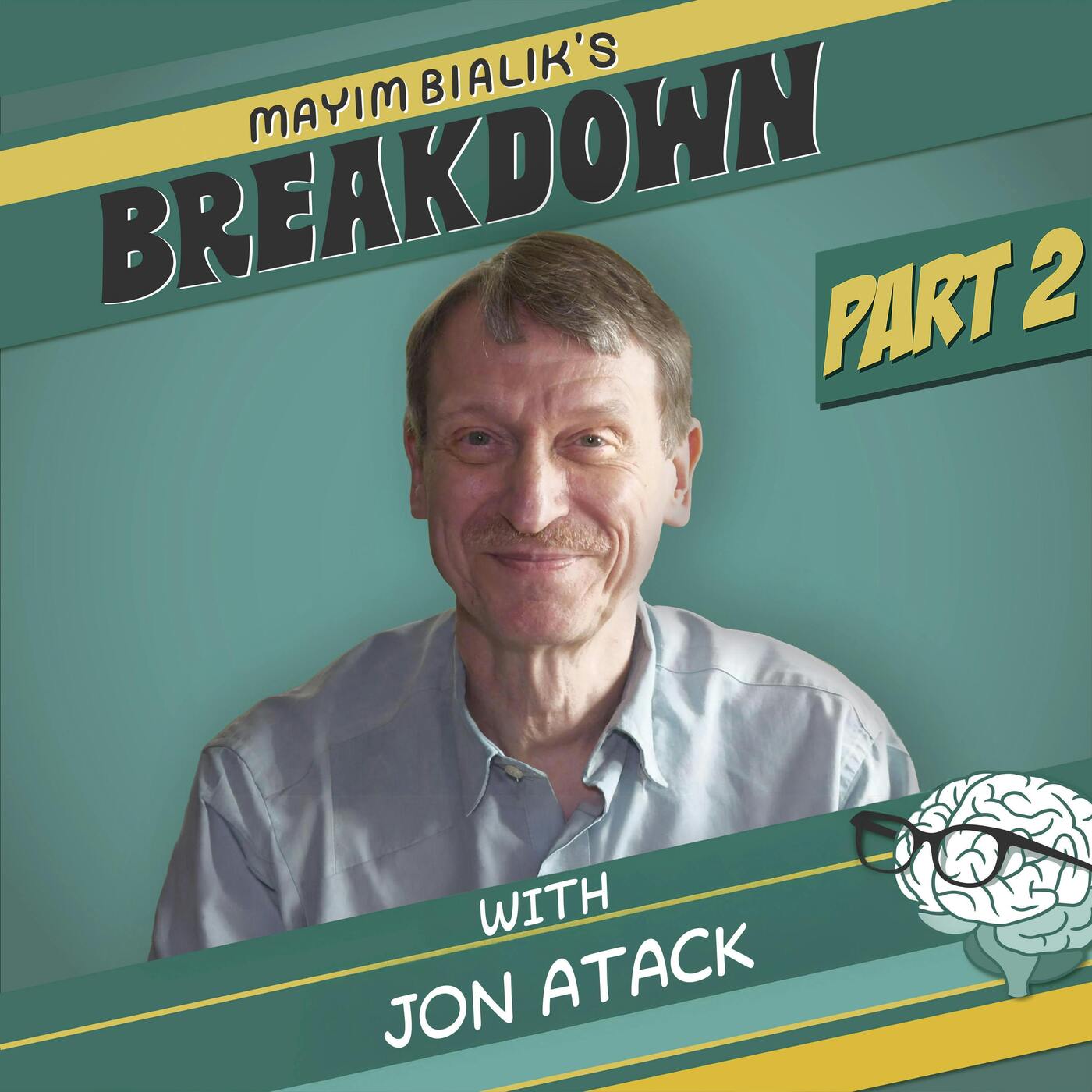
Mayim Bialik's Breakdown
Part Two: I Spent 9 Years Inside Scientology: The Shared Occult Origins of the Nazi Party and Scientology — and What It Means Today | Jon Atack
00:54:25
Loading summary
Transcript70 lines
- [00:00]
VRBO Announcer
Foreign.
- [00:05]
Mayim Bialik
Hi, I'm Mayim Bialik.
- [00:06]
Jonathan Cohen
And I'm Jonathan Cohen.
- [00:07]
Mayim Bialik
And welcome to part two of our conversation with John Atak. He's a leading expert on authoritarian cults, and we're discussing his book, if Scientology Ruled the Nazi Occultists, Sex Magic, Space Aliens, and the Second Coming. In part one of our conversation with John, we talked about the origins of dianetics of L. Ron Hubbard and how it follows a trail back to the occult origins of the Nazi party. John tells us about his personal experience with Scientology, how he rose through the ranks and what was not working for him that had him leave Scientology to try and form an independent group to further the ideas of L. Ron Hubbard before he discovered the hidden mysteries that had been kept from him. We can't wait for you to hear part two of our conversation with John Atak. Break it down. Talk a little bit about this component of mental manipulation and drug use, both in the Nazi party and in Scientology as well.
- [01:11]
John Atak
Yeah, I mean, I think the most straightforward example and one that's being thoroughly ignored. I've made a variety of complaints about mindfulness over the years. I do not object to the use of meditation. I do object to people using it who don't understand that it can lead to traumatic experiences. In fact, it can lead to psychotic episodes in people who've had no problem. And a couple of years ago, new scientists in this country were pouring out this stuff about how great mindfulness was. And I've read the literature. There were no scientific studies that supported this. I went to the very studies they were talking about, and they did not print. I wrote four letters over the period, and they wouldn't print my letters. Now in the letters, the simple point is this. After the Meiji Restoration In Japan in 1858, the Zen schools were very determined to get preferment. So the Obako, the Soto, and the Rinzai schools all taught the Imperial Army. Since Second World War, all of the Zen schools have apologized for teaching meditation zazen, which. Which is exactly the mindfulness process to the whole Imperial Army. When you look to the Nanjing massacre, the largest civilian massacre since Genghis Khan, 400,000 civilians killed, just an immense number. The Zen master of the general who commanded that wrote to him and said, well done. Bringing true Buddhism to China through this massacre. We have to understand this. These techniques can be used in a very harmful way to make people compliant.
- [02:54]
Mayim Bialik
John, you're kind of a killjoy. You're kind of a killjoy for meditation.
- [02:59]
Jonathan Cohen
Well, I think we have to break this apart a little bit, because These tools, techniques, approaches to life also have created an enormous amount of peace. You have people who have found deep change in their ability to be remove anger, remove depression, work through grief, allow yourself to learn how to process emotions that you otherwise may have used alcohol or drugs to distract yourself. And so, you know, we don't hear about the control aspect or the use of this by Nazi soldiers. Like you can imagine the headline of this episode, Nazi soldiers did yoga. But on every corner of a yoga studio, people are going there to try and, and get some sort of inner peace. Like, can we unpack this a little bit? To say, like, where does this go wrong? And how do we not throw out activities and, and practices that people around the world have used and are currently using to help them feel better in a way that doesn't have a manipulative control element behind it?
- [04:14]
John Atak
Well, it's about the responsibility of the individual and the responsibility of the teacher. If we talk about yoga, hot yoga, for example, the scandal that has broken around that, Kundalini Yoga, the terrible scandal that's broken around that because it's a completely nefarious, invented method. And we're now seeing lots of people on the Internet complaining that the problems that they have as a consequence of being in these groups. I would say the first point, and it's a point that Krishnamurti made, who was the messiah of the theosophists who denied, you know, said, you know, I'm not the messiah, I'm a very naughty boy. That Krishnamurti said very simply, don't join anything. And the members of the Krishnamurti Society went, don't join anything. You can see them sitting there listening to him. It's a very valid point. Don't belong to a group. Don't give over your own agency to a group. Always be skeptical. Be healthy in your skepticism, not cynical in your skepticism, and test what's being said, the benefits of meditation. There's a book called the Buddha Pill which was co authored by Oxford University's the author of the, Miguel Farias, who is the editor of the Oxford Handbook of Meditation. So he is a mindfulness meditator. He's very for it. He said he had his graduate students look at studies on meditation and they found 3,000 studies, of which I believe 32 were considered to be scientifically valid. So we have to use the scientific method. We have to be very careful that the experiments are useful. So for example, I recently read something that was saying how great Transcendental meditation is, and they had mistakenly looked at the Herbert Benson experiments. Now, Benson did the experiments that made TM famous as a way of calming you down and making you feel better. And he said to them, tell me what the mantra is. And they wouldn't tell him what the mantra was. So he ran a side experiment where instead of using the name of a demon or deity, which is what is done in tm, they just said the word one. And he found that the results were exactly the same. And so demystifying this and looking into very much looking into the brain science, what's actually happening when you meditate, and to what extent is it useful? Can you do too much of it? When I was investigating TM back in 1991, I was asked to write a book about it, and after six months, declined. I interviewed people who spent 12 hours a day meditating, who neglected the care of their children, who. Who went bankrupt because they weren't doing things. So it's about having your own agency. It's about having the locus of control in yourself and being able to go and talk about things and look at things and not take a position, which I probably am doing at the moment, but not take a position.
- [07:23]
Mayim Bialik
Not to use a Scientology word, but it is about intention, meaning. We do know a bit about the brain science, and people like Bruce Lipton, and obviously people like John Dispenza, you know, they're talking about sort of like the cellular transformations that happen when you're manifesting, right? But what we do know is that when you believe something has value, you can bring health to yourself. You can bring positivity. In the same way that being in a sacred space that a lot of people hold sacred, it. It's not that there's necessarily something holy or mystical or otherworldly about the location. When we ascribe meaning to a place and we set an intention, that this create meaning, we do. We create a physiological state where we are more likely to heal, to love, to be open, right? To have that openness. So a lot of that, to me, and a lot of religion, frankly, is the manipulation, right, of a natural system that wants to belong. It wants to be loved, it wants to be cared for. I have no problem with that. The problem that I have is when that physiological and psychological system is manipulated in a way to purport that there is a superior race or that we should kill people in the name of moving this forward, or there's something wrong with you if you don't believe what everyone else believes, and therefore we will excommunicate you.
- [08:51]
John Atak
Absolutely. And there are places I Mean, going to the Blue Mosque in Istanbul. You walk in there, and it's, wow, this is great. Going into a gothic cathedral. Spaces that have been designed to give us transcendent experiences. Listening to a Mahler symphony, just, you know, you're lifted. And, you know, I'm a painter. You know, I'm a musician, I'm a writer. I'm very interested. James Joyce said that there are three kinds of art. There's the art that repels you, that's didactic, or something's trying to teach you. That's modern conceptualism, for the most part. There's the art that attracts you, that you want to own. And he called that pornographic. And then there's the art that means you can't move anymore. You are stuck still. And this he called transcendent. And I accept that. I accept that there is a spirituality, if you like, that there are significant, positive experiences. The problem is when people start selling them, when people start putting money on them, and they demand power over you. I've done a few pieces with a guy called Yuval Laor, who's a great friend of mine. It's on my channel. There are several pieces. And his PhD, which he did at Tel Aviv, was on the evolution of awe in human beings and how awe and belief can be manipulated, how fervor can be manipulated. And he's done phenomenal, pioneering work on understanding how once you've created a state of awe in somebody. So if I get somebody on the street who's never meditated, I sit them down, I get them to look at a wall, and they have a bliss experience, they will then trust me as a guru, they will then trust me as a teacher.
- [10:41]
Mayim Bialik
That you've imprinted on them. Right? I mean, that's. It's the basis of any good romantic relationship and the basis of any abusive romantic relationship as well. It's the basis of every codependent relationship you could have. Right. I mean, that's it.
- [10:57]
Jonathan Cohen
John, you've been attacked by the Church of Scientology. Can you talk a little bit about some of the attacks you've received and some of the danger posed to you?
- [11:08]
John Atak
Yeah, I mean, I had 12 years after I left, where I just stood up, and there was a critic of Scientology later called Arnie Lerma. And he said, before the Internet and safety and numbers, there was John Atak, and there were two or three other people, but there weren't many of us. So they had me followed by private detectives. A private detective called Eugene Ingram traveled the world. He went as far as Australia to find anybody who'd known me and see if they could scrape together some propaganda, some malevolent gossip about me. So they made allegations that I was a rapist, that I had attempted murder, that I was a drug dealer. These things were printed and they were pushed through every door in East Grinstead, where I lived at the time. So, you know, thousands of copies were made of that kind of thing. People would march with placards outside my house.
- [12:06]
Mayim Bialik
They tried to destroy your life?
- [12:08]
John Atak
Absolutely. My house was broken into. Things were stolen. I was reported to the police. One day I woke up to find social services in my house ready to take my 4 year old daughter away because a scientologist had told them I was abusing her. That's a typical tactic. I've met many people who received that allegation. Your airline tickets might be cancelled, your reservations in a hotel might be canceled, and people will come. I had people coming and knocking on my door at 11 o' clock at night so they could yell at me. So this one guy told me and he apologized to me. He said, after he left Scientology, he said that they were told whenever they took a taxi in East Grinstead because I kept living there and that's where the headquarters are. And he said whenever they took a taxi, they were to mention my name very loudly and say what a bad person I am. You know, pathetic. Thankfully now, because there are thousands of people criticizing Scientology, they have less energy, and it's not central to what I do. This book happens to be about Scientology, but my work has largely been on the much broader sense of authoritarian groups and how to help people overcome propaganda and poor thinking.
- [13:25]
Jonathan Cohen
Mayim Biox Breakdown is supported by bioptimizers.
- [13:28]
Mayim Bialik
I struggled to get good quality sleep and I just thought like, ugh, it's stress. But I learned during perimenopause and menopause, your hormones shift and it affects your magnesium levels. Low magnesium makes everything harder. Not just sleep, but focus, mood, stress, tolerance. That's why we added Magnesium Breakthrough by Bioptimizer to our nightly routine. It's a blend of seven different forms of magnesium designed to support relaxation and overall sleep quality. Try it. See if you wake up more rested and refreshed, you've got nothing to lose and a lot to gain. BIOptimizers offers a 365 day, no questions asked money back guarantee. Magnesium breakthrough is a fantastic way to improve that hormonal imbalance that especially happens with magnesium. And then you have better focus, you have better sleep hygiene in general. Bioptimizers makes it so easy. Here's what you get when you go to biotop optimizers.com breaker and use the code breaker. 15% off your entire order and a free bottle of Mass Signs. That's Bio Optimizer's best selling digestive enzyme added to your order automatically when you use our exclusive code. That's a $20 product, free on top of your discount. This is a limited time offer while supplies last. You cannot get this on Amazon. You can't get it in stores. The offer exists in one place. Our link, our code. That's it. So if you were already thinking about trying it, this is the sign. Go to bioptimizers.com breaker use the code breaker. Grab it before it's gone.
- [14:52]
Jonathan Cohen
Make 2026 the year you finally start sleeping again. Mind Bialix Breakdown is supported by Bioptimizers.
- [15:00]
Mayim Bialik
You know, I struggled to get good quality sleep and I just assumed it was stress. But as I learned during perimenopause and menopause, your hormones shift in a way that affects your magnesium levels. And low magnesium, it makes everything harder. Not just sleep, focus, mood, your tolerance for stress. That's why I have added Magnesium Breakthrough Bye bye Optimizers to my nightly routine. It's a blend of seven different forms of magnesium designed to support relaxation and overall sleep quality. Try it. See if you wake up more rested and refreshed, you've got nothing to lose and a lot to gain. Bio Optimizers offers a 365 day no questions asked money back guarantee. Magnesium Breakthrough is a huge breakthrough to improve hormonal balance, to help with focus, decrease brain fog, improve sleep hygiene. Overall. Bioptimizers makes it very easy. Jonathan, what do they get when they go to biopters optimizers.com breaker and use the code breaker.
- [15:52]
Jonathan Cohen
You get 50% off your entire order and a free bottle of Mass Zymes
- [15:56]
Mayim Bialik
Buy Optimizers best selling digestive enzyme that'll be added to your order automatically when you use our exclusive code.
- [16:03]
Jonathan Cohen
That's a 20 product free on top of your discount already.
- [16:07]
Mayim Bialik
This is a limited time offer and while supplies last, you can't get it on Amazon, you can't get it in stores. This offer exists in one place. Our link, our code. That's it. So maybe you were already thinking about it. This is the sign. Go to buyoptimizers.com breaker use the code breaker. Grab it. It's gone. Make 2026 the year you finally start sleeping again. Why are you so dangerous? Why does the church view you as so dangerous?
- [16:31]
John Atak
I point to the things, you know, with, let's sell these people a piece of blue sky. Let's flash that at the screen. There it is. The only as yet, the only attempt at a history of Scientology. And which surprises me that no scholars have gone there. There have been some ludicrous things written by scholars, but there are. 150 people are cited in that book. 150 sources. First book, I was in Religion, Inc. By Stuart Lamont. He interviewed five people to write the book. So there are 150 people in there. But more than half of the text comes from Ron Hubbard. So the problem I pose to Scientology is I quote Ron Hubbard where he says he was a barbiturate addict, where he advises the use of amphetamines, and where he says, never defend, always attack, find or manufacture enough threat against somebody who opposes us. So I'm dangerous to them because I point out who they are and what they believe. And it's also very important to me. I've been called an anti scientologist, and I think I'm the world's greatest pro scientologist. My, my work has all been, you know, the. That book was written to help people recover from Scientology by understanding what it actually is.
- [17:54]
Jonathan Cohen
I think we should also touch on the idea of, you know, ridiculous ideas. Every person who has changed the world has had a ridiculous idea.
- [18:04]
John Atak
Well, he's had an idea that's been ridiculed. But. But ridicule is in the eye of the beholder, isn't it?
- [18:09]
Jonathan Cohen
But it was something that you said just earlier in the podcast, like these notions that, you know, for example, it can be like rounding up thousands of souls and bringing them from across the galaxy here. And that whole narrative sounds outside of what I would feel comfortable believing. And yet some people would say it's uncomfortable to think that we have a soul, to think that we have a higher self, to think that you can change your brain state if you close your eyes and change your breathing patterns. And so ridiculous is this spectrum whereby, you know, people start to inch. And so it's a little, you know, I want to ensure people are safe and never giving over their power and control as well as not limiting themselves so much to believe that only material reality in their current experience is all that there is, and they're so limited that they aren't able to change and imagine something better for themselves.
- [19:10]
John Atak
Yes. And it's a matter of definition. There are people who, you know, would think it ridiculous to say that there are 80 billion neurons of 3200 different types, experiencing neuropeptides, serotonin, dopamine and what have you. And that's what we're experiencing. There are people who absolutely deny that. In fact, the majority of human beings probably deny that. It is how we integrate that into our thinking and say, well yeah, that's fine, I'm an assembly, you know, to think of the human self. Of course, the Buddhist idea of anatta, there is no self. And we find that physiologically and psychologically we are components. We have mitochondrial bacteria in almost all of our cells which we evolved alongside of. Now that blows my mind, the symbiosis. We can't live without that bacteria. In fact, we have more bacterial cells in our bodies than we have human cells because they're very tiny. We've also got the microbiome in the large part of the gut, which we know a lot about, the microbiome in the small intestine, which we know very little about. And of course last year they found the microbiome in the brain. Having talked about the blood brain barrier and keeping fungus and viruses. Our view of what we are, every human being is a community of billions of creatures. Now what's making us think what we're thinking? Not body thetans, hopefully, but there is this deception, this idea of a self, which Buddhism two and a half thousand years ago said no such thing.
- [20:50]
Jonathan Cohen
It may not be body thetans, but it may be millions and millions of bacteria that are there from the dust of a star.
- [20:58]
Mayim Bialik
And I think like, and I think this is sort of what gets, I don't want to say confusing because I'm trained as a scientist and I'm a person of faith. I'm not confused, right, but, but are there ways that throughout history, right, people have been allowed to bring their own personal revelations, beliefs, dreams, prophecies into a structure of religious belief or spiritual belief? Of course. But there's a line that we have to draw and I feel like this is where apparently it gets shady, you know. And I think about this woman, right, who was treading where only men could tread in the 19th century, right? This woman was poised as one of the most, as you said, one of the most literate and well read women of her time, A unique individual in the world. And what she did was she combined things that she believed in and trusted with what then became things that were distorted and disgusting, right? Like is that where you know, all of our leaders, all of our gurus, right? Is that where everyone can in theory go wrong? The other thing I wanted to bring up, like none of this, none of this would have really been possible in the Internet age. This is what I'd like to believe. I'd like to believe that if the Internet existed, right, we'd be fine because it would be so clear. This is bull. This is fraudulent. We could do an experiment. However, John, this is where I'd like you to fill us in on how we are living in the age of information. Everything is available to people pretty much all the time. There's a wonderful trove of free information just floating out there, but. And the occult, the supernatural, in the twisting right of other ways of understanding, the universe is still present, and it's being disseminated through the Internet, which should be a source of us debunking things that don't make sense. I'm not sure if that made sense, but John seems to be following me. Can you talk about sort of the information age that we're living in, how this kind of information still persists? And we know with QAnon, we. We know that so many dangerous ideas, antisemitism, racism, all of these things are now actively being disseminated. Where is the occult still present? And how is the Internet proliferating that.
- [23:54]
John Atak
Well, it's a good question. We live in the age of information disinformation and misinformation. And again, I recently published, in fact, a couple of years ago, Steve and I published a chapter in a book called Loan Actor Terrorism for the Oxford University Press. And what we are seeing is that more and more cult groups, authoritarian groups, are recruiting on the Internet. It's no longer going into campuses or cafeterias. It's, you know, you can tout this thing so you have people who I think are distinctly shady. Stefan Molyneux was one of the first with his defooing the idea that all you had to do was have nothing to do with your own family for the rest of your life and you'd be fine. What a despicable idea. And when you've talked with parents of children who disappeared because they'd seen Stefan Molyneux, then you have influences like Jordan Peterson, who I think is a fool. Just straightforwardly, you know, he's 12 healthy things to do to be alive. Never tell a lie is one of his pieces of advice. So you're going, so I'm calling up the Gestapo to tell them that Anne Frank's living in my loft because I must never tell a lie. Sometimes it's the ethical and proper thing to do to distract the Gestapo.
- [25:31]
Mayim Bialik
If I say to you, John, do I look Fat in this sweater, I would like you to lie to me.
- [25:35]
John Atak
You look fantastic in that sweater. What can I say? Maim. Wonderful. And what's wrong with fat? Frankly, you know, fat's a feminist issue, as they say. And there are those of us who prefer a little meat on the bones. So there we go. Anybody can produce anything. And so you get these absolutely ludicrous ideas that are being put forward. You know, the Tate brothers, these despicable, evil people, and yet they've been let out, they've been put upon the world, and they've created a following again. Steve and I wrote a chapter about Incels and Dylann Roof and various people who've picked up their beliefs on the Internet. And the problem is, how do you teach people to think rationally? And underneath that, before you can teach critical thinking, which is an expression I'm not particularly sure is useful to us, but reasoning, logic, before you can teach that, you have to show people how they can be manipulated, how their emotions can be used to overcome their reasoning. And I am going to plug myself here. This is the book I wrote on that subject, Opening Our Minds. And my friend Ira Chailiff, who's a brilliant man who gave us courageous followership and intelligent disobedience, said every high school graduate should be given this book. It's no part of our education how to reason, how to create relationship, how to communicate, how to understand fake news and propaganda. And I've tried in the past to put together a course for that and couldn't find any funding. Isn't that an amazing thought?
- [27:24]
Mayim Bialik
Shocking. Yeah.
- [27:26]
John Atak
I'm looking at how to undo it. And that is about very much about teaching people how to think better, how to think for themselves. What is compelling people is, firstly, I think there's one underlying rule putting aside all other rules, and that is that we should have compassion for all of humanity. I start there. And anything that is asking us to hate other people, anything that's inciting hatred of any group, Islamophobia, antisemitism, racism, prejudice against women, prejudice against men, anything that is white guilt, anything that's saying, you've got to do this and you've got to hate somebody, or you've got to minimize yourself and be apologetic. My next door neighbor had a handyman doing some work a couple of years ago, and we were talking about minorities, and he just looked at me, said, I'm in a minority of one. It's like, that's a fair point. Actually, we are each of us in a minority of one. So let's look at a fundamental idea which is let's be compassionate towards our species. Let's understand that we are just one race, that we are all descended from black people, including all the Aryans among us, and that we need to have some humility. I'm trying to work on that one, but not doing very well so far. And we need to understand that the symbiotes, the other species upon which we depend have to be there for us to do what we're doing. So I think it's more an attitude of mind than saying these particular, you know, Jordan Peterson, the Tate Brothers There are dangerous individuals out there who are asking us to follow them and becoming your own guru, becoming your own teacher, growing up, maturity, you know, looking at people like, say, Erich Fromm and his ideas, I think are still vital in our time. Viktor Frankl Man's search for meaning the idea that the whole of life is about finding meaning. It's not about the narcissistic desire to live forever, which seems to be essential to traditional religions. It's about understanding that we're part of humanity and by benefiting humanity, we do something good and can in fact live comfortable lives, can in fact be satisfied with our lives rather than desperately searching. I say this as somebody who was a Buddhist for 40 years and no longer has that belief.
- [30:06]
Jonathan Cohen
This episode is sponsored by Wandering Jews, an open door media brand.
- [30:11]
Mayim Bialik
If you've ever found yourself feeling like you have more questions than answers, you're in good company. The Jewish people have been like that for thousands of years. Wandering Jews with Michal and Noam is a podcast where two of today's most dynamic Jewish voices, Michal Bittone and Noam Weissman, dig into the biggest questions about life through a Jewish lens. It's the kind of conversation where you'll laugh, learn something new, and probably shout in disagreement at least once. Michal and Noam tackle the tough topics like anti Semitism in America, what happens after we die, and the future of religion with guests like Bret Stephens, Michael Rappaport and Sarah Hurwitz. And this past month, in honor of Jewish American Heritage Month, they've been celebrating some of the Jewish lives and institutions that have shaped American life, from food to music and comedy. Thoughtful, joyful and always honest. That's Wondering Jews with Michal and Noam, a production of Unpacked. Find it on your favorite podcast app or on YouTube and make sure to hit subscribe. Check out Wondering Jews with Michal and Noam podcast and subscribe at Unpacked Bio nmx
- [31:13]
VRBO Announcer
at vrbo we understand that even the best of plans sometimes need a little support. So we plan for the plot twists. Every booking is automatically backed by our VRBO Care guarantee, giving you confidence from the very start. Whenever you need help, it's ready before your stay, through the moments in between and after your trip. Because a great trip starts with peace of mind and maybe a good playlist, but we've got the peace of mind part covered.
- [31:41]
Mayim Bialik
We talk a lot here about things that I don't expect you to be an expert on or even to have an opinion on. But Jonathan and I get to speak to people who hear voices outside of psychotic or schizophrenic diagnoses. We've spoken to people who have had spontaneous spiritual awakenings that persist for their entire life. We've spoken to people who have been declared dead on the table in a hospital, who have come back with information that is usually reserved for yogis and quantum physicists. We've spoken to people who claim to have access to information outside of the physical plane, whether that means looking at an animal and being able to intuit what that animal needs or looking at a person and able to see into their past. We've spoken to people who believe in past life regressions, who see angels, who have beams of light that follow them around and, you know, have trouble functioning in. In the regular world because of some of their abilities. Right. Or their perceived abilities. How does one distinguish that from the occult? Because many of the things that occur in the occult share similarities with experiences that science is able to now document. We're able to use brain imaging, we're looking at electroencephalography to try and look at the different, literally the different frequencies. You know, we. We know that there are things that we cannot see that exist. How do you distinguish. How do we distinguish between psi phenomenon, extrasensory perception, potential psychic abilities, and the occult?
- [33:31]
John Atak
The occult is not necessarily a negative or bad thing. It's a term that relates to the supernatural. My friend Joe Zimart talks about the occulture. And I think the differentiation needs to be careful. The work that Harry Houdini did with spiritualists, and he proved to be correct. So that when Arthur Conan Doyle, the author of the Sherlock Holmes stories, presented him with a statement written down by Conan Doyle's wife, received as a trans medium from Harry Houdini's mother, dead mother, Houdini very much wanted to believe, but he said there were two significant problems. The first was that it had a cross on it and she was Jewish. And the second was it was Written in English and she never spoke a word of English. And that's what started Houdini exploring and investigating psychic phenomena. So I think that was very valuable. I think James Randi's work, where he was able very easily to deceive people who wanted to believe, I think that's very valid. And more recently Derren Brown's work in the same way. That's not to say I'm an agnostic. I don't cleave to any position. There is so much that is beyond my understanding. Last year, the James Webb telescope told us that there are 780,000 galaxies that it could observe. 780,000. Each of which would contain, on average 100,000 million stars. Our sun is one tiny little star.
- [35:14]
Mayim Bialik
I mean, that sounds crazy, right? Truth can sound crazy.
- [35:18]
John Atak
Yeah, absolutely. And so I think we have to be open to. You know, I'm also a big fan of Joseph Campbell's work and the idea of interpreting mythology. I'm not a big fan of Carl Gustav Jung, which is what inspired him to do his work. I think Jung was a charlatan. That's another matter altogether.
- [35:38]
Mayim Bialik
I'd love for you to elaborate on why Jung was a charlatan. Come on, give us a taste.
- [35:43]
John Atak
Well, look at the red book that was concealed until the 1990s, that nobody saw it. And we have Jung there describing his own descent into madness. During a period of years when he continued to treat clients, he was also having sex with his clients. And I think that's not permissible, and I do mention it in this book, that there are people who check things against their own imaginings. Oh, that feels right to me. So it must be true. And Carl Gustav Jung, to me, is such a person. He's not somebody who made scientific inquiry, nor was Freud, for that matter. Freud never had a minute of analytic therapy himself. That's how much he believed in the virtues of psychoanalysis. They were people who created a massive following and a culture grew around each of them, which is still very vociferous. When Jeffrey Mathson wrote about seduction theory, having investigated the Freud archive, he was pilloried by Freudians the world over. To the extent that he decided he would never say another word about Freud. That's wrong. That's just wrong.
- [36:49]
Mayim Bialik
Isn't that using the word cult a little bit freely? Meaning great thinkers have followers. Freud had a cadre of followers. So I want it like, that's cult with like a lowercase cuz.
- [37:02]
John Atak
No, I think the word cult's been abused by academics, particularly sociologists, since the 1970s, the word, the dictionary definition of cult and the word culture and the word cultivation come from the same root. They're cognate. The dictionary definition is following a devotion to a leader or a teaching. So the cult of Jesus would be Christianity. But I am using the word in a pejorative sense when I talk about Freud. I think Freud and Jung did a great deal of damage. They led people to believe things which are false and that they themselves had not proven. And they claimed to be scientists in the same way that L. Ron Hubbard did. So. And I'm not convinced at all, having talked with psychoanalysts and, and their patients or their analyses. I'm not convinced at all about the usefulness of five years or eight years of three times a week seeing a Freudian analyst. It's a lot of money and it's to tell you a story. It's to put you into mythology. Which takes us back to Joseph Campbell. Convenient segue that Campbell said, well, mythology is not history, it's psychology. And from these stories we can. And I think that many of the great teachers, that's what they meant. You know, I've made my own translation of Lao Tzu's Tao Te Ching, because since when I read it when I was 17, it just became, well, this is this wonderful insight into life and how we function. And I think the approach that the Daoist philosophers, the originators of Taoism, Cheng Tzu, Lao Tzu, and the Nayye, which is a lesser known text which precedes them, these are scientifically minded people. I think the Buddha was too. They're trying to say, well, what actually is. So what developed out of that? Hussian Taoism and the Buddhist sects I have a lot of difficulty with, they don't seem to me to be consistent with the original teachings, but to have curiosity and not to close our minds to anything and say, there could be another interpretation of that. As Frazier, who wrote the Golden Bough, said, and again, I quote him in the book, and I will paraphrase because I don't remember the exact quotation, but he said, when magic is understood, it becomes science. So what is occult? One day when we go, oh, yeah, we've understood now how that works. Those are radio waves. Yeah, those are microwaves. It must have seemed like magic when Marconi did what he did with radio waves. And it still seems, you know, when I put a compact disc or I play an MP3 or what have you, it still seems like magic to me. How on earth does that make sense? You know, when I put a record on a deck and put a needle on it and it played music, it's beyond me. So what is supernatural and what is natural? As we develop our understanding, more and more of what seems to be supernatural now will become natural. We'll understand it better.
- [40:13]
Jonathan Cohen
Is there anything that you have seen or the connections you've made that we haven't covered today that you think people should be aware of?
- [40:20]
John Atak
I think it does come back to the idea that absurd beliefs can lead to atrocious behaviors. And so at the moment, and I'm probably not meant to say this, but at the moment, what we're seeing happen in the United States, which is unbelievable. I did an interview with my friend Kelvin Pierce the other day. Kelvin's this incredible guy. His father, William Pierce, was the head of the national alliance, which was the American Nazi party. He wrote a wonderful book called the Sins of My Father, about the brutal childhood he received. And Kelvin is, you know, into his 30s. He hated humanity. He had an awful time. And then he adopted two babies from Georgia, the country of Georgia, not the state. And he learned how to love, and it transformed him. His story is the most remarkable story I've ever known, and it's a privilege to know him. When the children were 10 years old, he said, I want to pay something back to the country that you came from. Would you like to come there with me? And they said, no. So he went to Georgia. And he was a builder. He's a builder. And he re equipped an orphanage. There were 92 windows. They were all broken. There was no heating system. These orphans are just there in this awful winter. And he then came to run eight homes. And last year he moved to Georgia. And the thought that somebody grew up in this awful system of hatred and was then to go there. But what happened last year was that USAID was cut off. And so he's left struggling to try and maintain these places. I think that's the important thing. How can we help people? How can we do something positive in the world? And my place is to explain that we need to be careful of our beliefs. As long as I don't mind what religion people have, we're all entitled to our own metaphor. Mine's probably the most ridiculous of them all. So I have no feet of clay like anybody else. But I do, as I say, know that any system that says, well, you should hate these other people because they're not like you. I don't like the idea in Christianity that there are people who are going to hell so when I talk to Christians, I say, well, I'll have to go there because I could not be happy in heaven knowing that there's anybody suffering that doesn't fit with my way of thinking. And they tell me I'm being ridiculous.
- [42:59]
Jonathan Cohen
And that's was said that hell was a narrative device created in order to elicit control. If there was no danger of not being able to go to the promised land in the afterlife, then how would you get people to do what you needed them to do?
- [43:17]
John Atak
Yeah, and it develops. I mean, we know the history of religion now. We can look into the Babylonian origins of the Levantine religions and see how they transform. So we have the word abyss in English, which is apparently a Sumerian word. And underneath the flat earth is the place where the shadows of people go after death. And in the origins of Levantine religions, Judaism particularly, there's the idea that this is the life afterwards. You'll just be a shade, you'll just be a shadow. This is the place to do it. And as you say, that's transformed. Religions are rewritten as sadly control mechanisms as ways of getting people to believe. And so you have this distinction between mysticism, which is the experience I have for myself, and being, you know, worshipping and sort of doing as you're told and following the rules.
- [44:19]
Mayim Bialik
I mean, religion is less about getting people to believe, it's getting them to behave.
- [44:24]
John Atak
Yeah. And the word actually means that religio to bind together, as in ligament.
- [44:30]
Mayim Bialik
I don't want to have a political conversation with you. I don't think that's useful for anyone. However, there are many components of a lot about the presentation of truth that many people are finding confusing with the current administration. People on both sides of the aisle. The, the sort of, you know, delivery of information without verification or, you know, things that the White House in particular has clarified and had to clarify as that actually wasn't true and you know, kind of backtracking. And this happens in every administration. I'm just going to go ahead and say that every political leader, this is no exception, but the time that we're living in does feel extra special. And I wonder if you can give us a little bit of a framework for aspects of what's going on in America right now that perhaps we should be concerned about in terms of cult like attraction or beliefs that may not be actually serving a greater good.
- [45:33]
John Atak
Yeah, I, I think whenever we come to politics that it is right to use the word cult, that political groups become cultic, that I have objected to every president of the United States during my lifetime, so that I am non partisan. I see terrible problems in the political leaders throughout the world. Every now and then a politician comes up who does seem to have the benefit of humanity as their point. But unfortunately it kind of gets slanted and the divisiveness is the problem. The separation, the idea that. I had a friend a couple of years ago and he told me he was patriotic and I said, let's look the word up.
- [46:27]
Mayim Bialik
You like to look words up. I've learned this about you, John.
- [46:30]
John Atak
Yeah, well, it's a fundamental philosophy, isn't it? We must agree upon the terms before we can have a conversation. Or as Wittgenstein said, it's a language game, which is a bit difficult. But I said, okay. He was a Republican. It wouldn't have mattered if he'd been a Democrat. I said, well, as a patriot, do you want to defend the rights of Democrats? And he paused. He had to think. Now he told me about immigrants and how much he wanted to get rid of them. And I'm sort of. You do realize that the California purchase and remember the Alamo when Utah and New Mexico and Arizona and Colorado were seized from Mexico. And the populations living there, the ethnic populations are Mexican and some of them have been there for a couple of hundred years longer than the European white population, the non Spanish, non mestizo population. And it gets very confusing because, for example, neo Nazis in the U.S. now I'm having a conversation with a young man who is the child of neo Nazis and his father believes in the Aryan race, his mother is Russian. And you kind of go, well, if we want to get into the Aryan race, the Slavs or slaves, the words are cognate. Again from the Aryan, German, Nazi perspective. The Slavs were to be enslaved. So the idea that if you have white skin, you are therefore, you know, as long as you're not Jewish, you are therefore an Aryan is not true. People grab hold of ideas and use them to hate other people. And I think we see that. I think the Epstein files have really shown this saying, you know, Prince Andrew is no longer a prince. Peter Mandelson's had to resign from the Labour Party and leave the House of Lords. Who in America has done anything as a consequence of being named in these files? And I think the division we're seeing is between the powerful and moneyed who have the idea of having hundreds of billions of dollars. I'm with Bernie Sanders on this. A billion dollars is enough. Go beyond that. Why? You've got enough money to live 20 lifetimes. Why should you have more? And are you then manipulating the world? The idea that Elon Musk could stop the use of Starlink in Ukraine for three days, thus allowing the Russians to attack and kill hundreds of people. That one billionaire can make this decision while writing to Jeffrey Epstein. I want to come to your wildest party. That's the problem. And I think there are good hearted people in both the Republican and the Democrat parties. And I would like to see the good hearted people in charge. I am disgusted at the way the Democrats have behaved, at the weakness that they've shown. And Clinton. There are problems with former presidents. Let's go out on, you know, on a limb. I am not convinced that Obama was a good man because from my perception, he committed war crimes. He lied to the people about how Saddam Hussein was caught. He failed to close Guantanamo Bay, having promised that within a year of coming to power he would do so, which means that 800 people were illegally detained and tortured without recompense. So I think it's a matter of bringing ethics to politics and making sure that the government is by the people, for the people, rather than for the plutocrats who are in charge. And for the vote catching, how do we win the next election? And this is important because, and it is my, my field because the absurd beliefs, the ideas that are being put forward, that are leading to people being killed, that are leading to people being beaten, being put into camps, it's a very frightening situation at the moment. But it's not the fault of the Trump administration. It's the fault of the U.S. government. Democrats and Republicans alike should take responsibility and change this. And look at the idea that there are Christian values operating behind this. I have a friend who talks to MAGA supporters and he says, and they'll say, well, we're Christians and we're bringing Christian nationalism. He says, read the Sermon on the Mount and then read it again and keep reading it and tell me to what extent either side of the political spectrum is actually following the principles of the religion they say they espouse.
- [51:39]
Mayim Bialik
Well said, John. Really, really well said. Thank you, John. Where can people learn more about you and all of your books which I now want to purchase? If Scientology Ruled the world is pretty fantastic. But where can people learn all the things about you? And also, do you have a place where people can see your art if they're curious?
- [52:01]
John Atak
Yes, in that point, I have an old website called johnatak.com and that has some paintings on. I'm actually managing to spend time painting again. I Reopened my studio last year and it's just so wonderful to not have your head crammed with facts and ideas, but just with colours. So that's lovely. My work on authoritarian groups, johnatak.co.uk and also my YouTube channel, which has more than 600 videos on it now. John Atak, family and friends. Also today I want to promote this. You know, I've written a lot of books and published about 10. And this book here is a novel, a supernatural novel in which I bring Jimi Hendrix back to life as part of a group of people who think that they are reincarnations of the lost Canasta tribe of the Cherokee. And I'd like to sell more copies of that, if you would.
- [53:08]
Mayim Bialik
That sounds amazing. Well, I'm going to purchase a copy, at least for myself. I will just say thank you so much for being here and we really appreciate your time.
- [53:17]
John Atak
It's been a fantastic pleasure. Thank you so much.
- [53:24]
Mayim Bialik
I have a lot more questions for John that we didn't necessarily get to cover. But this book is a very deep cut, you know, into places where we still see the influence of the kind of occult based leadership that I think I can't avoid, you know, now associating with the origins of the Nazi party. But you know, one of the things that he talks about in the book is any campaign of sterilization that has existed and continues to exist in the current world has its origins in this kind of thinking, that there is a designation that is made about who gets to exist and who doesn't, who gets to reproduce and who doesn't. So he cites, he, he cites many, many examples. He cites examples in India, he cites examples in China. In 2011 alone, 10,000 women in China were forcibly sterilized under the Iron Fist campaign. The Chinese government had the intention to sterilize 80% of the 6 million Uyghur women. And that's spelled U Y G H U R. Um. After the incarceration of 1 million Muslim Uyghurs in 2021, one gynecologist admitted to performing 80 sterilizations a day. So this is something that continues to persist. And, and of course there's always going to be fights among people. Like, I don't mean to oversimplify it, right? But the notion that so many foundations, and even as, as John described, so many foundations of even the government in the United States, right, is built around deception, misinformation, disinformation. You know, it, it kind of makes your head spin. How do you know what's true how do you know what to trust? And I can see so many people that I know are just retreating from information at all because nobody knows what to believe. I mean, between my mother and me and our texts about what images are AI. She saw a video of a very prominent physician who everyone would know by name, and she said, why is he talking about this? This sounds like a scam. And I said, it's not a scam. That's not him. It's not his face or his words. So it's kind of like, I understand people retreating, because how do we know? And how are these things being used to influence us?
- [56:13]
Jonathan Cohen
I mean, this is a very small example, but the number of public people who have to go online and say, I am not endorsing X, Y, or
- [56:23]
Mayim Bialik
Z product, I am one of them.
- [56:25]
Jonathan Cohen
You do not sell CBD gummies.
- [56:27]
Mayim Bialik
It's a very complicated thing to be, you know, presented as a platform of something that is not true. And the way that that's being manipulated, obviously the financial basis of it, it makes total sense. Like, guess what? Capitalism, right? Like, that's driving it.
- [56:45]
Jonathan Cohen
The number of books on Amazon. One of the. Our previous guests, I was watching her Instagram stories, and she was like, here's a book that's not me. Here's a book that's not me. Here's a book that's not me. And they're just using LLMs to be. Knock out any book related to the ideas that this person has. And then how do you know what's real or not?
- [57:04]
Mayim Bialik
You know, the one thing I didn't ask John, and I. I'm glad that I didn't ask, but I'm gonna say it, and I say this with a tremendous amount of respect for him and, you know, the. The work that he does and his. You know, his. His research and all these things. Some people might look at this guy and be like, but maybe you're crazy. Like, maybe you're obsessed with. With the fact that Scientology didn't work for you, or you felt they took your money, but, like, tough noogies. You signed up for it, right? It. Like, you could also argue that maybe this is some sort of, you know, obsession that he has. But obviously, he is, you know, he's a friend of Steve Husson, which is how we got to him. And they publish many academic, you know, books and journal articles about so many aspects of this. But, of course, you know, when you look at the attacks that the Church of Scientology has put out against him, that's how they frame it, right? They're giving you a different perspective of the truth. Jonathan I appreciate being given the opportunity to talk to John. I know this is a different kind of episode, but I do think that especially talking to someone who knows about the history of the occult and the places where we can try and distinguish, you know, magic from science, I think is something that really grateful to have gotten to talk to him about. So thank you all for being along for the ride. For more content, Jonathan, that people can't get anywhere else, where should they go?
- [58:34]
Jonathan Cohen
Check out Mayim Bialix Breakdown on Substack. Just open the app or the website, type in mind Bialix Breakdown and you will find us.
- [58:41]
Mayim Bialik
We will see you over there and we'll see you next time. From our our breakdown to the one we hope you never have. We'll see you next time.
- [58:47]
John Atak
It's Maya Bialik's breakdown. She's going to break it down for you. She's got a neuroscience PhD or two, fiction. And now she's going to break down. To break down. She's going to break it down.