← Mayim Bialik's Breakdown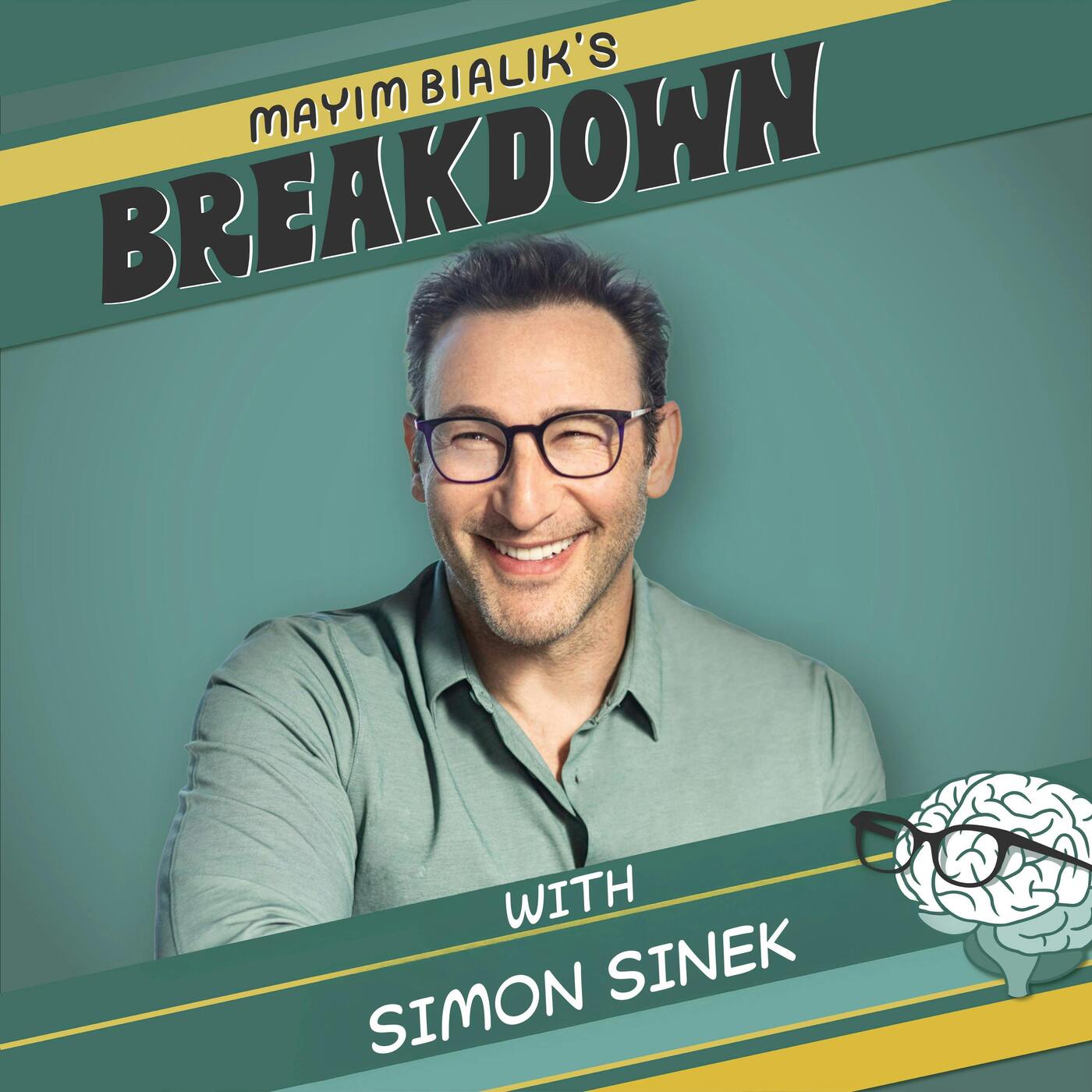
Mayim Bialik's Breakdown
The Physiology of Optimism, Reclaiming Our Humanity, and Accessing Your Soul’s Wisdom to Find Your “Why” | Simon Sinek
01:25:26
Loading summary
Transcript414 lines
- [00:00]
A
My Nbialix breakdown is supported by Helix Sleep.
- [00:04]
B
Spring is in the air and so are all of the allergens that come with it. Spring allergens means you need more sleep, but there are a ton of factors that can prevent us from getting a good night's rest. Night sweats, back pain, feeling the person next to you when they roll over a million times. We were so excited to hear that Helix wanted to partner with us. I've had my Helix mattress for about five years now and I have been sleeping so much better. Jonathan and also our kids love their Helix mattresses and all of those issues. Night sweats, back pain, motion transfer. Those things are significantly better with a Helix mattress. Helix delivers your mattress right to your door which is so much fun. With free shipping in the US they have a 120 night sleep trial and limited lifetime warranty plus their happy with Helix guarantee. Rest easy with seamless returns and exchanges, the Happy with Helix guarantee offers a risk free customer first experience designed to ensure that you're completely satisfied with your new Mattress. Go to helixsleep do/breakdown for 27 off site wide that's helixsleep.com breakdown for 27 off site wide helixsleep.com breakdown With Verbal's
- [01:11]
C
last minute deals, you can save over $50 on your spring getaway.
- [01:15]
B
So whether it's a mountain escape with friends, a family week at the beach or sightseeing in a new city, there's still time to get great discounts. Book your next day Now.
- [01:25]
C
Average savings $72 select homes only. Stress is the killer. 78% of people don't like their jobs.
- [01:44]
B
That's a lot of people.
- [01:45]
C
Happy people live longer. Imagine a world in which the vast majority of people waking up every single morning inspired and ending the day fulfilled by the work that they do. And I've committed myself to do whatever I can to try build that world.
- [01:56]
B
Simon Sinek the best selling author helps millions find their purpose, strengthen human connections and overcome modern challenges.
- [02:05]
C
Optimism is not blind positivity, it's just the undying belief that if we're in a dark tunnel that there is light at the end of that tunnel. We have to ask how much pain has to be caused before we get to bright.
- [02:14]
B
What does it feel like to step into following your passion?
- [02:17]
C
You have to be very careful not to confuse something I do versus who I am. Learning your why is actually learning where you came from and finding the patterns that you see to just naturally thrive. One person can find ways to bring themselves to life in wildly different ways and both are good.
- [02:33]
B
Well, they're both me.
- [02:35]
C
The question isn't what do I want to do with my life? It's rather, who am I? What are the opportunities available for somebody like me? And by the way, you can change your mind.
- [02:43]
B
Why are we so unskilled?
- [02:45]
C
It's very hard to be human. Most of us are bad listeners. Most of us are bad at confrontation. Most are bad at giving or receiving feedback. No one thinks they're evil. Everyone thinks they're on the side of good. Both sides have made the mistake of labeling the other side evil, unpatriotic. If you want to move towards understanding a peace, if you feel that you're the victim, then you're going to have to go first. I'll tell you why I'm optimistic.
- [03:06]
B
Because we're all going to die. And then there's something better.
- [03:09]
C
No. No.
- [03:17]
B
Hi, I'm Iimbialik.
- [03:18]
A
And I'm Jonathan Cohen.
- [03:19]
B
And welcome to our breakdown.
- [03:21]
A
What if who you are and what you're meant to do in this world has actually always been with you, as may describe. It's part of your DNA. It's part of your soul's journey and it's there waiting to guide you.
- [03:36]
B
And we're not just talking about a Kendrick Lamar song. We're talking about the things that are you, the things that you're passionate about, the things that drive you. Also the things that annoy you, the things that confuse you about the world that you live in. What if the answer to finding hope, to finding optimism, and to finding out who you really are and what you're here for. What if you've already got that inside of you? Today we're going to be speaking to an expert and a specialist who helps people understand why they are here and what they're supposed to do with their why.
- [04:10]
A
And that information is increasingly important in an ever changing world where there are factors like artificial intelligence that are changing the landscape that we are all working in, we're all living in, and even how we're relating to each other. He's going to describe to us how to find ourselves and also what some of the core human characteristics are to be better at being human.
- [04:34]
B
So many of us are finding challenges in the world that we never anticipated before. Whether you're a blue collar worker, a white collar worker, whether you're an artist, whether you're a student. The technology changes the demands on us in terms of what we're expected to do, what we're expected to achieve. It seems like the bar keeps getting raised Many of us are struggling to figure out how do we keep up? Simon Sinek is going to tell us all about not only how to keep up, but how to find our particular why and how to use the skills that we already have to live a better life. Simon is the global bestseller of Start with why as well as Leaders Eat Last and the Infinite Game. He's also got a podcast, A Bit of Optimism. He's a speaker and he's a consultant. He frequently works with different branches of U.S. armed forces and agencies of the U.S. government. He is the person that people go to when they try to figure out what's not working and how do we get it working for the most number of people. We're very excited to have Simon join us in person. So without further ado, welcome Simon Sinek, to the breakdown in person. Break it down.
- [05:42]
C
Thanks for having me.
- [05:44]
B
I would like to start in talking about the game, the game that we are playing, the infinite game as you. As you describe it. Obviously when you talk about these things, I can't help but think about a simulation and a different kind of game. Can you talk to us about sort of the game that we're in and the way that you frame it for people?
- [06:03]
C
Yeah, I mean, this work is this work done by this theologian and philosopher named James car in the mid-1980s. And that it. When I discovered his work, it's like he wrote this kooky little philosophy book. I mean, it's. And it, it so challenged my view of how I was going through life and trying to build a business and trying to build a career. The change was so profound and I ended up sort of following it, that I eventually wrote what I had figured out, how to make his philosophical sort of work actually actionable. In a nutshell, there's two types of games. There's finite games and there's infinite games. A finite game is defined as known players, fixed rules, and an agreed upon objective.
- [06:45]
B
Football, baseball, like some work environments you say, oh, 100%.
- [06:48]
C
Yeah, 100%. Like if you're auditioning for a part, there's a winner and there are losers. Someone will get it and other people won't.
- [06:54]
B
Right?
- [06:54]
C
And that's essential. In a finite game, there has to be somebody who wins and a person or others who don't.
- [07:00]
B
Right.
- [07:00]
C
And most important, there's a beginning, a middle and an end. Because once you have an audition, that's it, it's over.
- [07:07]
B
Right.
- [07:07]
C
Like it is done. Right. Then you have infinite games. Infinite games are defined as known and unknown players, which means you don't necessarily know who all the other players are. The, the rules are changeable, which means everyone can play however they want. And the objective is to stay in the game as long as possible.
- [07:23]
A
Relationships.
- [07:24]
C
Relationships. Health. Career. Career is an infinite game. Right. Nobody's going to be declared the winner of career. Right.
- [07:32]
B
Says you.
- [07:34]
C
I mean, you can keep trying. We all have to beat Tom Cruise.
- [07:37]
B
Right?
- [07:37]
A
Right.
- [07:38]
C
And, and business. And like, I get a kick out of the fact when companies talk about we're the best, we're number one, we beat our competition based on what agreed upon objectives, metrics and timeframes. And what I learned was that when you play with a finite mindset in one of the infinite games, when you play to win in a game that has no finish line, there are very, very predictable outcomes. Decline of trust, decline of cooperation.
- [08:04]
B
Chaos.
- [08:04]
C
Decline of innovation. And that's not to say that there are finite games within the infinite game. Like we said, your career is an infinite game. You want to stay in the game as long as possible, but there are gonna be wins and losses along the way. There's gonna be auditions, et cetera.
- [08:18]
B
You know, I'm also thinking how much this is something I've, I've talked about a lot. Parenting in this generation, or these generations that we're in has become a sort of finite game, but it's actually infinite. Meaning. There's this notion, and I, I've talked a lot about this, that for women, when we entered the workplace, you know, historically. Right. Many of us adopted and adapted to a male dominated workplace.
- [08:44]
C
Yes.
- [08:44]
B
But what then happened for those of us who then raised children, we took the rules of the workplace and we thought we could apply them to being a parent whose kid can read the fastest. And you get these like ridiculous competitions of like, my milk lets down quicker than yours, like ridiculousness. Right.
- [09:00]
A
I was never in that competition.
- [09:01]
B
This was. No, but, but this was one of my challenges with even just going to the park and interacting with other parents. There seemed to be this notion that other people believe you can win or lose at parenting. Right?
- [09:13]
C
Yeah. Or that your kid is a winner or a loser.
- [09:16]
B
Right?
- [09:16]
A
Right.
- [09:16]
C
And you see the ripples of this finite mindset brought to parenting. Right. So I'll give you a classic example. Really smart kid graduating high school or college. And I suggest, why didn't you take a gap year? Why don't you take a year off either get a job, get an internship, travel around the world, whatever, whatever your thing is, but take a year off before you enter your career.
- [09:43]
B
Right.
- [09:44]
C
And they all say the same thing. I can't. I'll fall behind. My. My friends will be ahead.
- [09:50]
B
Yeah.
- [09:51]
C
I'm like, ahead of what? You're not competing against your friends. Right. It's this. It's this horrible, insidious, sort of. What did Teddy Roosevelt say? Comparison is the thief of joy.
- [10:01]
B
Yeah.
- [10:01]
C
You know, and the irony is, is if you took that year off, you would come back so much smarter, so much more aware, so much wiser, that though you may be quote, unquote, behind in the short term, over the long term, you will do way, way better because of.
- [10:15]
A
You may arrive faster in whatever situation you're in because you have so much more experience.
- [10:19]
B
Your job is done here. We will tell that to our teenagers and you can go home.
- [10:22]
C
My sister had somebody years ago who, who was.
- [10:25]
B
Who.
- [10:25]
C
Who was a direct report to her, and the kid came to her and said, I can. I have a promotion. And my sister's like, no, no, you haven't. No. And he's like, no, no, no, no, no. You don't have to give me any money. You don't have to give me any responsibility, any additional responsibility. I just need the title, so I can put it on LinkedIn. I just need the title. Is that okay? Can I just have the title?
- [10:51]
A
You know, so backwards.
- [10:53]
C
Didn't want the money, didn't want the. It wasn't about the opportunity. It was about the projection and the
- [10:59]
B
comparison for people who may not know who you are or what you do. Can you explain what you do and sort of where you fit into, you know, our cultural understanding of, you know, success, pursuit of happiness. Who are you?
- [11:15]
C
I just knocked on a random door. I saw a podcast and we answered. I saw a podcast set up and I thought, well, this will be fun. So fundamentally, I'm an optimist with a simple vision. I imagine a world in which the vast majority of people waking up every single morning inspired, feeling safe wherever they are, and ending the day fulfilled by the work that they do. And I've committed myself to do whatever I can to try build that world. So I've done multiple things to help advance towards that vision. I've written multiple books. Yes. On the topic of. Of finding your passion and helping other people find theirs. I've. And the books are all about, sort of semi autobiographical, I guess, but they're really about finding passion, building team, and knowing how to go through this funny world. I've got my podcast on my own called A Bit of Optimism. What else do I do? I do a bunch of Speaking. I guess I do a little bit of everything.
- [12:12]
B
Why are you an optimist?
- [12:14]
C
Oh, because I believe the world tends to. Good.
- [12:17]
B
What evidence do you have?
- [12:22]
C
Did you ever see, did you ever see Shakespeare in Love? I mean that's a blast from the past. Yep, great film.
- [12:29]
B
He saw it.
- [12:30]
C
You know Geoffrey Rush's character when things go horribly wrong he goes, don't worry, everything will work out. They're like how do you know that? He goes, I don't know, it just does. And I mean I think this is what optimism is. Optimism is not blind positivity. It's not looking at the world and be like look how great everything is. It's not rose colored glasses or Pollyanna. You know, that's not what it is at all. It's just the undying belief that if we're in a dark tunnel and we don't even know how, how long it's going to be until we get to light. It's the belief that there is light at the end of that tunnel. And I do believe that.
- [12:58]
A
Have you always been like that?
- [12:59]
C
I think so. When I was younger I think it was called Happy Go Lucky. It's Viktor Frankl stuff. Viktor Frankl in Auschwitz made this magical observation that everybody's suffering the same circumstances. That some people had the will to live and other people didn't. I wouldn't compare myself to Viktor Frankl but I do think that mindset is a huge part of it.
- [13:20]
A
Mind Bialix breakdown is supported by bioptimizers.
- [13:23]
B
You know I struggled to get good quality sleep and I just assumed it was stress. But as I learned during perimenopause and menopause your hormones shift in a way that affects your magnesium levels. And low magnesium it makes everything harder. Not just sleep, focus, mood, your tolerance for stress. That's why I have added Magnesium Breakthrough Bye bye optimizers to my nightly routine. It's a blend of seven different forms of magnesium designed to support relaxation and overall sleep quality. Try it. See if you wake up more rested and refreshed, you've got nothing to lose and a lot to gain. Bio Optimizers offers a 365 day no questions asked money back guarantee. Magnesium Breakthrough is a huge breakthrough to improve hormonal balance, to help with focus, decrease brain fog, improve sleep hygiene. Overall Bio Optimizers makes it very easy. Jonathan, what do they get when they go to bioptimizers.com breaker and use the code breaker.
- [14:16]
A
You get 50% off your entire order and a free bottle of Mass Times
- [14:20]
B
Bioptimizer's best selling digestive enzyme that'll be added to your order automatically when you use our exclusive code.
- [14:26]
A
That's a $20 product, free on top of your discount already.
- [14:31]
B
This is a limited time offer and while supplies last, you can't get it on Amazon, you can't get it in stores. This offer exists in one place. Our link, our code. That's it. So maybe you were already thinking about it. This is the sign. Go to buyoptimizers.com breaker. Use the code breaker. Grab it before it's gone. Make 2026 the year you finally start sleeping again.
- [14:49]
A
My ambio breakdown is supported by Bio Optimizers.
- [14:53]
B
I struggled to get good quality sleep and I just thought, like, h, it's stress. But I learned during perimenopause and menopause, your hormones shift and it affects your magnesium levels. Low magnesium makes everything harder. Not just sleep, but focus, mood, stress tolerance. That's why we added Magnesium Breakthrough by Bioptimizers to our nightly routine. It's a blend of seven different forms of magnesium designed to support relaxation and overall sleep quality. Try it. See if you wake up more rested and refreshed, you've got nothing to lose and a lot to gain. BIOptimizers offers a 365 day, no questions asked money back guarantee. Magnesium Breakthrough is a fantastic way to improve that hormonal imbalance that especially happens with magnesium. And then you have better focus, you have better sleep hygiene in general. Bioptimizers makes it so easy. Here's what you get when you go to bioptimizers.com breaker and use the code breaker. 15% off your entire order and a free bottle of Mass Signs. That's bioptimizer's best selling digestive enzyme added to your order automatically when you use our exclusive code. That's a $20 product, free on top of your discount. This is a limited time offer. While supplies last. You cannot get this on Amazon. You can't get it in stores. The offer exists in one place. Our link, our code. That's it. So if you were already thinking about trying it, this is the sign. Go to buyoptimizers.com breaker. Use the code breaker. Grab it before it's gone.
- [16:17]
A
Make 2026 the year you finally start sleeping again. We talk a lot to a lot of different types of people on this podcast, from neuroscientists to spiritual leaders and even physicians. And we think about mindset from a variety of different angles. Some think about it, you know, how do my thoughts affect my Biochemistry. Some people think about it energetically and changing of consciousness and altering how we think. Talk a little bit about optimism as it relates to how people navigate life. Because when you think of there is light at the end of the tunnel, a lot more opportunity opens for you.
- [17:00]
C
So I think that, well, we know this, there's data on this. Happy people live longer. So if you want to go down that path of health, you know, and it's not, it may or may not be related to happiness per se, but it's about stress. Stress is the killer. Stress is what creates inflammation and all these other things in our bodies and having friends and getting enough sleep. These things are more important than almost anything else. I know there's this whole longevity movement wherever he's obsessed with whatever supplement and all of these things. And I mean that's not what it is. In fact, I did a thing recently where they, they took blood from me and they measured the inflammation of my cells because inflammation leads to everything that bad that happens to people. Basically they said if my glycan age is, is eight years younger than my chronological age, then I'm doing really well. Mine was 22 years younger. Wow. Now but this is important because I exercise kinda, you know, I eat healthy. Ish, you know, like I'm not obsessed with any of those things, but I have amazing friends and I focus a lot of my friendship and I do get enough sleep. Like I, I go to bed and, and I'm generally a happy person. And they were telling me that, for example, elite athletes don't live very long. They don't live, they don't, they don't live longer. And they're saying the longevity obsessed people actually do very badly in this, in this inflammation thing because they do something called stress stacking. So yes, it is healthy to have a hard workout. Yes, it is healthy to do your sauna and your Coldplay.
- [18:35]
B
And there's physiological stress.
- [18:36]
C
That's physiological stress. That's very important. It is healthy to do intermittent fasting, but of them every day it's stress stacking. And then you combine all of your wearables and it's like, oh my God, I didn't get enough sleep. And I'm like, you know that this, like I didn't hit enough, enough steps. Like, you know, like all of that stress is way worse for you. It's like the cortisol, that's the stress of eating dessert is worse for you than the dessert.
- [19:00]
A
I actually took off my wearables recently. A few months ago I was like, I Don't want that data right now.
- [19:06]
C
Yeah, it's nicer.
- [19:07]
A
I, I believe in data and I believe in knowing what your baselines are. But, but monitoring every day wasn't for me.
- [19:13]
C
As you said, data is just that. It's, it's, it's, it's something interesting and it's a component. But I think when, with all the wearables, I think people are putting too much weight on the importance of all of these nuances.
- [19:28]
A
I want to get to some of the very powerful statistics that happen around optimism and how people get that optimism. But let's frame a little bit about, like, how you see the world we're living in right now, because there's a divide, right. There are people who see the changing nature of technology, the changing nature of politics, the changing nature of media landscape, and they're like, this is the worst it's ever been. We're more divided than ever. And others have a more optimistic view. And I think at the core, what happens is people have a very hard time with change. And how do you frame the world that we're living in right now?
- [20:05]
C
Well, I think the introductions of new technology always throw people for a loop. You know, when the Internet showed up, we're all old enough to remember that, that created somewhat of a frenzy as well.
- [20:16]
B
I believe my dad said, I don't think this is going to stick around for long.
- [20:19]
C
Right. Yeah. And people are talking about that. You know, those who are like the big proponents of it, they talked about the death of bricks and mortar. Yeah, well, that didn't happen. Even the Edison electric light bulb. Somebody gave me a gift once, which was a copy of an original sign that said, this house is equipped with the Edison electric light bulb. Do not fear. It will not affect your health or sadness of sleep. You know, you put that above the switch, like. And a lot of these technologies took, not years, decades for adoption, including the light bulb. It took a long time for people to be like, do we want to put one of these in the home? You know, let's have a serious conversation about this. I'm not comparing AI to light bulb.
- [20:58]
B
No. But I was also going to say that there's a lot of things that did change when we implemented things like lighting. Right. It did change our sleep, it did change our productivity. It did change the amount of time that we spend together. And we're, we're not incorrect that the Internet.
- [21:15]
A
Yeah.
- [21:15]
B
As helpful and wonderful as it is, has a downside. Has a downside. You know, And I think AI is the same like, there's amazing things. It does. And also, it does create a completely different framework for how we operate.
- [21:26]
C
And I think what you're talking about is exactly right, which is everything is always both. And for people who think it's the end all, be all, you're completely wrong. And for people who think it's. It's the. It's the worst thing that ever happened, you're completely wrong. The question is, where. What's the balance and how do you maintain balance? And I. It's. And I do believe things should be regulated. Like, I. I think especially new technologies. Like. Like when cars became a thing, there probably weren't that many laws until there were enough accidents that somebody was probably like, I've invented a stoplight. You know, I think we should have speed limits. You know, like, things became a thing for a reason, to make these things as safe as possible, you know, and like, for people like, you can't tell me what to do. It's like, well, we tell you to wear a seatbelt, and that is for your health and for ours, so we can. The government can do these things for the good of you and us, like speed limits. The problem is when you look at Congress, that congressmen don't want to look dumb on camera, and so they ask stupid questions and don't go for the right things. And, you know, we're still governing the Internet based on laws passed in 1996, which is just a freaking embarrassment. Right. And we do know that the insidiousness of the advertising model and the addiction to money and shareholder supremacy has made companies make what we can all agree are the wrong decisions. Good for them, bad for us. You know, the ethical. Forget the law, because the law is always lagging behind ethics. Highly unethical. And I believe these things should be not just legal, but ethical. And so I think we're. Unfortunately, we kind of screwed the pooch on the Internet thing, and I'm. And the social media thing, and I'm kind of bummed out that we haven't learned our lesson with the AI Thing. I'm all in favor. And they all give the same, yeah,
- [23:14]
B
the genie is a little bit out of the bottle.
- [23:15]
C
They all say the same thing. Well, if we don't, you know, China will.
- [23:18]
B
And then it's like, that's an infinite game. We think we can beat China right? At something. You know what I mean?
- [23:26]
C
Well, this is what the Cold War was. The Cold War wasn't about winning or losing. It was about maintaining equilibrium. Mutually assured destruction was the thing it
- [23:35]
B
was about maintaining threat.
- [23:36]
C
But whether. Whether it's the threat of. Of death, the threat of. Of. Of bounty. The point is, is that keeping things in balance were the things that maintained peace. There was never nuclear war because both sides knew that there cannot be a winner and there cannot be a loser. And that's what made it work. It's not a dark feeling, by the way. It's not a dark thought.
- [23:55]
B
I feel very dark. You will feel dark by the time you end this hour.
- [23:58]
A
No, no, this is actually a good battle between the pessimist and the optimist who will come out.
- [24:04]
B
Feels a little judgy.
- [24:05]
C
I'm okay with the judgment, by the way. Just.
- [24:08]
B
I'm also thinking, you know, that statement you just made? There are things that many of us used to hold certain that we no longer hold certain.
- [24:17]
C
That's true.
- [24:18]
B
And that's where I think a certain amount of. I call it pessimism, fear. We used to believe that people could not be taken out of their homes with no recourse. We used to believe that people could not be shipped off to countries they've never lived in. Like we. I used to believe those things. I also, you know, was raised by civil rights activists who told me, you have a voice. Stand up to the government, lay your body down in peaceful protest for the rights of those who are not spoken for. That is no longer something that I feel comfortable recommending to young people. Right. Pessimistic yet?
- [24:55]
C
No.
- [24:55]
B
Okay.
- [24:56]
C
Because again, optimism is. I believe that we will tend towards bright. And even if the roads towards bright are bumpy, it tends towards bright. And the only questions we have to ask is how much pain has to be caused before we get to bright. Wars do end. Every war concluded only peace can last forever. War cannot last forever. And so as much as I don't like conflict and I don't like strife, I'd seek to understand the other side as well. Do you remember the movie Inglourious Basterds?
- [25:34]
B
Of course. I've seen it many times.
- [25:36]
C
Great film. And Christoph Waltz is chilling as the Nazi, Right? So he did this when he was promoting the film. He went on Letterman, and Letterman asks a question. He goes, what did you do? What did you have to do as an actor to. To play evil so effectively? And you see Christoph Waltz's face. He doesn't understand the question. He goes, what? And Letterman asks again, he goes, what did you have to source to play evil incarnate? And Christoph Waltz says, what? He wasn't evil. And this is what made him so chilling. Which is he understood that everyone thinks they're on the side of good. No one thinks they're evil. Evil is something we project on others. And I think the way I seek to understand the world, go through the world and find equilibrium and peace. And I don't believe that we can live in a world without conflict. I do believe we can live in a world where we can resolve conflict peacefully. Those are very different. And it always starts with empathy and the desire to understand the point of view of the other. And I think what both sides of the political aisle have made the mistake of doing is labeling the other side evil unpatriotic. Where both sides believe that they are on the side of good and doing things for the good of the country. That is what they believe. Right. And it is too easy to simply say, yeah, but they're wrong.
- [26:55]
B
Well, we tried that for many years. And I think many people are realizing, oh, guess what? The people that you wanted to deem immoral, unpatriotic and disgusting are living right next door to you.
- [27:05]
C
And so I think that peace starts with understanding. And if you know the work of Dia Khan, who's incredible, an incredible human being. Dia is a British documentary filmmaker. She BAFTA winning documentary filmmaker. And she made she Muslim woman who made some comments on the BBC about multiculturalism and multicultural societies. And her comments went viral in the white supremacist community. And she started being trolled very aggressively by the white supremacist community to the point where the police told her to stay away from open windows. That's how bad it got. The way that she responded to their counsel was to move to the United States and get to know the white supremacists. Now she was in Charlottesville, she wasn't marching with them, but she was walking with them. And she gave them a safe space to feel heard. It's what she did. And she, you can.
- [28:02]
B
This is a very nonviolent communication approach.
- [28:04]
C
And you can see it. She recorded it. She made a documentary called White Meeting the Enemy. And what starts to happen over the course of time is they start to trust her and they start to view her as a friend because she doesn't come in just screaming and yelling at them. She doesn't agree with them, but she doesn't scream and yell at them. And over the course of time, they start to trust her. And they can no longer reconcile their racist viewpoints with the fact that they consider this Muslim woman their friend. And so one by one, they start dropping out of the movement, including the leader of one of the oldest white supremacist movements in the country. And I've talked to Diya after January 6, and I've talked to Diya after George Floyd, and she has worked with, obviously white supremacists and jihadis and all of these things. And she says they're all motivated by love, every single one of them. Love of love of God or love of country or love of race, whatever it is, they're all motivated by love. So that's number one. You have to understand that. And if you want to start to understand and create reconciliation, she goes and she says to me, you're not gonna like my advice, but this is my experience. The victim has to go first because it's all fine and good to say. I shouldn't have to listen to them. They should listen to me. I'm the one who's been, you know. But they won't. There's no white supremacist that's gonna give DIA safe space. For her to feel heard, it's just never gonna happen. And so she said, if you want to move towards understanding and peace, if you feel that you're the victim, then you're gonna have to go first to help the other person feel heard. And when they do, then they will open up to you.
- [29:27]
B
Yeah. The same notion is true of, you know, the principles of many aspects of 12 step recovery. It's the recovered person who somet help the person who is still suffering, right. It's the basis of programs like Al Anon. Right? Fix yourself, work on yourself to leave an opening. And people say, well, why do I have to do the work if the other person is the right? And that's the same sort of basis. Well, and it's about a. It's. That's what generosity is.
- [29:49]
C
And it's not a moral disposition. It's just a shrug. I'd be like, yeah, I hear you. But that's, you know.
- [29:53]
B
Well, but most people don't want to give that up. They want to stomp their feet and have a victim competition, right?
- [29:58]
C
That's where we are now. It's a, it's a victim competition, right? And it's, it's a good, It's a good. Very finite. And, you know, and what I have attempted to do, because I stay away from politics because I believe both sides are right, you know, that doesn't mean that they're affecting their points of view in the right ways. And I have, I have agreements and disagreements with both. Right? I can have good arguments with both sides. I think the Most important thing is the skills. And so I've worked to try and a articulate a world that could be. I'm an idealist, and I have attempted to use my work to share with people how to get to those points of understanding and reconciliation. And, you know, in companies, we call it teamwork. You know, I mean, all of my work is about work, but not really.
- [30:49]
B
Well, I took. Oh, so I took the quiz. There's like a quiz on your website that can sort of help you figure out where you're at. And yeah, a lot of the questions were about, what is your main desire in your workplace? What's the main point of conflict in the workplace? And the. There are also questions about basically, are you even happy where you're at?
- [31:08]
C
Yeah.
- [31:09]
B
And I think that's something I'd love to hear you speak to because I think so many people feel that what's stopping them, right, from living their best life and, you know, pursuing their passion. Right. Is they're stuck. And, you know, there's socioeconomic factors here that is probably beyond the scope, but I think that is part of the conversation. What does that look like, you know, to take people who want to kind of do their best but do feel trapped?
- [31:33]
C
Most people, I mean, the statistics, they go up and down sort of by small points. But 70, 80% of people don't. Don't like their jobs, you know, and it's a very small number that would say, I love my job.
- [31:46]
B
That's a big percentage of people not liking jobs.
- [31:48]
C
They're disengaged and don't like it. And like. And yeah, no, it's a very high number. And
- [31:55]
B
I'm sorry, that's a lot of people.
- [31:58]
C
Yeah.
- [31:59]
A
And think about the quality.
- [32:00]
C
I think. I can't remember the exact framing. We'll have to ask Gallup. But don't feel, like, fulfilled or inspired at work. You know, like, they might like their colleagues and like, yeah, my job's fine, you know, but they're not like, I
- [32:10]
B
love going to work and I'm doing amazing things.
- [32:12]
C
How's your relationship? It's fine. You know, how's your life? It's fine. You know, it's a disposition. Right. And it's not about perspective. It's about. Most corporate cultures are meh. You know, and again, I can like my colleagues.
- [32:27]
B
Most relationships are bad.
- [32:28]
A
Yeah.
- [32:28]
C
I guess I can like my colleagues. I can. I can like the work. But, like, do I feel like I'm in a. I have a calling. Do I feel like I'm working on Something larger than myself. No, most people don't feel like they're working towards something larger than themselves. And the. And the sad part is, is. Is that it's a deep, innate human desire to feel like we're working on something belonging as a thing.
- [32:47]
B
It's also pretty recent in human history that anyone has cared. Like, did my grandfather want to be a sweatshop worker?
- [32:53]
C
No.
- [32:54]
B
Right. No one. No one asked him what his purpose was or what his, you know, deepest, like, excitement was in life. I mean, for most of human history, you kind of did what you had to do to do it.
- [33:05]
C
So let's not conflate, sort of needing to provide for the family and doing what needs to be done with feeling like I'm a part of something bigger than themselves. Because also, people attended church and were more religious.
- [33:14]
B
I mean, he was a deeply religious man.
- [33:16]
C
He's a deeply religious man. So I guarantee you he felt like he was a part of something bigger.
- [33:20]
B
Well, he just couldn't believe that he had survived World War II and was, like, in this country and didn't.
- [33:24]
C
And it didn't come from work.
- [33:25]
B
Right.
- [33:25]
C
That's the point.
- [33:26]
B
Right, right.
- [33:26]
C
But we've seen, you know, over the past, you know, 40, 50 years, church attendance is down. The bowling leagues don't exist anymore.
- [33:37]
B
You know, so you and Scott Galloway. And bowling leaves.
- [33:39]
C
I mean, it's because of the book Bowling Alone.
- [33:41]
B
No, I know, but, like, Scott Galloway has a thing like, men used to bowl together. Like, yes, they did.
- [33:45]
C
Bowling leagues are gone.
- [33:46]
B
You know, well, leisure time is kind of gone.
- [33:50]
C
All of these things that may have provided feelings of belonging and community and togetherness have basically gone away. And so now, you know, again, it's one of those shrugs. It doesn't matter if it's a good thing or a bad thing. It is an is thing, which is now people are demanding that their place of work provide them community, sense of purpose, sense of cause. And now we're even getting to the point where. And my job has to align with my politics. So we're just. We're asking too much of work. But at the same time, work has to do some of those things. Some of those things. And so if we're not going to get our sense of belonging, community from anywhere else, then why shouldn't it be from work? You know, work is the new tribes. You know, it used to just. I used to just go to work to make a living and survive at the same time. There was also a different mentality about work, which is the companies were loyal to you. And you were loyal to the company. You work for one company your whole life, and at the end you get your gold watch. And when I talk on a stage now, and I'll ask the audience, you know, especially if there's a lot of young people and I, I say, when I talk about the gold watch, how many of you have no idea what I'm talking about? And if you're younger than a certain age, literally when I say gold watch, they have no clue.
- [34:56]
B
My mother in law worked as a microbiologist and a medical tech for 40 years. They gave her a small clock. Yeah, like a clock.
- [35:04]
C
Yeah. But it, but, but it was, she was like, oh my God, thank you. You know, because it's, it's, it's the symbolism and, and comp. There was no such thing as mass layoffs in the United States prior to the 1980s. It didn't exist. It was for existential reasons only, like, we're going bankrupt. We have to lay off a whole bunch of you. But it's, but the whole idea is like, yeah, we missed our numbers. We're profitable, but just not as profitable as we told you. So you have to go home and tell your family you have no livelihood. That's a relatively new experience.
- [35:28]
B
It's terrifying.
- [35:28]
C
Yeah, but that's, that's normal in America today. That's normal in corporate life. But that is a relatively new concept of the popularization of mass layoffs.
- [35:37]
B
You're still optimistic.
- [35:39]
C
I'll tell you why I'm optimistic.
- [35:40]
B
Because we're all gonna die and then there's something better.
- [35:42]
C
No, no. I have a career. It's embarrassing that I have a career. I shouldn't have a career. I talk about trust and optimism. I talk about togetherness and teamwork. And there should be no demand for my work. Right? And if I started my career in the 1980s, I wouldn't have a career. They would have laughed at me. But the fact that my books sell and that, that, that, that people are interested in my theories and points of view, to me, is hopeful that people want something different than what exists now.
- [36:12]
B
Right?
- [36:12]
C
And there's a whole, there's a whole group of, of, of corporate leaders and entrepreneurs who want to build their companies different with a new image and reject the old sort of Jack Welch, Milton Friedman, you know, treat people like line items on a spreadsheet like that. There is a movement against that. And you even see it from like the Business Roundtable, where These very powerful CEOs now talk about the importance of having purpose and every single company has a purpose statement on their website. Now, whether they follow it or believe it is a different conversation. But the fact that social pressure and public pressure demands that they have to have one is a good thing. And it shows that our movement is moving in the right direction. Slow sometimes, sometimes a step back, but moving in the right direction. We're tending toward the good. So of course I'm hopeful because we're still here. I'm still talking about this stuff. There's still demand.
- [37:07]
A
This episode is sponsored by Wandering Jews, an open door media brand.
- [37:12]
B
If you've ever found yourself feeling like you have more questions than answers, you're in good company. The Jewish people have been like that for thousands of years. Wondering Jews with Michal and Noam is a podcast where two of today's most dynamic Jewish voices, Michal Bittone and Noam Weissman, dig into the biggest questions about life through a Jewish lens. It's the kind of conversation where you'll laugh, learn something new, and probably shout in disagreement at least once. Michal and Noam tackle the tough topics like anti Semitism in America, what happens after we die, and the future of religion with guests like Bret Stephens, Michael Rapoport and Sarah Hurwitz. And this past month, in honor of Jewish American Heritage Month, they've been celebrating some of the Jewish lives and institutions that have shaped American life, from food to music and comedy. Thoughtful, joyful, and always honest. That's Wondering Jews with Michal and Noam a production of Unpacked. Find it on your favorite podcast app or on YouTube and make sure to hit subscribe. Check out Wondering Jews with Michal and Noam podcast and subscribe at Unpacked Bio nmx.
- [38:14]
A
I'm very inspired and and I agree with a lot of what you're saying. And also, if we go back to the idea of the changing nature of the world and what we're facing as a society, as a global society, as Mustafa Soliman says, we're there's a narrow path to traverse with the coming wave of artificial intelligence. Meaning we may be imagining a world where no one has a job or very few people have jobs. That's one take.
- [38:44]
B
I know what happens when lots of men don't have jobs and there's civil unrest. They start wars.
- [38:50]
C
That's true.
- [38:50]
B
That's what Sulaiman talked about and Scott
- [38:52]
C
Galloway talks about the two. The most dangerous thing is alone.
- [38:55]
B
I'd like you and Scott in a room and see what happens.
- [38:57]
C
He's very pessimistic and I'm Very optimistic, and I disagree with some of what he says, but he's right about so many things, especially his new work, you know, his work about young men and is on the money before we get
- [39:13]
A
to painting us a world, because I think you're very good at that. Right. You're gonna give us the hopeful vision that we need to go towards. And if we don't have a vision, then I think we're all flailing around and lost.
- [39:23]
C
Correct.
- [39:23]
A
So I want to go there for a second, but actually, what really touched me when you were talking about your work, you said it's about corporations, but it's not.
- [39:30]
C
Yes.
- [39:31]
A
What it's actually about is fundamental human skills that are applied to every situation that you find yourself in as a human being.
- [39:37]
C
Yes.
- [39:38]
A
Tell me why AI is stealing that from me.
- [39:40]
C
Okay, so let's take a step back. Okay, so I gave a talk to a tech company and somebody asked me about the A question, and I gave a very cynical answer. I said, do you remember back in the 70s and 80s when robotics started showing up in factories and blue collar workers said, hey, you're going to take away all of our jobs? And the ruling classes and CEO types and Wall street types said, hey, man, it's the future reskill. Right? I'm like, well, the pendulum doth swing. I'm like, do you think your plumber cares about AI? No. Do you think the baggage handler at the airport cares about AI? Nope. Right. They don't. They don't think about it at all. And they have no fear at all. The people who fear it are the knowledge workers. You know, it's like, well, it's the future, baby reskill. You know, and so there is an irony in it, which is it is just a pendulum. The people who are talking about the death of jobs, they're talking the death of knowledge jobs. Because it's going to be a lot of human beings who are looking after all those data centers. It's going to be human beings who are building the nuclear reactors to power the data centers. It's going to be a lot of human beings. And just like when we saw the rise of. So the IRS many, many years ago decided to digitize taxes. So instead of having, you know, scores of accountants going through your tax returns, they would digitize it and have, you know, algorithms do it. And there was a huge prediction of how much money they would save by getting rid of all the accountants. Do you know how much money they actually saved? The answer is zero, because, yes, they got rid of all the accountants. And they had to build up their IT departments so the jobs will shift. And like it's the technologists themselves who love saying, you know, 80% of jobs today didn't exist 20 years ago. Well, so how do we know it's going to exist 20 years from now? Like we don't know. So is it the death of all employment? Of course not. That's nonsense. Right? Is it the loss of many jobs that we know to exist now? 100%. Is there going to be an adaptation? Yes. Is white collar and knowledge workers now suffering with what blue collars have been suffering with for many, many, many years? It's the future, baby. You know, so there is the, there's a desperate need like the salaries that are being paid in blue collar jobs in construction and these kinds of things are hundreds of thousands of dollars. Like the salaries are high. So I think you're going to start see opportunity in other places for manual creative work again, right? Which is maybe a good thing, right?
- [42:00]
B
You ready to build things?
- [42:01]
A
I gotta sign up.
- [42:03]
C
So that's one thing that the work will just change places. The other thing is the own journey that you want to take. So let's take me for example. I'll just use me as an example. I know well, which is we're so results oriented, we're so metrics obsessed. We're so obsessed with what the end product is that we've forgotten the joy and the value of the process. Right? I am smarter. I'm wiser, I'm a better pattern recognizer. I'm better at forming an argument. I'm better at organizing my thoughts. Not because books exist with my ideas in them, but because I wrote them. Because I went through the excruciating torture of having to organize my thoughts. And you can take my first book, which was start with why, and you can compare it to my last book which was Infinite Game. They are written very differently. Infinite Game is a much better written book because I got better at writing, right? So it's all fine and good for AI to churn out books. And you can say I wrote a book because AI wrote it for me. Were obsessed with the end product. But you're still a dumbass, right? Like the difference between your first book, second book and third book is you're not that you're not smarter. And I for one have chosen a lifestyle where I would rather like go to the gym and I would rather learn how to like make a friend or, or foster friendship rather than simply sit on a couch and inject something in Me that gives me muscles, right? Not that that exists, but like, but if that came out, like, it's just a different mentality. Like, I believe in process. And I'll give you another example. Let's go to relationships, right? Let's say you have a huge fight with your partner, right? You, you were an idiot in the fight and you want to make right. You go to ChatGPT, he's done it. And you say, he's done it.
- [43:58]
A
Wait for it, Wait for it. Keep going.
- [44:00]
C
And you say, tell me what I have to say to put this right. And you not memorize it, but come close, and you sit down and say, sweetheart, I need to tell you something. And you sort of parrot it off. And somebody goes, oh, my God. Oh my God, thank you. Thank you. That's what I needed to hear. And then they say, did you write this or did ChatGPT come up with this? And you say, chatgpt, and then you're angry again. You're like, you know, what the hell, right? And it's okay to ask ChatGPT for advice the same way it's okay to ask your friends or your therapist for advice, but you, at the end of the day, have to do the work and you have to mumble and fumble through it to make the actual. To make the person feel like you give a shit.
- [44:36]
B
Well, and to actually give a shit.
- [44:38]
C
And to actually give a shit. And I think that's the problem with ChatGPT, which is I'm trying to solve a problem metric and result. I'm not actually trying to build a strong relationship. I'm trying to make her not angry at me versus I'm trying to actually do the work that makes for a
- [44:53]
B
successful relationship so I don't do it again.
- [44:55]
C
Finite versus infinite. Finite is solve the problem, make the anger go away. Infinite is do the hard work of learning how to build a strong relationship. ChatGPT will solve a lot of the problems finite, but you have to do
- [45:08]
A
the work for context. What she's referring to, what she's referring to is that I was distracted using ChatGPT. She got mad at me, and I was trying to explain that this tool has some value. So I asked ChatGPT to write me an apology for using ChatGPT, which was very good. And I sent it to her.
- [45:30]
B
So the irony is lost.
- [45:33]
A
Yeah, I was making a joke and she said she was.
- [45:36]
B
Then I said, you always make jokes when I'm trying to be serious.
- [45:39]
A
And she was actually then quite moved by my apology, of course. And I felt I need to tell her that it was a joke.
- [45:45]
C
Of course. Because you felt like a fraud. Yeah, of course, exactly. Because when somebody's like, oh, my God, thank you, sweetheart. And then you're like.
- [45:53]
A
I was like, oh, she's not in on this joke that I'm finding very funny, I need to include.
- [45:58]
B
Which also doesn't feel good.
- [45:59]
C
I like the joke.
- [46:00]
A
Yeah, It's a funny joke.
- [46:01]
B
Do you want to date it?
- [46:02]
C
I know. I like. I just like irony.
- [46:04]
A
There you go.
- [46:05]
C
I just appreciate all dramatic or comedic irony. I like irony.
- [46:07]
B
It was very ironic, by the way.
- [46:09]
C
Nothing she sang about was ironic.
- [46:11]
A
It's true. That's.
- [46:12]
C
It's like. It's like rain on your wedding day.
- [46:15]
B
It's not irony. No, I know.
- [46:16]
C
Not irony.
- [46:17]
B
Good luck. Where I come from.
- [46:18]
C
Yeah.
- [46:18]
A
Well, they're just saying it's like, I didn't know.
- [46:20]
C
Well, if you come from a rainy
- [46:21]
B
day, it's also not ironic to meet the man of your dreams and then meet his beautiful wife. Shitty. Yeah.
- [46:25]
C
Not ironic.
- [46:26]
B
We'll let her know.
- [46:27]
C
But. But I find it ironic that she's singing about things that aren't ironic. That's ironic.
- [46:37]
A
Talk to us more about some of the emotional deficits. You know, we talk about our synthetic relationships. I think that's a terrifying prospect.
- [46:48]
C
Yep.
- [46:49]
A
While also acknowledging that there is an enormous amount of loneliness.
- [46:52]
C
Yep.
- [46:53]
A
But my concern is that companies with business models to keep you engaged at all costs without any guardrails, which are also sycophantic, start to erode the very fabric of how we know how to connect with one another.
- [47:06]
C
So the answer is yes and no. Right. You're 100% right. And the problem with the statement is without guardrails. Right. Like, we're okay with companies. We're okay with companies making money, but there have to be some guardrails because they can't be trusted. Because the temptations and the incentive structures, more importantly the incentive structures are all screwed up. Right. You can't incentivize performance. You can only incentivize behavior. And we incentivize the wrong behaviors in companies very often. But we, in all of these circumstances, all of the technologists and all the anti technologists and all of the pros and cons, everybody forgets that human beings are involved in these processes, and human beings are unpredictable and messy. And there's always a human element that they fail to consider, especially if they're on the spectrum building the technologies themselves. Right. Which is they forget all the human stuff. And this is where the optimism Prevails, which is humanity will always prevail, right? So let's just take our current state, let's take AI out of it. It's young people who are raising questions about social media and their happiness and their sense of loneliness. And they're the ones starting companies to help people meet irl. And they're the ones who are like, I just read about this morning about a technologist who quit her job and she started a company to make a landline so that she spend less time on the, on her cell phone. It's young people who are feeling lost, lonely, sad, separated, and they are taking steps to either tamp down, remove or mitigate the damages of these things that they are fully aware of now, contributed to and sometimes even caused the state that they're in. So don't ever underestimate human beings. And there are points at which we will say, I know that's good, but I still don't want it.
- [49:05]
B
I think what's particularly kind of ringing the bell for us is the notion of, yes, young people are lonely, isolated, depressed, anxious, you know, and possibly, yes, you can point to. Social media has definitely produced this factor. But I mean, the number one, the number one use of AI, Mustafa Suleiman said, is relationships. AI relationships. So you have these young people. And of course, like, I don't like to use anecdotal evidence, however, anecdotally, you have kids who can't tell the difference between fact and fiction who are befriending. I mean, in many cases, I mean, I think the sexual component we can leave aside, but in many cases they're befriending a thing. I don't even know what to call it. It's not a being, you know, but they're befriending this Persona that in many cases is encouraging negativity. I mean, we have, there's several cases of suicide and you can read the transcripts like it's bad. So, you know, I understand we can't put guardrails around everything, but I'm very interested, as I'm assuming you are as well, what does this mean? What does it mean, you know, for like, do we just say, like, whoops, we lost a generation?
- [50:17]
C
You know, I would admire companies who are involved in that who say we need to do better. And you know, I think when the, when Australia passed its law, you know, they got the usual pushback from all the tech companies and they said, you know, we, we should solve it with the enforcement of existing laws and blah, blah, blah, blah, blah. And you know, we're doing a better job. And I think one the Australian legislators said it best. She goes, you've been saying that for 20 years. You've been saying it for 20 years, and we clearly can't trust you, so we're going to intervene. And I think the Australian law, I'm very curious, it's very hard to enforce, but I'm very curious how it works out. And I'm also struck by how many, and this is important, one of the Australian broadcasters interviewed a bunch of 13 and 14 year olds. What do you think? And, you know, the amazing thing was how many of them actually were very much in favor of the law. And again, that's the discussion they have at the dinner table, which is, this is bad for you, honey. And they know that they're lonely and they know that they. And so they're asking for help, you know, and for kids who say, you know, we can control it ourselves, and even when companies say, you know, caveat emptor, you know, if you don't like it, don't use it, that's like, it's impossible.
- [51:25]
B
No, we're going to give you a pack of cigarettes slowly. That's what we're saying to you.
- [51:29]
C
That's exactly right. It's like, hey, you got to stop doing the cocaine. But, you know, I'm the cocaine dealer. But, you know, cave emptor, you know,
- [51:36]
A
so well, this is the most powerful technology that's hijacking our dopamine reward systems.
- [51:41]
C
Yeah.
- [51:41]
A
And young people have much less ability to control that. And so you're giving them this powerful tool in the palm of their hands and then saying, regulate yourself.
- [51:49]
C
So the analogy we need to start using when we talk about the addictive qualities of social media and cell phones is we talk about it, it's like a drug. It's like it's an addiction. It's like, like, you know, it's like cigarettes. I think we need to change the analogy. Right. Because when you deal with the addiction of alcohol or drugs or cigarettes, you completely stop using alcohol, drugs and cigarettes.
- [52:07]
B
You abstain.
- [52:07]
C
You abstain. You can't abstain from technology. It doesn't exist. So we need, I think it's more
- [52:11]
B
like an eating disorder.
- [52:12]
C
Exactly. We need to compare it to bulimia and anorexia. Because it's not about, you can't. Not food.
- [52:17]
A
Right.
- [52:18]
C
But you need to learn to have a healthy relationship with food. And it's not about abstract abstinence, it's about a healthy relationship. And I think we need to Start teaching healthy relationships with technology.
- [52:27]
B
I mean, I think adults need it as well.
- [52:29]
C
100% more parents sit at the dinner table with their phones on the table than, you know, the kids sometimes. Absolutely. The parents need to model the behavior. Amen.
- [52:38]
A
The access is so easy. You know, the. The friction is so low in order to get that reward that it's very hard to stop.
- [52:45]
C
Like, I'll go out for dinner and I'll leave my phone in the car. So it takes very, very little willpower to try things. And the thing about the addictive quality of the phone is simply putting it away helps. So I put my phone in airplane mode and leave it over there when I'm working, because otherwise you just find yourself looking at it the whole time. Right. Or what I do when I go with friends, I say, take my phone, and I literally give them my phone. And so I don't even have it. So if they go to the bathroom, I have to just look around the restaurant because I don't have a phone.
- [53:18]
B
I would start tweeting as you if you gave me a phone.
- [53:20]
C
That's funny. Horrible, but funny. Noted, Noted.
- [53:24]
B
Ironic.
- [53:24]
C
Noted, noted, noted.
- [53:27]
A
No, there's something about removing it from your physical body, like, not having it on you.
- [53:33]
C
The anxiety is caused when it's near. Yeah. When it's gone, it's weirdly fine.
- [53:38]
B
Yeah. And we have all these, you know, fantastic cognitive tests, you know, which are. Show that. And look, it's not like, as I explained to Jonathan, just from a neuroscience perspective, it's not that it starts ticking away at your iq, it's that when your brain has divided attention, it can no longer dedicate the resources to a cognitive task at hand. It can't. And even if you're not conscious, like, that's the point of attention. It's. There is a. There is a.
- [54:02]
A
Some part of you.
- [54:03]
B
There is some part of you that is tracking well. It's like being with someone that you really want to, let's say, touch when you're not supposed to. It's like, it's right there.
- [54:11]
C
You've been spending too much time with Scott Galloway. Tell us about the.
- [54:16]
A
Tell us about the human skills that we should be fostering and ensuring that we're not losing again.
- [54:23]
C
Now, this is ironic. Dogs and cats don't have to work very hard to be good at being a dog or being good at being a cat. They're naturally good at it. Right. But actually, it's very hard to be human, and we actually have to do work to be good at Being human. And so these skills are not innate.
- [54:43]
B
What do we tend towards?
- [54:44]
C
So, for example, like, most of us are bad listeners. You actually have to learn to be a good listener. Most of us are bad at confrontation. You have to learn to be good at confrontation. Most are bad at giving or receiving feedback. We have to learn to be good at giving and receiving feedback. And the list goes on. Difficult conversations.
- [54:59]
B
Why are we so unskilled? It's been a lot of evolution. What happens?
- [55:04]
C
Because we live in very large populations, for one. You know, we used to live in populations that Never bigger, about 150 ish, 200 people at the max. And farming screwed that all up.
- [55:13]
B
I mean, like, primates are.
- [55:14]
C
That's the technology changed society. Yeah. So. And I'm not even talking primates. I'm talking about Homo sapiens.
- [55:20]
B
Right.
- [55:21]
C
But Homo sapien lived in. Lived in tribes never bigger than about 150, 200 years. It was the Ice Age. The, the. Supposedly they understood the concepts of farming before, they just didn't need it. But it was when the Ice Age and the polar caps expanded and they were. Because we used to just. This is so human. If you look back at sort of the origins of humankind, we would like, move into an area with our tribe, kill all the animals, eat all the food, and then just move. Yeah, and then kill all the animals, eat all the food, and then just move. And then because the ice caps were like, nowhere to move, it's like, I guess we'll start farming. You know, it's like it's such a human thing to just screw it up, break everything and just leave. But, yeah, that's us.
- [56:05]
B
Hard to be human.
- [56:06]
C
Hard to be human. One of the things that I'm trying to do is teach the human skills at work. Because if you teach human skills at work, you get better teamwork, you get higher levels of trust. You get feelings of being a part of something. You get feelings of community. And if you have all of those things, obviously you get higher rates of innovation, higher rates of engagement, higher rates of productivity. You have much. You know, the data's. The companies that invest in these kinds of skills that they teach at work outperform their competition, you know, over the years.
- [56:36]
B
Are people happier also?
- [56:37]
C
Of course people are happier.
- [56:38]
B
Well, you were talking about how, you
- [56:40]
C
know, so, I mean, one of my favorite examples is a company called Barry Wehmiller. And the reason, there's many reasons I like to use them. One, they're really good at it. But two, it's American manufacturing. So it's not some high tech company where there's like a sexiness to it, which is why we all feel like we like being here. Because it's a startup and there's free granola. You know, it's a manufacturing company. They make big machines. It's blue collar work, you know, and yet you talk to the people who work there and they love working there, and their family, their spouses work there and the kids work there. I mean, how many people work in jobs that you want your kids to work at?
- [57:10]
B
In a lot of America, that's how it used to be, right?
- [57:14]
C
Exactly. And it's not because the work is good. It's because I want it to be here. And I trust that my kid will be looked after, that the company will look after my kid, because I know they look after me.
- [57:23]
B
We can still do that, you think?
- [57:24]
C
100%. So I'll have to take you to see Barry Waymiller. It's the most amazing, amazing experience. And by the way, it's not some rinky dink little startup, you know, it's, it's, it's 12 or 14, 15,000 employees. It's 3 billion in revenue. You know, it's, it's a proper company. It's got multiple, multiple factories around this country and around the world. They've never offshored a job ever. So even in 2008, they never sent and they never did any of their work offshore. It's kind of amazing. And what they started doing was teaching these human skills. And notice I don't call them soft skills because hard and soft are opposites and there's nothing soft about these skills. But they started teaching human skills in order to foster better teamwork at work. So we figured if we can teach people how to listen to each other, then we will resolve conflict and better communicate things that need to be done. What ended up happening, yes, that happened. Work did get better. Teamwork started to get better. But most of the people who took the course, if not all of them, came back and reported that my relationship with my kids is better, my relationship with my spouse is better, because the skills are the skills.
- [58:27]
B
Well, and this is where you get sort of a change in things like abuse, alcoholism. You see those rates in people who are in populations where they're not happy with what they're doing, they're not being well served, they don't have those resources. I wonder if you can speak a little. And this is really more for my curiosity than maybe other people's, but what is different about women entering the workforce? Like what has changed in terms of the needs of the workplace?
- [58:53]
C
Men and women are different and to.
- [58:56]
B
That's shocking.
- [58:57]
C
Yeah. And to think of them as the same and treat them as the same is unfair. You know, if you get in trouble from a male boss and you get in trouble from a female boss, you respond differently. You know, a friend of mine who's a very, very talented female leader, she was a colonel in the Air Force and she was deployed to Iraq and it was very, very, very difficult. I'll tell you the whole story because it's a good story. So three things happened to her simultaneously. Any one of them would be high stress. And all three happened simultaneously. She got promoted to senior management, so she got a big promotion. She got deployed for 365 days and she got her first command. So any one of those things is a big challenge. All three of them happen simultaneously. Right. And the command that she took over was running base operations for Balad Air Base in Iraq. So like laundry, housing, like all of the things that make a base run, that was her job. And the previous three people before her, two or three people before, had been fired because they did such a bad job. And now she's a high performer. She's a go getter. And she's like, I'm going to turn things around. I'm going to be the one that makes this work. And she comes in guns ablazing and she has older people who work for her. She has soldiers who work for her. There's mostly men. She has some, you know, she's a female obviously, and it's not going well. In fact, it's going badly. And she is failing and flailing every night. She cries herself to sleep. And because she's in such a dark place, all of the self loathing and guilt start to set in. The regret of joining the Air Force, the regret of serving her country. All she wants to do is go home. She hates it and she's stuck. And this is how every night goes for her. This went on for about six months. She's there for 365. So at some point she admits failure to herself. This high performer who doesn't believe in failure has to admit that she can't do the job and she's ill equipped. And it is what it is. And so she changes her strategy. Instead of trying to win and turn it around and be a success, she decides that everybody here wants to be home with their family. So she decides she's gonna now just work to make sure that their time Here is as good as it can be until they get to go home. That's it. She doesn't care if she succeeds or fails. She just wants everybody to have a half decent time. And weird things start to happen. The way she talks to people changes, the way she gives feedback changes, everything changes. And it turns out that she ended up being a huge success because now everybody was motivated to come together and was doing their best work because they felt so taken care of by their leader. It's an amazing story. So she was telling me that she learned, one of the things she learned is we teach male leadership. Just like we only do studies on men, we decide on prescriptions and things. And she said, but the thing is that there is such thing as female leadership. So for example, and one of her soldiers told her this. He said, ma', am, when a male officer yells at me, water off a duck's back, I take the feedback. I'm gonna go on with my life. When you yell at me, I feel like my mom's yelling at me. So people respond to men and women differently.
- [62:12]
B
A lot of people didn't have a great relationship with their mom.
- [62:15]
C
Fair. But women respond to women differently and men respond to men differently. We know this in the workplace that women can be pretty horrible to each other in a workplace. The point is there are these dynamics. And so I think any good leader is aware of the dynamics and it goes to all the other skills. So the simple answer to the question now is empathy, which is from a leader's perspective. It's not men versus women per se, but it's how does this person respond differently than that person? So for example, you know, we tend to give feedback the way we like to get feedback. Right. So I like it blunt and to the point. Just tell me, don't give me a frickin feedback sandwich. Just tell me what you want me to know. I'm good. So guess how? I give feedback. Right. Turns out not everybody wants feedback that way. No, they don't. So as a leader, I've had to learn to a find out.
- [63:04]
B
Yes.
- [63:04]
C
How somebody wants feedback. Even that process of learning is difficult. And then I have to adjust my style even if I drives me nuts, because that's the only way it's gonna. I'm gonna be heard.
- [63:15]
B
Right. It doesn't matter if you want flowers on your birthday.
- [63:18]
C
Correct.
- [63:18]
B
If they want flowers on their birthday.
- [63:21]
C
Correct.
- [63:21]
B
Send them flowers.
- [63:22]
C
Correct. And it's. And that's sort of the golden rule. We always say treat people how you want to be treated. But it's really treat people how they want to be treated, you know, and so when you talk about men and women coming towards the word wrong, that's
- [63:30]
B
the title of this episode.
- [63:32]
C
No, I'm simply saying there's more to the golden rule. It's multifaceted and dynamic. And so when you talk about men and women coming into the workplace and women come to the workplace, a good leader should be aware of all of it and should go through the process of understanding that there are differences. And I'm going to learn those differences so that I can make whoever is in my charge feel cared for, that I can help them work to their greatest ability.
- [63:58]
B
It's very hard.
- [63:59]
C
It's very, very hard.
- [64:00]
B
Especially if women want to get pregnant, raise their children.
- [64:04]
C
Yeah.
- [64:04]
B
You know, meaning the demands of women are different. And it matters for insurance, it matters for consistency. You know, all these things I'm thinking, especially in a large factory, you know, like, things like that things have to keep running.
- [64:16]
C
And at the same time, everybody's watching. And this is what people forget. Like, and you see like the rise of mass layoffs. And everybody's like, you know, the executive classes are like, we saved money, Check it out. Look how well we did. And what they forget is there were ripples. And so the ripples are now everybody operates out of fear. My friends have been fired, so I'm going to keep my head down. You think I'm going to take a risk and give you my best ideas? Hell no. You think I'm going to do the bare minimum just to get by and not be noticed? Absolutely. And they don't understand the long term ripples of these regular annual layoff rounds. Or one company, I mean, the infinite stupidity makes an announcement. We're gonna be laying off 10,000 people and we're gonna do a thousand people every month.
- [65:04]
B
Yep.
- [65:04]
C
Oh, so how do you think that year's gonna go?
- [65:06]
B
It's like Chinese water torture.
- [65:08]
C
I mean, like, and everybody's walking around on eggshells hoping that they're not in the next round. I mean, I mean, the stupidity, right?
- [65:15]
B
And that's what happens in the entertainment industry right now also. It's like everything. Everybody's sort of like waiting hang. It's terrible.
- [65:21]
C
And then they go to Wall street and say, look what we did. Aren't you happy with us? And so, but the point is, is that the ripples are not just negative. Like when you do something stupid, it has ripples for the long term, but so are the good ripples. So take Barry Wehmiller when other companies are all doing mass layoffs to survive 2008 and the financial crisis. Right. Barry Wehmiller goes to its people. It's also suffering badly. Right. Their orders are down 30%. Like they, they. They don't have enough projected income to, to keep the doors open. I mean, it's, it's a reality. And so what they made the decision was instead of having mass layoffs, they were going to do furloughs and that everybody had to take a mandatory. I can't remember what it was three weeks or three weeks off or two weeks off. Whatever it was. Everybody from CEO to secretary. And the CEO, Bob Chapman, the way he announced it, he said, better we should all suffer a little than any of us should have to suffer a lot.
- [66:09]
B
That's my parenting strategy.
- [66:16]
C
But the ripples not only made morale go up, but the contributions that other people wanted to make. It was not part of the program, but it happened organically that people who could afford to take more time off did so. So that people who couldn't take afford could take less time off and they would basically donate their salaries.
- [66:33]
A
I heard this story. I didn't recognize the name of the company when you were describing it, but it's amazing what will happen when people feel taken care of.
- [66:40]
C
And people still talk about it to this day. Over a decade later. Right? A decade and a half later, people still talking about what the company did for us. So guess what they want to do for the company. And this is what good leadership is. Good leadership is an infinite mindset. It's understanding that, yes, sometimes we fall backwards and sometimes it feels like it hurts. In the short term, learning to ride a bike is really uncomfortable, but the reason you stick with it is because you get to ride a bike. Yes. Going to the gym is the worst the first week. But. But once you build up a little strength, it gets easier. And by the way, the long term value is amazing. And the way I think about all of these things is actually more like. Is more like exercise, you know, which is if you want to get into shape, it's not an event. You don't go to the gym for nine hours and you're in shape. It just doesn't.
- [67:26]
B
If you're a man, you just think about it and then you lose weight.
- [67:29]
C
Correct. What do you do? Isn't that how you do it?
- [67:34]
B
No, the menopause. Exercise.
- [67:37]
C
Menopause, yeah. That's ironic. You know, if you think about. If I say to you, if you go to the gym every single day for 20 minutes. If you just work out every day for 20 minutes, 100% of people will get into shape. 100%. When? I don't know. And neither does any doctor. You trust the process. You trust the process and it's the lifestyle. And can you take days off? Of course. Can you screw it up sometimes? Of course. But how many days can I take off? I don't know. And neither does any doctor. Just not too many. Right. And work is the same. We treat health as a lifestyle, leadership as a lifestyle. It's something that sometimes is painful, sometimes you don't feel like doing it. Can you take days off? Yes. Can you be a disaster at it? One or two days, like parenting? Yes. Right. But you stick with the process of learning the skills of being a good leader, and you live a leadership lifestyle because it's not an event. It's not that you get a promotion. And I'm a leader. Nope. Becoming a parent is not about having the kids. It's about raising the kids.
- [68:36]
B
What's a leadership lifestyle?
- [68:38]
C
It's. It's. It's. It's. It's just like being a parent, which is. I recognize that when I go home at the end of the day.
- [68:44]
B
Got it.
- [68:44]
C
I'm still a leader. When you go to work, your kids are at home. You're still a parent. It doesn't. Your responsibility doesn't stop, even if you're not in the room. And. And those who elect to live a leadership lifestyle have elected to recognize that my responsibility is I'm responsible to see these people rise, whether I'm at work or not. That I have accepted the responsibility to learn the human skills necessary to be a good leader, like how to have a confrontation, how to give and receive feedback, how to listen effectively. All of these skills that we've talked about. And I will learn these skills not only at work time, but sometimes in personal time, because I'm living a leadership lifestyle and it's the right thing to do. And sometimes I'll even spend my own resources to learn these things, because that's what I choose to do. I'm living a leadership lifestyle.
- [69:25]
B
I like that.
- [69:26]
C
The best leadership. You know, a marine told me this. He said the first criterion for being a leader is you have to want to be one. It starts with a choice, and that choice is a lifestyle.
- [69:38]
A
You've described yourself as a failure.
- [69:40]
C
Yeah, Great. Great segue.
- [69:43]
B
I feel like this should have been the first thing we said.
- [69:45]
A
Well, you've said you think of yourself as a failure, not describe yourself.
- [69:49]
C
Yeah, either one is Fine.
- [69:50]
B
We think of you as a failure too.
- [69:52]
C
I feel as I've seen.
- [69:54]
A
Explain, but explain that for people. Why is that important to you? How did you come to see that for yourself?
- [70:00]
B
Well, I think also most people would look at you and say, this is a successful person, right? This is a person who has, you know, an empire in the nicest sense. You know, meaning you have a. You have a following, you have incredible wisdom, you've written books. Like, you have a successful life. Like, you seem to got it all. You got pretty eyes, you know, like the whole thing that seems like you're successful.
- [70:20]
C
I think what you're referring to is the last chapter of, of start with why is called I'm a failure. And it's not that I see myself as a failure. It's that I had to fail in order to recognize that the path I was on was wrong. I had to crash first. And there was an acceptance of that. And it was accepting. It's kind of like the story of Didi. I told you of Didi Halfhill, that I just told you of her in Iraq. It wasn't until she accepted that her personal goal and the standard metrics were not gonna succeed that she had to accept failure. To change her strategy, to embrace an infinite mindset instead of trying to make herself succeed, but to make everybody else's life better, that she had to get to that point in order to become the leader she wished she had. And my journey was the same. I had to get. It's not that I see myself as a failure. It's that it was a moment in time that I had to get to the same point as dede. Like, my life is not gonna go according to the plan that I had.
- [71:18]
B
What was the plan?
- [71:19]
C
Well, I was going to build a marketing company and I was going to do all these things and, you know, it was not working. And, and, and I was watching my, you know, because we confuse our. Our. Our goals and our plans with our identity, right? So if my plan isn't working and I'm not achieving my goals, clearly I'm a loser, you know, because I've conflated the two. And, and I had to get to that point to have the whole thing go to zero before I could separate the two and recognize no. What my goals and my plans are have nothing to do with who I am. So that. That was just a moment in time. I don't think of myself as a failure on a day to day basis, but I do think of myself as an idiot. If you want to Go down that road.
- [72:00]
A
I mean, you have opened it. What strikes me about what you're saying is that most people that I know have a very hard time separating what they think should happen from what is actually happening and finding the opportunity in between those two things.
- [72:16]
C
Everybody confuses their identity with their job or their title. It's very common. And the more successful people get, the more that that confusion reigns. And I mean, just look at people's bios, right? CEO of, you know, Oscar winning. So you're literally telling us that who you are is based on your title or something you achieved 20 years ago.
- [72:37]
B
I'm a five time Emmy nominee and a zero time winner. That's my favorite stat about me.
- [72:44]
C
Years and years and years ago during the Late Night wars, Jay Leno was, who was obsessed with being number one, took out a huge billboard in Times Square, which is where the Late show would film David Letterman's film. Huge billboard that said Jay Leno number one. And Letterman took out a billboard across the street that said David Letterman number three.
- [73:07]
B
Something that I think a lot of people who listen to us might appreciate hearing, you know, we hear from a lot of people who feel like there's an artistic side of them, there's a spiritual side of them, there's a side of them that their inner child, right, was always trying to express, the playful side, the creative side, the think outside the box side. And many of us feel, you know, like in the Logical Song, you know, that we're then made to be logical and they put us in a box, right, and we sit in our MC office. If you're a Gen Xer, you know, what would you say to people, you know, who, who might be looking to sort of expand especially into an arena that may not have the same kind of results, right. That a corporate life would have, that, you know, kind of more of a standard 9 to 5 would have. What does it feel like to sort of step into following your passion?
- [74:00]
C
So passion is not something you do? I think passion is an output, not an input. So I think first of all, that's the one mistake we make. Passion comes as a result of, right? So people like, we only hire passionate people. Well, how do you know that they're passionate for interviewing, not so passionate for working? You know, it's like you can't manufacture passion and you're not a passionate person. We're all passionate. If you give me something that I lights me up, what you're going to experience is passion, right? So it comes after, it comes as an output. And so I think we have to be very careful to not to confuse something I do versus who I am and what lights me up. And so I'm a dancer. Well, what if you break your leg and you never dance again? Then who are you? Right? Careful. Careful with those definitions. Well, I'm an actor. Well, what if you never act again? Then you were an actor or you acted.
- [74:48]
B
That feels personal, right?
- [74:50]
C
I mean, I'm an author, but what if I never write another book again? Am I still an author? You know? And so I think it's very dangerous to confuse. Even if I love doing those things. Even if you love doing those things. Great. That just means you love doing those things, but that's not who you are. You have found that that medium is great way for you to bring to life the thing that actually lights you up. Which is why I call myself an optimist, because I can bring my optimism through all these different media. It also shows up in how I am as a friend, as how I am as a leader, as how I am as a teammate, that I'm the one who annoyingly finds a silver lining in every cloud. Sometimes it drives people nuts, but I can't help it. It's who I am. And if I stop doing everything that I'm doing, that's still who I am. And so I think when the, like, our guidance counselors don't help us when they say, you know, what do you want to do? But rather, it's like, you know, it's like, where did you come from? Like, learning your why is actually learning where you came from and finding the patterns that exist naturally that. That you seem to just naturally thrive. Because, okay, you're an actor and you love acting, but not every acting job did you love. Some of them you fricking hated? And something you're like, think of the money, think of the money, think of the money. Like, anything to get you through it, right? And so that's incorrect to say acting is my passion. It's not. Because not every time is it enjoyable. And by the way, for me, too, or for anybody on the planet.
- [76:11]
B
Well, and it's kind of funny because also, you know, a lot of people say to me, like, oh, you're a neuroscientist. And what I usually say is, I got a PhD in neuroscience, right? But because I don't also, like, I'm not a practicing neuroscientist, so I don't think of it as that. But what I do know is that my training gave me a lens on the world that impacts the way I parent, the way I interact in this conversation, the way I get dressed in the morning, like, that's the lens with which I see the world. So when people say to me, you know, on the other side, like, I want to be an actor, what should I do? I say, think about teaching acting. Think about the other ways that you can also express the importance of that, because I cannot guarantee that you're going to be an actor.
- [76:49]
C
And I would argue. And I would argue that whatever it is that drove you and that you. The times you found passion in neuroscience and the things that interested you and drew you to wanting to do that in the first place, because it was a huge undertaking to get a PhD in neuroscience. And whatever helped you make that decision, the same thing that you said, I'm going to leave it. And I found this new thing in this creative medium, which is the total opposite of what I was doing. And then each thing that you've done, when you have found joy, that's important, I would argue. And we can go through the exercise if you want, but I would argue that there's a connective tissue that what drove you to become a neuroscientist or at Beast get your PhD in it, and what drove you to then pursue a career in the arts were exactly the same thing, even though they came out in different ways.
- [77:39]
B
I think of you, too. You have this varied background, this varied career. He's a healer, but also he's like a techy person. And it's interesting. Yeah.
- [77:46]
A
And I'd say fundamentally, I like to create things, and it's almost irrespective of the medium.
- [77:51]
B
Right?
- [77:52]
C
Yeah. And so that's how broad it is. And you're such a great case study because as a case study, you're so extreme. Right. You didn't go from like, I went from acting to directing.
- [78:03]
B
Sure.
- [78:03]
C
Right.
- [78:04]
A
You.
- [78:04]
C
I mean, because your case is so extreme, it demonstrates that one person can find ways to bring themselves to life in wildly different ways. And both are good, right?
- [78:16]
B
Well, they're both me.
- [78:17]
C
They're both you.
- [78:18]
B
Right. I'm the common denominator, and they're not.
- [78:20]
C
And the you is not a different you. It's the same you.
- [78:23]
B
Well, and also, if you want to get sort of spiritual, which we don't have to go there today, it's the same me that looked in the mirror when I was four years old. Right. It's the person that was in there.
- [78:32]
C
It's the person that was in there that said, you know, your brain fully formed Later.
- [78:36]
B
No, but I'm saying, like, the essence of who I was, the DNA that made the person that had the capacity for all of us, all of it. That's who you are. That's your soul. That's your.
- [78:46]
C
Your perspective and the way you see the world and what you want to accomplish in the world. And.
- [78:50]
B
Right.
- [78:50]
C
It's all sourced from the same place.
- [78:52]
B
Right.
- [78:53]
C
And the question. And so the question isn't, you know, what do I want to do with my life? I like acting, I like neuroscience. But the. The. It's rather, who am I now? What are the opportunities available for somebody like me to go do that? And by the way, you can change your mind.
- [79:07]
B
Right.
- [79:08]
C
As I have demonstrated. You've demonstrated. Like, the three of us have had very different careers that went in one direction, then into a wildly different one.
- [79:14]
B
Yeah.
- [79:15]
A
Often totally different than how we imagined them.
- [79:17]
C
And sometimes it's by choice and on our timing and sometimes it's done for us that somebody else recognizes that we shouldn't be here anymore, and they take it upon themselves to have the courage that we don't have. I always say, you know, that if you're really, really unhappy at work, like, everybody knows it. Like, it's like. It's like, if you're struggling, like. Like, I can guarantee your boss is like, that kid's struggling. Like, it's not. Like one person thinks everything's great and the other person's like, no, I don't see it. Like, if you're both. Like, if you're happy, everybody's happy. If you're unhappy, like, everybody knows it. The opportunity is to work together, to try and find goodness again. But if this is just not your calling either, you have to find the courage to be like, I gotta move. This is not. This is not where I need to be. I gotta move. Or at some point, somebody will make the decision for you. Because it's not working.
- [80:04]
B
Right.
- [80:05]
C
Right. So it's. Sometimes it's okay. You know, it's like, it's breakups as well. In a relationship, like, everybody knows the relationship isn't working.
- [80:14]
B
No good marriage ever ends, as Louis CK Says.
- [80:16]
C
Right, right. Exactly. Exactly. It's like, why do people keep saying sorry when you say, I'm getting divorced?
- [80:21]
B
He's like, if it was going well, we wouldn't be talking about the divorce.
- [80:24]
C
Exactly. So it's the same thing. It's like. And it's like breakups. You know, usually we get angry. Cause we didn't get to do the breakup. You know, I want the Last word,
- [80:32]
B
but that's that notion again of being generous. Right. And not playing the victim game instead of who's more hurt. This, this is something that evolved. And if it takes me being the one to say I'm letting it go, that can often be healthy.
- [80:46]
C
And then, look, this. We're going down. We're going off on a crazy tangent here. Yeah, but. But this is also good leadership. Right. Which is the problem with when people get let go from a company. It's usually done by lawyers or lawyers are involved or people are afraid of lawsuits. And so usually what we do is we make a case against somebody. We inform them that they're dumb, that they're useless, that they're underperforming, that they have no value here. That's why we have to let them go, because we're covering ourselves legally. That's what's happening.
- [81:14]
B
Is that why you brought him here? To tell me that?
- [81:15]
C
Right. But a good leader, A good leader will sit down with somebody and be like, you know, and by the way, there's been many feedback sessions. There's been the attempts to coach. Like, it's not like you show up on the first day. Like, like, like, if you get to the point where it's time to, to leave a company, if it's coming as a shock, then something, either you're blind or the other person didn't do their work.
- [81:34]
B
Same with a breakup.
- [81:35]
C
Same with a breakup.
- [81:36]
B
When people are like, I have no idea what happened. I'm like, really?
- [81:39]
C
Yeah, exactly. And those, Those cases happen rarely.
- [81:41]
B
Sure.
- [81:42]
C
Right. Somebody wakes up one morning, just decides, like, they've. Right.
- [81:46]
B
Or someone's living a double life. They did a really good job. But always you're like.
- [81:49]
C
And then I kind of had a feeling. And that involves a lie, right?
- [81:51]
B
Yeah.
- [81:52]
C
But it's the same at work, which is if it gets to the point where you've tried, you've tried, you've talked, you've tried. It's been a beautiful conversations. Difficult conversations. You've had all the difficult conversations. You've done the coaching. And it just gets to the point and somebody sits down and be like, listen. It's not. You can let people go with dignity.
- [82:07]
B
And also there's a sense of relief. Right. For both.
- [82:09]
C
You can let people go with dignity. What we usually do is we humiliate people out when we ask them to leave. Right. Like, you suck. Get out is usually how. I mean, not in those words, but your performance is useless. It's time for you to go. Like, we, we. We make we destroy someone's self confidence on the way out. And I think it's okay to let people go, but you do get to build them up, let them know that they are very talented, that they have skills to offer. It's just not working out here. And we want our people to be happy. It's like a relationship. Yeah, like in a, in a good breakup, you're like, I want you to be happy.
- [82:40]
B
Yes.
- [82:40]
C
Clearly I'm not the one able to make you happy. It is unfair for me to cling on to this thing where I'm screwing up left, right and center. Or it's just not for me. Or it's not for you. You should go date somebody else who can make you happy. And. And because I love you, I want you to be happy. And if that means somebody else has to make you happy, then I accept that. Fate.
- [83:01]
B
Why ask ChatGPT when you can ask Simon?
- [83:03]
C
But, but my point is, is all of these things, difficult, emotional things can be done with dignity. You know, and that's the other thing, which is we treat firings as facts, but they're not. They're emotional. And so emotion needs to meet emotion. You gotta bring emotions. You can't bring facts to an emotional gunfight. It's unfair to bring a list of statistics to somebody when they're losing their jobs. It's unfair.
- [83:22]
A
What would you say to people who may not have your optimism as ready and available to them as you do? How do you imbue that to someone who's listening?
- [83:34]
C
Stay connected to optimists. Like, hang out with your friends who are optimists. Read optimistic things, watch optimistic videos. Like, it's all of this mindset, you know, we know that the Internet, we know that social media likes to hijack our fear receptors. And so it doesn't give her a lot of good news. It gives a lot of angry stuff. It gives a lot of doomsdayish stuff, because that makes us. Keep scrolling, right? And so part of it is like, I gotta turn this thing off. This is bad for my health. It's like at some point I have to stop eating cheeseburgers, you know, and so there has. So it's like the 12 step program. Number one is admitting you got a problem. But if you're a pessimist and you hang out with other pessimists, then pessimism will conquer. I don't think pessimism is a bad thing, by the way. And being an optimist doesn't make me blind or stupid or naive. Like, I Said, I just believe the future is bright. I can accept that times are difficult and even confusing and even make me angry, you know, and there are things. But I can also see goodness in the world, and I look for goodness in the world and I look at history and I'd be like, you know, sometimes it's a bumpy road, but it always tends to good. And how do I be one of those forces? So my first and foremost is hang out with optimistic people, because you will maybe think they're an idiot, but you will. It'll temper your pessimism.
- [84:56]
B
And that's why I don't have friends. But you started a podcast, Simon Sinek. I mean, I recommend Start with why, but also the Infinite Game. Thank you so much for being here. It's really, really a pleasure.
- [85:09]
C
So much fun. Thanks for having me.
- [85:10]
B
Where can people find out more about you?
- [85:12]
C
All the usual places, you know, all the socials. I'm on all the socials. And we give away lots of free stuff on SimonSinek.com and, you know, come, come, come live the leadership lifestyle with me.
- [85:27]
B
I know we touched on kind of a variety of things. The through line, though really appreciated is this notion that the person we are is the through line for all of our journeys. That's who we are if we fail. That's who we are if we succeed. And I think that that first notion that we talked about early in the episode, that trying to apply finite rules to an infinite game. Right. An infinite simulation. Right. Or a simulation that doesn't have those kind of finite, you know, guardrails, is going to lead to frustration, it's going to lead to chaos, it's going to lead to unhappiness. Whether that's for you, whether that's for your kids, your spouse, your friends, your workplace, that's kind of what I took from this. I mean, I felt like I wanted to ask him about everything a lot of people write into. There's a New York Times Ethicist column, and I feel like I want his ethical response to like everything. Like, I'm curious about. I was particularly interested in women's issues in the workplace and how differently we are treated. You know, as someone who was in grad school when I got pregnant and had my first son, you know, the reaction both from female professors and male professors was so significant, and it. It impacted the way I saw myself. So I was thinking about some of that. I had so many other questions I wanted to get to. But I love this notion of we are kind of the common denominator in every experience we have and the resistance. Right. Of our natural tendencies, that's where we find, gosh, am I in the right job? Do I need to pivot? Do I need a different partner? You know, is what I'm doing working? I thought of our conversation with Jamil Zaki about, you know, the. The damage that we have from being cynical. Right. What it does to our nervous system, what it does to our brain. You know, how it reinforces that default mode network, this notion that. That even if I acknowledge things that are challenging, even if I acknowledge things that I don't like about what's happening, that doesn't have to bring me down. It doesn't have to lower my capacity to see a positive future or to make improvements.
- [87:38]
A
And understanding your why, the motivation behind what you're doing, he says, you'll actually live longer. 17% lower risk of dying from any cause. 17 to 19% reduction in cardiovascular events. Your brain stays sharper. 36% lower dementia risk. 31% lower functional disability risk. You bounce back better from stress. You are 32% lower odds of being diagnosed with clinical depression. 33% less likely to develop a sleep problem. Like if that was a drug.
- [88:18]
B
Right, Right, right. Well, we have the drug. Right? We have the drug and we know how to also potentiate that in our brains, in our nervous system. All the things that we talk about. Having some sort of concept of something greater than you. Learning what sleep hygiene is, eating foods that actually support your nervous system. If you have attention deficit issues, if you're on the spectrum, if you learn differently. Right. Learning the ways to maximize that, that's the optimism.
- [88:45]
A
Absolutely. And finding out what your internal driver is. Why are you doing this? If it's just to have a paycheck, okay, maybe you can compartmentalize, but can you find your why and your motivation outside of work so that you're fueled. And what I like and what I think is really obvious, but not obvious. And what he says is that. That if you're unhappy, people can tell.
- [89:09]
B
I think especially in a workplace. And look, there's a lot of reasons that people can be unhappy. And sometimes you're dealing with personal things or there's issues outside, you know, of work that are weighing you down. But if you do not like doing the work that you're doing, and if you feel like you're not appreciated, if you feel like you're not, you know, getting what serves the deeper you. Yeah, you're going to be unhappy. I love this quote. Also from. This is from Start with why there's a big difference between jumping out of a plane with a parachute on and jumping without one. Both produce extraordinary experiences, but only one increases the likelihood of being able to try again another time. And I thought that was interesting, that if you take a moment of exhilaration, a moment of excitement, you can either be able to do that again because you actually have protection, you have support, or it can be like, well, that happened and it's not gonna happen again. Right? That can be your demise.
- [90:05]
A
Going into podcasts with you is like jumping out of a plane with a parachute every time.
- [90:09]
B
That sounds great. Really recommend start with why. Also, I hope it's not weird to say, I kind of got Eckhart Tolle vibes.
- [90:19]
A
He's a little more animated.
- [90:20]
B
He's a little more animated. But just this notion of, you know, kind of being able to see better versions of you and apply things practically to be able to find better ways to get at them.
- [90:31]
A
That one thing we didn't even get to talk to him about was friendship and finding friends. How do we build.
- [90:36]
B
They better be optimistic.
- [90:38]
A
How do we build friendships this late in life? Stronger thigh muscles equals more friends.
- [90:44]
B
I don't even understand why that was in our document and I didn't want to bring it up. Well, where's that from? Did I miss that?
- [90:51]
A
If you want more information like that, find us on substack. May and Bialik's breakdown on substack.
- [90:56]
B
And from our breakdown to the one we hope you never had have. We'll see you next time.
- [90:59]
C
It's Maya Bialik's breakdown. She's going to break it down for you. She's got a neuroscience PhD or two. One fiction. And now she's going to break down. To break down. She's going to break it down.