← Mayim Bialik's Breakdown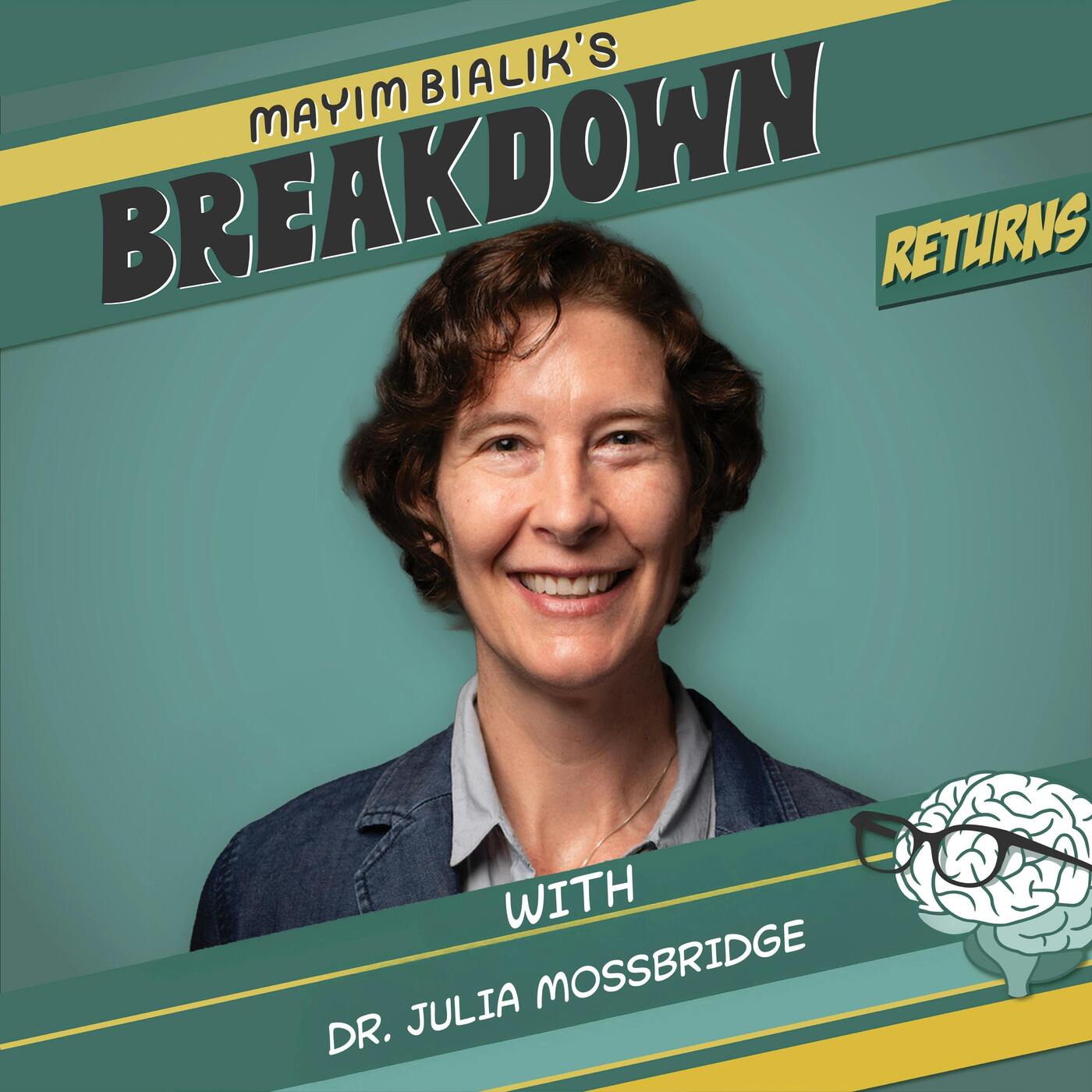
Mayim Bialik's Breakdown
Neuroscientist Dr. Julia Mossbridge: Was I a CIA Experiment? Remote Viewing, Missing Memories, and the Science of Psychic Abilities
00:54:35
Loading summary
Transcript178 lines
- [00:00]
Dr. Julia Mossbridge
How does one change things in the universe using one's conscious mind?
- [00:04]
Mayim Bialik
You say an informational only dimension exists outside of space and time.
- [00:11]
Dr. Julia Mossbridge
People ask me a lot about precognition and remote viewing.
- [00:14]
Mayim Bialik
What's the difference between remote viewing and thinking?
- [00:17]
Dr. Julia Mossbridge
If you're a gifted remote viewer and you're doing remote viewing for a defense contractor or intelligence agency, you're doing it because they've already used the analytic tools at their disposal and they know what is predicted by the past. You're doing remote viewing because they want to find out if their prediction is any different from what is actually going to happen.
- [00:35]
Mayim Bialik
Neuroscientist Dr. Julia Mossbridge is a lead researcher for the telepathy tapes. She specializes in precognitive dreams, psi phenomenon, and remote viewing. She's here today to disclose the secrets that she's kept for decades.
- [00:49]
Dr. Julia Mossbridge
Back in 1981, 1982, they were testing lots of kids and then I was one of the singled out. I had no behavior issues, but I had a counselor. For some reason, I would dread walking to her office as soon as I close the door. I don't remember a single thing that ever happened.
- [01:02]
Jonathan Cohen
Tell us about the pink drink.
- [01:04]
Dr. Julia Mossbridge
I don't know if that pink drink was an amnesiacic or if it was mixed with some kind of iodine to help protect us from radiation or if a little bit of radiation could cause psychic capacities.
- [01:13]
Mayim Bialik
It's also possible that whatever was happening, you did not want to remember.
- [01:17]
Dr. Julia Mossbridge
Intelligence and defense in the US realized they needed to study the effects from all the nuclear testing from computer screens, cell phones.
- [01:26]
Jonathan Cohen
Is radiation creating psychic people?
- [01:28]
Dr. Julia Mossbridge
There's two things we need to do before the end of this podcast. One is to talk about what I'm doing with the non speaking autistic that I've been studying. But two, we need to get your target for your remote viewing.
- [01:44]
Mayim Bialik
Hi, I'm Mayim Bialik.
- [01:46]
Jonathan Cohen
And I'm Jonathan Cohen.
- [01:47]
Mayim Bialik
And welcome to our breakdown.
- [01:50]
Jonathan Cohen
I just give up.
- [01:52]
Mayim Bialik
We're going to start this episode with us giving up. Why? We had a really, really unique opportunity to have a guest that we've previously had on visit us in person.
- [02:03]
Dr. Julia Mossbridge
And.
- [02:03]
Mayim Bialik
And the conversation goes from neurodivergence to
- [02:09]
Jonathan Cohen
special abilities to mime, learning how to
- [02:13]
Mayim Bialik
remote view how love is the universal answer to really what ails us.
- [02:21]
Jonathan Cohen
And if that sounds flaky to you, we give a practical explanation of how to incorporate this into your specific life to change your circumstances.
- [02:31]
Mayim Bialik
She's speaking for the very first time about a series of experiments, some of which she remembers, and some of which she mysteriously does not remember. That may have been a government attempt to understand the impacts of certain chemicals on the human nervous system. She's going to talk for the first time with us about why she chose to disclose this and what it means for all of us and our safety.
- [02:51]
Jonathan Cohen
This episode explores how to increase your own intuitive ability. If you can actually start to practice remote viewing and. And what constitutes a precognitive dream, you may be having them.
- [03:05]
Mayim Bialik
We also are going to talk about the telepathy tapes. Who's the person who can talk about all these things? I will tell you right now. It is neuroscientist Dr. Julia Mossbridge. She's written a very, very, in her own words, weird and intriguing book called have a Nice Disclosure. She's a cognitive neuroscientist, an author and educator. She studies, in particular, exceptional human performance. We've spoken to her about precognitive dreams, about premonitions. She's the human potential research lead for the telepathy tapes and an affiliate professor in the department of biophysics and physics at the University of San Diego. She's also the founder of the nonprofit the Institute for Love and Time. And a really, really exceptional mind and someone who balances the right brain, the left brain, and everything literally in between. We're so excited to have her in person. Welcome in person to the Breakdown. Julia. Break it down. We consider you a friend of the podcast and a friend of kind of all things in our universe. And having you physically in our universe is really very special.
- [04:09]
Dr. Julia Mossbridge
I feel the same way. I'm really glad to be here.
- [04:11]
Mayim Bialik
I just found out that the last time we spoke, who did you think I was?
- [04:17]
Dr. Julia Mossbridge
I recognized you. So I assumed when you told me that you were in the Vagina Monologues.
- [04:22]
Mayim Bialik
It's not usually what I lead with.
- [04:25]
Dr. Julia Mossbridge
In Chicago. I was like, oh, my lesbian moms took me to go see the Vagina Monologues. I must have recognized you from that because it was quite a moment where these vaginas were talking.
- [04:36]
Mayim Bialik
Yes, well.
- [04:36]
Dr. Julia Mossbridge
And you were one of the vaginas.
- [04:38]
Jonathan Cohen
I mean, I didn't even know that she was in that. So that's a deep cut.
- [04:41]
Mayim Bialik
It's a play, and there are three women on stage. And I did a run of this play. So that was in Chicago.
- [04:47]
Dr. Julia Mossbridge
Yes, Right. So I'm like, wow, I can't believe I remembered that because I have such a bad memory for faces that I was like, wow, I'm very impressed. Somehow that must have made a huge impression on me. Because I knew that you seemed so familiar. And then after I was done talking with you and I told my husband about my day, and he's like, what did you do today? And I said, I had this conversation with this woman, Mayim Bialik, and she's like, oh, you mean like from Big Game?
- [05:08]
Mayim Bialik
Big.
- [05:09]
Dr. Julia Mossbridge
Big Bang Theory. And I was like, oh, she was in Big Bang Theory? Because I'm so bad with faces. I'm just not good with that.
- [05:17]
Mayim Bialik
I look at people's energy, my voice. You didn't think like that sounds like that lady who was on the Big Bang Theory for nine years.
- [05:24]
Dr. Julia Mossbridge
I knew that I knew you, and you're familiar, but your way of being. I mean, like, actually for a neuroscientist, like kind of an amazing actress, your way of being on that show, it wasn't just being yourself.
- [05:35]
Jonathan Cohen
You have a lot less hand and arm movement as Amy than you do as Mayim.
- [05:40]
Mayim Bialik
I will sometimes be in the supermarket and someone will come from the next aisle and be like, I heard your voice and I knew that you're Amy Farrah Fowler. So I was filming this movie, this Jim Jarmusch movie called Father, Mother, Sister, Brother. Highly recommend people see it, but I was filming in a very small town in New Jersey, and it was a part of New Jersey that might as well not be New Jersey. Like, when you think of New Jersey, think like, hey, forget about it. That was not what was happening. I was in a very lovely log cabin on a frozen lake. It's a one stop light town. And I stayed there for the duration of the filming. And they would shuttle us to wherever we were working that day. But I had my local market. It was literally one intersection, this town. So I had the supermarket and I had the Thai place I went to, and there was a pizza place, but they didn't have gluten free whatever. There was a Walgreens. And you know, sometimes when you're like living somewhere for six weeks, you need makeup remover, you need cotton balls, whatever. So I go there and this woman behind the counter recognized me, but this is the way she recognized me. In a very small voice. She looked right at me and she said, amy. And it was not sexual, but it was an intimate whisper. And I didn't know what to say and I just said, yes. And then I bought my cotton balls and I left. But she looked very startled.
- [07:05]
Jonathan Cohen
If you're listening and you happen to see Miam, I think that is the new greeting.
- [07:09]
Mayim Bialik
But also just the marvels of the English language that all it takes right, is a slight inflection to communicate. Are you the person who played Amy on that TV show?
- [07:19]
Dr. Julia Mossbridge
See, I'm such the opposite of this. So because I have a really crappy ability to recognize people's faces clearly, I don't. I don't get starstruck ever.
- [07:27]
Jonathan Cohen
Right before neurodivergence, I'm gonna tell a story that happened to me recently. I was, I don't know, at least 75ft away from someone who had their back to me, and they were sitting at a coffee shop. And this person never crosses my mind randomly, but I look at this person, the slouch of their shoulders, the curve of the back of their head, and I turn to my son.
- [07:50]
Mayim Bialik
I said, that's very specific.
- [07:52]
Jonathan Cohen
That's John Malkovich. And, like, he's not someone you see around. We get closer, it turns around. It's John Malkovich sitting in a coffee, like, on a patio. And I'm just, like. Just kind of a little shocked, a little struck. I'm more struck that I clocked the back of his head in the roundness of his shirt.
- [08:13]
Dr. Julia Mossbridge
I'm impressed you remembered his name. I would have been like, oh, that's the guy who does the thing. But this is neurodivergence. What we're talking about right now is neurodivergence. Like, I really do have this thing where I'm really friendly to people because it's possible I know them. And so I'm just like, hey, how's it going? Because they could maybe not be a stranger, because maybe I don't remember their face.
- [08:33]
Jonathan Cohen
I had an interaction. I went to get a cup of coffee, and I had, like, a big mug of coffee, and Archie had climbed into the front seat, and he's, like, muddy from the park. So I'm annoyed, and I put the coffee on the top of the car, and I'm, like, luring Archie into the back seat. And then I get into the. My. My driver's seat, and. And I'm about to drive away, and this guy who I know, we've had him on the podcast, comes running towards me. I'm like, oh, he's excited to see me. It turns out that my coffee is on the top of the car, and he's, like, saving it. And I'm starting to interact with him in a very friendly way because I'm excited to see him. It's clear to me after that interaction, he has no idea who I am.
- [09:10]
Dr. Julia Mossbridge
And now, you know what he would do if a stranger had coffee on their Riff and was driving away. Right? It's the test of the Good Samaritan.
- [09:15]
Mayim Bialik
Neurodivergence is one of those things that feel, feels a little bit like, you know, the very famous description of pornography. It's kind of hard to pin down, but you know it when you see it. Right? One of my concerns and one of the things that we've talked about here is if everyone is neurodivergent, then no one is neurodivergent in terms of, there's this notion when we're kids of like, you're special, you're different, right? To what level do we want to be different? To what level do we identify as being different? And then to what level do you. Do we all realize that if everyone is slightly different, what is the nomenclature that we're trying to use?
- [09:51]
Dr. Julia Mossbridge
So as you know, there's no such thing as a neurotypical brain. Like what actual brain are you pointing to? It would have to be one brain because brains are so different between. There's so many inter individual differences between people. How different brains process things. So if you're saying someone is neurotypical, there has to be like one person who's neurotypical.
- [10:10]
Mayim Bialik
What a lot of kind of morphological studies do though, is they take a statistical representation of brains and they kind of massage them together. And this is, you know, when I worked in neuroimaging, this is what we did. If we're looking at, you know, an autistic brain versus a non autistic brain, I'll just use really simple terms. What we'd say is, statistically speaking, if we have, let's say, an encyclopedia of a thousand brains that are not autistic, we are more likely to see XYZ and ab, you know, through X, Y and Z, we're more likely to see these things. And so what can we isolate?
- [10:48]
Dr. Julia Mossbridge
How useful are those studies? So people do those studies, they're trying to get rid of those inter individual differences or massage them out by having either a large population or people who they think are, well, selected to be very similar. And then the conclusions from those studies inevitably end up being, we saw this area light up and this area didn't light up as much as in this other control group among this population. And then you're like, okay, and then you're back where you started. So it just, it feels to me like those studies are not actually so helpful. It's almost like the new phrenology, you know, in the old days, the map of the head and like different areas. Oh, you must be really, you know, visual if the back of your head is really big where the visual cortex is, but it feels like that's all you get. They don't go very far in helping explain what is the reality of inter individual differences. When you look at actual behavior and perceptions of people, what you end up getting is this incredible mix. And so when I'm talking about pointing to neurotypical, I mean, what is the brain of the person who behaves and perceives in some kind of typical fashion that we want to sort of canonize as this is the way a normal brain is?
- [12:00]
Jonathan Cohen
This episode is sponsored by Wandering Jews, an open door media brand.
- [12:05]
Mayim Bialik
If you've ever found yourself feeling like you have more questions than answers, you're in good company. The Jewish people have been like that for thousands of years. Wandering Jews with Michal and Noam is a podcast where two of today's most dynamic Jewish voices, Michal Bittone and Noam Weissman, dig into the biggest questions about life through a Jewish lens. It's the kind of conversation where you'll laugh, learn something new, and probably shout in disagreement at least once. Michal and Noam tackle the tough topics like anti Semitism in America, what happens after we die, and the future of religion with guests like Bret Stephens, Michael Rapoport and Sarah Hurwitz. And this past month, in honor of Jewish American Heritage Month, they've been celebrating some of the Jewish lives and institutions that have shaped American life, from food to music and comedy. Thoughtful, joyful and always honest. That's Wondering Jews with Michal and Noam, a production of Unpacked. Find it on your favorite podcast app or or on YouTube and make sure to hit subscribe. Check out Wondering Jews with Michal and Noam podcast and subscribe at Unpacked Bio nmx.
- [13:07]
Jonathan Cohen
My mbialix Breakdown is supported by bioptimizers.
- [13:10]
Mayim Bialik
I struggled to get good quality sleep and I just thought like ugh, it's stress. But I learned during perimenopause and menopause your hormones shift and it affects your magnesium levels. Low magnesium makes everything harder. Not just sleep, but focus, mood, stress, tolerance. That's why we added Magnesium Breakthrough by Bio Optimizers to our nightly routine. It's a blend of seven different forms of magnesium designed to support relaxation and overall sleep quality. Try it. See if you wake up more rested and refreshed, you've got nothing to lose and a lot to gain. BioOptimizers offers a 365 day, no questions asked money back guarantee. Magnesium Breakthrough is a fantastic way to improve that hormonal imbalance that especially happens with magnesium. And then you have better focus, you have better sleep hygiene in general. Bioptimizers makes it so easy. Here's what you get when you go to bioptimizers.com breaker and use the code breaker. 15% off your entire order and a free bottle of Mass Zy, that's Bioptimizer's bestselling digestive enzyme, added to your order automatically when you use our exclusive code. That's a $20 product, free on top of your discount. This is a limited time offer. While supplies last. You cannot get this on Amazon. You can't get it in stores. The offer exists in one place. Our link, our code, that's it. So if you were already thinking about trying it, this is the sign. Go to bioptimizers.com breaker use the code breaker. Grab it before it's gone.
- [14:35]
Jonathan Cohen
Make 2026 the year you finally start
- [14:38]
Mayim Bialik
sleeping again for all of these things. And I think part of, you know, what the telepathy tapes has taught us is that individual stories matter, individual experiences matter. The, you know, the, the variety of near death experiences we've spoken about here, the variety of transcendental psychedelic experiences that we've had, you know, those provide information. But I do think that there's something very interesting, especially among young people with a desire to have a label. And the irony is if you're all labeling yourselves different, then you're all the same different. And when my kids were little and lots of young kids were having these like really shaggy long hairdos, we kept giving our kids these like conservative like John F. Kennedy haircuts, which they seem to like. And I remembered thinking like, will there be some revolution where all these shaggy haired, you know, rough again kids will all have haircuts like my, you know, JFK children. But the idea was by trying to be so different, there is often this kind of ricochet back. We're not seeing that in conversations around neurodiversity though. I think we're seeing more and more levels, right, of difference. All these overlapping layers of trauma of, you know, all these things.
- [16:01]
Dr. Julia Mossbridge
I'm excited about that partly because like you, I'm a Gen Xer the Gen X world. We sort of said like, labels are horrible. That's putting yourself in a prison and just be free and do your thing. But labels end up being useful. So there's a tension here in the generations because labels end up being useful when you can use them to be free. In other words, there's so many different labels that it's like saying my label is Julia.
- [16:27]
Mayim Bialik
Right?
- [16:28]
Dr. Julia Mossbridge
And your label is Mayim and your label is Jonathan. And that's where I think the neurodiversity movement is headed. And then in terms of neurodivergence, people tend to use that as code for like extreme neurodiversity or autism often. And the concern there is people who need resources because not only are they neurodiverse, they're functioning differently in a way that society does not support. If you can't take care of yourself so that you can hold down a job, these are things that society sort of says, whoops, that's a big problem.
- [17:00]
Mayim Bialik
If you can't write like other kids
- [17:03]
Dr. Julia Mossbridge
write anything that makes it hard for the way society is working now to, to achieve in that independently. There's a big, you know, in the western world where like independence, if you can't be independent, then that there you need more resources. And if you end up taking away those resources by saying everyone is different and you know, we're all just a
- [17:23]
Jonathan Cohen
little different if you separate those people who need a label or diagnosis to qualify for help. Let's just remove that for a second. What we're starting to see more and more is everyone saying everyone is a little bit different. And I want to understand what my difference is. What is my collection of skills, abilities, deficits so that I can identify as whatever I am.
- [17:46]
Dr. Julia Mossbridge
Right. And when you're doing that, you're comparing yourself to some kind of a norm. And my question is we need to talk about what that norm is because that norm may not be a well functioning person.
- [18:00]
Jonathan Cohen
I would agree with that because a lot of the typical people I see have like other deficits that are just not prioritized as things that society has identified as things that they should be able to do.
- [18:12]
Mayim Bialik
I think everything you're saying is valid. It makes a lot of sense. There was a report about incoming first year students to colleges and one, I will not name it, one very, very prestigious university had 40% of the incoming class claiming they needed extra time and they need a lot of accommodations. Now that may in fact be true. However, what happens, and this is what's happening in high schools and then it's happening in junior highs and it's happening in elementary schools and it's even happening in preschool. The year that many of us weren't even raised to think you had to be in school is that we keep kind of moving the bar so that we keep sort of redefining what accommodations look like and of course there's gonna be things that fall through the cracks. And, you know, in many cases, I don't know, maybe kids need mental health support. Maybe they need lifestyle tips. Maybe, you know, I mean, I hate to say it, but, like, caffeine intake, ultra processed food intake.
- [19:15]
Dr. Julia Mossbridge
I completely agree. And I. And I think that you might be mishearing what we're both saying. Or at least what I'm saying. Probably what we're both saying. Which is. Which is that when you're comparing, when you're saying, I'm neurodiverse, I'm different from the norm, the neurotypical. If we don't describe what neurotypical is, then everyone's gonna say that. But if neurotypical is like, guess what? If you're neurotypical, you're. You're going to not be able to focus when you're drinking, you know, a lot of caffeine and sugar. You're not. And if you're on your phone all the time, your attention span's gonna go down. Like, we don't talk about the cognitive drain that our society creates by just being our society and the technology, processed foods, all that stuff. You could be different from the neurotypical in a way that's, like, really helpful and powerful.
- [20:06]
Mayim Bialik
Well, and also, Jonathan sometimes makes me feel bad for the fact that, like, I read, spell, take tests in the time allotted. When I'm given a task, I do it, and he's like, oh, it's so conformist.
- [20:20]
Dr. Julia Mossbridge
Okay, that's super interesting. I'm the same way. But I like, we're both really good
- [20:23]
Jonathan Cohen
students, in her words. I think quirky nerds help the world go around. They keep all the trains on the tracks. They think about things. They help take big ideas and ground them into actionable tasks.
- [20:37]
Mayim Bialik
We take tests in an hour.
- [20:39]
Dr. Julia Mossbridge
We can also do things like, someone says, this needs to be done, and we go, oh, okay, we'll do the thing.
- [20:45]
Jonathan Cohen
Super, super helpful.
- [20:47]
Mayim Bialik
Instead of, like, what if we created a new way to say the word thing?
- [20:51]
Jonathan Cohen
The power that she has in her quirky nerdum being so tied to the exact word makes it difficult for her to understand some things that are seemingly obvious to people who operate with a little bit more abstraction.
- [21:08]
Mayim Bialik
So who's neurodivergent, though?
- [21:10]
Jonathan Cohen
Well, it's just a different side of a spectrum. And both of those skills are highly valuable. And when we know that about each other. Correct. Utilizing them together.
- [21:19]
Mayim Bialik
And also, there's things about me that seem very, very special. Needs that you're like, how do you even function?
- [21:25]
Dr. Julia Mossbridge
I mean, every single person who got a Ph.D. survived a lot. And there's abuse and there's all sorts of crap like people taking you for granted and blah. So you survived a lot. Other people go through things and they survive a lot. They get PhD level experience in whatever they're doing. And so the problem I have with saying everyone's neurodivergent is that it's just the same thing as saying everyone has special, special capacities. Why don't we look at this in a. In an extremely positive way and say each person has gifts, each person's cognition is different, Each person can fill in a hole or a blank in the society where their own needs are, are. Are actually celebrated because they're exactly what's needed in that moment. The person who thinks slowly and processes slowly is very helpful when there's a bunch of people running around saying, we have to do this right now, and then someone's saying, like, give me 24 hours and I will tell you the big problem with this. On a team, you need all those people. So I kind of think we need to think about it, like, what are your gifts? Your cool abilities, as Vint Cerf would
- [22:28]
Jonathan Cohen
call them, and how do you match those and understand those? And how do you understand the other people around you so that you're not constantly saying that they're wrong? How we perceive information, what our skill sets are, impact, how we interact both with other people, but also with ourselves. And the book that you've recently written talks about this notion of disclosure, but also disclosure to oneself.
- [22:55]
Dr. Julia Mossbridge
Big deal.
- [22:56]
Jonathan Cohen
So when I heard that, I thought a lot about revelations I've had. And it could be like, oh, my God, I never realized this about myself, whatever that might be. How much of that I already knew, but I had compartmentalized or blocked off from my conscious awareness. Like, it sounds like we are all on a process of uncovering information about ourselves that we may already know about
- [23:23]
Dr. Julia Mossbridge
or we may not. And both of those things are true. Yeah. And so it's this discovery process, not just what's in the unconscious mind, but what's in the conscious mind but isn't framed in a way that you can understand. You know, to understand something, you really. I love the word understand because you literally have to kind of be a foundation. You have to stand under the piece of knowledge and be like, wait a minute, where does this fit? Almost like you're fitting a brick into a keystone into a building, you know? And so to understand these parts of ourselves, we need to fit them in some framework where we say, oh, I see, this ties to this and this ties to that. Otherwise they're kind of just free floating things. And as I write about in the book, and we can talk about whenever you want to talk about, there are pieces of my life that I did not understand until going through the process of writing the book and talking to people about the process of disclosure. And then I was like, oh, wait a minute, now I understand some things about myself. Turns out the book was working on me, which is when you know you've actually written something useful because it had an impact on you.
- [24:30]
Jonathan Cohen
Where I see a lot of this type of disclosure, personal disclosure happening is when people are trying to understand the relationship with their parents, right? They're like, oh, this happened in my childhood and I really never. I had a bad feeling about this. And I'm not talking about outright abuse, although it may include that, but it may just be like a dynamic or an interaction or, you know, my mom or dad always interacted with me in this particular way. And they'll say that and they'll have it in their knowledge, but then one day they'll be like, oh my God, I didn't realize that that pattern of conversation has made me defensive in this particular way and interact with everyone around me in this other way. And so they're aware of it. But when you talk about understanding it, it's like it integrates for them in a totally different way all of a sudden. And it changes their understanding of it
- [25:18]
Dr. Julia Mossbridge
and it changes your behavior. So like an example from growing up is a really simple example. My mom grew up in a family of eight people with a dad who was itinerant and who come and go. And she had two disabled siblings. And it was a rough situation, very poor family. No one was college educated. And so one experience that I had as a child growing up is we would go to restaurants, they would never have enough food. My mom. So we would go to restaurants. And my mother was so intensely focused on the food and so intensely focused on the service because she wanted people to bring food to her. You know, like this was the deal. She had enough money now that people would bring food to her. And it better be, the soup better be piping hot. Everything better, better be exactly right because. And my role was to like, be nice to the waitress because holy crap, my mom's like a monster. She's like, this isn't hot and da, da, da, da. And so I'd be like, oh, hi. You know, sort of just like, make nice. Make nice. Make nice. Because I'm sort of embarrassed, but also, like, that's what I have to do. And when I realized as an adult, Maybe in my 30s or 40s, it took before I said, oh, I'm a make nicer. I cover over people's sort of bad behavior and make sure that everything's okay. And I don't want to do that anymore.
- [26:33]
Mayim Bialik
You're a peacemaker.
- [26:33]
Dr. Julia Mossbridge
Yeah, yeah, the peacemaker thing, which ends up creating horrible boundaries where you decide it's your job to. There's a wonderful book called the Super Helper Syndrome. And it's your job to fix all the things, because people that you can't control, who you rely on for your life, are damaging things.
- [26:52]
Mayim Bialik
That's the Enneagram 9 for those Enneagram fans out there.
- [26:55]
Dr. Julia Mossbridge
By the way, I am an enneagram9.
- [26:57]
Jonathan Cohen
This leads us to a theme on the podcast, which is, does that type of upbringing make you highly observant to your surroundings because you have a coping mechanism? Is that all it is? Or is it that you do that and that opens you up to the ability to have extra sensory experience?
- [27:22]
Dr. Julia Mossbridge
There's no difference between those two things.
- [27:24]
Jonathan Cohen
So there's, you know, some people say a line, right? They're like, oh, we talk a lot about intuition. We talk a lot about consciousness outside of the brain. We talk a lot about developing premonitions, which we spoke about in our last episode. We talk about the CIA as it relates to building experiments to develop extrasensory abilities and even apply them to law enforcement. And some people are like, actually, none of that is real. All it is is just being slightly more aware of people's tics or tendencies because you have this protective streak. How do you parse those two things out?
- [28:02]
Mayim Bialik
Also, and please clarify, when you say there is no distinction between those two, are you saying there's no distinction for you or in general, there are no distinctions between those?
- [28:11]
Dr. Julia Mossbridge
I'm saying, for me, there's no distinction between unconscious processing of information that comes in and unconscious processing of information that comes in from non local sources. So it's all unconscious processing of information that comes in. I also believe that, in fact, everyone has unconscious processing of information that's local. So things that you hear in the environment that you just unconsciously suppress, things that you see in the environment that you unconsciously suppress. And your brain is doing, you know, something like 3% or less of what we're processing actually comes to consciousness. So your brain's doing that all the time, making decisions about what to do, what to say, et cetera, based on all these unconscious cues. And we don't have to think about psychic stuff for any of that stuff. That's just traditional neuroscience and psychology. Right? And one of the pieces we know, I mean, at least I know from the experiments I've done and from literature I've read from other people. Unless everyone else is lying, I know I'm not lying, that you get information also in that same way that comes from non local sources. By non local sources, I mean sources distant in space or time, in the way past, in the way future, or you know, way over there mind.
- [29:20]
Jonathan Cohen
Bialix breakdown is supported by bioptimizers.
- [29:23]
Mayim Bialik
You know, I struggled to get good quality sleep and I just assumed it was stress. But as I learned during perimenopause and menopause, your hormones shift in a way that affects your magnesium levels. And low magnesium, it makes everything harder. Not just sleep, focus, mood, your tolerance for stress. That's why I have added Magnesium Breakthrough Bye bye Optimizers to my nightly routine. It's a blend of seven different forms of magnesium designed to support relaxation and overall sleep quality. Try it. See if you wake up more rested and refreshed, you've got nothing to lose and a lot to gain. BIOptimizers offers a 365 day, no questions asked money back guarantee. Magnesium Breakthrough is a huge breakthrough to improve hormonal balance, to help with focus, decrease brain fog, improve sleep hygiene. Overall, Bioptimizers makes it very easy. Jonathan, what do they get when they go to bioptimizers.com breaker and use the code breaker.
- [30:15]
Jonathan Cohen
You get 50% off your entire order and a free bottle of Massymes.
- [30:19]
Mayim Bialik
Bio Optimizer is best selling digestive enzyme that'll be added to your order automatically when you use our exclusive code.
- [30:25]
Jonathan Cohen
That's a $20 product, free on top of your discount already.
- [30:30]
Mayim Bialik
This is a limited time offer and while supplies last, you can't get it on Amazon, you can't get it in stores. This offer exists in one place. Our link, our code. That's it. So maybe you were already thinking about it. This is the sign. Go to buyoptimizers.com breaker use the code breaker. Grab it before it's gone. Make 2026 the year you finally start sleeping again. We all are aware of the space that we are in in theory, right? We're in this sort of plane of three dimensions, right? It goes this way and that way and this way. And then there's a passage of time that we are Also aware of, right. We're having this conversation in a very, very small piece of time. If you expand out though, time is this other dimension that gets added to space and time. But what you talk about is an informational only dimension that exists outside of space and time. And what you say is that information is not equivalent to matter or energy, though matter and energy can carry it. This information doesn't have to play by space time rules. It probably has its own dimension with it with its own rules. And these intersect with space time rules. So what is this informational dimension? Can we grock it, you know, can we fathom it, can we understand it? Or does it live in a sort of out there space?
- [31:51]
Dr. Julia Mossbridge
I'm interested that I use the word informational dimension. I'm ambivalent about the word dimension, but I think I use it there just to communicate something. So dimension makes a lot of sense when you're thinking about space. Even when you get to time, it starts to not make sense. Because in a dimension you can go in both directions. Right? Now, in time, people generally experience moving in one direction. But in physics, we actually have time reversibility. And so maybe you can get both directions there.
- [32:18]
Mayim Bialik
And anyone who's had a flashback, anyone who's done EMDR, knows that there is a way to place yourself in a different time that's different than just remembering.
- [32:28]
Dr. Julia Mossbridge
Well, yeah, and that's mental time travel. I call it time travel therapy. And I have this organization, the Institute for Love and Time that does that work. We talked about that last time I was here. But in terms of this information dimension, again, let's just say there's information space that intersects with spacetime. The rules of it are different because it's not a dimension. It doesn't have the spatial extent, it doesn't have any time related. If you could think about it as a bunch of ones and zeros, sort of metaphorically, although they're not like on paper or they're not in a computer, because that's tied to matter and energy when they intersect with space time. Now they're tied to matter and energy and we play with them with a computer, et cetera. But the idea is that that exists foundationally to the universe. So space time is built out of information. The ones and zeros are the substrate.
- [33:22]
Mayim Bialik
When we talk about consciousness being foundational and fundamental, right? That most of us think like, oh, the Big Bang happened at some point, not the show thing. And when the Big Bang happened, all of matter as we know it was created and, and then evolution started Happening. And here we are, right? That's like the simplest story. But what we're talking about is that there's some sort of dimension that pre existed. Right. That even pre existed.
- [33:53]
Dr. Julia Mossbridge
That.
- [33:53]
Mayim Bialik
And you know, there are mystical traditions, the Kabbalah being one of them. There are mystical traditions that talk about, like, you know, even if you read the first chapter of the Old Testament. Right. And I'm not saying that in the
- [34:04]
Dr. Julia Mossbridge
beginning was the word.
- [34:05]
Mayim Bialik
Correct? Correct. So there's words before matter and there's nothingness before somethingness, and it's void. Right. There's like a null. So the idea is not that, like the Bible is true. That's not my point. What I'm saying is that for thousands of years there have been traditions of understanding that there is something before the word something, there's mind, and that the universe has a larger consciousness, for lack of a better word, that generates the probabilistic situation out of which matter then arises.
- [34:39]
Dr. Julia Mossbridge
Beautiful way of putting it. And the way I think of it is the mom of the universe is the mind, and also the mom of the universe of space. Time is time, not space.
- [34:50]
Mayim Bialik
The dad comes home at 5 o' clock and needs his drink, and that's the space.
- [34:56]
Jonathan Cohen
You said people only process 3% consciously of what they're experiencing.
- [35:02]
Mayim Bialik
The brain is a processor, and it's mostly using all of its capabilities to filter. And it's constantly experiencing the universe. It's, you know, the number of, like, people think of, like, oh, not a lot of people, but if you want to think about, like, oh, there's the brain and there's the spinal cord, and then there's all my organs, and then here's my body, right? And then there's my mind. What's actually happening is that the brain was designed with fibers that run throughout your entire body that are constantly communicating information about should you fall off this chair right now? So I think what Julia was trying to indicate is that a very small percentage of what's going on in the processor is actually communicated and experienced.
- [35:47]
Dr. Julia Mossbridge
It's almost like your conscious experience is a movie that you're watching that your brain has set up. It's direct, found the actors, it's directed it, it's edited it, it's put it out there. And then you're like, wow, this happened to me.
- [35:59]
Jonathan Cohen
But this is perfect. Right? Because then the question goes to, if I do not like the movie that is being played, what are the options for me to change said movie?
- [36:10]
Dr. Julia Mossbridge
Yes. Okay, so let's talk about that. So I Wrote this article about. It's called 10 Questions for People who Create Minds. And it's about. For people who make AI because they're creating minds, potentially, if they're working with the informational substrate of the universe, they're playing with that without knowing it. Right? So the questions are about, like, how do you understand the subconscious? How do you understand the relationship between the conscious mind and the unconscious mind? The key question to answer what you have just asked is how does one change things in the universe using one's conscious mind? Because we have this experience that if we want to pick up this glass of water, most of the time are successful. We can't always control it. Sometimes we're not successful, and we slowly bring it to our lips, you know, and drink. And that if everything goes well, we're good. And most of the time, for most people who don't have apraxia, for instance, everything will go well. So what do you do? What are you doing with your conscious mind? Is it capable of even doing anything? Or is that part of the movie too?
- [37:13]
Jonathan Cohen
Because I don't want to increase my awareness of the part of me that is processing, not falling off the chair. That's not how helpful.
- [37:20]
Mayim Bialik
But if we want to loop this also back to the conversation about neurodivergence, Many people who fall somewhere on the spectrum of neurodivergence often report an inability to filter out things that other brains are filtering out. So if we want to talk about typical and neurotypical, right. Then we want to say, when we're playing pickleball and I get hit by the ball and I start shaking and crying, and I don't know why, I would like to have a brain that does not react that way when hit by a pickleball.
- [37:47]
Jonathan Cohen
For context, for people who don't weren't on the pickleball court, she got hit in her thumb, which got hurt in a car accident, which she nearly lost that digit. So I would suppose that she time traveled back to the injury of almost losing that digit and couldn't pull herself back into the current timeline.
- [38:09]
Mayim Bialik
When we're interacting in the world, trauma can interfere with your ability to filter. ADHD can change your ability to filter. Autism can change your ability to filter. And if you. If you examine what our culture has typically locked away, right, which is people who are mentally ill, especially people with schizophrenia, people who are schizoaffective. And we spoke to Sam Knight with the Premonitions Bureau. There have been times in history where people have said, maybe the things that people are saying when we lock them up might actually have substance. What are they experiencing? Because they cannot filter.
- [38:45]
Dr. Julia Mossbridge
Which all comes to when you're working with your own mind. And this is really what we have to work with. This is our tool for everything is our own minds. There's a couple rules, and one of them is you work with what you've got and you understand what you've got. And that little 3% or whatever percent that's conscious, but, you know, and that's what you can play with. And some things over time will become conscious and some things will sink back down into unconsciousness, and that will be hopefully for your benefit. And you can work with what you've got. And the way to work with that. The big rule there is love rather than judgment. And I don't care if you're autistic. I don't care if you're bipolar, schizoaffective, schizophrenic love, accessing universal love, almost thinking of it as a force in the universe, and then experiencing the unconditional love that comes from that really helps you work with whatever you've got.
- [39:41]
Jonathan Cohen
So two ends of the spectrum are those people who are overwhelmed with opening of the filter and those people who have the filter so tight that they're not experiencing anything beyond what the filter is providing. And both ends of the spectrum can
- [39:57]
Dr. Julia Mossbridge
be adjusted and you don't have much control over it. That's why it's tricky. So when we get into this, like, oh, how can we harness this? Which is always like, how can we harness it? It's like when you try to harness something, you're forgetting that most of everything you're seeing in the conscious world is a movie that's already been made. How do you convince the characters to do something different in the movie? You're watching the movie, they can't hear you. And so it's a tricky. So that's one of these questions for people who create AI. It's also a question for anyone who works in psychology is how do you use your consciousness to interact with the information substrate to change something?
- [40:39]
Mayim Bialik
There's a chapter called Coping Tools. And I really like this chapter because it talks about all the things that we do to try and function, which, you know, you say you lose yourself in the Internet or music or booze or drugs or sex or food. You make dumb choices, right? And when you talk about the way to change, the way to step out of some of these coping tools that you think are helping you, but part of you knows that that they're not. It often leads you to trouble, to complexity. You say that forgiving yourself, having this unconditional love for yourself and others is the language, right, that speaks to all of these parts. And unconditional love is like a human response to a natural force we can call universal love. And. And you talk about all of the things that happen once we kind of open up that portal. There's a little prayer. I wrote it. I called it a prayer actively hiding part, meaning if there are parts of us, right, that we know, we. We're trying to get at, please allow me to forgive myself. Please help me access universal love. I don't need to understand how or why it's been hard for me to do this. I just ask that I can do it now. Thanks. So I called this the universal love prayer. Because how many times do we say, I'm just gonna give an example. This person is bad for me, right? This relationship is hurting me. This person is hurting me. I know that they're hurting me. And I often have people like you have friends that come to you. Why do I keep doing this? I don't have the answer to that. Right. But there's something in the repetition compulsion that so many of us have. And yes, it's rooted in your trauma and it's intergenerational and blah, blah, blue. But what you present as part of a conversation about disclosing parts of you to yourself, parts of you to other people is this notion that love with a capital L is the. It's the goo, right, that's kind of holding everything together. It's the cytoplasm of our existence. And anybody who's been paying attention, right, should know every time we've spoken to a great theoretical physicist, anytime we've spoken to someone who's had a transcendental experience, a spiritual awakening, a deep communing with the universe. What. What people who die and come back, People who are declared dead twice, they come back. What is the message that they have been sent back to give us? Love, compassion, understanding, peace, no conflict. Don't sweat the small stuff, like, how many ways do we need to get the message from the universe, right?
- [43:31]
Dr. Julia Mossbridge
I love you for seeing that and saying that and really getting it. My experience is that people who are reading this book are getting it, and there's nothing more gratifying. I've read in other books. I never have had an experience where people are getting it. I want to go back with the love piece as a forgiveness coping tool that actually allows you to change love and forgiveness are obviously, unconditional love and forgiveness are intertwined to your little marriage spat about you should be different. So in your mind, each of you has a sentence that starts something like, if you adjust X, then I could love you more. If you would just be less precise with your language and understand this is a heart to heart connection. I would love you more if you would just understand that the precision of language is how I function. I would love you more.
- [44:21]
Mayim Bialik
And we can also be a little more generous if he would just stop drinking, if she would just stop shopping.
- [44:26]
Dr. Julia Mossbridge
Yes.
- [44:27]
Mayim Bialik
If he would just quit his job,
- [44:29]
Dr. Julia Mossbridge
if he would stop hoarding, she would stop talking to her friends. When it's late at night and I want to sleep. Whatever it is, there's a. Everyone has this sentence in relationships that I've. That are where people fight. And it's something like, if you would just. And what that is is a demonstration of conditional love. Because guess what? Very few people have had the experience of unconditional love. So that's why when. When mystics come and talk about that, or when physicists talk about that, when anyone talks about that, it's a rare treat because people don't really know what that is.
- [45:04]
Mayim Bialik
What is it define for us? Conditional versus unconditional love. Because people, I think, use it very loosely, which I don't like. You know, like, oh, I love you unconditionally. What does it mean?
- [45:13]
Dr. Julia Mossbridge
So there's two definitions. One is a definition that I used when I actually created an unconditional love assay, which means questionnaire that we validated for use in experiments so we could find out if people were feeling it. That's like a paragraph long and it's very precise. The shorter version of it, which is also precise but shorter. Having the experience of being loved and being able to love without needing anything to change anything. So it's not, as you can see, it's very opposite to if only you would blank, I would love you. Having the experience of being loved and being able to love without anything needing to change. I always say it twice because it's so radical, like, nothing needs to change here, right? Everyone's doing the best they can with the brains they got and the situation that they were born into. And love is the only thing that frees you from the jail of conditioning.
- [46:12]
Mayim Bialik
It frees you. You have the key to the prison that you are in when you hate someone.
- [46:19]
Dr. Julia Mossbridge
That's a prison that couples put themselves in, that parents and children put themselves in, that friends and family and people in the workplace put themselves in. And it's incredibly freeing. And I can't even tell you how productive it makes you. And I'm not saying I always feel it, but I'm saying, like, I am learning to feel it. I'm practicing it.
- [46:36]
Jonathan Cohen
I'm in 100% agreement. And we've talked about loving kindness meditations and how powerful accessing this force can be, even for yourself, where you're like, oh, I didn't do the thing. Okay, let me provide myself with love and acceptance instead of that voice that's going to beat myself up in order to get myself motivated to do something. And at the same time, how do you speak to those people? Maybe it's spiritual bypassing, who are like, I'm just going to have unconditional acceptance for myself even when my behavior is knowingly off track or out of control.
- [47:15]
Dr. Julia Mossbridge
Okay, this is a pet peeve. Unconditional acceptance is not the same thing as unconditional love. So you can unconditionally love someone and absolutely not accept their behavior. People can do it all the time.
- [47:25]
Mayim Bialik
I'm doing it right now.
- [47:28]
Dr. Julia Mossbridge
Wait, let's ask Mayim about that. Mayim, we ask you to put yourself in a place of unconditional love for
- [47:35]
Jonathan Cohen
Jonathan, whose questions are not organized by the document.
- [47:39]
Mayim Bialik
Yeah, so what it means is, and what I've been taught in many different sort of avenues around this is it doesn't mean that I have to accept unacceptable behavior. Right? Meaning you can unconditionally love someone and choose not to be with them. You could unconditionally love someone and say, for example, you are killing yourself with drugs, alcohol, food, sex, whatever it is. And you can say, that's what detaching with love means, which is part of the 12 step structure, this notion of, I don't need to change you, you can do whatever you want. And I then get to make a decision if I would like to sleep in the same bed as that, work with that, take a jog with that. With all due respect to all of our parents, many parents, even those who love us were not trained not at all into how to love us unconditionally. Meaning it's like, of course I love my kid, right? Everybody would say that. Of course I love my kid. But they really need to get their together. They really need to like study what I want them to study. They really need to cut their hair or whatever it is. Guess what? The message to a child. And I say this, you know, my. I have a 17 and 20 year old. I mean, I literally like from the time that they could comprehend, I was like, I don't know what I'm doing. Like, you know, like, good morning. I've never parented you today. What the fuck's going to happen? Like, something's going to happen today. It's going to be bad and you're going to be in therapy. It is that notion of like, I'm going to do the best I can with parents who did the best they could from parents who fled a country. You know, like, that's my story. Everybody's got a story and everybody fled somewhere. Everyone's got trauma. Ask Gabor, mate. Everybody's got some trauma that's living in the. It trickles down and I'm hard pressed. Like, the only time I'm going to go, full disclosure, full disclosure. The only time I have experienced and embodied unconditional love is in relation to God.
- [49:45]
Dr. Julia Mossbridge
People tend not to feel like they are even allowed to have a relationship with God because of the self judgment and stuff.
- [49:50]
Mayim Bialik
And also it doesn't need to be a religious experience. And I use the word God just because, like that is true for me. I could say it another way. The only unconditional love that I have experienced is from a connection with something greater than me in this universe.
- [50:03]
Dr. Julia Mossbridge
Yeah, well, that's where it all comes from. But by the way, then that, then that trickles into wow simultaneously if I'm unconditionally loved. When you're experiencing that in that moment, it's almost impossible to not unconditionally love other people.
- [50:15]
Jonathan Cohen
You mentioned the term hidden part. Let's unpack that for people.
- [50:21]
Dr. Julia Mossbridge
I'm curious about which of you is more analytical, but Mayim and I are similar in that we're analytical creative. We're both analytical creatives. So we're unusual as scientists because we're sort of artist scientists. And you're analytical in an engineering sense.
- [50:39]
Mayim Bialik
He wants to know how things work so that he can make them work better.
- [50:42]
Dr. Julia Mossbridge
That's what I hear all the time from you.
- [50:44]
Mayim Bialik
I don't want anything to be better. I want it to be the best that it is and keep doing that forever.
- [50:50]
Dr. Julia Mossbridge
Exactly.
- [50:51]
Jonathan Cohen
That is the best description of the two of us. And where we bump up against each
- [50:56]
Mayim Bialik
other in personality tests, it's like, are you interested in how things work? I'm like, the fuck no.
- [51:01]
Jonathan Cohen
She's like, I don't want anything to change ever.
- [51:04]
Mayim Bialik
As an actor. I've said this to directors when I've met like new directors. I'm like, I will give you a performance. You keep Correcting it until it's exactly what you want. And then I will give you subsequent takes that are that and better. Those are your choices.
- [51:23]
Jonathan Cohen
But that is iterative, and that is engineering, in a way.
- [51:27]
Dr. Julia Mossbridge
But she optimizes. But she. Her assumption of her. You're both optimizers, and I get it. But her assumption of optimizing is that you are actually going to say exactly what you want. And once you do, that's what you wanted. Jonathan, your deal is like, oh, I have now discovered a new thing. And you're like, but you told me a year ago this is what you wanted.
- [51:47]
Jonathan Cohen
This is so right. This is the rightest thing I've ever heard.
- [51:51]
Dr. Julia Mossbridge
It doesn't take a psychic person. It just takes a person who notices people. And I'm more like Mayim in this. I'm like, but I literally have the auditory memory of your precise words where you said this thing. And my job is to do the thing that people want. And I'm really good at that.
- [52:05]
Mayim Bialik
People can have a framework, right? That is so different, that this is where a lot of people bump up. This is where also a lot of people who are very obstinate, who don't want to engage with other people. It's like they have a very rigid. I think of, like, obsessive compulsive personality disorder. Different from obsessive compulsive disorder. People who are like, this is the way it needs to be. And this is neither one of us, I don't think. But I think of that extreme of someone who's like, I need everything the way it is.
- [52:32]
Dr. Julia Mossbridge
Can we do an exercise now where you two get to a place for unconditional love with each other? Because I think that could help also other people. So, like, could you take the. I don't care what example. The words aren't in the right place where you said they were, or whatever it is. Like, I don't care. Just something where, like, it's messy. It's not supposed to be messy. Whatever it is. And we go through that exercise, I
- [52:52]
Jonathan Cohen
have been noticing these patterns in the way that she thrives. And instead of seeing it as an attack, which I previously felt like the way that she was trying to operate was a limit on me being able to experiment and find those things. I really have shifted my belief to be like, oh, when she gets something, all she's trying to do is create the system to replicate and keep it at the level that we locked in on, which is such a valuable tool. And that was a big shift for Me, because my story is, and comes way before I ever met her, is that people are going to try to make me not be able to operate the way that I naturally operate. Therefore, I can't be myself. Therefore, in order to be in relation, I have to basically shut down how I function in order to be connected.
- [53:45]
Mayim Bialik
There was a book that was written, I think, like, how much of me do I have to give up for you to love me, or do I
- [53:51]
Dr. Julia Mossbridge
have to give up me to be loved by you? You both have this incredible access. So here are the strengths that are in this relationship. So to anyone out there who's in a relationship where they're struggling and they love each other, like that's clear, you love each other and you want to see this relationship work. Since you both have that basic capacity to say, yes, I want the relationship to work, then you can make it work. And so then what is needed is moving into this. What's true is you are a team, and a team needs people who think differently. This is back to why neurodiversity matters. What? You have to work with different capacities, and you also have different fears, Jonathan. Your fear is, I'm not going to be able to be who I am. And, oh, I noticed you're going to be hyper vigilant. Ooh, I noticed she's saying this and now she's not letting me be. And you're going to be hyper vigilant around, oh, you changed your mind. Because you clearly grew up with crazy making parents. You're both hyper vigilant around the problem that's going to occur, but at the same time, you're very aware she does
- [54:48]
Jonathan Cohen
not like when I change my mind. Even if that mind changing is totally justified and moving us towards a better direction, she would rather have a worse result.
- [54:58]
Mayim Bialik
That's 100% true. I'd rather burn the house down.
- [55:04]
Jonathan Cohen
And I'm like, we made the decision with the information that was available at the time, but new information has surfaced.
- [55:11]
Mayim Bialik
This happens to me even without another person. I have, you know, I have my older son move to college. So I've got this empty room. I've got an empty room in my house. Can't figure out what to do with it. And I was literally like, I need to sell the house because I can't figure it out. It's just gonna sit.
- [55:26]
Jonathan Cohen
She has no tolerance for the unknown. And I love the unknown because you're
- [55:31]
Mayim Bialik
always right in the unknown. That's why people like the unknown.
- [55:35]
Jonathan Cohen
I have to give a shout out to my Son's mom, my ex, she taught me that more information will be available in time. And I was desperate always to stop the unknown and find a solution. And I saw over and over and over again to all of my resistance, that that ended with a worse result.
- [55:56]
Dr. Julia Mossbridge
Always we try to foreclose on the future. And when people ask me a lot about precognition and stuff, I'm like, yeah, it's super interesting. We can get information and stuff, stuff. And then they say, oh, let's do it now and find out the answer now. And it's like, actually it can be helpful, but the same way it's helpful to have more information and in time more is revealed. And so it actually makes you have a different relationship with time where you realize time is your friend. And I am. I relate to your experience. So when I move into a new house, I literally, before I go to bed that first night, not only do I have to have everything unpacked, I have to have the pictures on the walls. Pictures on the walls. Because this is my home and it better be clear. Yeah, you know, I can't sleep otherwise.
- [56:38]
Jonathan Cohen
I'm good at unpacking suitcases, but I'm not good at deciding what something should be until I've lived in it a little bit.
- [56:45]
Dr. Julia Mossbridge
This is why we're going to do this exercise. The exercise is going to be supporting Mayim in building those two personalities in your own mind and not outsourcing. Because you need his ability to not foreclose on the future and to live with the unknown. And you also need your ability to say, you know, dammit, we're doing this and this. And like, we have to make a decision and action has to happen. By helping her with this exercise, you're also going to be building in your own mind the Mayim part. So, like, we all have to build these parts in our minds. The part that we have a deficit in is the part we're learning to build when we're with a new partner. Just like your ex partner helped you build this capacity. You're always working with what you have and where your deficits are. And if you can work in love, then it's just this playtime about, oh, that's number 23. You know, that's your problem. Number 23.
- [57:38]
Mayim Bialik
We're going to hit pause on our conversation right here. Part two is going to open with the remote viewing exercise that Julia is going to take me through, which we will reveal the results of at the end of the episode. So you don't want to miss Part two. We're also going to get much more into detail about her experiences in public school, the kind of experiments that were done on her, what she remembers, how she's tried to bring those memories back and what is stopping her. We'll also talk about practical ways to increase intuitive, psychic and precognitive abilities and how the telepathy tapes is potentially going to change the way we view not only our own cognitive ability but consciousness as a whole.
- [58:16]
Jonathan Cohen
Stick around for part two. Until then, join us on Substack Mind B Alex Breakdown on Substack to join the Breaker community and get content that is not released anywhere else from our
- [58:26]
Mayim Bialik
breakdown to the one we hope you never have. We'll see you next time.
- [58:29]
Jonathan Cohen
It's Maya Bialik's breakdown. She's gonna break it down for you. She's got a neuroscience PhD or two non fiction and now she's gonna break down so break down. She's gonna break it down.