← Mayim Bialik's Breakdown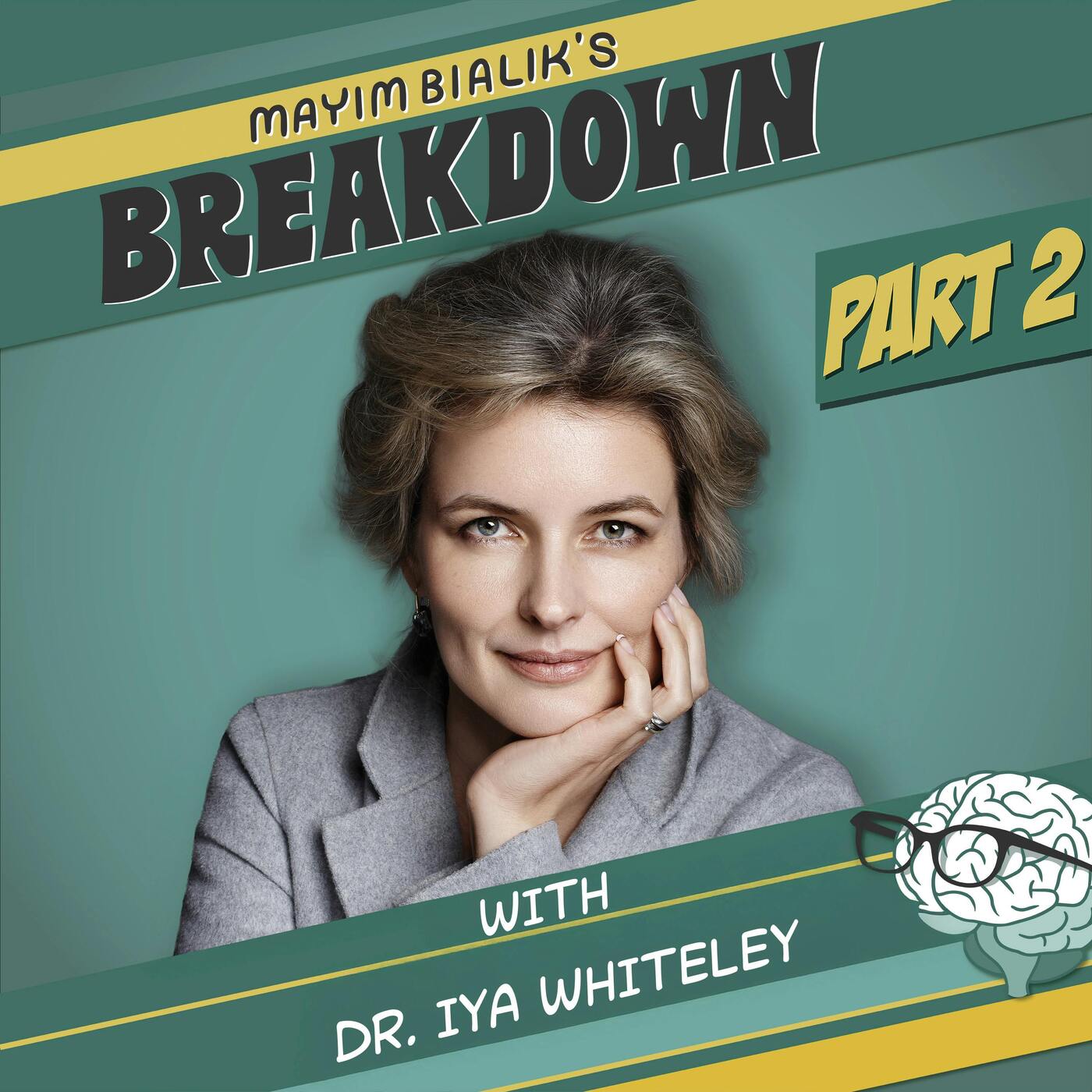
Mayim Bialik's Breakdown
Part Two: The Science of Messages From Your Soul: NASA Scientist on Telepathy, Mind Reading & What Astronauts Can Teach Us About High-Performance Intuition | Dr. Iya Whiteley
01:04:28
Loading summary
Transcript121 lines
- [00:00]
Jonathan Cohen
My Nbialix breakdown is supported by Helix Sleep.
- [00:04]
Mayim Bialik
Spring is in the air and so are all of the allergens that come with it. Spring allergens means you need more sleep, but there are a ton of factors that can prevent us from getting a good night's rest. Night sweats, back pain, feeling the person next to you when they roll over a million times. We were so excited to hear that Helix wanted to partner with us. I've had my Helix mattress for about five years now and I have been sleeping so much better. Jonathan and also our kids love their Helix mattresses and all of those issues. Night sweats, back pain, motion transfer. Those things are significantly better with a Helix mattress. Helix delivers your mattress right to your door which is so much fun. With free shipping in the US they have a 120 night sleep trial and limited lifetime warranty plus their happy with Helix guarantee. Rest easy with seamless returns and exchanges. The Happy with Helix guarantee offers a risk free customer first experience designed to ensure that you're completely satisfied with your new Mattress. Go to helixsleep do/breakdown for 27 off site wide. That's helixsleep.com breakdown for 27 off site wide helixsleep.com breakdown premiere hosts on VRBO deliver quality vacation rental stays with fast
- [01:13]
Dr. I.A. Whiteley
responses and clear instructions. Oh, I had a question, our host replied.
- [01:17]
Mayim Bialik
Super quick premier move.
- [01:19]
Dr. I.A. Whiteley
Wish I had a premier group chat.
- [01:20]
Mayim Bialik
They won't even write me back. Book a top rated stay with a premier host. If you know, give herbo. Hi, I'm Mayim Bialik.
- [01:31]
Jonathan Cohen
And I'm Jonathan Cohen.
- [01:32]
Mayim Bialik
And welcome to part two of our conversation with Dr. I.A. whiteley. She's got a PhD in cognitive engineering, has spent 25 years exploring human performance at the edge of capability. In part one of our conversation, we talked about what is unique about the performance levels of pilots and of astronauts, and what can we learn from their ability to direct attention and perceive things that many of us don't even even know exist? We also talked about heightened extrasensory awareness. We talked about synesthesia, spherical awareness, and intuition and telepathy.
- [02:07]
Jonathan Cohen
In part two we are going to cover synchronicity and coincidence, how it may be more than you realize, as well as a deep dive into family constellation therapy, where some unbelievable and profound changes happen right at the border of this world and the other. We see how intergenerational patterns can be passed down and broken.
- [02:32]
Mayim Bialik
Also, can you choose which child you get and communicate with your unborn child? Dr. Whiteley's going to explain how this can Possibly be. Here is part two of our conversation with Dr. I.A. whiteley. Break it down. What is coincidence? Because you've mentioned it, you know, a few times in different ways. Synchronicity, you know, can there sometimes just be coincidence? Because. And it could just be a different worldview. You know, I've definitely had instances. It happened just yesterday. Jonathan, I was thinking about your son and literally the next second you said, my son is calling. Let me call you right back. And I said to my son who was in the room, I was just thinking about Jonathan's son. And he called and my son said to me, no, I was thinking about his son. And I thought, what is happening? So my son was saying that he and I shared a thought about Jonathan's son. And then Jonathan's son called.
- [03:37]
Jonathan Cohen
And the question is, did you share a thought about him because he was about to call, or did your sharing a thought make him call me?
- [03:46]
Mayim Bialik
Did my son give me the thought about your son? Probably. Did I give it to him like, what's going on?
- [03:52]
Jonathan Cohen
I think he gave it to you because you're constantly scanning Fred to see what he's going to do. So I would more suggest that it was that way than him getting it from you.
- [04:03]
Mayim Bialik
But for me, I don't know that that changes my worldview. Meaning I think like that's a coincidence. But what. What is coincidence to you? And what would an expanded definition of coincidence be if we were in more of a dropped in place?
- [04:19]
Dr. I.A. Whiteley
Yeah, I like that. And there's a beautiful book and I don't think there's only one now, but I think it's called Synchronicities and coincidences. And there is types of them. I feel like we can almost expect them backwards or, I don't know, allow them to be meaningful. When we analyze our life path backwards or situation backwards. But the more we are open to say, and this is again going back to Aikido or hapkido, which is a similar approach, is that when we are open to options, we can see several paths. So it's like standing on the crossing. And then we are perceptive to the next clue that almost like a shortcut to whatever we want it to be. So it's having an intention, having a plan, doing an action, but not being set on the path. And then that coincidence happens, which allows us to say, I feel like it's the universe playing to see if we are watching. This is my take on it. And I don't have other words for it to explain it, but to me, synchronicity is like a coincidence. It's almost a discounting of taking the power out of it. But synchronicity to me is that things come synchronized with, I guess with our vibration, if you wish, with our expectation, with our mood, with our tone, with our perception. And then something opens up in the field. This doesn't necessarily explain the children calling in us knowing, but we are thinking of them in a sense that, I don't know, we had a closer proximity. And if you wish, if there was an electromagnetic fine tuning, maybe it's like,
- [06:34]
Mayim Bialik
you know, quantum particles, you're being appropriately evasive. But you know, I, I, I want to emphasize, you just mentioned, you know, a field, right?
- [06:45]
Dr. I.A. Whiteley
Yes.
- [06:46]
Mayim Bialik
You just mentioned thought having power right outside of it, existing in a localized place. Namely, this is what I'm thinking, right. What is that implication? And you know, don't be afraid to go there because Jonathan goes there all the time and I try and follow him, you know, what is the implication if thought is something that exists in a field?
- [07:11]
Dr. I.A. Whiteley
Yeah. So I don't have scientific explanation for it. So I can only talk about from experience and observation. And that's why I feel that our experience and applied research, which is what I'm interested in, is, is through observation, making a connection and allowing us to learn from it without explaining it too much. Because once we start explaining, we're losing the ability because our mind starts to doubt that it's not possible. So I allow for to say, well, when you last time were, you know, observing instruments, or when you were last time, you know, looking this way but felt it that way, you know, how did that feel? And you know, what action happened? And then bringing that into training situation and to construct similar possibilities where the people can learn the internal signals that, you know, you could call it synesthesia. Because sometimes people don't realize that they're synesthetes. Right. And they're like more than 150 combination of types of pairings that could happen.
- [08:22]
Mayim Bialik
More than 150.
- [08:23]
Dr. I.A. Whiteley
How? Yeah, I don't know. But if you go to the website for synesthesia, they say it's 152 or something. Last time I looked of what, what that could be, because it's not just two, you know, perceptual channels that they could mix. And if people have one type, they very likely to have other. So for example, we have a friend who is an absolutely magnificent and talented composer. And so he can see music. So he sees shapes and he sees colors and you know, what's coming first? The Music or colors or shapes as he's writing a piece can't be explained. You know, where does that come from?
- [09:15]
Mayim Bialik
Like, what is a symphony, right? Is it wavelengths? Is it like, what did it look like to Beethoven? You know, as you're losing your hearing and you're a composer, can you still compose? Right. Without your hearing? If you are seeing the music as it's evolving. I appreciate, you know, you acknowledging we don't have a scientific approach yet to be able to understand these things. But also, like, think about how many things that people thought, like germs, what. That doesn't exist. And like, yes, it does, right? So there's so many things. What would that look like? Also, if we do reach an ability to scientifically measure this, this kind of field, this, you know, difference in perception, it would be an enormous paradigm shift for the field of science in general.
- [10:02]
Dr. I.A. Whiteley
I agree. And that's why I thought. I thought to approach this from another perspective, from experiential. So we all, culturally, in every culture in the world, there is an example where there are, you know, women who support birth, for example. So we have doulas, we have people who. Healers, who people go to when they have nowhere else to go, you know, when the modern medicine doesn't give you an answer. But, you know, if you break a bone, you definitely want to go get an X ray and, you know, get a surgeon to. To look if they could, you know, put it right. But yet, for example, I'm very interested in Family Constellation. If you've come across that kind of.
- [10:57]
Mayim Bialik
Jonathan wants to talk to you all about it. Let's get into it. I. I'm just going to say right now, and I'll let you explain it. I don't want buy it. I don't understand it. I don't imagine. I don't even. I can't imagine a world where Jonathan's talked about it. He's like, well, this person pretended to be my father. And I got out all the things I needed to say. It would never work for me. Tell us about Family Constellation therapy.
- [11:24]
Jonathan Cohen
Also, just for context, I've explained it to her 16 different times. We've spoken about it on the podcast. No, she still has no concept. I've invited her to join me. She's like, I would. I can't go. Because until you experience it, it's very hard to imagine it. And once you do experience it, and this will make sense to anyone who's listening once you explain it a little bit more. But until you become a representative in A constellation. And you step into the role of whatever family system the person receiving the constellation is having. And all of a sudden you don't know anything about the person in front of you. And yet you feel so intensely in your body emotions and. And visceral sensations that you couldn't possibly make up because there's no context for which to make them up. All of a sudden, the veil between the known and the unseen is so thin that it's frightening.
- [12:24]
Mayim Bialik
It is frightening that I will agree with you. It's frightening. Let's let Dr. Whiteley explain it.
- [12:31]
Dr. I.A. Whiteley
Absolutely. So I came into it. I'm always interested in how healers work. You know, what is it, how do they intuit and why There's a cue and people report being well. And, you know, I was growing up and my mom took me to all the healers that there were. She for some reason thought they absolutely need to be healed and that I was frightened, that I was frightened by a dog and perhaps I was, you know, cured of that. I don't know. But, you know, it's sort of the belief is that if the child is frightened, it will have an effect on them down the line. And so I have come across, you know, all sorts of. Usually it's women and elderly women and sometimes they were not, you know, I guess not that elderly. Looking at it now from my position,
- [13:21]
Mayim Bialik
they were 35, which seemed ancient at the time.
- [13:24]
Dr. I.A. Whiteley
Yeah, totally.
- [13:26]
Mayim Bialik
And.
- [13:27]
Dr. I.A. Whiteley
And. But they always. I felt something. I felt something being in their presence. And they would. And they would be whispering and I would always be listening to what are they whispering? Like, what is this? And a lot of the times they would be whispering about like, let's say as the sunrise will set, as the sun will rise, you know, something will happen. And as the sun will set, that will dissipate or something. As the river flows, it will clear, let's say, you know, just almost like attaching the symptoms to nature. And I came across this not once, and I was, you know, curious about it and like, but it kind of remained as that. And so about. Is it eight years ago, I think I heard about family constellation. And we had a friend who came from Siberia and she's a geneticist and was working in academic city. So it's like the most prestigious place for scientists in Soviet Union and Russian Federation. And she was, you know, struck by what was happening to the science then where they couldn't be paid. And she had to find the way to be fun, you know, be basically find the way to income because she was paying for science that she was not being paid, but she was paying for her own experience from her own pocket at the, at the academic cities. So she came across this method. I don't remember what was the query, but she was very skeptical, you know, being a geneticist and a scientist. And then she stood and she was kind of on the outskirts listening in. But then ironically when she was teaching us. And if you know Jonathan, the background is that you generally work with generations or what happened across generations. And she says, it dawned on me many years later that I am still working with generations in a sense with some capacity of genetics. And let's say this is a coincidence, right?
- [15:46]
Jonathan Cohen
As we discussed before, Mind's breakdown is supported by Bioptimizers.
- [15:51]
Mayim Bialik
I struggled to get good quality sleep and I just thought like, ugh, it's stress. But I learned during perimenopause and menopause, your hormones shift and it affects your magnesium levels. Low magnesium makes everything harder. Not just sleep, but focus, mood, stress tolerance. That's why we added Magnesium Breakthrough by Bioptimizers to our nightly routine. It's a blend of seven different forms of magnesium designed to support relaxation and overall sleep. Quality, quality. Try it. See if you wake up more rested and refreshed, you've got nothing to lose and a lot to gain. Bio Optimizers offers a 365 day, no questions asked money back guarantee. Magnesium Breakthrough is a fantastic way to improve that hormonal imbalance that especially happens with magnesium. And then you have better focus, you have better sleep hygiene in general. Bio Optimizers makes it so easy. Here's what you get when you go to bioptimizers.com breaker and use the code breaker. 15% off your entire order and a free bottle of mass signs. That's BioPhimizer's bestselling digestive enzyme added to your order automatically when you use our exclusive code. That's a $20 product, free on top of your discount. This is a limited time offer while supplies last. You cannot get this on Amazon. You can't get it in stores. The offer exists in one place. Our link, our code, that's it. So if you were already thinking about trying it, this is the sign. Go to bioptimizers.com breaker. Use the code breaker. Go grab it before it's gone.
- [17:16]
Jonathan Cohen
Make 2026 the year you finally start sleeping again. This episode is sponsored by Wandering Jews, an open Door media brand.
- [17:26]
Mayim Bialik
If you've ever found yourself feeling like you have more questions than answers, you're in good company. The Jewish people have been like that for thousands of years. Wondering Jews with Michal and Noam is a podcast where two of today's most dynamic Jewish voices, Michal Bittone and Noam Weissman, dig into the biggest questions about life through a Jewish lens. It's the kind of conversation where you'll laugh, learn something new, and probably shout in disagreement at least once. Michal and Noam tackle the tough topics like antisemitism in America, what happens after we die, and the future of religion with guests like Bret Stephens, Michael Rapoport and Sarah Hurwitz. And this past month, in honor of Jewish American Heritage Month, they've been celebrating some of the Jewish lives and institutions that have shaped American life, from food to music and comedy. Thoughtful, joyful and always honest. That's Wondering Jews with Michal and Noam, a production of Unpacked. Find it on your favorite podcast app or on YouTube and make sure to hit subscribe. Check out Wondering Jews with Michal and Noam podcast and subscribe at Unpacked Bio nmx.
- [18:28]
Dr. I.A. Whiteley
But I was also in the same skeptical way when I began and we were doing very simple exercise and sort of when I go in, I wanted to experience it in order for me to, you know, in my mind if I, even if I can't articulate it, because that's what I'm interested, I wanted to viscerally experience it so I can tap into it. And so one of the constellation we were doing, we were doing something called Approach Johnson. Remind me the name of the founder. Bert.
- [18:59]
Jonathan Cohen
Bert Hellinger.
- [19:00]
Dr. I.A. Whiteley
Bert Hellinger. So he grew up training in religion as a priest and then he went to Africa to I guess, you know, share the faith. And then he came back and that's what he was. He brought back to Europe. And I understand that he picked this up from also from traditions in Africa. And part of his observation was, is that if families positioned or when they're talking to each other, that if they're positioned in a certain way that they have a better flow of love through the family, whatever that may mean to us. He was starting to explore with that. And if you place people in a certain position, it seems to be the situation or discussion or the flow or how people feel seem to open up or the release happens so that physical placement. And so that's kind of one, if you wish the element of that. But also when the idea in Family Constellation is that you sit down and you start talking. So there is a request that we are forming the, you know, the intention or what the query might be. And it's actually quite pertinent to get the request right before you do a constellation. And the request is actually formed not on the question I want, I don't know, like more money or I want to resolve the conflict. Usually it starts there or I don't know which house to buy for example could be very practical or whatever that might be. But what you're going to is that you, you as a master who is holding the constellation, you need to find the feeling of where it was either felt that way, something familiar, it doesn't have to be in childhood, but somewhere where you felt that either what you don't like or what you do like, depending on what your goal is for the outcome. And let's say we have a feeling that, you know, I seem to be getting always into argument with particular relative. And so you go to that situation where you had that feeling most viscerally right now it could be nothing to do with the current situation that you have, but you go as earliest memory
- [21:35]
Mayim Bialik
first or worst is what they call it.
- [21:37]
Dr. I.A. Whiteley
Yeah. So and you're going to that feeling of what you're experiencing now when did you recall it first? And it might be almost nothing to do with that relative either. But you go to that feeling and something comes up which in, you know, being trained as a clinical psychologist will take two years to get there, but here you get it in an instant through the feeling. So and then the idea is that you, you go down to that feeling of what you're experiencing and based on that, with the person who is holding the space for constellation, you decide which figures you're going to put in the field. And you start with the fewest number of figures or people. And depending on what that scenario was where you were filling this first, you start to invite people who would be those figures. And that is done with permission. And I think that's a key too. So let's say I would come to Jonathan and I would say Jonathan, would you be my father? And Jonathan would agree or not.
- [22:39]
Mayim Bialik
I ask him that all the time, it's not weird at all.
- [22:43]
Dr. I.A. Whiteley
And so then I would, you know, place my hands on, on the shoulders, at the back and would. Would go with the feeling that I'm having and place them somewhere in the room, somewhere, doesn't matter where, and it's kind of detached from the feeling. And then there's, let's say there's a sibling and I would say, you know, Mayam, would you please be my sibling? And that agreement is almost like a gate it's surrender to an opportunity to be in that situation. So let's play whatever the game would be. Let's, you know, playing a surfing game. And so you would go in the field, and then somebody would stand for me, for my own figure, and I would also ask them and then place them in the field. And then we let that field to stand. And people would be positioned in a certain way. And almost first thing that comes is that you see how we, you know, the person who made a request, or I position the people so will they be looking at each other, not looking at each other, whether they will be, you know, turning or not turning to each other. But something happens, and you almost feel either. Like you almost. You feel the surge of energy you have. You develop the feelings for that person whom you're looking at, and you have no precedent for it, you know, so how.
- [24:15]
Mayim Bialik
How do we make sense of this? What is. I. I mean, I understand that we don't know scientifically, but as a scientist, how. How do we frame this? And I have ways. I don't know that I believe them. I have ways to frame it. But I'm curious how you view it.
- [24:31]
Dr. I.A. Whiteley
I don't have an explanation. I don't even go there, let's say, in terms of trying to explain it from having these experiences, which was one of my very elating experiences in one of the constellations. I go to Eastern philosophy and read the people's diaries who have felt the knowing, felt the connection, felt. You know, it's like Diana, I don't know if you know, Professor Diana Pasulka, who is a professor of religious studies and describes how saints, you know, have these siddhis in Eastern tradition or that's what also Dean Ridin describes in one of his books of these extra abilities that people have somehow once they touch the divine, if you wish, once they believe that they are being touched by or they feel that they are divine power themselves. And so I started reading those people's diaries of how they come to that feeling, what happened to them? What was the event? And then how does they teach others? You know, why do people want to know? How do they describe that experience? And how do they explain. You know, people come with very mundane things, you know, like, I don't. I feel sad. I don't know what to do with it. And then they will start talking to them, and sadness would lift. And there's no psychology like I would do in a session, you know, available to that. And it's not like in Family Constellation that a specific phrase was said that was never unsaid and needed to be said, which you could kind of, you know, logically you can say, well, you know, finally they could have looked in the mirror. You know, I don't know, they could have, you know, had had another way of talking. But to me, they describe that there is the loving connection, the Eastern philosophy, that there is this. When you are in a state of love, perception and acceptance, certain things start to unfold and release happens. And the people come to these teachers, to this, or people who write diaries of being with teachers, they feel this pull, but also development of qualities of love that they have not experienced before, but they were so familiar that they would start to tear up. And that feeling almost like we were talking about that field, you know, the word field, that that person invokes in them because they admire them. I don't know. Sometimes people don't know why, you know, that that happens or why they're pulled to be with that person. And there's no obvious trigger of why the person feel that they've been released, cured, elated, or connected or had this divine presence. But like a really good example, which I really like is Ramdas. And I'm trying to think of his. Richard Alpert, right, His actual academic, the name. So he was a Harvard clinical psychologist. And they eventually had LSD and they wanted to explain what was happening with them. What, what was that experience? Where was that vision? What was that sensation? And so they went to. To Eastern traditions to see if they have an explanation in traditions. And so in one of the. I won't go into a longer story and I encourage everyone who is listening to actually go and listen from Richard Alpert's or Ram Dass's words. But I very much can relate to his thought process as he describes it when he's meeting his guru. And so he's sitting with his guru and his guru is telling him that things about his mother that nobody knows, he can't possibly know. So his mind goes in overdrive trying to solve the problem. How could he possibly know who told him? Where did this information come from? And at some point when he told him so many things and also tells him in the language that he doesn't speak, so that he names it in English, the organ that the reason his mother passed away. And in this impossibility, when the mind can no longer work, something breaks open because there was such pain and tension that he was experiencing, which even happened the night before, which was even more pertinent. So how could he Know when he never shared that with anyone. And in that tension. But I understand later what Ram Dass experiences with this person is that that person accepts everyone in who they are, no matter what they do. So it's that being in the field of acceptance, I mean, I don't have another word of love.
- [30:10]
Mayim Bialik
You're describing God. I mean, you're describing the place that people put God, that there is an entity, a power greater than yourself, that that is in a state of constant acceptance and love of you, right? It's that eternal parent that, you know, that is. And I'm not saying this is necessarily my perspective, but that is our origin, it's our destiny. This is what religious traditions for thousands and thousands of years, you know, have tried to articulate. And it has been suggested that many of these early mystical traditions from thousands and thousands of years ago, before we even have a record of, you know, the code of Hammurabi or the Old Testament and things like that, that predating that there was a place, right, where people would drop into and touch. That was a place of love, was not a place of control. It was not a place of organized religion and the patriarchy and all the rules and restrictions and customs, right? It was a place of love. It's the seat of our consciousness, right? Is the larger consciousness that theoretically produced us all. And that's what so many people who have near death experiences are talking about. People who have psychedelic experiences and are in touch with that familiar, warm, bright love, right? That unconditional love. I didn't mean to make you describe God, but you're kind of describing God.
- [31:39]
Dr. I.A. Whiteley
Yes, and, and that's interesting.
- [31:41]
Jonathan Cohen
And mind B Alex Breakdown is supported by Bio Optimizers.
- [31:44]
Mayim Bialik
You know, I struggled to get good quality sleep and I just assumed it was stress. But as learned during perimenopause and menopause, your hormones shift in a way that affects your magnesium levels. And low magnesium, it makes everything harder. Not just sleep, focus, mood, your tolerance for stress. That's why I have added Magnesium Breakthrough Bye bye Optimizers to my nightly routine. It's a blend of seven different forms of magnesium designed to support relaxation and overall sleep quality. Try it. See if you wake up more rested and refreshed, you've got nothing to lose and a lot to gain. Bio Optimizers offers a 365 day, no questions asked money back guarantee. Magnesium Breakthrough is a huge breakthrough to improve hormonal balance, to help with focus, decrease brain fog, improve sleep hygiene.
- [32:30]
Dr. I.A. Whiteley
Overall.
- [32:30]
Mayim Bialik
Bioptimizers makes it very easy. Jonathan, what do they get when they go to bioptimizers.com breaker and use the
- [32:36]
Jonathan Cohen
code breaker, you get 50% off your entire order and a free bottle of
- [32:40]
Mayim Bialik
Mass Zymes Bioptimizer's best selling digestive enzyme that'll be added to your order automatically when you use our exclusive code.
- [32:47]
Jonathan Cohen
That's a $20 product, free on top of your discount already.
- [32:52]
Mayim Bialik
This is a limited time offer and while supplies last, you can't get it on Amazon, you can't get it in stores. This offer exists in one place. Our link, our code. That's it. So maybe you were already thinking about it. This is the sign. Go to buyoptimizers.com breaker use the code breaker. Grab it before it's gone. Make 2026 the year you finally start sleeping again.
- [33:10]
Dr. I.A. Whiteley
And so what I found is that in, in my exploration, right? And I'm. I'm not the first discoverer as we know hist like people experience this in many modalities. But I found that that quality, that field that we create by experiencing pieces of it through our life and when they come together in that soup of qualities of love, when we are able to experience or touch that in this unfearful, right, unworried, open and relaxed space, something triggers and you could say healing or realization or perception or letting go or something happens. And so the Family Constellation, for example, coming back to that, if you know, there is a person who is very observant and open and not directive actually that they're not directing but allowing things to unfold without. Because there's one big rule in Family Constellation that you do not say bad things about the person who is not present, right? So it's all about the idea in Constellation is letting the love flow. And if it flows correctly, there is a release happens at various places. And to me it's the person who is in the constellation experiences or is touched what they've been having a glimpse of, but they have a bitter more acceptance of that. And people who are in Constellation allow them and their family to be accepted and be themselves, which is that state that we're describing, being loved unconditionally, whatever happens. And sometimes some of the situations are very horrific that we wouldn't even be able to talk about, but being accepted and feeling that, you know, allowing that possibility to unfold and allowing that moment of experience. Sometimes in Eastern religions, what I'm observing is all that's required. It's for that little opening for the quality of love to or you know, presence of God.
- [35:29]
Mayim Bialik
The notion Is not simply like, oh my gosh, I feel like it's my dad. But the notion is that when you place someone in an environment of acceptance, of openness, of that kind of care, something cracks open in them. I mean, it makes me think of also, you know, the work that we now know to do with people who are in a coma, with people who have different mental capacity than other people, with senior citizens that, you know, in many aspects of our culture. Right. Are just kind of put away somewhere where we don't have to look at them. It changes the way we think about possibility. Not just when we do different modalities, but when we show that we are connected, that we have acceptance, that we have care. Love then becomes this universal language. Truly. Right. And for many people, they would say, God is that universal language. Which, you know, is not that far off from a lot of the sort of quantum explanations and all the, you know, astrophysics explanations of the foundations of the universe. You know, that's what came before.
- [36:38]
Jonathan Cohen
I have a very simple example of a constellation that I experienced that really stuck with me because of how simple it it was. It was a woman who was struggling with procrastination. And you were like, well, that's a fairly mundane thing. You should, like, look at all the self help about how to not procrastinate. But she couldn't get over this perpetual procrastination. And it was affecting getting jobs and executing jobs and being, you know, available to the life, her life. And what unfolded was a sense of anger that she experiences internally when she procrastinates and then bumps up against the repercussions of that procrastination in the constellation that played out. Her father had this unresolved, very intense anger that she unknowingly held and then expressed in her own way. It was like these mirrored systems that often unfold without us even realizing that the thing that we're holding is a reflection of some other part or lineage of our family. And what's fascinating to me about how this often happens is that with the acceptance, with acknowledging, it doesn't have to be, oh, dad, this is yours, and I'm, you know, at blame. But it's more seeing that having acceptance for him, having love towards him and the pain that he was carrying allowed her to say, I don't need to hold this for you. I don't need to hold it as a representation of being connected to you. I can be connected to you in a way that is honoring of who you are and the pain you've had. But I can choose to do something differently. And then it began to shift.
- [38:33]
Dr. I.A. Whiteley
It's extraordinary things happen. And you know, I witnessed and you know, in disbelief as well on what I said and how impacted, how it impacted others, having not known any facts, but you just feel it and trusting, not trying to put it through my logical senses of where I could know this, is this the right thing to say? How are they going to be affected? So if we stop those veils and percolations that our mind tries to barrier, we can actually have those synchronicities more often because we're not discounting them. We're not discounting that monkey or that, you know, walking across the screen among the white, you know, but that's what it is. And to me it feels that feeling those qualities when the more we are in that state, which is a happy place if you wish, the more, which is what people in extreme environments describe. They love it, you know, and, and when they thrive and everything goes, you know, to plan is it's about excitement to be able to do it.
- [39:49]
Mayim Bialik
And I think also that that openness, right, when you say, like, oh, why does this only happen for other people and not for me? When someone is open to that, they are. Their, their persinium then opens up. They're open to seeing more patterns, seeing more coincidences. Then they form a yoga studio, then it's a cult. Different story. But I want to go into kind of a related field that obviously you're, you're an expert in. And it, it, it directly relates to born knowing how children awaken the sacred and everyday parenting. This probably happens to more people than want to admit it or talk about it for the same reason that the astronauts didn't want to say. I don't know, I just had an intuitive sense. There are reports of people communicating with their babies before the baby is born. I have a hard time with this, but Jonathan would like to tell about what happened in his womb when his then wife was carrying their baby.
- [40:48]
Jonathan Cohen
This is before conception. You should be talking to the baby spirit. What do you mean?
- [40:52]
Mayim Bialik
I'm sorry,
- [40:55]
Jonathan Cohen
how do you know what baby to get if you don't send out an application process? But no, I know several people who believe and have experience of dreams, thoughts, a sense, a knowing of that there is a spirit that will come to them as a child and starting to get familiar with that.
- [41:20]
Mayim Bialik
So wait, hold on one second. But if I'm going to enter this conversation, what we're talking about is that I'm going to go ahead and go there There's a field. There's a quantum field. There's a place where information exists, souls exist, consciousness exists. And there are, I don't know, souls waiting to be born. And their consciousness exists and they can be communicated. We don't need words. Why would I even care that it's an infant fetus. It doesn't need words. And you can communicate with that because it exists like anyone else's consciousness exists. Is that the idea?
- [42:00]
Jonathan Cohen
Well, I think back to our conversation with Buddha Betty, when she talks about her near death experience and being in a place where then she saw the choices she made to come back to Earth. And she was in this decision mode. She had technically died and she was deciding, do I come back to Earth in my current form or do I start again? And she was shown she was seeing
- [42:21]
Mayim Bialik
a place where souls essentially are choosing their bodies, is what she experienced.
- [42:26]
Jonathan Cohen
I imagine it like there's just all these little portals that have little water slides, and above the water slide, there's like a grid. And we're like, this is your. This is the person that you're going to, and this is where they live. And this is what your life might be like. And you're like, I'm gonna go down the water slide or not.
- [42:42]
Dr. I.A. Whiteley
But what if there is a no time component?
- [42:46]
Jonathan Cohen
No, there. There's probably this ever. This is another quality to these interactions.
- [42:52]
Mayim Bialik
When was your communication, Jonathan, though? And then we'll let Dr. Whiteley explain sort of what her understanding is.
- [42:58]
Jonathan Cohen
I mean, my communication. I was kind of kicking and screaming with resistance because my then wife was a few years older than me, and she was like, I feel this baby. And I was like, this is not a time for us to have a baby. And so it was like an awareness through her experience, more so than me directly. And, you know, but she would talk about, like feeling the presence of this being, wanting to. Wanting to arrive.
- [43:32]
Dr. I.A. Whiteley
I have a website that I've created. I was inspired by the website that they have called Last Words. So she is a linguist herself and she's collaborating with Raymond Moody. I don't know if you come across Raymond Moody. Oh, yeah. Yes. So she's. So her experience was, is that her father was communicating Last Words. And they were. So he became very lucid and were talking about this divide, you know, of seeing into some other dimension. And so she started collecting. So she made a website and allowed people to submit their stories of when they were having communications with their relatives or whoever they came in contact before they were crossing. And so she collects this Beautiful book. I highly recommend going either on the website or look at the book called Last Words. And there is a collection of what people, you know, experience in terms of what's coming or who is there. And there are things that they would know that they shouldn't have known if you wish. There were some equally like with the experiences when people considered to be that physically they died. But they, let's say they're, you know, inexperienced. I think it was North Carolina where they did the experiments and they put something on top of the cupboards or somewhere else where they could see objects. And so they were somehow had a different perception. But if you look at Dean Rudding experiments, it's sort of like did they know this before? You know, who was seeing it and when they were seeing it? It's not clear in this time perception aspect. But so that intuit me or that inspired me to create a website which is sitting there as a. As an option. It's called childbirthvisions.com and it's exactly that. What Jonathan is describing is that I started to collect stories. Like there is a little form that people can submit and there are a few stories that people who submitted were allowing me to share about how they've met the baby or had intuited something about the baby that would come and how that matched. In some cases there is no way of matching it if you wish, because it's all retrospective. But I'm interested in people's experiences because as we know in science, until we have data points, there is nothing we can do. So it's all anecdotes until we have enough data points that we can explore. So I'm interested in these in similar way, like in Last Words on what the story would, how it would unfold through other people's stories. So this is just a placeholder to inspire other people, you know, to report what they experience if, if, if it's such. So, so. And there's a few stories to read about it as well.
- [46:48]
Mayim Bialik
You've spoken to and worked with astronauts, cosmonauts, pilots, we all know. And if you, you know, have seen Age of Disclosure, the, the new documentary that came out, Gary Nolan is part
- [47:00]
Dr. I.A. Whiteley
of that and Luis Elizondo, who we've
- [47:03]
Jonathan Cohen
spoken to both of them.
- [47:04]
Mayim Bialik
We know that there are things that in particular pilots are in certain positions to be able to view in different ways and to track in terms of your experience working with not just pilots, but people who are traveling to the outer dimensions. Right. Of kind of our conscious space. Are there experiences that astronauts are also possibly afraid to talk about in the same way that they're maybe reticent to talk about intuition or other kinds of perception. Are there things that you have a view of when you are in space that might indicate something about some of these anomalous phenomenon.
- [47:47]
Dr. I.A. Whiteley
So I don't have a report to say which, you know, me backing out out of the direct answer. The reason I end up touching this field and interacting with people like Ryan Graves, who bravely, you know, supporting his colleagues and pilots and America. It's called asa, so American for Safe Airspace. And initially he started a subgroup of experts in American Institute for Aeronautic and astronautics. So AISS. And they have a group for UAP outreach which the whole organization has over 40,000 aviation and aerospace professionals, from pilots to engineers, anybody who works in that domain. And he set up a volunteer group. And I also was contributing as a human factors expert to see of what we can, given all the perspectives, because you want to look at an elephant from all of the perspectives that you can and all the expertise and tools. Indeed. And so we were talking with pilots and trying to understand what they were perceiving because part of my original training was to discern what is the ghost in the cockpit. That's what people were calling things that were happening with the aircraft where they couldn't understand why the aircraft changed the mode of operation when the automation came in first. And we detangled that by being different design philosophy. Meaning the engineer thought the plane should fly like this, but the pilot always flew it like this. Like this. So the change in logic on how the aircraft changed and what it, you know, vertical speed versus angle of attack and whatnot, when that was become more transparent on why the aircraft was switching from one mode to another. Stop having a ghost in the cockpit. But initially they couldn't understand why the modes would switch off because it will reach an envelope of safety and the pilot would not see that the aircraft is no longer doing what they set it to do. But it started as if pilots don't know what they're doing and what they're seeing, as if they're not trying, as if they're not paying attention. And it's clearly a pilot error, but it wasn't so when this came up and became more prevalent, mostly in the United States because of the capacity of this brave individual starting to talk up and not worrying to lose their pilot license of considering that they're either hallucinating or imagining something, you know, during their work hours, you know, where they should be paying attention. And in actual fact, I wanted to see, you know, what was it? What were they seeing? And so, because if they're seeing something out of the cockpit and they should be paying attention on landing strip, you know, things in the air that could be coming our way, you know, are there traffic that is coming in the air. So if they're being distracted, that means I am not safe as a passenger. You know, all of my family is not safe as a passenger. And I know, and we know, we discussed today, if the people are worried about something, they're not paying attention to something else. If they're looking out or in fact don't want to look or don't want to see an unidentified flying object, they're not going to see other things that they should be seeing. So that, I guess understanding wanted me to collect anecdotes which are called anecdotes. But these are real things that people experience and the more we can describe them, and I don't know if you come across somebody, a pilot, a helicopter pilot called Jake Barber. So last year, in January, late January, he was on News Nation with Ross Kohlhaert describing his experience of transporting object that he not meant to know what it was. It was just a delivery, you know, picking it up and transporting it. But when he was approaching the object, he felt an overwhelming sense of emotion and he started crying and he felt a feeling of elation and love. And he was describing it, and you can look at the transcript, it's a feeling of love. And he says, like mother, female type of love. And he actually, in that whole experience, he felt that he's not safe to fly. And he was reconsidering whether he should cut the mission short and not do the mission. And I gave a talk at Sol foundation, which are now being published online, that are coming out sort of in sequence as they happen in November in Italy by, you know, Gary Nolan is the founder. And so, Jay, I describe that experience and say how important it is for us to leave and embody the experience before we share it. Because if we are talking to a person who is likely not believe us or someone that we have to convince, we're going to take out the elements that will make us less, perceive us less than who we are or diminish our belief or experience. And because of that, we are missing the data and information of what people experiences in these situations. So Jake Baba was so brave, I would say, to talk about this because he's got the guts to share exactly what happened. And then other people start to Follow him and say, well actually yes, I did feel that, but I didn't feel it's manly to share that, this elation and this feeling that he felt disabling. But actually later in after that experience, it was empowering. So it's now empowering him to do his goal, mission, purpose, you know, what he does. And he is in a way diving into that dimension. And what we're touching is love again, you know, we're touching those qualities that he can't. The best he can explain. And the idea is to let that be part of the data, you know, part of those experiences, part of the state that you may need to come into in order to have those extra sensory perceptions. So I don't know, you know, I'm open to possibilities and I think have the experiences, you know, dive in yourself, you know, before you, before I, you know, would judge, I would go and see if I can tap into it, you know, feel it.
- [55:07]
Jonathan Cohen
We've heard you describe astronaut eye, where people are seeing flashes, streaks, clouds, sometimes with their eyes closed. Can you describe what you've heard?
- [55:22]
Dr. I.A. Whiteley
So this was a phenomena that was experienced by astronauts early on. And so they were not talking about this because they would be considered hallucinations or that they would have. Be medically unfit to fly or they will, you know, cut their mission short. And people in safety, critical profession, they are very careful in what they report, even if it's pain, you know, like that they're going through. For example, there is a big problem of shoulder dislocation during pool training that they do to prepare for extra vehicle activity. So where they wear the extra vehicle activity suit in the pool, where they're training the procedure of what they do in space in microgravity. But what happens in the pool, they are not floating in the suit as they would in space. They're still working against the medium, you know, of water. So the suit sits differently and it affects the joints. And so some of them have injuries, but they would not report it pre flight because they don't want to be, you know, and also they don't want to be. Not perform in the pool. So and it is, you know, like. But once they start reporting, the problem can be solved. So similarly here until the astronauts were happy enough to talk among themselves about these flashes that they were experiencing when they had their eyes open or closed, they didn't raise this because it was then, I'm not the only one. So this is it, you know, it's like, how can we share safely to the all expansiveness or all the spectra of all of those sensory perception or intuition or coincidences. How can we not even discount the time when do we say that it relates to this episode or it doesn't? How can we also consider time component to be part of it, not just an instant? Because a lot of this UAP and phenomena to do with encountering other life forms or how people interpret or even faith related experiences is that they're not always connected in one single moment. It makes sense looking at that they had other experiences that once they put together, they make sense, but they don't make sense on their own. But it's almost like building up the person to make a story. So the story is being written not in the moment, but across the lifetime. So these astronauts, when they, when they talk to each other then, then started to look into what happened and it was cosmic radiation that was actually hitting the retina that created that flash. So there was not flashes that were mysterious. But once we have enough data and we are brave enough to describe all the spectra, then we can dive in to see what it might be. So, you know, even if it's, we don't have to boil it down to science and take the, you know, belief in faith and love out of it, but we, we need to be brave to explore the whole spectra and not take out the, you know, things that we think the other person would not understand or would not consider it important. Everything is important when we're exploring. So every detail has a significance. You know, just like when we are, you know, meeting somebody for the first time or making a decision on a life partner or you know, on a job interview, whether we want or not want to spend time with these people. And if there's this, you know, gut sense or something is not right, it's worth investigating and exploring that and not discounting it outright. There's something in there.
- [59:28]
Jonathan Cohen
Beautifully said. We very much appreciate exploring with you and we're very excited to see what else are we not seeing as we continue to keep all our possibilities open.
- [59:40]
Mayim Bialik
And also really wanted to thank you for born knowing how children awaken the sacred in everyday parenting. And also please tell us where people can find out more about your individual and group sessions you do in terms of the breathwork that you teach. Also you have really incredible courses. Parenthood as a spiritual retreat. There's a Cosmic Baby Academy which is really cool. And also want to mention your Earth Design series for newborn baby development. Where can people find out more about all of these different parts of your research and your work?
- [60:11]
Dr. I.A. Whiteley
Well, the Easiest is Instagram or go to link tree. Dr. I.A. whiteley. As one word, and I use that as a sign for all of my possible, you know, social media, but mostly on Instagram or substack, which I'm working on developing. You know, a lot to learn from. Break it down, right?
- [60:34]
Mayim Bialik
Yes.
- [60:35]
Dr. I.A. Whiteley
We're.
- [60:35]
Mayim Bialik
We're trying to learn as we go. Thank you so much, Dr. Whiteley. Really a pleasure to speak to you.
- [60:41]
Dr. I.A. Whiteley
A pleasure. Thank you so much for your time and questions.
- [60:48]
Mayim Bialik
I don't know how to operate in a world where I'm supposed to. I understand that. That, like, there are just baby souls floating around that I could talk to. I guess it's not fair. Like, if I believe in anything else, why not that there's no way to test that. There's no way to, like, know. It's really, like, what do you want to believe? Do you want to believe that your baby's been waiting to come into your particular life? Okay. If it makes you feel more connected to them or happier as a parent, like, I don't care. I don't think, like, well, I don't know is, like, a thing. I don't know.
- [61:23]
Jonathan Cohen
There's this distinction between what is objective truth, reality scalable across everyone, and then there is what is each of our unique experiences, and how does that impact us? As Pete Holmes said in our interview with him years ago, what makes the better story? How does it make you feel?
- [61:45]
Mayim Bialik
Delusional. It makes me feel delusional. To me, that's like a delusional thought. Like, that I chose my baby, or, like, I don't know. It just makes me feel not well inside.
- [61:55]
Jonathan Cohen
It also makes me think of Michael Singer. Like, do I feel a larger connection to something, or am I fighting the universe? If I feel that I didn't have a role in this child coming into my life, and not just the creation process, but even more than that, then I will be like, why the hell did I get this kid who does X, Y, and Z when it's frustrating and I can resist and fight the process? Whereas if I am like, somehow I had a larger contract to be the guardian steward of this soul, and I'm able to lean into that, then how does that change my parenting? When I'm frustrated? How does that change how I relate to them on an. On a daily basis?
- [62:49]
Mayim Bialik
If that translates for people, that's amazing. And, you know, when I was pregnant, you know, in the. In the Jewish tradition, we do we pray. Like, we pray for the welfare of that child. I. I sent Good vibes out, I guess, to the baby. And, you know, with my second birth, which was a home birth, like, it was like, it felt very, you know, like you have to kind of be locked in to this being inside of you that is trying to get out, you know. Yeah. I don't know. I'm very curious for the conversation we get to have with our Breaker community about this in particular.
- [63:31]
Jonathan Cohen
Does this jump the shark? Where's the line?
- [63:35]
Mayim Bialik
No, I think other things we've, we've talked about have jumped the shark. I mean, look, if, if it's just about like, oh, your beliefs don't hurt me and you're allowed to have them, sure, that's fine. But I also think that, like, people, I don't know, I think there's a. There's a profile of people who tend to lean into these kinds of things that I don't necessarily resonate with. I would say for the most part, people that, you know, go to Constellation therapy. I wouldn't imagine I would be able to understand that, which I don't.
- [64:06]
Jonathan Cohen
You have a profile and sort of, you have a sense of who these people are. People like you there can be very practical, down to earth, reasonable people who go and have profound experiences that beg the question, what else aren't we seeing?
- [64:24]
Mayim Bialik
I would have to be drunk. I would have to be drunk.
- [64:26]
Jonathan Cohen
No, that's a horrible thing to do at a constellation.
- [64:28]
Mayim Bialik
But I, I can't be in my right sober mind and be like, why?
- [64:32]
Jonathan Cohen
You just are. You're too scared.
- [64:34]
Mayim Bialik
But I don't know, I just don't think that I would be a person to like, drop into that space of like, oh, I'm feeling it in my body. I feel. I just, like, don't think so.
- [64:44]
Jonathan Cohen
Let's take an Internet poll. How many people are like, mime should go to Family Constellation with Jonathan. And we report back on the experience,
- [64:54]
Mayim Bialik
the two of us. I don't want to deal with strangers. That's weird.
- [64:58]
Jonathan Cohen
You're okay, Valerie. Producer Valerie. You have to help me get mime this year, 2026.
- [65:05]
Mayim Bialik
I'll do it.
- [65:06]
Jonathan Cohen
One of my goals is to get mime to a family constellation. And we will report back.
- [65:10]
Mayim Bialik
I'm going to fold my arms and have my pouty face on. See if they can break through that with their magic wand.
- [65:16]
Jonathan Cohen
No one's going to pick you. You're going to get stuck in the corner and just be able to.
- [65:19]
Mayim Bialik
I said I can't be with other people. I freak people out. I'm going to close down their channels.
- [65:25]
Jonathan Cohen
You're not gonna.
- [65:26]
Mayim Bialik
They're gonna, like the. Like the pilots. If they're noticing me, they should be noticing other things. I don't trust them. I should be able to walk in there naked or in a gorilla suit and have nobody notice. They should be so dialed in.
- [65:42]
Jonathan Cohen
Tell us about the gorilla suit experiment, because it is a fascinating example of how we miss things that are right in front of us.
- [65:51]
Mayim Bialik
I mean, it's an example of shifted attention. And, you know, we. We pay attention to the things that we want to pay attention to Also. I just noticed they noticed that you put a light behind you on the wall, and I think you thought I wouldn't notice.
- [66:05]
Jonathan Cohen
It's been like, five episodes of recording. Look at your shifted attention.
- [66:11]
Mayim Bialik
Didn't never notice that you took that beautiful beadboard that was installed and taped a light onto it. The gorilla experiment is about shifted attention. Uh, I don't remember the specifics, but. But it's experiment. You're told to watch, like, how many times does the basketball go back and forth? And if that's all you're focusing on, you don't notice that there's a. An artifact of a dude in a, like, gorilla suit who stands in the middle of the court and, like, bangs on his chest. And I think, like, the vast majority of people, like, statistically, significantly, don't notice the gorilla because they're not, you know, looking at the whole picture. They're specifically looking at the ball being passed back and forth, which I think all of us, you know, experience these. These kind of selective attention things, you know, all the time. Most notably with the red flags that we. That we paint white in relationships. No, but. But often we will be pulled to something because our attention is in one direction, and we do. We ignore glaring things. Otherwise, sometimes they are conceptual, and sometimes they're literal.
- [67:15]
Jonathan Cohen
It's such a good metaphor for life in so much as what else is available when we widen the aperture or we reduce the filter a little bit. Can we look around? We did a practice on the substack community where we talked about the power of noticing, going and noticing three things that were. We may not have seen before. And I shared an example of. I did that. And in the garden that I've. In front of the house that I've lived at for over a year and a half, I noticed that there's a metal pole that sticks out of the ground, like, three inches that I never saw before that looks like it had
- [67:54]
Mayim Bialik
been, like, sawed off or something. Like, how did we never notice that.
- [67:58]
Jonathan Cohen
It's like there was a flagpole that got sawed off. Where did this come from? And while that in and of itself isn't, you know, enormously valuable information, it's indicative.
- [68:09]
Mayim Bialik
What else are you missing?
- [68:10]
Jonathan Cohen
What else am I missing? That is literally right in front of me? And how does that expand? What else is happening in a social situation? What might happen? You're desperate to achieve something in life. Where are the areas. Where are the areas that we are not consciously aware of at any given moment?
- [68:29]
Mayim Bialik
I will say, you know, that what I was deeply moved by was her description of this place of acceptance and opening that seems to communicate with the language of love, which for anyone who is a religious person or sees God as love, it's very, very consistent with a lot of religious traditions. And if you're not a religious person, that should still speak to you and touch you somewhere. Because that feeling of love, when you look into the eyes of someone who unconditionally loves you, when you have that feeling, or maybe you commune with nature that way. A pet. I mean, one of the best ways to lock into this feeling is a loving pet. That connection, right? That feeling of love that opens something up. And I really loved how she said that. Make sure to head over to Substack. I think there'll be a lot that you'll want to check out in terms of extra content and conversation, in particular about this episode. So head on over to bialikbreakdown.substack.com or get the Substack app and type in Bialik Breakdown. Make sure to join the growing Breaker community for content that you cannot and will not get anywhere except Substack. So we'll see you over on Substack. And from our breakdown to the one we hope you never have, we'll see you next time.
- [69:46]
Jonathan Cohen
It's Maya Bialik's breakdown.
- [69:49]
Dr. I.A. Whiteley
She's gonna break it down for you.
- [69:50]
Jonathan Cohen
She's got a neuroscience PhD or two, and now she's gonna break down, so break down. She's gonna break it down.