← Mayim Bialik's Breakdown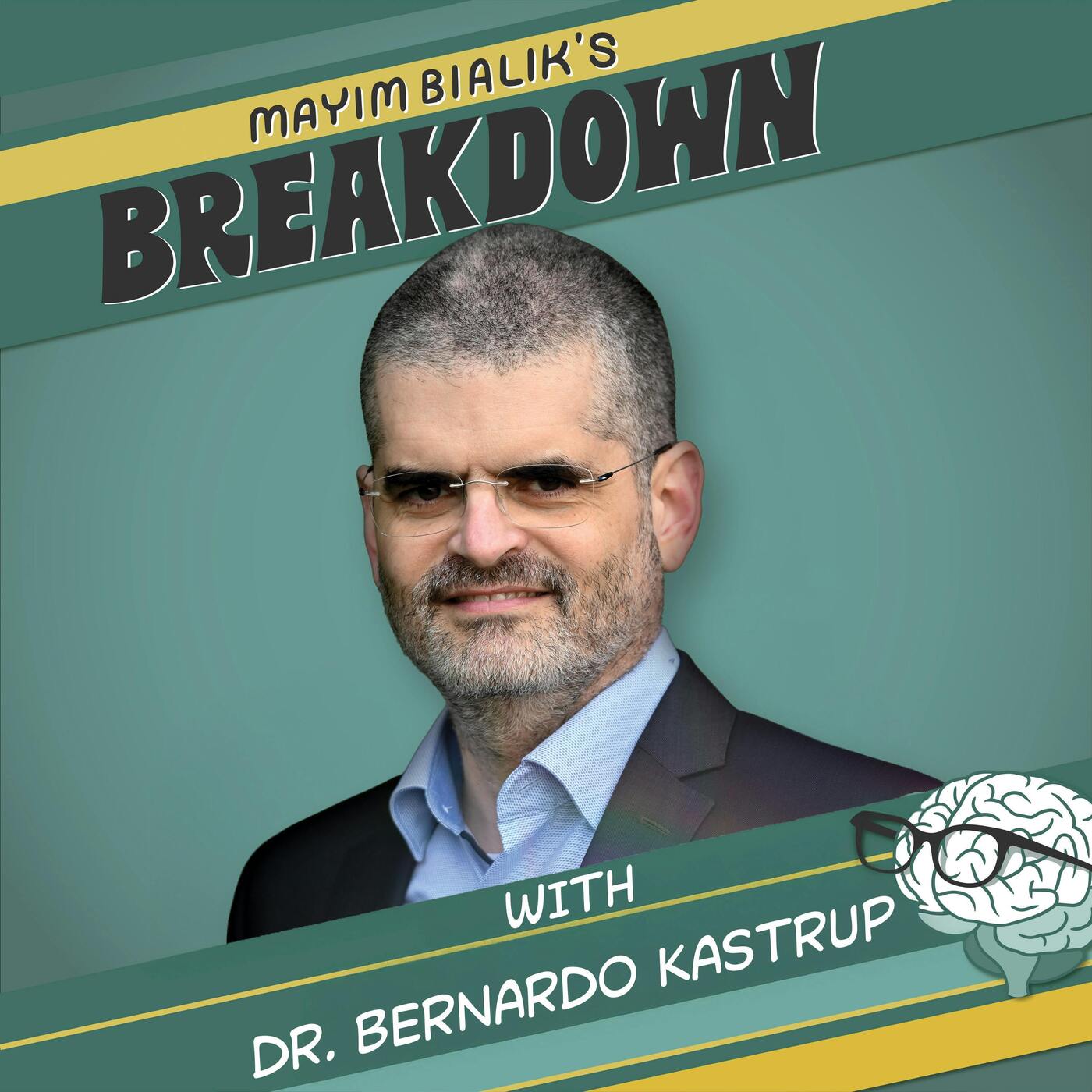
Mayim Bialik's Breakdown
Access Your Divine Intelligence! Dr. Bernardo Kastrup Provides a Mind-Expanding Explanation of Consciousness that Leads You to Higher Meaning
01:09:23
Loading summary
Transcript95 lines
- [00:00]
Jonathan Cohen
Mind Breakdown is supported by Helix Sleep.
- [00:04]
Ivy
Spring is in the air and so are all of the allergens that come with it. Spring allergens means you need more sleep, but there are a ton of factors that can prevent us from getting a good night's rest. Night sweats, back pain, feeling the person next to you when they roll over a million times. We were so excited to hear that Helix wanted to partner with us. I've had my Helix mattress for about five years now and I have been sleeping so much better. Jonathan and also our kids love their Helix mattresses and all night sweats, back pain, motion transfer. Those things are significantly better with a Helix mattress. Helix delivers your mattress right to your door which is so much fun. With free shipping in the US they have a 120 night sleep trial and limited lifetime warranty. Plus they're happy with Helix Guarantee Rest easy With seamless returns and exchanges, the Happy with Helix Guarantee offers a risk free customer first experience designed to ensure that you're completely satisfied with your new mattress. Go to helix sleep.com breakdown for 27% off sitewide that's helixsleep do for 27% off site wide helixsleep.com breakdown what is the proof that there is more?
- [01:12]
Dr. Bernardo Kastrup
There should be proof that there isn't more because we don't have an explanatorily satisfying account of the world.
- [01:21]
Ivy
Dr. Bernardo Kastrup is a renowned philosopher and prolific author whose groundbreaking work challenges how we understand consciousness and the nature of reality. His tech background in AI and innovation bridges his rigorous scientific insight with deep philosophical inquiry.
- [01:38]
Dr. Bernardo Kastrup
We are changing all the time. There isn't a single atom in the body of my five year old self that has stayed in my body. Everything about that five year old has changed and yet I have the clear sense that I was him. You take aggressive cancer cells. Cancer takes hold, multiplies. There is a bioelectrical field that seems to coordinate morphogenesis, coordinate how cells grow. A field that seems to give the body a cue about the body plan. If you control the biochemical field that surrounds the cells, lo and behold the cancer doesn't grow. We are the first animals that have disconnected from the supercomputer of natural instinct. We don't trust it anymore, we don't listen to it. We replace it with our own stories, our own narratives. We live now profoundly unnatural lives. What was the last time you looked up to the sky at night and saw the stars? The greatest threat to a human being is the loss of meaning when you deny transcendence. You are robbed of the source of meaning that has given meaning to every generation of humans before you. And now many of us deny that. So they lose their key source of meaning, so they have to compensate to another source of meaning. Consciousness is immanent in everything. The stars, the quasars, the galaxies, the black holes and supernovae. They are like your smile. They are physical configurations that betray the presence of an inner psychological, subjective state. So what is death? Think of it as what happens when you wake up from a dream. While you're dreaming, your mental inner life, it's constrained by the circumstances of the dream. When death dissociative state ends. Because you woke up, now you know much more. You went back to a much broader state of mind.
- [03:27]
Ivy
I can't explain it. Unbelievable. Hi, I'm Ivy.
- [03:36]
Dr. Bernardo Kastrup
Alec.
- [03:37]
Jonathan Cohen
And I'm Jonathan Cohen.
- [03:38]
Ivy
Welcome to our breakdown. What if we were to tell you that we have an episode today that breaks down and covers nearly every aspect of of the exploration that Jonathan and I started this podcast in order to discover. What's the nature of reality? What is our role in the universe? What happens when we die? How do we explain things that are outside of a materialistic framework? Does it matter if you find love? What's the purpose of suffering? Is there any pain too great to overcome? Why are we here and what does it mean?
- [04:23]
Jonathan Cohen
You may think this is highly metaphysical and philosophical, and while it is, it has very intense practical applications to how our bodies function, how the mind influences us, whether or not placebo can be used to decrease pain, reduce surgery, and even overcome very intense real physiological issues such as a cancer diagnosis.
- [04:50]
Ivy
We're gonna be speaking with Dr. Bernardo Kastrup. He is a Dutch philosopher. He has a PhD in computer engineering, worked in the high tech industry for almost 30 years, but he also holds a PhD in philosophy. He's part of a branch of philosophy that falls under analytic idealism. But what we discovered is that there is an incredibly rich, deep, nuanced, and very creative way that Dr. Kastrup has for understanding the nature of our reality, the purpose of why we're here, and literally how to apply these principles to a life well lived. Dr. Castrup, who goes by Bernardo, as he asked us to call him, is the Executive Director of Asentia foundation, and he's the founder and CEO at AI Systems company Euclid bv. We're going to be discussing the daimon and the soul of the west, but more importantly, we're going to be talking about kind of all of the things that make us able to function in a world that is so. So complicated, so enormous. And the notion that we can understand the smallest things and apply them to the biggest things is running through the thread of this entire conversation. We cannot wait for you to hear this.
- [06:12]
Jonathan Cohen
This interview is unlike any that he has given before. He actually came out of semi retirement from interviews in order to do this one. We are excited to share it. Dr. Kastrup also talks about how we are the only. Only animal that has been disconnected from our intuition and very practical steps that we can do to feel a connection to something greater than ourselves and reconnect with our instincts. If you haven't already checked out my Nbialix Breakdown on Substack, we have a growing Breaker community there and we release content exclusively there that is not released anywhere else. Check us out.
- [06:48]
Ivy
This is, we think, one of the most personal interviews that Bernardo has ever done, and he really doesn't do interviews anymore. But we're so grateful that he opens about suicide, which he talks about in his book, and some of his struggles with a variety of complex issues surrounding that. So we hope that you get a lot out of this episode. We certainly got so much from talking to Bernardo and yeah, let's welcome Bernardo Castro to the breakdown. Break it down.
- [07:17]
Dr. Bernardo Kastrup
Thanks for having me.
- [07:19]
Ivy
We often have a lot of clarity about what we're going to talk to people about. And then sometimes we do research and we learn about someone like you. And I literally say to Jonathan, I could talk to him about everything, and I don't know where to start.
- [07:37]
Dr. Bernardo Kastrup
Okay, let's do that.
- [07:39]
Ivy
So we'd love to get to as much as we can. I do want to start by saying I read this book of yours and you've written a lot of books.
- [07:48]
Dr. Bernardo Kastrup
Oh, I am surprised you read this one. I thought you would go to the hardcore philosophy stuff.
- [07:54]
Ivy
You know what, Dr. Castrup, I'm a very surprising person.
- [07:58]
Dr. Bernardo Kastrup
Please, call me Bernardo.
- [07:59]
Ivy
This Doctor thing, we did a lot of research on a lot of the different fields, but I really want to make sure that we get to this. So I'm just going to flag right up at the top that I'm a huge fan of Peter Kingsley and I'm a huge fan of Brian Murarescu, and I found all of these beautiful and profound and, you know, in many cases, very kind of upsetting. Right. Intellectually upsetting threads throughout the whole book. So we think that a simpler place to start, and I'm putting simpler in air quotes, is what is reality?
- [08:35]
Dr. Bernardo Kastrup
It is this. Right. Whatever this is, it's not like we are not acquainted with reality. We, we came out of it. We live in it like fish in water. We live and breathe it all the time. We are very, very intimately acquainted with reality. The problem is when we ask ourselves the question, what is reality? And then we want to sort of capture that in some nice neat conceptual framework, hopefully without contradicting ourselves in the process. And that's what is difficult.
- [09:07]
Ivy
There are many different versions of reality that we can interface with. One of my father's favorite quotes was La vida esueno. You know, life is a dream. And in the religious tradition and the mystical tradition that my people come from, this is a projection, you know, as if something's being projected on a screen. The Matrix movies came closest to kind of articulating what many of us have as our mystical legacy right over thousands of years. I wonder, can you give us a little bit of framework of why it's important to consider that what we see and what we touch and what we taste and what we smell is not the entirety of our actual experience?
- [10:04]
Dr. Bernardo Kastrup
Well, first of all, because it is a virtual certainty that it's not right. There is no way a monkey would have evolved a cognitive system and a perceptual apparatus to pick out everything that is philosophically salient about reality. There is just no way that would happen. So this can't be everything. And the ones who maintain that it is have the burden of argument and perhaps proof, but at least argument our conception of what this is, especially if we understand this to be all or a sliver of reality, it modulates our sense of meaning, our sense of purpose, the way we relate to ourselves, to other people, to animals and nature at large, the way we relate to past and future. Very important. And therefore it modulates how we live life and what we make of it. People who say we don't need metaphysics, it's a waste of time. Well, they say that because they are assuming, thoughtlessly, a sort of default metaphysics. And they say that they don't have a metaphysics. Well, in fact they do. They are just not self reflective enough to explore their own minds and their own hidden assumptions and their own dispositions to see what it is. But the metaphysics is critical to live life. It's the narrative in terms of which we relate to self, to others and to the world.
- [11:34]
Ivy
What would be the proof that there is more? Right, because if I go about my life and I go about the world and I'm interacting with things and I don't know, I wake up, I make Breakfast. I take my kid to the bus. What is the proof that there is more? Why should I believe that there is more?
- [11:51]
Dr. Bernardo Kastrup
There should be proof that there isn't more, because the zero hypothesis here is that the cognitive apparatus of a monkey doesn't pick out everything that is out there, right? Evolutionarily speaking, that's the null hypothesis. But I will entertain it. There are lots of indications, very strong indications. I hesitate using the word proof because proof is something that mathematicians do, usually science and philosophy. We don't deal with proofs. We deal with what is the best hypothesis at hand. The indications are, for instance, from certain experiments in foundations of physics that show that some basic assumptions we make about reality, like physical entities, have standalone existence, don't seem to hold. When you put a big enough microscope and you magnify reality to a point where you can really see the details, and when you look at reality at that level of detail, oh, those assumptions break. Physical things don't seem to have standalone existence. You can only say that they exist if you make a measurement. If you're not making a measurement, you can't say that they exist. In the neuroscience of consciousness, we have no account of how seemingly unconscious material stuff arranges itself in such a way as to give rise to the qualities of experience. There is a gargantuan gap between the two. I will limit my answer to these two fields. I could go on and on, but these two fields very compellingly tell us that our little narratives of completeness, they don't hold. There is more going on than we think because we don't have an explanatorily satisfying account of the world mind.
- [13:47]
Jonathan Cohen
Bialix Breakdown is supported by Bioptimizers.
- [13:50]
Ivy
You know, I struggled to get good quality sleep and I just assumed it was stress. But as I learned during perimenopause and menopause, your hormones shift in a way that affects your magnesium levels. And low magnesium, it makes everything harder. Not just sleep, focus, mood, your tolerance for stress. That's why I have added Magnesium Breakthrough bye bye Optimizers to my nightly routine. It's a blend of seven different forms of magnesium designed to support relaxation and overall sleep quality. Try it. See if you wake up more rested and refreshed, you've got nothing to lose and a lot to gain. Bio Optimizers offers a 365 day, no questions asked money back guarantee. Magnesium Breakthrough is a huge breakthrough to improve hormonal balance, to help with focus, decrease brain fog, improve sleep hygiene. Overall, bioptimizers makes it very easy. Jonathan, what do they get when they go to bioptimizers optimizers.com breaker and use the code breaker.
- [14:42]
Jonathan Cohen
You get 50% off your entire order and a free bottle of Mass Zymes.
- [14:47]
Ivy
Buy Optimizers best selling digestive enzyme that'll be added to your order automatically when you use our exclusive code.
- [14:53]
Jonathan Cohen
That's a 20 product free on top of your discount already.
- [14:58]
Ivy
This is a limited time offer and while supplies last, you can't get it on Amazon, you can't get it in stores. This offer exists in one place. Our link, our code. That's it. So maybe you were already thinking about it. This is the sign. Go to buyoptimizers.com breaker use the code breaker. Grab it. It's gone. Make 2026 the year you finally start sleeping again.
- [15:16]
Jonathan Cohen
This episode is sponsored by Wandering Jews, an open door media brand.
- [15:21]
Ivy
If you've ever found yourself feeling like you have more questions than answers, you're in good company. The Jewish people have been like that for thousands of years. Wondering Jews with Michal and Noam is a podcast where two of today's most dynamic Jewish voices, Michal Bittone and Noam Weissman, dig into the biggest questions about life through a Jewish lens. It's the kind of conversation where you'll laugh, learn something new and pre probably shout in disagreement at least once. Michal and Noam tackle the tough topics like anti Semitism in America, what happens after we die, and the future of religion with guests like Bret Stephens, Michael Rapoport and Sarah Hurwitz. And this past month, in honor of Jewish American Heritage Month, they've been celebrating some of the Jewish lives and institutions that have shaped American life, from food to music and comedy. Thoughtful, joyful and always honest. That's Wondering Jews with Michal and Noam, a production of Unpacked. Find it on your favorite podcast, Apple, or on YouTube and make sure to hit subscribe. Check out Wondering Jews with Michal and Noam podcast and subscribe at Unpacked Bio nmx. There are many people who would say that a lot of this kind of mental exploration of the nature of reality, especially when we introduce notions of like, oh, quantum physics, right? There are many who would say that this is a form of mental masturbation. The only explanation is the, the materialist explanation and anything beyond that is, you know, either the purview of, you know, religion, right? And religious structures that actually reflect more about humans than about God, if you ask me. Or, you know, there, there are the musings of a manufactured and and mystical thought experiment And I wonder if you can sort of speak to that. You know, we. We speak to all sorts of people who believe in psi phenomenon. We speak to all sorts of doctors, surgeons, you know, people who are theoretical physicists, who want to understand a larger nature of reality and who believe that even the foundations of how we articulate quantum mechanics is based on a foundation that acknowledged there is something irrational here. Right. Using that playfully. Right. So what, what would be the way to sort of approach this from an intellectually rigorous and forgiving perspective? And it's very easy to say, oh, that's all, you know, nonsense, and that's for the crazy religious people. But that's not the conversation we're having. I wonder if you can help us remember that we're not crazy to delve into this world.
- [17:57]
Dr. Bernardo Kastrup
Well, let me first acknowledge there is a lot of mental masturbation in philosophy, even in science. In science it's called P value engineering. A lot of mental. Mental masturb going on in there. And there's a lot of it in philosophy as well. There are whole fields of philosophy that are mental masturbation. Metaphysics is not one of them. And the only way for one to hold the opinion that materialism has accounted for everything and therefore anything else is a waste of time. The only way to hold that position is to be vastly misinformed of the issues. Not even those who defend physicalism in academia would say that it's a done deal. Actually, they are on the defense right now. It's very hard to find a physicalist philosopher today willing to go on stage and actively defend physicalism. It has become very hard. So physicalism does not provide us an account of a great many things. It doesn't give us an account of experience, Any experience. The taste of a chocolate cake, a belly ache, falling in love, and seeing the stars in the night sky. None of it has a physicalist account. Physicalism, when applied to foundations of physics, doesn't give us a causally closed picture of the world because we cannot predict the outcome of the outcome of any single quantum event. We can predict the statistical distribution of many, many outcomes taken together, but we cannot predict any single one. And there are great many things in nature that depend on the outcome of a single quantum event, perhaps even our thoughts. Materialism does not give us a metaphysically tenable, let alone satisfying of what's going on. And this is largely acknowledged in philosophy and in science today, even physics and neuroscience. So those who think that physicalism does, or materialism does, give us a complete account, frankly, they Just don't know what they're talking about.
- [20:01]
Ivy
Is that what we should tell people? You just don't know what you're talking about?
- [20:06]
Jonathan Cohen
But they're so sure of themselves. We spoke to someone recently who is a staunch physicalist. And just he's like, there's no such thing. There's no credibility, there's no data, there's no evidence. All the studies that you think you've seen, you haven't seen, people misremember. They come at it with such fervor that it's, you know, you need a repository of ammunition to fight back against.
- [20:31]
Ivy
We need Bernardo. We need him sitting right next to me all the time.
- [20:35]
Dr. Bernardo Kastrup
I was thinking, invite them to have a live debate with me.
- [20:40]
Ivy
We'll stand behind you with boxing gloves like this, like you tell them, Bernardo, tell them.
- [20:44]
Dr. Bernardo Kastrup
But look, the attitude you describe is not new. You see that in religious people, fundamentalist religious people.
- [20:51]
Ivy
This is exactly what I said. I said we were speaking to a secular professor of psychology who sounded more fanatical about me being wrong than I, as a person of faith, am about being right. He was more certain. And I said, who's the fanatic here?
- [21:09]
Dr. Bernardo Kastrup
Usually this betrays a lot of insecurity about the position they hold. It's important to live the position that this is a settled question, because if you acknowledge that it's not, many insecurities come to the forefront. It's very. Look, I say this not as a criticism, but as a human being who suffers as well. And I'm not going to say that I would never fall on that trap because I just may. But this is psychology. It's not metaphysics, it's not science. We are talking about the psychological issue here.
- [21:44]
Ivy
You know, Jeffrey Kpel is a friend of the podcast and we love him.
- [21:48]
Dr. Bernardo Kastrup
I love him too.
- [21:50]
Ivy
One of the things that, that Jeffrey taught us is that the notion that someone's experience, no matter how fantastical, how out there, how unbelievable, how impossible it seems, is in some ways a portal, right, either to someone's particular experience or to a larger experience that we're all having. Where is that line between delusion, between madness, and between an open understanding of what could possibly be aspects of the human experience that may not be easily verifiable, quantifiable, or able to hold up to the stringency that again, mathematicians would have.
- [22:40]
Dr. Bernardo Kastrup
It is not an easy line to find. I mean, the scientific method offers us some tools to use, some best practices, even some pre engineered value judgments, let's put it that way. It is not infallible. I'll give you an example. The scientific method presupposes that we can isolate all the circumstances, all the variables that matter to an experiment within a laboratory setting. So you're only allowing the variables to play a causal role in what you're experimenting with. The variables that you know, everything else you controlled for or eliminated. And then it expects that it can trigger any phenomenon under those controlled conditions in a laboratory. Well, that is an incredibly constraining assumption. That that presupposes that all causal influences in reality operate at a microscopic level. Because you can only isolate things in the confines of a small laboratory if the causal chains here are only microscopic and operate locally. But many of this stuff people call psi, I would imagine that they are only triggered under circumstances that evoke one's emotional reaction. And you can. You can't have that in a laboratory setting. Or you could have natural causal chains that operate only over large distances at the level of families or societies or cultures, all of which is beforehand eliminated by this notion that you should be able to see everything under a laboratory setting. So why. Why should reality conform to our experimental convenience? Reality is what it is. If we can't trigger a phenomenon in a laboratory, it doesn't mean that the phenomenon doesn't exist. It only means that it's very hard to study. We have to use observational science as opposed to experimental science. And there is nothing non scientific about it. Astronomy is an observational science. You can't trigger a black hole in the laboratory or a quasar. You are limited to watching it with care.
- [25:00]
Ivy
The notion that if something exists, that it has to or can exist that way every time and for every person is absurd. It's the equivalent of saying, I've had great sex before, and so I assume I will have great sex with every single person I have sex with. That's like. It doesn't work like that. You could put me in an appropriate setting that is just like the setting I had, and I will not have an orgasm, I promise. Right. Because it is dependent on the mood I'm in. What I saw on Instagram that morning, who the president has censored, what's going on in global politics and hormone fluctuations and things that do not travel. I mean, if you want to question science, be a woman in perimenopause. You know, there's no chart. All those charts. This is your luteal phase. When you get to like 40, it's like it. That's what it's like to try and recreate something in the lab, this is
- [26:00]
Jonathan Cohen
the first conversation about consciousness that has gone to menopausal sex.
- [26:05]
Dr. Bernardo Kastrup
Oh, then we are not having enough conversations. That's a major event in consciousness. I suppose. I'm totally with you there. People who think like that, and I'm not saying this to put people down, but they are not serious participants in the discussion. And it's perfectly okay to be like that. I am not a serious participant in a discussion about art. What is not okay is to not be a serious one, but think you are and act accordingly. That's a kind of intellectual arrogance that backfires spectacularly because one just makes a fool of oneself. People make a lot of metaphysical assumptions in the process of denying metaphysics. This happens all the time, and it happens even in language. For instance, when people say, can consciousness exist outside the body? What is the assumption they are making? Dualism. There is the body and there is consciousness. Well, it's not the only option. It could be that the body is a construct in consciousness, and therefore consciousness is not in the body, it's the body that is in consciousness. And then you say that and people go like, oh, let me think about that. Well, there are, there is a menu of hypotheses that are internally consistent, perfectly coherent, but which requires a little thoughtfulness and not knee jerk metaphysical reactions based on assumptions one doesn't even know one is making. And that's why often these people are not serious participants in this discussion. They don't even know what assumptions they're making.
- [27:46]
Ivy
You find ways to use words where I'm like, I think I know how to say this, I think I know what it is, but let's just be sure. Talk to us about what cosmopsychism is.
- [27:57]
Dr. Bernardo Kastrup
So our current mainstream metaphysics says that the world is physical and that consciousness is a sort of a secondary or an epiphenomenal construct of certain material arrangements like brains. And therefore consciousness only exists within brains. Another hypothesis is that consciousness is everywhere and that particular material arrangements simply reflect or betray the presence of certain states of consciousness or arrangements of consciousness. So my brain betrays the presence of a human arrangement of consciousness, but consciousness is primary. It's spread throughout the universe. So that's what is cosmopsychism. There are many variations of it.
- [28:46]
Ivy
What do you mean? That consciousness is separate from what I'm experiencing right now in my head, in this body, in this chair, looking at a screen?
- [28:58]
Dr. Bernardo Kastrup
I'm precisely saying that it's not separate, that it's intrinsic to your body. But since your body is Made of the same kinds of atoms and fields as the rest of the universe, then it's intrinsic to the entire universe. So consciousness is everywhere. Which doesn't mean that everything is conscious in and of itself. A single neuron in my head doesn't have its own inner chatter talking to its neural neighbors. There is only something it is like to be me. Not something it is like to be a single neuron in my head. By the same token, there may be nothing. It is like to be this bottle of water right now. And that doesn't contradict the hypothesis that consciousness is everywhere. Just as it correlates with the whole of my brain, including every neuron, it may correlate with the entirety of the physical universe. And that does not mean that everything is consciousness. It only means that consciousness underlies or is immanent in everything.
- [29:58]
Jonathan Cohen
What this leads to is if the body is a part of a larger consciousness, is the mirrored systems that we're interacting with all throughout our existence that are actually just mirrored reflections of different forms of consciousness. Meaning that if the body is a reflection of some larger system, what am I connected to? How do I operate? How does that change what I understand my physical reality to be?
- [30:27]
Dr. Bernardo Kastrup
When you look in the mirror, you see a physical body that you can describe. You can delineate its boundaries. You can say, there it is, there is a physical body there. But you know from direct experience that behind that physical body you see in the mirror, there is the entire inner life of Jonathan. An entire universe of subjectivity, of inner experience. Behind that image or underlying that image, there is the entire subjective inner life of a person, of the person who is looking.
- [31:02]
Ivy
And one of the best examples of that is when you were five years old, you were looking in the mirror at a completely different body. It was much smaller, it had a completely different experience. But you did not have a problem when you turned 6, being like, who the fuck is that in the mirror? You were like, five year old. Me is now six, and then I'm 20, and one day I'll be, God willing, you know, 120. Right. That's the you inside, that's the observing mind. Correct.
- [31:35]
Dr. Bernardo Kastrup
We have no problem in understanding that behind that image in the mirror, there is the entire subjective universe of me. Cosmopsychism would say the same applies to the entire universe. Behind the physical universe, there is the inner life of the universe, which presents itself to us in the form of physical arrangements. Just as my inner life presents itself to you in the form of the physical arrangements we call my body. My words, my smile, my facial expressions, those betray the presence of my inner life. If I cry, you will say, he is sad. So material arrangements, physical configurations correlate with inner mental state. We know that for people, panpsychism would say, now do the same thing for the entirety of the universe. There is a universal mind that underlies all the physical universe. And the configurations of the physical universe, the stars, the quasars, the galaxies, the black holes and supernovae, they are like your smile. They are physical configurations that betray the presence of an inner psychological, subjective state. And look how beautiful this is because it eliminates all arbitrary differentiations in nature. In all cases, matter, material arrangements, physical configurations are the extrinsic appearance of inner mental states that holds for your brain and it holds for everything else that is made of the same kinds of atoms and force fields as your brain. There is no arbitrary discontinuity in nature. Matter is always the external appearance of inner experience. Under, under cosmopsychism, it's.
- [33:24]
Ivy
That's staggeringly beautiful. You and your consciousness, right? Your conscious experience. You have the ability to be enamored with the fact that you even have the ability to think, to experience. You are. I mean, one with nature is like, putting it mildly and what it sounds a lot like from Jonathan and my experience here talking to people from all different backgrounds and perspectives is this is very, very similar to a unifying and loving understanding that many indigenous communities have that many of the early Greeks experienced, right? This is also something that people touch in transcendental states, often with the use of psychedelics or other highly, highly focused meditative practices. We had Thomas Campbell on and I joked that he accidentally proved God through an understanding of energetic fields and consciousness. And he accidentally proved that there is something that wants less chaos for us, right? Even as the universe is tending towards chaos.
- [34:45]
Jonathan Cohen
Mind B. Alix Breakdown is supported by bioptimizers.
- [34:49]
Ivy
I struggled to get good quality sleep and I just thought like, ugh, it's stress. But I learned during perimenopause and menopause, your hormones shift and it affects your magnesium levels. Low magnesium makes everything harder. Not just sleep, but focus, mood, stress tolerance. That's why we added magnesium Breakthrough by Bioptimizers to our nightly routine. It's a blend of seven different forms of magnesium designed to support relaxation and overall sleep quality. Try it. See if you wake up more rested and refreshed, you've got nothing to lose and a lot to gain. Bio Optimizers offers a 365 day, no questions asked, money back Guarantee Magnesium Breakthrough is a fantastic way to improve that hormonal imbalance that especially happens with magnesium. And then you have better focus, you have better sleep hygiene in general. Bioptimizers makes it so easy. Here's what you get when you go to bioptimizers.com breaker and use the code breaker. 15% off your entire higher order and a free bottle of Mass Times. That's Bioptimizer's best selling digestive enzyme. Added to your order automatically when you use our exclusive code. That's a $20 product, free on top of your discount. This is a limited time offer. While supplies last. You cannot get this on Amazon. You can't get it in stores. The offer exists in one place. Our link, our code. That's it. So if you were already thinking about trying it, this is the sign. Go to buyoptimizers.com breaker. Use the code breaker. Grab it before it's gone.
- [36:13]
Jonathan Cohen
Make 2026 the year you finally start sleeping again this summer.
- [36:19]
Ivy
Don't squeeze in. Spread out. Find homes big enough for your whole guest list on vrbo. That's vacation rentals done right. Book your stay now.
- [36:33]
Jonathan Cohen
I wonder if you could extrapolate the idea that matter is always a reflection of an inner experience too. The structure of society. Political discord, fract in social bonds. Can we take it not only to the Milky Way and the existence of the stars, but actually to the structure of what we're seeing in society and international politics?
- [36:59]
Dr. Bernardo Kastrup
The first thing to notice is that a direct implication of this notion that matter is always in all cases the extrinsic appearance of subjective states is that the world now is of the same kind as us. We are no longer this rare accident in which a world that is fundamentally unconscious temporarily became conscious. Behind everything you see around you, there is something of the same nature as you. So now you belonging here, you are not an accident, a temporary epiphenomenal aberration. The world now is of the same nature as you. You have an inner life. So has the world. That's the first thing. Now the next thing to understand is that what we identify with. And that's your point earlier, what we tend to identify with is a particular narrative of self. Could say, well, I am Bernardo, I am a philosopher, I live with Claudia. I also happen to do computer stuff and I love to watch the Big Bang Theory and I go to work at the high tech campus and this whole narrative of self. And we say, it's me. But if we follow this narrative over time, we realize that we are changing all the time. My 5 year old self had different thoughts, different opinions, different perspectives, a completely different body. There isn't a single body, a single atom in the body of that five year old that has stayed in my body until today. Many have left and returned. There are atoms that were once in the lungs of Napoleon, in my lungs at some point in my life, but it has never stayed static. Everything about that five year old has changed and yet I have the clear sense that I was him, even though everything else changed. Now, you can extrapolate very easily now and you can easily imagine that by the same token that you believe you were your 5 year old self on the same logical grounds. You must then believe that you are me. I am like your 5 year old self. I'm completely different from you, but the core subjectivity in me is identical to the core subjectivity in you. If we were to both be in a perfect sensory deprivation chamber and become completely amnesic for 30 seconds, during those 30 seconds, you and I would be completely identical. Not two identical units of the same model, but effectively the same model. Because you cannot talk about spatial or temporal distinctions in a state of complete mental emptiness. Not only is there subjective inner life behind everything you see around you now, you can even identify with everything else and everybody else, because distinctions are as significant to identity, distinctions between people are as significant to identity as the distinctions between you and your five year old self. Those distinctions don't stop you from saying I was my five year old self. So if you are to be logically consistent and rigorous in this line of thought, you must also acknowledge, I may just as well be.
- [40:44]
Ivy
Jonathan, I know that philosophers don't get to decide world politics, but this is one of the best and most compelling arguments for an understanding across political divides of our shared humanity on this planet. Meaning this is potentially the most love filled perspective on our existence. Which would then lead you to say, what is a border, right? Who are those people versus these people? And you know, I don't think it has to be a political conversation because it's a consciousness conversation. And you know, there's this mystical concept that in order for us to live on this planet, we have to be able to block out a certain amount of pain and suffering so that we can just walk around, go to the bathroom, raise children. That if we were awakened to the true suffering, right, that exists as the human condition, no one would be able to exist, right? So the notion is that being human is about this balance of being able to say, where do I end? Where do you begin and is there a way to introduce that into a conversation about belonging and justice?
- [42:06]
Dr. Bernardo Kastrup
Right, absolutely. Look, I don't think these notions, these philosophical ideas mean that we should all hold hands and sing the Kumbaya. I tend not to be a romantic philosopher and I'll tell you why. If I could go back in time and watch my 10 year old self throwing a fit and being nasty and destructive, I wouldn't go to him and say, come here, my darling, give me a hug. No, I would say, this is not fine. And you would set boundaries and you would set a stake on the ground and say, until here and no more. Even though it is your 10 year old self, you would still do that. So I think it's perfectly valid for there to be disagreement, for there to be robust discussions. It's perfectly valid for there to be criticism. There is nothing in me that cannot criticize what's going on in Ukraine and Gaza right now. There is no way I'm going to hold hands with certain people involved and sing the Kumbaya. But what it also means, ultimately this philosophical idea is the recognition that what is behind their eyes is what is behind your eyes. So there is a chance for reconciliation. It is not romantic reconciliation of singing the kumaya and giving three kisses. It's a more mature, sober reconciliation. It's the notion that there isn't a fundamental chasm that cannot be crossed. No, these chasms do not exist. You can always cross.
- [43:52]
Ivy
You know, we can't avoid what is happening. When I see what's happening in Sudan and I say, if everyone could see what is happening, it would collectively break the heart of the world. And I want to believe that it would then lead to a different conversation. And yet we're human and we have to live, you know, kind of this human experience. There's one more thing that I wanted you to talk about in terms of the universe has this sort of network capability of a brain, right? And, you know, the first kind of environmental level that many of us think of this sort of microcosm on is to say like, like, oh, the world is, you know, kind of, it's an expression of the human experience. And the trees are the lungs and the, this is the, you know, and the streams are the circulatory system, you know. But if we expand that out, you know, to the size of the universe and beyond meaning, beyond what we can even encapsulate. Can you talk like in a way that maybe can help people understand what it means to say that the universe is kind of mimicking the network that is a brain, and the brain itself, then, is made up of all of these separate networks, works, and that each cell, you know, as Bruce Lipton talked about with us in a very different way, that each cell has that kind of capacity for memory, for consciousness, which recently Essentia foundation talked about. Can you give us a little bit of a fractal understanding under this idealist
- [45:14]
Dr. Bernardo Kastrup
or cosmopsychist notion that matter is the outer appearance of inner experience, not what creates inner experience, but just what experience looks like from the outside? If you interpret this rigorously, then we will realize that the brain and its network structure, which has a certain network topology that can be quantified, the brain is the outer appearance of our inner life, of our subjective experience from within. So if the universe has a subjective inner life as well, at the largest cosmic scale, you could say, well, it's plausible that we should find a network structure that, once quantified, would resemble that of a brain, because they are both representing the same phenomenon at different scales. It's like the fractal you alluded to, as above, so below. So it's a brain at our level, but something resembling a brain. That's a valid hypothesis. If cosmopsychism is correct, something resembling or having some of the features of the network topology of the brain should be found at the largest scales that we can discern. Lo and behold, that's exactly what we find. So what Franco and Alberto did, they did a spatial Fourier transform of the distribution of matter, including dark matter, in the universe at its largest scales, as simulated by the best models we have today. You know, the standard model of cosmology. And the result of that spatial Fuhii transform shows a pattern of distribution of matter that is very, very much like what you find in a brain. The network topologies are very similar. It's not vaguely similar. It's quantifiably similar to a disconcerting level that nothing in physics would allow us to explain.
- [47:15]
Ivy
Can you talk a little bit about what it specifically means to say that we see the topology of the kind of network that we call brain in the larger universe?
- [47:25]
Dr. Bernardo Kastrup
So if you simulate the universe at its largest scales, you have to simulate, because you cannot take a telescope and figure out that structure since you are within it, Right? So you have to use our mathematics to simulate it. Matter is not distributed uniformly across the universe, including dark matter. It forms these filaments and these areas of concentration, and different areas of concentration of matter connect together through these filaments of material distribution. You can look at the topology of the network that is formed that way. You know, the galaxies, galaxy clusters, and the way they connect through these filaments of normal matter and dark matter. You can look at the topology of that and compare that to how neurons connect to each other in a mammalian brain. So you would have the accumulation of matter that is in your own body, and the filaments would be the axon and the dendrites that connect each neuron to the other neurons. And then you do a mathematical quantification of that network topology in both cases, and you compare the numbers and the numbers match surprisingly well in a way that is difficult to say. Well, it's just an accident. Now look, this doesn't mean the universe is a brain, because we define the word brain to, you know, biological organisms on this particular rock, the third rock from the sun. And functionally it also cannot possibly work very much like the brain, because the distances involved at the largest scales of the universe, given the speed of light limit, would mean that the universe cannot form what integrated information theory calls these re entrant loops of information integration. It's physically impossible, based on what we know today, for the universe to form those re entrant loops. So you could infer that, okay, the universe cannot be self reflective because there isn't just time since the beginning of the universe. And given the rate of expansion and the speed of light limits for these re entrant loops that are required for self reflection to form. But it can very much be a brain, like an instinctive brain, the brain of a nematode that also doesn't form very, very many re entrant loops. But the suggestion is that something in the very fabric of reality, in the basic organizing principles of reality, manifests itself. These organizing principles manifest themselves at one scale as brains, mammalian brains, and at another scale, the very same organizing principles manifest as the network topology of the, the web of galaxies.
- [50:16]
Ivy
I think many of us think that just like the universe is like if you take a pile of confetti and you like, throw it up in the air and wherever it lands, that's the universe. But what we're saying is that there's density, right? There's density and collections for gravitational reasons, for all sorts of fascinating reasons beyond my pay grade. But to say that there is some sort of order like that, you know, for me, and I'm often asked, as a person of faith, like, how do you believe in science? And any. In my opinion, anyone who has studied neuroembryology and sees how you go from One sperm and one egg. And when they meet it floor, it forms a blastula and you get an implantation that leads to a folding in I the way I described it to my students when I taught nurse. It's like a hot dog in a bun. You look like a hot dog in a bun. And then something incredible happens and the hot dog folds and all of a sudden you see a forebrain and you see a midbrain and you see a hindbrain. That is the holiest, most divine thing I have ever tried to understand. And to me that's kind of what we're talking about. If I think about that on a galaxy level, right? We have, we have nonsense, we have tohu va vohu did we say in Hebrew, you know, we have a nothingness that becomes a somethingness.
- [51:38]
Jonathan Cohen
It also then speaks to if there's a level of intelligence with intent for the structure of the earth and the people on the earth. Materialists say everything. There's no intelligent force in the universe. Everything is random, nothing cares about us. And of course the religious fanatics will say, go the you know, so far as to say that we should follow this dogma. Where does understanding that there can be a brain of the universe for over simplistically repeating, where does that take us to understand if this force has our highest good in mind or some sort of benefit for us, or an intention for how the world should unfold?
- [52:26]
Dr. Bernardo Kastrup
I am a naturalist. You could even say that it's my natural prejudice to be a naturalist. Everything in me resists the idea that this is a deliberate game and maybe that resistance is a sort of inner acknowledgement, I don't know. I'm open to my psychological limitations here, but I hold on to naturalism. But as a naturalist, I will immediately volunteer to you that there are incredibly difficult problems for the naturalist, such as the fine tuning of the universal constants, which is just mind boggling. If anything would deviate like a tiny, tiny, tiny little amount from their current values, there would be no complexity. There wouldn't be life. Planets, galaxies. The fine tuning is just mind boggling. And life, life isn't. I will use a word that the naturalist shouldn't use. Life is a miracle. It's again mind boggling how the organizing principles of nature seem to push towards richness, complexity, to a great stage, like Shakespeare would call it, with a very complex play going on. I acknowledge that. To go back to psychology, I think to be a good philosopher in this day and age, you have to have some affinity with psychology, because philosophers use only their minds as their instruments. They are not using oscilloscopes and telescopes and whatnot. They use their minds. So it's important that they be acquainted with how that instrument works so they know how to operate it reliably. When people say, look, we figured it all out. There is no mystery. We know how morphogenesis takes place in the growth of an organism. It's the distribution of certain fields and signaling molecules and whatnot. And the fine tuning, well, it's some kind of evolutionary universe in which new universes are produced on the other side of a black hole. And therefore only universes that have complexity can produce black holes and give rise to other universes. And you get the fine tuning that way. So all of these fantastical stuff that you wouldn't take seriously at all. It's like the talk of a drunk on the corner of the street. And yet people with PhDs will defend this as established facts. Look at the psychology. I think the psychology here is the incredible human need to find closure. Look, there is a theory in psychology called fluid compensation. It's part of terror theory and all that stuff. How do we react to threats? And the greatest threats to a human being is the loss of meaning. Amazingly enough, Viktor Frankl was onto this in the 40s and 50s. Now it's sort of experimental psychology showing us the same. It's an enormous threat if we are robbed of meaning. When you deny transcendence, you are robbed of the source of meaning that has given meaning to every generation of humans before you. Everybody was religious in one way or another until the middle of the 19th century. And now many of us deny that. So they lose their key source of meaning. So they have to to fluid compensate to another source of meaning. What are the other sources of meaning? Fantastically positive self image is one. The notion that you contribute to something that survives your existence is another. But a big one is closure. So even though the universe has no meaning, at the end, you're going to die anyway. You understood it, you got one up on it. It you figure it out, SOB you figure it out how it works. This is a powerful psychological motivation for people to communicate with great certainty. Hypothesis that are extraordinarily implausible, let alone proved or substantiated.
- [56:43]
Ivy
Well, and you could even extrapolate that out to say, I mean, I don't want to go here, but I kind of do that really. All of of our capitalistic materialistic culture of consumption is one gigantic distraction from actually having to figure any of this out. Meaning like When I look through my Instagram feed, and it is. It's war, it's protests, it's. And then it's like, check out this thigh slit on my dress. Right? And I totally get it. Like, you don't have to constantly be immersed in misery. I live it. And it's not really fun, but the. The cognitive dissonance that I have to sort of like. Like, oh, this is all going on, and there are people for whom that is a safe place to exist. But I think for me, when I was younger, and you and I are the same age, when I was younger, I felt like no one understood me. Like, everybody was so interested in, like, parties and boys and makeup, and I was like, don't you understand? We're all gonna die? You know? And, like, that's what happens if you read Sartre and Camus and Dostoevsky. You know, you become this, like, misanthropic, like, horrible teenager. But now that I'm an adult, I see that there are. We need all these different kinds of people. But our culture really is priming us to distract. Drink it away, smoke it away. Like, whatever makes you not have to be having this. This conversation.
- [58:15]
Dr. Bernardo Kastrup
There you go. It is the basis even of our economic system. Look, I'm not saying that there is a grand conspiracy, because I don't think any human being is smart enough to find himself in the position of directing a grand conspiracy. I think we are all lost, right? And we react to it in a very spontaneous way. Nietzsche saw this in the second half of the 19th century. He talked about us today as the Lestermensch. The last human and the last humans hop around planet Earth and they think they invented happiness because they have their little pleasure for the day and their little pleasure for the night. And then they blink and say, we have invented happiness. I almost quoted Nietzsche literally here. These are his words. Largely today, we know that he was right first. And we have even a deeper understanding of what the Lester Mensch is. The lestermensch is one that will pursue any addictive avenue available to distract themselves from the immediate questions of life. Who are we? Why are we here? What are we supposed to do? And what is this all for? We don't think about that. And we will engage compulsively in patterns of addictive behavior to take our attention away from that. This is how we invented happiness. Lo and behold, this is what moves capitalism. Take this away, and many less pairs of shoes will be sold. That's a problem.
- [59:55]
Jonathan Cohen
Less pairs of shoes. But also, we were talking earlier today that 40% of the s and P is focused and propped up by technology companies, that their primary motive of interacting with the public is to incite rage. So it's rage capitalist. And you can see, is that a reflection of our internal state that requires us or tries to have us distract from these other meanings. And if so, what is the alternative? Right? Like if, if it's not religion and we need to reconnect with some form of meaning, how do we go about that?
- [60:35]
Dr. Bernardo Kastrup
I don't have a recipe for the solution, but I think the path towards a solution doesn't go through blaming, doesn't go through saying that evil people are in control and that this is a deliberate move to destroy the lives of most of us for the benefit of the few who know exactly what's going on. I don't think anybody really knows what's going on. I think everybody is lost. The billionaire is as engaged in compulsive patterns of addiction as anybody else. But instead of buying the next pair of shoes, they are buying the next yacht, the next mansion. And they are also suffering. They also cannot find fulfillment. They are also desperately looking for distraction. Everybody is deep in the crap. So I think the path to a solution is not blaming and revolution. It is a form of mature, non romantic compassion. It's the recognition that every human being is just trying to do something to suffer less. I think this realization, it's not a solution. I'm not giving you a recipe or the seven steps to world harmony, but I think, I think at least this gives a direction. The direction is not blame. The direction is a mature, sober form of compassion.
- [62:01]
Jonathan Cohen
I like that because it really says, let's accept things as they are without trying to vilify and create more drama, which will only lead us further away from the type of love and openness that is required for a solution.
- [62:15]
Dr. Bernardo Kastrup
Yes, Jonathan, just look at our situation. As humans, we are the first animals that have disconnected from the web of instinct that for everybody else gives them instant answers about what to do and how to behave and how to go about life. We disconnected from the supercomputer of natural instinct. We now think for ourselves.
- [62:39]
Ivy
And Jonathan. It's funny because Jonathan and I met, I don't know, over 15 years ago. We met because we had children the same age. And Jonathan and I both, you know, followed a style of parenting where people told us, you're crazy, you should have a wipes warmer because the baby's tush can't. And we were like, no, we're gonna be hippies. We're gonna do it. And, like, I'm a lactation educator counselor, Right? Like, I help women breastfeed. I gave birth with no drugs. And people are like, you're crazy. All the benefits of society are waiting for you. What could possibly be wrong with that? And the notion, and it's not just about parenting, but the notion that saying, there is a wisdom in my body, there's a wisdom in my soul. Like, I'm even gonna say that. And it may not feel the same to you as it does to me, but my experience on this planet is to listen to that, to learn the information that I want, to listen to other perspectives and decide how I want to live my life. But that the notion that we have instinct, that there's something evolutionarily beneficial to tapping into that part of us is part of what makes us an organic aspect of the universe.
- [63:50]
Dr. Bernardo Kastrup
Yeah. But we don't trust it anymore. We don't listen to it. We replace it with our own stories, our own narratives. So we become utterly disconnected from it, and we. We live now profoundly unnatural lives. What was the last time you looked up to the sky at night and saw the star? If you ask that to most people, they will let me think about it. I mean, this was a daily occurrence.
- [64:14]
Ivy
It's fascinating when you look at the star, like, the shit happens up there. Like, there's shooting stars. You see patterns. And I always try and figure out, like, why would the Greeks make that a lion? Okay, there must be a lot more stars than I can see. But that you can see the band of the Milky Way, where Jonathan lit. You can see the band of the Milky Way. Like, that's amazing. And it was that. That was what you did to feel closer to something bigger than you. And that's what I always say. If you live in the projects, I understand you don't have nature. If you live in an apartment, you don't have the beautiful look up at the sky. That's it. One little hole, one star. That's your connection.
- [64:57]
Jonathan Cohen
Yes. And not to vilify anyone who may be purposely trying to remove us from this, but there have been a lot of unintended consequences based on decisions that prevent and separate people from this instinct. For example, the fact that most of the sky has so much light pollution in major city centers that you can't actually see it. There are so few dark sky in cities. I happened to live in one last year, and it was shocking how dark it was. Like, terrifyingly dark in a way that you had to get used to. And you're like, oh, my God. We have been removed from accessing this connection to nature that. That could be available to us all the time.
- [65:42]
Dr. Bernardo Kastrup
Yes, but why have we been robbed of that? It's because of our own addictive patterns of behavior that aim at distracting us from the real questions that confront us. We want to continue to be distracted at night, therefore, we have to illuminate everything. And we still want to go for a drink and dance at night and talk to others and read and whatnot. So that's the first tragedy that happened to us and that we should feel compassionate for. We've lost our connection to instinct. We are the first and only animal on this planet that unplugged from the supercomputer that orients life for everybody else, not for us. We replace that with our own tiny little chatter. That's the first tragedy. The second tragedy is also the greatest tool we have always had. We have become self reflective. We are the only animals that die. Nobody else dies because they don't have the thought, I'm gonna die, die to. They never die. My cat doesn't die.
- [66:54]
Ivy
That doesn't feel very fair.
- [66:57]
Dr. Bernardo Kastrup
We are the only ones that die because we are the only ones that know that we are gonna die.
- [67:02]
Ivy
Having a conversation about death is uniquely Homo sapiens sapiens, as far as we know.
- [67:08]
Dr. Bernardo Kastrup
Yes. You can see other higher animals grieving. I think there is sufficient evidence that some higher primates, pachyderms, like elephants, they do grieve. Even corvidians, some birds, they do grieve, but I don't think they are going around telling themselves, one day it's going to be me, therefore, what should I do? We are the only ones. So it is exquisitely difficult to be human. And I think that's the realization that we should always keep in the back of our minds as a background to casting blankets. We should cast blame. Sometimes we must cast blame. I damn blame Putin right now for the catastrophe that is unfolding in my continent again after eight years at this scale. I blame him squarely. And there is nothing my philosophy, that tells me that I shouldn't. But the background of my blame casting is it's exquisitely difficult to be Vladimir Vladimirovich Putin, just as it is exquisitely difficult to be me. And his humanity connects with mine, not in the sense of holding hands and singing the Kumbaya, you bet. If I had the chance, I would shove him in a very nice cozy cell here in the Hague.
- [68:29]
Ivy
This comes up when we talk to people who have had near death experiences. And this comes up frequently because people love to ask, you know, because people with near death experiences is most typically, statistically speaking. Right. Thousands and thousands of reports. They report experiencing a connection with something greater than themselves that is indescribable. It's eternal, it's light, it's love. Some people see Jesus like whatever you, God, whatever you want to call it. And what do people love to ask these individuals? Where are all the bad people? Where's Hitler? Is Hitler there too? In God's warm loving embrace? To which people who have had NDEs say, I can't explain it. I can't explain that there is a aspect of being in touch with consciousness is that there is something that potentially unites all of humanity and horrible things will happen in the human experience. But where are the places where we can still say there is. I don't want to say goodness. They're all just human words. Right. It's like you can't even articulate it
- [69:34]
Dr. Bernardo Kastrup
from my human, limited human perspective. I look around and I see a nature in which what we call evil is as prevalent as what we call good. And some many times not in a malicious way. I mean, I often talk about this experience I had many years ago. I was watching a nature documentary in which a pride of elephants isolated a grown elephant and brought the elephant down. The pride of lions consumed the elephant from the hind legs up for six hours before the elephant passed out. Passed out, not die. That is nature. This stuff happens. If we were in the neighborhood of a star about to go supernova, yeah, we should be giving ourselves our last rights right now. It's nature. It's not like supernova is malicious. People who are killed by tornadoes, you don't go and say the tornado is malicious. No, the tornado just doesn't know what it's doing. It literally does not know what it's doing. Many human beings do not know what they are doing. Supernovae don't know what they are doing. And the pride of lions doesn't really know what they are doing. They don't have the capacity of empathy to realize what they are putting another living being which is themselves. True. So there is reason for compassion, I think. Look, we are always looking for solutions and sometimes that's not the game. Sometimes the game is not to solve the problem, but to abide in the problem with some degree of compassion for ourselves. Some things are not problems to be solved, but experiences to be lived. So when we say we are distracting ourselves because we don't want to confront the real problems and People believe it, and then they will say, okay, now I will confront the real problem, but I need to solve it. That's the gut instinct of our society. We are culturally indoctrinated to think in these terms. If you acknowledge a problem, you have to immediately start thinking about solution. And your life will only be worth living after you find that solution. And until then, it's just work to be done. It all just only starts when you find the solution that is a problem. I think an avenue to explore is to, okay, stop the compulsive, addictive pattern of distraction that we are all engaged in and which moves our entire economic system. Look deeper, and then it will stop by itself. And then you will see the real problem. And it's a gargantuan abyss. It's monstrous. It's about to swallow us up. And then the way to go, I think, is not to say, okay, how? How do I solve it? Then? How do I close the abyss and walk to the other side? No, I think acknowledging how frightful our condition intrinsically is as human beings disconnected from instinct and knowing they're going to die, how frightful it is inherently, and then having a little compassion for ourselves and being okay with not being able to solve everything immediately and abide in the presence of the problem, of the question, without having to solve it or being distracted from it.
- [73:02]
Ivy
I'm going to ask a question that might sound funny, but I don't mean it funny. Why don't you do interviews anymore? Why are you talking to us? I would listen to you all day, every day. Why are you keeping humanity from you?
- [73:17]
Dr. Bernardo Kastrup
This is a completely different interview from what I usually go through. And I knew that. That's why I accepted your. Your invitation, because I smelled it. I watched some of your previous episodes as well. Normally in regular interviews, I'm just asked all the questions I've answered, answered 3,000 times already. And there is a point where I think I'm not really adding value by doing it again, you know? But I am not surprised that you guys didn't that at all. You didn't even use the word idealism or daimon once today, and I'm very grateful to you for it.
- [73:57]
Ivy
We're going to hit pause here on our conversation with Dr. Kastrup. There is so much more. In part two of our conversation with him, we're going to talk about some of the extremely practical implications of an understanding of the universe and the brain as a microcosm of what's happening in the larger universe. And we're also going to talk about diagnoses like cancer and how we can understand the dissociative aspects of things like cancer. We're also going to talk about the placebo effect and what happens when we die. In addition, he's going to really go deep into his own mental health journey and also his experience with psychedelics as consciousness expanding. So from our breakdown to the one we hope you never have, we'll see you next time.
- [74:41]
Dr. Bernardo Kastrup
It's Maya Bialik's breakdown. She's gonna break it down for you. She's got a neuroscience PhD or two, but now she's gonna break down. It's a breakdown. She's gonna break it down.