← Mayim Bialik's Breakdown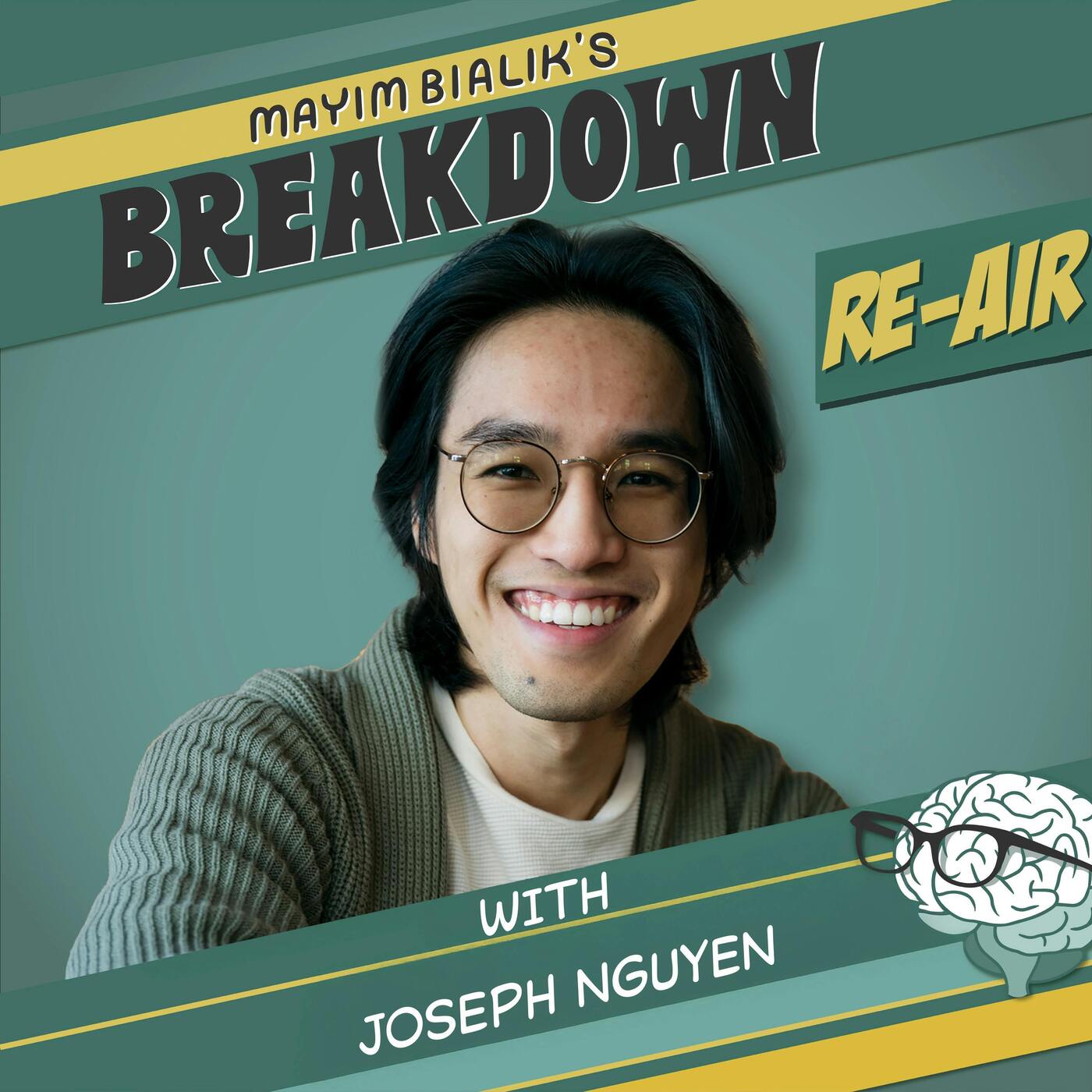
Mayim Bialik's Breakdown
Re-Air: We Aren’t Our Thoughts! Simple Steps to Achieving Inner Peace, Letting Go of Negative Thoughts & Becoming Happier, Healthier & Calmer
01:14:59
Loading summary
Transcript97 lines
- [00:04]
A
Hi, I'm Mayim Bialik.
- [00:05]
B
And I'm Jonathan Cohen.
- [00:06]
A
And welcome to our Breakdown. Today, in honor of Mental Health Month, we've got a really special revisiting of an episode that resonated with so many in our audience last year with Joseph Wen. Joseph is the New York Times best selling author of an incredible, very simple and very elegant book called Don't Believe Everything youg Think, why youy Thinking is the beginning and end of Suffering.
- [00:33]
B
It's like he wrote everything that was in my mind. I say mime, don't think like that and you won't suffer.
- [00:38]
A
Well, Joseph blew up on social media, in particular with younger folks. And actually this is a book I gave to both of my sons. He helped a lot of people realize that we truly can go beyond our own thinking and our own conditioning and live an abundant life that is free from suffering.
- [00:55]
B
He helps us break down how to find inner peace with practical tips that put a stop to overthinking, rumination and and how to actually start letting go of the thought patterns, behaviors and relationships that no longer serve us.
- [01:10]
A
We also talked about meditation, why your current practice might not be working, and what you can do to shift that. He also talked about his own rock bottom that he hit and the transformation that he made so that he could stop suffering. We got so much positive feedback on this episode when it originally aired. So if you have not heard this episode or if you need the reminders of tools to cope with anx, recover from burnout, and manage workplace stress, this is the perfect conversation to tune into. And we're re airing it now in honor of Mental Health Month.
- [01:45]
B
Just before we get to that, here's a crazy thought. Check to see if you're subscribed. Don't miss a single episode of Mind Bialix Breakdown. And if you want more content that is not available anywhere else, all ad free, check out Mind Bialix Breakdown on Substack.
- [01:59]
A
And now we hope you enjoy this episode with Joseph Wen. Break it down. Joseph Wen, welcome to the Breakdown.
- [02:07]
C
Thank you so much for having me. It's such an honor.
- [02:10]
A
I love this book. I also love that it's a small book. Like it's, it feels almost like it could fit in your pocket. The wisdom in it is very, very much like the kind of wisdom you'd like in your pocket.
- [02:21]
B
If I write a book that's the size of book I want to write,
- [02:24]
A
I want to start with one of the little sayings most of us only change when the pain of holding on to what we're attached to is greater than the fear of the unknown. This sort of taps into what I think a lot of people are coming to this book with meaning. I want to change. I don't like how things are going. I keep doing therapy, I keep working out, I keep dieting, I keep taking drugs, I keep drinking, I keep going to find the right partner, I'm trying to find the right job, I keep moving, I keep cutting people out of my life, I keep adding people to my life. And fundamentally, for a lot of people, nothing's changing. Can you talk a little bit about what is plaguing us? What is this kind of gnawing need to change and be okay? And how do you frame that in terms of how scary that is?
- [03:26]
C
Yeah, that's one of my favorite poems from the book. And we always want to be growing, we always want. But at the same time, paradoxically, we don't want to change. And so we can't have one without the other. And so with this book specifically, what I was trying to kind of unveil was, I mean, specifically in my life, I tried changing everything as well. I tried meditation, I tried all sorts of therapy, cbt, I tried acupuncture, acupressure, I even went vegan for quite some time to see if the foods that I was intaking was affecting my psychological and emotional well being. So everything that I did, it worked to a certain extent and. But then it wasn't long term, it wasn't lasting, it didn't give me the actual changes that I was looking for. And the reason was because in life we're always going to be exposed to a lot of different challenges, traumas and difficulties that is never ending. And so if we try to change our external circumstances without changing our own internal being, or more specifically, our own psychological frameworks with how we view the world, our own thinking is what I use in the book. Then nothing will change, Everything outside will change, but we'll still feel like we're not doing enough, we aren't enough, that we're not lovable, that we still have to do more in order to earn enough approval, love, respect. And that was the reason why I decided to write the book, was because I tried changing everything outside of me and that still didn't work. And achieved a decent amount of success. Enough money, having a house, having a partner, and all of these things that seemingly went well. But I was still ridden with an insane amount of anxiety and psychological suffering every single day. And it wasn't until I changed my own Thinking that everything around me started to change and it wasn't even the external things, it was just me that changed.
- [05:22]
A
A lot of the wisdom that you share and that you encapsulate and sort of explain in this book, much of it comes from Eastern philosophy, Eastern religious practice in some cases. But the problems that we are plagued by, they're timeless. And also there is a different set of pressures that I think a lot of people are feeling today. Can you speak a little bit to what some of the modern day, you know, pressures are and why, you know, this kind of ancient wisdom can still be helpful?
- [06:01]
C
Yeah. So back then, I mean, a lot of the stuff you correctly kind of insinuated that it does come from Eastern philosophy, some of it Western as well, a lot of Christianity influence as well. Since I was born and raised Catholic, all of this stuff, I mean, it's endured thousands and thousands of years and people still follow certain religions and certain Eastern practices. And so it still works for me. Some of the issues with trying a lot of those different modalities was that it kind of isolated me from the real world. It was very, very difficult to find out how to actually integrate these Eastern practices into daily life. How, how do I seemingly meditate while I'm in a meeting with my boss or having some sort of conflict with interpersonal relationships? That becomes very difficult. And I always like to say it's relatively easier to become a monk in the middle of the mountains where you're isolated and there's no one around and find peace there. But if you try to find peace in the middle of New York City, in Times Square, in rush hour traffic, then tell me if you're able to meditate and let that go. That's the true test in real life. That was really what I was trying to tackle. How do we make it more applicable? How do we make it simpler? And so back then, I mean, a lot of the issues and challenges were more physical. So, meaning we didn't have enough food, we didn't have enough water, we didn't have shelter. Those things are very difficult to go through. But even still back then, hundreds or even thousands of years, people were still suffering psychologically. People were still quite anxious, quite depressed and things like that. Probably less so back then than nowadays. But now the war has gone from the physical realm into the psychological or spiritual realm. And that's mainly because we have more time. So we're not working as long hours or as hard hours as back then. But now the fears have evolved from maybe, let's say, our physical lives and being afraid of potentially dying. But now the fears have shifted from that to if I am not loved by my friends, people at work or anyone else, what's the point of living if I don't have the approval of others and things like that? If I don't make it and become successful, then I'm a nobody and I'm insignificant and I'm worthless. So why would I keep continuing to live my life? So those are the shifts that have happened. But still at the root of it all is one thing, and it's been the same for millennia, which is fear. Fear is actually what we're tackling here. And that was alludes back to the quote that you were saying in the beginning, which is until the pain of where we are is greater than the fear of the unknown, that's when we actually make that shift. Pain is usually a great catalyst and motivator to jump into the unknown, straight into fear. And it's only on the other side of fear that we find everything that we want and are looking for.
- [08:56]
B
Mayimbialix Breakdown is supported by Bioptimizers.
- [08:59]
A
I struggled to get good quality sleep and I just thought, ugh, it's stress. But I learned during perimenopause and menopause, your hormones shift and it affects your magnesium levels. Low magnesium makes everything harder. Not just sleep, but focus, mood, stress tolerance. That's why we added Magnesium Breakthrough by Bioptimizers to our nightly routine. It's a blend of seven different forms of magnesium designed to support relaxation and overall sleep quality. Try it. See if you wake up more rested and refreshed, you've got nothing to lose and a lot to gain. BIOptimizers offers a 365 day, no questions asked money back guarantee. Magnesium Breakthrough is a fantastic way to improve that hormonal imbalance that especially happens with magnesium. And then you have better focus, you have better sleep hygiene in general. Bioptimizers makes it so easy. Here's what you get when you go to bioptimizers.com breaker and use the code breaker. 15% off your entire order and a free bottle of Mass Signs. That's bioptimizer's best selling digestive enzyme added to your order automatically when you use our exclusive code. That's a $20 product. Free. Free on top of your discount. This is a limited time offer. While supplies last. You cannot get this on Amazon. You can't get it in stores. The offer exists in one place. Our link, our code, that's it. So if you were already thinking about trying it. This is the sign. Go to buyoptimizers.com breaker use the code breaker. Grab it before it's gone.
- [10:24]
B
Make 2026 the year you finally start sleeping again. This episode is sponsored by Wandering Jews, an open door media brand.
- [10:34]
A
If you've ever found yourself feeling like you have more questions than answers, you're in good company. The Jewish people have been like that for thousands of years. Wandering Jews with Michal and Noam is a podcast where two of today's most dynamic Jewish voices, Michal Bittone and Noam Weissman, dig into the biggest questions about life through a Jewish lens. It's the kind of conversation where you'll laugh, learn something new, and probably shout in disagreement at least once. Michal and Noam tackle the tough topics like anti Semitism in America, what happens after we die, and the future of religion with guests like Bret Stephens, Michael Rapper and Sarah Hurwitz. And this past month, in honor of Jewish American Heritage Month, they've been celebrating some of the Jewish lives and institutions that have shaped American life, from food to music and comedy. Thoughtful, joyful, and always honest. That's Wondering Jews with Michal and Noam, a production of Unpacked. Find it on your favorite podcast app or on YouTube and make sure to hit subscribe. Check out Wondering Jews with Michal and Noam podcast and subscribe at Unpacked Bio nmx
- [11:36]
B
What did your suffering look like? You talked about all the things you tried and I think it's interesting to explore some of those and the shortcomings. But what did suffering look like for you?
- [11:46]
C
Yeah, great question. So my story goes back to my parents and that was the main reason why I kind of went down this path. My parents immigrated from Vietnam in the 80s and kind of plopped over here in Florida and mostly because it fell to the communists back then. And so my dad had a decision to make which was to either fight for the communists or to escape. And so he chose to just leave and he became a refugee in Thailand and after about a year or two he was able to come over to the U.S. my parents met over here and their primary goal was to give their kids a chance that they never had back then in their in their country. Knowing that they also started businesses over here. So my mom started a vital business. My dad started multiple gas station chain stores after the 08 crash. He lost essentially everything and my parents went into just over a million dollars worth of debt. So growing up I felt a lot of that financial pressure from them. They would hide it really well, but I could. You know, as kids you can always feel what they're, what they're thinking and going through, but even if they're not saying it. So that, to me, I kind of felt that a lot, especially because they came over here with, with literally nothing but the shirts on their back and no English. So they had to learn all of that from scratch. And to see that they are still going through such a difficult time over here, I just felt like that wasn't quite fair. So then I kind of made it my own personal mission, if you will, to help them get out of that debt. So that's. So I went to college for about a year and a half, but then actually left because I kind of did the math and I went for four years, graduated, made 40, 45,000 a year. I was like, there's no way that I can help them pay off that debt. And so I kind of left and started my own, my own business and advertising agency. And that's where a lot of the stress kind of stems from. For my own personal suffering, starting any sort of endeavor on your own is quite difficult. And so, I mean, I helped my parents scale their own stores and was able to help them significantly alleviate a lot of that financial pressure. And I also achieved a decent amount of success there with tons of clients and making them amount of money that I wanted to. The only issue is, after all of that, I didn't realize that I achieved all of that at the cost of my own mental health. And so I kind of asked myself like, was that worth it? Day in, day out, I didn't know where clients were coming from. I didn't know if I was going to have enough food on the table to take care of my partner. I didn't know, I mean, mostly anything and what was going to happen. And there were so many different platform shifts and things like that. So it was always uncertain every single day. My partner, now wife at the time, she suffered a lot of mental or physical illnesses. So she had gastroparesis, paralysis of the stomach, and so she couldn't eat. She got a feeding tube, was hospitalized multiple times, and so she's only eating 2, 300 calories a day. So we had no idea if she was going to be okay, how she was, if she can get cured. There was seemingly, and they confirmed that there was no cure. So that was going on at the time. Plus, my business partner and I had a falling out and split. So I went into 50,000 worth of debt around like 21 years old. So all of that happened within a very short amount of time. And my parents and I weren't on, like, good speaking terms because I left the very thing that they said. They literally left their country to come over here to give their children, right, the opportunity to go and have an education. So all of that was happening within a span of about 1 or 2 years. And so, you know, you could say that I hit rock bottom at that point.
- [15:29]
B
How old were you when you hit that rock bottom?
- [15:32]
C
That was probably 22.
- [15:34]
B
You were 22?
- [15:35]
C
Yeah.
- [15:35]
B
Which is a fantastic age to hit a bottom if you're going to hit it.
- [15:39]
C
Yeah. I don't know if that's going to be the last bottom, but
- [15:43]
B
what you're describing is the entrepreneurial American experience, plus many other stressors. I can relate. I went to graduate school. I wanted to be in the film world. My father, that was like the craziest thing you could possibly do. There was no certainty in it. He worked his whole life so that I could continue having stability. He wanted me to go into business or economics or something that had a stable path. And what I hear in your story is a collision point between parental values, working really hard, the entrepreneurial experience, which is anyone who's ever started, especially a service business, you never know where the clients are coming from. You never know how it's going to go. Expectations are constantly changing. Managing clients and delivery and then additional client acquisition is. Is impossible. If you ever have had someone in your life who is sick, especially with something that is mysterious or incurable. The pain and pressure of navigating the health care industry and alternatives to the health care industry are totally overwhelming. So you're dealing with an enormous amount of uncertainty there. It's a collision course of stress, anxiety, terror and more.
- [17:08]
C
I think everyone goes through something quite difficult. Right. I don't particularly find the need to compare, but I think everyone has their own battles, their own wars that are immensely difficult. And so that's kind of how I view anyone nowadays is like just imagining what. What kind of what internal battle that they must be going through. And having that. That lens gives a little bit more compassion, a little bit more love, a little bit more understanding to why they're doing what they're doing. Right. So coming from that lens it gives, it just helps me find a little bit more peace for myself, knowing that it's probably not personal. Kind of looking back on my story and seeing like, yeah, that's what I was going through as well, you know, everyone still goes through it.
- [17:52]
B
What did your coping strategies look like? At the time when you were struggling like that, were you spiraling? Did you turn to distraction like many people do? How were you keeping yourself together in whatever way that together meant?
- [18:08]
C
Mostly it was just overworking. I would probably categorize myself back then as a workaholic and just delve deeper and deeper into it. I was probably working 10, 12 hours a day, six, seven days, mostly just to distract myself from whatever this, this, this pain was. And the more that I did, the more stressed I became. So that didn't. That was kind of like a vicious cycle. That didn't help at all. As I realized that it wasn't really helping, that's when I started to seek different solutions. So like I was saying before, it was delving into all sorts of therapies, hypnotherapy, cbt, like Reiki, and doing all sorts of different types of meditations, Vipassana, transcendental, tons of different things like that. I was studying Dr. Joe dispens at the time, went to his retreat for like seven days, and I think they were doing meditations for six, seven hours a day, which was. Well, it's like probably 10 times more than I ever have done in a single day. So all of those things, going vegan plus trying, you know, studying stoicism and Hinduism, delving deeper into some of the Christian background that I had, just trying desperately to find a solution, because surely it's got to be out there somewhere. But it was. It was years of searching, reading tons of books and things like that. And all of that, I think, like I was alluding to, was it worked temporarily. So, like, if when I was meditating, the meditation worked while I was meditating, but then as soon as I opened my eyes and went back to work or whatever it was, all the anxiety would come back and just plague me. And so that puzzled me more than anything else. And so that's when I kind of asked myself, like, why is that the case that I only feel okay while I'm doing the modality, but not outside? What is the mechanism that was working there? And so I kind of realized that during those types of things or meditations or therapy, there was something that was happening in my mind that shifted. And what was happening was that I just wasn't thinking anymore. I wasn't actively judging myself, I wasn't actively judging my thoughts, I wasn't actively judging other people. And that negative judgment was the root of all of the psychological and emotional suffering. And of course, there's events in our lives that are very difficult and can Cause emotional suffering. But after an event has passed and it's gone, then any sort of emotional suffering that we have about that event is no longer from the event. It's actually from our own thinking about the event. And one scenario that I love to paint the picture for this for is there's so many people that have. That go through immense trauma in their lives, and a lot of them are similar traumas. But how is it possible that these two people who have gone through similar traumas can have radically different outcomes in their lives? One can spiral down into a deep depression, into drugs and all sorts of things and never get out of it. But the other person is able to turn the corner and to make peace with themselves in the past and to dedicate their whole entire lives to helping other people do the same thing and to dig themselves out of that hole. So how is that possible if they've gone through something similar? And so that's when I kind of realized that it's not the. Our emotions don't come from external events, but from our own thinking about the events. The difference between those two people now is how they view their past versus trying to prevent that from ever happening or trying to change the past, because no one can go back in time and do that. So those people didn't go back and somehow revert the things. And so that's the epiphany that kind of sparked this book. And. And yeah, that was like years, if not like almost like a decade in the making to find that epiphany, you know, but seemingly overnight, then a lot of that just surfaced into my awareness. And then I saw it for what it was, and I was able to let go of it a little bit easier.
- [22:06]
A
I think a lot of people confuse their feelings with their thoughts about their feelings. And that was a really interesting distinction that, that you make that there's a difference between feelings and your thoughts about your feelings, and then there's a difference between thoughts and thinking. So can you sort of tease those apart for us?
- [22:31]
C
Yeah, of course. It's so complex that I was like, how is. How can we possibly try to understand this? This one of the most, like, powerful tools, you know, created in nature. And so I had to create some sort of paradigm or framework to kind of simplify things so I can find peace a little bit easier. And so in my mind, I kind of found out that there was difference between thoughts and difference between thinking. Thoughts are neutral observations about the world, or it can be intuitive promptings. And then thinking, on the other hand, is Our own negative judgment or story about the thoughts or events that are happening. Let's take, for example, it's raining outside. The thought is. Let's say that's a neutral observation, is, oh, it's raining outside. The thinking. An example of that would be, this rain ruined my day. Why does this always happen to me? I'm so unlucky. All of these things that we say about whatever is happening, that is thinking, the criticism, the judgment, all of that, and that is actually unnecessary. And what causes this emotional suffering?
- [23:40]
A
But let's say it's raining, and let's say I. I'm just like devil's advocate here. Let's say I was planning a birthday party for, you know, a child, let's say, and, you know, 50 people are supposed to be arriving. How could I not have some complicated feelings about the rain?
- [24:04]
C
Oh, yeah. I mean, that's a great example right there. And so it's. It's less about trying to prevent negative emotions from ever surfacing. That's. That's obviously going to happen, especially during an event like that. But it's. It's more about how long do we want it to let it affect us? Is it going to ruin the entire. The entire day? Is it.
- [24:25]
A
Oh, it could ruin the year. It could be all we talk about for a year.
- [24:28]
C
Yeah. Oh, it definitely can. And that's how I think, you know, most of us kind of navigate life, right? We keep going back and replaying that scenario in our heads, is kind of ruminating on it, judging it, and just saying this is the worst thing ever. And just freezing in that. That fear and that resentment towards whatever is happening. Is that better or is the alternative better? Which is. Can we say that that really sucks? Like, I had this whole thing planned. I was planning for weeks and weeks and weeks. Like, it's supposed to be a huge birthday party. This is really unfortunate, but what can I do now, right? So what thoughts can I use which are neutral observations or intuitive promptings like what creative thought can I use here to maybe change whatever the outcome is? Maybe we change it to like a pool party where they're wet anyway, and they can just play there. That's when we can start shifting into more productive thoughts rather than kind of detrimental thinking that doesn't get us anywhere anymore. It's not always simple to do that, but that subtle shift will certainly alleviate a lot of that emotional suffering.
- [25:29]
A
Let's take truth. If you're thinking about something that's true, where does thinking become a problem?
- [25:37]
C
Yeah. So a scenario of let's say some sort of fact that happened. Let's say we lost our job. That is factual. An unfortunate event, Right? So that is a. The thought there would be. That's a neutral observation, is I lost my job. Thinking, on the other hand, is, I'll never get another job again. This is the worst thing that's ever happened to me. I'm never going to be able to feed my family. Like, my family is just going to judge me. Like, everything everyone thinks about me is absolutely true. I'm worthless. All that. So that. All of what I just said. There is a form of negative thinking that cripples us, that prevents us from taking action, that prevents us from experiencing any sort of peace. All of that doesn't actually change the event that happened. Now, a lot of times extend the time horizon to maybe a year, five years. There are many times where people say, like, losing my job was the best thing that's ever happened to me. So how can that be true if that event was seemingly the worst thing that's ever happened during that time? And the big difference there was their thinking about it changed. So they shifted from this is the worst thing I can never find another job to, well, maybe I can find something else. Maybe I can do something else. Like what? What would I do now? For example, for me hitting that rock bottom and losing, I mean, I lost probably 80, 90% of my clients within six to six months to a year timeframe. That was probably the worst thing that could have happened in my business. But at that time, when I was in that rock bottom, I asked myself, well, if I'm here and I'm already at the bottom and it can't get much worse, what would I want to do with my life if I don't like doing this advertising anymore, if I don't like the clients that I was working with, what do I want to do? And the question that I asked prompted the answer, which was, I wanted to write, and that was the inception of the book. And so that was an example of me shifting from judgmental thinking about the situation to generative and creative thought, which is, oh, like, what are the other possibilities?
- [27:39]
A
Here you make a distinction in the book between this kind of transformation that we need to have and positive thinking. Meaning, this is not a book about, you just need to look on the bright side of life, right? Because I think a lot of us are often told, like, you're cynical, you're too negative. Like, just think more positive thoughts, like, everything's gonna be okay. Like, everybody's always like it's, hey, happening for the best, you know, how is what you're talking about a different framework than just think more positive?
- [28:13]
C
Yeah, that was one of the things that, that really bothered me when going on my own journey of, of trying to heal from a lot of these things that happened. And I tried a lot of the positive thinking. And this is not to say that doesn't work. All I'm saying is there's alternative options to finding peace, and positive thinking is not the only way to do that. So an example that I paint in the book is if you kind of recall a time that you were the happiest in your life, totally in flow, how much positive thinking was happening during that time? Probably not much. Same thing with thinking in general. Like, how much mental activity was going on, let's say, like during wedding day or during the time that we accomplish something or with our loved ones at an amusement park or with our kids, whatever it is, the majority of the time there's really not that much mental activity. There's. There's very little judgment going on, if any at all. And so that was a big insightful moment for me, which is just realizing that joy doesn't exclusively come from thinking about something and being happy about it. I'm not constantly, like, walking in nature and just saying, oh, I'm so happy. Like, this is amazing. Like, I'm so grateful for this, this leaf, this tree, this branch. And like, is that really the only time that I'm going to be happy is if I'm mentally repeating to myself and narrating my entire life, like, how it just like, we already talked ourselves so much? So that would just make me go senile. So that's when I realized that, oh, we don't have to quote, unquote, think positive positively in order to find joy in our lives and. Or even peace. And actually, more often than not, not thinking or not judging at all is going to lead us to more happiness and peace rather than the other way around. Because a lot of times if we're starting to think, let's say, too positively, if that's a thing, and saying this is the best thing ever, like, this is the best day, this is, this is the best job, or this is the best person ever. And what happens when the partner that you said is the best thing ever does something that you don't agree with or wrongs you in some way? That positive thinking that you just created now is being challenged. And that might not be true in this specific moment anymore. And so that's when positive thinking can have a negative turn where it might not reflect reality as it is. And that's why I like going back to the idea of thought versus thinking and thought being. There's a neutral, objective observation of what's going on. Like that is true, that is reality. And from there building a base so that you can build it from truth rather than some sort of illusion that we want to experience all the time. So that was what happened to me. And one other question I love asking too is when we're really anxious and stressed, you know, how much thinking is going on. It's quite a bit, right? And so that to me, like the juxtaposition of those two things helped me realize that oh, like overthinking doesn't solve problems, it creates them. And so that helps me begin to unravel a lot of the thinking going on and begin letting it go rather than to constantly entertain it.
- [31:28]
A
So you talk about non thinking. What does it mean to be in a non thinking state?
- [31:35]
C
Remaining in a peaceful state is kind of difficult to do, I guess, to kind of grasp conceptually and even more difficult to implement. So I needed some other way to describe what this action was. Being at peace is very vague. Going into a state of non thinking is a little bit more actionable once I explain it. So non thinking, how I define it in the book, is not necessarily having a state of no thought. It's just a state of not actively judging, negatively judging whatever thoughts or events are happening right now. So you can be in a state of non thinking while still having thoughts of oh, like I'm sitting here right now or there's a tree out there, I'm on a walk. Like those are, you know, neutral observational thoughts and that doesn't really cause any suffering. And that's the state that we kind of want to be in of like just observing things as they are versus creating an illusion in our mind of what we wish it would be. This is very, very true, especially for people wishing our partners would be different, better, whatever it is, right? Acting a certain way, our parents, interpersonal relationships, we always wish that events or people were different. And that kind of creates a the schism in our mind of oh, like now we're going to constantly judge them and say, why can't you just be or uphold this certain standard that I have of you. Why are you being different than what I thought you were? All of that creates so much suffering for us rather than allowing people to be as they are and kind of accepting that even if it's not quote unquote ideal. It gives them permission to be themselves. And also you can give yourself permission to do the same thing. And from that place we can understand others better. And that's what you know, more generally leads to a more happy and fulfilling life when we come from a place of love versus judgment.
- [33:29]
B
Mind Bialix Breakdown is supported by bioptimizers.
- [33:32]
A
You know, I struggled to get good quality sleep and I just assumed it was stress. But as I learned during perimenopause and menopause, your hormones shift in a way that affects your magnesium levels. And low magnesium, it makes everything harder. Not just sleep, focus, mood, your tolerance for stress. That's why I have added Magnesium Breakthrough by by optimizers to my nightly routine. It's a blend of seven different forms of magnesium designed to support relaxation and overall sleep quality. Try it. See if you wake up more rested and refreshed, you've got nothing to lose and a lot to gain. Bio Optimizers offers a 365 day, no questions asked money back guarantee. Magnesium Breakthrough is a huge breakthrough to improve hormonal balance, to help with focus, decrease brain fog, improve sleep hygiene. Overall, Bioptimizers makes it very easy. Jonathan, what do they get when they go to bioptimizers.com breaker and use the code breaker?
- [34:24]
B
You get 50% off your entire order and a free bottle of Mask Bioptimizers
- [34:29]
A
bestselling digestive enzyme that'll be added to your order automatically when you use our exclusive code.
- [34:34]
B
That's a $20 product, free on top of your discount already.
- [34:39]
A
This is a limited time offer and while supplies last, you can't get it on Amazon, you can't get it in stores. This offer exists in one place. Our link, our code. That's it. So maybe you were already thinking about it. This is the sign. Go to buyoptimizers.com breaker. Use the code breaker. Grab it before it's gone. Make 2026 the year you finally start sleeping again. And so that's also a way of kind of distinguishing between thoughts and thinking. Meaning you can state a concern that you have without it consuming you to the point of needing to change the other person or change your expectations.
- [35:13]
C
Yeah, and that's exactly how you set boundaries. You're saying this is what happened. This is how I'm reacting to whatever's happening. Is it possible that we can have a different outcome? And if not, we can't change other people. But maybe there's something that we can, we can air out here or maybe Just by communicating that alone, the other person didn't even know what they were doing. But by simply bringing that to the surface, more options are now available than before. And that's where something creative can happen.
- [35:41]
A
You have this five step process to stop thinking. And I wonder if you could talk us through it.
- [35:48]
C
Yeah, so the framework is aptly named pause. So the goal again isn't necessarily to stop all mental activity because that's kind of difficult. I think only monks might be able to do that after maybe like a decade of meditating for several hours a day. That's probably not achievable for most of us. But by using this framework, you can find more peace quite quickly and in a matter of minutes. And it's a lot more actionable than just saying, oh yeah, just observe all your thoughts and let go. It's like a step by step process. So the first, so pause is an acronym and the first letter is P, which is to pause and to take deep breaths. And you know, a lot of science has shown how helpful deep breathing is in order to help regulate our emotions and our nervous systems. And so that's really the first step is to calm the body down. Because if we're in a fight or flight state, it's very, very difficult to stop the thinking. Because if we think that we're going to die or something is actually dangerous, then there's no way to really stop that runaway train. But by intercepting with our own consciousness, then we can actually create space. That's what deep breathing does, is regulating us and creating space. So taking deep breaths, it only takes maybe about five deep breaths. You don't have to overcomplicate it. There's a box breathing technique, there's 4, 7 and 8. But just take deep breaths, you'll be a lot better than not doing it. And so once we're slightly calmer, right, like you don't have to be totally calm, but calmer. The next step is a, which is ask yourself, is this thinking useful? Whatever negative judgment I'm having right now, is this helpful and is it making me feel the way that I want? If not, the next step is you, which is understand that you have the ability to let that particular judgment go. We might not be able to change the event, we might not be able to change the neutral observation of that event, but we can let go of the negative judgment about the event and about ourselves. Because a lot of times we just blame ourselves. We constantly criticize ourselves, saying this is all our fault. We're always like this. Nothing's ever going to change all those things that we say and think about ourselves, that is something that we can let go of rather than the event. So that's you, which is understand that you have the choice to let that go. Then the next step is S, which is say and repeat the mantra. Thinking. You know, specifically, like negative judgment, thinking is the root cause of suffering. Now you can use any mantra that's rooted in truth at this step. And the reason why mantras are so effective is because it's quite difficult to think of two things simultaneously. So by having and repeating a mantra, which is the basis of transcendental meditation, your mind is singularly focused on this one thing. So it's quite difficult to negatively judge something or think about the past or do something else when you're saying this mantra and focusing on it repeatedly. So that helps to quiet and calm the mind as you're doing that only takes maybe 30 seconds to a minute to do that. And other mantras, for example, is I let go and choose peace. That is another mantra that you can use that really grounds you into yourself and reality. So that's S and then E, which is. A lot of times people will kind of assume that, oh, like if you just stop thinking, aren't you just bypassing the emotions or whatever is going on? And that's not what we're trying to do. What we're doing is actually letting go of the judgment about the situation so that you can actually process the emotion that's going on. What happens is the more that we judge an emotion, that's the exact energy that perpetuates it. So by doing that, we're kind of digging ourselves deeper into the hole. But as soon as we let go of that, that particular judgment, then we're able to allow that judgment to pass through us. And emotions pass quite quickly when we're not resisting anymore. I think some neuroscience and studies have been saying it's like 90 seconds or something like that. If we're not constantly ruminating on that particular thought anymore, which is quite fast, I don't think most people can probably do it that quickly, but you can definitely do it in a few minutes. Maybe not the entirety of the emotion, but it can. The intensity of it can be significantly reduced. And over time, the more that you kind of see it for what it is and are able to let go of the judgment, then we're able to regulate a lot more easily. And so that's the whole entire process. It's just P Is pause and take deep breaths. A Which is, ask yourself, is this thinking helpful? Is it useful? You would just understand that you have the ability to let that go. The judgment of it. S is saying, repeat the mantra. Thinking is the root cause of suffering. Or I choose peace. Or I let go and choose peace. And E, which is experience your emotions fully without resistance to it. Allow yourself to. To go into it without judging it, without saying, without resisting it, without saying, I shouldn't feel this way, right? If that happened, all of that only perpetuates it. So the more that you're just able to sit there with the emotion and say, oh, this is. This is what it is. I'm creating space for it, I'm honoring it, the more quickly it will pass. You know, that process you can use over and over again, and it's best used in real time. So a lot of times we meditate only in the morning or only at night. This is something that radically changed my own life, which was to use it while I'm working or while I'm out and about, maybe in traffic or talking to other people. In your life, in your life, you know, like, it only takes a few minutes. Doing it while you are experiencing some sort of heightened emotion is where you're going to get the biggest benefits of it.
- [41:21]
A
I think that's something that a lot of people miss. And I include myself, myself in this category. You know, many of us think that we're. We're supposed to sort of like fill up the meditation cup, right? Like, you fill it up and then it's supposed to just magically sustain you. Or well, I did my meditation. I checked it off the list. Like, I did it. We're fine. Right? But what, what the idea of something like a meditative practice is, is ideally supposed to do is to infuse your physiological and spiritual consciousness throughout the day. So that you're sort of training your nervous system, you're training your body to operate in an optimal way. But as you indicated, the stresses of life, those are happening throughout the day in ways that sometimes, you know, filling that cup in the morning or at night is not going to sustain you. So this notion is that these things are happening all day. Big emotions are going to come all day. If you're working, if you're in a relationship, things are going to happen throughout the day. This is a method to sort of take with you that is constant.
- [42:30]
C
Yeah, that's exactly it. And if we're not doing it, I mean, you know, don't get me wrong, meditating in the morning and at night is Immensely helpful than not doing it at all. And what that is doing is just literally training our bodies. It's kind of like athletes, when they go into training and literally go into the gym and train all that stuff, but they still have to perform when it's time. And so our life is that performance. And so we need to actively do that in life. And that's where we're going to find a lot more peace and. And regulate it in real time.
- [42:58]
A
Right. And for some people, and for some people, they may find that meditating once a day or twice a day lowers their nervous system and therefore things come easier. But for someone. For someone like me, I'm just still having spikes all day. You know, like, I get real calm in the morning and then I'm like kind of spiking all day. And then I have. Oh, I feel really calm. And I, you know, was able to do that before I went to bed.
- [43:20]
B
If we go back to the losing your job example, I'm wondering if this entire approach, which I believe in, and I have had success trying to eliminate thinking, but if I'm presenting it to a general public, sometimes it seems like
- [43:36]
A
he's not thinking at all.
- [43:39]
B
I have no need for it. Lots of thoughts, no thinking.
- [43:43]
C
Exactly.
- [43:44]
B
But if I'm considering an audience member who is like, my intellect is my greatest power, and by using my thinking, I solve all these problems. What you're suggesting to me is being super passive. But I would posit that it requires a level of accepting uncertainty and saying that we do not have the perspective on our life and situation to make the judgments in the moment. That there is a larger perspective. There is a God's eye view to our life. There is a path that is unfolding that we may not see even in the difficult times, that if we can trust in that path, the next step will be revealed or a larger perspective and that it is not good or bad in the moment. Can you speak about the necessity to. To have a spiritual perspective or connection in order to achieve this level of calm and peace?
- [44:41]
C
Yeah. I love the nuance that you're bringing into this. So. Well, I think there's a quote by Rumi or someone similar that says the path is only revealed when you, you know, take the next step. And so that's. That's very true for life. There's no way that we can possibly think of every single possible outcome that will happen from this decision. What I will say is it's less about not using your mind in order to create things. It's more about releasing the judgment behind those things. So the criticism of maybe I'm not good enough to do this or everyone else is better than me or people are going to judge me when I'm doing this. All of that is the thinking that's unhelpful. But when we're solving problems, we're actually using what I would call creative thought, which is thought that is again, that's like more intuitive, that's more creative, it's more expansive, that's non judgmental. So all of that can most certainly be used. And so an example of that would be, you know, if we're creating some sort of new business, most of those thoughts that you're generating or you know, problem that you're solving your business are, is going to be creative thought. Where it goes into the dangerous thinking territory is this business is going to fail because whatever, or I shouldn't do this because a lot of people are going to judge me or it's never going to work because of xyz. All of those things are more so unhelpful than actually helpful. But the more that we kind of use that creative thought, the more successful that we're going to be. That's where the source of where songs are written from, where art comes from. That's something that's far greater than our own minds. Most of us, our minds work by trying to take the past to try to predict the future. But how can we create something new if we're constantly just referring back to what already happened? So that's why a lot of us kind of relive the same life over and over again, the same days, over and over again. We're not intercepting this pattern of thinking to say what can we do differently? What's something new that I haven't tried? And that's again going into unknown territory. That's the uncertainty part of it. Starting anything new is going to be very, very, very daunting. But that's exactly the thing that we need to face a lot of the time in order to create the change that we want. And so the more that we can kind of sink into that feeling of fear and saying, okay, this is a feeling of fear and it can't actually kill me, but it will take the life of all of my dreams and desires if I listen to it, right? And so that's why I love this practice of feeling the emotion fully, without resistance and allowing ourselves to, to, to see it from that perspective and say like, okay, I'm still going to do this because this is What I truly want, I value my freedom, my sovereignty, my growth. What I really love, like let's say this, this dream, I value that more than whatever other people might say or whatever judgment I might be making of myself.
- [47:39]
A
I wonder if you can talk a little bit about intuition. You talk about it a bit in the book and I'm sort of on a quest to try and understand what intuition feels like. And I guess you know it if you've got it, so maybe I don't. But I wonder if you can talk a little bit about how kind of non thinking and in particular kind of understanding your thoughts in this way can. Can help you have an opening to understand intuition.
- [48:11]
C
Yeah, intuition is probably one of my favorite subjects to talk about. It's so elusive though, and very difficult to kind of make the abstract concrete. But some of the best ways are examples. So in life a lot of times we make, let's say, quote unquote mistakes, if you want to call them that. And many times it comes from listening to fear or this judgmental thinking. It's playing it safe mostly trying to fit in, to be liked, to be approved, to be loved, to feel like we're enough. But by doing that, we're actually denying our true selves. And I would argue that our intuition is our higher self, if you want to call it that. Some people can call it God, some people call it higher self, whatever it is, right? It's something beyond the hypercritical judgmental mind of ours. And we access this all the time. It's whenever we are trying to problem solve. It's whenever we are doing music, art, anything creative, we are tapping into intuition. Athletes actually view or utilize this significantly more than people who don't play as many sports. But let's say, for example, they're already training, right? It's very intensive and things like that. But when they're actually in the game, they're in a state of flow and they're not really thinking about things as much anymore. And actually the people that are like missing the shots at the free throw line or whatever, those are people that are thinking way more than the people that aren't. Most of the people that just make it, they're just not thinking about it, just going, going, going, going. All that practice, all that time that they put into it, they just trusted in it, their instinct, their intuition. That's where like I was talking about flow really comes from. As soon as we start judging our own thoughts, whatever we're doing, we get cut off from that source. And so intuition Also can be felt when we're making major life decisions, but we really don't know why. So if you kind of. I like to run this thought experiment and I ask, like, you know, think about, think about, like, some of the best decisions you've ever made in your life, the ones that radically change for you and your life for the better. Like, how much of that was made from a fearful, judgmental thinking, and how much of that was made from intuition. For example, choosing the partner that you're with now. How do you know when to marry the person or when to leave a person? How do you know when to take up this job or leave a job and it ends up being the best thing you've ever done? Meeting your best friends, a lot of this stuff, it was just so random. It was serendipitous. It was. You decided to go to this coffee shop one day that you usually never go to, or you took this route randomly because you're like, oh, it looks nice over there. There's a dog. And you just went there. And somehow you stumbled upon your. Your best friend, your partner, or some person that led you to finding whatever it is in life that you. That you really admire now. So that just all came from following your own intuition. And it's unexplainable. Like, we have no idea why we did that. We just knew that we probably should. Should marry that person or should leave that person, should start this job or leave this job, start this business, leave this business. You know, most of those decisions, the most important ones that really change our lives for the better came from intuition more than anything else. And so that's why I try to lean more so on that side than, you know, judgmental thinking. And a lot of times you can. It can warn you of things like that, but view it from a more objective stance. You can go back to intuition and say, okay, now that all that. Now that all this data is available to me, what do I feel is right? And a lot of times it's going to be opposite of what most people say. It's going to be opposite of what your parents say, what your friends say. Most of those things that turned out for the better. Like a lot of people in your life probably told you it's probably not going to work out. Like, you probably shouldn't leave college, or you probably shouldn't start that business, or you probably shouldn't do music or whatever it is. And then if you did it and when you did it, now everyone's like, oh, we believe in you. All along. We knew you were going to be so successful in doing all this stuff. That's actually what happened with my book and things like that. And it's like, thanks for your support now, that's great. I still love them all and things like that. But you're the only one that kind of knows what you want in life, that knows yourself best, that knows your dreams. No one else knows that more intimately than you. And so you kind of have to pave your own path. Like, there's no way that I've never seen two people who, quote, unquote, made it or became successful follow the exact same path. And that's because they followed their own intuition. They knew that this was something that they truly believed in and wanted to do. All the major inventions in the world came from that place of intuition. Like it didn't exist before. So they can't just use the past to try to predict the future. It's just they had to create it from scratch. And that's. Those are just a few examples of intuition that I can best explain it in.
- [53:07]
A
I was Talking to my 16 year old about new ideas, specifically trying to introduce him to some of the ideas about consciousness and spirituality and sort of the quantum mechanics of, you know, understanding probability states of, you know, the placement of electrons and things like that. Like you do and.
- [53:24]
C
Yeah, yeah, easily.
- [53:25]
A
Well, he, he started kind of like, he started kind of vibing on it. You know, he was like, I was,
- [53:30]
C
oh, yeah, I love quantum entanglement.
- [53:31]
A
Yeah, Well, I was like talking about consciousness and he was, was kind of like, I could see that. And I was talking about some of the scientists we've had Thomas Campbell on, and we were talking about some of the scientists that are exploring, you know, aspects of consciousness that previously, you know, were owned by the realms of, of spirituality and mysticism. And he was kind of really connecting to it. And then the next day, out of the blue, he's like, you know, I was thinking about what we were talking about. He's like, you know, and how like people used to think, like, Copernicus was crazy. He's like, Copernicus was kind of weird. He was, he kind of had weird stuff. So maybe we shouldn't, shouldn't have believed Copernicus. And what this was, was his way of trying to resist these new ideas about consciousness by going back in time to say, like, well, maybe, maybe that was. Copernicus was wrong. You know, like, we're, we shouldn't be here. It just reminded me of that, though, in terms of the way we want to twist, you know, we want to kind of, like, twist reality to make it sort of fit, you know, what we're comfortable with. You also, you have a really beautiful explanation of love in this sort of context that I wonder if you can talk about. You. You talk about with your partner. You had a set of thoughts about why you love this person, and you had a very specific kind of formula that you had designed for what equals love. And I wonder if you can describe how you experienced love versus how your partner did and how you can understand the differences in. In terms of this framework.
- [55:01]
C
Yeah, it's. It's so interesting how a lot of this kind of leads to the same destination. Like how trying to find peace also allows you to find more joy and at the same time, more love in life. And it's so. It's all interconnected, and so it's. It's quite difficult to kind of extrapolate and dissect it when it all leads to the same place in terms of love. I experienced it more intellectually in the beginning, which was, oh, I love this person for these sets of reasons. She is intelligent, she's funny, she loves helping people and all these different things. And there's a checklist. And I was like, oh, yeah, that's why I love her. That makes sense to me. And then one day I kind of just questioned that, and I was like, what happens if she doesn't exude some of those qualities one day? What if she somehow does something that's not as intelligent one day? Or, you know, he makes fun of me in a way that I don't like or whatever it is. And it's like, do I still love. Like, if she doesn't make me laugh one day, do I still love her? And so I was like, that's weird. I do. So then it's like, why? Why is that the case? And so that means that this set of criteria doesn't work anymore for love. And that puzzled me more than anything else. I was like, so why do I love her? And every time I would ask my. She's now my wife, I would always ask her every. I think every year, bless her soul. I was like, why do you love me? She's like, you know, I listed off, like, the 20, 30, 40 different reasons of why I loved her. And I was like, okay, like, your turn. Like, what are you. Like, like, what do you. Why do you love me? And she's like, I don't know. Like, I just do. And I was like, what? Like, what do you Mean you don't know why you love me? Doesn't make any sense, like, does it? That means you don't actually love me. And she's like, no, I obviously still love you, so how can you say that? And so for her, she had a different model for love, which was, it wasn't tied to particular reasons. That means because for my model, I kind of connected reasons to loving her, which means that if she didn't have those reasons anymore, that means I wouldn't love her. But now that I saw this new model, I was like, oh, that doesn't work anymore. And so she had almost no criteria for love and she just knew that she did. And so what that means is that she loved me unconditionally regardless if I excluded certain traits one day or another and didn't another, whether I did something wrong or bad or whatever it is, like she knew that she would always love me. And so I was like, oh my gosh, like that's how true love is. It doesn't judge, it doesn't say that I only love you when this happens. And that's another view of God that, you know, some religions have, which is like, you know, if God is, is all knowing, all loving and unconditionally loving, then he's going to love us no matter what we do. And I, I thought before too, like, oh, God wouldn't love me if I, like sinner, did certain things, right? And it's like, oh, that's not true. So then this view of unconditional love is more of like a quote unquote godlike view, which is no matter what happens, no matter what you do, no matter what you say, like, I will still love you. And I was like, oh my God, like that's what the true marital vows are, you know, through, through sickness and in health and all that stuff. That's what it, that's what it means. And so I started to let go of a lot of these reasons that I thought I needed to love her. And now I, I'm able to love more deeply, more unconditionally from a place of a lot less judgment, right? And so I became just so much more like fluid about it. And that love can now extend to like many different other people, right? And so that's how I can view like my family, that's how I can view friends and anyone that I come across. It goes beyond the barriers of, of of reason.
- [58:50]
A
I wonder if you could talk a little bit about your parents reaction to your success because, you know, it's, it's like a little bit like, it's a little counterintuitive. You know, you went on this path to try and help your parents, which, you know, I think a lot of people would be like, why is that your responsibility? But in the family that you come from, that was not unusual for it to be a burden that you all shared, you know, and shouldered together.
- [59:17]
C
That's the culture.
- [59:18]
A
Right. So, you know, I wonder if you went down this path of trying to do something with the express purpose of, let's say, helping them or, you know, earning financially so that you could help them. And it ended up, you know, I don't want to say falling apart, but it sort of. It crumbled because it wasn't, let's say, the right fit for you and your psychological development. And what came from that, you know, this kind of like lotus, you know, rising from, you know, a challenging, muddy situation, you know, actually turned out to be something that in your own healing has become a very successful, you know, business. And I'm not just talking financially. I'm saying you became more of the person that you always wanted to be. How do your parents kind of view the. The journey that you went on?
- [60:14]
C
Yeah, that's. That is a journey, to say the least. So I'll take you back to the beginning, which was when I decided to leave college, which was definitely a difficult decision. One of the more difficult decisions. I knew I wanted to leave, but they, of course, did not. And it was crazy because I had a full ride. Everything was paid for. Like, there was no reason. Not like I was actually getting paid more than what the tuition was. So I was literally getting paid to go. And they were like, why are you doing this? This makes absolutely no sense. Like, you have everything paid for the cushion. Everything's going to be secure for you. Why would you leave? This thing that we all have built, it just didn't make any sense. And it got so bad. We have these family dinners for Christmas and things like that. It's like all of our family's here. So it's like 40, 50 people at this maybe 2,000 square foot house, and we all just cram in here. This is the best time. And so one, I think his Thanksgiving, I think it was Thanksgiving and I was just eating there. My own business. Like, eating turkey is great. And my parents are like, hey, like, oh, can you come out here? We want to show you something for a sec. And I was like, okay, yeah, sure. Like that. They're going to show me, like, my grandma's new plants. Or something. And I walk out and there's like a semicircle of all my aunts and uncles and they're all standing there and my parents are like, hey Joseph, like, do you mind telling us like your plan that you have so that all of the aunts and uncles can listen? And it was like 10, 12 different aunts and uncles. And I was like, what is going on? Like, what kind of intervention is this? So I had to explain to them my whole vision, which was to leave college that I'm fully getting paid for and making a profit on somehow. And I was going to leave and go into this extremely unproven, uncertain business that I had no idea how I was going to make it successful to hopefully pay off your debt of like a million dollars. And all of the aunts and uncle, like that was the plan. And I was like, I'm not going to stop until I make something happen. And that was my whole goal, right? I kind of did the math and I showed them like going to make 40, 50 grand from this thing after four years. And if I do the math, it's going to take a decade to get to maybe 100,000, maybe. And by that time you guys are like 60, 70 and like, who knows? Like we're still going to have this massive debt and it's probably going to compound because interest. And so they all looked at me and they're like, and they looked at my parents and they said, like, why are you stopping him from doing this? Like, he's trying to help you guys and you're just like getting in the way. And so like it just, I was like, I was so baffled and stunned that like a lot of the aunts and uncles was just like, just let them do it, just let them try. Because I had a fallback plan of like, yeah, if this didn't happen in like a year or two, right, then I'll just go back. So they're like, I mean, yeah, it's still risky, but you still have a fallback plan. You can still do whatever you need to and you'll probably still be safe. Like you're decent, like half intelligent kid. Like you could probably figure it out. And so my parents are like, oh, that's weird. So it just completely backfired, which was funny. But they still did not agree with it like at all. And so they were, they were very mad. They actually didn't talk to me for about a year after that happened. And you know, we were just kind of distant. And eventually I was able to kind of Grow the business. And I actually just helped them and. And marketed their own businesses, and it grew. So my mom expanded to multiple stores. She was able to pay off, like, the majority of the debt now, because a lot of these things. And so, you know, throughout that time, after about a year or so, we started to make amends and to become closer. And now they're, like, so elated that I went down this path. They're like, we're so grateful that you left and kind of followed your own gut and intuition on doing this. You definitely helped our business. And then now we're able to pay off this debt and all this stuff. And they're super proud of the book and everything, but they. My mom was like, why do you want to write? Like, you're gonna. You're not gonna make any money? Like, there's no point. Who's gonna listen? Like, you don't have a degree. Like, why? Like. And I was like, I know, mom. I already thought about all this. Like, I know I'm telling myself this as I'm, like, trying to go to sleep. So she's, like, super realistic. It's hilarious. But now she's like. So she, like, now goes. And whenever she has a new conversation with anyone, she's like, have you heard of this book? Like, she's, like, literally handing out free copies, like, telling everyone to buy it. It's just hilarious. And so it completely flips, right? And I think that's the case for most people that kind of follow their intuition on this stuff, which is, like, once you kind of make some traction and see some external success, then everyone comes flocking back in there, like, yeah, we believed in you, like, the whole time. But before that, everyone. Most people are going to resist it, and it's not out of ill intent, right? It's just because they want what's. What they think is best for you. They want to protect you. They want you to be, you know, successful in the safest way possible. But we all know that's, you know, that doesn't really happen. You kind of have to take the uncharted path, you know, maybe not, like, initially, but through all the circumstances that they've been through, through sacrificing so much to come over here, you know, working way more than I did, right? If I. If you thought I worked a lot, like, they worked twice as much, plus still donate donated, like, all their weekend to the church and were just amazing people. They gave so much. So, like, all that was just fuel for me to, like, really make something happen. Just Because I didn't, like, I couldn't, like, bear just standing or. And looking at them and seeing, like, why is all this bad stuff happening to really good people? And now I kind of understand how those. Those challenges really shaped them and me to be able to do this. So, like, I wouldn't trade that for the world. Right. So it's like hindsight's 20 20. It's like, oh, yeah. Like now looking back, this is like the worst thing that ever happened, but the best thing that ever happened.
- [66:26]
A
First of all, it's a great read, and it's also very beautiful. And in addition, it's super practical. And, you know, the back of the book you dedicate to practical exercises and in some cases, thought experiments, writing experiments. Why do you think this is resonating so well? You know, in particular with. With Gen Zers? Kendall Jenner mentioned you in Vogue magazine that she really? Yeah. Did you not?
- [66:52]
C
Oh, I have no idea.
- [66:55]
A
Yeah, In. In. In Vogue in May 2024, she said that she learned about you on TikTok and.
- [67:02]
C
Oh, no way.
- [67:03]
A
Why do you think that the message that you're delivering is resonating, especially people right now?
- [67:10]
C
I think a huge part of it is just, like, luck and timing that I don't really have a hand in. So I definitely want to acknowledge that. On the other hand, I had some part to do with it because I obviously had to write something down to share it. And I think what I did was I didn't write it with the intention of trying to prove anything, trying to sound smarter than I was, or trying to convince anyone of anything. Actually, I wrote it for myself. And I wanted to document some of the paradigm shifts that. That I had personally that really helped me find more peace and joy in my life. And if no one read it, that would be okay. And that's because now I have it for myself and I'm able to experience that. But I kind of went with the idea of if I can help one person, that would have made the whole writing process worth it. And so it was just raw, unfiltered. I let go of all potential negative judgments about it. So, like, not having a degree, not having any background with, you know, neuroscience or anything like that, not being a monk in the middle of the mountains for years or decades. That's why in the back of the book, like, I'm not even there. Like, there's no picture of me. There's no bio. Because I wanted people to focus on the message, not the messenger. Because I'm. I'm Pretty much irrelevant in the equation because if something is useful, it's actually useful, right? Like, objectively, no matter, like, who brought it to you. So to me, I, I acted as much as I possibly could as a, as a conduit and a channel for, for the message. And I removed any sort of personal, like, tint that I could have had on it. Of course, a lot of it came from my own life experience, but I tried to just be really authentic and truthful with whatever it was and didn't try to spin anything. And I wrote the book that I wish I had was mainly it. Right. So why the book is so short is because I actually don't read that many books. I read very, very slow. It's quite embarrassing. And so I was like, if I'm going to write a book, it better not be in an encyclopedia because I'm not going to read it. And I had to read it on social media to share it. So I tried to write it as simply and as short as possible because I knew people were short on time. I personally didn't want to read a Bible. And that's actually how my mind works. It doesn't understand very, very complex things very quickly or easily. So I try to distill down everything that I learned as much as I could. And I think because of that, people really value simplicity and a practical thought process rather than like over explanation or over explaining something. So I'm so grateful that people resonate with it because I, I really had no idea if, if anyone would pick it up or not, and certainly not Kendall Jenner.
- [70:07]
A
So. Well, I mean, if you have an endorsement from Deepak Chopra, which you do on the back of your book, you don't really need to put your face like, that's a really big endorsement. So between that and Kendall Jenner, who says that, yeah, your book helped her start shifting her thinking and dealing with her anxiety. That's a, that's a pretty good, pretty good audience. So before we let you go, May is mental health awareness month. So I wonder if you want to sort of, you know, give a thumbnail explanation of, of how, you know, this kind of thinking can be helpful to people who might be struggling.
- [70:40]
B
If someone is listening to this that is suffering right now, what would your message be to them?
- [70:46]
C
One of the most important messages that I can share with you is that you're not alone. This is a battle that I think almost every single human on earth is fighting and that we're all fighting with each other. And so I hope through this episode and through some of my work and writings that you're able to find a little bit more solace in life. It might not solve everything in your life, but hopefully it gives you a little bit more relief so that you can begin trusting yourself again and to let go of a lot of the negative beliefs and judgments that might be, that might be plaguing you right now. And so knowing that, that you are not your thoughts is one of the most empowering beliefs that you can begin to adopt. And once you understand that, you can then discover who you truly are, which is beyond your thoughts. And one example I love giving is if the last thought just left your mind, how are you still here? So this means that we are something beyond our thoughts, beyond our mind, beyond our past experiences, beyond all the negative judgments that you have about yourself, other people or other people have of you. And so that is where true joy and peace can come from is this space that is beyond all these things. And so I hope this helps you.
- [71:59]
A
The book is Don't Believe Everything you Think. Why youy're Thinking is the beginning and end of suffering. And you have so many other books, they've been translated into dozens of languages. Such a pleasure to talk to you. Thank you. Joseph Wen.
- [72:11]
C
Thank you so much. It's such an honor to be here.
- [72:13]
A
Break it down. The end of Don't Believe Everything youg Think has a bunch of very helpful exercises and some of them are writing exercises and some of them are thinking exercises. But one, one thing I wanted to talk about was how you create a non thinking environment. Jonathan, how would you create a non thinking environment?
- [72:33]
B
I would just stop thinking.
- [72:36]
A
Sounds very easy. Okay, so he actually encourages us to list, like make a list of the things that make us more likely to overthink, to ruminate and to become anxious. So for example, physical health. You would, you would listen to the things in your physical health that are likely to make you overthink your physical environment. Like noise, temperature, location, things like that. Digital environment, checking your phone, like what are the things in each of these categories? Also digital consumption. He's big on what you put in affects what comes out, right? So the input, if you're inputting with checking your phone notifications, email, social media, all these things. So he wants you to, to list those things and, and then identify the top three triggers that affect you most in each of the categories and then you can start to implement ideas to minimize the overthinking regarding those categories. He encourages journaling. He's big on journaling and writing. I think for many people, it's kind of like, yeah, I just need to stop thinking. I need to stop thinking. Or if I can meditate, then I'll stop thinking for five minutes at a time.
- [73:45]
B
I want to clarify what I meant. The first thing that I've actually done and felt like it started to make a difference was identifying thinking, to say, oh, wait a second, what I'm doing right now is actually thinking. And there's a level of subjectivity to that process that I'm on the roller coaster of. And by identifying it as thinking, then it stops being the reality, stops being an ultimate truth, and it can be malleable.
- [74:13]
A
What I heard a lot of was a lot of emphasis on acceptance, meaning there are all sorts of things that are going to happen. It's our struggle with them that takes us from the thought to the thinking to the ruminating that if we are in acceptance, for example, of the rain, right, if we're in acceptance, it's not that you can't feel disappointed that you're the birthday party is canceled because it's raining, but the notion of how much do we tell a story then about these things always happen to me. I should have checked the calendar, I should have checked the weather, or I shouldn't have planned an outside party. All of that stuff is the stuff that trains your nervous system to keep being anxious. I mean, that's really what it is too. So the notion that you use these tools throughout the day is a way to try and keep. Keep lowering your tendency to continue to be anxious.
- [75:10]
B
My background as a writer has been about narrative. And the intersection with mental health has always been, for me, the idea that in every single thought, there are endless stories. One thought is a building block to a story. So in the birthday example, the fact that it rains and someone can go to I shouldn't have planned this party begins a narrative. That's the jumping off point of a story. When we start those stories with, oh, I shouldn't do this, I can never do that, I'm a failure. Because it puts us in such an intense psychological state. And we know that that creates a cascade of chemicals in our body that make it really, really hard to find solution spaces versus that's really difficult. I acknowledge that. But where is the opportunity in this? Well, instead of this big outdoor party, maybe there's a smaller group gets to play indoors and celebrate what that brings, which could be a really intimate connection that we may not have foreseen. For me, what it goes to the most is not believing that we have the ultimate idea of how things should unfold. And if a wrench gets put in the plan or there is uncertainty that it could be that something great is. Comes out of that, that we couldn't have imagined in the first place. And that's not a failure, and it's not weak to say, oh, I wasn't able to implement the exact thing that I wanted.
- [76:39]
A
You can only come to that when you are coming from a place of expansiveness and an opening and seeing things as some sort of opening while also experiencing the feelings that come with it. So this chart is really, really, you know, helpful. You know, the difference between thought and thinking. So if a thought is, is seen as something light, the thinking would be heavy, right? How do you find the, you know, how do you find the way to still persist and, and acknowledge lightness for what it is without emphasizing heaviness? You know, if the thought is love, the thinking is fear. If your thought is about love, the fear that it will go away, the fear that it's not right, the fear that you did it wrong, the fear that someone will betray you, that's the thinking surrounding love that turns it into fear.
- [77:32]
B
I want to touch on this idea of heaviness versus lightness because it's a very tangible, somatic sign of the difference between the two. When we think this horrible thing is going to happen, that's not really intuition as much as it is thinking. When we have a premonition of something bad, we usually have a direct insight into doing something differently or making an action. When we think, oh, this horrible thing is happening, or I shouldn't have done this, or I'm bad for this, we literally like our shoulders round, our heart gets heavy, we feel like a weight on us. And when we think in a different way, where there's more up, uplift, more positivity, our shoulders relax, we pick our heads up a little higher, and our limbs can literally feel lighter. So when people get into practicing the difference between those two, it can show them a barometer for how they're thinking.
- [78:33]
A
I found a lot of comfort in discovering that my thinking is the beginning and also the end of my suffering. Meaning, just like my thinking can create suffering, my thinking can also end that suffering. So we hope that you will find that to be true as well. Don't believe everything you think for more breakdown to the one we hope you never have. We'll see you next time.
- [78:53]
B
It's Maya Bialik's breakdown. She's gonna break it down for you. She's got a neuroscience PhD or two. And now she's gonna break down.
- [79:04]
C
So break down.
- [79:05]
B
She's gonna break it down.