← Mayim Bialik's Breakdown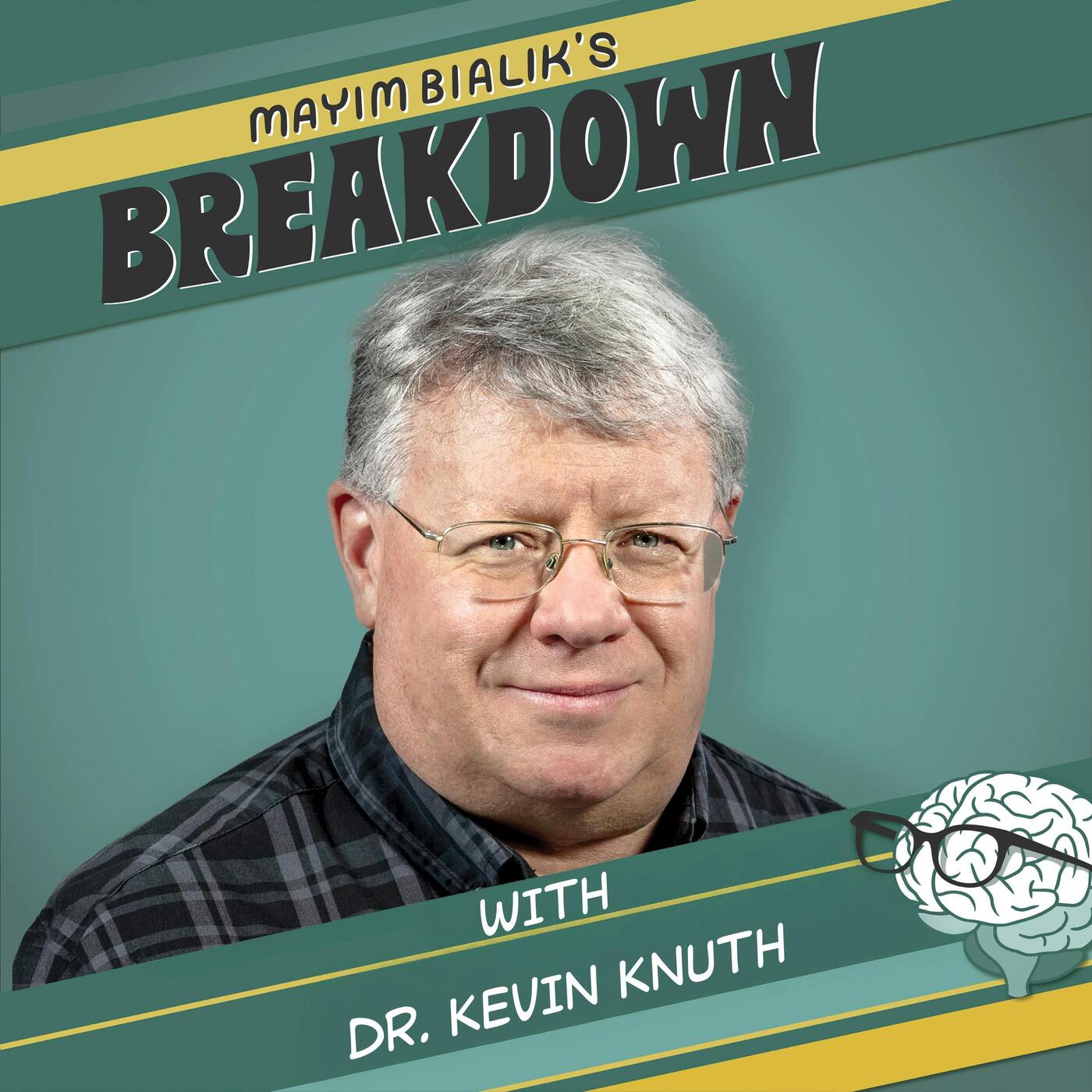
Mayim Bialik's Breakdown
NASA Physicist Takes UFOs Seriously: Dr. Kevin Knuth on Aliens Already Living on Earth, Nuclear Missile Shutdowns, and the Government Cover-Up
00:44:26
Loading summary
Transcript138 lines
- [00:00]
Jonathan Cohen
Mind Breakdown is supported by Helix Sleep.
- [00:04]
Michal Bittone
Spring is in the air and so are all of the allergens that come with it. Spring allergens means you need more sleep,
- [00:10]
Imbialik (Maya Bialix)
but there are a ton of factors
- [00:11]
Michal Bittone
that can prevent us from getting a good night's rest. Night sweats, back pain, Feeling the person next to you when they roll over a million times.
- [00:19]
Imbialik (Maya Bialix)
We were so excited to hear that Helix wanted to partner with us.
- [00:22]
Michal Bittone
I've had my Helix mattress for about
- [00:24]
Imbialik (Maya Bialix)
five years now and I have been
- [00:26]
Michal Bittone
sleeping so much better.
- [00:28]
Imbialik (Maya Bialix)
Jonathan and also our kids love their Helix mattresses and all of those issues.
- [00:32]
Michal Bittone
Night sweats, back pain, motion transfer. Those things are significantly better with a Helix mattress. Helix delivers your mattress right to your
- [00:40]
Imbialik (Maya Bialix)
door which is so much fun. With free shipping in the US they
- [00:43]
Michal Bittone
have a 120 night sleep trial and limited lifetime warranty. Plus they're happy with Helix Guarantee Rest easy with seamless returns and exchanges. The Happy with Helix Guarantee offers a risk free customer first experience designed to ensure that you're completely satisfied with your new mattress. Go to Helix Sleep do slbreakdown for 27% off site wide. That's helixsleep.com breakdown for 27% off sitewide helixsleep.com breakdown early birds always rise to
- [01:11]
Verbo Ad Voice
the occasion for summer vacation planning because early gets you closer to the action. So don't be late. Book your next vacation early on verbo and save over $120. Rise and shine. Average savings $141 select homes only when
- [01:25]
Imbialik (Maya Bialix)
you say shutting down nuclear missile sites,
- [01:28]
Dr. Kevin Knuth
one of the professors said, I have friends who work up at Malmstrom Air Force Base and they have problems there with UFOs flying over the nuclear missile sites and shutting down our nuclear missiles. He said, yeah, yeah, they're often UFO sightings when that happens. So I started paying attention.
- [01:44]
Michal Bittone
Dr. Kevin Knuth is a professor of physics and a former NASA scientist willing to go where most of his colleagues won't.
- [01:50]
Imbialik (Maya Bialix)
UFOs, UAPs, and the possibility that aliens
- [01:54]
Michal Bittone
might already be in our solar system.
- [01:56]
Dr. Kevin Knuth
I look through cases where you have something unexpected. When people are abducted by gray aliens that were 60% reported they were given babies to hold. Why would anyone report that?
- [02:10]
Imbialik (Maya Bialix)
Specific things that keep popping up all over the world.
- [02:14]
Dr. Kevin Knuth
Nepal to Congo to Chicago. But here's the interesting surprise. They could have discovered Earth. A long time ago, Congress noted that UFOs had become more aggressive toward our pilots in war zones. And if you think of them as having found Earth, they may have the mindset Earth is their planet. We could end up In a conflict eventually. I don't think anybody's ready for this.
- [02:41]
Imbialik (Maya Bialix)
Hi, I'm Imbialik.
- [02:43]
Jonathan Cohen
I'm Jonathan Cohen.
- [02:44]
Imbialik (Maya Bialix)
And welcome to our breakdown. As you can tell from my T shirt and if you can see close enough, my earrings. Today is a day when we're going to discuss the impossibility of aliens. Our guest today is someone who has the incredible opportunity to study unidentified aerial phenomena. UAPs from the perspective of physics. He is a professor at University at Albany. That's SUNY Albany, New York. Kevin Knuth is a professor of physics. They focus on the scientific study of UAPs.
- [03:20]
Michal Bittone
He's a former NASA research scientist.
- [03:23]
Imbialik (Maya Bialix)
He worked at the Ames Research center in the Intelligence Systems Division. This episode is a perfect example of how we can blend skepticism, curiosity, criticism with open mindedness and the ability to to open our conscious experience of what is here and now into a possible understanding of what is beyond what we can see and measure. We're going to be discussing some of the most compelling data out there in terms of speed, acceleration, the amount of power required to even be able to imagine how UAPs would travel. Dr. Knuth is also going to walk us through the statistically significant and disturbing reports of UFO sightings surrounding military and nuclear activity. What is going on? What should we be concerned about? And where do we go to get the information about what happens next? We're going to talk about who we can trust with this information.
- [04:21]
Jonathan Cohen
We're going to touch on the unique characteristics of 3i atlas research that's being done to test actual debris from crash sites and what we can learn from that.
- [04:31]
Imbialik (Maya Bialix)
We're also going to talk about the water world hypothesis. What would it mean to imagine that
- [04:37]
Michal Bittone
aliens might not be traveling from other
- [04:39]
Imbialik (Maya Bialix)
places, but might actually be here already
- [04:41]
Michal Bittone
and they might be underwater?
- [04:43]
Imbialik (Maya Bialix)
You're going to want to make sure you listen to the very, very end of this episode where we ask Dr. Knuth what has personally happened to him that makes him believe that the study of UAPS is scientifically not only necessary, but critical to our understanding of our humanity. Before we welcome Dr. Knuth, you can find out more about his research@albany.edu giving uapx if you want to learn more about what it means to support this kind of research. Dr. Kevin Knuth, welcome to the Breakdown. Break it down.
- [05:20]
Dr. Kevin Knuth
Hello. Thank you so much for having me.
- [05:22]
Imbialik (Maya Bialix)
I'd like you to give us a framework of why you do what you do in terms of your study of UAPs.
- [05:30]
Dr. Kevin Knuth
I was born in 1965, so I was 4 years old with The Apollo moon landings. And I remember them. I remember my dad holding me just after we watched it on TV and pointing up at the moon and saying, there are people up there. And that had such a huge impact on me. And so I was thrilled to see Artemis to go around the moon. 1977, I was, I was what, 12 years old. And that's when Star wars came out, which of course had a huge impact. And at the same time, at night, 6:30 at night, they would play In Search of with Leonard Nimoy and In Search of. Always had some UFO things which were always exciting and interesting. Went to graduate school at Montana State University and got my master's degree in physics there. And when I first moved out there, that would have been late summer of 1988. I'd been living out there for about a week or so, and classes had just started. And there was a cattle mutilation in Bozeman on a ranch that night. There were a hundred phone calls to the Sheriff's office about UFOs. And then you have this cattle mutilation where there were two cows that were killed and surgically manipulated. It was very bizarre. And this was all over the news. And people were worried that, you know, it's aliens or it's Satanists. And those were the two main explanations that those are the two hypotheses everybody ran to, right? And we were discussing this in the physics department and the, some of the new students were, you know, we've all, you know, you've been to grad school, so, you know what? You, you move to a new place, you're going to be, you're going to be there for five years. So the conversation was kind of more centered around what kind of crazy place have we all just moved to and how are we going to navigate this, right? And it was a pretty heated discussion. And one of the professors came out of his office to see what the commotion was. Clearly we had bothered him and, and we told him and he, he didn't have any words of comfort for us. In fact, it was even stranger. He said, yeah, yeah, that happens from time to time. And there are often UFO sightings when that happens, but people look into it and they never figure it out. And then people forget about it until it happens again. Like, well, that's not very satisfactory. And then he tops it all off with this additional statement. He goes, you know, I have friends who work up, who are in the Air Force who work up at Malmstrom Air Force Base in northern Montana, and they have problems there. With UFOs flying over the nuclear missile sites and shutting down our nuclear missiles. And, you know, we listened politely. And when he walked away, to be honest, we laughed our butts off because it was. It was hard to imagine that that's even possible. Right. The UFOs are shutting down our nuclear missiles and our government isn't on high alert. I mean, this isn't all over the place. So we. Nobody really believed that. And that kind of became a running joke for the year. Anytime somebody would say something strange happened, somebody else would chime in. Yeah, but, you know, it's really strange. UFOs are shutting down nuclear missiles at Malmstrom Air Force Base. And we would all laugh. And so that stuck with me until I was here at UAlbany teaching. And this would have been about 2015 or so. So it's before the New York Times article still by Wesley Kane and Ralph Blumenthal and Wayne Cooper. And so it was before that. And I was teaching a course in astronomy and preparing for a lecture on astrobiology and possibility of life elsewhere. And some of my students wanted me to talk about UFOs. And I didn't know what to talk about except the Drake equation or the Fermi paradox. So I was just poking around on the Internet to think about, is there anything intelligent I can actually say? And I stumbled on a. The press conference held by Robert Hastings in 2010, where he had five or six people from the Air Force talking about UFO incursions at nuclear missile sites. And the first person that he talked to was Robert Salas, who was at Malmstrom Air Force Base. And I. And I got that. I was like, whoa, whoa, whoa, wait a minute. I heard about this 30 years ago, right? It was. I heard about this when I was in grad school from a physics professor.
- [10:11]
Maya Bialix
And.
- [10:12]
Dr. Kevin Knuth
And it just. It just hit me like, you know, a ton of bricks. Like, wait a minute. This. This is very possibly real. And what. And nobody's doing anything about it. Nobody's even knows about it. And this could be incredibly dangerous. And it just. I was very concerned on hearing this. And then I. So I stayed up, I watched. The whole press conference was like two or three hours, I don't think. I went to bed till like 3am that night, had to get up early for class. It struck me as that somebody needs to look into this and see if this is really real. And so I started just paying attention. I was paying attention. I started reading up on the topic and getting anything that I could that seemed reasonable. And. And then when the New York Times article came out to talking about the OR a TIP program. Then I thought, yeah, this scientists need to be involved. Somebody needs to be studying these things. And so I decided to try to study it. I don't know what I can do, but I thought let's first I'll do my homework. Let's just do what you should do is so we have a set. I found there were a set of encounters where they had descriptions of how fast these objects were moving. And I thought, well, I can at least, at the very least I can estimate speeds and accelerations and get some idea of what we're dealing with here. And that really shocked me that the speeds and accelerations were crazy. I mean crazy huge. The observers would have to be very, very, very wrong for those numbers to be anywhere close to that. So I found that really amazing.
- [11:55]
Jonathan Cohen
This episode is sponsored by Wandering Jews, an open door media brand.
- [12:00]
Michal Bittone
If you've ever found yourself feeling like you have more questions than answers, you're in good company. The Jewish people have been like that for thousands of years. Wondering Jews with Michal and Noam is a podcast where two of today's most dynamic Jewish voices, Michal Bittone and Noam Weissman, dig into the biggest questions about life through a Jewish lens. It's the kind of conversation where you'll laugh, learn something new, and probably shout in disagreement at least once. Michal and Noam tackle the tough topics like anti Semitism in America, what happens after we die, and the future of religion with guests like Bret Stephens, Michael Rapab Port, and Sarah Hurwitz. And this past month, in honor of Jewish American Heritage Month, they've been celebrating some of the Jewish lives and institutions that have shaped American life, from food to music and comedy. Thoughtful, joyful, and always honest. That's Wondering Jews with Michal and Noam, a production of Unpacked. Find it on your favorite podcast app or on YouTube and make sure to hit subscribe. Check out Wondering Jews with Michal and Noam podcast and subscribe at Unpacked Bay Bio NMX
- [13:02]
Jonathan Cohen
My imbal breakdown is supported by bio Optimizers.
- [13:05]
Imbialik (Maya Bialix)
I struggled to get good quality sleep
- [13:07]
Michal Bittone
and I just thought like g it's stress. But I learned during perimenopause and menopause, your hormones shift and it affects your magnesium levels. Low magnesium makes everything harder. Not just sleep, but focus, mood, stress, tolerance. That's why we added Magnesium Breakthrough by Bio Optimizers to our nightly routine. It's a blend of seven different forms of magnesium designed to support relaxation and overall Sleep quality.
- [13:30]
Imbialik (Maya Bialix)
Try it. See if you wake up more rested
- [13:32]
Michal Bittone
and refreshed, you've got nothing to lose and a lot to gain. BIOptimizers offers a 365 day, no questions asked money back guarantee. Magnesium breakthrough is a fantastic way to improve that hormonal imbalance that especially happens with magnesium.
- [13:47]
Imbialik (Maya Bialix)
And then you have better focus, you
- [13:50]
Michal Bittone
have better sleep hygiene in general. Bio optimizers makes it so easy. Here's what you get when you go to bioptimizers.com breaker and use the code breaker. 15% off your entire order and a free bottle of Mass Signs. That's Bioptimizer's bestselling digestive enzyme added to your order automatically when you use our exclusive code. That's a $20 product free on top of your discount. This is a limited time offer. While supplies last. You cannot get this on Amazon. You can't get it in stores. The offer exists in one place. Our link, our code.
- [14:21]
Imbialik (Maya Bialix)
That's it.
- [14:21]
Michal Bittone
So if you were already thinking about trying it, this is the sign. Go to buyoptimizers.com breaker. Use the code breaker. Grab it before it's gone.
- [14:30]
Jonathan Cohen
Make 2026 the year you finally start sleeping again.
- [14:34]
Imbialik (Maya Bialix)
Generally speaking, why, why are so many scientists of a variety of fields afraid to touch this stuff?
- [14:45]
Dr. Kevin Knuth
I mean, there clearly is a taboo against it. You know, a lot of it probably has to do with the way that it's been covered up by our government and other governments. And that is it doesn't take much to cover it up. Which is why it doesn't need to be a grand conspiracy theory. All you have to do is make fun of it. Just make fun of the witnesses and everybody laughs and giggles. They might report it on the nightly news and you know, the report, the anchor people are laughing, ha ha. While they're talking about it and they've got the little silly graphic of a saucer with a green person in it. And, and that's all it takes. And everybody looks like nutcases. So scientists don't want to get involved in it. Some scientists are very adamantly against it. Like, like when they find out you're working on it, you are no longer a scientist in their minds. It's a very strange response and it's not a response that you would expect a scientist to have. Scientists ought to be curious, right? And, and, and they have this strange expectation that there has to be some kind of smoking gun evidence. I mean, Michio Kaku uses that phrase all the time. There's no smoking gun evidence. Well, There never is in science. I, I study exoplanets and we don't have smoking gun evidence about what their atmospheres are like. We don't have samples, nobody's been there and nobody's actually seen the planet with their own eyes. But we know, know a lot about them. You get lots of little pieces of information and you piece that all together and, and under a theory you can make inferences. And that's basically how you work in science.
- [16:30]
Imbialik (Maya Bialix)
Humans like to find patterns and we, we are wired to recognize patterns and sometimes that means we will create patterns where they don't exist. And when we're talking about this kind of data, it's very tempting to piece it together into a pattern that points to there are aliens and they're interested in nuclear facilities. Can you give us a little bit of a background as to when people started talking about potential alien interest in nuclear sites, military sites? How legitimate is that and is that a place for us to start the investigation?
- [17:11]
Dr. Kevin Knuth
I think it is legitimate for a few reasons. I think first that this was recognized rather early on. In fact, I have an article from 1951 and it's put out by the Atomic Energy Commission and they're asking people to report UFO sightings near nuclear power plants. That's very odd. I mean, clearly somebody knew something was going on.
- [17:37]
Imbialik (Maya Bialix)
Right, but that's also selection bias. Right? Because if they were to say, we'd like you to report alien sightings near dairy farms, you know, I, I can't go back in time, at least not currently, and say, well, if we had been looking at dairy farms, you know, maybe, and again, I'm devil's advocate here. Maybe people who think that they're seeing UFOs will see them anywhere you tell them to look.
- [18:02]
Dr. Kevin Knuth
It's, it's, that's very true. Possible. Yeah, but I think, yeah, so, so I mentioned that because that was the earl piece of information that highlights that, a possible connection. You then have the. Many of the Air Force sightings are related to nuclear weapons being shut down. Which is, which is interesting. If the fact that they're actually somehow possibly interacting with these, whether they're into. It's an intentional interaction or non intentional interaction. It's not clear.
- [18:40]
Imbialik (Maya Bialix)
When you say shutting down nuclear missile sites.
- [18:44]
Dr. Kevin Knuth
Robert Salas describes this. Well, the UFO would come down and hover over one of the launch tubes for the nuclear missile and shortly after it would become, it would basically become deactivated. He's in one of his interviews, he said that it was a guidance, a guidance malfunction that caused the shutdown. So is. Is it an intentional shutdown? I mean, most people, I think, are assuming it's intentional, but doesn't need to be. If you have a guidance system running on this nuclear missile, the missile needs to know where it is. It needs to know that it's still in the launch tube. Right.
- [19:23]
Imbialik (Maya Bialix)
In the absence of other evidence, my first assumption is not alien. My first or second or even tenth assumption might be there's many countries in the world that would love to fuck with our missiles. Right. Like that. So I'm not necessarily going to ufo, but maybe you can give us a little bit more of the landscape, you know, of how we piece together all of these things to direct us towards that as opposed to many of the other explanations that some of us would come up with.
- [19:56]
Dr. Kevin Knuth
The main difficulty is this started, as far as I know, the. The nuclear missiles being shut down started in the 1960s. And so at that time, we didn't. Nobody had drones at that time. You don't have a drone. So these objects were behaving very much like what we would today call drones. Right. And. And so I think that was. That's one of the major difficulties. They were. When they were observed, they looked like what people described UFOs to be some of the descriptions, balls of light. And. And so this is where they went to that explanation. And it was apparently rather common. The. My. I was. My wife's from Louisiana. We were down for Mardi Gras two years ago. We were having a little barbecue with. With. For family, and we were grilling. And I was. I was at the grill with my wife's Uncle Matt. And I noticed he had his air. He was. He had been in the Air Force, and I never really thought about that, but he had a cap on, and his cap, you know, said Air Force and said Malmstrom Air Force Base. And I was like, what, wait, you were at Malmstrom? When were you at Malmstrom? And he said, the early 1970s, which is. Right. The time period when these shutdowns were happening. I said, did you know anything about UFOs shutting down nuclear missiles? He goes, oh, yeah, that happened all the time. And blah, blah, like, like it was common knowledge. And I was. And I ran and got my wife. I said, you have to come out here and hear. Hear this. And I had him tell her because I'm tired of being the only crazy person in the room. It was nice to have somebody else like, yeah, this was. This happened all the time. Yeah, so. So that, that's apparently it was not a rare event. And there's a nice study by the scientific coalition for UAP studies, and they were studying UFO sightings from 1947 to the mid-70s. They did a comparison of the numbers of sightings, UFO sightings at nuclear. Nuclear sites, either nuclear production sites or storage sites or weapon sites, and then compared that to military, nearby military bases and nearby cities. And it turned out that the. The nuclear missile sites had more. More sightings than the others did. And in fact, those sightings went back earlier. The sightings at nuclear sites started when the sites were being constructed, before there were any nuclear materials there.
- [22:40]
Imbialik (Maya Bialix)
If we were to think about, you know, a UFO that exists outside of this planet, right? Like, it's not here now, and it's coming down to, let's say, pick up, you know, some radioactivity detection system that's like, making it come down, whatever. Explain to us from a physics perspective, what are we actually talking about? How is this UFO actually getting here?
- [23:11]
Dr. Kevin Knuth
It's related to one of Carl Sagan's arguments against UFOs being alien. And that was he. He. He said something like, I have a hard time believing that you've got a craft arriving from interstellar space every Tuesday.
- [23:27]
Imbialik (Maya Bialix)
Right.
- [23:27]
Dr. Kevin Knuth
And I think he's right about that. I think that's not what's happening. I think they live here.
- [23:32]
Imbialik (Maya Bialix)
The Sagan perspective would be, in theory, that outside of our galactic kind of knowledge, there are places, Right. Where there are flying saucers, for lack of a better word, and they somehow can travel across time. Right. They're traveling from wherever they are at speeds that we don't even understand, Dan. Because technically. Right. That's where they'd be coming from is outside of our remote measurement.
- [24:04]
Dr. Kevin Knuth
Another star system.
- [24:05]
Imbialik (Maya Bialix)
Correct. From another star system. Great. So they would be then entering our atmosphere undetected until a moment of reveal. Right. Or until they need to, like, access whatever information they're here to gather. And then they are able to, again, like, against all of our measurement capabilities, disappear out of sight, sometimes in an instant, and then they exist somewhere in another star system with whatever information. I mean, one question I have, you know, consistent with that is like, why are they crashing? If they're sophisticated enough. Right. To be traveling across galaxies and star systems, they can't just keep steering correctly
- [24:49]
Jonathan Cohen
because they're fighting with the people they're traveling with. They're all hangry.
- [24:54]
Imbialik (Maya Bialix)
Their wife is saying, why don't you stop and ask for directions Anyway, So your solution to my question is they live here.
- [25:06]
Dr. Kevin Knuth
They have to live within one light day of this, of Earth.
- [25:11]
Imbialik (Maya Bialix)
What's a light day?
- [25:12]
Dr. Kevin Knuth
So that basically puts them in our solar system somewhere. So they have to be somewhere in our solar system and very possibly here on Earth already. The Soviets, when trying to study some of these objects, would make military maneuvers, especially naval maneuvers. So they would perform these large naval maneuvers that would typically just confuse the United States. But what the Soviets were doing is they would make this large naval maneuver and then UFOs would show up and they would study them. So they were actually moving military equipment around to get UFOs to come. And that would typically happen within 24 hours. So light travels 186,000 miles a second.
- [25:57]
Michal Bittone
Got it.
- [25:58]
Dr. Kevin Knuth
So you. So for a UFO to get here in 24 hours, the light would have had to travel out information some distance, and then they have to travel back.
- [26:07]
Imbialik (Maya Bialix)
If we're talking about us communicating with aliens and them receiving information enough for them to act on it and then show up, why on earth do they have to follow our information timescale of how bits and quanta travel through the universe?
- [26:28]
Dr. Kevin Knuth
This also happens with natural disasters. So with the Fukushima nuclear power plant disaster, there were UFOs there the next day.
- [26:36]
Imbialik (Maya Bialix)
What if their method of detection, information transfer, travel. What if none of it obeys any of the laws that we can talk about? And I'm not just bringing this up, like to give you a straw man. It's very interesting to me how we limit ourselves when we're talking about something like aliens, which is limitless as far as I'm concerned. They may be communicating on a level that we don't even understand. Like, you know, like the dog whistle. Right. Like, extrapolate that out. Like, they're operating on, like, an AI energy level that, like, no one understands. And it also, like, detects, you know, the, like, level of estrogen in my, you know, blood. I don't know.
- [27:21]
Dr. Kevin Knuth
No, that's a, that's a good point. And it's. It makes studying something that you don't know anything about very difficult.
- [27:29]
Verbo Ad Voice
Right.
- [27:29]
Dr. Kevin Knuth
You can either just say, I don't know anything about this, so everything's open, or you can say, well, I do know how this typically works. So if, if this is typically, you know, if information's basic, if they're getting information the way everybody else here does, then you're limited by the speed of light. And so that means that they have to not be that far away.
- [27:53]
Imbialik (Maya Bialix)
Okay, I'm willing to. So I'm going to go ahead and grant you that One possible solution, one possible, you know, explanation for numerous decades of reports of some sort of temporal connection between military or radioactive activity on this planet and some sort of increase in reports of sightings, activity, those. For those things to occur temporally, the logical explanation that we can provide within the framework of math and physics and science that we have, the logical conclusion would be they don't have to travel that far. Let's say aliens are within a light day of us. What should I practically be thinking about for a framework? Are they hiding in clear sight? You know, what does this look like?
- [28:50]
Dr. Kevin Knuth
I mean, that's a good question. We don't know anything about them or their intentions or what they're up to. So it's hard to know exactly. You, you, they probably have a. If they come from an, if they originate from another star system, then you would hypothesize that they have some type of, you know, base or colony or something like that here with, you know, the scale on. No, it can't be a huge scale because we would have noticed already. So, so it's in our. And are they hiding? That's very possible. They could be. They could be have a base on an asteroid in the asteroid belt and it would take forever to find that. They could be in our oceans underground on Earth. You know, you could do the same for some of Jupiter's moons. Europa has a 60 mile deep ocean. They could be living there. They could be from Europa. You know, they might not actually be from another star system. They could also be from Earth. They might have lived here the whole time and we didn't know it. So that's another possibility. There's so many possibilities, that's hard to know. There's also the. Michael Masters in Montana has suggested they're time travelers. So it's very hard to know what the situation is without being able to get hard data.
- [30:18]
Imbialik (Maya Bialix)
What hard data is the most compelling to you that supports that something is going on that is extraterrestrial, as it were.
- [30:27]
Dr. Kevin Knuth
The most interesting for me has been the speeds and accelerations and the amount of power involved in some of these maneuvers and also their luminosities. That's one thing that Bruce Maccabee had looked at when he was alive and Jacques Vallee has looked at, and that is that some of these craft are very luminous, like bright, you know, burning people's eyes, get people getting sunburnt, but these things are that luminous. And in fact, Choc Fillet has a paper that came out last year in the same special issue that our paper Came out in. Where they looked at a landing in northern Louisiana. And I think it was right at the border of Arkansas where the UFO had landed in a clearing. And a physics professor had actually seen the light from the object and realized that this thing was putting out megawatts of light and literally stopped in the highway, turned his car, went the other way, because I don't want to go anywhere near this thing, and that it actually scorched the trees. And so they did a study of the bark, the scorched bark, to get some idea about the energies involved. And so some of these. Some of the UFOs are putting out hundreds of megawatts of light. It's basically a nuclear power plant. Amount of light being emitted. Why you would need to do that is beyond me. And it's. It's. That's shocking. But that's something that humans wouldn't be able to do or wouldn't bother doing. So it would be. So it's very strange.
- [32:08]
Jonathan Cohen
This is being written about, you know, when some people who aren't in the space hear about a claim like that, that there was a craft that landed and was observed, they can say, well, there's. Where's. Where's the picture? How come we didn't have a cell phone? How come we haven't, you know, back to the smoking gun. But the article Valerie just posted says, estimates of radiative energy values in ground level, observation of unidentified aerial phenomenon, new physical. New physical data. So people are writing about this, and
- [32:41]
Dr. Kevin Knuth
in that case, there's hard data. There's actually the tree park.
- [32:43]
Jonathan Cohen
You're like, what is happening in that tree bark? What. What is happening that it's being observed in that way?
- [32:51]
Imbialik (Maya Bialix)
Do all indications point to alien? Not necessarily.
- [32:55]
Dr. Kevin Knuth
Not. Not all of them do.
- [32:57]
Imbialik (Maya Bialix)
Yeah, right. You always. You always have to think of, you know, is there an adversarial nation, experiment, terrorist, whatever, who is experimenting with things that we don't understand? Especially if it's from a country with technology that is secretive or that we don't know about. You know, these are all sort of like the. The possibilities that are there. I think the question is, you know, why is it so elusive, Dr. Knuth? Like, do you think that there's, you know, is there a plan to hide this? And just sometimes they don't hide it well. Like, what is the message that's trying to be communicated with kind of intermittent and disparate visitations like this? Is there a larger message that some of us might say, look, if this is happening, why is it happening? Sporadically. Why is it happening in this way? Is there interest? You know, and also, like, I'm a, I'm a contact fan, I'm an arrival fan, you know, is this, is it a benevolent message? Is there, you know, something we should worry about? Could it be that they don't believe in nuclear war and they'd like to destroy all of the reactors because they know that there's a greater love and peace than we have been able to access on this planet?
- [34:14]
Dr. Kevin Knuth
First, you're absolutely right. They're not all. We know for a fact they're not all alien spacecraft. I mean, most, most sightings have prosaic explanations, and that's 97% of the sightings or so are, have prosaic explanations and are usually misidentified aircraft. Misidentified human aircraft. Right. But UAP is still a class of objects, not a specific type of thing. So we don't have a taxonomy of what these things all are yet. So are some of them adversarial drones? Very probably. That's probably the case. And probably a larger percentage of those than there are alien craft. The most compelling pieces of evidence are usually the amounts of energy and power involved. I mean, if you think about it, you're putting, you got something putting out a hundreds of megawatts of light. It means you're dealing with that amount of power in your craft. Well, if you have a 1%. I mean, all of our, all of our human devices have some inefficiency to them. So Even if it's 99% efficient, most of our things are running around 20% efficiency. Right. We're not. Thermodynamics is hard. But if, even if they're really good, they got 99% efficiency, that means there's a 1% inefficiency. And if they're putting out 100 megawatts of light, that means they've got 1 megawatt of power going into waste heat inside the craft, which is incredibly dangerous. You wouldn't be able to do that. That wouldn't work. So it's not clear how to even interpret the results because we don't know how you could engineer something like that in the first place, why you would do it or how you would do it. It's, it's really not clear. And I think that's some of the most compelling pieces of evidence. But, but most, most sightings are not those things. Right. And I think that's one thing that's been difficult. I mean, I still have, even scientists will ask me how do UFOs fly? I said, well, they fly different. Some fly differently than others and we don't know all the different types of craft there are. And takeoffs. I find takeoffs interesting because they almost never observe takeoffs, almost never go from ground to ground to zooming away. They don't almost mind.
- [36:41]
Jonathan Cohen
B. Alex Breakdown is supported by Bio Optimizers.
- [36:44]
Imbialik (Maya Bialix)
You know, I struggled to get good
- [36:45]
Michal Bittone
quality sleep and I just assumed it was stress. But as I learned during perimenopause and
- [36:51]
Imbialik (Maya Bialix)
menopause, your hormones shift in a way
- [36:53]
Michal Bittone
that affects your magnesium levels. And low magnesium, it makes everything harder. Not just sleep, focus, mood, your tolerance for stress. That's why I have added Magnesium Breakthrough by by optimizers to my nightly routine. It's a blend of seven different forms of magnesium designed to support relaxation and overall sleep quality. Try it. See if you wake up more rested and refreshed, you've got nothing to lose
- [37:14]
Imbialik (Maya Bialix)
and a lot to gain.
- [37:15]
Michal Bittone
BIOptimizers offers a 365 day no questions asked money back guarantee.
- [37:20]
Imbialik (Maya Bialix)
Magnesium Breakthrough is a huge breakthrough to improve hormonal balance, to help with focus, decrease brain fog, improve sleep hygiene.
- [37:29]
Michal Bittone
Overall, Bioptimizers makes it very easy. Jonathan what do they get when they go to bioptimizers.com breaker and use the code breaker?
- [37:36]
Jonathan Cohen
You get 15% off your entire order and a free bottle of Masymes Bioptimizer's
- [37:41]
Michal Bittone
best selling digestive enzyme that'll be added to your order automatically when you use our exclusive code.
- [37:47]
Jonathan Cohen
That's a $20 product, free on top of your discount already.
- [37:51]
Michal Bittone
This is a limited time offer and
- [37:53]
Imbialik (Maya Bialix)
while supplies last, you can't get it
- [37:54]
Michal Bittone
on Amazon, you can't get it in stores. This offer exists in one place. Our link. Our code.
- [37:59]
Imbialik (Maya Bialix)
That's it.
- [38:00]
Michal Bittone
So maybe you were already thinking about it. This is the sign. Go to buyoptimizers.com breaker use the code Breaker. Grab it before it's gone. Make 2026 the year you finally start sleeping again.
- [38:10]
Audible Ad Voice
Now Audible gives you audiobooks, podcasts, Audible originals and more all in one place. Whether you want to dive into a series, listen to a bestseller, or check out the latest episode of a great new podcast, Audible has you covered. Enjoy genres you love like motivation, mysteries and sci fi. Follow names you know in comedy or true crime podcasts, or discover the Audible exclusive. Everyone's talking about the Sandman. The new Audible is your playlist for life. Try it for 30 days on us. Visit audible.com never do that.
- [38:41]
Dr. Kevin Knuth
They get off the ground some distance, hover for A second and then zoom away. But how they get off the ground is different for different crafts. So in the Lonnie Zamora case in New Mexico, Socorro, New Mexico, this was, I don't remember the dates, the 60s, I guess. This craft, blimps shaped craft, used something like rocket engines to get off the ground. It actually had a rocket blast and sagebrush was on fire and then the thing hovered and then went, was gone. Whereas you have another case in, in France where the amaranth case, where the, this thing was in a field and the thing lifted off, but, but there were no, there was no sound, nothing. No flames, no sound, no histrionics. But the thing as it lifts off all the grass, like, pointed toward the thing, like it was statically charged. So, so these craft are using different propulsion techniques. We don't even know what these. You know, we don't know the taxonomy even yet. We haven't, we haven't done the work of stamp collecting yet. Which, so it's a hard, we're in a hard spot.
- [39:52]
Jonathan Cohen
How far apart were those examples? Like, is it that they're using different technology or the technology that they have, has, has Advanced?
- [40:00]
Imbialik (Maya Bialix)
Socorro was 1964, and Amaranth was probably
- [40:04]
Dr. Kevin Knuth
not, not too different.
- [40:06]
Imbialik (Maya Bialix)
I mean, the Socorro example, it was, it was a sergeant that reported it, Sergeant Zamora. So this was a sergeant who called in what he thought was a, like some sort of car accident or something. I think this is another question. And that sort of brings up like, who do we trust? Because when farmers were reporting that rocks were falling from the sky and they were, you know, oh, those dumb farmers, they don't know what they're talking about. And then, you know, it was actually, things do fall from the sky. How do we decide who to trust? And what have you found in terms of evidence? You know, do we trust one person's report more than another person's report? Because a lot of these things, you sort of have to first believe the report. You know, we talked with David Kipping about this, right? Like, how do you as a scientist decide what gets weight? What evidence kind of tips you from? I don't know. This sounds anecdotal or maybe it was a hallucination or maybe they were asleep. What tips the scale for you in terms of understanding who to trust?
- [41:14]
Dr. Kevin Knuth
That's probably the hardest thing to deal with. I mean, most of the information we have is anecdotal evidence, which is not very trustworthy. I don't think anybody would, would claim otherwise. What I typically do with it is I look at different anecdotes and I look for commonalities that are unexpected and especially in older cases. In older cases you didn't have the global communication that you do nowadays.
- [41:47]
Imbialik (Maya Bialix)
You didn't have the vernacular of oh, they're going to expect me to say this or if, or I'm going to lean towards that. So older data is technically more isolated
- [41:56]
Dr. Kevin Knuth
in a good way, typically will focus on older cases. And you want to look for something that's unexpected. I mean, that's basically what you do with information theory. Information is related to entropy. But a good way to think about is it's the sum of P log p of your probability times the logarithm of the probability of the event that you're thinking about. You can think of the logarithm of the probability of an event as being. That actually has a name. It's called the surprise, which is a great name for a physical, for a quantity. So the logarithm of a probability of a signal is, is called the surprise. It's a minus the logarithm of the probability. So the probability is small. Then the surprise is large. So, so you want to, so you. So I basically look through cases where you have something unexpected, where the surprise is high. Right. And if you can find that there's some consistency across cases, especially across the world or over some periods of time, then, then I think that's more reliable.
- [43:07]
Imbialik (Maya Bialix)
What's one of your favorite surprises?
- [43:09]
Dr. Kevin Knuth
So I have two, two favorite surprises. The, the first one has to do with cars shutting down. When a UFO hovers over a car, the car sometimes shuts down. Not all the time. Sometimes the car shuts down and then sometimes when the car, when the UFO leaves, the car will start up again by itself.
- [43:29]
Imbialik (Maya Bialix)
What.
- [43:30]
Dr. Kevin Knuth
Basically the kinds of cars that get shut down were cars with spark plugs. So they're gasoline powered cars, not diesel.
- [43:37]
Imbialik (Maya Bialix)
Right.
- [43:37]
Dr. Kevin Knuth
The hypothesis is then that the, that the UFO is putting out high electric fields and that's ionizing the air, which is shorting out the spark plugs.
- [43:52]
Jonathan Cohen
Okay.
- [43:52]
Dr. Kevin Knuth
And so you short out the spark plug. So you kill a gasoline engine. But a diesel engine doesn't have spark plugs, so it isn't affected. So then why does the car start again sometimes when it leaves? And that was the most unexpected thing for me. I thought that's just very weird. And McCampbell wrote a, wrote a paper in 1983 on cars restarting. And what happens is when you've got a high electric field, you're also Shorting out the, the distributor cap. So you're just. You're shorting out that, too. So you've got current flowing to the primary ignition coil. So you've got a magnetic field around the primary ignition coil. Now, when the UFO leaves, the cap stops shorting, the current stops, the field collapses. But that induces a field into the secondary coil, which then sends a spark to the, to the, to one of the pistons. And if that piston is ready to fire, if it has an air gas mixture in it ready to fire, it'll fire, and that'll start the car. And it turns out you can calculate how often that should happen. And it's, it's rough. I don't remember the exact number. I'd have to pull it up, and I don't want to have to mess with it here. But. But I've worked that out. It's, it's, it's, it's basically, it should happen like, like 10 of the time.
- [45:18]
Imbialik (Maya Bialix)
Wow.
- [45:19]
Dr. Kevin Knuth
So what happens with observation? So here's the interesting surprise from Mark Roediger's database of cars being shut down. I think there was something like 2000 cases. 200 of those people reported the cars restarting 10% of the time. So what about these cases? Well, those people were telling the truth. They all were. All 2,000 of them would have been telling the truth for the statistics to work. Right. So they were dependable, at least in that rights aspect of the description of what happened. The other one is one that got me more interested in the whole abduction phenomenon, which, when I first got into this, I was like, I don't even want to think about that. That's. That seems crazy to me. And that was. I was watching a talk by John Mack where he was the Harvard psychologist who had studied alien abductions and got into it trying to understand what psychological thing is happening to these people so that they think they're all being abducted by aliens. Right. And his conclusion was like, that's because they're being abducted by aliens, apparently. And so was his conclusion. So I was watching a video of a talk of his, and he talked about how when people are abducted by gray aliens, there were 60% of the people reported around the world that they were given babies to hold before they. So they would have some medical tests done, some things medically done to them, and then before they were sent back home, they would be given babies to hold. And I was like, wait, why would anyone reported that? That's bizarre. And so that was one of the surprising things. But it turns out it's 60% of the cases from Nepal to Congo to Chicago. It's. It's. It's again, something. And these are old cases. So these are things that you wouldn't
- [47:21]
Imbialik (Maya Bialix)
expect when we're thinking impossibly, you know, what it means is that, you know, as kind of. As kind of Jeff describes it, it doesn't mean that you take everything off the table that you can't explain and say, well, I can explain everything, and everything else doesn't make sense. What? Leaving everything on the table means that even the things that seem impossible, they. They exist. And even if you're looking at anecdotal reports, why would people from vastly disparate cultures and cultural narratives and social dynamics. I mean, look, and this is one of the things we. We can talk about, like, what does the human mind conjure? Right. What do I have in common with someone in Nepal and in Morocco and in Colombia?
- [48:10]
Michal Bittone
Right.
- [48:10]
Imbialik (Maya Bialix)
We all have a human brain, and it can construct all sorts of things. But we also know that culture is inclusive, incredibly influential on determining narratives and folklore and. Right. Why would you have those kinds of similarities across the world? I mean, there has to be some explanation. I don't know if it's aliens, but it's certainly not nothing.
- [48:33]
Dr. Kevin Knuth
Yeah, you can't be sure that they are being given babies to hold by aliens, but you can be sure something's going. There's something interesting there. Right. There's something that's. That's causing those correlations.
- [48:46]
Imbialik (Maya Bialix)
So I'm kind of like hearing the skeptic being like, well, I'm sure lots of things happened. Right. But we're not talking about finding similarities between, oh, these people walked on two feet, and therefore aliens exist. Right. We're not talking about reports of something that's mundane or banal. We're talking about specific things that seem to keep popping up all over the world in ways that we cannot explain. And it's not enough, especially from a scientific perspective, to say it must be bull like, that's not an explanation.
- [49:23]
Dr. Kevin Knuth
It's something that calls for study and calls for an explanation. And I think that's really all you can say about it.
- [49:33]
Michal Bittone
We're going to hit pause here on
- [49:34]
Imbialik (Maya Bialix)
our conversation with Dr. Knuth. But there is so much more coming up in part two. We're going to talk about angel hair, this caterpillar silk that seems to appear in blankets over regions that have experienced UFO sightings. We're going to talk about the intelligence motivations of non human species. How much does the government know what does it actually have access to? And then we'll get into remote viewing, extrasensory perception, and his personal experience with the impossible. All of that and more in part two of our conversation with Dr. Kevin Knuth.
- [50:10]
Michal Bittone
From our breakdown to the one we hope you never have.
- [50:12]
Imbialik (Maya Bialix)
We'll see you next time.
- [50:13]
Maya Bialix
It's Maya Bialix. Breakdown. She's gonna break it down for you. She's got a neuroscience PhD or two and now she's gonna break down. So break down. She's gonna break it down. Quatro Quatro doll.
- [50:32]
Verbo Ad Voice
Wherever you go, whatever. From chill time to everyday adventures, protect your dog from parasites with Cridelio guattro. For full safety information, side effects and warnings, visit credelioquatrolabel.com consult your vet or call 1-888-545-5973. Ask your vet for Cordelia Quatro and visit quattrodog.com.