← Mayim Bialik's Breakdown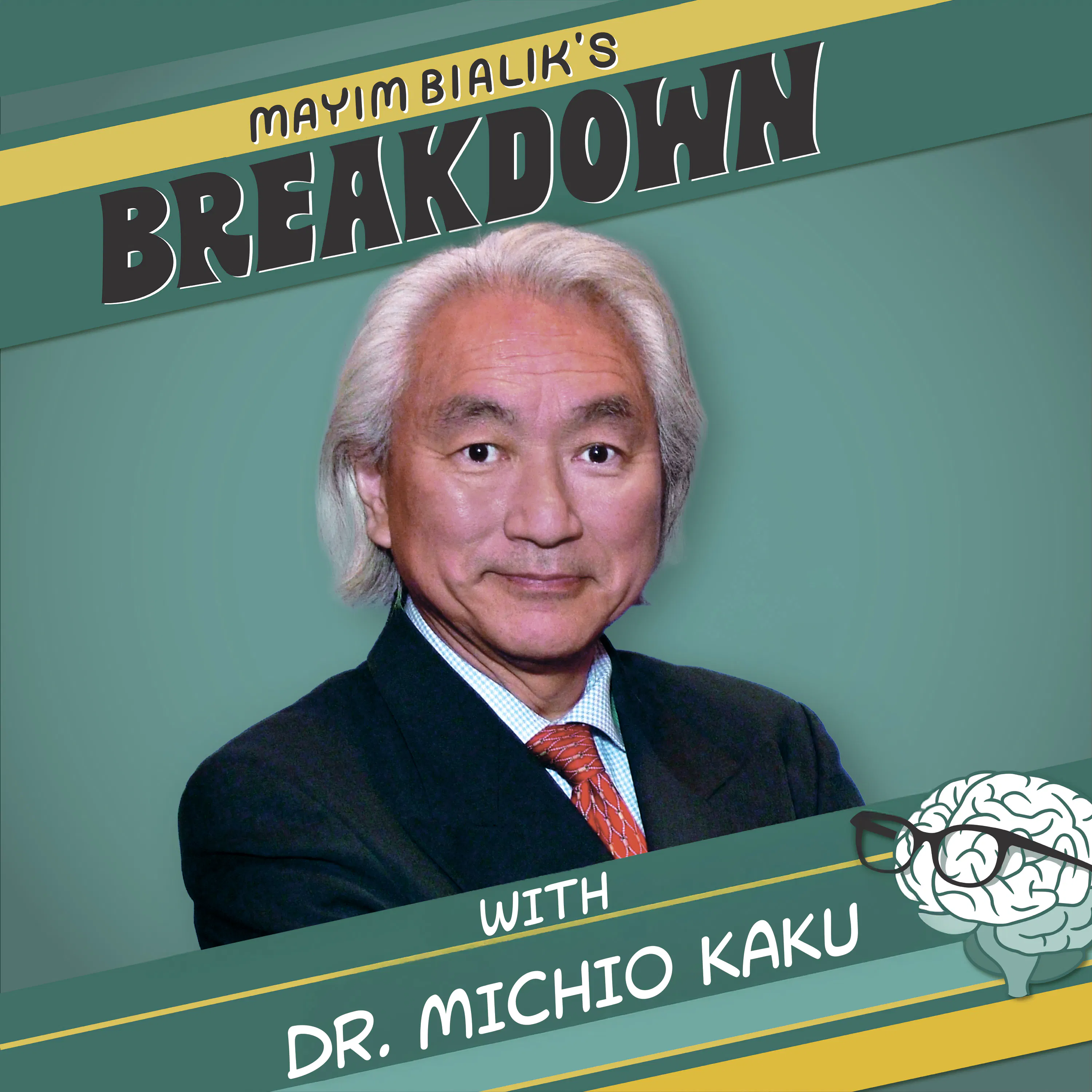
Mayim Bialik's Breakdown
Co-Inventor of String Theory Dr. Michio Kaku on How Quantum Computers Will End Disease & Aging, Explain Parallel Universes & Reveal What Happens When We Die
00:53:08
Loading summary
Transcript108 lines
- [00:00]
Dr. Michio Kaku
Why do we get old? Why do we have to die? Ordinary computers cannot crack the code.
- [00:06]
Mayim Bialik
This is actually one of my favorite contemplations of what quantum computing even means or how it could apply to us.
- [00:12]
Dr. Michio Kaku
There could be aliens communicating with distant star systems. At the center of almost every single galaxy. We think there is a black hole. It could be a gateway to another universe.
- [00:24]
Mayim Bialik
Can you say more?
- [00:25]
Jonathan Cohen
I was going to say the same thing.
- [00:27]
Dr. Michio Kaku
Our universe may not be the only one. There could be a multiverse of universes out there.
- [00:33]
Mayim Bialik
People who have died in our universe might be alive in another.
- [00:38]
Dr. Michio Kaku
It might be possible to bend space and time so we can hop across a wormhole to a distant part of our galaxy.
- [00:46]
Mayim Bialik
Dr. Michio Kaku is the co founder of string field theory. He's going to be talking about quantum supremacy. How the quantum computer revolution will change everything.
- [00:57]
Dr. Michio Kaku
One thing that keeps me up at night is the question of artificial. Artificial intelligence. What happens when they start to be self aware?
- [01:03]
Mayim Bialik
Can a robot take my mother to her checkup?
- [01:06]
Dr. Michio Kaku
We're talking about a whole new realm of things that can be solved. We're not simply observers to the dance of nature. We are now becoming choreographers to the dance of nature.
- [01:26]
Jonathan Cohen
Hey, Sal. Hank.
- [01:27]
Dr. Michio Kaku
What's going on?
- [01:28]
Jonathan Cohen
We haven't worked a case in years. I just bought my car at Carvana and it was so easy. Too easy.
- [01:33]
Dr. Michio Kaku
Think something's up?
- [01:34]
Jonathan Cohen
You tell me. They got thousands of options, found a great car at a great price, and
- [01:40]
Mayim Bialik
it got delivered the next day.
- [01:42]
Jonathan Cohen
It sounds like Carvana just makes it easy to buy your car, Hank.
- [01:46]
Mayim Bialik
Yeah, you're right.
- [01:47]
Jonathan Cohen
Case closed.
- [01:49]
Mayim Bialik
Buy your car today on Carvana. Delivery fees may apply.
- [01:55]
Jonathan Cohen
Mind Bialix breakdown is supported by Helix Sleep.
- [01:57]
Mayim Bialik
Spring is in the air and so are all of the allergens that come with it. I know. I'm starting to feel them already. Spring allergens mean you need more sleep. But there are a ton of factors that can prevent us from getting a good night's rest. Talk about night sweats, back pain, feeling the person next to you when they roll over. We can't tell you how excited we were to hear that Helix wanted to partner with us years ago. After all of the incredible feedback, we'd heard about them over the years. I've had my Helix for about five years now and I've been sleep pretty good. Jonathan and my kids also love their Helix mattresses and all of those issues. Night sweats, back pain, motion transfer. Those things are significantly better. We highly recommend taking the Helix Sleep quiz. Like we did to find your perfect mattress in under two minutes. Everyone sleeps differently and we're confident you'll find a Helix mattress model specifically designed for your specific sleep positions and field preferences. I took the Helix sleep quiz and I was matched with the Midnight mattress because I like something a little firm and I mostly slee Jonathan is a Twilight person. Our mattresses, though, are an absolute major upgrade from our last ones. Their models with memory foam layers, provide optimal pressure relief and cradle your body in the areas that need it most. And it's the perfect combination of comfort and support. Jonathan loves the cooling feature of his Helix mattress keeps him from overheating at night. Go to helixsleep.com breakdown for 27% off
- [03:19]
Jonathan Cohen
sitewide exclusive for our listeners of my balix breakdown. That's helixsleep.com breakdown for 27% off site sure you enter our show name after checkout so that they know that we
- [03:32]
Mayim Bialik
sent you helixsleep.com breakdown hi, I'm Ayan Bialik.
- [03:37]
Jonathan Cohen
And I'm Jonathan Cohen.
- [03:38]
Mayim Bialik
And welcome to our Breakdown.
- [03:40]
Jonathan Cohen
This is one of my favorite kind of episodes because it's both spiritual and practical. It's an exploration of science and it's a look at how the world is going to change drastically in a way that many people haven't even considered yet. And it's happening faster than we can imagine.
- [04:02]
Mayim Bialik
We're going to be talking today about the possibility that the way science, our approach to the environment, our approach to longevity, detecting cancer, all of the ways that we've been doing all of those things have come to an end. You may not have known it, but they've come to an end because we are entering the world of quantum computing and it's going to change every aspect of our lives. Whether you like it or not, whether you're alive or not. When it happens, it has already started happening. What is a quantum computer? What does it mean to even calculate things on a quantum level? Well, we're going to speak to the co founder of Stringfield theory, Dr. Michio Kaku is a professor and theoretical physicist at the City University of New York. And that's right, you didn't hear me wrong. He is the co founder of String Field Theory. He's the author of so many acclaimed science books including Hyperspace Beyond Einstein, Physics of the Impossible, the Future of the Mind, the God Equation. And today we're going to be talking specifically about quantum supremacy, how the quantum computer revolution will change everything and is already changing everything. Is the multiverse real? We're going to actually Explain it from a quantum physics perspective. What is dark matter and why does it take up so much space in the universe?
- [05:30]
Jonathan Cohen
Also, is there life on other planets, in other galaxies and solar systems? Are they more advanced than us, and can we contact them?
- [05:38]
Mayim Bialik
In addition, we're going to talk about what it would look like to merge with technology and the kind of cultural and societal conflict that could arise from different perspectives about if we should even embark on this.
- [05:51]
Jonathan Cohen
We also discuss the future of artificial intelligence and when we need to be able to pull the plug if robots become dangerous. We do something really special in this episode, which is have a few asides where we deep dive into explanations of core concepts to help people better understand. We had a limited time with Dr. Kaku, but it's an amazing conversation that I know you're going to enjoy.
- [06:15]
Mayim Bialik
And with that, we will welcome Dr. Kaku to the breakdown. Break it down. In your new book, Quantum Supremacy, which I read every single page of and enjoyed very much, you talk about how the world as we know it is about to change. Can you help us get a framework for what that looks like?
- [06:37]
Dr. Michio Kaku
Okay, well, let's start at the beginning. For thousands of years, humans lived in poverty, sickness, disease. We didn't live very long. You were lucky to reach the age of 25 or 30, and then you would die of wars and diseases and things like that. And then around 1800, something magical happened. After so many thousands of years of misery and disease and poverty, what happened was science began to happen in the 1800s. All of a sudden we had locomotives. All of a sudden we had sewing machines. All of a sudden, the Industrial revolution began to take its hold. And then around 1900, a century later, all of a sudden, we had yet another revolution taking place with electricity. All of a sudden, we had the electric revolution, lighting up the cities and our homes. And then after World War II, we had the transistor, so we had the computer revolution that. That took hold. And now we're in stage four. We're in stage four with artificial intelligence, and we can see the beginnings of the state of stage five when we have quantum computers. So history is accelerating very quickly right now. So we are in the fourth stage, the fourth stage of artificial intelligence. But we can see the beginnings of the next stage, quantum supremacy, when we begin to compute on atoms, not just molecules and transistors.
- [08:18]
Jonathan Cohen
For people who may not understand the implication of that, can you help make it a little clearer how that jump leads to some unbelievable breakthroughs?
- [08:29]
Dr. Michio Kaku
Yes. We realize that what you have on your desktop today, okay, Is hundreds of times more powerful than what you used to have. But what's coming down the line is quantum computers, which in some sense are millions of times more powerful than the digital computer sitting on your desk. So that's going to change everything once we have computers that powerful, millions of times more powerful than what's sitting on your desk. For example, take a look at medicine. Cancer is a mystery. What about the Parkinson's disease? What about all the diseases that we don't understand? Ordinary computers cannot crack the code. Ordinary computers simply hit or miss, Try different avenues of approach, but it's not systematic. Quantum computers work at the atomic level, at the level of neutrons and protons and DNA. And so we think that this could have a revolution in terms of disease and also in terms of energy. Nuclear fusion, people have always talked about it, but why don't we have fusion reactors that light up our cities? The power of the sun on the earth? And that's because we don't have computers powerful enough to mimic fusion power. And that's coming with quantum computers, not to mention things like global warming. Why can't we predict the weather? You realize that computers are not powerful enough to predict the weather more than just a few days ahead. And then again, this is where quantum computers come in. Quantum computers will be able to solve the global warming problem as well. So we're talking about a whole new realm of things that can be solved with quantum computers that compute on atoms, individual atoms, rather than transistors, which compute on zeros and ones. Zeros and ones. Zeros and ones.
- [10:35]
Mayim Bialik
One of the other applications of quantum computers. And, and the book is a really beautiful explanation, you know, even for. For laypeople, you know, who may be sort of trying to understand the basics, right? You kind of walk us through the journey from how we get from. From digital to, you know, to this kind of quantum realm. One of the other arenas that. That there may be quantum supremacy in that would really impact a lot of us, would be in. In terms of helping us live longer and better. And you talk about sort of the level of analysis that we've been doing as to why certain people, you know, have particularly good health, why certain people seem to, you know, have the luck of the draw in terms of aging. Can you explain how quantum computing can help us understand longevity differently?
- [11:22]
Dr. Michio Kaku
First of all, if you want to see a quantum computer, simply go outside. Go outside and you see leaves and trees and animals. They are not computing on zeros and ones. Zeros and ones, zeros and ones. They're not digital computers outside your door. They are quantum computers. And that's why we have the variety of vegetation, the variety of animals, the variety of what you see right outside your door. And now we're beginning to understand how the aging process is working and how that affects the development of Homo sapiens. And so we're beginning to understand mother Nature on her own language. And this is amazing. Before that, it was all magic. Why do people get old? Oh, well, it's just aging. That's all it is. But you begin to realize that things like the aging process are quantum mechanical. We age at the molecular level. And if you want to understand this, think of a car. Where does aging take place in a car? The engine. Because that's where waste products build up. That's where you have combustion and waste products and soot building up inside a car. Well, what about a human? Now, why do we get old? Why do we have to die? The same thing. We consume energy. Energy creates waste. It creates mistakes. These mistakes build up, and that's why you get old. That's why your skin starts to get sagging, and that's why your bones begin to creak. It's because of the buildup of errors. And so we're going to begin to cure some of these things in the future. And does it mean that we're gonna live longer? Well, that's the goal.
- [13:09]
Mayim Bialik
You mentioned that there's an asteroid that is coming, and it's going to be very close to our planet. I believe you said, April 2029, there's an asteroid that's gonna be coming close. How can quantum computing help us predict the demise of our planet? In particular, in trying to track asteroids that may be coming towards this planet?
- [13:34]
Dr. Michio Kaku
Yes, that asteroid is only the third one. The third one to come into our solar system from outside the solar system, and that is why it's caused so much fear and anxiety. So many websites are devoted to trying to understand, is it aliens that are behind this thing? Well, to the best of our knowledge, we're not talking about aliens. We're not talking about superhuman devices that can impact on the planet Earth. We're talking about a natural phenomenon, a natural phenomenon created by asteroids and meteors from outside the solar system. This is only the third time it's happened. The third time it's happened. And we're still using the primitive computers that we have here on the Earth in order to understand its trajectory. And we're beginning to understand that it's normal, it's not alien, it's not a spaceship. From outer space. But it does mean that our tracking abilities are much better than before. We have telescopes, we have sensors, we have probes by which we can see these objects in outer space floating, and we can tell whether or not one of them can compose a danger to
- [14:54]
Jonathan Cohen
the planet Earth mind Bialix Breakdown is supported by IQ Bar, our exclusive snack, hydration and coffee sponsor.
- [15:01]
Mayim Bialik
IQ Protein Bars, IQ Mix, Hydration Mixes and IQ Joe Mushroom Coffees are the delicious low sugar, brain and body fuel you need to win your day. The Ultimate Sampler Pack is what we recommend. It's a great way to try all IQ Bar products and flavors. You get nine IQ Bars like this one, eight IQ Mix Sticks and four IQ Joe sticks. All IQ Bar products are clean, label, certified and entirely free from gluten, dairy, soy, GMOs and artificial ingredients. They're packed with clean, delicious ingredients that keep you physically and mentally fit, like magnesium, lion's mane, and more. IQ Bars Plant Protein Bars are the smarter snack choice with plenty of plant protein, tons of fiber and no added sugar. IQ Mix is a zero sugar drink mix that hydrates with electrolytes, improves mood and boosts clarity. IQ Joe is a mushroom coffee designed for mental clarity and packed with 200 milligrams of natural caffeine. Plus comes in four different flavors that will transform your morning routine. Plus we always look forward to the limited edition and seasonal flavors too. When IQ Bar sent us their Ultimate Sampler Pack, what stood out to me was that Jonathan tried everything and loved them all. I love them as well. This is the only one that's left from our last box. So this is what Jonathan left me which is the wild blueberry which is delicious.
- [16:14]
Jonathan Cohen
Please don't eat it.
- [16:16]
Mayim Bialik
I will not eat it. I'll save it for you. It's great as a go to snack. Satisfies hunger with no sugar crash and they're super easy to just throw in your bag. Right now, IQ Bar is offering our special podcast listeners 20% off all IQ Bar products, including the Ultimate Sampler Pack, plus free shipping to get your 20% off. Text breakdown to 64,000 Text breakdown to
- [16:36]
Jonathan Cohen
64,000 that's breakdown to 64,000 Message and data rates may apply. See Terms for details. Mayimbialics Breakdown is supported by Odoo so
- [16:46]
Mayim Bialik
much of what we talk about here on MayimBioX breakdown is about alignment, making sure the systems in your life actually support your authentic self and the life you're trying to live. That includes how you run your business. Luckily, Odoo is here to help you in that journey. Odoo is an all in one management software designed to help entrepreneurs and small businesses focus on what actually matters. Instead of getting buried in administrative work, they offer a range of applications for managing customer relations, marketing, point of sales and even custom websites. All that plus your sales, accounting, inventory and operations fully integrated on one simple and easy to use but very intuitive platform. With Odoo, when something happens in one part of your business, everything else updates automatically. That means fewer errors, less duplication and way more clarity. We also love that Odoo is scalable. As you grow, you only add what you need. No bloated software, no unnecessary complexity. Invite your whole team, keep everyone in lockstep with notifications and chat and their plans include all their apps. Odoo is also affordable. They offer several pricing plans. Your first app is free for life with unlimited hosting and support included and a custom domain name for the first year. Then starting at 2490 per month, you gain access to all available applications. Plus it is tailored to where you live. Taxes, currency, regulations, everything's built in. That takes another huge thing off your plate. If you're ready to build a business that actually supports your well being, you can start a free 15 day trial with Odoo or book a meeting with one of their experts to explore your ideas by visiting the link in our show notes. It's a really thoughtful platform designed to grow with you, not overwhelm you. Use our links in the episode description for the best deals possible and get started with Odoo today.
- [18:22]
Jonathan Cohen
My Bialix breakdown is supported by Rabbit Air.
- [18:25]
Mayim Bialik
You know I'm sitting here with my Rabbit Air giving it the biggest hug that I can because I am one of those people who thought that my destiny was to sneeze all the time. I grew up sneezing all the time. I thought that that's just normal and it wasn't until I was an adult that it was suggested to me that I try a Rabbit air and I did not realize how significant the changes could be. I then got them for my kids rooms. They had a complete change in their especially morning routine which used to be like sneezing blowing your nose. Rabbit Air has really changed. It's changed the air in our lives and it really has changed our lives. It's been an unbelievable experience. Trusted by healthcare researchers, Rabbit Air purifiers were selected for eight clinical trial at John Hopkins University studying environmental control as an add on therapy in childhood asthma. A testament to the precision and reliability behind the technology with advanced HEPA Filtration, customized filter options and ultra quiet operation. Rabbit Air is engineered for spaces where air quality is a priority blending award winning design with powerful performance. It delivers air purification, relied on in research environments and is thoughtfully crafted for everyday living.
- [19:36]
Jonathan Cohen
Visit rabbitaire.com or call their 247 consultants today.
- [19:41]
Mayim Bialik
That's R A B B I T A I r dot com. Let's take a pause and talk about quantum computers. When we talk about quantum computing, what are we even talking about? So Jonathan, I'm going to speak to you as if you're my class right now because I feel like this needs a little bit of instructional, you know, kind of explanation. And this is like, if you want to learn this for yourself, quantum supremacy is the way to go. So modern computers that we know about, right, like the ones that we're using, they encode things in, in binary, right? Like zeros and ones. And, and you don't even have to understand it. I don't even really understand it more than that.
- [20:24]
Jonathan Cohen
I know that I type google.com and information comes to me.
- [20:28]
Mayim Bialik
So the zeros and ones go through some sort of digital processor. And again, we don't need to know what that processor is. We just need to know that some calculation is done based on these and ones and, and you get an output. So when you think about like your Internet connection, that's the example that he used. That's gigabits per second. Gigabit, right? They're actually called gigabits. Gigabits per second. That means that a billion bits are sent to your computer every second. That's what makes you allowed to view things, to watch videos in real time.
- [21:02]
Jonathan Cohen
To see you right now, to see
- [21:04]
Mayim Bialik
me right now, however, and Richard Feynman is a huge part of the conversation about the shift from understanding this transition from, from zeros and ones into a quantum understanding. So what Feynman said is what happens if we replace zeros and ones with the states of atoms. And it's a theoretical construct at first. So what we know about atoms, and this is just basic stuff, they're, they're like spinning tops. That's how he describes it. So if you place atoms in a magnetic field, they can either align with respect to the field or in opposition to the field. That would correspond to 0 or 1. So the power of a digital computer relates to the numbers of zeros and ones. But in the subatomic world, when atoms are being kind of calculated and considered, atoms can spin in any combination, right. Of these states. For example, I'm just going to Give you the example from the book. An atom can spin up 10% of the time and down 90% of the time. It can spin up 65% of the time and down 35% of the time. And this is the key thing. There are an infinite number of ways that an atom can spin that increases the number of states that that atom can exist in. So an atom is not just carrying information that can be held in a bit. It can be held in a qubit, which is a simultaneous mixture of up and down states. So what we also know is that objects existing in simultaneously in multiple states is called superposition. Okay, that's what it's called. So what happens is when qubits interact with each other, they can get entangled. You've heard of entanglement. Quantum computers are exponentially more powerful than digital computers because the qubit power is what makes it different. So, for example, today, quantum computers can have over 100 qubits. That means they are two to the 100th times more powerful than a computer that just has one qubit. I don't know if this helped, but that is the explanation. So Google's sycamore quantum computer that was the first to achieve quantum supremacy, has the power to process 72 million billion bytes of memory. It has 53 qubits. So the power of a quantum computer dwarfs any conventional quantum computer. There's a quantum computer on page 89 of Quantum Supremacy, and I'll be honest, it looks like a chandelier. I'm showing Aton. It looks like a chandelier. I didn't even know what it looked like. Most of the complex hardware is pipes and pumps that are necessary to what? To cool the core to near absolute zero. And the reason that it has to be cooled is literally because, like, atoms move fast. It gets hot, it's going to overheat. And we've heard about this as a problem. What's fascinating is that mother Nature is calculating on a quantum level without anything needing to be cooled down. And he talks about this throughout the book. And this is the. The fantastic, like, understanding of our limitations as humans. We have to build something that mostly is made of things to cool it to a temperature. When we can isolate the movement of atoms that mother nature does all by herself in all sorts of temperatures. So the heart of a quantum computer may be as small as a quarter, but the rest of it is everything that's involved to cool everything down. That's your brief primer into what quantum computing is.
- [25:07]
Jonathan Cohen
Just before we get back to the episode Talk a little bit about how this technology finds solutions in ways never before imagined.
- [25:18]
Mayim Bialik
I love that you're asking this question. So what does it mean to be able to utilize the power of a quantum computer? It means that everything is faster. And I don't just mean like, oh, you're not waiting for something to upload. It means that the number of calculations of possibilities is happening at a quantum level. And if you don't understand that, that's okay. That's what quantum means. It means that every single possibility in the universe is being simultaneously calculated. It still take some time for some of the more, you know, sophisticated mathematical equations. But I'll give you an example. Pandemics. You know, how we have to figure out, like, a vaccine that goes with a virus and that the virus is like mutating. Remember with COVID there were all these
- [26:09]
Jonathan Cohen
different strains, and if you got the vaccine, you were worried that the virus was going to mutate faster than your immune system.
- [26:15]
Mayim Bialik
It was. So a quantum calculation of the trajectory of a virus means that computer can track what all the possible growth trajectories are for all the possible mutations that might exist simultaneously. So in real time, we are potentially able to say, this is how it's mutating. This is the drug that would have to meet it. And most importantly, how do you stop the spread of a virus? By detecting it early, by understanding its mutation, and by trying to figure out how to cordon it off. So literally, people would not have to. We would not have to have a million people die before we could figure out how to contain it. We would have learned about it much earlier. We would have learned about its mutation patterns and ways to devise a vaccine. Vaccine much quicker with much less catastrophic impact. That's just one example. That's just pandemics screening and curing cancer. So this is an amazing thing. You've heard of dogs that can detect cancer, right?
- [27:25]
Jonathan Cohen
They can smell it.
- [27:26]
Mayim Bialik
They can smell it.
- [27:28]
Jonathan Cohen
I mean, if we're not teaching Archie how to do that, what are we doing?
- [27:31]
Mayim Bialik
Dogs are being used to detect coronavirus. I didn't know that dogs were, Were. Were trained to detect coronavirus. A specially trained dog was able to give a 95% accurate identification within 10 seconds. I know the Helsinki airport did it because they're ahead of everything.
- [27:49]
Jonathan Cohen
Not before he's had his walk and been told he's a good boy, though.
- [27:52]
Mayim Bialik
Dogs have been trained to identify lung, breast, ovarian, bladder, and prostate cancer. Dogs have a 99% success rate in detecting prostate cancer by sniffing a Patient's urine sample. Dogs can detect breast cancer with 88% accuracy, lung cancer with 99% accuracy. Why? They have 220 million nasal scent receptors. We only have 5 million. So their sense of smell is exquisite. And the question is, why have we not been able to figure out what they are detecting in a way to replicate it? The answer is because we didn't have quantum computing. So this is one of the places where a quantum computer is able to access and assess smell like a dog? No, but they're able to figure out what are these components, what are these parameters in ways that are much more rapid and in many cases are simultaneous.
- [28:55]
Jonathan Cohen
Think about that applied to all problems. The notion of battery storage and how to exponentially increase battery storage, exponentially increase solar capture and transition into battery storage.
- [29:08]
Mayim Bialik
Quantum computers have the ability to understand why we don't have enough successful grain production in parts of the world where people are dying. Right? This is what it can be used for. Global warming. The. The understanding of what is actually happening and how to repair it. In terms of, like, there's a whole thing about nitrogen pairing and nitrogenase. All of that can be calculated with extreme precision, extreme accuracy. And it is literally, it's bending time by saving time, right? It's getting us to this next parameter, not in a linear fashion, which is how history has gone, and there have been little spikes. This is a quantum projection, right, of the capability of the. The planet's resources, sickness, the way to fix disease. I mean, it's unbelievable.
- [30:02]
Jonathan Cohen
Let's get back to the episode and stick around for the Outro, where we will describe more applications for how a quantum computer can solve some of the world's biggest problems.
- [30:14]
Mayim Bialik
So, speaking of aliens, in terms of your understanding of our place on this planet, what can you tell us about the human interest in exoplanets and in potential either intelligent life or. Or even non intelligent life on other planets?
- [30:35]
Dr. Michio Kaku
Well, you know, when I was a child, I still remember getting a coloring book where you color Saturn, Jupiter and whatever. And at the end of. At the end of the book, the book said, that's all, folks. That's all there is. From Mercury out to Pluto. That's all there is. Now we realize that's not all there is at all, that there are other solar systems that we can photograph. This is amazing. Our probes are good enough now that we can lock onto distant stars and see the imprint of a planet, a planet orbiting around these stars. And we can even start to count how many planets there are in our vicinity. This is Amazing. And we begin to find that none of these planets look like ours. We used to think that our. Our solar system was perhaps typical, normal. They're all just like us. Nope. We realize that there are solar systems out there that are bigger, larger, faster, smaller, that. That we are the exception to the rule, in fact. And does that mean that there are aliens out there? Well, who knows? But it does mean that we underestimated the diversity of what's out in our own celestial backyard.
- [31:55]
Jonathan Cohen
What do you imagine is out there? Obviously, there are a lot of studies still exploring the nature of what could be out there. If you put your theoretical hat on, what do you imagine we may find? Do you think there is future alien civilizations or intelligent civilizations?
- [32:16]
Dr. Michio Kaku
Well, let me stick my neck out and say that, yes, I believe they're out there. I believe that there are other intelligent beings. We're not the only game in town, okay? However, the distance between stars is so great that you would have to be extremely advanced to reach us from a distant star in our own backyard, in our own galaxy. And so it's possible. It's possible that there's civilizations out there that are older than ours that have mastered the art of interstellar travel, but we haven't. We're just beginning. We're just beginning. We're novices in this game. We're just beginning to shoot probes out to the distant nearby planets, while we think that out there there could be aliens that have already mastered the art of communicating with distant star systems much farther than what we know about the Earth. And that takes us into black holes, takes us into pulsars, takes into all sorts of celestial things that could be out there that have life forms that are older than ours and have already mastered distant travel to different stars, like black holes, for example. Black holes were first looked at by Albert Einstein himself in the 1930s, but he thought that they would not be able to be seen. They're simply too great, too fantastic. Nice to think about, but they're not going to be reachable from the planet Earth. But we now realize that black holes could be get. This could be gateways, gateways to distant realms around the universe. So if this is a sheet of paper, a sheet of paper, and we are here, and there's a distant star over here, it might be possible to bend space and time and so that we can then hop across a wormhole to a distant part of our galaxy. Now, of course, this is still science fiction. We don't know for sure whether that's possible. But the equations show that, yes, if you have a black hole, you may be able to create a shortcut between the stars.
- [34:35]
Jonathan Cohen
Just like every Marvel movie. Little whirling image opens up, and we just jump through to another timeline, which opens up a lot of complicated issues about time itself. And is it linear? Is it circular? Are there multiple universes happening simultaneously? And if I jump through one of these black holes, am I messing up what's happening in my current reality?
- [35:02]
Dr. Michio Kaku
Well, this gets us into what's on the other side of a black hole. We see black holes out there. They're not science fiction anymore. In fact, at the center of almost every single galaxy that we see with their telescopes, we think there is a black hole. And then the next question, what happens if you fall into a black hole? Do you come out the other end? And the answer is, we simply don't know. But there are mathematics, there are mathematical theorems that show that it may be possible to survive a passage through a black hole. I'm not saying that's going to be easy. I'm not saying that it's going to be, like, commonplace to go through a black hole, but it could be a gateway to another universe. And what would it be like? Well, think of our universe. Our universe is a bubble of some sort of. And the bubble is expanding. That's called the Big Bang theory. But if string theory is correct, it means that there are other bubbles out there, other universes, that our universe is not the only one. There's a multiverse, a multiverse of universes out there, and perhaps gateways to reach them through a wormhole. And again, this is still speculation. We don't have any concrete evidence, but the mathematics seems to indicate that we could be in a bubble bath, a bubble bath of universes.
- [36:30]
Mayim Bialik
Say more about a bubble bath of universes.
- [36:33]
Dr. Michio Kaku
Think of a bubble bath where you have different balls that can collide to create a bigger ball, or it can fission and create two smaller balls. So these are the gyrations that you get with a multiverse of universes, which we now think could exist. When you look at string theory, you realize that string theory says that our universe may not be the only one, that there could be other bubbles out there. And these bubbles can collide, they can bump into each other, or they can fission, fission into two smaller bubbles. And so we think that at least the theory seems to indicate that there could be a multiverse, a multiverse of universes out there.
- [37:21]
Mayim Bialik
This episode is brought to you by Peloton Break through the busiest time of year with the brand new Peloton Cross Training Tread plus powered by Peloton iq. With real time guidance and endless ways to move, you can personalize your workouts and train with confidence, helping you reach your goals in less time. Let yourself run, lift, sculpt, push and go. Explore the new peloton cross training tread +@onepalaton.com this episode is brought to you by Palmolive. Family time isn't just the big moments. It's weeknight dinners, sitting around the table, everyone talking all at once. So when the plates are empty and the sink is full, use Palmolive Ultra. Palmolive's most powerful formula removes up to 99.9% of grease, leaving your dishes sparkling clean. And the new convenient pump makes cleaning even easier so you can spend less time tackling dishes and more time together. Shop now@palmolive.com I get so many headaches every month. It could be chronic migraine 15 or more headache days a month, each lasting
- [38:22]
Ad/Promo Voice
four hours or more Botox Audubotulinum toxin A prevents headaches in adults with chronic migraine. It's not for Those who have 14 or fewer headache days a month. Prescription Botox is injected by your doctor. Effects of Botox may spread hours to weeks after injection, causing serious symptoms. Alert your doctor right away as difficulty swallowing, speaking, breathing, eye problems or muscle weakness can be signs of a life threatening condition. Patients with these conditions before injection are at highest risk. Side effects may include allergic reactions, neck and injection site pain, fatigue and headache. Allergic reactions can include rash, welts, asthma symptoms and dizziness. Don't receive Botox if there's a skin infection. Tell your doctor your medical history, muscle or nerve conditions including als, Lou Gehrig's disease, Myasthenia gravis or Lambert Eaton syndrome, and medications including botulinum toxins, as these may increase the risk of serious side effects.
- [39:08]
Mayim Bialik
Why wait? Ask your doctor. Visit botoxchronicmigraine.com or call 1-844botox to learn more. One of the things you talk about in the book is if you apply quantum theory not just to our kind of daily experience or even our cellular experience, but if you apply, you know, all of the principles of of quantum theory to the entire universe, it would hold that there may be parallel universes. And I don't mean that necessarily in a science fiction sense, but if if everything can exist, right in all possible states and forms, why would the universe be any different?
- [39:52]
Dr. Michio Kaku
Well, that's the subject of tremendous debate within the physics community because of the fact that we do have the Big Bang theory. The Big Bang theory says that the universe started from a single bubble, a single bubble that then expanded rapidly to create the stars, the galaxies, you and me. But why one? Why simply just one universe that created the entire universe as we know it? Why not a multiverse of these universes? And string theory seems to indicate that that's the way to go. String theory, we think, is the ultimate theory of everything, that all the universes are nothing but different kinds of string states within a multiverse called string theory. And we think that, therefore, string theory can coexist with other different universes. And even Stephen Hawking talked about this. Stephen Hawking talked about the fact that if you go to the small scale now, not to other galaxies, but to your own backyard and look at small distances, that space is not smooth. Space becomes bubbly. And there are bubble universes, bubble universes that we never see because they're so tiny that they pop into existence and pop right back. And so Stephen Hawking said, the vacuum is full of tiny baby universes. And one day, one of these bubbles simply did not pop into, vanish again, but it just kept on going and kept on going and expanding. And that created our universe. So our universe may have started from one of these bubbles, one of these bubbles that existed. And most of these bubbles simply pop into existence and pop right back into the vacuum. But one day, one of them just kept on going. And that's you and me.
- [41:53]
Jonathan Cohen
We're going to take another very quick pause and explore parallel universes.
- [41:57]
Mayim Bialik
We know what electrons are, right? Can we just, like, think of a tiny little ball? Just think of it like that. Now, I might tell you, it's not a ball, it's a wave. We'll get to that in a second. So, Jonathan, we've talked about before that before you observe an electron, right? You don't know where it is. And you could say that about anything. Like, before I observe you, I don't know where you are, right? The thing about an electron is that when you measure where an electron is and when you go to look for it, the way we describe it is that the wave function, it normally propagates as a wave. It collapses, and you're able to isolate where that electron is. That's how, essentially, you get an answer from a quantum computer. Because you have a probability. The electrons, like, all over. It's in a fuzzy state. This is how we learned it in school. But when you measure it, it's not all over, right? You can't measure something unless you're looking
- [42:49]
Jonathan Cohen
at it, this is the slit experiment.
- [42:52]
Mayim Bialik
So, yes, it can be demonstrated with the slit experiment, and it's called the collapse of the wave function. The collapsing, as Dr. Kaku says, has haunted quantum physicists for the past century because it doesn't really make sense. Like, if you take a really, like, big step back. What do you mean? We live in a world where a wave function collapses so that you can see a particle. Why? How. What does that mean? How can we utilize it? And yes, the double slit experiment is an example of that. So if you think about this electron that, again, doesn't have a location until you measure, can live in any number of states and worlds, right? There are an infinite number of places where it can be. Those are the parallel universes that we talk about. Every branch of the multiverse is as real as any other, but it's representing all possible quantum states of that. That's the notion of parallel universe. So how do you get to us having parallel universe experiences? It's. If you use the principle of superposition and you say this can happen on every level, that's the most simplistic way for us to understand that parallel universes, in theory, it's not that they can exist. They have to exist. Just like all states of that electron have to exist until you measure it,
- [44:21]
Jonathan Cohen
they have to exist, but then you choose the one that you want to inhabit. So how does that relate to our actual physical reality? We. Sliding doors. That.
- [44:31]
Mayim Bialik
That's exactly it. So. So we're all constantly choosing. The question is why? Why do we choose this? Why does my wave function collapse to lead me to sit in this chair and talk to you right now? Right. Why does any particular choice get chosen? What's the probability of one thing being chosen over another? This is the basis of a conversation about the multiverse. It's the basis of, you know, all of our favorite, in particular, Marvel, you know, comics and movies, Right. What is it like to step into? I mean, I think the Deadpool is the one that, you know, kind of comes to mind most recently. What's it like to step into a reality where you're not the sex or gender that you thought you were, you're not the age that you were, you didn't grow the same, you sliding doors that, as Jonathan likes to say, all of those paths in theory could have existed? And what I would say is that people maybe who do readings, people who are doing past life regressions for people or people who are psychic. Maybe I'm being super generous here. Maybe those people are Tuning into other possibilities. Could it be your imagination? Absolutely. But, like, what's your imagination other than an alternate state of the life that you're living and the path that your electron is on right now?
- [45:58]
Jonathan Cohen
What is creativity but a quantum computer evaluating possibilities and dreaming up a scenario that could be possible?
- [46:06]
Mayim Bialik
The only thing I can compare to a quantum computer is what it's like to brainstorm with Jonathan.
- [46:12]
Jonathan Cohen
You know what I'm brainstorming. Getting back to our conversation with Dr. Kaku,
- [46:18]
Mayim Bialik
I wonder if you can go into string theory a little bit for people. You know, this used to be something that when I studied physics, it was really on the fringes, you know, of. Of even being able to sort of be comprehended, especially on sort of an undergraduate or even a graduate level. Can you explain what string theory is and what it can explain and what it can't?
- [46:40]
Dr. Michio Kaku
Sure. Back in the 1930s, we had a very simple understanding of matter and energy. Everything consisted of neutrons, protons, and electrons. That's it, folks. That's the universe. Electrons, neutrons, and protons. That was it back in the 1930s. And then after the war, we built atom smashers, machines that could create higher particles. And all of a sudden, we were drowning, drowning with new subatomic particles being created by our atom smashers. And J. Robert Oppenheimer, the father of the atomic bomb, was so frustrated that one day he announced that the Nobel Prize in physics should go to the physicist who does not discover a new particle this year. People just drowning in these things. Okay, so that's the way it was for many decades. We just kept finding more and more subatomic particles, gave them bizarre names. Not just neutrons and protons, but lambda particles and hyperons and all sorts of different names to catalog all these subatomic particles. Now we have string theory, which has not yet been proven yet. Okay, so that's why we're not going to get the Nobel Prize anytime soon. But the Ching theory says, why do we have all these particles? And the answer is music. These are just musical notes on a vibrating string. So this would be an electron, this would be a proton, this would be a neutron. They're nothing but different vibrations of a string. And so how many vibrations are there? Well, how many notes are there on a piano? If you think about it, there are an infinite number of notes, because you just make the string longer, stronger, tighter, and you create another note. So how many notes are there on a piano? Infinite. There are infinite number of notes you can play on the piano. So if this string of A piano was a subatomic string. How many particles are possible with string theory? Infinite number of particles. And that's why we are drowning in subatomic particles today. When I was a graduate student Getting my PhD, I had to memorize the names of all these subatomic particles. And I thought to myself, maybe one day when you get your PhD and they ask you, why are there so many particles? The answer would be string theory. It's nothing but different vibrations of a string.
- [49:31]
Jonathan Cohen
Another brief aside. We're going to explain string theory in a little bit more depth.
- [49:36]
Mayim Bialik
The leading and essentially only candidate for a quantum theory behind the standard model that we've been using is string theory. And, and as Dr. Kaku said it, it is a theory, right? This is. This is theoretical. There's a lot of competing theories. But if you're going to have a theory of everything, and string theory is sort of playing into this, if you're going to have a theory of. Of everything, it has to contain Einstein's theory of gravity. It has to contain the standard model of particles like quarks, gluons, neutrinos, all this stuff. And it must be finite and free of anomalies. The only thing that can satisfy those three criteria is string theory. That's why we're talking about string theory, string. And I'm just going to, like, I'm going to work from a little bit of what Dr. Kaku said, but also the way he describes in the book is so beautiful. So string theory says that elementary particles are like musical notes on teeny, tiny vibrating strings, hence string. So you know how a rubber band, if you pull a rubber band, and if you pull the rubber band really tight, it'll be like, high, right? It's like a higher frequency.
- [50:42]
Dr. Michio Kaku
And.
- [50:42]
Mayim Bialik
And if you let the rubber band go like this, it'll be a lower frequency. So just like a rubber band. String theory says that each vibration of these tiny bands or strings corresponds to a particle. So it would say that all of these particles, electrons, quarks, neutrinos, everything from the standard model that we talked about, they're just like different notes. Notes, right? They're different notes. If you think of the universe as a symphony, right? These are just different notes. So physics is corresponding to the harmonies that one can play on these strings, which I just, like, gives me chills. I could be the only one. Chemistry is the melodies created by the vibrating strings. I mean, literally, this brings me to tears. This is why I study what I do. The universe can be compared to a symphony of strings. So I'm going to do this again. Physics is the harmonies that you can play on the strings. Chemistry is the melodies that the strings present. And the universe is a symphony. Wait for it. The mind of God that Einstein wrote about would correspond to cosmic music resonating through the universe. If that's not beautiful, I don't know what is. So this is a very, very simple explanation of string theory. But think of it as physics is just explaining what exists. Chemistry is just explaining what exists. Right. The universe is just trying to hold everything that exists. And the God that people like Dr. Kaku would say is for another field. According to Einstein, that is the cosmic music that is resonating through the entire universe. That is Dr. Kaku's explanation of string theory. In your book, you talk about and you know, these are some of our favorite facts and figures. And we recently spoke to Neil Degrasse Tyson and we talked about this with him. 68% of what we experience, what we see, what we can't even understand, is dark energy, 27% is dark matter, 5% is hydrogen and helium, and then 1% is just about everything else. Can you explain what it means for people who don't know anything about dark energy or dark matter? What does it mean to say that most of what we can access or most of what we're in the middle of is dark energy or dark matter?
- [53:26]
Dr. Michio Kaku
Well, we think that dark matter and dark energy are nothing but higher musical notes on a vibrating string. Everything you see around you, the neutrons, the protons, they're nothing but the lowest vibrations of a vibrating string, but they're higher vibrations. These higher vibrations have been cataloged with our atom smashers. But where does it end? It doesn't. It just keeps on going forever. The next set of subatomic particles that we would find on the earth would be invisible. They don't have electromagnetic properties. They're not like light beams. And so why do we have dark matter? They're nothing but the next vibration, the next musical note, the next musical note of string theory, beyond the neutron, the proton, the lambda, and so on and so forth, is dark matter. So dark matter is not a mystery. Now, how do you prove that that's difficult? Because it's difficult to do experiments on something that is way out there. We're talking about dark matter that envelops galaxies. And so therefore, it's difficult to find an experiment by which we can capture dark matter, put it in a jar, and then analyze it and say, ah, it's nothing but a higher Vibration of a string. Okay, but the betting is, the betting is among a lot of physicists that dark matter is nothing but a higher musical note because the theory predicts that the next musical note would be invisible. And sure enough, dark matter is invisible, just like what the theory says. String theory is going to the point where we know everything about the Big Bang, why it happened, where it happened, what does it mean when we have an explosion of that nature? And what does it mean? Okay, and so it's not that we're going to be able to use this to create a religion or to create a sect or to enhance our understanding of spirituality. No, we're not talking about that. We're simply talking about, do we know why we're here? Do we know why we have neutrons, protons, electrons? Do we know why we have DNA? And if so, then can we alter it? Can we perhaps change it a bit, tinker with it? But it's not as if the question is, does it mean that there is a higher authority? A God, a spirit, spirit? No, we're not talking about that. Some people would like to talk about that, but I'm a physicist and I would rather talk in the realm of mathematics.
- [56:12]
Mayim Bialik
I mean, all of the great quantum physicists believed in God, believed in mystical experiences. So I, I would, I would say it is, it is very dur. To, you know, reject a religious notion. But, you know, even the, the initial calculations that were done and the introduction of quantum mechanics as a, included some notion of a separate plane that was beyond our understanding, which many physicists, you know, kind of accidentally use to, to describe what many mystical experiences also you know, seem to articulate.
- [56:50]
Dr. Michio Kaku
Well, Einstein himself was asked about these things, and Einstein thought that, that, yes, the mathematics was such that it does look as if things are designed, but at that point he would not take a position because it means that there is a designer who designed the universe. So even though the universe looks like it could be designed, he refused to take a position on the question of a designer. Okay. And I think that's a rational way to look at things. That the further we push our understanding of religion and the universe, we begin to realize that there's a. A realm that we cannot penetrate. And that realm is the question of, is there a God? Is there a design to the whole thing? And so far, we see no concrete evidence one way or the other.
- [57:45]
Mayim Bialik
We're going to hit pause on our conversation with Dr. Kaku, but there is so much more. In part two, we're going to talk about long term concerns about robots becoming too intelligent. We'll talk about what it's like to merge with technology and what it might mean for people who don't want to. Also, are there more 3i Atlases coming?
- [58:05]
Jonathan Cohen
Join us on Substack for a deep dive into this episode and bonus content you can't get anywhere else. And we are so excited for you to see part two. So make sure you're subscribed on audio or on the YouTube page.
- [58:19]
Mayim Bialik
And from our breakdown to the one we hope you never have, we will see you next time.
- [58:22]
Jonathan Cohen
Next time, it's Maya Bialik's breakdown. She's gonna break it down for you.
- [58:26]
Mayim Bialik
She's got a neuroscience PhD or two.
- [58:30]
Jonathan Cohen
One fiction and now she's gonna break down.
- [58:32]
Mayim Bialik
So break down.
- [58:34]
Jonathan Cohen
She's gonna break it down.
- [58:38]
Ad/Promo Voice
This episode is brought to you by Athletic Brewing Co. No matter how you do game day, on the couch, in the crowd or manning the snack table, Athletic Brewing fits right in with a full lineup of non alcoholic beer styles you can enjoy bold flavors all game long. No hangovers, no buzz, no subbing out for water in the second half. Stock the fridge for tip off with a variety of non alcoholic craft styles. Available at your local grocery store or online at athleticbrewing.com near Beer Fit for
- [59:06]
Mayim Bialik
all times Pack for spring break with Abercrombie Kids. Their newest drop has all the outfits to wear on their favorite week of the year. Start with the new AF Hybrid trunk. It's breathable and quick dry, making it perfect for long family beach days and for every other adventure. Pack, graphic tees and comfy shorts. You can't go wrong with mix and match essentials. Plan your spring break escape with Abercrombie Kids. Shop in the app, online and in stores.