← Mayim Bialik's Breakdown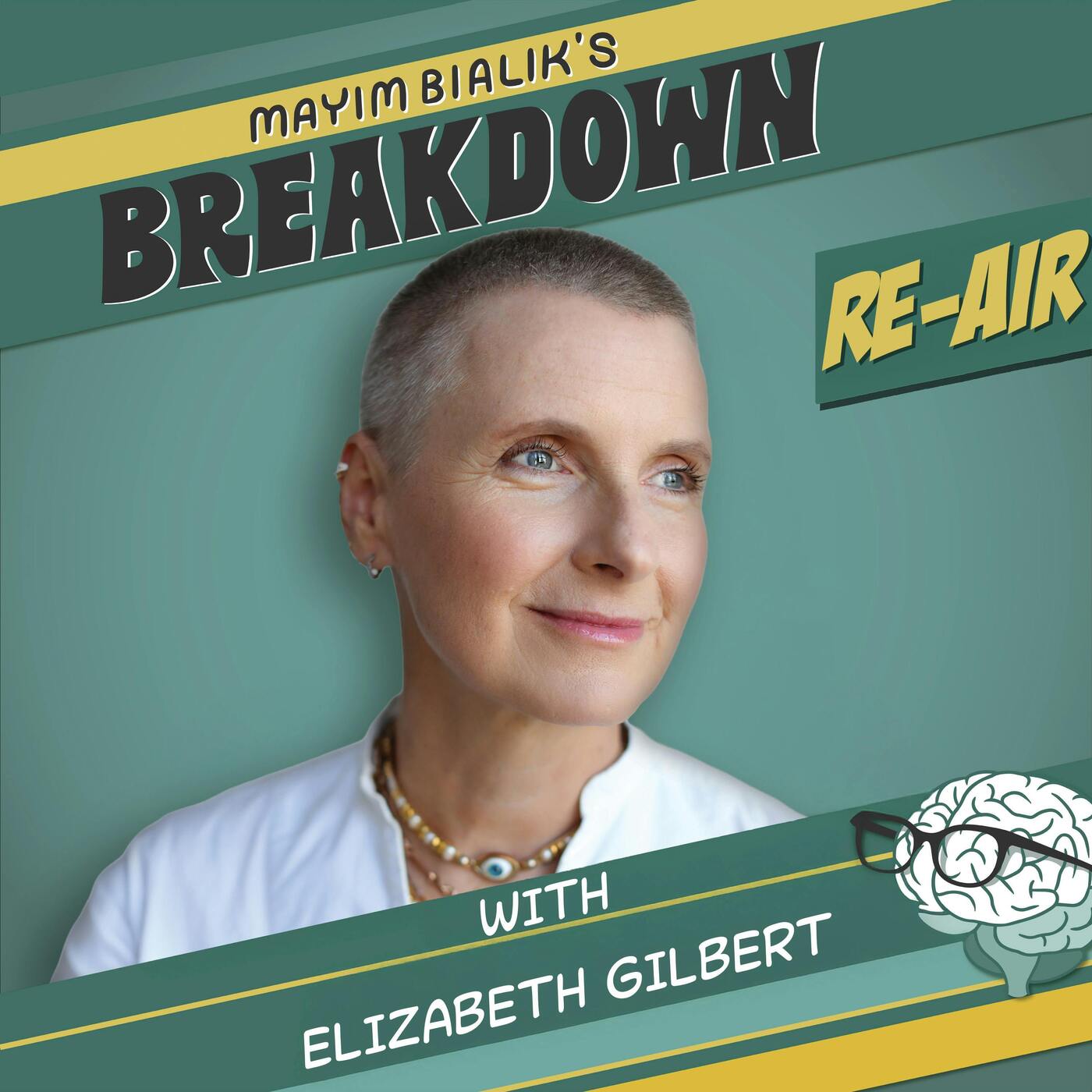
Mayim Bialik's Breakdown
Substack Live Re-Air: Elizabeth Gilbert on Addiction, Love, & the God-Shaped Hole
00:55:11
Loading summary
Transcript80 lines
- [00:04]
A
Hi, I'm Mayim Bialik.
- [00:05]
B
And I'm Jonathan Cohen.
- [00:06]
A
And welcome to our Breakdown. Happy Saturday. Today we're sharing something special that was previously only available over on our Substack page. So if you want to get stuff before anybody else hears it or sees it, please head over to Substack. But we're releasing here a very special conversation that Jonathan and I got to have with the incredible Elizabeth Gift Gilbert, the author of Eat Pray Love, Big Magic, and her most recent memoir, all the Way to the River. That's right, people, the Elizabeth Gilbert.
- [00:37]
B
This is a fascinating conversation because not only is she an amazing storyteller, her story itself is so powerful and it connects ideas that we touch on in this podcast all the time.
- [00:51]
A
She talks about how her path took her from a suburban marriage into this life altering romance with her best friend who became her lover. But her recent book reveals that that love affair was not all it seemed to be. It led to both of them relapsing into their deepest addictions, drugs. For her wife and for her, the deepest depths of codependency. She came to the point where she was contemplating both murder and suicide. And she talks about the differences between discovery and recovery. We're so excited to get to share this conversation with you. And please, if you want to hear these things right when they come out, make sure to follow us over on Substack Mind Bialix Breakdown.
- [01:31]
B
Not only can you hear these conversations right when they come out, often these conversations are interactive. So we cannot wait for you to join the growing Breaker community over on Substack.
- [01:40]
A
And we really hope you enjoy our conversation with Elizabeth Gilbert. Break it down. Many people know, obviously Eat Pray Love and they know a bit about your story. If you had to thumbnail like, give us a thumbnail sketch of the journey of your life that was revealed in the Eat Pray Love section of your existence. Why don't we start there?
- [02:03]
C
What's this Eat Pray Love thing? Everyone's talking about this, this current thing. So Eat Pray Love is a book that it's coming up on its 20th anniversary, which I think is incredible and hard to imagine. And that was a book that I wrote about a journey that I took alone around the world when I was 34 years old and fresh out of a really debilitating divorce. And then right on the heels of that divorce, a even more debilitating, if that could be said to be so, breakup with somebody who I was completely obsessed with, and a suicidal depression and a sense of tremendous failure and loss and dislocation and disorientation. And so I went to try to recreate my life through travel, which I now call. I have a little running joke about how, looking back on it 20 years later, and I love the young woman who did that. I love the young woman in me who had that idea. I call this my new subtitle for eat, pray, love. The original one was one woman search for everything across Italy, India, and indonesia. My new updated subtitle is Good guess, Good guess. Like, it's such a good guess. It's like, well, maybe if I go out there in the world and I consume everything that the world has, you, know, food and love and travel and beauty and a new language and a new guy and a new like me, maybe that will work. And to a certain extent, it did. And certainly it bettered my life and also remains something that I'm very touched to see, has inspired endless numbers of women, especially, to feel that they have permission to leave relationships, to leave jobs, to see the world, to create their lives in their own image. So it did a lot for me. And for a lot of people, what it didn't do and couldn't do Was get at the kind of untouchable darkness of my deep codependency and love addiction. That's what it couldn't reach. And that re emerged the way addictions always do when they're not treated. And 20 years, you know, nearly 20 years later, I found myself with a lot of the same pathologies that I've always had.
- [04:23]
A
I wonder, you know, with the framing of sort of repetition, compulsion, you know, can you sort of tell us you met this love in 2000? Right. And the notion that we sometimes think we're doing it different, but then we find that we're doing it the same. Can you talk about what that journey looked like for you? What were the hardest parts? What were the ugliest parts? What were the most beautiful parts? And what did you learn about this notion of repetition Compulsion?
- [04:54]
C
Yeah. That's a beautiful way to say it. I think one of the really tricky things about addiction Is that it's not just that you keep doing the same thing and expecting a different result, Is that you keep doing the same thing and telling yourself that you're not doing the same thing. And the first person who I deceive in my addiction Is always myself, Because I'm like, yep, but this time, it's not. I know it looks exactly like what I always do, but it's not what I always do. And here are the reasons why it's not what I always do. And my particular patterning is what's I've heard been called jungle gymming. Like just going from one person to another person to another person to another person and thinking that the problem is just if I could just be with somebody entirely different, then I will be entirely different. And I have 35 years of pretty hard evidence to back up that that's not the case. And yet when I'm convinced that that is the case, I will do that. So I met Raya Elias in the year 2000. I was already married to the wonderful guy that I met in Eat Pray Love. And it wasn't, you know, part of the reason that it didn't feel like I was in any dangerous territory was that we had a 17 year friendship. Like we, we like knew each other very deeply and at a deep level of trust and, and connection that I do believe was, was real, was, was a genuine kind of love. So this was not some sort of one night stand. This is a person who became my best friend and then became my person and then became my intimate and then became my everything. And then slowly over the years I pedestalized and pedestalized and pe Raya until she became a higher power. And I was like, this is the person who has the answer to literally, I mean, that's how I felt about her. I'm like, this is the person who has the answers to literally everything in life. This is the person who can keep me safe. This is the person who knows me. This is the person who I know. And then we fell gradually in love. She was diagnosed with terminal cancer and given six months to live. And I left my marriage to be with her. And that was traumatic. And then she relapsed into her drug addiction and that was also traumatic. And then I. The way I express it is that we both became the lowest versions of ourselves. The lowest version of Raya was just a desperate drug addict. And the lowest version of me is a spineless, enabling codependent who will give pour anything of myself into somebody to try to get them to take responsibility for my life and my heart. So we went to a pretty degraded place before she died.
- [07:38]
A
The world appreciates your honesty and your ability to sort of navigate this from a literary perspective and from a deeply psychological and emotional perspective as well. And there's a spiritual component that I want to get to in a little bit. You know what's funny is when you say what it looks like to make someone your higher power, when you say what it looks like to essentially be in that codependent web, all of the things you're saying, if I put a different tone and a different background, they sound amazing. This is the person I feel safe with. This is the person that I trust. This is the person that if I need anything, I know that I'll get it from them and they'll make me feel better. You could say that as your wedding vows and be like, this is amazing.
- [08:21]
C
What is the difference?
- [08:22]
A
Where is that fine line between. This person is my everything. I am deeply in love. I am deeply committed. I know that this is my mirror, that's my person. What? How do you know that? The other side is. I am so addicted, right, to this web that I'm in that I will, you know, accept crumbs right after I've given.
- [08:47]
C
I.
- [08:47]
A
Where's that line? I think many of us find ourselves on the other side of it, and we didn't know we crossed it.
- [08:53]
C
Well, isn't that true of every addiction? You know, most. I think, you know, certainly in the rooms of recovery, they often talk about what they call the invisible line of, say, alcoholism. Like, where's the line between a drinker and a heavy drinker? Where's the line between a heavy drinker and a problem drinker? Where's the line between a problem drinker and alcoholic? You know, like where somebody. You know, And I think that the original founders of the 12 Step World were wise in allowing people to self diagnose, because I can't see that line. I can't. I don't know what the difference is between a very heavy drink or a problem drinker or an alcoholic. I would never feel comfortable diagnosing somebody else as that. And yet, if you come into the rooms of recovery, they give you the opportunity to say, I think I might be. And I think a really nice way to do this is to backwards engineer your way into step one. So step one and all the 12 step fellowships is came to believe we had a problem. We came to believe we were powerless over blank, whatever it is, drugs, alcohol, eating, gambling, spending, cutting, sex, whatever it is, right? Pornography, prostitution, whatever. I came to believe we were powerless over this thing, this behavior or this substance. And then the really important, often overlooked second half of that first step is, and that our lives had become unmanageable, right? So oftentimes what I guide, when people come to me and they're like, do I have a problem? Is this out of control? Has your life become unmanageable? If the answer to that is yes, then you may have. You may have a Problem, right? And so what happened over time in my relationship with Raya is what has happened in so many of my relationships. My life became unmanageable. And what unmanageability looks like to me is I'm not. Okay, here's a really good example of unmanageability for me. This person didn't kiss me goodnight and say, I love you before they went to sleep. And. And now I'm in the bathroom on the floor sobbing. That's cool.
- [10:55]
A
It's called every other Saturday for me
- [10:57]
C
because my life has. The bottom has fallen out of my life. They don't look at me the way they used to look at me. And now I cannot fucking function. Like, I. Instead of being like, well, relationships change. I'm what the big book of AA calls a trembling wreck, right? I'm a trembling wreck. I can't do my job. I can't eat, I can't take care of my health. Like, unmanage me is you give me this. My mind tells me you, this person I love, give me this feeling which is how I have always wanted to feel, without which I now believe I cannot live. And if that is withheld, even in the slightest degree, I'm going to start to fall apart. Like, I'm going to start to not be able to function. And if you remove it from me completely, I will want to kill myself. And I say that very literally, Like, I will not want to live on this earth anymore. Now that, to me, is the ultimate definition of my life has become unmanageable. Like, I literally can't live without you. And the tricky thing about love addiction and sex addiction is how super celebrated it is in culture where, like, literally 90% of our favorite songs are about, I can't live in this without you. You know, like, we love that shit. We make movies about it, we make books about it. Like, that's upheld as how you're supposed to feel. But I'm telling you, it's not cute and it's not pretty. What happens to my actual life and the groundlessness of my being when I have given myself to somebody to that degree? And they now. Glennon Doyle quoted to me one time that she was in an Al Anon meeting where somebody said, my higher power used to be the expression on your face. Like, my higher power is the expression on your face. And if the expression on your face changes, I have no world, right? And that's not healthy. And that's somebody being my higher power again. For me, this is not anybody else's diagnosis, but this is my. This is what it feels like for me.
- [13:04]
A
I feel a little called out, but that's for me to deal with in therapy.
- [13:08]
B
Mind's Breakdown is supported by Bioptimizers.
- [13:12]
A
I struggled to get good quality sleep and I just thought like, ugh, it's stressful. But I learned during perimenopause and menopause, your hormones shift and it affects your magnesium levels. Low magnesium makes everything harder. Not just sleep, but focus, mood, stress tolerance. That's why we added Magnesium Breakthrough by Bioptimizers to our nightly routine. It's a blend of seven different forms of magnesium designed to support relaxation and overall sleep quality. Try it. See if you wake up more rested and refreshed, you've got nothing to lose and a lot to gain. BIOptimizers offers a 365 day, no questions asked money back guarantee. Magnesium Breakthrough is a fantastic way to improve that hormonal imbalance that especially happens with magnesium. And then you have better focus, you have better sleep hygiene in general. Bioptimizers makes it so easy. Here's what you get when you go to bioptimizers.com breaker and use the code breaker. 15% off your entire order and a free bottle of Mass Signs. That's Bio Optimizer's bestselling digestive enzyme added to your order automatically when you use our exclusive code. That's a 20 product free on top of your discount. This is a limited time offer. While supplies last. You cannot get this on Amazon. You can't get it in stores. The offer exists in one place. Our link, our code. That's it. So if you were already thinking about trying it, this is the sign. Go to buyoptimizers.com breaker use the code breaker. Grab it before it's gone.
- [14:36]
B
Make 2026, the year you finally start sleeping again. Mind balx Breakdown is supported by Bioptimizers.
- [14:44]
A
You know, I struggled to get good quality sleep and I just assumed it was stress. But as I learned during perimenopause and menopause, your hormones shift in a way that affects your magnesium levels. And low magnesium, it makes everything harder. Not just sleep. Focus, mood, your tolerance for stress. That's why I have added Magnesium Breakthrough bye bye Optimizers to my nightly routine. It's a blend of seven different forms of magnesium designed to support relaxation and overall sleep quality. Try it. See if you wake up more rested and refreshed, you've got nothing to lose and a lot to gain. BIOptimizers offers a 365 day no questions asked Money back guarantee magnesium breakthrough is, is a huge breakthrough to improve hormonal balance to help with focus, decrease brain fog, improve sleep hygiene overall. Bioptimizers makes it very easy. Jonathan, what do they get when they go to bioptimizers.com breaker and use the code breaker?
- [15:36]
B
You get 15 off your entire order and a free bottle of Mass Zymes
- [15:40]
A
bioptimizer's best selling digestive enzyme that'll be added to your order automatically when you use our exclusive code.
- [15:46]
B
That's a $20 product, free on top of your discount already.
- [15:51]
A
This is a limited time offer and while supplies last, you can't get it on Amazon, you can't get it in stores. This offer exists in one place. Our link, our code. That's it. So maybe you were already thinking about it. This is the sign. Go to buyoptimizers.com breaker use the code breaker. Grab it before it's gone. Make 2026 the year you finally start sleeping again. You know, someone, someone made a comment like, yeah, this is what happens in an abusive relationship. This is what happens even in a relationship that's not abusive. I will make it abusive.
- [16:19]
C
If you give me an opportunity, I'll make it abusive and I will cut myself with you. Like I will weaponize this story that we're in as a way of self harming. Yeah, you don't have to do, you don't even have to hit me. I'll do it.
- [16:34]
A
You've talked about what the need feels and looks like and I wonder if you can also help us distinguish again between being in love, being really, really connected to people. And especially if you're a deeply feeling person and you're with a deeply feeling person, you're gonna have a lot of complexity in the depth of the connection.
- [16:56]
C
Right?
- [16:57]
A
But you've talked about, you know, what does it look like to need constant validation, right? Constant touch, constant reassurance, constant presence. What does that look like and how do you distinguish it for yourself between it's amazing to be in love and like we're in this blend and it's amazing and we're always be touching, you know, what's the difference for you?
- [17:20]
C
I'm probably not the person you should come to for guidance about what healthy sexual and romantic love looks like. Honestly, you know, and I've, and I've tried, I mean, I'm just saying that very candidly. I think there are probably other people who would be able to give you a more sane and sober answer about what that is. Because what I want is to not exist. So what I want is to disappear into somebody so deeply that there is no Liz left. You know, that's. Anything less than that is going to be deeply unsatisfying for me. Like, I want to be so devoured by the moment that we're in together that I. That there's no moment. Like, so that's a junkie thing, you know what I mean? Like, and there are people who, God bless them, can have that experience with somebody and then later they can be like, and now the relationship has changed. And you know, and I'm like, no, it can't, it can't. No, it can't. And. And the thing is, I present, I can. I'm such a good little trickster. And this is part of the cunning, baffling and powerful nature of codependency. As with all disease, I can present as something incredibly self, confident, self reliant, resourceful, generative, creat, you know. But as a friend of mine says, like, I'm out there in the world looking like that, except for the one person I take hostage, right? And then God help them. Like, blink if you need help if you're the person that I take hostage, because you're now gonna have to fulfill, you know, every one of my emotional needs. So I guess I just wanna. I'm not trying to dodge the question. I'm just trying to be honest about my capacity to answer that question. And I don't have full faith. I mean, I wrote a whole book called Committed after I got married the second time, in which I was trying to. Because I know how I am. I was trying to learn everything that could be learned. Like, I did two years of studying, like, relationships and marriage to write this book so that I thought that I could insanity proof myself through educating myself. And as we say in the rooms of recovery, discovery is not recovery. Like, I know why I'm like this. I could write. That's why I said, if only therapy helped, right? Like by the time I was 30, I could have written a doctoral thesis called why I Act like this. But that didn't stop me from acting like this. So that's where the only thing that can save me is literally a higher power than my own mind or anybody else's mind. Otherwise all I'm going to do is just keep doing this. Just one hostage crisis after another or allowing somebody to take me hostage and calling that love, right? So, yeah, I'm a pretty hopeless case. And I can say that today with a little bit of amusement and love toward myself. Because I just know what I'm like. I know how I get. I know how I get, and I know how quickly I get that way.
- [20:23]
A
This kind of love tends to be romanticized. The notion of limerence is the basis for many of our favorite movies. Poems, thoughts, right, movements. But you, you reached a point where you talked about considering murder and suicide. That, that there was a time when that felt not a fleeting thought, but like a thought out solution. Can you talk about what that was that your bottom and what happens on the other side of that?
- [20:54]
C
It was one of my bottoms. And I would love to say that it was my last one, but it was, it was one. Rhea used to joke. I mean, I think it's probably a common thing in the world that she's like, just when you think there's, you've hit rock bottom, there's a trapdoor at the bottom of the rock bottom and there's another rock bottom below that. Like, until you fully put down the thing that you keep using, the bottoms are gonna keep piling up, right? But at that moment, what was happening was that Raya was a hospice patient on a death watch, dying of pancreatic and liver cancer who had also relapsed into opioid and cocaine addiction. She was not a nice addict. I remember one of her friends saying, like, I wish Raya was a nice drug addict. She wasn't. It unleashed a darkness in her that was I had never met. In the 17 years of our deep loving friendship, I'd never met Raya the drug addict. I'd heard tales. I'd heard tales. Cause she was sort of legendary, you know, but like, you know, and I remember, I remember her telling me a story about when she. One of the many relapses she had back in the day when she was an active, active drug addict on cocaine. She had started using cocaine again. And a mutual friend had taken her girlfriend at the time aside and said, you've gotta get away now. Like, you don't wanna be dealing with Rhea on cocaine. You have to get away now. And the woman was like, well, I can handle Raya. And this guy said, I can't handle Rhea on cocaine. And I'm a Korean war veteran, you know, like, you can't handle Rhea on cocaine, and I couldn't handle Raya on cocaine. And we had descended into this darkness from which I really, truly felt there was no escape. Because how do you do an intervention with somebody who's a cancer hospice patient? Like, what are you gonna say? Like, this is gonna kill you. She had this incredible ace card to play, which was like, be dying, there are no rules. Which was also part of what gave us this free for all of this love story that we fell into that made it so hot and so exciting, was like, there's no rules. There's no restrictions. This person's gonna be dead soon. We get to do whatever we want. Started off as, like, the most incredible joyride in the entire world and super limerency, and then ended with this descent into, like, the ninth circle of hell. And I was sleep deprived. I was being abused. I was at the end of myself, like, and the thought I had was, like, I should kill her. Like, we've got all of these. She's on infinite. Also hospice. Bless them. Give hospice patients however much painkillers you want. So she had, like, access to, like, all the drugs she had ever dreamed of. And I was like, I gotta overdose her so that this ends or me, like, one of us. Like, one or both of us have to die. And I was so degraded and insane and lost and desperate at that time that that seemed like a really good idea in the moment that I had that idea. Like, it genuinely. You know, we talk in the rooms of recovery about, like, where our best thinking landed us. That was my best thinking on that day. What stopped me was one of one, is that Raya smelled a plot because she had the most incredible survival instincts of anybody I've ever known. And she just, like, came up out of her stupor and was like, don't you start turning against me now. Like, I was like, how did you just read my mind? And also what stopped me was a voice that I call God that came to me and said, if you ever find yourself in a situation where you want to kill someone or take your own life, you have probably reached the end of your power. And that being the case, it might be a good idea for you to call some people and ask for help. And I called a bunch of people, and I went to my first Al Anon meeting that night. Now, why I say it wasn't my final rock bottom was because I continued to go to Al Anon until Rhea put the cocaine down, stopped using, and died sober. Because I was like, well, I don't need Al Anon anymore because my addict isn't using, so I'm good. And I stopped going to. I stopped recovery and of course, just went back out after she died and continued to do what I always do and continued to live how I always lived. Because the problem in me was unsolved, regardless of what the addict is doing or not doing. My codependency was just as strong as ever, and that wasn't healed, so I had to have another bottom after that about a year and a half later. And that was where I was like, okay, now I think I'm ready to go to the rooms and actually take this on.
- [25:33]
B
I'm curious about the spiritual moment where you heard that guidance, and what did it sound like to you? We talk a lot about spirituality, intuition, but especially when someone is in a place where they get touched and there is an intervention in a way in their life where they have such a profound, you know, in that moment, it was an awakening from where. What it sounds like to me. Can you talk a little bit about that moment and what it sounded like or felt like?
- [26:02]
C
Yeah, it felt very similar to anybody who read Eat, Pray, Love or even saw the film. Eat, Pray, Love begins with a very similar moment. A place I've been many times on my knees on the bathroom floor, crying in the middle of the night, alone and degraded and begging for help. And a voice came to me, and this is, I think, the moment that my spiritual journey began, that I'm still on over two decades ago. A voice came to me and said, go back to bed, Liz. Because I was begging like, what do I do? Do I leave my marriage? Do I stay in my marriage? Do I leave? Do I stay? Do I leave? Do I stay? And the answer came, go back to bed, Liz. So I've heard it said that fear, anxiety, and addiction always speak in urgent questions, and intuition and higher power always speak in calm answers. So what happened was I was living in this state of urgent, emergent questions of like, oh, my God, what do I do? What do I do? What do I do?
- [27:04]
A
What do I.
- [27:05]
C
You know, how do I fix this? How do I solve this? How do. That's my mind spinning like my monkey mind just wrapped around the axle, you know? And there's never gonna be any good answer that comes at that plane. You know, it's just panic and terror and a repetition of terrified, urgent questions. And then. But the. But that. That moment came, and you can feel it. It's a voice I hear in my head. It sort of sounds like my voice. It comes to me as, like, there's that lovely line that they say in Hindu Shaivism, God dwells within you as you. Right? So it's like. It comes to you as you, but a freaking out, spinning, urgent, questioning voice. It's a simple thing. Go back to bed with, you know, or in this case, call somebody and ask for help. It's a simple directive, simple statements with periods at the end. That's how my higher power speaks to me. And I can tell that it's what I call God, or what you might call source or higher power, divinity, by the. What it does to my nervous system when I hear that voice. There's a, oh, okay. You know, it's like. I'm like, you know, and then all of a sudden, it's like, call somebody and ask for help. There it is.
- [28:27]
A
How important is it to ask, how did we get here? Meaning you can spend a lot of time. And I happen to be a person who likes therapy a lot, and I think that talk therapy has its benefits, and for me, it's a very helpful thing. But, you know, how important is it? I think in the comments, a lot of people are like, what was she raised? Like, can we point to. Here's what happened that made me like, this. Is it what happens in the hours after you're born? Is it what happens in the first year? Like, is it what we grow up with? Is it. I mean, I'm asking somewhat rhetorically, you know, we know it's a combination of genetics, epigenetics, environment, all these things. How much do you feel comfortable sharing with. Oh, these are some of the things that I've connected.
- [29:07]
C
Right.
- [29:08]
A
Cause if we're raised in chaos, chaos feels very comfortable. And no one cooking smells like home cooking.
- [29:14]
C
Right.
- [29:14]
A
And no one would ever say, like, oh, I love. I love to pursue chaos. And I find chaos, it's just like, you feel alive, you feel excited. That doesn't feel scary to you when it's like, I don't know what time I'm picking you up, and who knows if I'll even show up? It's like, cool, I'll just wait around. Right. What was it in your formation.
- [29:33]
C
Right.
- [29:33]
A
Of who you are that you think contributed, and then how much of it is not about that? How much of it is karma or other things?
- [29:41]
C
Can't know. Like, I can't know. Fun to speculate. You know, I can certainly posit a bunch of guesses, none of which I would talk about here, just because they involve other people and they involve people who are still alive. Sure. And I'm super comfortable being vulnerable and revealing about myself, but I'm very protective of not being vulnerable and revealing about anybody who has not consented to that or who could be harmed by that. So there are things about my childhood that I don't talk about publicly, only for that Reason and. But yeah, we could sit here. Like, if we were in a therapist's office, we could just connect the dots. You know, it's this. It's too much of this and not enough of that. Plus a combination of what I do think of as kind of my Earth School curriculum in this lifetime. Like, my personal theology is, like, you know, we come here in certain incarnations with certain problems to work out. And, like, this one was mine for this lifetime. And I came here, like, let's go to Earth School about this. Let's go to Earth School about codependency. Let's go to Earth School about. About the addiction to other people. Let's see if we can. Let's see if we can in this round of incarnation. Let's see if we can find emotional autonomy. Let's see if we can find dignity. Let's see if we can find a way to stand on our own two feet. Let's see if we can do that. And in order for that to happen, we're gonna have to set up all of these challenges. The way you were raised and the culture that you were in. Like, let's see if you can see through all of that and find yourself in that. That makes it sort of sound more like an adventure to me, and I like that. So. So, yeah. Here's the thing, though. I spent a fortune and sat in therapeutic offices for years talking about this, and it didn't stop. I couldn't interrupt the behavior. I could only understand the behavior. If therapy would help anybody do it, you know, And I still am so grateful to the therapists that I had over the years who were so loving and expert. It's not like. It's not like anybody was faulty at their job. It's just that. That this thing, this vacancy in me is so immense. I feel in me. And again, I just want to be really clear. I'm only talking about my own experience here. This vacancy in me, this hollowness and emptiness and need is so oceanic and so unfillable. And I've done the research. Like, I went out there and I found people who loved me. I found people who wanted me to fill that vacancy, who signed up for it, was like, I want to be the one who's going to fill you with love. Like, it's not like I only found people who were withholding. I found people who were abundantly loving. Can't touch it. It's like they can't reach it. They can't touch it, because it's not meant in my concept of my understanding of myself now to be met and filled by human love. For me, it can't be. For others, it might be able to be. And the only thing that settles it, the only thing that has ever made that vacancy feel full and serene and peaceful is the love of the God of my understanding. That's the only thing that can reach it. Because I think it's infinite. I think the whole is infinite, and so it can only be filled by something equally infinite. And I can't look at a human being and ask them to deliver infinite love to me. They sometimes have to go to work or eat a sandwich. You know what I mean? Like, people have lives like they can't, you know, even if they want to, right? So I've got to find that elsewhere. And I think that for me, that was my Earth school assignment was like, can you. It's again, good guess, good guess to think that this person can give it to you, or that person can give it to you, or that this achievement can fill it, or that this substance can fill it. But that's not. It's never worked for me. I wake up on Tuesday morning and I'm still lonely.
- [33:34]
B
This episode is sponsored by Wondering Jews, an open door media brand.
- [33:39]
A
If you've ever found yourself feeling like you have more questions than answers, you're in good company. The Jewish people have been like that for thousands of years. Wondering Jews with Michal and Noam is a podcast where two of today's most dynamic Jewish voices, Michal Bittone and Noam Weissman, dig into the biggest questions about life through a Jewish life lens. It's the kind of conversation where you'll laugh, learn something new, and probably shout in disagreement at least once. Michal and Noam tackle the tough topics like anti Semitism in America, what happens after we die, and the future of religion with guests like Bret Stephens, Michael Rapoport and Sarah Hurwitz. And this past month, in honor of Jewish American Heritage Month, they've been celebrating some of the Jewish lives and institutions that have shaped American life, from food to music and comedy. Thoughtful, joyful and always honest. Honest. That's Wondering Jews with Michal and Noam, a production of Unpacked. Find it on your favorite podcast app or on YouTube and make sure to hit subscribe. Check out Wondering Jews with Michal and Noam podcast and subscribe at Unpacked Bio nmx.
- [34:44]
C
Wherever you go, whatever they get into, from chill time to everyday adventures, Protect your dog from parasites with Cridellio Guattro for full safety information side Effects and warnings, visit credelioquatrolabel.com consult your vet or call 1-888-545-5973. Ask your vet for Cordelio Cuatro and visit quattrodog.com
- [35:11]
B
non local consciousness. You know, that's the phrase that's used a lot, but I think there's a lot of people using a lot of different terms for the notion of there being something greater than us and how do we each connect to it individually. So, you know, there's such a huge topic, but maybe you could start us by just starting to explore moments where you began to fill that unfillable void with. With something else. And what was that? Like, how did you develop that relationship?
- [35:39]
C
It's been the most important relationship of my life, and the. And it's been a slow burn. You know, I'm like. I would say that I've been on a very serious and devoted spiritual journey for the last 25 years, which, in the terms of the cosmos is like, eight seconds, whatever. Like, what is that even? You know, Like, I just heard a chorus of laughing age. They're like, oh, you've been doing this for so long, it's like, you know, or millions of lifetimes. Who even knows, right? There are these clues that started to land on me as I was reading and studying and listening. Like, I would hear somebody say something, or I would read an ancient text, and I would be like. Like that part. That part, you know, like, what? Wait, wait, wait, wait. Like. And it's almost like, you know, there's. There's a term I love. And the ashram where I studied India talked about something they call the splendor of recognition. And the splendor of recognition is when your soul recognizes its true nature in a. In a moment. And you're like, oh, that's what I. Oh, that's what I am, you know, like, oh, my God. Oh, my literal God. You know, I'm not just this collection of pathologies and difficulties and challenges and stories and failures. Like, there's something quite epic going on here, and there's this splendor of that moment of recognition. So one of them for me was, you know, at the very bottom of my shame. And I have so have had so much shame in my life from the behaviors that I exhibit in my relationships because they're so at odds with my true nature. Like, my true nature. I think all addicts struggle with why this is so baffling. Like, my true nature is one of such gracious love and kindness. And generosity and my addictive nature. I'm a fucking vampire squid, you know? It's like I am a manipulative, angry, resentful, grasping nightmare, right? And I'm like, this is. This can't possibly be who I really am, you know, because all I really want is for everyone to be all right and for everyone to be. You know what I mean? Like, all I really want is for all of us to be safe and loved. But I don't act like that. I had a vision once where I saw this figure, this representative figure, and it was this. This woman with this incredibly kind face, dressed in white. And. And it felt like we were kind of like in a yurt. I don't know how else to explain it, but it was like. It's like this little room, and there are all these cots and, like, futons laid out. And I could see that it was the interior of my heart. It was like I was looking at the inside of my heart. And this woman was this representation of my true heart. And, I mean, I wasn't on any psychedelic drugs or I hadn't been doing any breath work. I was just desperate and crying out for guidance. And I saw this image and felt this woman, and she opened up the door. It was like she opened up the door of my heart, and she said to me, give me all of your anger. Like, all of your anger. Just give it. Just give it to me. And I was like, you don't want it. It's so ugly. It's so repulsive. And she was like. And she just kept going like this, like, bring it in here. Bring it in here. And she was, like, taking every angry thought that I had and, like, lying it down, laying it down. I never know which one it is. That's why they pay me to be a writer. Putting it to bed on this. On these futon, like, on these blankets and just tucking it in and being like, you just rest in here. Like, just come and rest in here in this heart. And then she said, bring me all of your fear and every single fearful thought. And I was like, oh, I'm so ashamed of how afraid I am. And she's like, bring them all in here. And we're just gonna put them all to bed, each one of them. And she laid them all down and tucked them in. And then it was just this infinite amount of space. No matter how much fear and anger I had, there was room, you know, in my heart for it. And then she said, bring me your shame. And I was like, you don't want. You don't wanna know. You don't wanna know what. You don't want it. They're like, it's going to contaminate this whole. You know, it's so. It's so toxic and awful. It can't be seen. And she was like, each one, and this was like, each shameful thought, each fearful thought, each angry thought was like an orphan that she just welcomed in and made a bed for and settled in. And she kept saying, anything else? Like, is there anything else? Any other anger, any other fear, any other shame? Like, bring it. Don't hide any of it. Bring it all in. And then in this low light, in this space, she just tucked them all in and she was like, and now we can be together. Right? This is all they have ever needed. They just needed a safe heart to rest in. And that, to me is what that infinite loving compassion says to me is there is nothing you can bring me. Like, I have a higher power that does not clutch its pearls when it sees what I have done or what I am up to or what my dark thoughts are. You know, it's just like, oh, sweetheart, yes, of course I see that. And there's a home for you here. There's a home for you here in love. And I've got you, and I'm not going anywhere. And there's nothing. What I always hear in those prayers and in those visions is there's nothing you could ever, ever, ever do that would cause you to be expelled from this place of love. There's nothing.
- [40:44]
A
Where my brain goes is like, but don't we feel that about a partner? And the answer is no. That this is a kind of love that needs to be carefully cordoned off from any human desire that you have. Meaning, you cannot, should not, will not get that from a human. No matter how much you think that's their purpose, that sense, comfort at home,
- [41:08]
C
they might even think it's their purpose. Right.
- [41:11]
A
Like, that kind of wholeness is literally. It's an inside job and it's between you and your higher power.
- [41:18]
C
Right? Yeah.
- [41:19]
B
Well, there's infinite capacity.
- [41:22]
C
Yeah.
- [41:22]
B
When you're describing it and they're welcoming and welcoming, it's what else is like, they don't have to sleep. They don't have to think about anything. That's just an infinite holding and ability to receive. And it also strikes me, like, reminds me of our conversation with Michael Singer, like, how much we're holding that we just never have a place for because we are misplacing it. Right. We're trying to have our partner hold it, or we think it can only come out in a therapist's office or, you know, so we're just all bottled up, knotted inside without ever being able to expand in that way.
- [41:58]
C
That's beautifully put. I love Michael Singer with All the Way to the River.
- [42:02]
A
You know, it was an instant bestseller and it was an Oprah's Book Club pick. And you know, like that's, you know, in many circles, like that is a place of success, recognition as a writer. But there's something I want to ask you that I don't know if you've spoken about before. I'm very interested in this also, just because it's been part of my journey. You're not only evolving as a person, but you are choosing to become a personality surrounding a set of issues that most people try and hide. They put them away. It's something shameful. You talk about it maybe if you get to therapy or if you get to a 12 step room. But I wonder if you can talk a little bit about the complexity of fame on top of the need to please, on top of the need to be part of a transactional relationship where you're getting rewards. You're being lauded, right, for talking about how adulation is and criticized. You know, you're interfacing in a way that feeds into so many of the patterns. And you know, I'm curious about that. Like, writers, we don't write because we want to be famous. We write because it's. It feels like what needs to happen, right? With the thoughts, the emotions, the dreams, whatever it is. But I wonder if you can talk a little bit about what it feels like to have fame on top of this. Both the adulation and this intense criticism that can come from being public about the most raw parts of you.
- [43:34]
C
I think all of us, if we're lucky and attentive, we might notice that there's like one or two things in life that aren't hard. You know, that like you're naturally sort of like I sort of. You have a good, healthy relationship with it and you didn't have to work to have that good, healthy relationship with it. For some reason that I cannot explain any more than I can fully understand or explain my pathologies. I have always had this very sane and healthy relationship with creativity and with. And this understanding of it, what it is, what it isn't. This like, right. Sizing of it, this understanding and acceptance of like, some people will like some of the things that you do, and some people won't Some things will be successful, some won't. Doesn't matter. I don't know. Like, if. Believe me, if I could have this kind of neutral indifference that I have about the work that I make in the world, if I could have that in my interpersonal relationships, we would all be a lot happier. But I'm just lucky that I have it in this one realm. And there's a line in the Bhagavad Gita that I love, that I feel like for some reason, I just was born getting this, that you're entitled to the labor, but you're not entitled to the fruit of the labor. And it's such a sane way to create. It's such a sane way to put work out into the world. And so I'm very relaxed about what I put out into the world, even if it's something that's this vulnerable. And I feel that my relationship with my readers is actually one of the healthier relationships of my life, where it's like, I really love you guys. I don't feel like you're my higher power. I don't feel like I'm your higher power. I'm gonna share with you something that I think you might be interested in seeing. You're not obliged to come along on this journey if you don't want to. If you want to. Here's a book. If you don't want it, you don't have to read. Doesn't feel like a fraught relationship. And as far as the sort of motive of publishing this book, God, I wish somebody had told me about Sex and Love Addicts Anonymous a long time ago. Right? And the fact that so few women, especially, will talk about sex addiction and love addiction and very understandably won't because of the amount of shame that can be leveled upon women for. For talking about these things. I'd heard of sex addiction, but I really thought that it was something that men had. I really associated it with a certain set of behaviors that I wasn't doing that involved, like massage parlors and sex workers and porn addiction and serial cheating and all the stuff that I wasn't doing, I was acting out in a very different way that I just. It didn't feel like that was mine. And when I came into the rooms of recovery, I found it really interesting. I met a lot of women who have liked decades of recovery in AA and na, and everyone in their world knows that they are sober. They are so proudly sober in alcoholism and drug addiction, and they have decades of recovery in codependency and Sex and Love Addicts Anonymous. And nobody knows. Their husbands don't know, their children don't know. They live in terror that somebody will find out, right? And I'm like, oh, this is incredible. This must be like the last stigmatized addiction. And specifically to women where this is a thing we can't talk about in public. And since I have been so open in my life about so many things already and I kind of feel like y' all already know me, I was like, I'm happy to talk about this and I'm happy to offer my, my experience, strength and hope. I'm happy to, to share my story. And what happened when I was on my book tour was that it became really clear to me and a fellow in my program helped me to see this. Those live events that I did were meetings and those interviews that I did were 12 step meetings where I was qualifying. That's what my fellow said. It's like when you go to this event, you're not selling your book. You're qualifying as an addict in recovery to a room with some newcomers. And I'm not proselytizing, I'm just saying this is what my experience was. And I'm gonna talk about this in this book forum. And so that helped me to just sort of right size what that book publication was about. That made it slightly different from other book publications where I might have been more paying more attention to like, how's it selling? Who's, you know, what are the critics saying? Like with this book more than anything else and having been in this a long time, I sort of do this anyway. But I officially did it with this book where I said to my publisher, I'm not interested in seeing any of the reviews. I'm not interested in. I don't want to see the good ones either. It's because they're both disorienting. It's disorienting to be praised and it's disorienting to be condemned. So I'm just going to put this thing out there and anybody who's interested in it and anybody who has any questions about it can ask me about it and I'll talk about my experience. So actually that aspect of it hasn't felt complicated. And also just to bring it back to a spiritual thing, I do two way prayer every day, which some of you are in the rooms know what that is. But it's, you know, a direct communion with the higher power of my understanding. And like. And honestly you guys, this book was an assignment and some of my Books. Some of my books come from the spirit of just like fun creativity. And some of them are assignments. And this one was an assignment. And at times it was a really difficult one, but it was. There was. I don't negotiate. When that voice says I need you to do this, I just don't it. And. And so. So that's the answer to that.
- [49:21]
B
Can you tell us about the moment you received the assignment? And do you imagine that voice as a higher power? Is it a council of guardian angels? Is it a specific guardian angel? Is it your higher self? How do you understand that voice of the assignment?
- [49:38]
C
Well, I tried to write this book three times in the last seven years in three different ways. And that was my will. So the first version of it I wrote within a year after Rhea died. I wrote a novella called Nobody Leaves that was a fictionalized account of what had happened. It was like a lesbian ghost story. And I'm like, here's how I'm gonna do this. This is so me. This is so my relationship with divinity. I'm like, here's what I'm gonna do. And then I do what I'm gonna do. And when I was done writing a whole entire book, I sent it to my literary agent. I'm like, I don't know, I just wrote this. It's a thing. Nevermind, forget it. I wish I was never born. Lose my number. I don't think this is the. I don't like, whatever. I don't think this is it. And then I tried to write it as a book of prayers and poetry where I was talking around addiction because I still wasn't ready to really like the fact that I tried to hide it as fiction. And then the fact that I tried to hide it as poetry and prayers. I wrote a whole other novel in between about something else entirely because I tried to not write it. So my three efforts were like, I'm going to write it as fiction. I'm going to write it as poetry and prayer. I'm not going to write it. In each case, it was like, I don't want to go into the white hot nuclear reactor radioactive center of this thing. And then what happened was that Rhea came to me in a vision on the morning of my 54th birthday. And as clearly as I'm talking to you, I could feel her in the room. And she was like, bitch, write that book. And you know, Raya was like, Raya was a truth teller of the highest order. And Rhea was like, it's time for you to write a completely honest book. About what actually happened. Like, don't hide it as fiction. Don't hide it as prayer. Don't hide it as poetry. Like just in her words, write the living shit out of that thing. And don't try to protect my dignity or yours because it's not gonna be very helpful to anybody.
- [51:33]
A
Have you had visits from other people who had passed on before? Was this a new encounter?
- [51:38]
C
Rhea's mother? You know, I don't think of myself as somebody who walks around listening to the dead. But I write in the book about three encounters that I had with Rhea's mother who had died long before I ever met Rhea. And when, around the time that Rhea got sick, she came to me. When she was desperately sick, she came to me. And again after Rhea died. And I felt like she was a guiding force for both of us during that time. But Rayyan was really. Was so present in the immediate aftermath of her death. I was talking to her all the time. I was joking. Like, Ray is more present in death than most people are in life. Like, I could just call her basically. Like, I would go for walks in the woods and I would just turn on the voice app of my phone and talk to her and feel like I felt completely like she was there. Like we were walking together and talking together. Wow. And that has. That has diminished to the point of I almost hardly ever feel her anymore. It's a rare occurrence when I do. And the way I see that is that. That knowing how much I depended on her. She used to say before she died, she was. She would say, I'm not gonna leave until we're both ready. And she also used to say, I won't quit on you until I see that you can stand on your own two feet in every single circumstance of your life. And that was what she wanted of me. And I feel that her. The fact that I can't feel her direction anymore intimately to me feels like she died. But she didn't leave. And then now I feel that she has left. And a message that I get from my higher power sometimes when I reach to Rhea is, any questions you have for Raya, you can now ask me. You know, I'll let you know. And also I've gotten a really strong message from my higher power of like, leave Rhea alone. She's like, she has a really important work to do on her soul. And you have really important work to do on your soul. And you both need, like, she needs space. This is the last thing a codependent ever wants to give anyone. And you and you also need to keep focusing on your own life. So if you have any questions, you can come to me. Ray is fine. And now it's me and you, right? Like, it's been like a transfer between, like, Raya is your higher power to now you actually have a God of your own understanding and you don't need to be asking other people for guidance anymore.
- [53:55]
B
Do you think that the message from her, when you were to write that the book honestly and vulnerably and not to pull punches, for lack of a better word, do you feel like you needed the message to empower you? But did you also feel like you needed her permission to go there to, like, that she was on board with the project?
- [54:13]
C
Well, she'd always been on board with it. So the whole time that Rhea was dying, I was taking notes. I mean, I would go into my office every night and write everything that had happened that day. Like, we both knew that I was going to write a book about her. Rhea had written her own book about her own drug addiction, that she had written short films that she had produced about her own heroin addiction and drug addiction. She had a documentary film crew following her around while she was dying, who they're still editing and making this film about her. Like, everything about Rhea and her healing was always about transparency, transparency, transparency. And the thing that I loved about Rhea more than anything was her. When she was well and when she was sober, her truth telling was so redemptive. And she would just say, like, if she was ever in any conflict with anybody, she would say, like, let's just get to the truth as soon as possible, since that's where we're gonna end up anyway. So, like, you tell me your truth and I'll tell you mine. And let's put it on the table and let's hammer this out. And, you know, we talked about what the title of the book should be. Like there was no. She absolutely wanted me to write this book. I didn't want to, is the thing, you know, like, I was the one who was the problem. Like, I didn't. And it wasn't because I was afraid. I don't think it was fully. Because I was afraid of revealing myself or her. I didn't wanna do the work I knew I would have to do to write this book. I didn't wanna go back to the hell that we were in together. I didn't wanna revisit that. It was the most excruciating thing I've ever been in. And I was like, let me whitewash this with fiction and poetry and not have to say directly, like, what happened to her and what happened to me. So, yeah, I was the one holding up the show. And I think her insistence on coming in and being like, like, dude, seven years. Like, you've been waiting seven years. It's time. It's time. Like, come on, let's do it. And just all you have to do is tell the truth. Just tell the truth. That's it.
- [56:06]
B
How did her voice. When you say she was so present, how did her voice sound different than, for example, when you got your spiritual awakening the first time, where it was your higher power? Because a lot of people listening are trying to navigate, like, is how do I feel? Is it someone? Am I making it up? How do I navigate these different, you know, voices? And I use voices lightly because I don't think it's, you know, as a schizophrenic. Like, I think it's, like, tones and cadence of a voice versus, you know, it being totally different. But what was it like for you?
- [56:40]
C
Raya's voice is so unmistakable. There's absolutely no possible way that it could be anything but Raya. I mean, that was.
- [56:46]
B
Did you hear it, or is it, like, a feeling?
- [56:47]
C
Yeah, I just hear. I mean, she's in my head, right? It's a voice in my head, but it's her. And it's very distinct from the voice that I call God, who, for instance, would not be like, bitch, write that motherfucking book and don't be a pussy about it. Right, so it's language and tone. Yeah, that's Rhea. Right. You know, like. And, you know, like, stand on your own goddamn two feet and, like, don't back down. Like, that's Rhea. That's always how I loved Rhea's voice, you know, so there's no. Rhea's voice is not, you know, And God's voice is just. It's different. It's just the great knowing, you know, like, you know, we live our lives in anxious questions, and God answers in simple statements. That's the only way that I can possibly describe it. And it's a must.
- [57:30]
B
And you can feel the difference. You can feel the difference.
- [57:33]
C
It's an energetic.
- [57:34]
B
That energy, and then the very, very calm, grounding, supportive, infinite.
- [57:39]
A
Elizabeth, we're so grateful to get to speak to you. You've been someone, you know, who's been on, obviously, our cultural radar. But as our work has drawn us closer to understanding psy and spirituality and where science and spirituality meet, we've been so inspired by you. And we're so grateful that so many of your followers joined us for this conversation. It's just really such an honor to
- [58:01]
C
get to speak to you.
- [58:02]
B
Elizabeth, as we leave, do you want to just tell people briefly about Letters From Love?
- [58:07]
C
Letters from Love is a project that I've been doing with my beloved friend Margaret Cordy on substack, where we are teaching people how to do essentially two way prayer, where you learn this practice of, of asking source, love the universe, God, what would you have me know? And learning how to speak to yourself and write to yourself from a place of a spirit of unconditional love. And it's been two and a half years that we've been there. We've got over 200,000 people over there writing to themselves and speaking to themselves from a place of that deep source that we spoke of, of the infinite, abiding, accepting, unconditional love that is available when we reach for it. So come, I see Mary Beth, I see a bunch of names I recognize as Lovelette. So come, come hang out with us over there. We call it the kindest corner of the Internet. And I would love to invite both of you to do Letters from Life if you would ever do it. It's amazing. We want you over there and you belong over there.
- [59:09]
A
That's wonderful. Really, really appreciate it. And you know, you have such a fiercely loyal audience, but I really, I'm so inspired to hear how you know your truth and how raw you are. Touches so many people and inspires them. So we're just really grateful to get to share this substack space with you. So thank you so, so much.
- [59:29]
C
Thank you. Thanks for inviting me. Wonderful to talk to you. It's Maya Bialik's breakdown. She's gonna break it down for you. She's got a neuroscience PhD or two and now she's gonna break down, so break down she's gonna break it down.