← Mayim Bialik's Breakdown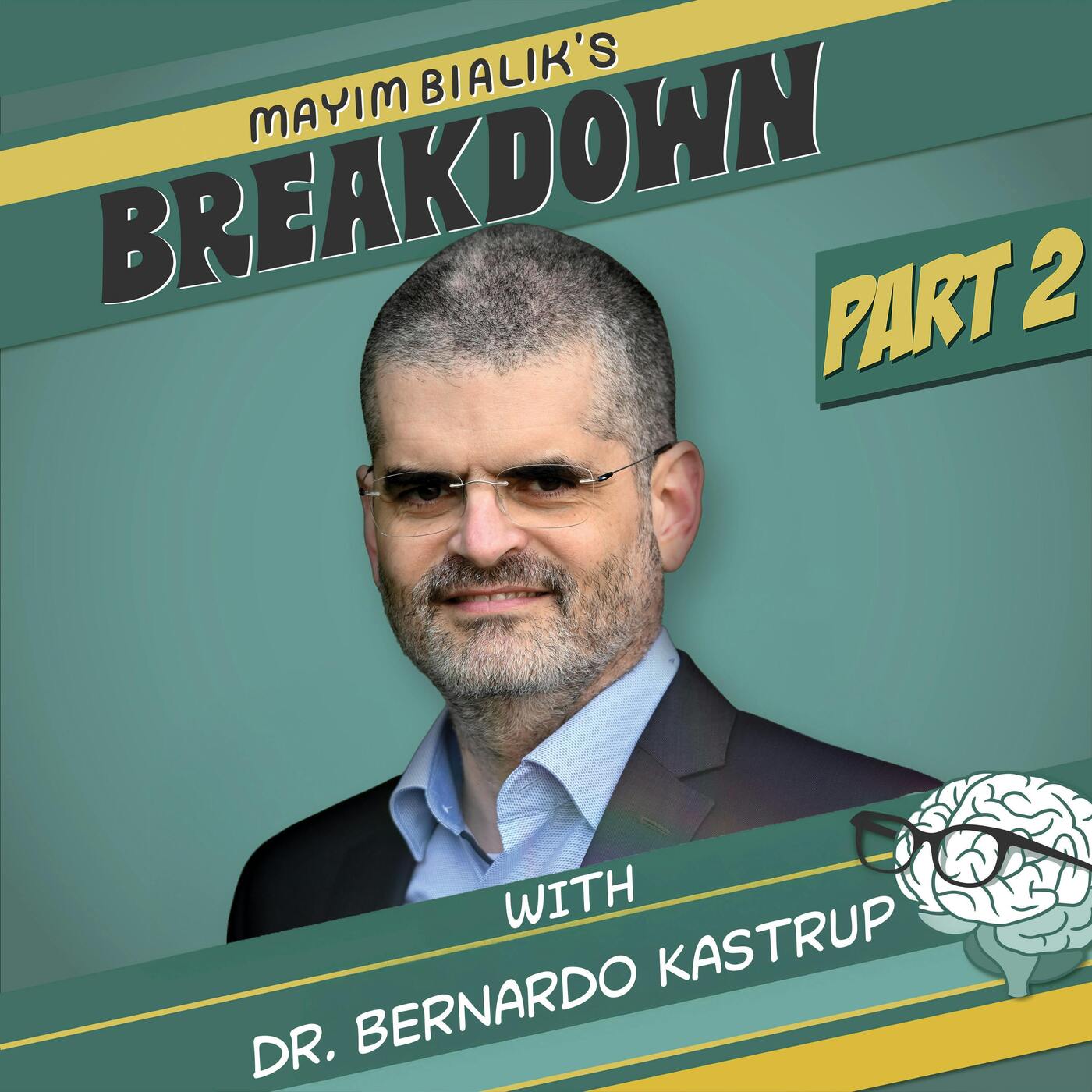
Mayim Bialik's Breakdown
Part Two: Access Your Divine Intelligence! Dr. Bernardo Kastrup Provides a Mind-Expanding Explanation of Consciousness that Leads You to Higher Meaning
01:00:06
Loading summary
Transcript90 lines
- [00:00]
Mayim Bialik
Mind Breakdown is supported by Helix Sleep.
- [00:04]
Jonathan Cohen
Spring is in the air and so are all of the allergens that come with it. Spring allergens means you need more sleep, but there are a ton of factors that can prevent us from getting a good night's rest. Night sweats, back pain, feeling the person next to you when they roll over a million times. We were so excited to hear that Helix wanted to partner with us. I've had my Helix mattress for about five years now and I have been sleeping so much better. Jonathan and also our kids love their Helix mattresses and all night sweats, back pain, motion transfer. Those things are significantly better with a Helix mattress. Helix delivers your mattress right to your door which is so much fun. With free shipping in the US they have a 120 night sleep trial and limited lifetime warranty. Plus they're happy with Helix Guarantee Rest easy With seamless returns and exchanges, the Happy with Helix guarantee offers a risk free customer first experience designed to ensure that you're completely satisfied with your new mattress. Go to helix sleep.com breakdown for 27% off sitewide that's helixsleep do for 27% off site wide helixsleep.com breakdown. Hi, I'm Mayim Bialik.
- [01:15]
Mayim Bialik
I'm Jonathan Cohen and welcome to part
- [01:17]
Jonathan Cohen
two of our conversation with Dr. Bernardo Kastrup. Really hope that you heard part one of this conversation. Dr. Kastrup is a philosopher and an analytic idealist, but as you probably gleaned from our first conversation with him, he's got something to say about why we are here, what's the nature of reality? What is this dream that we are living in. And in part two of our conversation with him, we're going to talk about the practicalities of an understanding of the materialist world that that many of us are believing that we live in. But how placebo effects can impact so many aspects of our health and how a cancer diagnosis is an example of dissociation that he believes we can also combat in really, really novel ways. And he's going to talk very personally about his own journey with tinnitus. Catastrophic tinnitus was his diagnosis. And we're going to talk about love, what happens when we die. And yeah, we really, really hope that you enjoy part two of our conversation with Dr. Kastrup. Break it down.
- [02:22]
Mayim Bialik
I want to connect some of the topics that we're, we have been discussing today, including this notion of us being a reflection and part of a larger consciousness system and I think a lot about the mirrored systems of, of the World that we live in and potentially the universe at large, all the way down to the level of the physical body in terms of how the immune system is functioning. And you have described this, but I think you can describe it in this. In this context even more fully. The experiment by which cancer stopped growing. Can you explain to us the experiment and then what that might be saying about our place connected to a larger consciousness system and maybe the inherent wisdom both of the body, and it even relates to meaning and purpose that we may have individually.
- [03:15]
Dr. Bernardo Kastrup
Okay, this is not my work. This is professor Michael Levin's work at Tufts. All credit goes to him. And I probably cannot properly represent his work here. So I do it in a more or less cumbersome way.
- [03:32]
Mayim Bialik
But it does touch on some of these larger theories. So that's one of the reasons. So I appreciate the caveat. And also I think it's important because sometimes this can be such a esoteric concept, but it does come back down to many things that people struggle with, including health, how their immune system functions, and then even feeling lost in the world and trying to find their way.
- [03:56]
Dr. Bernardo Kastrup
Yes, and Michael himself is well aware of it. We have had several discussions, because my own metaphysics, analytic idealism, Is something that may inform some of the results he's seeing. But of course, in his publications, in his scientific publications, There is no talk of metaphysics as there shouldn't be. These are empirical results. So the experiment goes as follows. You take cancer cells that are riddled with all the genetic mutations that lead to cancer and aggressive cancer. You take human cancer cells. I believe it was melanoma in the particular experiment I have in my mind right now, and you implant it in a frog, and, of course, the cancer takes hold and multiplies and eventually kills the frog. What Michael realized is that if he controls the biochemical field that surrounds the cells, a field that seems to give the body a cue about the body plan, which is a global field. It's not only local chemical signaling. There is a bioelectrical field that seems to coordinate morphogenesis, coordinate how cells grow, so they know where they are and what they should do and what they should look like, given the place where they are. So cells in the frog's arms are arm cells, and cells in the frog's lungs are lung cells. So this bioelectric field seems to coordinate that. And what Michael did is taking this as a hypothesis. The bioelectric field coordinates growth. What will it do if I force the correct bioelectric field in the organism in which I Just implanted cancer cells. Lo and behold, the cancer doesn't grow, Regardless of these terrible genetic mutations that otherwise would correlate with very aggressive cancer. I believe the frog in question is still alive. You don't need to keep on forcing that bioelectric field 24, 7. You apply the treatment, and the tumor comports itself.
- [06:10]
Jonathan Cohen
When we talk about a bioelectric field, right. What we're talking about is that the method of transmission for all, you know, cells, right, for neurons, for the nervous system, is through a series of electrical signals. It's voltage. Literally, voltage changes, and that releases the opening of certain channels that allow ions to flow in different directions. Everything that you're experiencing is actually from electrical signals that are being sent down axons and dendrites, which, you know, if you've heard of multiple sclerosis, it's that that myelinated sheath that in multiple sclerosis, the signals can't get through. Right? That's the signals we're talking about.
- [06:53]
Dr. Bernardo Kastrup
The wire insulation goes bad, Correct?
- [06:56]
Jonathan Cohen
Correct. Yeah. So we're, you know, that that's the network. So what this kind of experiment is talking about is if you manipulate the. The biological environment and the proportion or the distribution of signaling, you are changing the milieu, as it were. You're changing an electrical environment that has an impact on then what signaling is occurring or not. So it's a very intricate. And he didn't just do it with cancer. So this is something that can be done with growth of limbs, regeneration, and, you know, I don't know. I think the question that Jonathan also wants you to sort of tackle is how much can we extrapolate this out? You know, Jonathan, you know, has history of working in energy and across fields that we cannot see, but many people experience. Can we extrapolate this out more from a philosophical perspective to say there is an extension. Right. I mean, Neil Thies talks about this with the fascia of the body and with the, you know, the microbiome. Right. That we share.
- [08:03]
Dr. Bernardo Kastrup
Right.
- [08:04]
Jonathan Cohen
When I live in a house with you, we share something special as organisms that other people don't. What does this say for a larger understanding of our experience?
- [08:15]
Dr. Bernardo Kastrup
So, of course, the temptation is to say, well, it's just local electrical signaling. Signaling, you know, it's. We know that, we understand that. And then there's nothing extraordinary here. But let me give you another study that Michael performed 12 years ago. In 2013, he took some planaria, which are these little aquatic flat worms. They have a small brain and the brains and their entire nervous system Is in their head. They have two eyes and a tail. And then they know how to navigate water. So Michael put them in an aquarium and trained them to navigate a sort of a maze in the substrates to find food. And it took a while, but they learned. So they had to navigate a sort of a maze in the substrate of the aquarium to find food. And eventually they learned how to navigate that maze so they could find food much faster than first time around. They learned how to get to where the food is. And then what Michael then proceeded to do was to decapitate them all. And planaria have this amazing feature. If you cut off any part of their bodies, they grow a new one, including their heads. So here are these planaria that have learned, they are trained.
- [09:28]
Jonathan Cohen
So if you cut off the head and you grow back the head, the question is, will they still know how to navigate the maze?
- [09:35]
Mayim Bialik
Yeah.
- [09:35]
Dr. Bernardo Kastrup
And they take two weeks to grow a new head, and lo and behold, they go straight for the food.
- [09:41]
Jonathan Cohen
What?
- [09:42]
Dr. Bernardo Kastrup
Yeah, yeah. So even though all their neurons are in their heads and all neurons were dissected when they were decapitated, they grow a new one. They still remember. So, okay, now give me an account of that in terms of local, you know, electrochemical impulses.
- [10:00]
Jonathan Cohen
Well, I mean, I. I was instantly thinking, if you tell me to stop dating people who are emotionally unavailable, and I say I never want to experience this pain again, when presented with an emotionally unavailable person, I will gravitate towards that person. Like a planaria that's been decapitated.
- [10:21]
Dr. Bernardo Kastrup
There you go. Multiple instances of the principle at hand here, look. This was published in a respected peer reviewed journal in 2013 by a group at Tufts university, which is very respected. Michael Levin, Very respected. Why aren't people talking about this? Right. But here you go. So the hypothesis here is that this field effect, it's not only about morphogenesis, it's also about memory, it's about mind. And mind seems to permeate everything. And mind seems to be field like. And it has applications in remembering stuff when your head is cut off and controlling the non growth of cancer, not allowing mere genetic mutations from developing into an actual cancer. And it also shows that the cancer is not only about genetic mutations. It's not only that if you knock off the wrong base pair somewhere in our cell now, you're condemned to cancer. No, because these base pairs are knocked off all the time. There was this old study done with people who died in car accidents because it's a very neutral sampling of the population. And a lot of Them had tiny little cancerous tumors. For most of them, those tumors are going nowhere. It's not genetic mutation alone. You may need a genetic mutation to be present to prime the process, but it's something else.
- [11:56]
Jonathan Cohen
Well, the field of mind body syndrome. And what is psychosomatic pain? Right. The whole field of chronic pain is predicated on this notion that if you get a scan, for example, and you have a herniated disc at L4, everybody gets a herniated disc at L4. L2 to L4, right? You have back pain, you need surgery. And Dr. Sarno. Right. Was the person who kind of revolutionized this notion, in particular of back pain. But it has been expanded to understanding chronic pain in general. Many people in. In multiple longitudinal studies, many people who have herniated discs report no pain. But also, I think about how this applies to conversations about trauma and PTSD in particular. We know there are all these other factors. You know, everybody's favorite word, if you've been on social media lately, is triggered. This triggered me. This triggered me. This triggered me. And as a neuroscientist, I'm thinking, what's. What's the mechanism of this trigger? Right? What are we talking about? What. What pathway are we talking about that keeps getting activated? Right.
- [12:58]
Dr. Bernardo Kastrup
Let me just very quickly start with a disclaimer. I take modern western medicine very seriously. If I had cancer, I would go through the standard protocols of treatment, right? Now, having said that, here's what I think. What the science and the philosophy seem to be showing is that when it comes to health, when it comes to mind, when it comes to memories, all these things seem to be holistic. They are not local patterns of causation. They are holistic. They depend on an overall plan that may appear to us in the form of what we call fields. So in that sense, what is cancer? Cancer is when a part of the body doesn't follow this holistic body plan, it goes off on a tangent. It thinks, oh, I am my own thing, and I have to secure my own future. So let's grow some new cells to conquer more territory because we need to survive. It's exactly what we would do when we think that we are separate from our own environment. We are cancerous. We go off on our own journey because we think we are our own people. We are not following sort of a broader natural body plan. So cancer, in terms of psychology, it's a form of dissociation. I use this metaphor with Michael, and I will let him tell you what he thinks about it. Cancer, if you Understand the process psychically in terms of mental processes. And if cosmopsychism is right, then everything is a mental processes that merely appears or looks like matter. Cancer is a form of dissociation, like when it become dissociated from yourself, cognitive dissonance or as a result of trauma. When people undergo dissociative identity disorder, a part of you thinks it's separate from the rest of you. You're psychologically dissociated. Well, that's just like cancer. Cancer cells don't follow the body plan, the overall body plan, they go off on their own road. Now if you understand things this way, what is the worst possible mental attitude you could have if you are diagnosed with cancer? Is to say I am going to fight it. I am at war with the cancer that only bloody reinforces the dissociation. What you want to do is bring that lost part of yourself back to the body plan so it plays in harmony with the rest of the orchestra instead of following its own tune. Like Fasnacht in Switzerland, the Swiss carnival in which everybody plays a different song at the same time in the same place. So our entire society sort of programs us with what I believe to be a very unhelpful mental attitude when it comes to some of our conditions, including cancer. We go to war with it, we want to extirpate it, we want to kill it. No. If I am ever diagnosed with cancer, and chances are one day I will, I will do chemotherapy. But my inner attitude will be, if I'm talking to the cancer, my inner attitude would be this. I'm sorry, I'm going to do this. This is not what I wanted. You are part of me. I want you to come back. But you're really off on your own trajectory. And if I allow you to continue, you will kill both of us. So I can't do that. But I want you to come back. I'm not at war with you. That would be my inner attitude to it. So it's an attitude of self compassion. It's not like cancer is a monster that parachuted from somewhere else within you. It is bloody you mind.
- [16:48]
Mayim Bialik
Bialix breakdown is supported by bioptimizers.
- [16:50]
Jonathan Cohen
You know, I struggled to get good quality sleep and I just assumed it was stress. But as I learned during perimenopause and menopause, your hormones shift in a way that affects your magnesium levels. And low magnesium, it makes everything harder. Not just sleep, focus, mood, your tolerance for stress. That's why I have added magnesium. Breakthrough. Bye bye optimizers. To my nightly routine. It's a blend of seven different forms of magnesium designed to support relaxation and overall sleep quality. Try it. See if you wake up more rested and refreshed, you've got nothing to lose and a lot to gain. Bio Optimizers offers a 365 day, no questions asked money back guarantee. Magnesium Breakthrough is a huge breakthrough to improve hormonal balance, to help with focus, decrease brain fog, improve sleep hygiene. Overall. Bioptimizers makes it very easy. Jonathan, what do they get when they go to bioptimizers.com breaker and use the code breaker?
- [17:43]
Mayim Bialik
You get 15% off your entire order and a free bottle of Mass Zymes
- [17:47]
Jonathan Cohen
Bio Optimizer's bestselling digestive enzyme that'll be added to your order automatically when you use our exclusive code.
- [17:53]
Mayim Bialik
That's a $20 product, free on top of your discount already.
- [17:58]
Jonathan Cohen
This is a limited time offer and while supplies last, you can't get it on Amazon, you can't get it in stores. This offer exists in one place. Our link, our code. That's it. So maybe you were already thinking about it. This is the sign. Go to buyoptimizers.com/breaker. Use the code breaker. Grab it before it's gone. Make 2026, the year you finally start sleeping again.
- [18:16]
Mayim Bialik
My ambulance breakdown is supported by Bioptimizers.
- [18:20]
Jonathan Cohen
I struggled to get good quality sleep and I just thought like it's stress. But I learned during perimenopause and menopause, your hormones shift and it affects your magnesium levels. Low magnesium makes everything harder. Not just sleep, but focus, mood, stress, tolerance. That's why we added Magnesium Breakthrough by Bioptimizers to our nightly routine. It's a blend of seven different forms of magnesium designed to support relaxation and overall sleep quality. Try it. See if you wake up more rested and refreshed, you've got nothing to lose and a lot to gain. BIOptimizers offers a 365 day no questions asked money back guarantee. Magnesium Breakthrough is a fantastic, fantastic way to improve that hormonal imbalance that especially happens with magnesium. And then you have better focus, you have better sleep hygiene in general. Bioptimizers makes it so easy. Here's what you get when you go to bioptimizers.com breaker and use the code breaker. 15% off your entire order and a free bottle of Mass Signs. That's Bioptimizer's best selling digestive enzyme added to your order automatically when you use our exclusive code. That's a $20 product, free, free on Top of your discount. This is a limited time offer. While supplies last, you cannot get this on Amazon. You can't get it in stores. The offer exists in one place. Our link, our code. That's it. So if you were already thinking about trying it, this is the sign. Go to buyoptimizers.com breaker. Use the code breaker. Grab it before it's gone.
- [19:44]
Mayim Bialik
Make 2026, the year you finally start sleeping again.
- [19:49]
Jonathan Cohen
It reminds me of conversations like Louise Hay, who's like, the part of your body that's sick will tell you the information about what it needs, right? And while that's, you know, it's kind of on the other edge of the universe from what we're talking about, but it's actually not right. Gabor Mate talks about this. Van der Kolk talks about it too. You know, where does trauma rest in your body?
- [20:12]
Mayim Bialik
Trauma, unmet needs.
- [20:13]
Jonathan Cohen
Mate talks about it. Women are typically the caregivers, the doers, the shove it down, just do it. And, you know, every woman has a thyroid condition. It's literally the chakra. It's the. It is the center of owning your voice. Right.
- [20:30]
Mayim Bialik
A lot of parts work, too, is how do you reintegrate the parts of yourself? It speaks to the Julia Mossbridge time travel therapy, where we're going back in. And it speaks a lot to unmet needs, too, because I think we should expand a little bit on this idea of the body plan, because it feels like it's a part of your mission, purpose in life. Like, what do you mean by when you say the body plan?
- [20:58]
Dr. Bernardo Kastrup
Well, I was just talking the scientific language that Michael probably would use, that the bioelectric fields have tremendous causal influence in morphogenesis, in the emergence of form in our body. In other words, they sort of determine the body plan partly, at least, if not fully. But going back to philosophy, how would I interpret that from a cosmopsychist perspective? Under cosmopsychism, everything in nature is a mental phenomenon. And what that mental phenomenon looks like when observed from outside is what we call physicality. That's why my inner life, which is mental, looks to you like a very physical body made of the same atoms and force fields that constitute the rest of the universe. So under cosmopsychism, the body, the physical thing, is just appearance. It's not the thing in itself. It's like the image that you project on the screen, but not the actual projector. It's the external appearance of it. So cancer, too, is a mental process. The body plan is a mental process. Process. It's an archetypal idea in the mind that is reflected on the outside or appears on the outside as a body following a certain anatomy, a certain plan. This is very important because if this hypothesis, cosmopsychism or idealism, is correct, we really have to re evaluate how we think about things. Because when we think about physical things, we tend to think in terms of mechanisms, like a car engine. In other words, we don't think about it in mental terms, like a pattern of thinking and feeling, which may also obey regularities that appear as the laws of physics. But it's a different way to think about it. When you think of cancer as a mental phenomenon with experiential qualities, you bring psychology into bear. When you think about the expansion of the universe in cosmopsychism terms, you have to bring in a form of cosmic psychology, because the thing in itself is mental. Physicality is just an appearance. And this shift from thinking about things as mechanisms to thinking about things as the results or the appearance of psychological dynamics is very fruitful. Naturally reorients our search for solutions for a better life in a very natural and intuitive way. So if this is correct, it's critical that we think along the correct lines. Stop thinking in terms of mechanisms, start thinking in terms of psychological dynamics that do have regularities in psychology. You call them archetypes. They do have regularities, but they have qualities. They are feeling toned. They are not blind, stupid, random mechanisms.
- [24:06]
Mayim Bialik
This follows so much about many holistic practitioners approach the mind and body as an integrated system and trying to understand how our perspective is going to influence our biology. We've spoken to a lot of people on the podcast who are taking western medicine and saying we have to integrate the other parts of our reality and our experience to know how it's impacting our biology. And we are not only biological. So this aligns to a lot of what we've been hearing.
- [24:36]
Dr. Bernardo Kastrup
We know the placebo effect exists. It's actually a problem because for you to approve a new drug, you have to show to the FDA that it is x percent better than placebo. And placebo is getting better, so it's getting more difficult to approve. Placebo is not denied by anyone with any awareness of what's going on. It's a growing phenomenon. It's very strong. Even placebo operations of the knee seem to have compelling results. Not only sugar pills.
- [25:09]
Mayim Bialik
There was this whole study where people went in for fake knee surgery and the people who got the knee surgery versus didn't get the knee surgery. There was no statistical difference in the result. Repairing a tendon in the knee seems to be something that is extraordinarily fake physical.
- [25:25]
Dr. Bernardo Kastrup
There you go. So we are in a situation in our society today where everybody acknowledges the placebo happens, but nobody's thinking, well, what does it mean then? How can a mental state completely influence the physical state of the body? Well, under cosmopsychism, the body is a mental process, and the appearance of that mental process is what we call the body. But everything is mental. So it is no surprise at all for the idealist or the cosmopsychist that the placebo effect is there. It's a necessity. It's exactly what you would expect. But because we deny that something like this should happen, even though we know it does, because it's an empirical fact, we don't even have the immediate next thoughts, which are, how do we use the placebo effect in treatment? Shamans worldwide have been doing this for millennia. All that cigarette smoke blowing and feathers and dancing and screaming. What do you think that is? It is to induce the placebo effect. In the west, until around the middle of the 19th century, most of medicine was the placebo effect. The good doctors were the doctors that had a reassuring bad presence. Those who are the good doctors, figures of authority.
- [26:50]
Jonathan Cohen
I don't know if it's fair to say it's plus placebo. I think that harnessing the power of the mind is, is, is functionally significant.
- [27:02]
Dr. Bernardo Kastrup
But that's what I'm saying.
- [27:03]
Jonathan Cohen
But like when I use self hypnosis, Jonathan loves when I talk about giving birth, when I use hypnosis. And I don't, you know, I don't experience birth as a traumatic state of suffering from, from which I need to escape or whatever that is harnessing the power of my mind. Right?
- [27:22]
Dr. Bernardo Kastrup
Yes. Yeah, we just, we just happen to call it placebo, which is a sort of demeaning name because it, it sounds like insignificant, random. And this is a cognitive dissonance in our culture because everybody who is anybody looking into this acknowledges the placebo effect is there. And it's not small even. It's compelling. You know, there are cases in the literature it not sure you could call this placebo, but it goes under the same category where you could cure warts through talk therapy.
- [27:57]
Jonathan Cohen
Oh, this is Dr. Amir Raz, wrote the Suggestible Brain and he talks all about these incredible cases. He cured Tourette's syndrome, you know, like this things, because he told this little kid, like, oh, I've got this machine. And it can detect when you're going to have a tick. The kid had no tics anymore. Like, unbelievable.
- [28:16]
Dr. Bernardo Kastrup
We have this cognitive dissonance. We know it's there, but we dismiss it and we don't try to explore it. So we look at the shaman as an idiot. Because there is no way blowing tobacco smoke, shaking feathers and doing a dance can have causative effect on anything. Well, think again. If the patient believes that it does, then it has. And what is the causative effect? A mental inner state. A mental attitude affects a mental process. And the image of that mental process is the body. There is nothing logical here.
- [28:50]
Mayim Bialik
The New York Times. My father just recently sent me an article talking about how it's been observed and studied that the lack of meaning and purpose in someone's life increases cognitive decline.
- [29:02]
Dr. Bernardo Kastrup
No surprise to the idealist or the cosmopsychistic. We don't exploit these things and we are comfortably numb because we know the phenomena is there. Our entire metaphysics tells us it shouldn't be there, but it is. And we don't abandon our metaphysics and we don't leverage it. The result of that is that, at least in my country, and I'm very happy for how medicine is practiced in the Netherlands compared to where you guys are. In the Netherlands, it's not commercialized at all. And the idea is minimal intervention and you only intervene when it makes a difference. You don't just intervene for no reason or just because it makes the patient feel better. So I'm grateful to that. There are no commercials about medicines in the Netherlands. It's completely cut away from any notion of profit and commercialization. I'm grateful for that. But today in the Netherlands you go to your doctor, and only in extremely rare circumstances, your doctor will even touch you. Your doctor will listen to your story and then either will give you some medicines or will order some exams. In other words, it is evidence based medicine. I am all for it. But we are leaving on the table the greatest value that medicine had until the middle of the 19th century, which was the reassurance of your doctor, the authority of your doctor. What now goes under the name the placebo effect. We don't reassure anyone. According to the law, your doctor has to be completely truthful and honest towards you. So if there is a 0.01% that thing is a cancer, your doctor has to say it. Maybe that's where we are now. This is where we are. We think the body is a mechanism and therefore doctors become mechanics. And I think this is a tragedy because the evidence is screaming in our faces that this is not what is actually going on. There is something to be said about the little dance and the blowing smoke, except that it should be adapted to our expectations, our cultural references, something other than that.
- [31:22]
Jonathan Cohen
You know, here in Los Angeles, you can't swing a dead cat without finding someone who did an ayahuasca journey. And the notion, you know, when you, when you hear from indigenous people who use these kind of medicines, it's in an entire cultural framework that has a language and a vocabulary. It's not just like you drop in with your girlfriends after the pedicure and, like, do some ayahuasca or, you know, have a mushroom journey, which I know a lot of people. And, you know, there's many fascinating and very significant studies about, you know, the use of psilocybins therapeutically in particular, but that notion that there's a framework for, in particular, mystical practices, which is also why I'm so interested in your story. And I, I mean, I, I. We may have to ask you back for another interview another day. I have so many things to ask you.
- [32:12]
Mayim Bialik
When I think about the body having intelligence and having a plan, I actually think each one of us are on some sort of course that we may or may not realize ahead of time. And we spoke to Rizwan Verk, who talked about how he was hospitalized when he believed his life went off plan. He knew from a very young age he had a vision of he was going to work in the video game industry and become, become a venture capitalist. And then he knew at some point he was going to transition. And when he didn't transition his life, he fell ill. Now, could it be coincidence? Sure. But I think a lot of people, especially who have chronic disease or have significant health issues, they end up reevaluating them their life and say what really brings me joy? How do I connect with something that I truly feel alive and happy to be doing and that begins to change how their body is on the physical level. So we can see it again in this married reflective states.
- [33:10]
Jonathan Cohen
That's also a huge component of this book and the struggle that you experienced and what literally you were confronted with.
- [33:18]
Dr. Bernardo Kastrup
Yeah, how to reorient my life and accept that reorientation. When all the narratives of the culture would tell me, no, you're in the right path right now. Don't change anything. Our culture tells us everything about what Jung called and James Hollis calls the first half of life. It's not really half. It's the first part of life, so to say. Because in that phase of life. We have to carve out a space in the world for ourselves. We have to find a way to have a roof over our heads, food on the table, pay for health insurance and the mortgage and so on. Right? So our culture gives us the steps to get to that place. Go to a good school, then professional education, or go to a university, find a partner to have kids, and then get a good mortgage and a good health insurance, find a good job, progress in your career, attain some reputation and accumulate some resources. Now you have carved out a place in the world for yourself and you have some resources to express something in the world. What do you do with it now? And our culture is completely mute about that. It doesn't give us anything. And then what you end up seeing is septuagenarian adolescents, people who keep on playing the same game because they don't know the game has changed. So they keep playing the only game they know how to play. More money, more resources, more status, more power. And then the plasma replacement theory. So you leave more years and then
- [34:53]
Mayim Bialik
you build a ballroom.
- [34:54]
Dr. Bernardo Kastrup
Yeah. Or you compete to be the highest in the Forbes list.
- [34:59]
Mayim Bialik
This episode is sponsored by Wandering Jews, an open door media brand.
- [35:04]
Jonathan Cohen
If you've ever found yourself feeling like you have more questions than answers, you're in good company. The Jewish people have been like that for thousands of years. Wondering Jews with Michal and Noam is a podcast where two of today's most dynamic Jewish voices, Michal Bittone and Noam Weissman, dig into the biggest questions about life through a Jewish lens. It's the kind of conversation where you'll laugh, learn something new, and probably shout in disagreement at least once. Michal and Noam tackle the tough topics like anti Semitism in America, what happens after we die, and the future of religion with guests like Bret Stephens, Michael Rapoport and Sarah Hurwitz. And this past month, in honor of Jewish American Heritage Month, they've been celebrating some of the Jewish lives and institutions that have shaped American life, from food to music and comedy. Thoughtful, joyful and always honest. That's Wondering Jews with Michal and Noam, a production of Unpacked. Find it on your favorite podcast app or on YouTube and make sure to hit subscribe. Check out Wondering Jews with Michal and Noam podcast and subscribe. Subscribe at Unpacked bio nmx. You either save it and don't use it right, because you're leaving it for some abstract existence that you're not even going to experience, right? You have this like, this, this awe, this like Shock and awe relationship with, you know, money that you're essentially worshiping as a God. Which is a great transition to the question, what happens when we die? So if consciousness is this sort of thing that exists, right? You said, like the body doesn't have consciousness, consciousness has the body, right? What. What is happening? Because Jonathan and I spend a lot of time talking to people who have a tremendous amount of certainty that consciousness exists. For many of them, it comes as a download, you know, when they are out of their body, as it were. What does your sort of worldview and universe view allow happens next? And can you and I hang out when we die?
- [37:02]
Dr. Bernardo Kastrup
Probably more than you expect. I will segue into answering your question just by completing the thought of the previous one. But I will sew them together in such a way that you think I'm just answering your question. Look, nature is stronger than culture, right? Even though culturally we don't get a recipe for the second half of life, nature is trying to do something through us because we didn't parachute here. We are creations of nature. We are nature expressing itself. And then the challenge is, how do you listen to that? And you allow yourself to be played by nature as an instrument, as opposed to artificially imposing the rules of the game that's not being played anymore, which is the first half of life. Now, eventually that comes to an end, right? According to nature's plan, it will come to an end. How do I see that? The only way to talk about death is to first understand what life is, right? Because death is the end of whatever life is. So we need to understand life. As an idealist cosmopsychist, you could say, I think there is only one mind in nature. If we postulate multiple fundamentally distinct minds, we run into all kinds of problems, not the least of which is the interaction problem. It is a shit show. So you avoid all that by starting with, okay, one field of subjectivity in the universe. That's the only thing that exists. Everything else is what mental processes in this one field of subjectivity look like from the perspective of other mental processes in it. But then the immediate criticism is, well, my inner life is not universal. I don't know what you are thinking about, what you're feeling. I don't know what's happening in the galaxy of Andromeda. My mind seems to be very defined and localized in space and separate from all the rest. Well, you can reconcile that with there being only one mind, because we know from psychology from the phenomenon or the condition called dissociation, especially extreme forms of dissociation, like dissociative identity disorder, in which what was originally one mental space apparently fragments itself into multiple disjoint centers of awareness. We know this happens. We know it empirically, we know it clinically.
- [39:21]
Jonathan Cohen
They can also have distinct physiological states as well, which is fascinating. Yeah.
- [39:26]
Dr. Bernardo Kastrup
The body is the appearance of mental processes. So dissociated mental processes that differentiate from each other Will lead to different appearances. I'm not surprised by that. So the hypothesis that I put forward is that what we call life biology Is the appearance of a dissociative process in this one field of subjectivity. And the boundary of the dissociation appears as the skin, the eardrums, the retinas, the outer surface of our body. And that's why we think we are separate from the rest, because what we think of as ourselves Is a mental process dissociated from the other mental process, processes that are unfolding in our immediate cognitive neighborhood because there is a dissociative boundary in between. So life is what dissociation looks like. So what is death? It's the end of the dissociation. Right. It's the immediate implication of this account of life Is that death is the end of the dissociation. And if that is true, then death is precisely the opposite of what physicalism would say. Physicalism would say death is the end of consciousness. It's the end of your inner life. Analytic idealism, cosmopsychism, as I interpret it, Would say death is the end of the dissociation. Therefore, it's an unfathomable growth of your inner life because you reconnect with your cognitive neighborhood. So you become many times more than you thought you were. Think of it as what happens when you wake up from a dream. A dream is a dissociative state. When we are dreaming, we identify with our dream avatar, not with the rest of the dream. Even though we are the whole thing, we are doing the entire thing. Right? When we wake up, our dream avatar dies. It's toast. It is the end of your dream avatar. But what happens from your first person perspective while you're dreaming? Your mental inner life is small. It's constrained by the circumstances of the dream. When that dissociative state we call dreaming ends, because you woke up, you still remember your dream. You didn't lose that, but now you know much more. You went back to a much broader state of mind, Meaning your entire life, your past, your present, and your entire world, not just the dream. I submit to you that death should be very analogous to that as experienced from a first person perspective, it's probably a mind boggling enlargement of our field of awareness because it's the end of a dissociation. And the best model we have for death today are psychedelics, because we know now that their effect is to reduce brain activity. They don't light up your brain like a Christmas tree like we used to think until 2012, they actually suppress brain activity. What is death? Well, it's the ultimate suppression of brain activity. So if you take psychedelics to be the best model we have for the experience of death, ego dissolution and the tremendous expansion of awareness during a psychedelic trip probably only gives us minor taste of what the experience of death is, which is the cessation of the dissociation. Not just a weakening of the dissociative boundary, which is what I think psychedelics do, but a complete cessation of the dissociation. If you ask me. Am I afraid of it? You bet I am. I'm bloody terrified of it. It was much better to think that death is the end of it, because there is nobody there to be afraid to experience, surprise, horror, whatever. And in my worldview of today, which I truly believe in and I live accordingly, death is a very tricky thing because I know I will be there to witness that. And if a psychedelic trip is a sobering experience, whoa, I'm bloody terrified with the whole affair, if you ask me.
- [43:43]
Jonathan Cohen
Do you partake in psychedelics or is this something you've tried to dabble in as an. As a kind of consciousness expansion?
- [43:53]
Dr. Bernardo Kastrup
I haven't done it in years. I don't feel the call to do it again. But I have done it several times, high doses, over 10 years ago, as a part of a personal study plan. I didn't do it like people would normally do, like with friends to have fun and experiment with it. I read the entire bloody literature. I went to my doctor, I had my liver checked, my heart checked, I had a plan. I had a protocol. Start with low doses to test my sensitivity, then grow slowly. I had the whole shebang about how to go through it in a deliberate way. And I hadn't copious notes. I tried to train myself to maintain my self reflection during the journey so I could come back and write it down. And so I did all that. So I had pretty deep psychedelic experiences. I took vast doses at some point because I realized I'm a very hard head. It's very difficult to shift me off my baseline consciousness. So what happens is, if I take a medium dose or even A high dose. I resist it. I don't break through. So to break through, I need to take a dose that completely smashes me.
- [45:12]
Jonathan Cohen
There's so many components of the diamond and the soul of the west, finding identity, meaning, and purpose in a sacrificial life that, I mean, I could do an episode on each of the chapters. It's so great. One of the most human things that you talk about is how you experienced tinnitus. I wonder if you can just tell us a little bit both about how that resolved, meaning how you've gotten to the place that you are, and also what you believe that diagnosis and journey has led you to.
- [45:47]
Dr. Bernardo Kastrup
So my tinnitus sounds like a dentist's drill, and I have one inside each ear. So it's stereo. It's 24 7. There is no off button. A couple of years ago, I had this. I became religious, and I had this profound, sincere gut prayer to God. And my desire was, can you please give me 10 seconds of silence? That was all I wanted. That was the miracle I needed. Give me 10 seconds of silence so I can experience silence again. So it's not the end of it. You know, it's not like I'm locked out of paradise forever because I am a natural introvert. Silent for me. Silence for me is very important. My level of tinnitus clinically is the same level that two or three people in the Netherlands every year undergo euthanasia.
- [46:50]
Jonathan Cohen
So I just want to be clear. The kind of tinnitus that you experienced qualifies for a request for euthanasia?
- [46:59]
Dr. Bernardo Kastrup
Yeah. And two or three people do it per year on average. Here. Here. There was one case that was very publicized, and the woman was vilified because she had two young children. She did it anyway.
- [47:09]
Jonathan Cohen
Yes, I remember this case.
- [47:13]
Dr. Bernardo Kastrup
I almost committed suicide twice. Today. The tinnitus is there. It didn't change much, really. And I'm perfectly okay with it. I mean, almost complete peace with it. There are some brief exceptions to that. And I'm like, ah, this annoying thing. But there are many days I go through the entire day without thinking of it. Of course, now I hear it because you're talking about it, and it's in the center of my head. The tinnitus is there. It did something for me. You know, we were talking about the transition from the first to the second half of life. The nature of the game changes completely, but we resist that transition because all of our adaptive armor is effective only for the game of the first half of life. So you resist becoming naked again. Without having any adaptive weapons to deal with in your game. So I resisted it a lot and I'm bloody strong. I can resist stuff all the way to catastrophe. I'm very hard headed in that sense. And the only thing that broke me was the tinnitus. Tinnitus just flattened me. It was the end of me. And it changes you because once suicide is a very concrete thing that is going to happen. It's not an abstract idea, it's not a hypothesis. It is going to happen in the next 30 minutes. Once you've been there, it becomes impossible to orient your life in terms of what you stand to lose because you were just there ready to lose everything voluntarily and gladly in a hurry. Once, once your mind is imprinted with that, it's very hard to go back and say I'm not going to do this because my financial security, you know, life changes in that way. So tinnitus did it to me. It opened me up, me up to the second half of life. I quit my job, I started a foundation, essential Foundation. Well, I didn't start it. Fred Matters is the founder and the architect behind it. But I started dedicating my life to it recently. I sort of went back to technology. I started an AI company that is also a pattern of the second half of life in the sense that I'm not doing it from money or status. I'm doing it because I think somebody should do AI in a responsible way. And I don't see myself as the hero. But if I have the thought and I don't do anything about it, then I'm just a hypocrite. So if I have the thought I should do something about it. I face life in a much softer way now. I don't try to control everything. I'm loser. I'm too keenly aware now that I've never been in control. I am not and I will never be. It was an illusion to think that I was in control. So I don't try to be in control because I know it's impossible. It's a very different way to live life. Much more natural way I think. At least that's how I experience it.
- [50:31]
Jonathan Cohen
Well, and one of the most, you know, powerful and, and powerless experiences we can have is that of love. And you know, for me, as in neuroscience, people are always like, well, explain love. And I say, well I can do that. I can tell you all the chemicals, I can tell you all the things, I can tell you physiologically what's happened. I can, I can do, I can do It. But I want to give you an opportunity to tell us a little bit about Claudia. Because the way that you speak about your experience of connection and love with another human, you know, many people are searching for that one, or they're searching even in their relationship for a point of deep connection. I wonder if you can explain, as someone who is so grounded in technology, in AI, you know, in philosophy, what is the purpose and for you, what is the sort of theoretical mechanism of love?
- [51:28]
Dr. Bernardo Kastrup
What love was for me had nothing to do with what I thought it was. I also didn't see it immediately. I resisted it for months. It didn't care about my expectations, my models, my preferences, my ideas. It wholly ignored the checklists. Does she check this box and that box? Pros and cons completely ignored that. And it was not like what people refer to as falling in love. It had nothing to do with infatuation. It operated in its own terms. It was relaxed, it wasn't possessive. It just felt right. And it kept on feeling right. And at some point I surrendered to feeling right. And it's been 12 years.
- [52:34]
Jonathan Cohen
I love that. And you know, I was very, very moved in, in this book in particular, when you talked about how that love was one of the primary things that you feared harming if you harmed yourself. Yes, I found that very moving because, you know, you're such a rational person and you've got all the things and all, you know, like you said, everything is very compartmentalized and it kind of like it breaks your heart, right? And the notion that there was a life waiting for you on the other side of that pain, there was something waiting for you to kind of hold this next part of your life. And that she was kind of the window to that.
- [53:23]
Dr. Bernardo Kastrup
That was in the two occasions that I was very concretely following the steps of suicide. It was the middle of the night, Claudia was asleep and I was going through the motions of doing the thing. And then the image came to me of what she would see the next day when she would wake up. And that image just. It's like you're hit in the face with a two by four. And the immediate feeling is this would be so incredibly unfair and selfish of me to do this and that. And of course a generous dose of cowardice stopped me both times. It's very clear to me, not in a conceptual way, not in terms of opinion, but as a felt experience. The whole psychological trajectory about suicide with me was based on, was resting on this notion that my life was about my happiness, my well being, and therefore if tinnitus made my happiness impossible, then my life had no more point. And today I look back at that and I realized how incredible, incredibly fucked up that that kind of thought is. It's so unnatural. It is incredibly unnatural for any one of us to think that our lives are about us. That's not how nature operates. The life of the apple blossom is not about the bloody apple blossom. It's about the whole scheme of apple trees and life on earth and the universe and all that. But we are locked into this notion. I certainly was locked into this notion that the purpose of life was to make myself happy. And if, therefore, that would be impossible, and it was impossible, in my view, because of tinnitus, then I should pull the plug. And the image of Claudia finding what she would find the next day, coming to me, revealed in a very sort of pungent, guttural way, very clear, not conceptual, without intermediaries, how absolutely rubbish that notion was that my life was about me. That image made it crystal clear that that was not true. And of course, as a philosopher, that was a little thread hanging, and I started pulling from that thread. And the result is what you saw in the book, which is that my life is not about my tinnitus. And therefore I'm in almost complete peace with my tinnitus today. There was some time ago a friend who is a researcher to an academic medical center here in the Netherlands, he was telling me, oh, there is new research to control tinnitus by giving shocks to the back of your tongue. And then I was listening to that, and I thought, the feeling came to me, even if this is true, even if this works, I don't need it. It's okay as it is now. Now I almost fall off my chair telling this to you because it's such an impossible thing. And yet it's. This is how I feel. I didn't pursue that. I'm okay with my tinnitus. It is. If I could transfer it to you for 30 seconds, I think it would drive most human beings absolutely insane. At 30 seconds of that, you would say, I cannot live with this at all. But amazing. Amazingly, nature is such that you can find a place in your mindscape where even this is perfectly okay. So much so you're not even trying to get rid of it anymore. And a lot of it has to do with this notion that is very ingrained in me now, which is my life is not about me. So if I am not happy with my tinnitus, who. Who the f cares? It is not about me. Yes, There is a bloody tinnitus. It's not preventing me from thinking, from feeling, from doing something in the world, from expressing what nature wants to express through me. So I sleep like an angel tonight is an awe.
- [57:44]
Jonathan Cohen
It reminds me of that quote that we talk about. You know, death is only the end if you assume that the story's about you. And I guess that's true for everything that ails us.
- [57:53]
Dr. Bernardo Kastrup
I think it's the most oppressive thought a human being can have is the thought, my life is about me. Because now you are in a catch 22 of a magnitude that is unlike anything else. Because it is completely impossible to make sure that you will be happy. Because the number, the sheer number of variables that have an impact on how you feel is so mind boggling you can't even catalog them, let alone control them. So you convince yourself that the purpose and sole means and sole meaning of your life is to do something that is completely unachievable. It is the biggest shackle you could ever put yourself in. It's a disaster thought if you truly believe it. Your life is about you. You are in for a ride. That is not fun. And the problem is that everything in our culture, including the well being industry, is telling you that your life is about you. And you should take the reins of your life and you should take the steps so you achieve that which is impossible, which is to be happy all the time, to have control over life, the universe and everything. You're not in control. You're not in control of your life, of your body, of what is happening around you, not even of your actions, many of which are taken through unconscious impulses or subconscious impulses. So liberating myself from that is something that I don't think I would, wouldn't have happened to me. It's not an achievement. You don't achieve this kind of liberation. It happens to you. And I think tinnitus was one of the instruments that allowed it to happen to me. Today I find it risible, laughable, the thought that my life is about me and yours is about you. It's like saying the life of the apple blossom is about the apple blossom. That. Good luck with that thought.
- [59:59]
Jonathan Cohen
Bernardo Kastrup, it's been an incredible honor to get to talk to you. If people want to learn more about the work that you do, where would you like us to direct them?
- [60:08]
Dr. Bernardo Kastrup
Bernardocastrup.com for my personal philosophical perspectives or essentialfoundation.org for the broader work that we are trying to do, including the thought of many other better Greater scholars than I am.
- [60:23]
Jonathan Cohen
Thank you so much. This was really incredible.
- [60:26]
Dr. Bernardo Kastrup
Thank you for the opportunity. I really enjoyed this one.
- [60:31]
Jonathan Cohen
I don't know what happened today in that conversation with Bernardo, but I had a great time. We didn't even get to talk about AI.
- [60:40]
Mayim Bialik
We didn't get to talk about AI. We didn't get to talk about aliens.
- [60:43]
Jonathan Cohen
Also, I didn't get to say, like, this book is like, what?
- [60:47]
Mayim Bialik
Okay, tell us a little bit about the book. I haven't read it.
- [60:50]
Jonathan Cohen
The book is called the Diamond D A I M O N and the Soul of the West. So a daimon is. Hold on, I need to look this up so that I say it correctly. What a diamond is. It's not a demon. A diamond is a term from ancient Greek mythology. Shout out to Brian Marescu. It refers to a lesser deity or guiding spirit. It's not necessarily bad or good. It's kind of this neutral force.
- [61:17]
Mayim Bialik
What's it lesser than?
- [61:18]
Jonathan Cohen
When things go south in our lives, we are prone to blaming mere circumstances or contingencies for the re emergence of the ever present primordial lack in the field of our attention. We're very good at conjuring up eminently reasonable causes for what's always with us as part of us. We blame the economy, the boss, the partner, the weather, the neighbor, the death of the father. But it hardly ever occurs to us that the lack we feel wasn't caused. Instead, it has always been present. Sometimes more visibly, sometimes less so, but always there as an intrinsic part of us. We're simply put together this way. Arch, tipoly, archetypally. I don't know how to pronounce that. And the Western life is surfed atop a forever rolling wave of primordial lack. Paradoxically, this wave is what sustains and propels us forward. For in a state of total contentment, we wouldn't care to lift an arm or achieve anything. Life would lose its impetus, its drive, and grind to a frozen halt. So, I mean, that's just a little taste. That's just on page 37. He had a moment. His father died when he was 12. And it was devastating, as it is for. For young children and in particular, he was an only child of his parents, and he literally heard a voice one day. He said it was his voice, but not my usual tone. And it said, the boy really is desperate now. And he remembered being like, what the. What's. Who's this? What's happening? And he realized in that moment there was an observer of his experience. Now we are Taught to do this in meditation, we're taught to do this even as a philosophical concept. But as a child, it literally dropped in. It dropped in like that, that there was an observer and he was tapping into it. And this became his life's experience. This is why it reminded me of Peter Kingsley, the Book of Life. He was able to interface and that's how he's lived his life. He went into computers and tech and that was his world. And he had this complete change of life where he realized, I am a philosopher. He's. There's a poem in here, a very long poem that just dropped into his brain. This would happen to Peter Kingsley. He would hear messages and things from other realms that just dropped in like that. What was already obvious to others suddenly became obvious to me too. I had no control over life, had never had and would never have. At best, I could nudge it in certain directions, but certainly not take the reins of its course. All the adaptive mechanisms I had constructed to deal with loss, useful as they had been, had a fatal flaw. They deceived me into the illusion that I could amass enough power in life to prevent the rug from being pulled from under my feet again.
- [64:21]
Mayim Bialik
There is too much actually to dive into. There are so many little sub pockets that we can talk about. I love how this conversation dovetailed to so many of our other episodes, from consciousness to very practical things about the mind, body connection and what we're learning about medicine and how medicine is changing in order to incorporate a much more holistic perspective of the body.
- [64:45]
Jonathan Cohen
Really, really hope that we can continue this conversation. And in case you're not subscribed to Substack, make sure that you are because I think that this is going to be the topic of a lot of conversation over there that we'd love to continue to get into with you.
- [64:56]
Mayim Bialik
Check out Mayim Bialik's breakdown on Substack. We release exclusive content not available anywhere else and it's a growing Breaker community that is there. Can't wait to see you over there.
- [65:06]
Jonathan Cohen
From our breakdown to the one we hope you never have. We'll see you next time.
- [65:09]
Dr. Bernardo Kastrup
It's Maya Bialix, Breakdown. She's going to break it down for you. She's to going got a neuroscience PhD or two and now she's going to break down. To break down. She's going to break it down.