← Mayim Bialik's Breakdown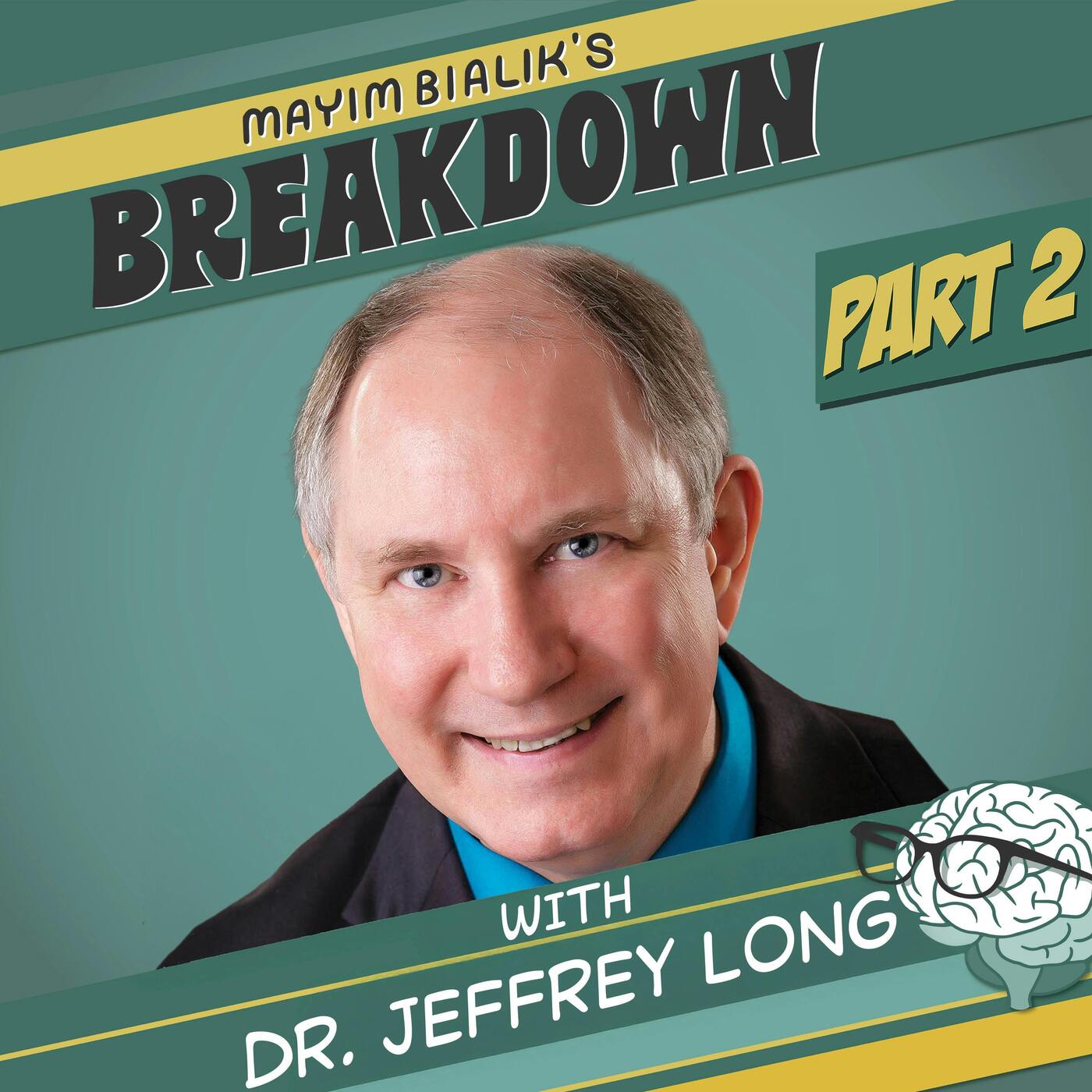
Mayim Bialik's Breakdown
PART TWO: 5000 Near-Death Experiences: Exploring God, Precognition, & The Science Behind the Afterlife
01:06:24
Loading summary
Transcript87 lines
- [00:00]
A
Foreign Hi, I'm Mayim B. Alec. I'm Jonathan Cohen and welcome to part two of our conversation with Dr. Jeffrey Long. He has studied thousands and thousands of near death experiences. He has a website N d e r f.org where people post unbelievable stories that he verifies does research on part two is pretty incredible like largely because we start by talking about God and we are interrupted by a lightning and thunderstorm where Dr. Long is. So it seems that the forces didn't want us to finish this episode but we did it. So you'll see that there's a little jump but we, we did it on two consecutive days in part two we're going to talk about some exceptional NDEs. We're going to talk about special abilities that many people acquire after they have an nde.
- [00:54]
B
We really talk about God, the notion that we co design the life that we have. We are chosen for this life and we choose this life. And what are the similarities in terms of people meeting divine or representatives of the divine? People see Jesus in a variety of different ways and what are the main takeaways that they have from these experiences that can shape how they're living now?
- [01:22]
A
Also, should we fear death? You will find out in part two.
- [01:26]
B
If you haven't already subscribed to Mind Bialik's Breakdown on Substack. There are two pieces of content that just couldn't fit into these episodes that we are releasing exclusively there for the Breaker community. Check us out and join us. Mayim Bialik's Breakdown on Substack and without
- [01:43]
A
further ado, here's our conversation with Dr. Jeffrey Long. Break it down. I can tell you what a lot of religious people would say. What they would say is this is because God is love, right? This is because we're having access to a spiritual experience that many atheists who have a spectacular psychedelic experience. Many atheists come out of it and say like, wow, did not expect to come out of that saying there is a higher being that loves all of us. And many cultures call that God, right? That would be one of the explanations is that the ultimate force in the universe is one of love, forgiveness, understanding and compassion beyond what we can even comprehend as mere mortals. We are welcoming back Dr. Jeffrey Long in the middle of the conversation we were having because I was asking a very, very specific question about God and no joke, lightning struck. Dr. Long is okay. The building that he is in is okay. It's not like he's in a part of the country where like thunderstorms never happen. He Is in, in a part of the country where this does happen, however, it happened at such a specific, like such a specific time. And we, we then were able to communicate with Dr. Long. We tried a different way to finish that episode. It happens again. So we could not finish our episode. In celebration of us picking this episode up, I'm wearing the same T shirt so that when people see the episode, if they see me with a black hoodie, that is second version of the conversation.
- [03:37]
B
I mean, the real question is, is the devil trying to keep us down? Why is it that divine intervention has to necessarily be negative?
- [03:48]
A
I was going to give the theological response, which is that it's only negative. It's only negative. If you believe lightning and thunder are negative, meaning the. The only thing negative about them, and this is also, I guess, kind of a Buddhist conception is the only thing negative about them is sort of how they damage things that we have created that we value and have attachment to, including human lives. But again, that's like a very theological perspective. Lightning and thunder just is. Just like in my belief, God just is.
- [04:16]
C
We were saying it was an anomalous event. And anomalous, like other paranormal phenomena, it has to be different from earthly everyday things. It has to be highly unexpected, like lightning shutting off my wi fi and cutting off our discussion. But that's how we learn about the paranormal, is by studying these anomalous events, being open minded, always asking why? Why did this happen? And being open minded to the possibility that it might not be natural cause. But if you exclude carefully a natural cause, you're left with the paranormal. So it's literally how we all study paranormal. Not just near death experiences, but a wide variety of these other type of phenomena. So we have to have these unexpected, you know, sometimes, you know, frightening, sometimes, you know, quote negative. And I agree with you, negative is a relative word and probably not absolutely true, but it certainly helps us to learn about that greater picture of the universe we're in, consciousness and everything by having this opportunity to be exposed to anomalous, unexpected paranormal events.
- [05:18]
A
Very well said. Thank you. Now, for the third time, can I ask my question?
- [05:24]
C
You sure can, Jonathan.
- [05:26]
A
Are you ready?
- [05:27]
B
Yes.
- [05:28]
A
Is everyone strapped into their seats? Valerie is half hanging off of her chair, as she likes to. So just to give a little bit of framework, and you know, we were talking specifically about the content of so many NDEs, thousands of reports. Right. Um, and the overwhelming, and I don't know the statistical significance, but I would say a statistically significant, large, vast proportion of the thousands of cases that you have studied through your website and through the research that you do. Overwhelmingly they are positive. They communicate to the experiencer a feeling of love, a feeling of safety, a feeling of warmth. You know, those are the human words that people are using to describe this experience. My question, which led to a lightning storm was what is your response? And I'm curious, your response, both as a clinician and also as someone who spends a tremendous amount of time trying to understand things that we can't understand. Right. Is, is the explanation that the reason people are reporting this overwhelming, positive, warm, loving, safe, comforting feeling is because they are in fact getting in touch with the source of creation or the universe or God or whatever you want to call it. And that indeed God is love. Right. That is what so many religious traditions talk about. God is love. And that's a mantra. It's something to hold on to. These experiences seem to echo this notion is that what you think is going on is the answer. God is love. And these people are getting in touch with God because when you die, you meet God.
- [07:24]
C
Yeah. The short answer is yes, but let me drill down on that was easy.
- [07:29]
A
And we're done.
- [07:31]
C
Okay. So exactly as you say there very. One of the most common things people having a near death experience describe is an overwhelming sense of love. I mean we've all sensed love in our earthly life. We have a qualitative sense of that concept, but remarkably consistency. The people that have a near death experience say it's love beyond anything earthly possible. It is so overpowering, overwhelming through them, within them, and in a way that they said cannot even exist on this earth and often defies literal English or any other kind of language to try to explain it because it's that powerful and it's so different from anything they've ever known or believe they could know. So this overwhelming sense of love is much more common. Not in the initial part of the near death experience when they're, as we've talked about that out of body experience, consciousness over the body, but it's more, far more felt far more consistently when they're in that afterlife unearthly realm. And that's where the great majority of near death experiencers describe that overwhelming sense of love. In fact, I have a survey question I've asked over. Well, gosh, at this point, about 2,000 near death experiencers and the percentage that say that they encountered concepts regarding love and their near death experience is well over half. Far more common than tunnels, life review, meeting deceased loved ones. So it's really a core especially of Deeper near death experiences that are more detailed. So I am convinced, based on a mountain of evidence, that this is a part of a understanding of the greater truth, that indeed that afterlife God, literally, the universe is literally in a very real sense ruled by, imbued with that type of unearthly, overwhelming love that seems to be a critical part of near death experiencers describing the afterlife. And again, we're back to that basic scientific principle. What's real is consistently observed. And that's what's really struck me. This is, you know, you look for things where they feel anti love, where they feel something radically different from love, they're vanishingly rare. I mean, they're extremely rare. So by the basic scientific principle, if it's real, you're going to see it consistently. We've got that in mountains, in the concept of love and near death experiences.
- [09:55]
A
And also I should note that's not, you know, for people who are like, I feel bristly about that. I don't know. First of all, God is just the human term that we ascribe to try and describe something that is indescribable. This sort of, you know, force depending on your religious tradition. You know, I come from a tradition that has a, a very well fleshed out mystical set of understanding around the unknowability of whatever this is that has many, many different names in my tradition. But also I want to point out, and Jonathan, I don't know if you have anything to add to this, this notion of God is love, right? Or, you know, that whatever our source is, it is positive, it wants our highest good. You know, you hear this in many mystical traditions. You even hear this from people like Thomas Campbell who are theoretical physicists talking about the quantum understanding and the fractal nature of everything and how all of the coding that we're receiving, even, even in a system where it's zeros and ones coming at you, what we are looking for, what we are seeking is our highest good, the most probable, quote, successful outcome. That's not inconsistent with this. I mean, Jonathan, I just, I, I'm not looking to prove that God is love or to prove that God is real. But I really take Dr. Long's analysis very seriously that what we're observing from people who are having an experience that most of us will not get close to is not just a fantasy conversation, it's not a religious conversation and it's not even specific to a theological conversation.
- [11:35]
C
Well, that's a lot of not. Yeah. So let me say sort of from, from research and overwhelming Evidence what is over and over when, when people have near death experiences. I've actually studied and, and formally wrote up in a book over 260 near death experiences in which they were aware of or encountered God. And again we're back to that basic scientific principle. I won't say it again. I mean it's real and there's overwhelming consistency in what people say that they encounter God or are aware of God, especially in the more detailed near death experiences and especially in that unearthly heavenly realm. God and near death experiences variably described. Not a surprise you're not in a physical three dimensional earthly realm when you're in this non physical, timeless heavenly realm if you will, radically different from what we know on earth. So not surprisingly, while there's some variability in what God's described, the common theme that comes out is light. Light is the most single common descriptive word about God. And it's a seems to be a light with a personality, with an intelligence, an intelligence vastly beyond anything that they knew, beyond any of the other beings they have there. And what's remarkable is that intense love. These are people that may have lived their life in fear of God because that's what they were taught with their religion. Well, for anyone's viewing and got that concern, here's some great news for you. You essentially, basically, uniformly when your death experiencers des encounter God, no judgment. However they've lived their life an overwhelming sense of peace, love and they felt loved beyond anything they knew in their earthly life. Completely through and through and interestingly, and this took me literally years to wrap my head around it. So I'm going to tell you one of the most common descriptors of God understanding. It's a tough concept and that is they feel beyond connected, even unified with God. There seems to be a connection that transcends. They're much more likely to use a stronger word unity than they are connection in describing this. And if you look in the dictionary, connection is part of the core earthly understanding of love. So I think that sense of unity or being a part of God literally is simply that super love that simply beyond earthly words understanding that near death experiencers encounter that is just simply part of that love beyond anything that we could know in our earthly life, beyond words. And I might add too, God is a loaded word that means a lot of different things to a lot of different people. So let's look at that specific word for a while. In the English language it's the most common word that people use to describe that overwhelming being of Love, capacity, compassionate and that that they feel a part of in the afterlife. But over and over near death experiencers will say that have encountered God. God is a human word that can't even begin to do justice to this overwhelming, powerful, beautiful, loving, overwhelmingly amazing being that they encountered. They said this simply is not describable in the English language and that by using words you're actually living limiting that which is unlimited that they encountered on the other side. And so that that helps put the concept of God. It's not like you would have almost certainly heard of in your earthly everyday life or frankly not like what religions generally teach. It's something very different. And the fact that we're seeing this so tremendously consistently in near death experiences which frankly isn't classic religious teaching, especially in the western world where great majority of near death experiences originate from, you know, there's just one more line of it's, it's consistently observed and yet not expected from prior religious or cultural beliefs.
- [15:28]
B
God.
- [15:28]
C
And that tremendously good news literally for all of humanity is on top of everything else, yet another very powerful line of evidence for the reality of near death experiences that we really are connecting with the afterlife with the other side.
- [15:42]
B
Mind breakdown is supported by bioptimizers.
- [15:44]
A
You know I struggled to get good quality sleep and I just assumed it was stress. But as I learned during perimenopause and menopause your hormones shift in a way that affects your magnesium levels. And low magnesium, it makes everything harder. Not just sleep, focus, mood, your tolerance for stress. That's why I have added magnesium Breakthrough bye bye optimizers to my nightly routine. It's a blend of seven different forms of magnesium designed to support relaxation and overall sleep quality. Try it. See if you wake up more rested and refreshed, you've got nothing to lose and a lot to gain. BIOptimizers offers a 365 day no questions asked money back guarantee. Magnesium breakthrough is a huge breakthrough to improve hormonal balance, to help with focus, decrease brain fog, improve sleep hygiene. Overall bio optimizers makes it very easy. Jonathan, what do they get when they go to bioptimizers.com breaker and use the code breaker?
- [16:37]
B
You get 15% off your entire order and a free bottle of Mass Z
- [16:41]
A
Bioptimizer's best selling digestive enzyme that'll be added to your order automatically when you use our exclusive code.
- [16:47]
B
That's a $20 product free on top of your discount already.
- [16:52]
A
This is a limited time offer and while supplies last, you can't get it on Amazon. You can't get it in stores. This offer exists in one place. Our link, our code. That's it. So maybe you were already thinking about it. This is the sign. Go to buyoptimizers.com breaker. Use the code breaker. Grab it before it's gone. Make 2026 the year you finally start sleeping again.
- [17:11]
B
My Ambiox breakdown is supported by Bioptimizers.
- [17:14]
A
I struggled to get good quality sleep and I just thought like, ugh, it's stress. But I learned during perimenopause and menopause your hormones shift and it affects your magnesium levels. Low magnesium makes everything harder. Not just sleep, but focus, mood, stress tolerance. That's why we added Magnesium Breakthrough by Bioptimizers to our nightly routine. It's a blend of seven different forms of magnesium designed to support relaxation and overall sleep quality. Try it. See if you wake up more rested and refreshed, you've got nothing to lose and a lot to gain. BIOptimizers offers a 365 day, no questions asked money back guarantee. Magnesium Breakthrough is a fantastic way to improve that hormonal imbalance that especially happens with magnesium. And then you have better focus, you have better sleep hygiene in general. Bioptimizers makes it so easy. Here's what you get when you go to bioptimizers.com breaker and use the code breaker. 15% off your entire order and a free bottle of Mass Signs. That's bio Optimizers selling digestive enzyme added to your order automatically when you use our exclusive code. That's a $20 product, free on top of your discount. This is a limited time offer. While supplies last. You cannot get this on Amazon. You can't get it in stores. The offer exists in one place. Our link, our code, that's it. So if you were already thinking about trying it, this is the sign. Go to buyoptimizers.com breaker use the code breaker. Grab it before it's gone.
- [18:38]
B
Make 2026 the year you finally start sleeping again.
- [18:44]
A
I really, I appreciate that. And you know, it's, you know, it's a big statement to say kind of we're getting God wrong, you know, but a little bit. It feels like if so many people have a hang up over this word, in many cases it may be that the concept isn't big enough. The way it's been described to me by a mentor is you can, you can ask the universe for a bigger concept of God. Whatever you were raised with, whatever they told you, whatever they beat into you or beat out of you about God and your obligations as a person on this planet, you as an adult person and even as a younger person. You can say that doesn't speak to me. Right. What I want to believe in is larger than that. And these experiences I think are so. They're so helpful, you know, and it's like it's an arena that I wish more of us were taught about meaning. I don't expect this to be for third grade Sunday school students, you know, what they're going to teach. But I do think it's an important part of understanding the experience of being human to say there are exceptional circumstances. And indeed in medical school, I'm sure it's spoken about in some way, but probably not as much as it should be in terms of. This is an aspect of certain people's experience and we have to pay attention to it. One of the things that I love about your website and if you have not checked out the website, you have to. It's N D E R F. So like near death experience research. Yes. Foundation. Did I name it right?
- [20:16]
C
Yep, you nailed it. Got it.
- [20:17]
A
N D E R f dot org. So you can obviously, if you've had an nde, you can share it and there's a link and it's a whole questionnaire, but the stories of all of them are stellar. But there's a tab that you can click called Exceptional ndes. And. And I've spent a good amount of time in there. I want to talk about one. I don't expect you to remember every single, every single ND that's here. But there's one that I wonder if you can speak to in terms of how common this is the case. In case anyone wants to look it up. It's Jonathan S NDE. It's coded as 5422 Jonathan S NDE 9980. So it's one of the exceptionals. And I believe what happened was he had sepsis and he had a slow, a slow breakdown of his faculties. And he kind of started like passing out and feeling faint and he was still going about his business. He was like at, you know, Home Depot or whatever. He was still doing things. But there came, there came a day where he looked in the mirror and he said that he looked gray, like he looked dead. And he thought it might be a hallucination, but it wasn't. He. He looked in the mirror and then he looked at himself and he realized something was going on. He ends up having a near death experience. And he said that There was a lot of darkness. He said he could see 360 degrees. Something we have heard about before, which I think is really fascinating. Right, Jonathan, that notion that vision is not confined, as you spoke about, Dr. Long, kind of to the eyeballs, you know, pointing forward, unless you're a chameleon, in which case they're like on the sides. Right. And he has some exceptional, unbelievable things. But what he said. He has a life review, and we've talked a little bit about life reviews, but what he said. My life review did not focus on how many F bombs I dropped, how many women I slept with, how much I drank, my abandonment of religion, porn, money, nonsense, or how I might have acted like a child. It didn't focus on really much of what we refer to as bad behavior here on Earth. What it focused on in my case was interactions with people. We looked at whether I get chills when I read this. We looked at whether I used my gifts and talents to help people and how I made them feel during those interactions. I was shown how we're all connected everywhere, everyone, everything. And how we're meant to be helping each other progress through our human existences. I was shown that our human lives are a collective movement, not an individual achievement. So, first of all, that's just very wow to me. And he goes on a very interesting story in that it has taken a very long time for him to recover because what sepsis does and organ failure and things like that are very complicated. Um, but I wonder if you can talk a little bit about this notion. Um, Elizabeth Crone, when we spoke to her and she talks about in her book, she had a very distinct understanding that religion itself didn't get it right. Meaning it's not so much about rituals, it's not so much about what you do. And are you following this? Right? And so many religions make an issue of what's your life gonna be like? Are you gonna go to hell? Are you gonna go to heaven? You know, she said it was really about the content of her character. Is this a common. Is this a common thing that people experience? This notion of the specifics of what I did don't matter, but how did I make people feel? What did I contribute to humanity? Is that really what we should be aiming for?
- [24:00]
C
Absolutely. I'm glad you brought that up because that is a very typical theme in near death experiences. And it's extremely important. Throughout near death experiences, it is truly rare that there's a sense of judgment. So as that near death experience you read, not surprising to me, that there wasn't a sense of judgment about here. Gosh, I must have. Jonathan. That guy must have been a real bad old boy and he knows it. But you notice that that wasn't the important thing. Judgment or a threat. So in near death experiences, it is essentially non existence that there's judgment or a threat of punishment based on our earthly behaviors, which is very radically different from a lot of conventional teaching. And you're absolutely right. As Elizabeth said and as. As that near death experience you read said what seems to be by far the most important, you talked about interactions with other people and positive and helping them. We're back to what we just talked about earlier. Love. Ultimately it's that manifestation of that universal great truth of love, the glue of the universe. And in, in the difficulties and challenges of our earthly life, finding a way to each of us in our own way, with our own talents to reach out to other people as lovingly, as compassionately as we possibly can. Over and over we hear that that's literally among the most important deep meanings of what we can do with our earthly life. That is really what we're here for and what's really going to make a difference. So again, it's all about love. God is love. Our earthly life, optimally lived, should be focused exactly on that love. Compassion to other people, to ourself too, certainly. But manifesting love throughout your earthly everyday life is, is a huge deal and a great truth.
- [25:45]
A
So here's, here's the harder question. Here's the harder question. Has there been or can there be people who do not emanate love in their life? They maybe feel determined, detached from love. Maybe they're disconnected. Maybe they're suffering from addiction or mental health challenges that prevent them from feeling love or feeling connected. Maybe they're not pursuing that. Do you have any examples of what happens when those people have nde? Because I am not trying to like make you tell the story of like, I went and was told I was a piece of garbage by God. However, I am curious. Is, is there a neutral experience? Is there an experience that's like you can do better, like get back in there, get back in your body. Can you do better?
- [26:39]
C
Yeah. Yeah. That's interesting. There's been, you know, a significant interest by both me and other researchers looking our scholarly phrase is pro social and anti social. So you know, most people go through their life the pro social they have lived live loving relationships, don't go out of their way to do bad things. But then there is of the antisocial People and we just heard a little bit of an example of a person from near death experience that had certainly some antisocial type of attributes. What's interesting is during a near death experience, again, even in the antisocial, you just don't see that permanent threatening judgment. I mean it just, that would be, in fact, that is so rare. I would actually question a near death experience where that was a dominant threat theme, whether it really was an nde.
- [27:25]
A
Wow.
- [27:26]
C
Rare with that order of magnitude. But don't forget when you're having that life review and you go back and see everything that you did in your life, or an awful lot of what you did in your life, you have the chance to make that own internal judgment as to, you know, what you saw. And even when there's other beings around the life review, you, there's still not going to be that external judgment. So we, I think we live our earthly life and it's really to a large extent a learning thing. We're human. We're nowhere near that overwhelming, knowledgeable, loving, compassionate, infinite, non physical souls that will be in the afterlife. We are very attenuated as souls in our constraints of our earthly life. God knows that. They all know that on the other side, they know we're going to make mistakes. Nobody's perfect. No one on earth today here is perfect. So the good news is Earth seems to be, you know, if you will, a place where you can, you can grow, you can learn, you can, it's okay to make mistakes because you're going to learn and you're going to be a more. It'll help your soul progression. And, and a lot of us, you do things right, you go to your life review and go, wow, that little act of love, compassion of reaching out to that child, petting that dog, giving back the candy I stole or reaching out to other people and you know, extending yourself in some very prominent way to help those less fortunate. That seems to be again, that's love. That's love manifest on Earth and that's very, very important. It's all again, part of a learning process and it's all love. And, and there's not a shred of evidence near death experiences that, that even the antisocial people are going to be condemned some kind of permanent hellish realm. It's, it seems to be that on the other side they very astutely understand just how limited we are on Earth and how much of a struggle it is to manifest love with all the constraints and limitations that we have in our earthly everyday life.
- [29:28]
A
Do you use the word they intentionally? Do you believe that there's a plural entity on the other side?
- [29:36]
C
Well, there's a lot of other spiritual beings. There's again, while we've talked about that connection and that unity, that's absolutely true. And again, that's why it took me a heck of a long time to kind of wrap my head around this. And I'm asking people to kind of grasp it, you know, in a matter of seconds to a minute or two. But there seems to be. On the afterlife, there's no question that we are individual souls. That memory, that being that who we are in our earthly life carries forward to the other side. We, we are that individual, but just in a blissful heavenly realm. And yet also it is very much an exact reality that as you just said, we are all connected, we are all one. And so there's, there's both of those operant in a way that's difficult to understand in our earthly life. So there is that concept of unity. And I find that very empowering, very positive that we're not, you know, no man is an island, no woman. I mean, we really are all in this together. Isn't that yet another powerful reason why we should reach out to others with the greatest amount of love and compassion, passion we can? Because we're literally in that connection we have. It's, it's sort of like we're, we're reaching out, loving to others and it's going to circle back to ourselves. So again, all very important. I see you're holding my book there. What you got there?
- [30:53]
A
So we, we wanted to ask a little bit about, you know, it doesn't get a lot of, a lot of real estate in the book, but we do know that this is a field that gets a lot of real estate in other places. So we wanted to give you the opportunity to sort of elaborate on it. And I also noticed this on the website. So you did a study where almost 50% of people who were surveyed said that they had psychic, paranormal or special gifts following the experience that they did not have prior. And you know, we've talked a bit here about precognition. We've also talked in the Elizabeth Crone story and it comes up also on the website. Some people have, it even has its own little acronym, adc, After Death Communication. This is a really hard arena, you know, for a lot of people to kind of take the next leap into. But it's undeniable from a clinical perspective that after a near death experience, many people at least Roughly half from the study you did come back different. And they come back with abilities that in many cases they didn't even know they could access or didn't even believe in. You know, Elizabeth Crone described that she didn't even know what an aura was and after her near death experience started seeing colors and like, you know, things rippling off of people's heads and was saying what is happening? So can you talk a little bit about what you most commonly hear of that people come back able to do after their near death experience?
- [32:41]
C
Sure. Understand that after a near death experience people are profoundly changed. I actually very recently published the largest study that's ever been done on what we call near death experience after effects. The consistently observed changes for people. And it was a huge study. We had 834 near death experiences and one of the most common changes. And they, they described like their level of compassion at the time they had their near death experience and then later when they shared it an average of 15 years later. And one of the most striking things was their increased self described compassion. Again we're back to that love. You know, it's like they took a little piece of heaven back from heaven into their life and are manifesting it. You want to look at it that way. But I think a significant part of their self identified paranormal gifts is what the great majority of people have after a near death experience. And that is they're a lot more compassionate, they're a lot more attentive to people. They'll pick up the verbal, the non verbal clues and they are more attuned as part of that newfound compassion. And I think for many people, at least in my study of that this sort of intuition is a lot of it is due to just picking up those verbal and nonverbal clues in a way that they didn't do before, in a way which very few people do. So that can be a good part of it. But again, look at Elizabeth. There's a lot of it that transcends that and it's like auras or being aware of colors or other, you know, true precognition. You know, these are all certainly things that people that have near death experiences describe that really hasn't been studied in a scholarly way nearly as much as I'd like. You just, you just sort of reminded me that would be, that's. I have to check that box off and start looking into that more. But it's a fascinating, I mean as remarkable as these, these abilities are that people describe, you'd think there would be a lot more study of it. But we again, it's, it's certainly a part of. And a very common part of. You're right, it's about 50% of people answered yes to the survey question about returning with paranormal or other gifts that they did not have before the experience. So this is, it's for real and it's just a matter of clarifying, you know, more specifically what they are, how they manifest, how they change over time and how they can best use those new gifts to help reach out lovingly to the world as they know is so important.
- [35:11]
A
No, that's very helpful. And I think one of the things that I'm, you know, most kind of curious about and you have a couple stories in the book and then as I said, you can find some online. I'm going to ask. It's going to sound like a dumb question, but I want you to answer it. Why might people who have had a near death experience be able to communicate with the dead?
- [35:37]
C
That's a great question.
- [35:38]
A
I'm not being face, I really want to know.
- [35:42]
C
Gosh, no. They're called, as you said, afterdeath communication or the ability either spontaneous or induced to have communication with people that have been deceased. And there's many near death experiencers that believe they're far more able to do that than they ever could before. And we see that a lot. So what's going on here? I don't have a good answer for that. I think once again, you know, if you've been in the afterlife, I mean, maybe there's a tune to that. I mean don't forget 20% of people actually encountered a deceased loved one in their near death experience. So I think they may, that that communication may continue, that they may have that. Another thing that may drive that. Don't forget the majority, significant majority of people that have a near death experience come back aware of that unit, that unity, that connection, that universal unity literally that we have with all of us. So I think they may be manifesting that kind of awareness that they learned or their near death experience and then they have years and years to develop it. But this is all a good example of what I've said over and over. What we don't know about near death experiences exceeds what we do know. You, me, everybody that's watching this, we're all literally pioneers in coming to understand these amazing experiences. There's a lot of mysteries, a lot of what we don't understand. And that's part of what just makes it so darn exciting.
- [37:05]
B
This Episode is sponsored by Wandering Jews, an open door media brand.
- [37:10]
A
If you've ever found yourself feeling like you have more questions than answers, you're in good company. The Jewish people have been like that for thousands of years. Wandering Jews with Michal and Noam is a podcast where two of today's most dynamic Jewish voices, Michal Bittone and Noam Weissman, dig into the biggest questions about life through a Jewish lens. It's the kind of conversation where you'll laugh, learn something new, and probably shout in disagreement at least once. Michal and Noam tackle the tough topics like antisemitism in America, what happens after we die, and the future of religion with guests like Bret Stephens, Michael Rapoport, and Sarah Hurwitz. And this past month, in honor of Jewish American Heritage Month, they've been celebrating some of the Jewish lives and institutions that have shaped American life, from food to music and comedy. Thoughtful, joyful, and always honest. That's Wondering Jews with Michal and Noam a production of Unpacked. Find it on your favorite podcast app or on YouTube and make sure to hit subscribe. Check out Wondering Jews with Michal and Noam podcast and subscribe at Unpacked Bio nmx
- [38:12]
D
Now. Audible gives you audiobooks, podcasts, Audible originals, and more all in one place. Whether you want to dive into a series, listen to a popular bestseller, or check out the latest episode of a great new podcast, Audible has you covered. Enjoy genres you love, like motivation, mysteries and sci fi, follow names you know in comedy or true crime podcasts, or discover the Audible exclusive. Everyone's talking about the Sandman. The new Audible is your playlist for life. Try it for 30 days on us. Visit audible.com
- [38:42]
A
Jonathan, I'm going to ask you to speak to this because I'm curious and I'm. I'm going to ask you to play a part, Jonathan. Play the part of the person who, like, is totally vibing with everything that's happening.
- [38:54]
B
Meaning, like, everyone listening.
- [38:56]
A
Like, everyone listening. But what. What would be sort of an energetic or kind of like akashic. Like, what would be the energetic explanation for that, Jonathan? Is it about, like, tuning into a frequency? Like, how would we frame it if we were, you know, gonna try?
- [39:12]
B
Firstly, just a slight tease. I think you like to just pepper the word akashic places.
- [39:16]
A
I know you're gonna bring it up. Well, it could be the Akashic records.
- [39:20]
B
No, I mean, if I think about our conversation with Bruce Grayson and I think about what Dr. Long is telling us, someone's brain when they experience an nde, someone's brain has a rapid and drastic change to the real reality filtering mechanism. And once that mechanism is changed and they experience something beyond our current reality, which is the limits that we have set in order to survive and be on podcasts and not be distracted by entities in the room, if the larger reality is actually made up of far more complexity than we can possibly process in any given moment, then once you've stepped through the door, there's no turning back. And actually, when people describe being asked to come back into their body, what I've heard a lot of is that the body feels too small to contain the vastness of the human spirit. And when that happens, the work is actually coming back into the body and integrating the reality that they've just experienced. Because now all of a sudden they've seen that the vastness of the soul cannot be contained in the human body solely, that we're actually probably traveling in multiple realms all the time and that we're just not aware of it, we've just blocked out that part of our interaction with that reality. And you know, there's, there's, if, if we talk about Internet trends, there's the trend that says I'm going to blow your mind. The, our eyes only, you know, perceive, I don't know, what is it, 1/60 of the light that's available, the light spectrums that are available on Earth. And you know, animals perceive so much more. So, you know, and then they use it as a, as a way to describe the limits of our perceptive ability to say what else is possible. And when people go through a near death experience, they then see what else is possible and they come back and they can't help but be curious or look again. And I think it's fascinating because they then sometimes struggle to not be overwhelmed by the extra sensory information. And you know, the work of some people is to expand beyond their limits and to allow themselves to imagine and then experience something beyond the material world. And other people, their struggle or their balancing act is to integrate that information because we are here having a physical experience. So how do we open our minds wide enough if we haven't experienced the non physical reality? And if we have, how do we then not get lost in speaking to dead relatives? Or how do we prioritize the extra sensory information so that we can still be here on Earth, have a human experience and be integrated into the life that many of us are living and have to live and have to pay bills and you know, continue on?
- [42:19]
C
You know, I I think that's a real. You really hit the nail on the head there. A lot of people that do come back from near death experience, I mean, you just, you know, for those, the great majority of us that have not had a near death experience, I mean, just imagine here you are on a completely realm that defies words, outside of anything they ever thought was even possible, and then, boom, they have to come back here. The integration is tough. I mean, you kind of yearn to go back, wouldn't you? I would. To a place of overwhelming love, where there's no pain, no misery, where you feel connected, unified with one. You're with the deceased loved ones again. You know, certainly it would be a natural human instinct to yearn for that and to try to seek it out and to try to find anything through any mechanism of their cognition, their extrasensory abilities to, to try to integrate, to try to recapitulate that experience, to explore it further. So not at all. It's certainly near death experiencers absolutely do that. You know, certainly I think that that explains why about half of them do have those paranormal gifts. I mean, they're, they're curious, they are highly motivated to feel that again, to experience that again. And that can help them in time, either as true gifts or through their own efforts and development. You've got about half of them having those paranormal gifts.
- [43:44]
A
I'm also wondering in terms of understanding what might be different and you know, I'm really curious, kind of from a, you know, anatomical perspective, what might be different? If we wanted to try and find a brain region, right. What might be different in how the brain is processing information that might in some way explain the variety of changes we're seeing. And the answer may be we don't know. It's too disparate. We'll never know. But part of me wonders, you know, I, I don't think, I believe there's kind of like a special abilities region of the brain. Right. But I'm wondering if there's, you know, we know that we can induce certain states that make us more likely to experience transcendental things. We know that, right? We know what parts of the brain are active. We can put people in scanners when they're having a variety of, you know, out of consciousness experiences or out of normal consciousness experiences. What, what might, you know, what might be an explanation for what's happening. Obviously when someone is struck by lightning, we can know, oh, there's certain electrophysiological things that we could kind of look to. But generally speaking, is there One area of the brain or one system. I mean, I think default mode network comes to mind as kind of a, you know, sexy term of sort of like that, that constant, you know, for many of us, kind of like negativity and rumination, that once that's lifted, we're open to a lot more. What's your thought?
- [45:12]
C
Wow, that's a good one. I, I don't, you know, certainly the, the, the core answer to that is we really don't know. That's a classic example where we need to do more functional MRI imaging. You know, we need to, you know, electroencephalograms that are actually looking for some kind of alteration. People that have had near death experiences compared to a control group. So I can tell you, looking at near death experiencers, they seem to be, you know, they're more compassionate, they're more loving, they're living life with less fear. I think that really involves integration pretty much in all the higher cognitive. So I would expect there'd be some new integration transmission from the higher cognitive areas. And of course, let's not forget the hippocampal area that's involved with memory. So we talked about life review, so I wouldn't be surprised if there's some development in that as they, you know, contemplate what they were aware of during their life review. But I think it's just a good example of where I wish we had a lot more research for this. Fascinating. And I'll bet, I'll bet you, if you, if someone really did a good study of study enough people, we'd find some differences in people that have had a near death experience and have manifest the changes, the after effects in comparison to people that have never had a near death experience.
- [46:30]
A
And also, you know, the research, some of the ketamine research, some of even the other, you know, psychedelics, the psilocybin and the LSD research, you know, a lot of it is also pointing to concepts of neurogenesis, of, you know, differential pruning. Right. Could it be that some of these changes, some of the neuroplasticity that we're seeing from these kinds of experiences might be also potentiating further opportunities to see positivity, to be more compassionate. Right. It's kind of like if you, if you have this extremely powerful, you know, multisensory and, and, and beyond sensory experience, it may be this kind of newly encoded memory, right. That is so integrated into the brain, into the nervous system, into the psyche, whatever that means. Right. That it becomes more of a default. Right. So that you're then open, right? Like you're open to seeing, feeling like time feels different. It's like you're, I'm not gonna say like you constantly feel like you're, you know, having a trippy experience, but you're in touch with something that many people have not experienced.
- [47:39]
C
And I think that's true. I just thought an important concept. While we're talking about memory with near death experiences, even if they occurred decades ago, near death experiencers remember their experience absolutely verbatim in general, far more so than other ongoing earthly events around the near death experience. Both prospective and retrospective studies have found that amazingly that memory persists and it's neither embellished nor forgotten over literally for decades. And so that again, shoot, that's not everyday earthly memory. There's some kind of memory with near death experiences or maybe some kind of memory induced by psychotropic or brain acting drugs that has the same type of effect. But there's no doubt that near death experience is pointing us in the direction of saying you can have an experience, you can have a memory that affects the brain differently. It's encoded, it's embedded, and it's able to be recalled verbatim literally decades later in a way that that essentially no other earthly memory can. So again, it's all part of that. You know, there is something going on, there is something going on in the brain, there has to be for that memory to be there verbatim decades later. So again, it's just a matter love to find some anatomic or imaging correlate to that. But there's definitely something there that is an important part of what we could learn.
- [49:02]
A
Yeah, I'm sorry, I'm no longer working in the department of neuroimaging at ucla. I need to go back and do another degree. I wanted to ask another thing that comes up, it comes up sporadically, but enough that I think it's worth talking about. Me personally, I don't believe that there's one specific God that's given to each group of religious or ethnic tribes all over the world. Meaning I believe in the oneness of God. That is the. Just like there's one gravity, there's one God. So every religious tradition, and it is our right to do so, comes up with the words, the images, the prayers, you know, around the team that we're gonna rally around. Right. But for me, ultimately there's kind of this like one source. So when I read these NDEs, I'm like, yep, sounds right, you know, like one light. It's not Like I'm the God of Abraham or whatever. It's a, you know. But some people do have very specific visions. And in many cases people are seeing, you know, imagery, for example, of Jesus, of Mary. We don't, I mean, I don't know if this is blasphemous to say I don't know that we know what Jesus looked like. I know there were no cameras at the time, and I know that, you know, there's artwork. But, you know, there's been a lot of conversation about, you know, the angle that many, you know, historical epics had to put on what Jesus looked like. Right. I mean, I've heard a lot of people say, like, he probably looks like, you know, just like a person who might be from Yemen or, you know, like, he probably was short, you know, like darker skinned. Right. When people say that they've seen, you know, images, can you. Is that because everyone has their own personal cultural framework? I mean, I've had interesting experiences where I have, you know, witnessed in, you know, altered states, gods of other religions. Meaning I don't all of a sudden feel like, oh my gosh, I had it wrong this whole time. To me, there's still this one God. But there are certain things that are just kind of like in. They're in the soup of the culture that we grow up in. Is that what you think is happening? I'm sure that if I were a religious Christian person and I had an NDE and I was like, I saw Jesus, I would be so excited, excited. I'd be like, I was right. He's our guy.
- [51:37]
C
Well, yeah, there's no doubt about that. In earthly religions now and throughout history, there's been about 3,000 beliefs in God that are radically different from each other. So our earthly awareness of God is literally all over the place in terms of God's nature, appearance and everything else. That's what's so exciting about near death experiences. While the appearance is variable, there is those consistent themes, light and the nature of God. Overwhelmingly loving, compassionate, connected, unity. I mean, we see this just overwhelmingly, consistently. So that's part of it. So we get back to that. You know, what about the. And you brought up a good example about Jesus. And I'll just address that because I've studied over 150 times in near death experiences where they described awareness or encounter with Jesus.
- [52:30]
A
Was he ever a short, dark, Semitic man?
- [52:34]
C
It can be. Once again, interestingly, the appearance is significantly varied. There can be blue eyes, dark eyes, light hair, dark hair, wearing clothing, and everything is different. But that doesn't surprise me because again, this is not Jesus in a physical earthly life. This is Jesus in a non physical, radically different from what we'd go here. So a couple lines of thinking about that. First of all, occasionally we see in near death experiences that there will be an amorphous being or a sense or a light that will literally ask the near death experiencer, how would you like for me to appear to you? And so there seems to be some sort of co creation of this experience. This isn't looking at Jesus in a way that you would have expected how he looked in earthly life. It's not earthly physical Jesus and near death experiences. So that's one important concept that, that you really need to know to nail this down.
- [53:34]
A
Sorry. The comedian in me is like, if you ask me how I'd like to perceive God, I would say like, like bing bong from inside out.
- [53:42]
C
Here's an atheist who saw Jesus. The atheist lived all, you know, pretty much all his adult life as an atheist. So here he's having a near death experience. And oh by the way, when they encounter Jesus in near death experiences, almost instantly, they know it's Jesus. It's not like Jesus comes up and says I'm Jesus. That's very, very uncommon. There seems to be that knowing awareness even with the variable appearance, even if the appearance is not like the classic pictures or classic art.
- [54:09]
A
I could pick out Jesus with my eyes closed.
- [54:12]
C
Yeah, there you go. Okay, so that's good. But so the eight, this is just sort of instructive for understanding about how Jesus appeared near death experiences. So the atheists, they started talking with Jesus and, and the atheists said, well wait a minute, what are you doing? You got a business suit on. What's that all about? That's not you. And Jesus said, yeah, I know that, but I had to appear. If I'd appeared in robes, you wouldn't believe me. Right? And they both thought that was very funny. So I think part of understand I thought that's one of my favorite stories. But I think a sort of a big picture about how all this happens is when we had the near death experiencer encountering God at a hugely blissful experience and asking why me? Why was I chosen for this? And God's very definite statement, love falls on everyone equally. This is what you needed to live your earthly life. So I think a lot of that variability is not seeing historically realistic things because that historical reality literally doesn't exist anymore, but seeing a manifestation that is considered to be out of a overwhelmingly loving Compassionate God and Jesus, that's best for that person in that experience. That's best for them to understand and live their earthly life. So that's my understanding.
- [55:31]
A
That's beautiful.
- [55:33]
C
Jesus is, is very different from how people would understand Jesus reading the Bible. Wow, that was obvious to me. What you see with this is Jesus is essentially never giving. Like the commandments you see in the Bible. Thou shalt go forth and do this with your life and build that. There's essentially never specific information from Jesus or anywhere else in the near death experience about specific life directions. Yes, you do see that, but it's rare, quite rare. Jesus also, interestingly, again like God, you feel that overwhelming sense of compassion, non judgment. Jesus in near death experience is one of his major roles is clearly to listen, to be apart, to be that profoundly compassionate, loving being with them. Interestingly, Jesus is part of that free will which is overriding everywhere in near death experiences. Interestingly, Jesus does not advocate for Christianity. Jesus just simply wants to convey that love, that peace, that presence, that, you know, that they are deeply throughout, through and through, loved. It seems to be as if Jesus leads by example, not by giving commands. And that's a great truth in Jesus. Again, this is over. You know, we're back to that principle. If it's real, it's consistently observed and that's very strikingly, consistently observed. In encountering with Jesus, we could give
- [56:54]
A
a small shout out to the tradition he came from, you know, like Christianity existed after, you know, kind of as a later iteration. But he, you know, Jesus came from a tradition, you know, in terms of Judaism that had many different concepts of God, some of which were very punishing and which were very complicated. And you know, there's kind of like four different kind of main themes we see and we have 72 names for God, but there's also like seven main ones that we use. Many are plural, some are feminine. But this notion, you know, that, you know, perhaps what we, what we look for in charismatic leaders, you know, as someone who, let's say, just for me personally, I don't believe in Jesus as a deity, but in terms of his teachings and in terms of the compassion, the love, the wisdom that he spread, that is what a religious leader should bring us to the best of. Love, compassion, connection. I mean, I may not be versed in the New Testament, but I know the kindness that Jesus, you know, spread, right. And so when people talk about this kind of like Christ light, right, you hear that a lot in energetic circles. What do they call it, Jonathan? Christ consciousness, Christ Consciousness, Right. There's, there's this notion that maybe that is something that, you know, a charismatic leader like that was getting right, was saying, guess what? God is love. Right?
- [58:16]
C
Yeah. In near death experiences, Jesus is, you know, that that concept of you often associated with light, that profound compassion, is very reminiscent of God in your death experiences. Again, we're back to that connection, that unity. And you see that same kind of very critical, overriding theme in near death experiences. Love, connection, compassion, nonjudgment. Very strikingly, consistently.
- [58:44]
A
One of the things you mentioned in terms of people's experience of, you know, like why me? People, people who might, you know, experience that in an NDE of like, why is this happening to me? You know, do I have choice to be here? Do I have choice to go back? One of the other things that people talk about regarding choice, and we spoke to someone else who had a near death experience who talked about this. There, there sometimes is this notion that the life you have is the one that was chosen for you. And in many cases it was chosen a long time ago. And that the hardships that many people experience are seen from a different lens in an nde. They're seen from a lens of this was the struggle you had to go through, but you get to see the pain from another dimension. Right? Meaning even if you experienced, you know, God forbid, abuse or addiction or you know, really, really difficult circumstances, that you have a whole different perspective on it and it is shown to you as something that was in many cases kind of chosen for you because that's your specific mission. Can you talk a little bit about that aspect of chosenness?
- [59:56]
C
Yeah, it's interesting. You bring up the concept that you have a life chosen for you and then boom, you come down to your earthly life. I will tell you that in what we call pre mortal existence or pre earthly incarnation, we have a fairly large number of near death experiences that describe that. And the great majority don't talk about lacking that free will choice. The great majority of near death experiences actually say that they're choosing their parents, choosing their circumstances, choosing what they're going to do in their earthly life. Again with that overriding concept that free will is paramount both, well, certainly in the afterlife. And so that's far, far more common that people will, will choose parents, circumstances. And again, in the heavenly premortal realm, you're vastly more intelligent, vastly more knowing what's important for your soul growth or what experiences you need, not just based on your tiniest slice of your eternal existence here on Earth, but from your Soul, which is unending and eternal and unlimited. So I think it's, you know, at least what I'm seeing in my near death experiences, and that's quite a few of them. It's a matter of choice that people have. I don't know that everybody has a choice. I know at least some seem to. It would be. I can't even hardly think of another experience where they were basically involuntarily selected into a life without having input.
- [61:27]
A
Our last question hopefully won't be the hardest one, but I think it will be the most personal. You know, Jonathan and I are very curious why pretty much every expert that we speak to does what they do. But we want to ask this from a slightly different angle as we close here. I'm assuming, were you born in Iowa?
- [61:50]
C
Yeah.
- [61:51]
A
Okay.
- [61:51]
C
Well, no. Sort of. I was born. Technically I was born in New York, but my parents, I wanted to be with my parents. So when they moved to Iowa when I was six weeks old, I went right along with them. So technically I grew up. I grew, I grew up in Iowa. Yeah.
- [62:05]
A
I'm assuming that when you were growing up in Iowa, and I've been to Iowa many times, it's a lovely state. I'm assuming when you were growing up, you weren't thinking. I'm gonna study near death experiences so that I can speak to thousands of people about their encounters with God in another realm. But now that you have lived the life you have, and also, you know, your, your day job, right, is also doing very, very difficult and holy work. Right? But in terms of the life that you've lived, the research you've done, what you've learned from an understanding of people's experiences and what you would argue is evidence for an afterlife, and in many cases a presence of God in an afterlife, what is your life like in terms of how you live with what you know and how has it changed the way you lead your life and encourage others to do so?
- [63:01]
C
Okay, that's a great question. Studying near death experiences now for over 25 years has changed me radically. I started out, if you will, as a skeptic. I make my medical decisions based on evidence and reasoning. And that's exactly how I went after this amazing unearthly phenomenon. I mean, how can you not start out as being a skeptic because it's so different from anything you encounter in life. So it literally took me years of seeing this overwhelming consistency before I really intellectually grasp, yeah, this is the real thing. But as time has gone on in 25 years, is such an ongoing part of my life. I mean, just put yourself in my shoes a minute. Here I am, you know, multiple times a week reading these powerful near death experience accounts that people share on the website, talking about their encounter with an afterlife, you know, with God, with love, with an understanding of life reviews. And it's important. I mean, it's, it's really in some way I've taken that little piece of heaven that so many near death experiences shared with me and taken it into my own life. And it is substantially made an impact on my being a physician. I was decades ago a much more cold, impersonal, unrel. At times unkind person and physician, both in my personal and professional life. And that's radically different now. I am deeply compassionate. I deeply care. I always go the extra mile for my patients that I serve with Cancer Press Ganey is the survey that you do for patient satisfaction. I mean, it's me and the group I work with, we're at like 99% on surveys for over two years. So we objectively can see how me and the group we have, you can reach out compassionately with care. Going the extra mile, always letting people know that we're concerned about them, that we care for them and that we want the best for them. So that has helped radically with me in my professional life to be very successful because I care and I work with my patients a lot better. It's profoundly affected my personal life. It's far more compassionate. I mean, Jody and I are literally soul mates with my wife. So we literally have this shared experience of both of us being aware of this and sharing that. My, my wife Jody, she's actually the webmaster, posts all these.
- [65:25]
D
Whoa.
- [65:25]
C
So this is, this is. So she is. I mean, what her perspective on this is, is just changed her radically too. So we go forward obviously not fearing death, knowing darn good and well, based on a mountain of evidence, there's a la afterlife, you know, profoundly more positively living life out loud, sharing, compassionate and you know, continuing with what we consider to be a very critical mission. I mean, we are, Jody and I are uniquely positioned in the world to have such a mammoth number of these types of experiences that we have the ability to share in love with the rest of the world, just as the experiences were shared lovingly with us. So it's, it's a mission, if you will. It is, is a focus of ours and we take it very, very seriously. I'm frankly a little bit surprised I'm still working full time as a doctor. I mean, you know, my heart is really in my near death experience and sharing it with the world. So that's a little bit about how substantially it has changed my worldview and my personal life for certainly much, much for the better.
- [66:31]
A
So we shouldn't be afraid of death?
- [66:34]
C
No, absolutely. Well, you know, as a cancer doctor, I know we all can rightly be concerned about the dying process. We can be concerned about the death of the people we love, and that's loss. And obviously that is going to be grief. But as far as having a fear of death in the sense of, is death going to be the end? Is there not going to be an afterlife? Oh, heck no. I know darn good and well based on. And we haven't even literally touched the surface of the mountain of evidence of near death experiences and other experiences that I've studied over the 25 years. No question, Absolutely, unequivocally, each and every person hearing this, we have an afterlife, a wonderful afterlife. And that's for all of us. May I add, that critical understanding that there is that afterlife or we're going to be eternal souls far more than we are here is literally the most profoundly positive message I can conceive of to give to all of humanity.
- [67:33]
A
Unbelievable. The book Evidence of the Afterlife. Highly recommend it. Please check out the website. And we just. We cannot wait to hear people's reception to this episode. And we'll be continuing this conversation over on Substack as well. Jonathan, I really wasn't sure if we were going to be able to finish this episode because first the thunderstorm, lightning storm. And Dr. Long is a very busy person. He's literally a radiation oncologist. He has patients, he does all these things. I was thinking we're never gonna get him back. And I was right in the middle of this thread of really wanting to get into God stuff. And I thought it wasn't gonna happen. I am so grateful that we were able to get him, really, on consecutive days. Yes, I'm wearing the same T shirt, but that's just the way it is sometimes. I was wearing something else this morning, but now I'm wearing this. Anyway, this conversation, it just dovetails so nicely. And if people follow us on Substack, they will get to know so many more things about some of the architecture of how these episodes kind of thread into our lives, thread into other episodes. You know, for example, we recorded an episode in between our conversation with Dr. Long, part one and part two, that informed so much of this conversation. And we talk about those things over on Substack. So I really hope that people will open their minds to to learning about substack. If you don't know about it, it's really easy. You can select all your notifications, you can get what you want when you want. And we just want to share more content in a really different and intimate way. Also, Jonathan has a substack which we recommend highly.
- [69:10]
B
Practical spirituality, helping people navigate and connect with their inner compass, especially in a noisy world. Mime and I do lives there sometimes, but we have really on the Mayimbialic substack page really been enjoying connecting with our audience more directly. We're able to answer questions and the Breaker community has been just amazing to connect with. So check it out. This episode particularly really blew me away. I love the notion of not fearing death. I always said I fear the dying process but not necessarily the death. And you know, thinking about that we are just souls being squished into this physical experience. A lot of the stuff you may look at our channel and be like, well, why do you talk about microplastics and vitamins and then near death experiences? And for me it's because we're given these bodies as spiritual beings and we have to learn to navigate them. There's no user's manual up there when you're selecting your life on what vitamins are going to keep you healthy and should you get enough sunshine or not and what's your vitamin optimal vitamin D level. So I think all of this that we do here is to help us understand the physical, the spiritual, the emotional and help us live a more integrated, healthy, inspired and creative life.
- [70:32]
A
But if you do happen to have an nde, we hope that you're okay and that you recover. But ask if we should be as worried about microplastics as Jonathan thinks we should be. I really want to know. Bring that information back. Post it in the comments from our breakdown to the one we hope you never have. We'll see next time.
- [70:48]
D
It's my Bialix breakdown She's going to break it down down for you she's got a neuroscience PhD or two one fiction and now she's going to break down so break down she's going to break it down.