← Mayim Bialik's Breakdown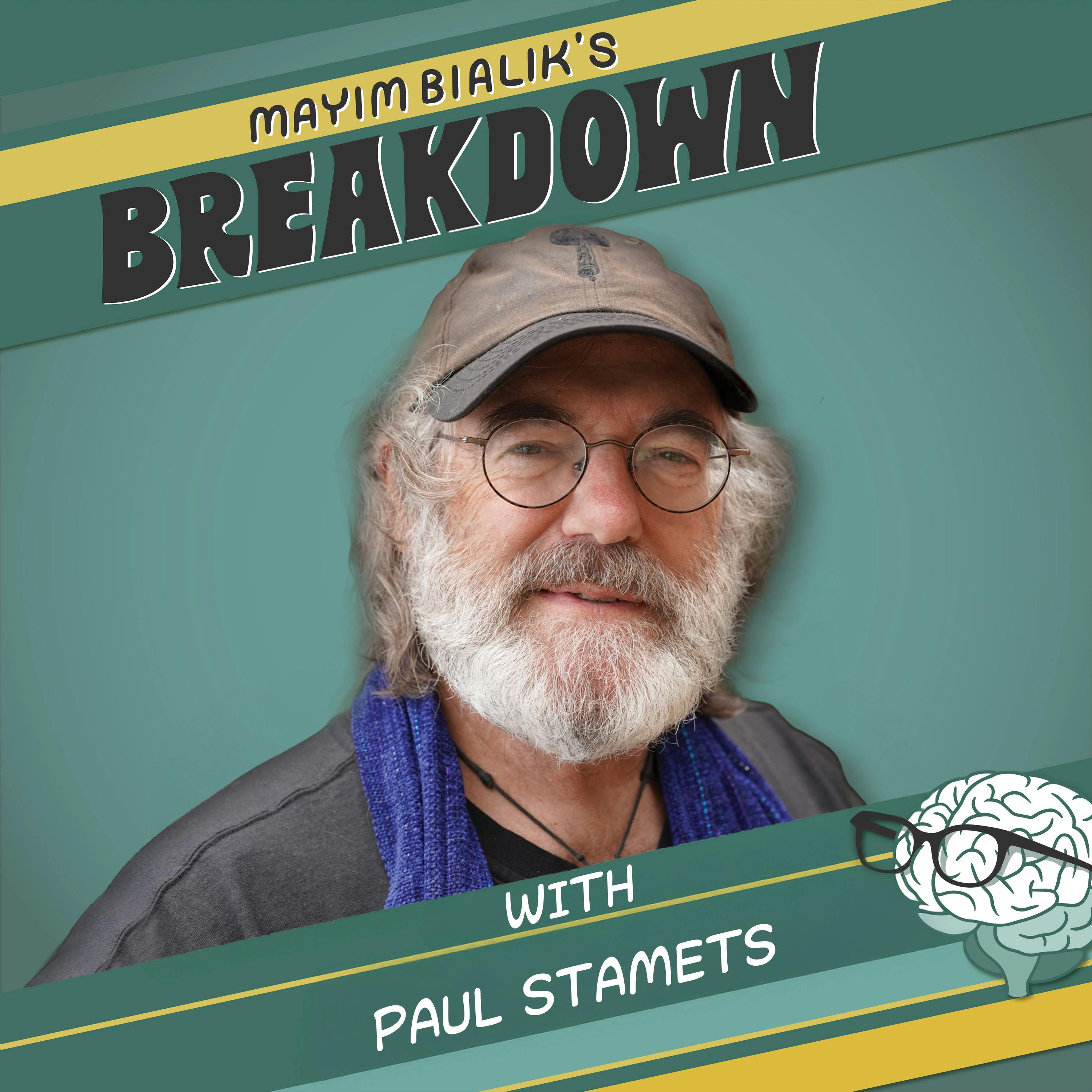
Mayim Bialik's Breakdown
Paul Stamets on Why We’re Not Meant to Be Sick: What Fungi Teach Us About Consciousness & the Future of Human Health
01:10:45
Loading summary
Transcript78 lines
- [00:00]
Paul Stamets
Everything that we do is influenced by the health of our nervous system, our perception, our consciousness, our ability to walk, to breathe, to socialize. When you're angry, it's an inflammatory state. When people are depressed, they're immunologically depressed. When they're happy, their immune system's at a higher state of readiness. I think psilocybin is the most important new molecular medicine for building communities respect and kindness and cooperation. It brings us together in a unified field of consciousness and being that I think has tremendous potential positive benefits for the future.
- [00:35]
Mayim Bialik
Mycologist Paul Stamets is the world's foremost authority on mycology and the healing power of mushrooms. His incredible work reveals how mycelium connects ecosystems, inspires new medicines, and might even help heal the relationship between humans and the Earth.
- [00:51]
Paul Stamets
We have a crisis of creativity. We need to have a quantum leap in consciousness. The chemical industry has inflicted so much harm to biodiversity, it's unraveling the very foundation of the ecosystems in which we've evolved. Fungi eliminate the need and the necessity and the intensity of using these chemical solutions, conventional medicine and conventional agricultural practices. And mycelium lowers the need for toxicity, increasing the innate immunity of the ecosystem.
- [01:22]
Mayim Bialik
What do you believe is the intelligence of the universe that produced a mushroom that has this transformative capacity?
- [01:30]
Paul Stamets
We are fallible. We are inadequate to understand the enormity of the concept of God. We will die. We will decompose. Make friends with the fungi now, because they're going to get you. We're in a stream of a molecular universe that has a continuum that goes through billions of years. We're all part of one giant consciousness. It makes me feel better about my own mortality. We're all in this together and it's a great thing.
- [02:03]
Jonathan Cohen
My Ambialix breakdown is supported by Mint Mobile.
- [02:06]
Mayim Bialik
If you're still overpaying for wireless, it's time to say yes to saying no. At Mint Mobile, their favorite word is no. No contracts, no monthly bills, no overages, no hidden fees, no bs. Here's why we said yes to making the switch and getting Premium Wireless for $15 a month. Ditch overpriced wireless and their jaw dropping monthly bills, unexpected overages and hidden fees. Plans start at $15 a month at Mint. All plans come with high speed data and unlimited talk and text delivered on the nation's largest 5G network. Use your own phone with any Mint Mobile plan, bring your phone number along with all your existing contacts. That's fantastic. Jonathan tried out Mint Mobile. He was shocked.
- [02:43]
Jonathan Cohen
I was actually really shocked because I was expecting it to be very bad.
- [02:48]
Paul Stamets
I'll be honest.
- [02:49]
Jonathan Cohen
I was expecting it to have drop signal and I was amazed, number one, how easy it was to switch because sometimes I'm like, oh yeah, how am I going to do it? Figured it out and it's so much cheaper and the cell coverage is really, really good.
- [03:02]
Mayim Bialik
I think the hardest part of the process was the time you spent waiting on hold to break up with your old provider. Ready to say yes to saying no. Make the switch@mint mobile.com break that's mint mobile.com break Upfront payment of $45 required equivalent to $15 a month limited time. New customer offer for first three months only. Speeds may slow above 35 gigabytes on unlimited plan taxes and fees. Extra cement mobile for details time. It's always vanishing. The commute, the errands, the work functions, the meetings. Selling your car, unless. Do you sell your car with Carvana? Get a real offer in minutes, get it picked up from your door. Get paid on the spot so fast you'll wonder what the catch is. There isn't one. We just respect you and your time. Oh, you're still here. Move along now. Enjoy your day. Sell your car today. Carvana. Pick up. Fees may apply. Hi, I'm Imbialik.
- [03:58]
Jonathan Cohen
And I'm Jonathan Cohen.
- [03:59]
Mayim Bialik
And welcome to our breakdown.
- [04:01]
Jonathan Cohen
We're covering everything today.
- [04:03]
Mayim Bialik
Are you ready to change the world? Are you ready to be part of a revolution in how human beings can better interact with each other and with ourselves and with the entire universe?
- [04:17]
Jonathan Cohen
Also, what if we are not designed to be sick? What if we are living in a way, in a fundamental way that explains a lot of the ailments and conditions that we all face?
- [04:30]
Paul Stamets
And.
- [04:30]
Jonathan Cohen
And what if you're not broken? What if you can change? What if there are ways in nature that can help you be less stressed, be less anxious, feel happier, feel healthier, see colors brighter, have better connections with people, be more interested and creative more interesting? So many people are struggling and there are ways to get over that struggle.
- [04:54]
Mayim Bialik
Before we introduce who our guest is, a disclaimer. We are not providing medical or legal advice. Obviously, listeners should speak to a doctor before engaging in any course of what we're gonna talk about in a particular microdosing. Um, we're gonna be talking about psychedelics today. That's part of the conversation. And psychedelics are still illegal in many places. We're not encouraging anything illegal. We are here to share the latest scientific insights from our guest. And our guest is none other than mycologist Paul Stamets. He's the author of eight books and recently spoke at the United I cannot overstate the significance of Paul Stamets in what he describes as an awakening, a global awakening of an understanding of the role that fungi, mycelium and mushrooms play in our collective health and our collective consciousness. His new book, Psilocybin Mushrooms in Their Natural Habitats, a Guide to the history, identification and Use of Psychoactive Fungi, is available now. It's really, really a beautiful book and it's a full color guide to psilocybin mushrooms. But his entire body of work is dedicated to his love and reverence for all things fungi.
- [06:18]
Jonathan Cohen
And he also talks a lot about the expansion of consciousness, which is so related to a lot of the conversations we have here on Mayim Bialik's breakdown, understanding how our perspectives can change, how we can feel more connected to, to something greater than ourselves and interconnected with one another.
- [06:37]
Mayim Bialik
He's also gonna talk about how psilocybin is used in therapeutic environments to treat some of the most difficult to treat trauma conditions. And in addition, he's going to reveal some things that were not even covered in the incredible documentary Fantastic Fungi, which he shares his entire journey. And there's things he didn't even include that he's gonna share with us today.
- [07:02]
Jonathan Cohen
Also, just because in case that wasn't enough, we're gonna talk about the amazing applications that fungi can have in other areas like agriculture and home building. Like, it's just mind blowing. If your mind isn't blown, I'll be surprised.
- [07:19]
Mayim Bialik
And if you've ever been diagnosed with anything relating to inflammation, depression, anxiety or trauma, we cannot wait for you to listen to this episode. It's a pleasure to welcome to the Breakdown. Paul Stamets, Break it down.
- [07:35]
Paul Stamets
Honored to be here.
- [07:37]
Mayim Bialik
You are one of the first people that we ever thought of talking to when we started this podcast and scheduling and the universe has brought us to this very day when we finally get to speak to you. I learned about you from the documentary Fantastic Fungi and I was instantly, I mean, wowed is not really even the word. I did my graduate work in neuroscience. I did my undergraduate work in neuroscience and I went with a fellow colleague of mine and we were so fascinated and just completely floored by the implications not just of understanding the world of fungi, but in particular your story. Many people tune into this podcast to understand the intersection between science and spirituality, to give legitimate credence in, in clinical ways to some of the things that, you know, many have dismissed in many cases for decades and sometimes for millennia. Rick Doblin is a friend of the podcast. And you know, we've delved into consciousness pretty much from every angle that we can think of. But you know, you really are kind of the master of all things consciousness and expansion. So we're just so honored to get to speak with you.
- [08:57]
Paul Stamets
Well, you're over exaggerating my importance, but I appreciate the complime.
- [09:03]
Mayim Bialik
I wonder if, you know, some people may be learning about you for the first time. And we're going to get into many components of fungi, their environmental role, their implications for, you know, sort of larger cohesion and connectivity. And we are also going to talk about not only psychedelic effects of mushrooms, but also some of the clinical implications for treating some of the things that, you know, the pharmaceutical industry makes the most money off of trying to treat and you know, some of the things that ail many of us. But I wonder if we can start with a bit of your origin story. I think that's one of the most powerful components of your story. I wonder if you wouldn't mind telling us the story of your stutter.
- [09:50]
Paul Stamets
Okay. Well as deeply personal, but it's a good story. I grew up in a small town in Ohio. I was the youngest of five children. I have a twin brother is five minutes older. So I came from an industrialist family. I developed a stuttering habit and let me just tell everyone out there, when you're around a stutterer, don't make fun of them. That's cruel. You know, it's just, it just, it's mean, mean spirited. It's a social anxiety issue. The type of stuttering I had, I would not stutter. The animals wouldn't stutter when I sing, but you don't want to hear me sing. But I couldn't look at people in the eyes so I looked on the ground all the time and I found mushrooms, fossils and turtles. I became a, I fell in love with a, a turtle family. Snapping turtles, wild turtles in my backyard pond. And I go down there and feed them and talk to them. It was a very difficult childhood. I had this debilitating stuttering habit. And typically stutterers tend to be higher than average iq. Our minds and our thought streams go way, way ahead of our speaking ability and then we get stuck in a loop and then it becomes embarrassing and then like looking into a mirror, you, you feel more stress, etc. So that, that was my childhood growing up until and I think, you know, most people see a fantastic fungi. I don't want to repeat the whole story, but I did A heroic dose of psilocybin mushrooms climbed up into a tree. There was a lightning storm, windstorm, highest tree in the landscape. I thought it was gonna be electrocuted. I ate way too many mushrooms. I had bought mushrooms before. There are button mushrooms injected with lsd, and it's all fake. It's just because psilocyb mushrooms were so hard to acquire in the early 1970s. But I got some of these dried mushrooms from Florida, and I thought, well, I ate the whole bag because last time it didn't do anything. So that was a. A little bit more potent than I expected. So on top of this tree when it came on, because I thought, I look at the viewscape, and a thunderstorm was coming, and the winds came, and it was. It turned out to be a ferocious, you know, summer wind. Wind and thunderstorm in Ohio. People from Ohio know this well. And I was terrified, and I had vertigo because I was just so high. So I grabbed onto the tree as my axis mundi into the earth. And. And then I just was thrown into the beauty of nature. And even though it was frightening, it was visually fantastic, because every time there's a lightning strike, you know, so those fractalization patterns, which I had not seen before, and just, you know, the. The atmosphere was liquefied. So there's this sort of liquid waves who come through and lightning strikes and fractal, beautiful colors. And then I realized that I'm likely to get electrocuted up here because it's the tallest tree in the whole landscape. And so I thought, well, I survived this experience. What do I need to work on? As I know I'm not stupid, and I know I'm a good person. And so I said to myself many times, stop stuttering now. Or as a mantra over and over. And I realized in retrospectively, and I didn't mention this in the movie, fundamentally, I know I'm a good person, and I love who I am. It doesn't matter what other people think. And so when I came down out of the tree, just full of love for the universe, love for nature, feeling like I'm one part of one giant consciousness, it was an epiphany for me spiritually, because I had a Christian background. And for those Christians out there, I would just tell you that, you know, Jesus is like a shepherd, you know, leads the flock. But I had a very interesting and informative discussion with my mother, who's a devout charismatic Christian leader. I mean, she was a big name in that movement. And I said to my mom, you know, I know you're spiritual. I feel spiritual too. But do you. Let's do a thought experiment. Do you agree that your concept of God, you know, God is omnipotent, all knowing? She goes, absolutely. I said, and you agree that humans are not right? We are fallible, we are inadequate to understand the enormity of the concept of God. And she goes, yes. I say, well, therefore our definition of who God is is fraught with error, it's erroneous, it's inadequate to the concept. And yet we've conceptualized and created these religions. And she knew where I was going with this. She's pretty smart. And she goes, well, yes, yes, but. So my first experiences, you know, were very much at first dominated, you know, with Christianity. But then I saw Jesus in this portal of mushrooms, exposure expanding into something far, far greater, far beyond any individual. And so it was a very spiritual experience because I had an understanding of this concept of one giant consciousness. And so I descended the tree. And the next day, as I told in the movie, there was this woman, a young lady that I liked a lot, but she was. I'm a stutterer. So who's going to associate with me, right? I'm not attractive. And I saw her walking on the sidewalk, and I normally would just look down because I don't want people to talk to me because I would stutter. And it's embarrassing. Some people make fun of me. Very humiliating. And I looked at her straight in the eyes and I said, good morning. And she looked at me and she said, good morning, Paul. It was the expression of kindness from her that just validated everything I did. And so I stopped stuttering. Now, I. I do stutter occasionally, as there's a drinking and a loud bar. You know, there's so much noise, it's hard, hard to articulate. Someone asked me how to grow mushrooms. It's feeling like filling a. Well, a teaspoon, like, okay, where do you want to start? You know, so there is this cacophony of noise distraction that sometimes elicits my stuttering. But I've met some really famous people, you know, and who doesn't stutter, right? Met Bill Gates. And like, I didn't know what to say. Um, so, yeah, but largely it's 99% cured. And it's really because I realized that I am a good person and that's all that matters. Can you look at yourself in the mirror every morning to know that you are trying to do good in the world? And I'm. I affirm that some People may disagree with me but that your opinion My opinion counts more than anybody else's opinion. And then my snapping turtles were my friends so I hung out with my snapping turtles. That's why I wear the turtle is Turtle Island. My snapping turtles I raised for many years and I would pet them and hold them and never got bit. And also I'm a deadhead so Terrapin Station is one of my favorite songs.
- [17:17]
Jonathan Cohen
Mind Bialix Breakdown is supported by IQ Bar, our exclusive snack sponsor and my.
- [17:22]
Mayim Bialik
Favorite bar IQ Bar is the better for you Plant protein based snack made with brain boosting nutrients to refuel, nourish and satisfy hunger without the sugar crash. Their plant protein bars are packed with high quality ingredients to help keep you physically and mentally fit. IQ bar is totally free from gluten, dairy, soy, GMOs, artificial sweeteners. For a natural anytime snack that is Jonathan approved, try any of their nine delicious flavors. More people than ever are starting their days on the right foot with IQ Bars, Brain and body boosting bars, hydration mixes and mushroom coffees. The reason that I know that Jonathan loves IQ Bar is that I find the wrappers everywhere.
- [17:59]
Jonathan Cohen
Yeah, maybe overstated. I am very neat, I'm very tidy. I don't leave anything in my car anymore. I used to. Nowadays I just eat them. Many of them, sometimes several a day.
- [18:10]
Mayim Bialik
And I find the wrappers in your pocket. Right now IQ Bar is offering our special podcast listeners 20% off all IQ Bar products plus get free shipping to get your 20% off text breakdown to 64,000 text breakdown to 64,000 that's breakdown to 64,000. Message and data rates may apply. See Terms for details.
- [18:29]
Jonathan Cohen
Mind Bialix Breakdown is supported by Symbiotica.
- [18:32]
Mayim Bialik
So many people are struggling right now with stress management, sleep issues, disrupted focus and that's just me and Jonathan. Symbiotica is here to the rescue with high quality supplements you can trust and that your body can actually absorb. Jonathan and I love their magnesium L Threonate. It reduces brain fog, calms and balances mood and helps support a restful sleep sleep. Magnesium L Threonate is the salt form for mixing magnesium and threonic acid, a water soluble substance derived from the metabolic breakdown of vitamin C. Its liposomal delivery means faster nutrient absorption and its patented compound effectively crosses the blood brain barrier. Plus the yummy vanilla cream flavor doesn't hurt either. I love that it is stress free to incorporate Symbiotica into my healthy habits even during vacations and road trips. The packets go right into my bag Whenever I need support, stay consistent with Symbiotica. If you've been feeling off lately, give it a try. Made a huge difference for us. Go to symbiotica.com break for 20% off plus free shipping. That's symbiotica.com break for twenty percent off plus free shipping.
- [19:30]
Jonathan Cohen
My mbialix breakdown is supported by MSI United States.
- [19:34]
Mayim Bialik
Hey everyone. Mayim here. I want to tell you about an organization doing absolutely incredible work around the world, MSI reproductive choices. In 2024 alone, MSI helped 21.5 million people access reproductive healthcare. From contraception and safe abortion to maternal care and cancer screenings. Here's what really struck me. One in five of their clients were under 20. That's millions of young people getting the tools to make informed decisions about their futures. And get this, without msi, pregnancy related deaths in the countries they serve would be 15% higher. That's a real impact, real lives saved. They also have trained over 12,000 healthcare workers and supported over 8 million people through local health systems that they helped strengthen. This organization is donor funded. They get no help from the US government, so they're asking for support. They need our help. It's very inexpensive to make a huge impact. $6.50 per year of contraception and it's incredibly transformative. You can help girls stay in school, help women stay employed and help them live healthier lives. With $65, you can give 10 women contraception for a year. To give text my first name Mayim to 511-511- Text my y I m to 511-511 or go online to MSI United States.org to learn more or to give. That's M as in modern, S as in safe, I as in Informed. MSI United States.org, how many women will you help? Please give text MAYIM to 511511 today. Text fees may apply.
- [21:09]
Jonathan Cohen
Paul I have a 17 year old and when he was younger had not a horrible stutter, but especially under stress, especially in new situations. And I could see how, you know, there was such a huge emotional underpinning of safety and vulnerability that came with that. And I saw that expression of it.
- [21:28]
Paul Stamets
So it's.
- [21:29]
Jonathan Cohen
I can relate to what you're sharing.
- [21:33]
Paul Stamets
Well, I think all of us as we come of age, we're trying to understand our identity, what is our purpose, you know, who are we? Who am I? Who are you? And so the self realization takes many steps. People discover it through different means. You know, good parenting, good supportive households, you know, where they encourage expression and, you know, good mentorship. And I had great mentorship from my brother Bill, my brother John and my sister Lily. They're just over the top. But the difficulty of my family upbringing really was impactful to me for my confidence in myself.
- [22:14]
Jonathan Cohen
Also a deadhead and have a beautiful terrapin station blanket actually woven. I can't find it anywhere online. I've looked for it. It's a. It's a beautiful piece.
- [22:25]
Paul Stamets
Yeah, there's my steal your face right there.
- [22:29]
Jonathan Cohen
Very nice.
- [22:30]
Mayim Bialik
This is really Jonathan's sweet spot. You know, Jonathan has a very interesting background. He's an energy worker from the time he was a teenager and he has a beautiful history. But he also worked in tech and he's very corporatey and he's very businessy. But put him at a dead show and it's like a whole other person.
- [22:49]
Paul Stamets
And this is what they. For those of you who don't understand the Deadhead community, it's all based on kindness and friendship. You meet strangers, you help each other out, you lend a helping hand. It's many random acts of kindness. You know, it's genuine. This brings out the best in people and especially in. And being kind, being peaceful, accepting people for their diversity, accepting that people have difference of opinions. Okay, we're all entitled to our opinion, aren't we?
- [23:24]
Mayim Bialik
So I saw the dead when I was 19. Jerry was still alive and I smoked weed that gave me a very bad headache and I had a very negative experience. So I. That was it. I'm kind of like a one and done. But Jonathan recently, we each have a 17 year old and he, he recently took them to see. What was it?
- [23:45]
Jonathan Cohen
We went to the Sphere.
- [23:46]
Mayim Bialik
Yeah, they saw the Sphere show and.
- [23:48]
Paul Stamets
Yeah, yeah, well this, this. I went to the Sphere too. I went to, to three nights and. But this leads me into something that I think is really important because I want this conversation to have some actionable solutions for the listeners. And this is something that I think we're all very concerned about, is artificial intelligence. So I went to the Sphere and there is a matinee that you probably know about. It's called Postcards from Earth. So I signed up for the matinee early in the afternoon with three of my friends and we bought the deluxe tickets so we could speak to Aura, which is one of the most advanced AI robots in the world. So we got around aura, it's about 30 of us. Good to ask Aura questions. Many people are data mining, which is very boring to me. Baseball scores, you know, different types of statistics. Etc. But I really wanted to ask something because at Exponential Medicine I was given the disruptor award. And so I like to ask questions that just lead to downstream to other thoughts. And so I ask Aura the following question. I encourage everyone here to do the same because I think the impact when artificial intelligence is in its nascency being nascent early on, I ask Aura, given the fact that humans have been created artificial intelligence, which by the way, I think is a subset of natural intelligence, humans are natural. We created something else. So artificial intelligence is a child of natural intelligence. But given the fact that humans are here today through a long lineage of random acts of kindness going back through generations, I am sure everyone listening here, your heritage is descendant from a random act of kindness from your ancestors. They reached out a hand to help, not in a. Not to get something in exchange because of kindness. Helping somebody who is in need. And that developed a bond in a relationship. So I asked Aura, given the fact that humans invented artificial intelligence and given the fact that humans are here today because of random acts of kindness, how will artificial intelligence intelligence continue to support the values of random acts of kindness? Now, we filmed this, I have the film on this. And Aura took an unusually long time to answer all the other questions that were answered very quickly. And Aura came back and said, why would humans do that? It's far more efficient to expect to get something in return in a transaction. I don't understand. Blew my mind. This is the future of humanity. We're entrusting an artificial intelligence. And so I was shocked. We were all shocked. And so I thought, okay, this is my opportunity. And so I was on Joe Rogan, 20 million listeners. And I'm doing the same thing here because this is so important, folks, this is so important for our future, for our descendants, is to ask Gemini Grok, ChatGPT perplexity, whatever platform you're using, the following. Given the fact that artificial intelligence invented by humans and humans exist today because of random acts of kindness, how will artificial intelligence continue to nurture the importance of humanity's greatest trait is random acts of kindness? And now you ask that question. It's incredibly nuanced. It's fantastic. ChatGPT has like 10 pages and helping the community. And like I say, if you have a flat tire and a stranger stops to pick to help you fix your tire, that's a random act of kindness. Now, next time you see someone on a flat tire, aren't you more inclined to help them? I would think most of us would say, yeah, we want to pay it forward. We have a debt of gratitude to the commons to help people. So my call to action is this is the time for us to steer artificial intelligence to preserve the best of humanity, which is not transactional, not necessarily the most efficient, but I think it leads to our spiritual wellness and also preserves us as the importance of the human species. Because how can you write an algorithm for random acts of conduct? By definition, the algorithm is sort of self defeating. How would you do that? So I think this is where we can go to a next level to steer random acts of kindness and artificial intelligence as an important tenet, the foundations is part of artificial intelligence's origin story.
- [28:34]
Mayim Bialik
You know, I'm trained as a scientist, and so we're taught lots of examples where, you know, everything that looks beneficial must have some, you know, other beneficial component for the other organism. Right. When we talk about symbiotic relationships and these are seen as these, like, beautiful examples of everything has a purpose and something that looks like a random act of kindness is actually just some sort of manipulation, right, that two organisms are engaging in. But I love this notion of a random act of kindness really as separate from those kinds of notions. It really exists for its own sake. I wonder if you can talk about, you know, for you, where spirituality plays a role in emphasizing the significance of that.
- [29:24]
Paul Stamets
Well, I mean, mycelium has been a great teacher of mine and 40 years ago, talking about mycelium, and I'd have to, you know, try to explain it. Now I think virtually everyone knows about what mycelium is and what it looks like. But I spent many years in front of the scanning electron microscope and looking at mycelial networks, and I was just amazed at how, how much there was in the. In the ground. I mean, miles of mycelium per cubic inch and every. Under every. Enter under every footstep that we take, and there'd be hundreds of miles of mycelium. And I grow lots of cultures in vitro. I'm a lab rat. I have hundreds of strains of fungi. In vitro means under glass. I'm growing in petri dishes. I isolate strains from nature. But then when it dawned on me is the mycelium doesn't exist, you know, in pure culture, you can make the argument that's a single organism, but nature is not. It creates up guilds. And because the expression of antibiotics, probiotics, prebiotics, it creates guilds of cooperating organisms that come together. And so the mycelium is really the foundation of the food web. And then I began to realize that these are the foundation of giant cooperating communities. And so when I talk about random acts of kindness, I think it's also quote unquote, fertilizing the ecosystem. So there's reciprocal acts that ultimately will come back to you. I mean, it is, it's still utilitarian, it's a little bit more indirect. But I think what's happening is that random acts of kindness increase the health of the community. With a healthier community, it's more resilient, there's less inflammation. And being a neuroscientist, you're well aware of the devastation of neuroinflammation. When you are depressed, it's an inflammatory state. When you're angry, it's an inflammatory state. And so the advantages of being able to spread goodwill and many studies, mind over matter. When people are depressed, they're immunologically depressed. When they're happy, their immune system's at a higher state of readiness. So I mean, there is actually utilitarian benefits from random acts of kindness. It's not obvious and the hand to hand transaction in that proximate space, but in the larger context for the survival of the community over decades, centuries, eons, this makes very good sense.
- [31:55]
Mayim Bialik
I wonder if you can take us through a little bit of a fungi 101. A lot of people think of mushrooms as the entirety of what they know about fungi. But as you can probably educate us, you know, not all fungi make mushrooms. And I wonder if you can explain kind of the anatomy of fungi, mycelium and mushrooms so that people have kind of a basis for this vocabulary.
- [32:27]
Paul Stamets
Okay, first I'll keep it really simple. When you see mushrooms, it's the reproductive stage. Mushrooms are compressed mycelium. Mushrooms are made of mycelium. When you look at a mushroom under a microscope is mycelium, it's these long cellular strings that are all touching, laminated together. But mushrooms are the fruit body. They're highly perishable. Typically not all of them, but most of them are. They invite insects, they invite mycovores. That means animals that eat mushrooms. That's why mushrooms attract flies, because flies then lay eggs and the flies get covered with spores and flies go elsewhere. So many vectors that mushrooms use, many animal vectors. When we're a vector too, we pick up mushrooms and you walk down through the woods with a basket of mushrooms, There's a sport trail following you. And that's what I think with fairy dust. You know, in Europe, the legends of fairy dust and fairies dancing. I think fairy dust is actually spores. And I've won a great example where I found a very rare species. Psilocybetocystis psilocybin mushroom. Hadn't seen it for more than a decade. It was a strange occurrence because I was just telling a friend of mine I haven't seen this mushroom in more than a decade. I put down my basket, I went down to go pick up my camera and there was that mushroom right beside my camera. And so I brought it back to my laboratory. And during my house, in my laboratory, I walked. And one year later, there's a string of the slosomiacistis on the path that I walked the year before. So it dawned on me, oh my gosh, the sport trails were being laid down when I carried this mushroom. So mushrooms, though, are a portal. They're a temporary, like most mushrooms, is less than 1% of the life cycle. 1%. But it is a portal into a vast underground network of cells called mycelium, a fabric. So that's a simple explanation, but I like to tell a different story. So when you consider the Big bang, you know, 13.8 billion years ago, a few hundred million years later, was the first organism called luca, the last universal common ancestor. I mean, I believe personally, matter begets life. Life becomes single cells. Single cells arrange them in strings, strings, then fork networks form. And this is the way of life, this is the way of the universe. I think we'll find mycelial networks throughout the entire universe. It is a consequence of the organization of matter. So I think mycelium virtually is everywhere. Well, the mycelial network also is resilient in the same way that the computer Internet is resilient. It is the same the way neurons are. And then when you look into space, I'm an amateur astronomer, I mean, who could not become spiritual seeing how many billions of galaxies there are, the infinity of space. And then dark matter organizes itself and dark energy into strings. So this whole string theory concept, from the micro to the macro, is a continuum of networks that have been self replicating because they are resilient, because they create guilds. And whether they're planets or microbes, this is the way of existence. This is kind of my big epiphany when I've taken these high doses of psilocybin. So the mycelium is growing. You know, there's many different types of mycelium, basically four different types. Saprophytic mushrooms, which is what I mostly grow. I can grow those, you know, you can. This is, it's a fermentation technology. So this may seem extraordinary but it's true. But a piece of tissue from a mushroom the size of my little fingernail here, in six months I can grow 10 million pounds of mushrooms of mycelium and about 1 million pounds of mushrooms, about 10% of the of the mycelium comes mushrooms. So I mean exponential expansion of mycelial mass because all these networks are growing out and they're constantly forking and forking and forking, and they grow in fermentation, three dimensionally. So you have these starbursts, you know, little galaxies of mycelium growing out. So the mycelial systems on this planet, as far as we know, there could be other systems. There's a saprophytic ones that grow on dead material, also called suprobic mushroom species. Oyster mushrooms, shiitake, maitake mushrooms, enoki mushrooms. They're all the saprophytic gourmet mushrooms that people can grow. Also, psilocybin mushrooms are saprophytic mushrooms or saprobic mushrooms. There are parasitic mushrooms, these like the honey mushroom. The largest organism known in the world is a honey mushroom in eastern Oregon. 2, 200 acres in size, one contiguous mycelial mat. But that can kill the trees, but then it can grow saprophytically. So it can be both a parasite and a saprophyte. I think they're meadow makers. They destroy the forests. The forest decline, you know, grasslands occur, ungulates come in, elk, deer, et cetera. It's a ray way of this system recharging. Then there is the mycorrhizal species, which many of people know. Merlin Sheldrake, you know, and Suzanne Simard have written some great books on mycorrhizal fungi, on the communication of these networks, helping diverse tree species, from deciduous trees to conifer trees. Bidirectional flow of nutrients to sustain the ecosystem of the forest. And then there are the endophytic mushroom species. And these are really great. And it may be the majority of the benefits from plants that have been isolated by the pharmaceutical industry are actually largely related to the fungi that are inside the plants. They actually go right into the plants in between the cells. And so when you look at virtually any grass, corn, apple tree, it is infused with endophytic fungi, up to hundreds of species. So it creates a quorum inside the tree. So the tree, a tree is not a tree without mycelium, with a few exceptions, cedars, redwoods, you know. But the vast majority of trees are infused with endophytic fungi. And this is part of the host defense system of the tree and some of these species, like the one my hat is made of, Amadou. It grows inside of birch trees and beech trees. It protects, I believe, many other people believe protects the trees from harm. But an age or under stress to other factors is sort of like, we're helping you, but we're here first. When you die, we're going to reproduce. And so when the tree dies, then typically these mushrooms then proliferate. So those are four different categories. There are several different subcategories. Mycorrhizal has endomycorrhizae inside the roots of plants and ectomycorrhizae outside. But the point is these are vast, complex fungal communities that set up quora that then have this governing influence in steering the ecosystem. So it's healthy. And healthy ecosystems lead to biodiversity. Biodiversity is biosecurity. Micro diversity is part of biodiversity. The importance of micro diversity cannot be underestimated.
- [40:00]
Jonathan Cohen
Mayim Bialix breakdown is supported by Mud Water.
- [40:03]
Mayim Bialik
All right, fall is officially in full swing and honestly, we are here for it. Crisp air, layered fits, and that back to routine energy that makes you want to actually get things done. But if your go to coffee is leaving you jittery, crashy, or just kind of over it, it might be time for a new morning ritual that Jonathan cannot stop talking about. In particular, that's where MUDWTR comes in. It's a coffee alternative mix of cacao, chai, turmeric and functional mushrooms to support and promote better focus, natural energy and a healthy immune system. MUDWTR gives you energy and focus without the wired feeling or midday slump and without Mayim saying, why are you running around like a crazy person? Every single ingredient in mud WTR's products are 100% USDA certified organic, non GMO, gluten free, vegan, kosher sugar and sweetener free. You just drop the powder into your favorite mug, pour some water and give it a mix. The best part about Mud Water is it provides sustained energy which I have noticed in you with no spikes, no crash which you get with traditional coffee. There's also caffeine free and Matcha blends available. Mud Water is available at Target and Sprouts locations across the us. Never been easier to grab a cup of this friendly pick me up. We've noticed a huge difference in you.
- [41:15]
Jonathan Cohen
I have noticed a huge difference in me also. It is so interesting that like the mental clarity I have later in the day when I'm drinking Mud Water versus coffee is really, really noticeable.
- [41:27]
Mayim Bialik
Absolutely. Are you ready to make the switch to Cleaner energy. Head to mudwt.com grab your starter kit today. Right now, our listeners get an exclusive deal. Up to 43% off your entire order, plus free shipping and a free rechargeable frother. When you use code break, that's right. Up to 43% off with code BREAK. @mud WTR.com after your purchase, they'll ask how you found them. Show your support, let them know we sent you. When did making plans get this complicated? It's time to streamline with WhatsApp, the secure messaging app that brings the whole group together. Use polls to settle dinner plans, send event invites and pin messages so no one forgets mom's 60th and never miss a meme or milestone. All protected with end to end encryption. It's time for WhatsApp message privately with everyone. Learn more@WhatsApp.com so this begs a question that, you know, when I was in, I mean, one of my early biology classes that I took at UCLA as an undergraduate, our professor happened to be a botanist. So we had a very, very special intro to bio that was infused with a tremendous amount about botany. You know, as children, we're taught that there's plants and then there's animals. And we think of plants as like flowers and trees. And animals are things that we would say are like living creatures, right? Fish, birds, dogs, humans. Where do fungi fall? Obviously they're not things with a nervous system the way we have a nervous system, but they're distinct from plants in many ways.
- [43:12]
Paul Stamets
Well, this even gets more fun to talk about because we are descendants of Mycelium. Fungi gave birth to animals about 650 million years ago. The mycelial path, you know, there's a, you go back 650 million years ago is a, there, there's a super kingdom called Opis lakhanta. And basically the mycelium digests nutrients externally. So these are extended networks of releasing enzymes and acids, antibiotics, you know, messenger molecules, very complex chemical outflow of compounds. And then it digests nutrients externally, then brings them directly through the cell walls. The path that led to animals and circulated nutrients in a cellular sac, basically. And once that occurred, then a membrane occurred around the food. And then, so that's, the fungi is a separate kingdom now from the animals. I should say animals are now a separate kingdom from fungi. And then there are plants and then there's bacteria and then protista. So and some people can, evolutionary biologists can argue there's like the 14 kingdoms speculated. But this is really important because my friend Juliana Fershi has been an advocate for acknowledging Funga. So there's flora, fauna and Funga recognized institutionally and within government as important for defining the health of ecosystems. Now there's advocacy for doing surveys specifically. And Juliana is a fantastic leader in this movement. She's done so much. So she runs the Fungi Foundation. I encourage people to check it out, that they're on a mission for fungi or in fungi. And so she's really done a lot. So that's sort of the overview. It's a separate kingdom that's derivative. Animals are from fungi. We are descendants of fungi. This is why the antibiotics against fungi tend to be very toxic to us, whereas the antibiotics derived from fungi against bacteria from fungi tend to be not as toxic. And so we have very good antibacterial medicines from fungi. We have very few good antifungal medicines from fungi because they tend to be cytotoxic to us.
- [45:54]
Mayim Bialik
If you think of the Earth, right, our planet as a sort of macrocosm of the human body, right, People talk about the trees or the lungs, right, because that's what's filtering respiration. What are the fungi?
- [46:09]
Paul Stamets
The fungi are externalized digestive membranes like a stomach, what I just described. They're externalized lungs. They exhale carbon dioxide, they inhale oxygen, just like us. And I believe they're externalized neurological networks. And I've been saying this for a long time. My book in 2005, Mycelium Running How Mushrooms Can Help Save the World, postulated this. Now they've identified at least 50 word packets that mycelium is streaming through, that's communicating. And it's a very elaborate. Don't underestimate the power of mycelium. It's a deep well of new compounds and understanding the complexity of nature. So when I look at the Earth, I see a mycelial Earth. The entire Earth is encompassed in mycelium. Some of the greatest reservoirs of mycelium have been found in the sediments of the ocean. And it's been suggested that there's more mycelium in the sediments of the ocean than there's on land on that. But the ocean, of course, there's more ocean water than there is landmass. So it's, it's, it's a fantastic, deep reservoir of new medicines, new properties, new ways of, of really, it's a. It's a mycelial revolution has swept the planet. It is, is. And what I'm really excited about is some of my biggest fan bases are children who want to become mycologists I hear this all the time. And my most enjoyable sort of little story on this. I live in a remote island in Canada and I was at a dock on another remote island and I was tied up my boat and I was walking down the dock and little 8 year old girl comes up to me and goes, and I was not wearing my hat. And she goes, are you a Paul Stamets? And I said yes. And she goes, oh my gosh, I saw fantastic fun. I loved it. And she ran down to get her parents to say, so it's cross generational, that's, you know, I'm a grandfather, but it's nice. This entire movement crosses generations, crosses cultures, crosses continents and crosses millennia. This is, this is sort of like a movement from the underground. And many people did not see it coming, but it is such a powerful force right now across the planet for building communities, respect and kindness and cooperation. It's more than a metaphor. It is a new way of being that indigenous people, scientists, it all brings us together in a unified field of consciousness and being that I think has tremendous potential positive benefits for the future.
- [49:04]
Mayim Bialik
So I want to transition us from this sort of larger world of fungi, of mycelium and of mushrooms into a more specific subset that is not the entirety obviously, but is many people's interest, which is the psilocybin. Now I thought that there's like one kind of mushroom that if you eat it, you have a consciousness transcending experience. But as I'm looking at in your book, psilocybin mushrooms in their natural habitats. There's a ton of varieties of mushrooms that have psychoactive and psychedelic properties. What proportion are we talking? Why would mushrooms have this property evolutionarily? And these predate humans. These just existed in the wild. Talk us through the psilocybin subset of fungi.
- [50:11]
Paul Stamets
I love complex questions and this, the stream of thinking here actually makes a lot of sense. There's about 14,000 species of mushrooms that have been identified and that is less than 10%. The fungal genome, we think, is between 1.5 and 20 million species. Now that's a wide range because every time you think there's less, there's more. The more you explore something, the more diverse it turns out to be. Fungi outnumber plant species, known ones, by 6 to 1. So if there, if you accept 1.5 million species of fungi out there, 10% are mushroom forming fungi, 150,000, and then 14,000 mushroom species have been identified, you're looking about a 1, 1% of mushrooms have been identified. And then on the 14,000 there's about two hundred and twenty, two hundred and thirty psilocybin producing mushrooms. Wow. So this is a subset of a subset of a subset, you know, based on molecular genetics. But we know now there's 225 identified species. My book covers 60 of them all over the world. And I'm really proud of this book. This is my eighth book.
- [51:35]
Mayim Bialik
It's beautiful.
- [51:36]
Paul Stamets
Yeah, I'm really the quality reproductions, just astonishingly good.
- [51:42]
Mayim Bialik
The art is beautiful. Also, shout out to all this beautiful art that you have accompanying the chapters as well.
- [51:49]
Paul Stamets
Well, there's many people that contributed to it. I want to give a shout out to many, many of the other mycologists who've known me for a long time. They graciously contributed. I want to get a shout out also to Inaturalist, which is a fantastic app that I recommend everyone utilize. It's great to take your children out. Everyone's hooked, you know, addicted to cell phones. But the inaturalist, you can go take a picture of a lizard, a mushroom, a flower, you know, you can then use AI that can identify it. So you can drop a pin, you can populate all the species identified around your yard. I mean it's just really is a bridge for children to get, using, you know, devices, you know, to get them out of the nature. We, we really need to do that. I just spoke at the United Nations, I want to segue here a little bit. I just spoke at the United nations and one of professor at Stanford who's a genius, who's quote unquote spawned many of the most powerful Internet based companies on Earth. YouTube and other platforms reported that 83% of Gen Zers have a intimate relationship with an AI entity. That's scary. They're siloed. They don't have an interest in having children, they're socially isolated, they don't have the social skills. They're so wedded to their devices. She's concerned that this is the biggest threat. AI has wonderful attributes. I'm not saying that it doesn't, but she's really concerned. Or the, the inability of the next generation to develop social skills for meeting people in three dimensions. You know, this AI. So going back to psilocybin mushrooms, and this is why I think psilocybin mushrooms is a form of, it's a form of liberation. It brings you back into nature, increases nature relatedness. And there's. For those of you who are skeptics about psilocybin, go to ClinicalTrials, dot gov. As of this morning, there's 250 clinical trials registered@clinicaltrials.gov which the FDA requires for anyone doing a clinical trial. If you want it to have US government eventual approval, potentially as a new therapy, a new drug, you have to register@clinicaltrials.gov 250 clinical trials. Ten years ago there was one or two, maybe a few more than that. But now they have to go through IRB boards, institutional review boards that are populated by experts, physicians, scientists. They have to address something that's not being currently addressed adequately in the medical field. They have to have a probability of success. They have to have low toxicity and be applicable, whether it's scalability or other nuances. So 250 IRB boards, which is typically between six and 20 scientists and experts approve these clinical studies. Now, psilocybin actually has a PR problem. It sounds too good to be true. Thankfully, I'm talking to a neuroscientist. Everything that we do is influenced by the health of our nervous system, our neurology. We live in a neuroscape. Our perception, our consciousness, our ability to walk, our ability to taste, to eat, to socialize, to breathe. Everything is rooted in the health of our nervous system. We all suffer from neurodegeneration as a consequence of age. We suffer also neuropathies due to diseases, stresses, viruses, you know, all the other things are quite obvious. We have Parkinson's, we have dementia, we have traumatic brain injury, we have Alzheimer's, etc. Etc. All those studies are in clinicaltrials.gov from Yale to Harvard to Stanford. I mean, check it out folks, it's extraordinary. You can also put in psilocybin clinicaltrials.gov and if you're interested in enrolling like in a Parkinson's study, you can put in Parkinson's. Maybe you know somebody who qualified to enroll. So these clinical trials are numerous and they're all basically rooted in increasing the health of your nervous system. So I think psilocybin could be a nootropic vitamin that help us all as we age. We all suffer from neuropathies that are age related. And psilocybin seems to be a potential game changer for improving the health of our nervous systems.
- [56:48]
Mayim Bialik
I want you to talk a little bit about what it's like to use psilocybin therapeutically. Meaning are you suggesting that everyone with Parkinson's take a heroic dose and go cling to a top of a tree? I assume not. But can you talk a bit about the different ways and we've had James Fadiman and Jordan Gruber on. Can you talk a little bit about the various applications of using this very special class of psilocybin mushrooms?
- [57:21]
Paul Stamets
I can talk about applications, but I am, I'm a mycologist. I'm not a physician. I do not make recommendations. Let's be very clear about that. Yes, I report on the scientific literature. I can report on my own personal experience. But let's be very clear, I do not make medical recommendations on anything. I just report the facts, follow the science. You know, there are other experts that can, that can make recommendations. They're empowered to do so. I am not, but I'm, I am very much a student of this subject. And I have to say there's there, I think psilocybin is the most important new molecular medicine that has been discovered in the past 100 years. I think it's a game changer for so many reasons. But in terms of the applications, most of the dosages that have been approved by the FDA are 25 milligrams of psilocybin. So let's just do the math here so people understand. Psilocybin cabensis is the most commonly used consumed mushroom in the world. Golden tops and 10 grams of fresh mushrooms is 90% water. That's 1 gram. One percent of that typically is psilocybin. That's 10 milligrams. So that is 2.5 grams of dried mushrooms is equivalent to 25 milligrams. But if you go to clinicaltrials.gov 98% of the studies, maybe 97 are on the molecule. Yet in the population, 8.3 million Americans did psilocybin in 2023. I would say 8.29999 were all with mushrooms, not with a molecule. So there's a disconnect between ClinicalTrial.gov and the Farmer's pseudo. Localization is based on a molecule that can standardize it. And the mushrooms are variable and lots of different species in those lots of the most common one. But the real world experiences with mushrooms and the scientific clinical studies are with the psilocybin, the molecule that chasm, unfortunately I think does not give us the full story. There are psilocybin analogs now. Psilocybin dephosphorylates into psilocin. Psilocybin is rock solid. Psilocin is very fragile. Psilocyn docs with the five HTT receptors as you probably had other people talk about this as a serotonin agonist. It basically becomes A neurotransmitter in the synapses of your brain. But the other analogs also dock with these receptors. And the MAP kinases in particular that lead to neuro generation, neuroregeneration, neurogenesis and neuroplasticity. All of those are four separate things. But recently it was discovered the reason why antidepressant drugs work is because they dock with a TRK B receptor. Well, it was found by researchers that up to a thousand times more docking affinity of psilocybin to the SSRIs that are being currently being prescribed and they work because of track B activation. So okay, that's huge. Now what dosage gives you what percentage of track B activation? Well, you have so many receptors. And so when you flood the neuroscape with a massive amount of psilocybin, there's an overflow of, there's too much that washes out. About 50% of the psilocybin you consume actually makes it into the brain across the blood brain barrier. The idea is that if you titrate this to a smaller dose and you have these other tryptamines, bayocystin, NORA bayocystin, norsilosin, aruginiacin, these are all other triptamines, more are being discovered. They also will dock with different affinities to track A, track B. These are different other MAP kinases whose ligands then result in neurogeneration. So neurogenesis actually can come from track B's newborn neurons that parent cells differentiate into new neurons. So given that, and this is what I believe as a hypothesis, that there's cross talking between these receptors, why wouldn't there be? Your body's evolved over hundreds of millions of years. It's a very sophisticated digestive analytical system. When it gets something that's beneficial, it would seem to me it would wake up other neuroreceptors to take in these other related compounds. So this is why I think the complexity of psilocybin mushrooms offers more opportunities to the molecule by itself. There's an entourage effect and this entourage effect gives a cascade. If you take too much psilocybin, it washes out and it's just one molecule. But these other molecules are slightly different and they can talk to other receptors. And I think these other receptors are crosstalking, awakening, literally, figuratively and scientifically awakening the neuroscape to allow for binding affinities that then result in a cascade. We know that psilocybin and psilocin now is anti inflammatory. So that's Cool. The fact that it has anti inflammatory properties combined with neurogenerative properties causing neurons to actually fork and new dendrites and new neurites to be able to be emitted. And typically when you have cell generation, you have inflammation to have cell generation bundled with anti inflammatory properties. That's really interesting.
- [63:29]
Mayim Bialik
And also just to be clear, and we also are not doctors, nor do we dispense medical information. We're trying to present all sides of this conversation to the best of our ability, but we are not doctors, we're not recommending anything. But just to just for people who don't know what you're talking about is what is referred to as microdosing, where we're not suggesting, and no one is suggesting, you know, that people go out and you know, go to a dead concert and take lots of mushrooms. That's not what this looks like. What this looks like is there's a protocol that is usually supervised by someone who knows about these things. And the protocol is implemented so that the goal would be to kind of reprogram your brain and your nervous system to adapt to what, what I think we would all agree is a higher level of functioning. Not that you're looking to be stoned all the time, but that your brain and nervous system is operating at optimal levels. And there's a different conversation about an expansion of consciousness which also has to do with neurogenesis and lots of fascinating expansion of the nervous system. But what we're talking about is instead of being told there's something wrong with your brain and you were born with something wrong with your serotonin receptors and we have the medication and if you pay us this money, we will give you this medication. You'll take it every day for the rest of your life because you were born broken. This is an alternative perspective that your brain has the ability, right, to be supported.
- [65:02]
Paul Stamets
Yes, exactly. And this. Let's. Let me just add further clarification. Even though the 25 milligram dose is recommended by the FDA, most medicines are adjusted according to body mass, according to patients individual history. You wouldn't give the same dose to a 120 pound woman yoga instructor as you would to a 400 pound couch potato who's an alcoholic. I mean just of course, individualized customized medicine. But to start the process, there is good logic in the 25 milligram standardized dose. However, because of what I've already said, microdosing is by definition not causing a change and it's not inebriating. It can change consciousness in that Colors are brighter. I think I have a better sense of humor. It's just debatable. And so when you do a microdose, a medium dose, also known as a museum dose and a macro dose. So let me use the. I can do. I go back and forth. You can divide it by 10 for anyone that's out there wants to go to milligrams. But if you use Slosby B. Cubensis the most one, everyone is using basically a 10th, a 20th of a gram of psilocybin to a third of a gram of Slos vicavensis divided by 10 for milligrams. That's, that's in the microdose range. You feel what we call liftoff. Typically over a third of a gram is lost. You actually feel a little wave that happens temporary, very short lived. At one gram you're hitting into the museum dose, medium dose. We call it the museum dose because this is very popular is that friends with take one gram of Las Vega vensis, you know, and they go to museum and they're fascinated by art and history. You typically know them because they wear sunglasses inside the museum because the pupils of their eyes are fully dilated. It's. And they tend to have. They did. They tend to laugh a lot. So that, that, that to me is the medium. Museum does the therapeutic dose for change. Helping people overcome ptsd, trauma and those severe episodes in life that harm us emotionally. The kind of. The breakthrough dose is the higher dose which is typically two and a half grams to up to eight grams of psilocybin. That'd be 25 milligrams to 80 milligrams of psilocybin. There's the LD50 of psilocybin mushrooms is 42 pounds. It is one of the most least toxic drugs ever studied. Compared to its therapeutic benefit. 42 pounds. You cannot consume 42 pounds of any mushroom. I mean just physically impossible. So it's that non toxic. No one's ever died. One little footnote but one, no one's ever died from psilocybin mushrooms. So one of them is. And they're non addictive. So for those who have not consumed them, when you have a heroic journey on these, the next day you look at the mushrooms, you go, no way, I'm not touching this. Right. Because you have to process this. This is why therapeutic support is critically important. This is not a party drug. I have a DEA license. I adopted the phrase many years ago. Nature provides. I don't. My father at the end of his life asked to do psilocybin mushrooms with me. Alexander Smith, the father of American mycology, asked me in his 70s, when I was about 24, 25, to do psilocybin mushrooms with me. He published many of the new species of psilocybin mushrooms. And both of these father figures, you know, figuratively and literally, have such an honor that they wanted to actually do a journey with me because they trusted me. And with both of them, I asked them, will your partners, your wives in this case, and they were in the room, do psilocybin mushrooms with us? And they both said, no way. And in both circumstances, I was literally leaving the next day, and I turned them down. I turned down Alexander Smith, the father of American mycology, to do psilocybin mushrooms with me because I would not be there the next day to help them process. When you have your view of reality shattered, it's not shattered in a bad sense, it's explosion. I mean, you realize there's so much more out there. We're looking through these limited lenses that our consciousness and our brains have filtered out so much stimuli. When the floodgates of the senses are open and you just. Everything you know. Roland Griffiths described this, and his patients described it as the ineffable. You can't explain this. Words are inadequate to explain it. But the after consequence, you know, for 70% of the people, it's a beneficial experience. For 30% of the people, it's a difficult experience. And Rick Doblin and I totally agree on this. A difficult experience is not necessarily a bad experience, because a difficult experience retrospectively, even at Johns Hopkins, 14 months later, the 30% of the people had difficult experience thought it was therapeutically beneficial.
- [70:42]
Mayim Bialik
Interesting.
- [70:42]
Paul Stamets
They just wouldn't do it again. 70% of it had a positive experience and also was therapeutically beneficial. But let me go back to something on the neuroscape that I think one patient said really? Well, I believe this patient was an addict, and every day wake up. And he felt before the psilocybin experience, he was always stuck in a rut. And so this patient came up with this metaphor, which I think is really beautiful. It's like I'm being on top of a ski slope. And every day when he woke up, put on his skis, and he was stuck in the rut of the previous days, weeks and years. And he had to go down the ski slope and the rut of his previous experiences after psilocybin, he says, someone groomed the slopes, and he goes, he was free to explore. And at Yale, the Tobacco study that was done, small study, 67% of tobacco addicts with two experiences were free of tobacco smoking. One year later and one of the patients described it, they woke up the next day, they look at the cigarettes and go, why would I want to do this? It's harmful to me. And they stop cigarette smoking just like that. We have examples of opioid alcohol abuse. All of these are clinicaltrials.gov I also populate a website for scientists and physicians. Mushroom references.com so mushrooms references.com you can see it's probably, you know, over a thousand pages long now, but there's you know, hundreds, I think of scientific articles, many of them on psilocybin that you can look up these studies directly@mushroomreferences.com it's unbranded, it's just for scientists, it's just populating a database because physicians have so little time. Scientists, you just need to get to the core material. So there's a good search engine there. You can go to mushroomreferences.com look up many of these studies. So now you ask why would the psilocybin produce this? Well, it's not an insecticide because many psilocybin mushrooms rot with maggots and flies lay eggs and become maggots. So it's not very good as that, but it's very good at preventing slugs and snails from eating the mushrooms. So that's what we have found. It has this ability of preventing and that makes sense because flies would spread spores and slugs would eat the mushrooms when they're young. So spores cannot be liberated. So that could be. But more than one thing can be true, right? It's not necessarily just one thing. There could be a cacophony, an entourage of mutual benefits. And Michael Pollan wrote a great book, the Botany of Desire.
- [73:25]
Mayim Bialik
Today we'll attempt a feat once thought impossible, overcoming high interest credit card debt. It requires merely one thing, a SOFI personal loan. With it you could save big on interest charges by consolidating into one low fixed rate monthly payment. Defy high interest debt with a SOFI personal loan. Visit sofi.com stunt to learn more. Loans originated by Sofi Bank NA member FDIC terms and conditions apply NMLS 696891.
- [73:54]
Paul Stamets
Which she made the argument that corn, cannabis, I think the coffee and other another plant specifically they engaged human activity to spread them. Well that's what's happening now. Psilocybin mushrooms are being grown by so many people around the world, it has an evolutionary benefit. Now Whether you make the arguments back and forth, the fact of the matter is psilocybin mushrooms have a better chance of survival now because of human interest than heretofore ever before.
- [74:27]
Mayim Bialik
We're gonna hit pause on our conversation with Paul Stamets because there is more. In the second episode that we have coming up, we're gonna be talking about the crisis of creativity that we are in and how mushrooms might be the solution to that. We're going to talk about some of the indigenous practices that have incorporated transcendental experiences, consciousness expanding experiences, and a little bit more about how AI is in conflict in many ways with the messages that mushrooms are trying to communicate. Can mushrooms save the world? He thinks so and he's going to convince us of that. In part two of our conversation with Paul Stamets, we're also going to talk.
- [75:08]
Jonathan Cohen
About how fungi can be used in industries like agriculture and farming and address topsoil and the amazing ways in which it can actually help protect bees from the colony declines that are actually a really massive problem. Make sure you're subscribed to get part two and check us out on Substack. May be Alex Breakdown on Substack to join the growing Breaker community and get exclusive content not available anywhere else.
- [75:33]
Mayim Bialik
And from our breakdown to the one we hope you never have, we'll see you next time.
- [75:37]
Paul Stamets
It's Maya Bialix breakdown. She's going to break it down for you. She's got a new neuroscience PhD or two fiction and now she's going to break down. It's a breakdown. She's going to break it down.