← Mayim Bialik's Breakdown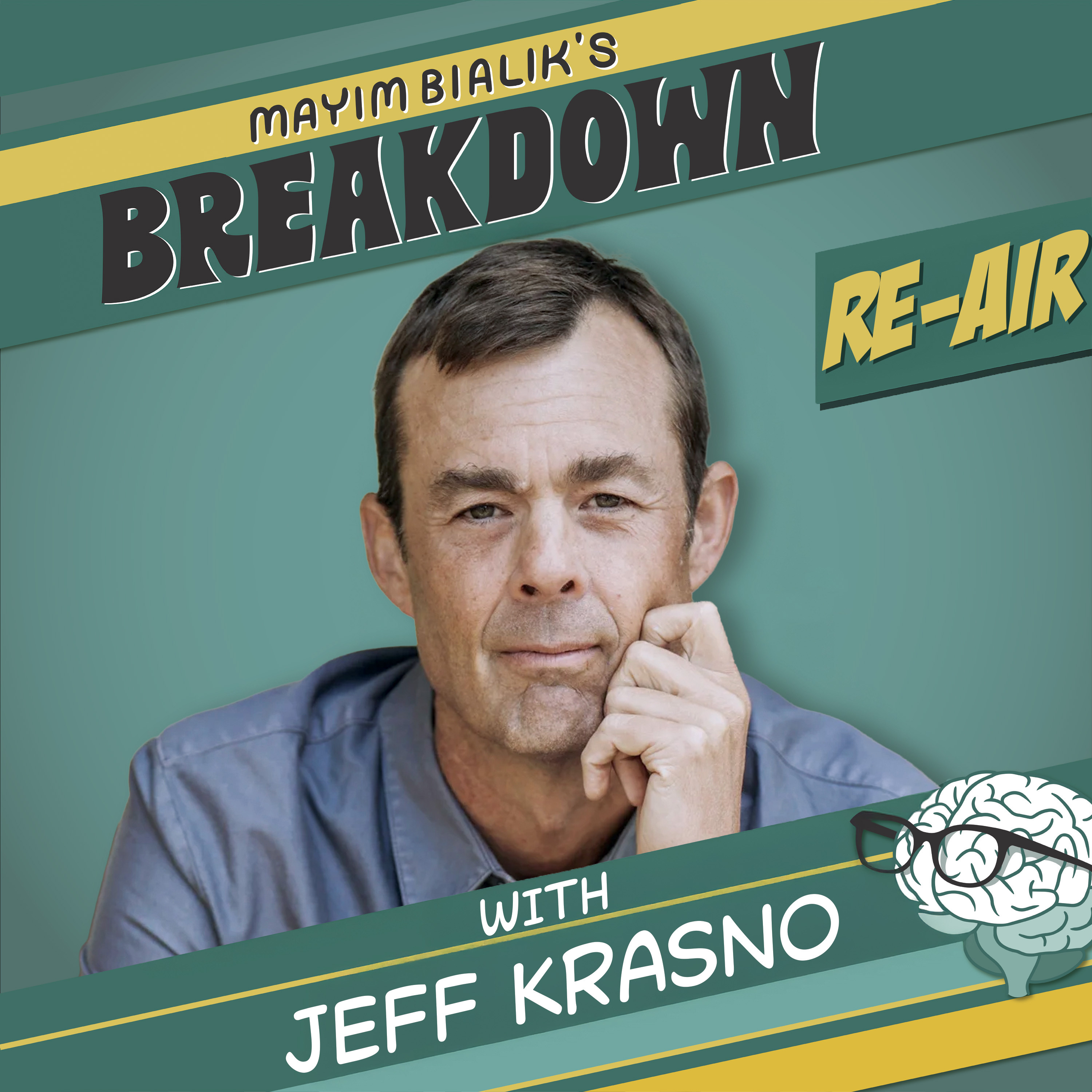
Mayim Bialik's Breakdown
Substack Live Re-Air: Are Convenience and Comfort Causing More Harm than Good?
00:40:29
Loading summary
Transcript95 lines
- [00:00]
Mayim Bialik
Foreign.
- [00:05]
Jonathan Cohen
Bialik and I'm Jonathan Cohen and welcome to our breakdown. It's July 4th weekend, so if you're
- [00:10]
Mayim Bialik
in the United States, hope you're having a good one.
- [00:13]
Jonathan Cohen
Today we're sharing something special that was previously only available over on our Substack page. It's a conversation Jonathan and I had with Jeff Krasno. He's the co founder and CEO of Commune, which is a platform for personal personal and societal well being. He's also the host of the Commune Podcast and he's the author of Good Stress. Jeff talks about how a diabetes diagnosis led him to explore a number of ways that ease and over convenience have affected all of our health. He turned his life around, turned his health around and he shares the wisdom that he has gathered with us in this very special conversation.
- [00:51]
Podcast Announcer
We cover a topic that we've heard before but framed in a new way, about how each of us are living in a constant state of emotional deregulation. And Jeff shows us a few unique and novel ways to rebalance.
- [01:06]
Jonathan Cohen
We hope you enjoy our conversation with Jeff Krasno and we will see you over on Substack.
- [01:11]
Jeff Krasno
Break it down Queen Carvania stood haloed by the morning sun. An army hung on her every word.
- [01:21]
Jonathan Cohen
My champions, I have so many. Hold my chariot on Carvana. Twas a lovely suv, an inexplicably queenly offer. They're even coming to the castle to collect it. Tonight we feast. An offer you can feast on. Sell your car today on Carvana.
- [01:41]
Mayim Bialik
Pick up fees may apply.
- [01:43]
Podcast Announcer
Mayim Bialix Breakdown is supported by Helix
- [01:46]
Jonathan Cohen
Sleep Summer's in the air and so are all of the allergens that come with it. Summer allergens means you need more sleep, but there are a ton of factors that can prevent us from getting a good night's rest. Night sweats, back pain, Feeling the person next to you when they roll over. We are so excited that Helix wants to partner with us. I've had my Helix for I think over five years now and I sleep so great. Jonathan and my kids also love their Helix mattresses and all of those issues. Night sweats, Back pain Motion transfer Significantly better or gone. Helix delivers your mattress right to your door with free shipping in the US they have a 120 night sleep trial and limited lifetime warranty plus their happy with Helix guarantee. Rest easy with seamless returns and exchanges. The Happy with Helix Gu offers a risk free customer first experience designed to ensure you're completely satisfied with your new Mattress. Go to helixsleep.com breakdown for 20% off site wide. That's helixsleep.com breakdown for twenty percent off sitewide. Helixsleep.com breakdown.
- [02:42]
Mayim Bialik
Thank you so much for being here. Tell people who you are and how we all got here.
- [02:46]
Jeff Krasno
I'm a jack of many trades. I assume that makes me a thought leader because I'm an expert in nothing but. Yeah. I started a festival called Wanderlust, which developed some repute over the years. And so I was essentially traveling with my significant brood, my estrogen footprint. I have a lot of daughters for many years as sort of a band of gypsies. And finally settled into one place, I started a. A concern called Commune, which is really dedicated to amplifying ideas around health and happiness and well being. And I write a lot of ink on paper books and a regular newsletter, et cetera, and host a podcast. I'm really, really good at tearing my calf muscles. Um, and I'm really good at eulogies.
- [03:48]
Mayim Bialik
It's funny because Commune could also be read. Commune. And you know, a lot of what you do is also kind of gather people in spaces, you know, depending, you know, kind of on their needs. And, you know, I wanted to give a shout out to your book. Good Stress, the health benefits of doing hard things. There's a lot of really wonderful information in there from a metabolic perspective, a physiological perspective, and we've talked about this. We had Dr. Sharon Bergquist on the podcast to talk about sort of some of the ways that we've made our lives easier in many cases is not introducing enough of the kind of literal stress to our body that that breeds resilience. And I wonder though, if today we can talk a little bit more about sort of the emotional side of it, the spiritual side of it. You have a really interesting, you know, personal health journey. Maybe you can give us a little framework for, you know, how dis ease kind of made its way into your life and also, you know, how ease actually plays into disease.
- [04:48]
Jeff Krasno
Yeah. It was curious that the great yogel of Wanderlust, which was a clever portmanteau between yoga and mogul that I did not create, found himself in a very precarious health position. But about five years ago, I was about 60 pounds heavier, but really suffering from not particularly ordinary or extraordinary symptoms, but ones that I think many people listening can find to be extremely ordinary and anodyne. You know, just brain fog and chronic fatigue. I had like dad bod. The man boobs. Yes, all of the above. And then my friend had started a continuous glucose monitor company and I slapped one of Those on my triceps. And for people who are not familiar with that little wearable device, it's a little disc that sits in your triceps and measures the interstitial fluid and gives you a fairly good proxy of your metabolic health. It reads your blood glucose levels moment to moment and zaps it to a little nifty app. And lo and behold, I peered into the app and discovered that I was a diabetic, and then subsequently didn't cancel my primary care physician appointment for once and went and did all the panels. And lo and behold, I was part of this greater epidemic of chronic disease. And so this really springboarded me on a journey to discover, like, why I was so sick, but really myself as a proxy, like, why is the world, or much of the Western world suffer from so much metabolic dysfunction? And so that kicked me off and I jumped into my own petri dish and became a lab experiment, my own little nematode. And then I went off and probed the mental gladstones of maybe 400, 500 doctors. So I did a lot of interviewing and came up with a primary thesis. When you look at the panoply of chronic diseases, they're really actually primarily lifestyle diseases. And we didn't really have much diabetes or heart disease or stroke or fatty liver disease on the Serengeti, you know, 10,000, 20,000, 30,000 years ago, a little bit of cancer, but not too much. Obviously we suffered from infectious diseases, but really the diseases that so plague us now are primarily man made diseases. And, you know, as I began to unpack that a little bit more, you know, my thesis became clear that chronic disease is really primarily the result of chronic ease that, you know, over the last 150 years, but particularly accelerating over the last 50 to 70 years, we've essentially engineered, often in the name of economics, but not always, but engineered our society for convenience and ease. And that convenience has led to, unfortunately, a lot of very inconvenient realities for people. It makes a lot of sense because homo sapiens for 200,000 years or so, and then hominids for millions of years before that. We evolved in relationship to our environment. And that environment over millions of years had a lot of Paleolithic stress. You know, there was calorie scarcity and exposure to crazy vicissitudes and temperature fluctuation. You know, we lived in community, we lived primarily outside. We didn't have, you know, cushy shoes or cushy armchairs, et cetera. You know, over the last 50 to 70 years, really our culture has jumped the perch of our evolution and in many ways has hijacked our biology, our engineering, and that's led to a lot of disease. And there's so many different examples to pull on there.
- [09:06]
Mayim Bialik
There's a real illogical, you know, kind of nature to the fact that so many of the things, not only that, that plague us, but so many of the things that the healthcare system is now responsible for, and by extension, the taxpayers and the insurance companies are bearing the brunt of it would almost take a paranoid mind to say, I wonder if there's some incentive, you know, to us not being able to get the right kind of, you know, help to step out of this, you know, And I think back to a lot of
- [09:40]
Jonathan Cohen
the things that you're talking about.
- [09:40]
Mayim Bialik
The ease, you know, During World War II, it was a very stressful time. Like, that's my most recent, you know, kind of like touch point for me, knowing something right about this evolution. Women went to war, right? Women weren't home the same way that they had been. And this is like a by and large statistical thing, right? I'm not talking about the one woman who was already working. I'm saying that by and large, people were experiencing a different kind of economic situation. And a goal was to make house care easier, cooking easier. Women like my grandmother, who had children
- [10:12]
Jonathan Cohen
during World War II, I'm sure, really appreciated it.
- [10:14]
Mayim Bialik
Like, plastic containers was a revelation, right? But what we're seeing is, you know, 50, 60, 70, you know, 80 years, you know, on a lot of the things that were done for convenience in many ways have created a new set of problems that now we have. Oh, medication, and I'm thinking even of diabetes. Well, just take this pill. This is the new world is that you sit in a chair all day in front of a computer, you get diabetes, and now you take a pill like, that's it. Can you talk a little bit about what that reframe looks like, you know, to try and approach it this way?
- [10:45]
Podcast Announcer
My imbialic breakdown is supported by quint.
- [10:49]
Jonathan Cohen
Summer always makes me rethink what I'm reaching for every day. Lighter fabrics, better materials, things that just feel good the moment you put them on, but also look effortless. That's why we keep coming back to quints. They focus on high quality essentials. Think breathable linen, soft organic cotton, washable silk, but without the luxury markup. It's that rare balance where everything feels elevated but still easy. Quinn has beautiful everyday pieces like 100% European linen pants, dresses and tops with style starting at $32. Their denim is soft and easy to wear. Their organic cotton sweaters are perfect for layering on cool summer nights. Everything at Quinn's is priced 50 to 80% less than similar brands. Quint works directly with ethical factories and cuts out the middle people, so you're paying for quality, not brand markup. And it's not just clothing. Quin has really become a destination for elevated essentials across home kitchen, bedding and beyond, making it easy to bring a more premium feel into everyday life. I actually just bought two sets of Quinn sheets for my son. They were on sale and now he has two different colors, Quince's 100% European linen wide Leg pants that's quickly becoming my summer uniform. They feel like pajamas but look like I put more effort in than just showing up in pajamas, whether I'm dressing for casual work days, lazy weekends or feeling those vacation vibes. Elevate your summer wardrobe. Go to quince.com breakdown for for free shipping on your order and 365 day returns. Now available in Canada too. That's Q-U-I-N-C-E.com breakdown for free shipping and 365 day returns.
- [12:20]
Podcast Announcer
Mind Bialix Breakdown is supported by Element.
- [12:23]
Jonathan Cohen
Element has a new flavor that we
- [12:25]
Mayim Bialik
are so excited about. Here it is. It is Lemonade Iced Tea.
- [12:30]
Jonathan Cohen
Same great electrolytes and taste but with black tea extract. So you can still get your caffeine boost without the mid afternoon energy slump. Turns out caffeine doesn't actually give you energy, it mutes the signal that tells you that you're tired. So when it wears off, that's actually the crash. Isolated caffeine, the kind that are found in most energy drinks, hit harder and drop faster because there's nothing in it to smooth the curve. But Element Lemonade Iced Tea uses a full black tea extract, caffeine bundled with L theanine and polyphenols and a meaningful dose of electrolytes free of sugar, artificial colors or other dodgy ingredients and built on the same formula as Element's core drink. Mix sodium, potassium and magnesium at levels shown to support optimal hydration. The result is a noticeably steadier feeling, less spike, less drop without the crash that comes for most caffeinated drinks. Get a free 8 count sample pack of Elements Most popular drink Mix flavors with any purchase@drinkelement.com mayim find your favorite flavor or share with a friend, no questions asked. Refunds Try Elements See how you feel if for any reason you're not satisfied. Their customer service team Will take care of you.
- [13:32]
Podcast Announcer
My mbialic's breakdown is supported by tumble.
- [13:35]
Jonathan Cohen
You know, finding the right rug for a home is surprisingly difficult. An expensive rug makes you feel like no one should walk on it because you're afraid of staining it. Also, we've got dogs, cats, life. We knew that stains were going to be inevitable. But those standard washable rugs often look cheap and they feel temporary. Most rugs don't seem to be designed for actual real living. But then we discovered tumble rugs. You can finally have the best of both worlds. And now we do. Their rugs look like beautiful designer rugs, but they're built for real life. Spills, muddy paws and accidents are just a part of what's gonna go on. Tumble rugs are spill proof and machine washable. They feature a proprietary spill proof surface that causes liquids to bead up on top of the rugged. So instead of a stain soaking into the fibers, you can literally wipe it away in seconds. And when you need a deeper clean, tumble rugs are fully machine washable, even the larger sizes. Our favorite part about tumble rugs, though, with all of this being said, is how amazing they look. They often feature hand illustrated designs that look like designer rugs. Mine features illustrations by none other than Frida Kahlo. But don't take our word for it. Hundreds of thousands of homes have already switched to tumble rugs and they have over 30,000 five star reviews. They're perfect anywhere in your home where life tends to get a little messy, which for us is everywhere. Machine washable rugs made better. For a limited time only, Our listeners get 10% off plus free shipping@tumbliving.com break that's T U M B L E living.com break after you purchase, they'll ask
- [15:08]
Podcast Announcer
you where you heard about them. Please support our show and tell them that we sent you.
- [15:14]
Jeff Krasno
Yeah, it's interesting. Just as a brief aside, I interviewed my grandmother when she turned 100, so she made it to 104. She was born in 1910, and I asked her what was the most significant technological innovation of your lifetime. Of course I was expecting like airplane travel or the Internet or something. And she said the washer dryer, it saved her 25 to 30 hours a week. So, you know, technological innovation isn't all bad. This is definitely not my case. But you know, coming out of World War II, for some very legitimate reasons, we were trying to essentially create enough calories, shelf, stable calories for a growing population. And population did, you know, grow and expand and, you know, we had what's known as the Green revolution, where we applied a lot of like our military industrial mindset to agriculture in the form of, you know, synthetic fertilizers and subsidized crops, et cetera. And yeah, we created a surfeit of calories sort of available at all times of year. And now of course, we've taken that to the ridiculous extreme where like Jonathan can like order doordash up like a summer squash in the middle of winter before this podcast ends. I mean, it's, it's absurd and it'll arrive at his door. In this world of endless always available calories, our body is simply doing what it is designed and engineered to do, which is to warehouse fat, which is essentially just stored energy for a rainy day because we used to experience the fallow of winter. So it would be totally adaptive for my little loincloth to get a little tight around the middle, around the fall harvest, you know, where I'd gorge on figs, because the paucity of winter was just around the corner. Now we live in a world where winter never comes, really from a calorie perspective. So our body is just doing what it's supposed to do. We're just warehousing energy. And then of course, then we try to come up with some technological moonshot to solve the problem that we created. And this is the optionality that is in front of us. You know, to solve a lot of these health problems is like, yeah, we can go into Yamanaka factor and CRISPR and try to change our genetics to meet our engineer, like our, our lifestyle, I should say. Or we could just simply try to change our lifestyle to better comport and conform with our genetics. And that would be my. That would be a simpler path to pursue. And now, you know, my argument is that we have to self impose some degree of Paleolithic good stress in order to realign our lifestyle with how we're engineered. Now to your other question. Yeah, we can take a GLP1 and I'm interested in newfangled solutions. That solution is really often masking an upstream issue, which is that we are not. We're are. Our culture. The way we live is hijacking our biology.
- [18:41]
Podcast Announcer
You started by, by explaining how we once interacted with our environment and lived much closer to the elements. And the natural world provided a lot of the opportunity for this cyclical environment. The issue really for me is that while some people can think about it and provide any and execute an enormous amount of willpower to avoid calorie stacking, which is what we're designed to do so to overcome that requires just an enormous amount of conscious effort every single time there is food available that you then don't reach for. The additional issue is that our entire economic survival has been designed to be geared towards sedentary activity for most people that are not outside.
- [19:30]
Jeff Krasno
Yeah, I mean, the statistics are fairly jaw dropping. I think we spend 6% as a society of our time outside. I think 80%, 82% of us now have some form of sedentary desk job. Yeah, you're absolutely right. We've built an information economy or attention economy that essentially revolves around a lifestyle that is at friction with health. And how do we, how do we undo that? What I found, I mean, here I am sitting in a, you know, temperature neutral studio in a cushy chair, you know, with shoes on and a decent shirt. Although that's up for some debate. And so it's not like I'm, you know, living like my hunter gatherer ancestors. But I think that there are my, I think there are protocols that we can adopt to superimpose some degree of, of Paleolithic lifestyle of health imparting Paleolithic period environmental stressors.
- [20:40]
Mayim Bialik
You know, a lot of us have been hearing about, and Jonathan and I have spoken about it and you know, the irony that, you know, many people kind of flag us for even talking about it. I think it's an important conversation to talk about, not just what it means to fast. And I almost feel like we need to remove that word. But like, you know, for many of us and myself included, you know, many of us don't think there's anything wrong with like eating twice after dinner, like at all. You know what I mean? Like, I'll eat dinner, but then there's like, okay, but like a substantial dessert and then I need a snack while I'm like watching tv. Like that's a completely.
- [21:16]
Jonathan Cohen
I think for a lot of people
- [21:17]
Mayim Bialik
it's like a normal thing to just like you never basically stop eating except when you close your eyes. And so that notion of like, oh wait, we're actually not supposed to like load up and eat right before bed. And I see my kids who they, you know, they'll eat right before bed and they seem no worse for wear. But this stuff is cumulative, right? These are habits that we're trying to teach. Can you talk a little bit, you know, really about like what happens with consumption?
- [21:44]
Jeff Krasno
You're absolutely right. If we take an honest inventory of our lives, we're eating pretty much from the moment that we wake up to the moment that we go to sleep. I mean, that's at least how I was living for a very long time. And I think there's a lot of reasons for that. I mean, as Jonathan, you suggested. Yeah, we are wired to consume calories and we've never existed in an environment where there's such a surfeit of them. But I think that there's some other aspects at play. Like, for example, like this caustic little device, you know, this is designed essentially to make us feel inferior or not worthy.
- [22:23]
Mayim Bialik
It's not exactly how they sold it to me.
- [22:26]
Jeff Krasno
That's true. I mean, listen, it's nice to have the history of all the world's knowledge or most of it in the palm of your hand from time to time, but I mean, if you spend much time on social media, I mean, it is, you know, algorithmically preferenced to make you feel like shit. I mean, make you feel angry or outraged or a sense of fear or not enough. You know, it essentially projects false images of, of cultural beauty and excellence which don't reflect reality, but always make you feel. Feel in jail.
- [23:01]
Mayim Bialik
Jonathan sends them to me anyway.
- [23:03]
Jeff Krasno
Yeah. Damn it, dude. We're in a constant state of emotional dysregulation, you know, not just because of the phone, but 24 hour news media, et cetera. And in order to assuage that feeling of discontent, guess what? There's a larder just right there, you know, filled with dopamine inducing foods, you know, that are bioengineered to hit that perfect little bliss point of like, you know, fats and sugars and salts to make us feel ephemerally great, you know, to get that, stimulate that spritz of dopamine. And it is, it's, it's right there. And it's not just food. It's also like retail therapy on Amazon, you know, a glass of wine, all of these things that are available to us to assuage the emotional dysregulation that we've caused.
- [24:01]
Mayim Bialik
You're taking away everyone's phone.
- [24:02]
Jeff Krasno
Oh, I'm sorry.
- [24:03]
Mayim Bialik
Okay, I'm going to go back my second post. Dinner meal. You're taking away shopping. I'm assuming wine, drugs, like everything. Can you have sex before bed? Probably not.
- [24:13]
Jonathan Cohen
It's bad for your heartbeat.
- [24:14]
Jeff Krasno
Probably not. Yeah, I'm a eunuch. I didn't put that in my bio. So this is the thing. So this is like why we can take some mastery of and some agency over our own life. And yeah, fasting has become kind of this, you know, Overused moniker. It's like a cornhole bag, people just throwing around. But really, it's just, you know, when you. Here's the most impactful aspect of having some form of fasting protocol. It's. Yeah, there's a lot of physiological impacts to it. But if you become a disciple to that practice after dinner, it doesn't mean that Mayim or Jeff or Jonathan doesn't get hungry. It's just that for a brief moment you can examine the provenance of that hunger and ask yourself, is this a biological need or a psychological desire? Right.
- [25:16]
Mayim Bialik
Yeah.
- [25:17]
Jeff Krasno
And if you believe in Viktor Frankl's old adage, you know, between stimulus and response, there's a space in that space of choice. And that choice lies our freedom. Freedom and liberation. What fasting can actually provide for you is that little bit of space where you can assess what is the nature of my discontent. And you know, instead of just mindlessly going to the fridge and it's a
- [25:44]
Mayim Bialik
lot of, it's a lot of boredom, right? I mean like, that's really. It's a lot of boredom.
- [25:48]
Jeff Krasno
Yeah. And it has like pleiotropic impacts. It's like, it's not just about food. If you can cultivate that space between stimulus, the hunger and the response just eating, can you not cultivate the space between, you know, like, yeah, having that extra glass of wine or like, what is the more appropriate response to my children when they're endlessly like annoying and screaming? You know, would it be just like some knee jerk reaction to get pissed? Or would it be like, oh, no, maybe they had some issue at school or some, you know, so this is where I think a lot of these physiological practices actually bridge into emotional or psychological practices.
- [26:28]
Podcast Announcer
And we don't have to call it fasting, we can just call it not continuously eating fair.
- [26:35]
Jeff Krasno
It is bad branding in a way
- [26:36]
Podcast Announcer
because people are like, fasting, oh, I need to be in caloric restriction. I need to go 12 hours. No, I need to go 15 hours. No, I need to Go 18 hours. No, I only need to eat for three hours. Like, no, let's just, let's just like bring it all back a little bit.
- [26:49]
Jeff Krasno
You can approach these things kind of from a more spiritual perspective. I mean, like, not eating is baked into virtually every spiritual tradition from, you know, Buddhism to, you know, Ramadan. Apparently like Muhammad received the Quran in a fasted state. I mean, I don't know, go figure. That sounds slightly apocryphal, but. Or Jesus went to the desert for 40 days and was tempted Neither by the devil or lunch, apparently. So.
- [27:20]
Mayim Bialik
So, I mean, you're leaving out Moses, the other of the Abrahamic, you know. Yeah, he was likely fasting. And when he received. I mean, they were. You know, that was a. It was a spiritual practice for sure, that we've lost. What are some of the other things, you know, besides not eating constantly, what are some of the other ways to sort of tap into, you know, some of this, I guess, paleo wisdom, you know.
- [27:43]
Podcast Announcer
I know, but just.
- [27:43]
Mayim Bialik
Jonathan's not.
- [27:44]
Podcast Announcer
Just before we get there, just before I can let this go. The devil never comes with lunch. He comes with breakfast or dinner. Because your fast should happen on either side. Breaking the fast doesn't happen in the
- [27:55]
Jonathan Cohen
middle of the day unless you're my
- [27:57]
Mayim Bialik
family on Yom Kippur when I was growing up, we only fasted till lunchtime. There's the Huberman School. There's the light, there's the breath, there's the. You know, all these things. You know, it's funny because one of the things that when my kids were younger, and my kids are 17 and 20, so fortunately, on a little bit of the older side of the phone craze, meaning there's a little bit more space, you know, between phones becoming a thing and it becoming kind of what it is now, when they would sit on their phones, that's what I would say. Go outside. Go outside. And I was thinking, like, you know, that's what my parents would yell at me just when my brother and I were fighting and they wanted us out of the house. Go outside. But can you talk a little bit about what it means to kind of get outside? Right. What role does nature play? I know that's a huge part of a lot of the retreats that you do, and sort of this community you've created is about being in nature. Can you talk about that as well?
- [28:50]
Jeff Krasno
There's very identifiable physiological knock on impacts of being in nature. You know, it lowers cortisol, it grounds you in your parasympathetic nervous system. But I think some of the more impactful aspects of it really, again, are psychological or spiritual. I mean, we know when we spend time outside the. How would I say it? Like, the aperture of our attention widens, you know, where we spend most of our time inside, staring at a little screen or a phone. And just think of, like, how narrow that experience is versus, like, going outside and literally opening up the periphery of what you're experiencing. And it's almost like spotlight versus lantern consciousness. If you spend all of your time narrowing the spotlight of your conscious awareness, like what are you not perceiving? What are you not experiencing? A lot of people that have like near death experiences talk about that. This kind of like warehouse consciousness that opens up. And I think we, we get a taste of that when we're in nature. And it's often in that open space where we are the most creative and we, it's where it's in that compost where like the seeds of, I think, compassion and, and love and kindness and connection, sort of the feeling that you are not a separate self, that you are connected to some bigger universe that happens almost exclusively when you're outside.
- [30:38]
Mayim Bialik
CDev asks a fun question. I hadn't thought about this. Is there any research to your knowledge about which types of nature have the highest physiological impact for lowering cortisol levels? Like looking at the ocean or mountains. I mean, I think there's probably so much subjectivity there, but yeah, cur.
- [30:54]
Jeff Krasno
Yeah. So one really interesting thing so is how we evolved with light itself. And I'll try, I'll try not to mansplain too much on this one. And if you don't know what mansplaining is, I have a workshop about that later. Yeah, so we literally evolved in relationship to this fusion reaction that's happening 93 million miles away. Right. So as part of the electromagnetic radiation that's emitted from the sun, there's a whole sort of breadth of wavelengths associated with that electromagnetic radiation. We see in a little tiny band between like 400 and 700 nanometers. But then we know that there's these other parts of the electromagnetic wave spectrum that we connect with. I mean, we're very aware of like UV and uvb. You know, my girls are always checking the UV scan to try to get as tan as possible. But we also obviously generate or produce endogenous vitamin D in, in relation to vitamin or into, in relation to uvb. But I think what's actually more interesting is our relationship to the other side of the spectrum to infrared and near infrared radiation. So we generally absorb these rays, this particular part of the electromagnetic wave spectrum when we're in greenery. So it's actually not when we're in direct sun. So this is another reason to get outside. So if you're on or around grass or trees, infrared radiation will bounce off of those, anything green and they will actually penetrate the skin up to 8 cm, which is amazing. And you can kind of think about it by analogy with like, if you ever like pulled up on Sunset Boulevard to a tinted window suv and all you can hear is like the bass of like hip hop. Right. Those are like low waves that emanate through the steel. Well, these are infrared waves, look like the same thing. They can basically penetrate into the skin. And they have a direct impact intracellularly in our mitochondria where they actually stimulate the production of antioxidants like melatonin and glutathione that fight oxidative stress and inflammation. So this is what one thing that I would really say to do. Yeah, you could buy a red light panel or do it near infrared sauna, but really just get outside into a green environment. And that has inestimable impacts on your health.
- [33:45]
Mayim Bialik
I mean, I'm sure Jonathan is already googling how to create a little patch of grass exactly where he likes to sit outside.
- [33:52]
Jeff Krasno
Yeah, I see a tree back there. You're good.
- [33:55]
Mayim Bialik
There is a tree back there. That's very interesting. And I'm also just, you know, kind of as a, you know, human experience of it. You know, you think about what it's like to like sit in a field of grass or like, if you've ever been, you know, to like the field in Central Park. Like, there's something about sitting in grass like that the heat feels different. Like, and now I'm thinking about all of the bouncing waves going everywhere. That's really cool.
- [34:19]
Podcast Announcer
Do you need to have your skin exposed in order to get the benefit?
- [34:23]
Jonathan Cohen
Oh, he loves, he loves to take his shirt off.
- [34:27]
Jeff Krasno
Yeah, I mean that, that was my ploy. Just right here on this.
- [34:31]
Podcast Announcer
I'll take it off right now.
- [34:33]
Mayim Bialik
No, no, not what I meant.
- [34:35]
Jeff Krasno
You actually don't need to be bare chested. In fact, infrared radiation will travel through even a relatively thick sweater.
- [34:44]
Mayim Bialik
And I like to wear sweaters outside. He just clocked us. He likes to be shirtless. I like a thick sweater year round.
- [34:52]
Jeff Krasno
Yeah, that's why you guys are such a good pair. You're like electron and proton. And it's actually the warmth that we feel like on our back, even when we're wearing a shirt. That is infrared radiation.
- [35:06]
Jonathan Cohen
This is really interesting.
- [35:07]
Mayim Bialik
Can you tell people kind of what are the things, especially in the journey that you've been on, what are the things that you have discovered that either bring joy, you know, bring a sense of wonder, make you feel like I made the right decision in life to, you know, kind of turn my health around, you know, whether it's benefits to your, your family, you know, your kids. What are the things that kind of feel the best for you in this phase? Of of your health mind.
- [35:33]
Podcast Announcer
B Alex Breakdown is supported by Superpower
- [35:36]
Jonathan Cohen
we all know what it's like to leave a doctor's appointment feeling like you are leaving with more questions than answers. There's no real data. There's no game plan. This has happened to me so many times, especially when I was starting my perimenopause journey. And that's why we love super power. Their one simple blood draw gives you information on over 100 of your blood biomarkers. Superpower sends a licensed professional to your home. You can also visit a nearby lab to unlock a real understanding of your body and what's going on in it. The Superpower app includes detailed information on your heart, liver, thyroid, hormones, metabolism, vitamin and mineral levels, even environmental toxins. So from disease prevention to simply optimizing your gym game, Superpower is the the most comprehensive and advanced system out there. Superpower also tracks your results over your lifetime. Each test builds on the last so you can see progress year after year. Superpower helps you connect the dots and understand long term trends in your health data and take action on them. Stop reacting to health problems and start proactively improving your health based on real personalized data. Superpower is the most affordable 100 plus biomarker blood test starting at $199 and it's HSAF SA eligible. Unlock your new health Intelligence make this the year you stop guessing about your health with Superpower. For a limited time, our listeners get $20 off to unlock their new health intelligence. Head over to superpower.com use code BREAK for $20 off your $199 superpower membership.
- [36:57]
Podcast Announcer
After you sign up, they'll ask you how you heard about superpower. Tell them MayimbaLix Breakdown sent you to support the show. MayimbaLix Breakdown is supported by AG1.
- [37:09]
Jonathan Cohen
It's summertime and that means sun, vacations and changes to your usual routine. We're so excited to take a break from our regular hustle and bustle, but sometimes that means we take a break from good habits too. Except for the 30 seconds it takes to mix AG1 one scoop plus 8 ounces of water every morning. AG1 AG1 is a healthy drink with multivitamin, pre and probiotics, superfoods and antioxidants. 1 Scoop 8 ounces of water ag 1 helps to maintain energy, support gut health and and support immune health. It's clinically shown to support gut health and fill in common nutrient gaps. Summer maybe you're licensed to chill, but with all the late nights, long weekends and spontaneous plans, AG1 helps you keep one thing consistent. High quality nutritional support every single day, no matter where you start your morning. The next gen formula delivers 75 plus ingredients clinically shown to support gut health, fill common nutrient gaps and improve key nutrient levels within three months. AG1's comprehensive nutrition provides nutrients that support our bodies, our brains and and our gut health all in one scoop. We are so thrilled to use it every morning and glad that it's going to support our immune defense as we continue planning our travel Summer Vacations. Visit drink ag1.com breakdown to get a free AG1 travel case with seven free AG1 travel packs in your welcome kit with your first AG1 subscription order while supplies last. That's drinkag1.com breakdown well, I'm going to
- [38:28]
Jeff Krasno
do two sort of slightly surprising ones because I could talk about sauna and cold plunging and all that kind of fasting and but I think the world has quite enough of that. Surprisingly, one of the good stresses that I discovered was crying. Crying is an adaptive emotional response to stress. And there's different kinds of tears. I'm not talking about the tears that are induced from an onion cutting session, but I'm talking like emotional tears. If you were actually to harvest those tears and take them into a chemistry lab, you would find stress hormones in those tears. So you would find a gene. I think it's adrenocorted tropic hormone. And so when you are crying you're literally flushing out stress. And we know just by dint of our own experience when we have a full bellied throated sob, you're, you're forced to take a deep breath. And we don't really do that much in life. You know, we take these snippy little choppy breaths and of course it is that deep breath that helps move us back into our, our parasympathetic autonomic system. So but we vilify crying, right? And vulnerability, particularly in the manosphere. I would say, you know, be crying is actually a really adaptive response. The other one taps a little bit into stoicism, but it's building your psychological immune system. So we hear about our physiological immune system a lot of the time. So you know, you, you come in contact with a virus or some bacteria and you know, your adaptive immune system spins up these little proteins that we call antibodies and then when you come into contact with that bacteria or virus again, you have that built in immunity, right? Metaphorically really comports to our psychological immune system in many ways. And in, in 2020, I committed to having 27 hour long Zoom calls with people that don't like me.
- [40:49]
Podcast Announcer
Was there a sign up sheet? Like, yeah, did you literally from 1 to 10 the ways that I annoy you and you just like sent them out to people who you suspected of having ill?
- [41:01]
Jeff Krasno
More or less. It was, it was more harvesting from the endless stream of incoming opprobrium. So you know, I write a newsletter. 2020 was a. People were on a short trigger and you know, I was writing about just like very neutral topics like Covid and George Floyd and things like that and, and how dare a white man center himself at this juncture. So I got a lot of incoming there and I grew up like a people pleaser. So I was very defensive initially as I was receiving a lot of incoming insults and criticism. But over time I built my psychological immune system and also with a lot of, you know, breath practices and meditative practices, et cetera. And I just started asking some of my more thoughtful detractors if they would jump on a zoom call. I got basically a in vivo lesson on nonviolent communication and how to disagree without being so disagreeable. And it was amazing learning experience for me to, to sit through these 27 Zoom conversations because at the end of the day what I realized is like we often didn't even get around to the issue that had put us at loggerheads in the first place. People just wanted to be seen and heard. And if you can create that container in a safe way and really listen to understand and not to respond and find points of connection and not solution, that is an invaluable lesson to the broader society. And I ended up from that experience hosting a six day summit at our retreat center between Jewish Israeli students on a number of campuses and Palestinian students on some of the Columbia and Brown and UCLA administered this week long retreat of nonviolent communication and sitting in each other's narratives. And the output of those six days was nothing less than absolutely incredible.
- [43:34]
Mayim Bialik
It's really incredible and just that notion, and I've done some studying of nonviolent communication and just that notion that, you know, exactly the thing that you think is impossible is the place that it actually is most beneficial for us to sit in. You know, emotionally. It's such an incredible skill.
- [43:53]
Jeff Krasno
This one particular experience where we're receiving all these kids and these were the most involved kids on these campuses. On both sides of the equation. The satin setting was more conducive to cooperation. We had like cold plunges and saunas and yoga studios and things like that, you know. But the process was Very good. Stressful, if you would. I mean, we spent the first two days just in active listening. And so each student would come up, would get up and tell their story, and then we would breathe and sort of integrate and assimilate, and then we'd flip to the other side. And then on Wednesday, the middle day, I paired up a Palestinian student with an Israeli student and had them sit right across from each other and me in the middle. And the Palestinian student would tell the narrative of the Israeli. The Israeli student to that person, and they would essentially tell each other's narratives to each other. And it was one of the more emotional. It's just even, like, I can feel the emotion just talking about it. And then that night, unprompted, we all sat down at these big, long dinner tables, and one night we were doing pasta and food. One night we're doing Israeli food, et cetera. And one of them, like, picked out a pencil and a piece of white paper, and they just started writing down things like, okay, what do we do about the right of return? Okay, what do we do about the settlements? Like, and it was just. By Friday evening, they had put together completely cooperatively, a white paper not just on various different solutions in Israel, Palestine, but also for solutions on campuses. And they ended up taking those back to the various administrators on campus. It was quite amazing.
- [45:53]
Mayim Bialik
Well, and just when you create that kind of holding place, like, the things. And I think that's true for us, you know, individually as well. Right. Like being able to open up the aperture. Right.
- [46:04]
Podcast Announcer
Are there some open questions that you're sort of most curious about right now?
- [46:09]
Jeff Krasno
It does feel overwhelming because you need to hold a tremendous amount of information in your head, if only for risk of embarrassment, you know, like, we're sitting down, like you guys do with. I'll speak for myself. I'm sitting down with people a hundred times smarter than me about a specific topic every week. And I try to be a sort of rigorous reader and researcher going into that. And then, you know, unfortunately, a lot of the times you finish the interview, you're right off to the next thing, and. And a lot of that information just, you know, dribbles out one side. So that's frustrating sometimes. But, you know, I've had a lot of conversations recently on the nature of consciousness. There's no answer to this. Gordy, we figured it out.
- [46:57]
Podcast Announcer
Don't worry.
- [46:58]
Jeff Krasno
Oh, good. Wait. Yeah, you're going to just tease that for the next episode?
- [47:02]
Podcast Announcer
Yeah.
- [47:02]
Jeff Krasno
I find this topic endlessly fascinating because there is no consensus on it. So I know Michael Pollan just wrote a book, and I sat with him and Annika Harris and. And Sam Harris. I think that topic is fascinating. I think some of the new theories around consciousness and the neural correlates of consciousness are really quite interesting. So that's been stoking my curiosity lately.
- [47:33]
Mayim Bialik
Jeff, where can people find out more about you? Obviously, you're on Substack.
- [47:38]
Jeff Krasno
Well, I have a podcast called the Commune Podcast. Really my platform commune is just this repository of incredible knowledge of other people, other experts. So you can go to 1communune.com and I'm waxing alternately poetic and pathetic on Instagram. Jeff Krasnov. And those are the primary places. And tomorrow I have. My pet project is launching, and I'd be remiss if I don't mention it. I've been writing this memoir on raising my three daughters called Diaries of a Dance Dad. And I write a lot about science and human physiology, biology, and a little bit of philosophy, but these are just stories from the heart. They make me cry and laugh in equal measure.
- [48:31]
Mayim Bialik
Well, we wish you good things with that and all of the other wonderful work that you do. Thank you so much for bridging. You know, I think also it can be really, really overwhelming, the number of voices and perspectives. And, you know, many of us are trying to just, you know, kind of get our feet under us in this arena, and so really appreciate all the hard work that you have done, you know, so that you can also collect, you know, the best of all of these perspectives. Really, really appreciate it. So thank you so much.
- [48:57]
Jeff Krasno
Likewise. You guys impart such wisdom, and you do it in a very enjoyable and fun way, which I find to be very important. It's Maya Bialik's breakdown. She's gonna break it down for you she's got a neuroscience PhD or two one fiction and now she's gonna break down so break down she's gonna break it down.