← Mayim Bialik's Breakdown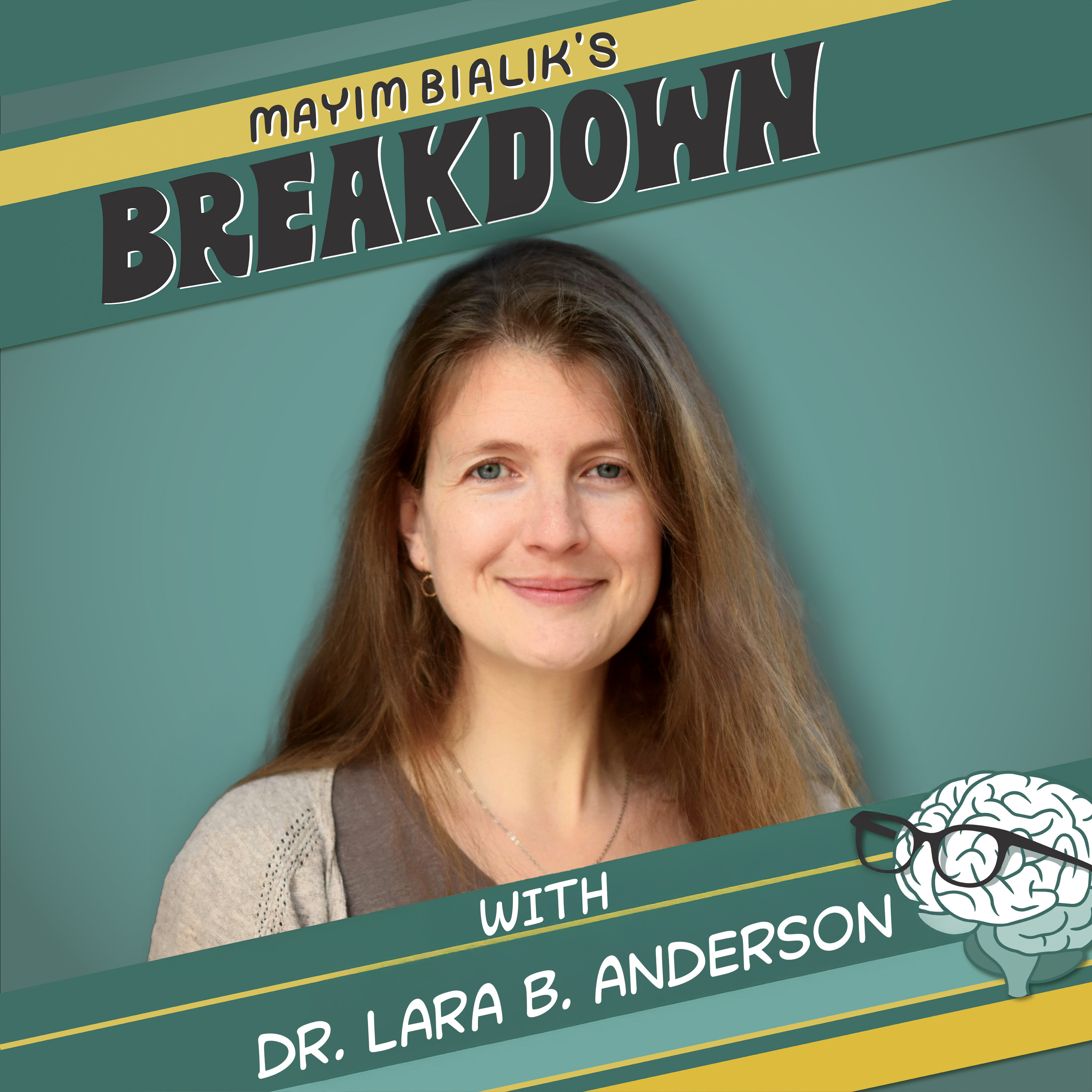
Mayim Bialik's Breakdown
We’re Not Alone. String Theory Explains Aliens, Time, AI & The Hidden 95% of the Universe | Dr. Lara B. Anderson
01:04:24
Loading summary
Transcript162 lines
- [00:00]
A
There are lots of things we don't understand about the universe.
- [00:02]
B
Right now, this seems like a really big problem.
- [00:04]
A
I would be very surprised if the universe isn't absolutely full of life. I work in theoretical particle physics and string theory. Very much the stereotypical nerd physicist from the Big bang theory. Early 20th century physics showed us there are more dimensions than what we see around us. I'm totally fascinated with how organisms could arise, how they could function. It's got mass, it's got energy, and it's not the stuff that the stars near us are made of. There's a lot of discussion about new proofs that are being generated in collaboration with AI.
- [00:34]
B
What does it mean for this next level of evolution?
- [00:37]
A
We're in a really remarkable moment. Are these things going to be conscious? What happens when these things become much smarter than us? I find it really scary and really exciting at the same time.
- [00:49]
C
Best thing that's ever happened to you. Financially.
- [00:51]
B
Go easy. Sold my car on Carvana.
- [00:53]
C
Amazing offer, really.
- [00:55]
B
I hit 200 on the scratcher. Did the scratcher come to your house
- [00:58]
C
and hand you a check?
- [00:59]
B
No.
- [01:00]
C
How many scratchers did you hit to get that?
- [01:02]
B
I hit a button on Carvana.com once. Okay, that's fair.
- [01:06]
D
It's like the lottery, except you always win.
- [01:09]
B
Not like the lottery at all, actually.
- [01:11]
C
Exactly. Inexplicably good offers worth bragging about.
- [01:16]
B
Sell your car today on Carvana.
- [01:17]
C
Pickup fees may apply.
- [01:24]
B
Hi, I'm Mayim Bialik.
- [01:25]
D
And I'm Jonathan Cohen.
- [01:26]
B
And welcome to our breakdown. Today we're going to be speaking to an expert in string theory. But we're not just gonna talk about this incredible theory which is a fundamental component of theoretical physics. We're gonna be speaking with Dr. Lara Anderson. She's a professor of physics and mathematics at Virginia Tech and she studies theoretical high energy particle physics and string theory. She's gonna discuss the biggest mysteries of the universe. Dark matter, multidimensionality, the multiverse. What holds the universe together that we cannot see and still do not understand? And what does it mean to say that reality is actually comprised of more dimensions than we can even perceive?
- [02:11]
D
Take a quick second and check to see if you're subscribed. Don't miss out on all new episodes of Mayim Bialik's Breakdown. We cannot thank you enough.
- [02:21]
B
And now it is a pleasure to welcome to the breakdown, Dr. Lara Anderson. Break it down.
- [02:27]
A
Thank you so much. It is my pleasure to be here.
- [02:30]
B
We'd like you to start with sort of telling us what you Study and why you chose to study it.
- [02:36]
A
I work in. In high energy theoretical particle physics and string theory. Connecting to. To your own background. Very much the. The stereotypical nerd physicist from the Big Bang theory. I have to say, that show really did channel our people. Well, I appreciated the. The insight into. Into physicists that was given there, but y. Theoretical particle physics and string theory. So the work I do is theoretical meaning. I use computers and equations to try and understand how the universe works, what makes up the universe. So what are the basic building blocks of matter, energy in our universe? And then what equations, what laws of nature do they obey? And for me, actually, the way I got into this was very much a sort of transformative moment. When I was a kid, I went into a planetarium at age 12 years old, and I saw a star show that had been designed by Stephen Hawking, actually, that was about the origin of the universe. You know, the Big Bang, black holes, expanding universes, galaxies, all this stuff. I just thought it was so freaking cool that people could figure out stuff like that about the universe by observation and by thinking about it. So I marched out of the planetarium at age 12 and I was like, I want to do that.
- [03:48]
D
What do most people get wrong that you're trying to explain?
- [03:52]
A
One thing that I think is difficult about physics is that a lot of the ideas of how you think about things, how you ask questions, how you test those questions, they're very different than how you would explore things in your everyday life. When people talk about doing research on something, that normally means you look stuff up on the Internet and you think about it and stuff. But that process of how do you pose questions, how do you then try and decide what the answers are? And unfortunately have lots of great ideas that don't work. That's something that I think is not super appreciated.
- [04:28]
B
I want to know about when you first heard about Big Bang Theory, because I'm curious, sort of in the cultural vernacular. And then we will absolutely get into all of the hard science. Did you hear about this? Did other people say, like, hey, there's a show about physicists? I'm just like, curious, personally. When you sort of discovered that there was a show about. Because when I auditioned for the Big Bang Theory and they told me they wanted a female Sheldon cooperation, I had never seen the show. And so I googled Sheldon Cooper and I said to myself, oh, this is like all the people I went to grad school with, like, these are like, all my friends. Like, this is how we talk. This is how we function. And so I found it fascinating that there was a TV show about it, because I didn't know about it either. So I'm just curious what your first foray into understanding there was a show about people like you.
- [05:15]
A
I think it was probably, you know, my family, extended family, saw it was like, hey, you gotta check this out. Random anecdote. The show had been on for, like, a couple of years, and I was. I was at a physics department, and I was hanging out, like, this big table full of people in my field. And the show came up and there was some people that were saying, this is like stereotyping physicists. And this is, like, so unfair and stuff. They were kind of griping about it. But I looked down this table and just like, the perfectness of the setup. Right. You know, these were exactly. You know, the people that we're talking about going to the comic book shop and playing video games are like, super into their equations. You know, it was the sort of irony of that situation of like, yeah, they're stereotyping us, but. But here we all are doing. What we were doing was.
- [05:56]
B
Yeah, it was very cute when people would ask me, like, how do you feel about the show stereotyping people? And, you know, and I said, you know, there's all different kinds of physicists, and in. In particular, there's all different kinds of women in science. And I had professors that looked like models, and I had professors that looked more like Amy Farrah Fowler. So, like, to me, like, there's all different kinds, but I absolutely based my character on a composite of two actual humans in my circle who were incredible women, incredible scientists, incredible mentors. So for me, it was a way of, like, honoring, you know, the quirks about many of us. And yes, many of us find our way to science. Let's go back a little bit, because your. Your specialization is mathematical physics, right?
- [06:41]
A
That's right.
- [06:41]
B
I wonder if you can also explain a little bit about how those two sciences come together and what's special about the work that you do.
- [06:49]
A
If you want to decide how something works in physics or the universe, you sort of have two tools to try and attack that. You can either do a measurement, and you can say, I predict that when I drop an apple, it's going to fall at this rate. It's going to hit the ground at this time. You can make predictions, and you can test those predictions, or you can try and say, let me model mathematically what I think is going to happen before you do that experiment. And then hopefully you do both and see that everything agrees, both your theoretical understanding and your, your practical observations. So in, in the kind of work I do, a lot of things to directly test the questions in particle physics that we would want to understand. You would need immense particle colliders, like the size of the solar system, to be able to smash atoms together and directly access energy levels, you know, and see how particles behave in that way. So instead of being able to do that because we don't have the budget for a solar system size particle collider right now, you can also try and mathematically work through what's going to happen in all these different scenarios. And that mathematical consistency of the number of things that you can observe about the universe and write down and then figure out if this is true and this is true, then how do you fit that together? What does that imply for the next thing? That type of mathematical consistency is really powerful for ruling a lot of things out. So the role of theorists is to try and understand what should be looked for in experiments and then to make sure that our theories, as we're developing them, are mathematically consistent.
- [08:22]
B
Yeah, and I think that's an important point, especially for people who might be listening and not really have a handle on a lot of these sort of larger concepts. You know, what, what mathematical physics is doing and what sort of, what the theoretical world allows us to do is to study things in a way that they can't be studied in the real world, either because of physical limitations or conceptual limitations. But, you know, one of the things I love about math, I'm just like, you know, a math person, like, it's a language. It's a language that allows us to access these different pockets of the universe that we can wonder at. But these are the ways that we actually study what is beyond when we can't necessarily touch it or see it with the naked eye, if that makes sense.
- [09:12]
A
In my field in particular, when you're asking questions about fundamental physics, not only is there a question of the size and scale of the experiments, but many things are really hard to visualize or beyond the scope of what we're familiar with. One that comes up in string theory is this question of what's the shape of our universe that we live in? Is our universe actually three spatial dimensions, like a box, up, down, side to side that we can see, plus a time dimension, or could there actually be additional dimensions beyond that?
- [09:45]
B
We have these planets, right? And because of lots of interesting reasons, they're spherical. Right. And we know that there are also, you know, in the solar system, we Know that there are other planets and that they have these kind of elliptical shapes, right? That they kind of move around. But then if you were to ask me like, what's beyond there, I would just be like a lot of black and a lot of stars and a lot of planets and it just goes on forever, right? How, how close am I? Because if you ask me, the shape of forever, you know, it's like this feels like a Hallmark card. What is the shape of forever? I just think it goes out in like every possible dimension to infinity. Is that a shape?
- [10:36]
A
What's beyond the solar system? As you said, there's, you know, lots of galaxies, there's these big structures of, you know, like walls of galaxies, lots of empty space. And we are limited in the way our ability to probe the universe actually by where in the universe we can see back to from the light that has reached us or more recently through things like gravitational waves that have reached us. So short answer is we don't know actually the very far distant structure of the universe, there's parts of the universe that we don't have access to yet. But we do know some structure about the universe. So one of the things we know, for example, is that the universe is getting bigger, it's expanding. And that already is hard to visualize, right? So if you say like expanding into what? Right? It's, you know, it's a three dimensional space that's, that's, you know, getting bigger. So the analogy that people use is if you were to look at like the surface of a balloon as you were blowing it up, if you were to draw a bunch of dots like on the surface of that balloon as you blew it up, all those dots would be getting further apart from each other. But there's no center to that expansion on the surface of the balloon, right? So the same thing is happening to our universe is that every part is getting further away from every other part. But that expansion is not happening in our three dimensions. It's in some sense happening into a larger dimensional space is one way to think about it.
- [11:52]
B
What does that mean for things to be getting bigger in a larger dimensional space? Because what I picture is kind of like, you know, if you picture a firework like before, you know, they kind of arc, right? That's what I'm picturing. But also the expansion is happening quite slowly to me. Can't it just expand out into every dimension that it's already in? Meaning I'm picturing like all these vectors, right? And the vectors are just going out from whatever the center is. Right. And it's just like, again, this is like, I feel like a five year old. It just keeps going.
- [12:31]
A
So here's the thing. If we were like the firework analogy, you would need a middle of that explosion, right? You need some point in space where all the bits are coming away from that point. And what we see looking at the universe is there isn't a middle like that. Every point is getting further away from every other point, but not from one center part of our 3D space, if that makes sense.
- [12:53]
B
Where is it expanding from? Right. And where is it expanding to? Because if you look at like a map, right? And you would say, oh, if I were to zoom out, we are evolving around the sun in our solar system. But if you zoom out and there are I don't know how many other solar systems.
- [13:14]
A
Uncountably many.
- [13:16]
B
Right. So you don't have one center from which things are expanding. I mean, I also. The thing that I love about physics is also these ideas can be applied to like our human existence, right?
- [13:30]
A
Very much so, yeah.
- [13:31]
B
If I grow, if I grow as a human, even conceptually, Right. What is the limits of human growth and expansion and expansiveness? It's a beautiful thing.
- [13:42]
D
Mayim Bialik's breakdown is supported by Quince.
- [13:45]
B
Summer always makes me rethink what I'm reaching for every day. Lighter fabrics, better materials. Things that just feel good the moment you put them on, but also look effortless. That's why we keep coming back to quints. The they focus on high quality essentials. Think breathable linen, soft organic cotton, washable silk, but without the luxury markup. It's that rare balance where everything feels elevated but still easy. Quinn has beautiful everyday pieces like 100% European linen pants, dresses and tops with style starting at $32. Their denim is soft and easy to wear. Their organic cotton sweaters are perfect for layering on cool summer nights. Everything at quinn is priced 50 to 80% less than similar brands. Quince works directly with ethical factories and cuts out the middle people. So you're paying for quality, not brand markup. And it's just clothing. Quince has really become a destination for elevated essentials across home, kitchen, bedding and beyond, making it easy to bring a more premium feel into everyday life. I actually just bought two sets of quince sheets for my son. They were on sale and now he has two different colors. Quince's 100% European linen wide leg pants. That's quickly becoming my summer uniform. They feel like pajamas, but look like I put more effort in than just showing up in pajamas. Whether I'm dressing for casual work days, lazy weekends or feeling those vac vibes. Elevate your summer wardrobe. Go to quince.com breakdown for free shipping on your order and 365 day returns. Now available in Canada too. That's Q U I n c e.com breakdown for free shipping and 365 day returns.
- [15:17]
D
Mind B Alex breakdown is supported by
- [15:19]
B
AG1 it's summertime and that means sun, vacations and changes to your usual routine. We're so excited to take a break from our regular hustle and bustle, but sometimes that means we take a break from good habits too. Except for the 30 seconds it takes to mix AG1 one scoop plus 8 ounces of water every morning AG1 AG1 is a healthy drink with multivitamin, pre and probiotics, superfoods and antioxidants. 1 Scoop 8 ounces of water ag 1 helps to maintain energy, support gut health, and support immune health. It's clinically shown to support gut health and fill in common nutrient gaps. Summer may be your license to chill, but with all the late nights, long weekends and spontaneous plans, AG1 helps you keep one thing consistent high quality nutritional support every single day, no matter where you start your morning. The next gen formula delivers 75 plus ingredients clinically shown to support gut health, fill common nutrient gaps and improve key nutrient levels within three months. AG1's comprehensive nutrition provides nutrients that support our bodies, our brains, and our gut health all in one scoop. We are so thrilled to use it every morning and glad that it's going to support our immune defense as we continue planning our travel Summer Vacations. Visit drinkag1.com breakdown to get a free free AG1 travel case with seven free AG1 travel packs in your welcome kit with your first AG1 subscription order while supplies last.
- [16:35]
D
That's drinkag1.com breakdown MayimBialix breakdown is supported by Tumble.
- [16:42]
B
You know, finding the right rug for a home is surprisingly difficult. An expensive rug makes you feel like no one should walk on it because you're afraid of staining it. Also, we've got dogs, cats, life. We knew that stains were going to be inevitable, but those standard washable rugs often look cheap and they feel temporary. Most rugs don't seem to be designed for actual real living. But then we discovered tumble rugs. You can finally have the best of both worlds. And now we do. Their rugs look like beautiful designer rugs, but they're built for real life. Spills muddy paws and accidents are just a part of what's gonna go on. Tumble rugs are spill proof and machine washable. They feature a proprietary spill proof surface that causes liquids to bead up on top of the rug. So instead of a stain soaking into the fibers, you can literally wipe it away in seconds. And when you need a deeper clean, tumble rugs are fully machine washable, even the larger sizes. Our favorite part about tumble rugs though, with all of this being said, is how amazing they look. They often feature hand illustrated designs that look like designer rugs. Mine features illustrations by none other than Frida Kahlo. But don't take our word for it. Hundreds of thousands of homes have already switched to tumble rugs and they have over 30,000 five star reviews. They're perfect anywhere in your home where life tends to get a little messy. Which for us is everywhere. Machine washable rugs made better. For a limited time only, Our listeners get 10% off plus free shipping@tumbliving.com break that's T U M B L E living.com break after you purchase, they'll ask
- [18:14]
D
you where you heard about them. Please support our show and tell them that that we sent you. Well, we left this thread hanging, which is 3D space, maybe time. And we speak to a lot of people who have either had near death experiences and have gone off and experienced and come back with all this information and they're like, where is this?
- [18:38]
B
We speak to a lot of people who leave their bodies or whose consciousness seems to leave right this body and they have experiences that often involve experiencing an expansiveness of their being in the universe, that they have no scientific basis for meaning. If you take someone who's never studied physics either, theoretical, practical, any kind, what they describe is, you know, experiencing, traveling right into all of these other aspects, right of the galaxy. And some of it could be the things that your brain sort of fills in. But can you talk to us about multi dimensionality? Is that a kind of place where consciousness can exist in a different dimension? What are the choices for other dimensions besides, you know, the sort of X, Y, Z plane and time?
- [19:33]
A
There's this beautiful quote by Arthur Eddington, early 20th century physicist, who said that the universe is not only stranger than we suppose, but it's stranger than we can suppose. So I think it's fun to explore some of these things that really stretch our own visualizations of how all this works. So we were just talking about the expansion of the physical size of the universe just to go back to that balloon for a second to help us visualize what's about to come. So if you imagine the surface of a balloon, all the parts are moving on that balloon further away. But the expansion of the balloon isn't happening on the surface, it's actually happening in the middle of the balloon, right? So that would be like a two dimensional surface. All the parts are moving away, but it's expanding into three dimensions. So that's the kind of picture that you think of for our universe, is that our universe is three dimensional, but it's expanding into four dimensions. And now this is where, at least for me, my brain kind of stops because you think, what does it mean to have four dimensions, right? How would we have, you know, up, down, side to side, and whatever else is happening that mathematically is really easy to write down. But our human minds, based on just all of our experience in the world to date, can't really visualize what that would be like. So the analogies that you could sort of play with is you could imagine what would it be like if we imagined, instead of our 3D world, a 2D world, right? What if you lived on the surface of a table, what would you see? If you were to see a 3D creature move through your 2D world, you would only see the cross sections of that, right? Like as it passes through your world, you'd see, you know, as something enters, you'd see a circle of one size get bigger and then smaller again as something move through. So you'd see sort of a two dimensional shadow of a three dimensional thing. And mathematically you can write down exactly that same sort of structure for our universe. You could say, if there were four spatial dimensions or more, what kind of three dimensional shadows would we see of something that was four dimensional that could, you know, move through our universe? In the kind of work that I do in string theory, it's actually essential for the sort of consistency conditions of physics that there are more dimensions than what we see around us, and they don't all have to be the same size. So this is another thing that's sort of hard to imagine. When you say, like size of a dimension, what does that mean? So an analogy that I use sometimes is if you imagine looking at something like a wire, something very thin from far away, it would look like it's only a one dimensional object, it has a length, but if you were able to zoom up really, really close to it, you would see that it has a thickness, right? It has another direction to it. It's actually a 2D surface so this is a question we can ask in physics, is that our universe looks like it's three dimensional, but if you were to zoom in really, really, really small to all the space that we look at, could there be other. Like that thickness of the wire? Are there other directions that things could move? Other directions that energy can move into, that particles could interact with? And then you could ask, you know, what is the consequences of that for physics? So a long time ago, I tried to explain what I do for a living to my grandma by saying that I wrap up extra dimensions for a living. So I wrap up these extra dimensions. I try and say, if they were really small, what would be the consequences for physics and what would we observe?
- [22:46]
B
Jonathan just sent in our. In our little chat here, a hypercube image. And I'm gonna say something very strange. When I looked at this, it made me feel like crying, meaning I had an emotional reaction to seeing something that is outside of the bounds of what I think I can perceive.
- [23:12]
A
Yeah.
- [23:13]
B
Does that make sense?
- [23:14]
A
Being attracted to things that expand the way that we think about stuff is really cool. I definitely felt that. You mentioned, as one of your guests, Michio Kaku, he wrote a bunch of popular science books, and I remember reading one when I was about 13 years old. And again, just that feeling of being like, wow, this is so cool that people can figure this out by thinking about things, right? That you can think about things differently and then imagine structure that you never knew was possible.
- [23:40]
D
I think we should tackle what is string theory? Because the layperson has heard about it, but probably doesn't quite understand how to explain it or how it's practical to them.
- [23:52]
A
String theory is an attempt in one consistent theory to try and model basically all of the fundamental interactions that we see in nature. So first I have to say, what do we mean by a fundamental interaction? So we think that everything that we see in the universe that accelerates, speeds up, slow down, does so for basically one of four reasons that we've figured out so far. This includes gravity. So things that are holding us to the Earth right now, structure of the solar system, all that good stuff. Electromagnetism, which is basically electrical interactions in atoms. That's the structure of the whole periodic table. That's why I can't put my hand through my desk right now, is electric repulsion between electrons. Then there are two other forces, the strong and weak nuclear forces that are responsible for things like radioactive decay and for holding together the center of nuclei. So those forces describe basically everything moving or accelerating that we See, and we have a really beautiful framework in theoretical physics for making predictions that are extremely accurate, like accurate to 13 significant figures for how three out of the four of those work at very small distance scale. So this is called the standard model of particle physics. We have this great ability to describe the strong and weak nuclear forces and electromagnetism. We also have a description of gravity, thanks to Albert Einstein that describes gravity as the curvature of space and time that he developed in the early 20th century. Also an incredibly predictive, really beautiful theory. It's why modern GPS works. These two frameworks for gravity and then the other three forces, they're really, really useful, really, really powerful and fundamentally incompatible. If you try and sort of put together our understanding of quantum mechanics and quantum field theory with gravity, you end up getting really stupid answers. These are so called disastrous infinities. So you can like try and predict things that it just doesn't work. You get wrong answers, manifestly wrong answers. So string theory is an attempt to put all of those fundamental forces, including gravity, in one coherent framework. And the basic idea is, what if matter wasn't little point particles like an electron that you imagine like a little ball floating through space. What if instead all of the matter that we see was actually made up of extended one dimensional objects like little strings? And just like a violin string could vibrate different ways and produce different notes. String theory asks, if you had these fundamental strings, if they vibrated in different ways, could they become different particles? So could they vibrate one way and be an electron, vibrate another way and be a quark? It turns out if you ask that sort of cute idea like, can you make different particles from different vibrational modes of a string? If you ask that quantum mechanically, you actually get Einstein gravity for free. So you end up with a theory that must be gravitational. So these strings can only move through space times that obey the equations that Einstein wrote down, which is like super duper beautiful. The catch, unfortunately, is that in order for all this to work, you need your universe to have more than three spatial dimensions and one time length dimension. So that seems like a really big ask. So that's where the wrapping up dimensions comes in. You could say, could this actually be consistent with experiment? And what would the consequences of that be if it was? If there were extra dimensions, what would it mean for physics? What could we predict? What could we test?
- [27:17]
B
How can a string be one dimensional, just having a length, but nothing just has a length?
- [27:23]
A
Well, interestingly, there are some particles in nature, like electrons, where we think that they, you know, from what we can observe, they seem like they're just points, right? They're not actually. They don't have a length, they don't
- [27:33]
B
have a radius, but we also don't have a location for that point. Meaning we have a probability that we can calculate of where you might should hope to find that.
- [27:46]
A
And the same for these strings. So you would have sort of a probability distribution of this, this one dimensional object that you're describing.
- [27:53]
D
So now we have these strings that can shape shift.
- [27:57]
B
It's not that they shape shift.
- [27:59]
D
Depending on how they're feeling, they're gonna vibrate differently.
- [28:02]
A
Okay, I can go with that. Yeah. Different vibrational modes, different masses, different charges, different properties.
- [28:09]
D
I think a lot of the hippie energy workers out there are like. Exactly. We've been telling you that you just need to change your vibration frequency and all of a sudden you're inside, you're outside, and everything around you changes. Why are they right or wrong?
- [28:28]
A
The idea of vibrational, you know, things vibrating and having different energy levels, that's one that you can do for all sorts of different, you know, distance scales from violin strings to waves in water, all those. So in the case of the, the hippies, I don't know what's vibrating for them, but, but it's a fair question,
- [28:48]
D
but how does that change our understanding of the nature of reality? If things can change what they are
- [28:56]
A
in that way, the consequences of that are that if you have these little one dimensional strings that are vibrating in different ways, they're being different particles as they move through space. The kinds of ways that they could interact with each other, so the ways that they can join up, separate different vibrations, all of that tells you about what particles could exist and then how they're going to behave. And that allows you in principle to predict lots of things. So a big question is there are lots of things we don't understand about the universe right now. So we know from research in astronomy that we actually don't know what the majority of the universe is made of.
- [29:33]
B
This seems like a really big problem to me.
- [29:36]
A
It's a really big problem, right. So there are things that we refer to as dark energy or dark matter. These are things that we think in terms of the gravitational structure of the universe. There has to be stuff out there that's interacting gravitationally with everything else. It's got mass, it's got energy, but we don't know what it is. And it's not the stuff that the stars near us are made of. So the question of, you know, what is all that energy? What is all that matter out there that's determining how the universe is evolving and what's going to happen to it? That's something that a theory like string theory would try and answer by positing what particles and what forces might exist. A fun, actually observed quantity that lots of people and lots of theorists are thinking about is the fact that the universe isn't just expanding, it's speeding up. So the question of, like, what's driving that expansion? What's producing that energy? Right, That's a great question.
- [30:25]
B
What do you mean it's speeding up? I was just still trying to get my head around expanding like the balloon. What does that mean, that it's. It's speeding up?
- [30:33]
A
Yeah, it means that it's. All the parts are moving away from each other. And the rate that that is happening is, as you said, slow but subtly increasing over time.
- [30:42]
D
Again, not to quote the hippies, but everyone's saying things are moving so much faster these days. And it's the speed of technology, which we're bombarded by information, but to think of that being paralleled.
- [30:53]
A
So there's one possible thing that could be driving that expansion. So one maybe explanation for it, which is the idea that empty space itself might have energy. So in quantum mechanics, which describes how particles interact, as you alluded to a few minutes ago, things happen probabilistically. So you say, is a particle here or there, you can't really say, but you can say the odds of it doing X or Y. You can figure out when you say space is empty, you have to say, how sure am I that it's actually empty? So could it be the case that you think you have empty space, but actually a particle and an antiparticle appeared and annihilated and then disappeared again while you weren't looking? Right. Could it have happened in just an infinitesimal fraction of a second? So there could be this sort of bubbling soup of particles that may or may not exist probabilistically in empty space, and that can actually contribute energy to the universe. And then as the universe gets bigger, you got more space, so you got more energy of this uncertainty of these particles in empty space. And that can actually drive expansion. It can make the universe accelerate even more.
- [32:05]
B
Okay, the universe is expanding. It's expanding more than it was. Right. Let's say a second ago and a year ago and a light year ago. And it's not only expanding more, it's expanding faster. So I can't help but think, like, what are we Careening towards, you know, when you think about sort of the Big Bang theory and you think about whatever led to the fact that like, you know, we're all stardust and all of those beautiful notions, that's our evolution story, what's our catastrophe story, right, that we can tell ourselves about this expansion that's happening at even a more rapid pace. Like I picture us hurling now through space, right, with some catastrophe looming. Is that just my, you know, puny human mind?
- [32:58]
A
No, that's a totally fair question. And it's one that scientists have thought about for a long time. So this is about the fate of the universe, right? So as you say, if you imagine that the universe arose from some sort of big singularity or cosmic explosion in its past, where is it going? And there are different possibilities that people consider, and that's very much dependent on what the universe is made of and what's happening to it that we don't fully understand. But possibilities could include if you don't have enough stuff in that universe, it could expand for a while and then eventually gravity could kind of win out again and everything could start moving back closer and closer together until it basically recollapses, possibly explodes again. So this would be a recollapse scenario for the universe. You could also have an expansion. And this is what our current data sort of indicates is that you could have an expansion that just keeps going forever and everything gets further and further apart and colder and colder and colder in the ultimate fate of the universe. So these are referred to as like the big Crunch if it re collapses or the big Freeze if everything just expands arbitrarily far apart. All the stars eventually burn out and everything gets cold and dark at the end.
- [34:10]
D
May Bialik's breakdown is supported by element.
- [34:13]
B
Element has a new flavor that we are so excited about. Here it is. It is lemonade iced tea. Same great electrolytes and taste, but with black tea extract. So you can still get your caffeine boost without the mid afternoon energy slump. Turns out caffeine doesn't actually give you energy. It mutes the signal that tells you that you're tired. So when it wears off, that's actually the crash. Isolated caffeine, the kind that are found in most energy drinks, hit harder and drop faster because there's nothing in it to smooth the curve. But element lemonade iced tea uses a full black tea extract, caffeine bundled with L theanine and polyphenols, and a meaningful dose of electrolytes free of sugar, artificial colors or other dodgy ingredients. It's built on the same formula as Element's core Drink Mix sodium, potassium and magnesium at levels shown to support optimal hydration. The result is a noticeably steadier feeling, less spike, less drop without the crash that comes from most caffeinated drinks. Get a free 8 count sample pack of Element's most popular drink. Mix flavors with any purchase at drinkelement.com mayim find your favorite flavor or share with a friend, no questions asked. Refunds Try Elements See how you feel. If for any reason you're not satisfied, their customer service team will take care of you.
- [35:22]
D
Mind Bialix Breakdown is supported by Superpower
- [35:25]
B
we all know what it's like to leave a doctor's appointment feeling like you are leaving with more questions than answers. There's no real data. There's no game plan. This has happened to me so many times, especially when I was starting my perimenopause journey. And that's why we love superpower. Their one simple blood draw gives you information on over 100 of your blood biomarkers. Superpower sends a licensed professional to your home. You can also visit a nearby lab to unlock a real understanding of your body and what's going on in it. The Superpower app includes detailed information on your heart, liver, thyroid, hormones, metabolism, vitamin and mineral levels, even environmental toxins. So from disease prevention to simply optimizing your gym game, Superpower is the most comprehensive and advanced system out there. Superpower also tracks your results over your lifetime. Each test builds on the last. You can see progress year after year. Superpower helps you connect the dots and understand long term trends in your health data and take action on them. Stop reacting to health problems and start proactively improving your health based on real personalized data. Superpower is the most affordable 100 plus biomarker blood test starting at $199 and it's HSAF eligible. Unlock your new health intelligence. Make this the year you stop guessing about your health with Superpower. For a limited time, our listeners get $20 off to unlock their new health intelligence. Head over to superpower.com use code BREAK for $20 off your $199 superpower membership.
- [36:46]
D
After you sign up, they'll ask you how you heard about Superpower. Tell them mayimbialics Breakdown sent you to support the show.
- [36:54]
C
Why does Progressive work hard for truckers? Because truckers unite the world. They unite kids with their first drum sets and parents with earplugs. But truckers can't do this if they're not on the road. That's why Progressive has over 360 heavy truck employees to help truckers stay on time and on track. Quote Truck Insurance today in as little as eight minutes@progressive commercial.com, progressive Casualty Insurance Company and affiliates.
- [37:21]
D
Should we be concerned?
- [37:22]
A
It's going to happen a really long time from now, much beyond the life cycle of our star, so we won't be around to worry about it. Some people say like this could be, you know, a cycle of universes arising, getting destroyed, and then becoming again. So one possibility would be your universe collapses in and you create a new big bang that makes a new universe.
- [37:42]
B
So in this other option where everything keeps expanding, it gets cold. Because when no one is close enough to a sun or any of those kinds of stars that are generating the sort of heat that in our particular planetary climate keeps us alive.
- [38:01]
A
Yeah. Or just phrase differently that, you know, a lot of the energy in the universe comes from density. Right. You have to smush things together to make stars and, you know, things like that. So if everything gradually gets, you know, further and further apart, you don't have, you know, clouds that are going to condense to form stars. And so, yeah, everything eventually becomes very cold and dark.
- [38:19]
B
I wonder when people talk about, you know, kind of imminent environmental concerns and the concerns of, of our planet's needs, how much do you consider those kinds of needs, considering the kind of thing that you study?
- [38:35]
A
I think these types of concerns are so far distant in timescales that we do not have to worry about them as humans. I mean, they're fun to think about. But in terms of what will happen to our planet and our sun, you know, this is many, many, many lifetimes of suns in the far distant future have to worry about anything like this. I do think it's really fascinating to ask, you know, what can we determine about this and can we figure out, you know, what's in the universe so we can decide, you know, what these scenarios happen. The specialness of star formation, the specialness of, you know, solar systems, of being in the sweet spot for the earth such that life could form. There's all sorts of great questions you can ask like that in physics about what it takes to get not just life, but complexity. Right. What does it take to build complicated things like we see in the universe? And it's all really special, just to mention one kind of quirky one when we're talking about higher dimensions. If you said, I want to build a universe and I'm willing to build it in any number of dimensions. Right. Don't care like, what's going to happen if you try and build something like a universe in two dimensions? Two dimensions is just too simple to actually be able to build rich structure like we see in the universe, to be able to build stars and galaxies and stuff. If you go up higher and you say, I want to be in four big macroscopic dimensions, I just want this big higher dimensional universe, it's actually things sort of generically miss each other. It's too much space to build complicated things. It's hard to build stable gravitational orbits like we build our solar system out of. So three dimensions is actually kind of a sweet spot. To be able to build something like our universe that is complex and stable and can support stars and planets and galaxies and us.
- [40:16]
D
I heard that potentially there are more dimensions than three dimensions, but potentially they are hidden. We haven't observed them fully. How does that relate to the multiverse that Marvel keeps showing me?
- [40:31]
A
This is related to this quantum mechanical uncertainty that we were talking about a moment ago. So if you have a particle and you say, I'm going to take this very small electron that makes up atoms, and I'm going to shoot it at a target, I'm going to ask, where does this thing hit? If you try and do that, it isn't like shooting a string of billiard balls at a target. You don't just get, here's where each ball hit. What you find is this distribution of almost like a wave of how things could have behaved. And that is, in quantum mechanics, the fact that we don't know for sure where these little particles are, that they are extremely hard to pin down. And so that theoretical probability distribution of, like, these are all the possible things it could do that actually gets realized as a physical measurement of this weird distribution of possibilities being realized as, you know, the results of where did my electron hit when I shot it at this screen? So people have tried to ask, you know, can I interpret those different possibilities? Is the particle here? Is it there? Is that some sort of, like, physical, real thing? Right. Is there one universe where it's here and there's another universe where it's there? That's the idea of the multiverse. I personally think that that's not really a scientific question yet, because we have no ability to probe those multiple, you know, versions of a universe happening simultaneously. So there's no real measurement we could do that would distinguish that from just the mathematical notion of probability that we're using. But it's a really cool thought, and I like all the multiverse movies too. Say you know, there's one version of me in another universe that's doing something
- [42:07]
B
different when I got to study this, you know, and we got to think about parallel universes and things like that. You know, it's fascinating not just, again, kind of conceptually when you think about what it means for different selves of you, but this notion that there are different versions possible of every reality that we also think that we can see, from people who have had near death experiences to physicists, to, you know, psychologists saying, you know, everything that we're seeing is what we're perceiving and what's being projected upside down on the back of a, you know, retina that, you know, sends information and, you know, through all of these different cells. But you know, the, the easiest example is, you know, when we describe a color that's actually the, the one wavelength that's not being absorbed right. By, by an object. But Donald Hoffman talked about, you know, what if we see reality as we're already wearing the goggles, right? This is the VR experience, right?
- [43:12]
A
Yeah.
- [43:12]
B
And so I think when we think about it in terms of particles, in terms of probability, in terms of the double split experiment, it's, it's exciting and it's exciting in a creative way. And, and obviously people who are, you know, creating science fiction and talking about these things get to take it to all these different levels. But we also get to talk about sort of the, the mathematical level, which is, I think, equally entertaining.
- [43:36]
A
You can't really have one without the other. And that you need to be able to explore these ideas. Right. If things are, are just, you know, only explored in a lab or only explored in mathematics, that isn't the thing that captures people's imagination. So I'm very grateful to Marvel for exploring all this too in terms of the physical consequences of this. There's a lot of current research in things like quantum computers, where people are trying to revolutionize computing and cryptography, and all these things that'll have really big real world implications that are based on this sort of composites of reality and all this uncertain probabilistic behavior.
- [44:14]
B
Many people who, let's say, experience flashbacks from trauma describe it not as a memory, but as being placed in a completely different time. And their bodies, their thoughts, in many cases their physicality responds as if it is in a different epoch of time. And obviously that's not proof of anything. That's not the way we decide things in science. But I wonder if you can talk a little bit, for example, about the difference between remembering something and having, you know, an experience of being in a completely different time frame. Is that kind of time travel with a lowercase t? Is there another way to imagine that we can experience time in a nonlinear fashion?
- [45:04]
A
One of the things that early 20th century physics showed us in a really remarkable way is that there is no universal notion of time for the whole universe. That this is very much a local thing that is based on how we're moving and where we're positioned. And that clocks will tick differently all over the universe in different scenarios. So to give a couple examples that one might have heard of, if you're moving really, really fast, so you know, if you're in your rocket ship and you're zooming off to another planet, this is Einstein's famous twin paradox where, you know, you say you have two different people, twins. One of them gets on the spaceship and moves very close to the speed of light, far away. One of them stays on Earth, they come back and they are different ages. How is that possible? That's something that really is possible in physics, that clocks do not have to be universal. Another example is that in your, when you're near very strong gravitational fields, so if you were in, you know, a planet that's really close to a very large black hole, clocks will tick differently on that planet than they would, you know, here on Earth. And so you can have manifestly extremely different perceptions of time between different observers in different parts of the universe, doing different things. And that can come up with all sorts of paradoxes and contradictions that aren't really contradictions, but seem like it because of just how non universal time is. So I think that's a neat thing, that time doesn't mean something for the whole universe. You can't just say now and then. That's a universal thing that everybody gets to agree on. The question of can you go back in time? So is time travel possible? Lots of physicists have thought about that over the years and yeah, I'm not going to be the definitive word on that. Some people are still thinking concretely on this. But we can say that if you try and write down a physics theory that allows time travel, that allows these so called closed time like paths where you go back in time and do something. Physics breaks down really fast. You end up with all sorts of nonsense answers. So this is the famous, you're going to go back in time and shoot your grandpa and then you get a logical contradiction that happens in physics all over the place. If you have time travel in the sense of you get to Go back. So in terms of consistent physics theories, I would say there is no universally agreed upon consistent physics theory that allows time travel. It seems to be really hard. The universe seems to protect itself really strongly against such things. Does that mean that that's absolutely the case? Maybe there's some clever way that this can be done that we don't know about yet.
- [47:29]
B
Is it possible that one of these other dimensions that we get to think about holds an experience or holds things on a timescale that don't have to exist in a way that would impact the physical world so that we wouldn't be dealing with this possibility of kind of physics falling apart? But just as people with, you know, you could call it extrasensory perception or people who are incredibly intuitive. Right? People who are in touch or tuned in. Right. To other, for lack of a better word, frequencies. Right. Is it possible that there are experiences or people who have access to some other plane where this information exists and is accessible, but doesn't have to obey all of these other physical rules of the linearity of time?
- [48:23]
A
The neat thing is, is that when you mathematically model this, the rules apply to everything. So whether it's an extra dimension or it's an ordinary dimension, you don't get to, like, get a get out of jail free card just because it's. It's not something that you can observe in our. Our current universe. Um, so in that sense, I would say that, you know, things like time travel in the literal back to the future kind of sense, you don't get helped by having extra dimensions in that. Indeed, people have actually asked, could some of those extra dimensions be timelike? So could you have more than one time? That's a cool concept. And again, that breaks down real fast. It gets really hard to do consistent physics in that scenario, but people are still thinking about it. And then the question of what human beings can perceive, how we function consciously, I think that's a fabulous set of questions, but not, unfortunately, physics at the moment.
- [49:13]
B
From the time that you were a little girl and fascinated with physics and wanting to study the cosmos and all of the incredible things that you get to study. How has your understanding of life on other planets or life in other galaxies, how has that changed? And how do you incorporate that into the work that you do? Because it's changed really, in the last several decades in terms of what we know, what we can know, and what is actually possible. How has that changed your worldview?
- [49:47]
A
This, this comment you made earlier about the sort of specialness, apparently, of life on Earth, right? That we haven't observed life elsewhere in the universe, that we seem to be in this unique position. My physics training has shown me that somehow that type of specialness doesn't arise very readily. That if you have something that's possible, if you can build complex molecules, if you can build human beings and consciousness, the idea that that would only happen once in the universe seems almost infinitesimally unlikely to me. So that is not a proof that life exists elsewhere in the universe. But I feel like, of course, life must exist elsewhere in the universe because frankly, we're just not that special. And throughout the entire history of humanity, when we thought we were right, when we thought that the sun orbited around the Earth, we've been consistently dethroned in terms of how special we think we are. So I don't have any proof of life outside of Earth, but I think that almost certainly. I mean, the universe is so vast and there's so many possibilities and such a rich environment to create complex systems and life. I would be very surprised if the universe isn't absolutely full of life. And just to riff on that in one other direction, the other thing that I think the modern moment is teaching us is even with the advent of things like machine learning, we're beginning to understand that human consciousness maybe isn't that special even, right? That you can build very complex networks that begin. And again, I'm not saying AI is thinking yet, but we're beginning to understand better how you get things like thought out of complex systems. So I think that's a really neat scientific question as well.
- [51:18]
B
There's something about speaking to someone who literally lives in the math of physics, having this kind of conversation that is so thrilling to me because I want to know, what does that mean? You know, if you kind of like take off your professor hat, right, and then you put it back on, like, what are you picturing? Do you picture carbon based beings? Do you picture silica based beings? Do you picture, you know, as. As many people have talked about that if something is out there and we're not aware of it, which I'm assuming we're not in the practical sense, it likely is thousands and thousands of years ahead of us. It may actually be some artificial intelligence that isn't even recognizable, you know, as some sort of, you know, green or gray, you know, kind of alien. What do you imagine and what are you allowed to imagine, given your credentials?
- [52:15]
A
Again, our view of what's possible for life, for complexity, for how things would form and behave, is so limited by what we've experienced. So I don't know what I visualize, but I very much am excited by the idea that there could be things just so wildly different from us, not necessarily in terms of their building blocks. Carbon is a pretty great way to build complex stuff. It's a lot better than silicon, actually. So maybe that is the ubiquitous way that this arises in the universe. But in terms of how organisms could arise, how they could function, communicate what would be important to them, how they would explore the universe, I think all bets are off. And I'm totally fascinated with what that would look like. I'm particularly interested. It seems really hard for organisms to cooperate, to survive, to take care of their planet, to move wider in the universe. So if other civilizations have done that, that would be fantastic to learn about.
- [53:12]
B
I mean, I think it would also be fantastic to learn about civilizations that aren't constantly going to war with each other, you know, because, like, when I think about sort of our experience, when I think about what's possible when people come together, when systems come together, I mean, even think of our body, right? It's a. It's an entire organism of cooperation, right? When you, when you extrapolate that, the possibilities are literally endless. And if you think of sort of like love and peace and hope as things that we can actually experience, I would love to know, right? Has someone figured this out? Because we clearly have not.
- [53:53]
A
And there's been this question in the structure of the universe, like, why have aliens not communicated with us if there's other life in the universe? And a. The space issue, it just is so big and it takes so long to send signals that. That's one explanation. But also, as other people have commented, maybe when we go a new place, we don't, you know, lay down on the floor and try and talk to the ants right away.
- [54:15]
B
Speak for yourself.
- [54:15]
A
Maybe we should.
- [54:17]
B
Can you talk a little bit more about your understanding of machine learning? Again, you. You've been, you know, a professional in the field that is so impacted by a different understanding of how we understand the universe because for so long we've tackled it one way and we're now in this entirely new era. And one of our, you know, our main interests in talking to Dr. Kaku was about how all of these kinds of theories are now being computed, contemplated, and really crystallized in a completely different way with quantum computing. How do you frame sort of this notion of machine learning? Language models, you know, are we creating thought or are we creating an artificial representation of our limited understanding of thought?
- [55:09]
A
I Think no one really has the answers to that question yet, and lots of smart people are trying to answer it. But I think that actually, as of this year, we're in a really remarkable moment for artificial intelligence as it impacts science. So for me personally, for a number of years, I've been involved in work that involved numerically approximating solutions to things. You have really hard equations that you need to solve that you don't know how to solve, and so you come up with schemes in a computer to run code and to simulate how a solution might look. And a few years ago, people started using neural networks. We tried to use some of these techniques of machine learning to make solving these equations more viable. And the immediate progress was really remarkable. Things were so much faster. It was this really powerful new computational tool. And then you have things like these large language models, the transformer architecture of machine learning. This comes in with things like ChatGPT and Claude. And at first it seems like, okay, yeah, maybe you can use this to write your college essay, but it's not going to be impactful for science. But really, just in the last six months in my field at least, this is really starting to change the way that people do physics and mathematics and the type of results that you're able to get out of these large language models. The question of whether they're capable of innovating in science, can they actually reason? Can they come up with new ideas, new beyond what human beings have come up with? This is a very serious question that lots of people are now tackling. And certainly I would say these machine learning tools now, the large language models, they're at the point that you can have a conversation with them about these ideas, a productive scientific conversation like you would with a colleague, and they're able to generate new ideas. So mathematicians, there's a lot of discussion in the math literature about new proofs that are being generated in collaboration with AI that humans might not have come up with before. In my field, people are really trying to push this to be able to come up with new paradigms, new ways of thinking about things. And I find it really scary and really exciting at the same time. So where is this leading? Are these things going to be conscious? Is there a notion of general artificial intelligence that's close by? What are we going to do with them? I'm not sure, but I think things are changing really fast at this moment.
- [57:27]
B
Again, this is the second time I've been kind of like moved in a very special way in, in talking with you, because, I mean, I'm just thinking about, you know, even in our lifetime, the way things used to be done. Like when I was in grad school, I, I, I talk often with younger scientists about what it was like to fill out IRB forms. If you needed to work with human subjects, you had to produce four Xerox copies. And then, like, the printer was out of, you know, toner, and you had to, like, go to a different printer with your copycard to take the forms to an office. Like, it was just, this was just to get approval to do your research or when I think about what it was like to write a grant, most of our time was spent doing things that now you do not have to spend time doing. So I'm thinking, gosh, what can we do with even just the brain power that is now open to us because of the systematic, you know, methodology we can now use to do just, you know, kind of logistical things? Beyond that, I think of things like, what's it called when people have, like, AI psychosis and people think that they have all these amazing ideas. And in many cases they do. But I'm thinking, like, gosh, how much of science now has kind of like blown this wide open? And I don't mean to use your own kind of metaphor, but it's as if it's expanding out in every dimension at increasing speed.
- [58:58]
A
It's really changing the landscape of how we do science and the questions that we can get answers to, the way that we can ask them. And, you know, a lot of people, myself included, you know, when these first, these tools were first available, I sort of viewed it as, you know, a clever way of predicting the next word. Right. You know, you just, it's, you know, it's pattern matching. It's saying, okay, when people write letters, you know, what word goes, goes where? But it's clear that they've become a lot more than that. There's a lot more possibility there. And to come back to a previous point about human beings not being that special, it's also clear that if you build networks that are sufficiently complex, in some sense, human brains are predicting the next word too. We're running on algorithms, although we don't know it. And so where that stage of you have a network that is a machine that is connecting in certain ways, what level of complexity does it begin to, to think? And then also taking a human brain apart the other way and saying, how does consciousness mechanically form? What are the rules for how we became what we are? I think those are a fascinating set of questions. And I think we're starting to get new insight into how those things hook together.
- [60:06]
B
When you look at something like trauma and people say, why do I keep picking people who hurt me? Why do I keep going down this same path? It's because your brain knows this is comfortable, this is the groove. We've created this pathway, and we're going to keep hitting it. And if someone triggers it in some other way, you get this notion of, why am I having the same reaction, even though I know I'm safe?
- [60:29]
A
Right. Yeah.
- [60:29]
B
That is what this complex system does, and it's the best that it can do. But I. What's fascinating is that, you know, when we get into healing modalities, and especially when Western medicine says to people, I don't know why that's wrong with you, take this pill. Right? Other healing modalities say, there's another way to think about it. There's another way to create grooves in the brain, right? So when you think about AI in this sense, it's yet another level of creative conversation that we can be in. I mean, there's something that's so romantic to me, though, that I need to get rid of that. That romantic notion of there's these theorems and we can't figure it out. And, like, what's your favorite math question that can't be solved? The notion that that might also be a thing of the past to a certain extent. What happens when theories are no longer theories, but they're actual things?
- [61:24]
A
Right.
- [61:24]
B
When we talk about the theory of relativity, we talk about string theory. What is that like for you to enter, you know, an era where there may not be as many unknowns? What does it mean for this next level of thought and evolution for us?
- [61:41]
A
So one question that I know mathematicians and physicists are taking very seriously is what happens when these things become much smarter than us? Right. So right now I can have a conversation with a large language model about my research, and I still know more about my research than it does. And so it will hallucinate, it'll make mistakes, and I can be, no, that's not right. And then it says, oh, sorry, I'll fix it. But it could very readily become the case soon that computers, these AI, could generate theorems, they could generate theories, as you're describing, that are right. And maybe it's hard for humans to decide if they're right or not. So there's actually a really strong community coming in, the mathematics community, which is trying to basically write code to make algorithms that can verify mathematical proofs that might be too Complicated for humans to understand. So they're basically trying to build the architecture within machines to try and verify machines own theorems so that if it's too tough for us, we can still have some way to trust it. Which is not a problem that I thought we were going to be having anytime soon. But here we are, right? So this question of, yeah, what do we do when they tell us this is the right answer and we don't
- [62:57]
B
know if they're right, we're too stupid. We're like Neanderthal lensis. And Homo sapiens is like, I know what to do, go here, mate with this person. Like mash this up and it'll be tasty. We're going to be like the Neanderthals or hopefully not.
- [63:11]
A
But like how do we, how do we navigate that? Right, that's, that's a really tricky question and I think we're already getting hit by that of how do we decide, you know, there's the whole like ethics issues of how all these tools are used, but also just the practical of if you have this really powerful tool, how do you guide it toward discovery? What questions do you ask it? Do you believe what it says? How do you figure that all out?
- [63:31]
B
I can't help being struck by the fact that, you know, every generation believes that they know things that the previous generation didn't understand. Whether it's rock and roll, whether it's, you know, computer technology, what I'm dealing with and I think what Jonathan also is dealing with, I have a 17 year old and a 20 year old and Jonathan has an 18 year old. But they know a lot more than I do about certain things. And the basis of my parents parenting was we know more than you. And when you think you know more, we're gonna put you in your place. And what I now have, and this has literally happened in one generation, I now have children who in many ways are still absolutely children. I think I definitely have a lot to teach them. But in one more generation we may have a situation where the knowledge scales are being tipped in ways that feel a little bit scary. Go five generations ahead. This thing is expanding in every direction at a rapid pace.
- [64:43]
A
I think it doesn't even take a generation to ask that question. Honestly, I think the space of change is so rapid that all of us, regardless of our age, are going to be in that position of having to grapple with something wildly new. And I definitely, I sympathize with what you're saying. I help my parents through the technology transition. I can already See ways that younger people are much more adept than I am at certain things. And I think, yeah, these brand new tools, this is just exponentially fast. And so what does that look like? How do we keep up? What do we do with it? How do we do that responsibly? It's a tough set of questions. Yeah.
- [65:17]
B
The only thing that makes me feel better is that very soon and possibly in my lifetime, my children will see what it's like to be told that they don't know what's going on.
- [65:26]
A
And also the question of access. Right. If you have these powerful tools, like, how do we make sure that. That they are available to everybody and that people do get to use them and.
- [65:36]
B
Or that they're used for good and not for evil. Right in the com. I mean, I feel like many aspects of our existence feels like we're in a comic book, you know, in terms of the. The language that certain leaders use, it feels like very comic book villain. But this notion of, you know, even the, the current boundaries that we're trying to put around technology that can hack into every system on our planet. Right. How do you control and regulate that when it's being devised to be used for all of these other incredible things?
- [66:08]
D
You know, two very important questions. The first, if people are only listening, you have some equations behind you on the blackboard.
- [66:15]
A
I do, yeah.
- [66:16]
D
What are they about?
- [66:17]
A
These are about geometries for extra dimensions. So if you say, what could the shape of these extra dimensions be? And they have to be really small so we don't see them, but they can be wrapped up in all sorts of weird and wonderful ways that will change the physics that you could get out. And so we write lots of equations to try and describe what those dimensions look like, what would the consequences of their shape be, and things like that.
- [66:44]
B
What are our choices for shapes? Because I tap out at like a buckyball.
- [66:49]
A
So again, it's really hard to visualize because they involve more than three dimensions. So in string theory, the common extra dimensions that we posit involve like, for example, six extra dimensions. And they can have holes and all sorts of. A very weird and wonderful structure. Very simple examples range from things like a donut shape. The extra dimensions you could have, you know, a little torus all the way up through very, very crazy knotted geometries, things that are called collabial manifolds. So there's. Yeah, there's a bunch of weird configurations. That's actually one of the aspects of my research is try to say how many different shapes are possible and we actually don't know at present if there's a finite number of shapes that are allowed, or if it could be infinite.
- [67:35]
D
What do you hope you're going to discover by understanding the shape of these other extra dimensions? Like, what unlock does that provide for us?
- [67:45]
A
Long term, we'd love to know these questions about like, what's in the universe? What's dark matter and dark energy? How many particles could exist? How do they interact with each other? So the shapes of these extra dimensions in string theory impact things like what literal particles we would see. So, you know, we know that there are things like quarks and electrons. If you were to zoom in with your super powerful microscope, smaller and smaller distance scales, you can ask, are there other particles? You know, what would their properties be? And also structure of like these questions we asked, like, what is the shape of the universe? Why is it expanding? What's going to happen to it? All of those questions are things that in principle a theory like string theory could try and give you. The short term is we would need to understand what are the rules for extra dimensions first. And then we can ask, you know, what would particle physics see? There's actually some fun visualizations you can do of if those extra dimensions were so small that we couldn't see them, but still big enough that say, very small particles could interact with them. You could imagine at the atomic or subatomic scale, you had two atoms that are interacting, two particles that are colliding with each other. They might lose energy into those extra dimensions. Or you might, if they're described as a wave, part of that wave might tail off into an extra dimension. So you can try and do experiments to see, could that be measured? Can you see that deficit of energy or how things might behave in that way?
- [69:05]
B
So what is your favorite shape?
- [69:08]
A
I would say these Calabiya manifolds are really fun to play with. There's a lot of possibilities for, you know, their twistiness, their holes, their structure. So just in terms of like fun shapes to, you know, manipulate, look at, to, you know, poke holes in Calabiyas are pretty fun.
- [69:27]
D
I've never asked anyone this next question in over 350 episodes, but it feels like I need to ask you, have
- [69:34]
B
you asked me this?
- [69:35]
D
Nope.
- [69:35]
B
Okay.
- [69:36]
D
If you could have one superpower, what would it be?
- [69:39]
A
Oh man, that's a great question. Right now at this moment in my life, I want the ability to like pause time for everybody except for me. And I, I'm doing that because I just feel super swamped. I got Way too much going on. I want to be able to, like, just pause all the things and then take my time and do everything and, and enjoy and then restart it, you know, unpause the universe when I'm ready to get back into things. That would be a great superpower.
- [70:02]
B
Dr. Andersen, thank you so much. This has been really, really wonderful to speak with you. Are you anywhere that you'd like to tell people to find you on the Interwebs?
- [70:11]
A
I have a website. I would say. Yeah. Check out Virginia Tech Physics.
- [70:16]
B
Amazing. Thank you so much. We really appreciate your time.
- [70:19]
A
Thank you so much for having me. It's my pleasure.
- [70:24]
D
Quick review. A lot of dark energy out there, a lot of dark matter, a lot of stuff. Every time we speak to a scientist, we basically figure out that they don't know a lot of things.
- [70:38]
B
That's the take home message. This lady didn't know a lot of things. We asked her.
- [70:42]
D
They know a lot of things, but they also discover they don't know a lot of things.
- [70:46]
B
You know, I think that's an unfair assessment of Dr. Anderson, who clearly knows a lot of. A lot of things.
- [70:52]
D
I mean, I'm not saying I know more things.
- [70:55]
B
No. But I think. Well, no one is saying that, but I think what's interesting is when we speak to people in theoretical physics, in the theoretical realms, like the fact that, you know, I was thinking, like, what does her lab look like? Probably exactly what we saw. A chalkboard and a lot of scratch paper and a computer.
- [71:13]
D
You know, I didn't ask her if she dreams in equations.
- [71:17]
B
I really appreciated her framework for what it's like to operate in this era of science. Because like I said, when you picture her as a little girl being like, I want to study that, and then you get into the field at a time when the technology has shifted so much, everything we do about how to explore everything, it's literally expanding out in all directions.
- [71:45]
D
That's very true. And the final thought that comes to my head that I'll leave us with is if Amy and Sheldon were on air right now and they were having date night and they were interacting with GPT, you can imagine them arguing and fighting with the current large language models.
- [72:08]
B
I mean, Big Bang Theory happened at a time that was so special that likely could not have existed Right now with the capability and the, the framework that we have for physics, for sure,
- [72:19]
D
I think both of you would be very upset with GPT.
- [72:23]
B
Really, really fun episode. And yeah, from our breakdown to the one we hope you never have, we'll
- [72:27]
D
see you next time it's my embe Alex Breakdown.
- [72:30]
B
She's gonna break it down for you.
- [72:32]
C
She's got a neuroscience PhD or two and now she's gonna break down. So break. Ever wonder who's out there making the world go round? It's Truckers. Who unites baristas with coffee beans? Truckers. Who unites dogs with their favorite chew toy? Truckers. That's why Progressive offers truckers even more protection with cargo plus coverage to keep truckers moving right along. Quote Truck Insurance Today in as little as 8 minutes@progressivecommercial.com progressive casualty insurance company and affiliates. Coverage subject to policy terms, limits and conditions not yet available in California, New York and Virginia. You're listening to this podcast, so I know you've got a curious mind. Here's a helpful fact you might not know yet. Drivers who switch and save with Progressive save over $900 on average. Pop over to progressive.com, answer some questions and you'll get a quick quote with discounts that are easy to come by. In fact, 99% of their auto customers earn at least one discount. Visit progressive.com and see if you can enjoy a little cash back. Progressive Casualty Insurance Company and national average 12 month savings of $946 by new customers surveyed who saved with Progressive between June 2024 and May 2025. Potential savings will vary.