← Misquoting Jesus with Bart Ehrman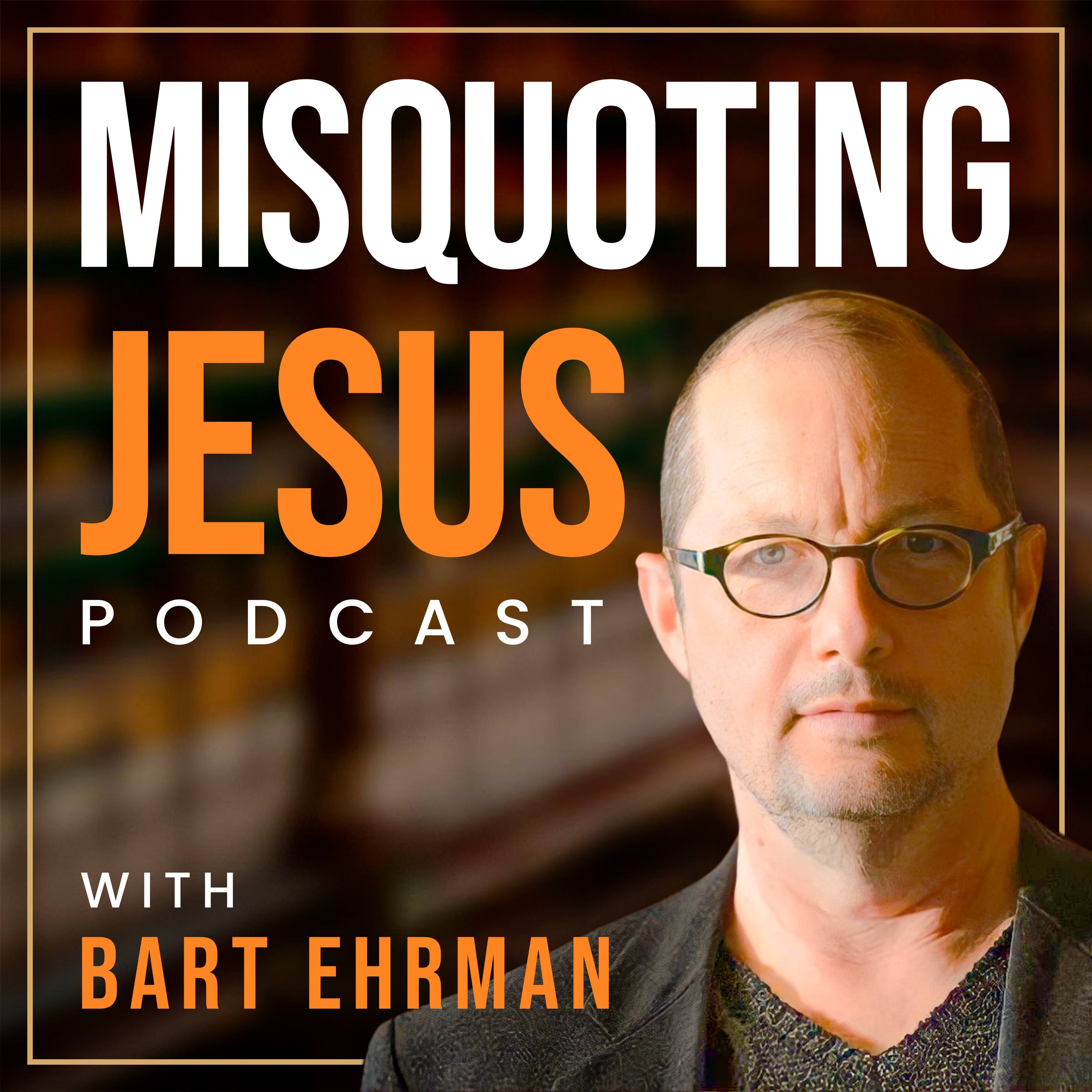
Misquoting Jesus with Bart Ehrman
Bart and the Bible: What Made Bart Ehrman Change His View on Biblical Inerrancy
00:44:19
Loading summary
Transcript61 lines
- [00:00]
A
Ryan Reynolds here from Mint Mobile. I don't know if you knew this, but anyone can get the same Premium Wireless for $15 a month plan that I've been enjoying. It's not just for celebrities.
- [00:10]
B
So do like I did and have
- [00:12]
A
one of your assistant's assistants switch you
- [00:14]
B
to Mint Mobile today.
- [00:15]
A
I'm told it's super easy to do@mintmobile.com Switch upfront payment of $45 for 3 month plan equivalent to $15 per month Required intro rate first 3 months only, then full price plan options available, taxes and fees extra. See full terms at Mintmobile. Do. Welcome to Ms. Quoting Jesus with Bart Ehrman, the only show where a six time New York Times best selling author and world renowned Bible scholar uncovers the many fascinating little known facts about the New Testament, the historical Jesus and the rise of Christianity. I'm your host Megan Lewis. Let's begin today on Misquoting Jesus with Bart Ehrman. I'll be talking to Bart about his best selling book, Misquoting Jesus, the story behind who changed the Bible and why, and asking questions about his journey through faith and academia. This episode will have more of a biographical feel to it than being purely informative, but I promise we'll spend more time in the changes to the Old Testament in the next episode. So stick around if that's what you're here for. This is a discussion based podcast. We'll be focusing on one topic each week and we want to do more than just scratch the surface. So after some basic introductory questions we will dive right into the fun part and possibly go off the deep end. Each episode also includes updates from Bart on his various projects and courses as well as a bonus segment and those include Bart answering your questions. So if you have one you want to ask, please head over to www.bartehrman.comaskbart. now before we get started, it's probably a good idea to introduce ourselves. As you heard in the show's introduction, I'm Megan Lewis. I'm an Assyriologist, which means I study the languages and cultures of ancient Mesopotamia, which are modern Iraq and Syria. I'm also a YouTuber and podcaster working to make the ancient world accessible and understandable to everyone. My other two main projects are the Digital Hammurabi YouTube channel and the Reading Party Podcast. With me is Dr. Bart Ehrman, who I suspect needs no introduction, but I am going to ask him to give one anyway. But just in case anyone listening doesn't already know, could you tell us who you are and what you do?
- [02:25]
B
Yes Right. Thanks, Megan. This is great. I'm really glad that we're doing this together. I'm a professor of New Testament and Early Christianity at University of North Carolina at Chapel Hill. I've taught here since 1988, which makes me the old geezer on the faculty. And I've long been interested in a large range of issues, just about every issue connected with what happens in the New Testament and Christianity for the first 400 years. I write books for scholars in those areas, and I try to communicate with broader audiences. And so this podcast will be part of that, trying to communicate the kinds of things scholars talk about and know about to lay people who would be interested if they just knew about it. So that's the point.
- [03:11]
A
Excellent. Thank you so much. And I think it's very important to be able to talk to laypeople, and I think it's something that a lot of academics really struggle with. So I'm glad that there are people like you out here doing that important work. So, moving to the episode's topic, could you maybe take a minute and explain what impact learning about the textual history of the New Testament had on you as a young man?
- [03:33]
B
Yeah, right. I started out as a. I was raised in a Christian household, but we weren't particularly religious. But when I was in high school, I had a born again experience, and I became a conservative evangelical Christian. I was completely committed to the faith, to a relationship with Christ, and I believed that the Bible was the inerrant word of God. That's what I had been taught in those circles. I went off to a fundamentalist Bible college, went to Moody Bible Institute, and I started studying the Bible. But one of the things I learned early on was that with the New Testament. It's true with the Old Testament, too, but with the New Testament, we don't have the original manuscripts. We don't have the documents that the authors actually wrote. So when Mark wrote a gospel, he wrote something, and we don't have that thing he wrote. We have copies of it that were made later, and we actually don't have copies. We've got copies of copies of copies that are many centuries later most of the time. And so I realized that as an evangelical, but the more I studied it, I went off, I went to. I did a degree, wheatonkashen English degree. Then I went to Princeton Theological Seminary to do a master's degree studying the New Testament rigorously. By this time, I had Greek, and I started studying the New Testament rigorously in Greek. And these manuscripts started bothering me a little. Bit because I believed that the Bible was God's words. It's not just that it was like his communication broadly, it was his very words. But then the more I thought about it, I realized, you know, there are places where we don't know what the words are. Their entire passages in the Bible that I was familiar with that probably weren't originally there. They're in some manuscripts, but not in other manuscripts. And so somebody's either added them or somebody's taken them away. And, and how do we know? For me, that started kind of an avalanche of doubt. Didn't make me become a non Christian or anything. It's just like, wow, why is that? You know, if God gave us his words, why don't we have them? And so, yeah, this study, this kind of thing that I talk about in some of my books is related to that and my faith journey that I
- [05:22]
A
think your story is probably very familiar to a lot of agnostic and atheist people I know personally. A lot of my friends have had very similar experiences. For you, what did learning Greek specifically, what impact did that have on your kind of personal faith journey?
- [05:38]
B
Greek was the thing. Because I had gone through Moody Bible Institute for three years and didn't know Greek, but I was rigorously studying the text in English. I realized, look, if you really want to understand the nuance of what an author's saying, you've got to read it in the original language. I mean, it's just, it seems like common sense, but once you start learning these languages and start reading texts in them, you realize, wow, there is just no way to put that sentence into English and capture all the nuance. You just can't because the words aren't exactly the same. And so I wanted to study Greek and so I studied Greek in college, when I went to Wheaton College and did Greek there. And that's when I realized I wanted to do a PhD in New Testament because I was good at Greek, pretty good, good enough. And I liked it. And so studying Greek made me start digging deeper and deeper into the text and you start realizing that you see things that you can't see in English. And some of the things I started seeing started bothering me because I started realizing, oh, that doesn't say what I thought it said. And in fact, what Mark says here in this verse in Greek doesn't line up very well with what Matthew says. About the same thing I said, oh boy, here we go. And so it started me again. It didn't start me to be a non Christian or anything. It just Started me realizing how deep these kinds of questions are when you think they're pretty simple, right? Reading the Bible, how hard can it be? Just read the Bible. Turns out it's hard.
- [06:57]
A
Thank you. As an Assyriologist, one of the advantages I have, I think, over biblical studies is that my field actually has the original copies of the texts we study because they're written on clay, which lasts an awful lot longer than papyrus does. And you mentioned already that what you have when you're working with the New Testament are copies of copies of copies. When in your academic career, do you think you first truly understood how removed our Bible, our New Testament, is from the original manuscripts of the New Testament texts? And what kind of impact did that have?
- [07:31]
B
It's a very interesting question and an important one. And you're right. I mean, for a lot of the cultures of the ancient Aries, which you know better than any of us, you know, if somebody writes something on a clay tablet, they stick it in a storage room someplace and it stays there for 2000 years or whatever. And for the New Testament, you know, we're dealing with these. It's written on papyrus, which are. It's sort of the ancient equivalent of paper. And papyrus actually last pretty long. But part of the problem is these papyrus, say the copy of Paul's letter to the Galatians, he writes this, probably had it written on papyrus. And he sent it off to some churches to read, and they read, and then they kept reading it and reading it and reading. As, you know, as pages wear out, you get what of these paperback books? After a while, you start losing pages, you know, and that's just like this was a book made 10 years ago. What. What are the manuscripts? 100 years old or 200 years old. You start losing things. And the thing is that you're not only losing things, but because they're wearing out. You've got to copy them. And the big problem is that when anybody copies a long text, they're going to make mistakes. My students don't believe me sometimes when I say that. I say so I tell them, okay, go home tonight and copy the Gospel of Matthew and see how well you do. You're going to get sleepy, or your roommates are going to start making noise, or you're going to get inattentive. Your mind's going to wander. You're going to leave out a word, or you're going to, like, miss. It's like it just happened. It happens. But then somebody copies that copy that you've just made. You made this copy, and you made mistakes, but that person is copying it, doesn't know those are mistakes necessarily. He might know, but, you know, then he just copies your mistakes. Then the next person copies both of your mistakes. It goes on like that for a long time. I don't think I really realized the gravity of the situation until I was in graduate school and started digging deeper into our manuscripts. I knew that there were some big changes, and I just thought, well, we know what they are, and we know what the solution is. But as you start studying them, you realize we're not talking about a couple dozen places that the scribes change. We're talking about. Today's scholars think that among our many, many manuscripts of the New Testament, there are probably something like 500,000 differences among our manuscripts.
- [09:34]
A
That's not an insignificant number.
- [09:37]
B
I didn't realize that when I was an evangelic, and for a lot of evangelicals, that doesn't matter very much. But for me, it did start to matter.
- [09:44]
A
I think one of the things that possibly might surprise people who are maybe Christians, maybe very familiar with the Bible is that these variants, these changes, haven't all been magically resolved in the English translations that we read today.
- [09:58]
B
Right.
- [09:58]
A
We still have these problems in the Bible that this is used in churches.
- [10:03]
B
Well, that's right. That's a long and complicated story that we will probably get into some of the details later. But the reality of some of the, you know, favorite passages that we know in the Bible that are among my. My favorite passages are almost certainly not originally there. This isn't just kind of the crazy idea of a liberal New Testament scholar teaches at Chapel Hill. I knew this when I was at Moody Bible Institute. It just didn't bother me very much. But, you know, the famous story of Jesus and the woman taken in adultery, I think it's got to be the most famous story in the Gospels. It's in every Jesus movie ever made. So it's like this woman's been caught in adultery, and they drag her in front of Jesus. And the Jewish leaders say she's been caught in the act of adultery. And according to the law of Moses, we're supposed to stone her to death. What do you say? And so this is setting up a trap, because if he says, well, yeah, stone her to death, then he's violating his own teachings of love and forgiveness and mercy. But if he says, no, let her go, then he's breaking the law of Moses. And so what's he supposed to do? Well, he stoops down, he starts riding on the ground. And he looks up and he says, let the one without sin among you be the first to cast a stone at. He stoops back down, starts riding on the ground again. They all start realizing they're sinful and they walk away one by one, until he's left alone with a woman. He stands up and he says, is there no one here left to condemn you? And she says, no, Lord, no one says, neither do I condemn you. Go and sin no more. This is a fantastic story.
- [11:30]
A
It's a wonderful story.
- [11:31]
B
It's a great story, but it's not in any of the old manuscripts of the Gospel of John. Church fathers who wrote commentaries on John don't know about it until the 12th century in Greek. So this is not a debated thing among scholars that this passage doesn't belong in the Gospel of John. It's nowhere else in the New Testament, but you're still going to find it in your Bibles. The thing is, the translators know it doesn't belong either, but they're not about to leave it out because you won't buy their Bible if you don't have that story in it.
- [12:01]
A
You'll read this and be like, where is this?
- [12:03]
B
Everyone knows this is in the Bible. Exactly. Yeah. So there are other passages that are not as well known where a similar thing happens or where scholars just can't agree. What was the original wording here? Scholars who are, you know, committed evangelicals to scholars who are atheists to everything in between. Just study these things on this with the same tools. And the evidence isn't clear. Was the passage worded this way or was it worded that way most of the time? Look, I need to be emphatic on this point. These differences don't matter for anything. Most of the differences. I said there are 500,000 differences. That counts spelling changes, like how do you spell a word? And who cares? The vast majority of them are really picky. You and little and you can't even translate the difference. But some of them really matter. They affect what a passage means or even the theology of an entire book depend on which passage. And scholars can't agree which one it is, this or that.
- [12:59]
A
How does that kind of realization affect anyone viewing the Bible as inerrantly inspired?
- [13:06]
B
Well, this was what got me starting to wonder whether my views about the Bible were correct because I believed that God had given us the words. I wasn't quite sure how it happened. I wasn't sure, you know, did he dictate the words to the authors or did he he just make sure they didn't write the wrong words or, you know, what did God do to do it? But he did it, and the words were no mistakes in the words. And so that was my belief. But the more I thought about this problem that we have, these changes in all these manuscripts, it made me wonder. Well, if God wanted us to have his words, that's why he would have inspired them in the first place. So God wanted us to have his words. If he wanted us to have his words and he inspired the words, why didn't he make sure that we still have his words? It wouldn't be any more difficult, it wouldn't be more of a miracle to make sure the scribes didn't change anything significant. But he obviously didn't do that because we know he didn't do that because we can't decide what the words are sometimes. So I started thinking, if I don't think God preserved the words, then I don't have no reason to think he actually inspired the words. And if that's the case, I started realizing the Bible is a very human book. This book was handed on by scribes who changed things. And if the scribes could change things, why couldn't the authors change things? God didn't stop the stripes. What makes me think he stopped the authors?
- [14:22]
A
And that's kind of related to an anecdote you tell in misquoting Jesus, where you're a graduate student at Princeton, you're writing a paper for Cullen's story on a passage in Mark that contains a slight contradiction, and you describe how you wrote a really long and complex argument explaining it away. And you're convinced that your professor is going to be very impressed and absolutely understand where you're coming from because he himself is also a Christian. But the only comment you received was maybe Mark just made a mistake, like from how you write about it. Clearly a pivotal moment for you. But why was it so profound?
- [14:57]
B
Well, it was because, you know, I'd started wondering, you know, if maybe God didn't give us the words. And I, as an evangelical, I was convinced there could not be any contradictions in the Bible. I'm not talking about a difference. You know, like John says one thing about Jesus, Matthew says a different thing. Well, you know, they both might be just like one saying part of it and the other saying the other part. It doesn't necessarily. But if there's a contradiction, you know, where actually they both can't be right, then one of them is wrong. And so that was my view, and I Started wondering about that because of the. These manuscripts, scripts. And so that's right. So I took this class and I. It was early in my master's degree, and I wrote this long paper. It has to do with the passage in Mark, chapter two. In this case, it wasn't a problem about a scribe changing the text. It's what apparently was the original text. In Mark, chapter 2. Jesus disciples are going through the grain fields. It's a Sabbath, and they're hungry, so they're eating some grain off of the stalks. And Pharisees are standing around. They see what they're doing, they get all upset. And they tell Jesus to tell disciples, stop that. They're not control your people. Get them under control here. They're your followers. And Jesus says, come on. Don't you remember what King David did when Abiathar was the high priest? How he and his people were hungry and they went into this temple and they ate the showbread that only the priests are supposed to eat. Sabbath was made for humans, not humans for the Sabbath. In other words, it's okay to eat if you're hungry on the Sabbath, even if it means plucking some grain. So the thing about the passage, we had to do a term paper. And my term paper was trying to explain one little detail. In this passage. It's when Jesus says that Abiathar was the high priest. All of our manuscripts have that, that Abiathar. So it's something that really was in the Gospel of Mark. But the thing is, when you read the passage in 1st Samuel, Abiathar was not the high priest. His father Ahimelech was the high priest at the time. And so this is one of these things, these little picayune little contradictions. And I. I wrote this big page. I don't know, it was 30 pages or something, arguing on the basis of this detailed explanation of the grammar that in fact, it's not a contradiction, that when Mark says Abiathar was the high priest, he doesn't mean Abiathar was a high priest. He just kind of means I came up with some explanation for it's not a contradiction. And yeah, my Professor Cullen story, he was very, very committed Christian and pretty conservative theologically, but he just. Yeah. What if Mark just made a mistake? Oh, my God, maybe Mark. Yeah, that's an easier solution. And once I realized that, that started opening the floodgates for me. You know, if you could have one little contradiction, then you need to see if there are other little contradictions. And if you got other little, maybe a big contradictions. And it started changing my view of Scripture.
- [17:25]
A
One of the things that I see quite a lot online with online apologetics is a lot of people doing what you did in that paper and coming up with complex arguments to say, isn't it possible that X that it's not a contradiction, that this isn't incorrect somehow? And I think the thing that often trips people up is you can say, well, it is possible, but is it plausible? Is that the most likely response or the most likely reason, given the evidence we have? And it feels like that's kind of what Dr. Story did for you.
- [17:58]
B
Well, that's right. I mean, you know, all of history is a matter of establishing what's most probable. You're never going to definitively prove history because, you know, it's not like a chemistry experiment where you can do it a thousand times and come up with the same results. If you don't change the variable, history can't be repeated. And so all we do with history of every kind is just trying to establish what probably happened with the Bible. I had been firmly convinced there were no errors. And so I was one of these guys who would like these apologists who would just, you know, reconcile everything. Well, it could be this, it could be that. And after a while you start looking at and say, you know, is that really likely if you just had one or two of these problems in the Bible? Yeah, you could probably do that. But when you've got dozens and hundreds of them just in the New Testament, you get to a point you're saying, you know, every one of these, I've got to say the unlikely thing is the right one every time. Yeah, I got to a point where I just said, look, it is humanly possible to write an inerrant book. You know, I can write an email that lists all the addresses of everybody in my neighborhood and not make a single mistake. It could be inerrant. But how do we decide if something is inerrant? Well, one way is to go in ahead of time, say, look, whatever else somebody tells me, I know this is inerrant. And so if you see something that looks like an error, well, it can't be an error because it's inerrant. And so you reconcile. The other way to do it is just to look at it and see, is it inerrant? And then decide. And so if you're doing this list of addresses, just look, you know, do they have the wrong address there? And if you find errors, that. So it's A different way of doing it, and it's a different way doing it theologically. So instead of starting out by saying the Bible has to be inerrant because God says it's inerrant and I believe, and so therefore it is inerrant, instead of that, why don't you just look to see if it's inerrant? Because if it's not, then it's. The truth is that it's not. That's the truth. And to. The truth should matter to Christians.
- [19:55]
A
It should, and people often say it does. But I suspect, as you well know, when the truth means a drastic shift in your own personal faith, that is a little more challenging.
- [20:07]
B
The thing is, it's not just correcting a mathematical problem. You know, it's like you're wrong on your math test and you realize, oh yeah, I messed that one up. I divided by zero. You can't do that. You know, it's not like that kind of thing. It's more like something that's the very core of your existence. You know, it's what you believe reality to be about and truth and meaning and the world and human. And so these kinds of faith issues end up being far more deeply disturbing than just regular matters of fact.
- [20:36]
A
I would definitely agree with you. So, changing tact slightly, and you. You mentioned this earlier. One of the things that struck me personally when I started learning ancient languages and doing my own translation work is exactly how nuanced a job it is. Sitting down and working out which translation this particular word needs to have in this context is difficult, really. And when you have things like errors in spelling, it can throw off an entire passage. Did you have any similar translation difficulties that you found troubling when you were looking at the New Testament as an evangelical scholar?
- [21:11]
B
Well, I certainly realized that just changing a single letter sometimes can change what an entire passage means. And a lot of times this gets down into kind of subtleties. You know, I'll be the first to admit that, that sometimes they end up being important things, but sometimes they're pretty big things. I'll give you one example. There's this passage in 1 Timothy 3, 16, which is sometimes used to argue that Jesus is called God because it says Jesus Christ who? And then it goes on to say so and so Jesus Christ who? Or in some manuscripts, instead of saying Jesus Christ who, it says Jesus Christ God who? Okay, so in that case, it's calling Jesus Christ God. This is one of those things you just wouldn't know. You look at this translation and you think, well, this translation called Jesus God, this one just says who. It's a relative pronoun. What's that all about? I'll tell you what it's about. There are two letters in Greek. There's a theta, which looks like a zero with a line through it. And there's a omicron, which is a, an o. So you have an O, or you have an O going with a line through the middle. Okay. If the original text is had the theta, the O with a line through it, it calls Jesus God. If it's just the O without the line through it, it's who. And so which is it? It's not even just. I mean. Yeah, it's one letter. It's also like, it's just a line that affects whether the New Testament ever directly calls Jesus, where the Apostle Paul ever calls Jesus directly God or not.
- [22:46]
A
Wow. That is a huge theological thing.
- [22:49]
B
Big. Based on like a line going through a letter.
- [22:53]
A
Wow. How do you try and work out which is the original then?
- [22:58]
B
Well, the funny thing is there's actually a long discussion about this among scholarship. There was this 18th century scholar named Vetstein who was looking at the oldest manuscript available for first Timothy that others had looked at and had said that it had the theta. It said God. And so he was examining this manuscript and he's looking at it very closely, and he realizes that on the page where it looks like you've got that zero with a line through the theta, that the line that's going through that zero actually isn't on that side of the page. On the other side of the page, you know, there's writing on the other side, and there's a line on the other side. Exactly across from the omicron, from the O. And that line is bled through the page, the ink is bled through the page to make it look like that. That omicron is a theta.
- [23:46]
A
Wow.
- [23:47]
B
He sees this. Oh, my God. That's an omicron. That is not a theta. This is our oldest manuscript. And in his case, in bed, Stein's case, it started making him think that Jesus really wasn't God. It was like a big, big turn in his life. Oh, my God. So sometimes, you know, the smallest little details can make a big difference. And, you know, and most Bible readers, of course, you know, they don't go into the details, but the details end up mattering, sometimes significantly.
- [24:15]
A
So, wow, that's a lot that changes. Like the entire theology behind Christianity as a modern religion.
- [24:23]
B
Of course, evangelicals will say, yeah, well, that's that passive but, you know, you can use this passage and that passage that, you know, that's absolutely right. When, when I wrote this book, Misquoting Jesus, which is what we're calling the podcast, as people will have noticed, we're using in kind of the broad sense of, like, issues with the Bible. But when I wrote this book, Misquoting Jesus, I pointed out lots and lots of changes, like in our manuscripts that had a big effect. And my evangelical opponents, who are almost always friends of mine, I mean, they're, you know, we, they're academic friends of mine, some are personal friends of mine, a lot of them have pointed out, yeah, look, you know, these are picky and little things. They don't really matter for very much. And, and, you know, they, they have that kind of view and they, they say things like, none of these changes affects any of the major doctrines of Christianity. And so they're not that important. Important. The thing is, I agree with them that none of these single changes, this change in 1 Timothy 3:16, is not going to change the Nicene Creed. It's not going to change everything, because it's not that kind of thing. I mean, you'd have to change everything. That doesn't mean it's not important. It's important whether Paul the Apostle Paul thought Jesus was God or not. And if it's not in that passage, which passage is it? And you have to look at all of them. The way I explain it to people is that these textual changes among the manuscript, maybe they won't affect your doctrine of the Trinity, or maybe they won't affect your view about the Holy Spirit, or maybe they won't affect some major doctrine you've got. I said, but, you know, if tomorrow morning we all woke up and it turned out that the New Testaments around the world suddenly, for some inexplicable reason, we no longer had the Gospel of Mark, the Book of Hebrews or the Book of James. Suppose, like those three books just disappeared, would that matter? Yes, that would matter. Would it change any essential doctrine of Christianity? No. Know. So the essential doctrines of Christianity are not the only things that matter.
- [26:13]
A
Thank you. And somewhat related to that, actually, you've mentioned that a lot of people who study the Bible, New Testament scholars, are evangelicals and remain so despite knowing the same things about the text that you know, and being familiar with the variants and the problems with all the manuscripts that we have. Do you have any thoughts on why some people retain their faith through this process and some people don't?
- [26:38]
B
I've thought about it. A lot, obviously, because I've. I myself have left that camp. And I know others also who have left the camp. Some have left it because of these problems, the manuscripts. But I'd say most people, that isn't what does it. And for me, that isn't what did it either. I've been kind of upset over the years because some evangelical scholars, including friends of mine, have written books in which they said that I, Bart Urban, left the faith. Faith. Because I found out there were so many mistakes in the manuscripts and they're kind of doing that in a mocking way, like, huh, that's why you left the faith? That's kind of crazy. And when I first read this, I guess I won't name names here, but I certainly can. When I first person did this, I read it, I said, what in the world? I called him up and said, what are you talking about? That's not why I left. The faith had nothing to do with it. I knew all that when I, when I was an evangelical. So what ends up happening is people start studying and they realize something like this thing about the scribes changing the text. And then they. They realize, well, it's a very human process, copying books. And then isn't it a very human process, writing books like the authors were human. And then they start seeing the human, the guy, the humanness of the Bible. And that's when they start seeing things like contradictions. And for me, it was the contradictions that led me away from being an evangelical. And so evangelicals have no trouble recognizing their manuscripts. There are differences in the manuscripts. You need to figure out the original text. Most evangelicals, that's not very problematic. But it's the contradictions and the mistakes in the Bible, the errors just flat out errors, geographical errors, historical errors, scientific error. That tends to lead people away from an evangelical point of view once they realize these really are errors. But I do want to be clear that none of that led me away from being a Christian. Once I realized the Bible had contradictions and mistakes and other things, I continued to be a Christian for probably 15 years. I continued to be a church going, you know, Sunday school, teaching Christian. This kind of biblical scholarship, I don't think is the sort of thing that should lead somebody away from their faith unless their faith is just that the Bible has to be inerrant or I won't be a Christian. And if that's your view, you got a very strange view of Christianity. I know a lot of people have that view, but that is not what historical Christianity ever was. And so for me, it didn't make me be a non Christian. It just made me not believe in the inerrancy of the Bible anymore.
- [29:00]
A
Thank you. So looking then at textual variants and the maybe historical understanding of them in misquoting Jesus, you go into some detail of how the New Testament has been studied academically and how that study started. And it looks like the first real examination of textual variants was published in 1707 by John Mill, who was from the University of Oxford at the time. How did people react to this knowledge?
- [29:26]
B
Well, you know, I say I got upset about people reacted to misquoting Jesus. It was nothing like what John Mill got. Unfortunately, or fortunately, he died two weeks after he published his book. He didn't know about it, but in 1707, John Mill published an edition of the Greek New Testament where he had studied about 100 manuscripts of the New Testament. And he realized that this verse is worded differently in this manuscript or this manuscript. So what he did is he print a few lines of the text, and at the bottom of the page he would print were manuscripts of different readings. One manuscript said this word or that word or whatever. And so in the entire edition of the New Testament, he found 30,000 places where the manuscripts differed. And people went ballistic because they saw this and they thought, he's attacking the Bible. You can't do that. And so there was this big controversy about it. And his defenders said, look, he's not attacking the Bible. He didn't invent these places. He's just telling you they exist. You know, they exist whether he said it or not. And, you know, you can either ignore it or you could deal with it. And so it led to a huge furor. And it's in some ways what started the entire discipline of New Testament textual criticism, which is the field we'll be talking about in the next podcast. It's a technical term, textual. It doesn't mean studying text or learning the literary meaning of text. It means knowing what an author wrote and when people were in such shock by these numbers. And of course, I'll point out that mill had 100 manuscripts. Today we have something like 5,700 manuscripts. Yeah, we have so many and so many differences that. So, yeah, it was a shocker when he published that.
- [31:01]
A
So you said that there were people who essentially supported Mill and saying, look, they exist. Anyway, it's not his fault. One of the responses you go over in the book was by Richard Bentley, who was a professor at Cambridge, and he argued that a you should expect this large number of variants, given the size of the corpus you're working with. And as you've said, people make mistakes when they're copying. If you have that many manuscripts there, even if they have just one spelling error in each, there's going to be a lot of variation. But he also argued that because the variants existed before people knew about them, they shouldn't really shake your faith. It shouldn't really have much of an impact on Christianity as a whole. Was this a convincing argument for people at the time? And do people still find it convincing or not?
- [31:45]
B
Yeah. So when John Mill published this in 1707, scholarship was starting to really expand in the classics and in history and the subjects in the classical liberal arts. And Bentley was a brilliant Greek scholar who published editions of a number of Greek authors. He was a classical scholar. He had a good point. You know, if you've got two manuscripts of, say, you know, Matthew, Suppose you got two manuscripts and you compare them, you know, you might find 100 differences between them, them, say, and most of them minor. But if you got three manuscripts, well, you know, you might have, like, 150 differences. And then if you got five manuscripts and got 10, if you got 800 manuscripts of math, you're gonna have a lot of differences. And so Bentley's point was that, of course, the more manuscripts you get, the more differences you're gonna. You would expect that. And I think that's absolutely right. People did have different views of it at the time. This was right around when the English deists were starting out. English deists were these people who kept maintaining that reason is more important than revelation. And they were trying to have a reasonable way of looking at the world, rather than simply accepting an authority like the Bible or an authority like the Pope. And so they started arguing, look, these differences really matter, because Christianity isn't the same thing if your Bible's not reliable. So it ended up leading to controversies. And it's one of these controversies where both sides got better at their arguments, which made the other side get better in their counter arguments, which made the other side get better in their argument. And it kind of went like that. So it really helped scholarship in an ironic way, scholarship about the Bible, as critics and supporters started developing deeper arguments.
- [33:21]
A
Thank you. And we are going to have one last question before we move on to our next section. And this is a very personal one. So early scholars tried to uncover the original text for theological reasons. A lot of people are still on that same journey. Why does finding the original matter to you? Or indeed, does it matter when scholars
- [33:41]
B
started exploring these variant readings, as they're called, when John Mill finds 30,000 of them, scholars mainly wanted to know, look, what did the authors write? Because those are the inspired words. And so there was a big push to find the original texts of the New Testament, and that push continues today. It is the reason probably most experts are interested in studying our surviving manuscripts so that we can know what the authors wrote, because they're the inspired words. You want to know what the words are, are. And so that's. That absolutely makes sense. About maybe 30 or 40 years ago, a lot of scholars started getting interested in a related but different question, which was, why did scribes change these things? Suppose the scribe intentionally changes it from saying christ, who so? And so, to saying Christ God. Why would somebody want to change that from who to God? People start saying, you know, this would really help us understand what early Christians were saying about Jesus and about God and help understand how their theology is affecting how they're copying. And so they're starting this new movement that's also very big now of trying to understand why changes were made. It may not be as important to most people as what did the authors write? But so getting to the original for many scholars continues to be, we want to know what God's word is. Even for people like me, I am no longer a believing Christian, but I'm still fascinated with the Bible and I'm fascinated by a lot of literature. And when I read Plato, I want to know what Plato wrote. I don't want to know what some scribe wanted him to write. I mean, I might be interested in that for other historical reasons or philosophical reasons or, you know, when I read Shakespeare, there are different forms of Hamlet, and they are very different. And I'd like to know which one did he come up with, you know, or is it even possible to know? It turns out in Shakespeare's case, there's no way to know. Know. We can't know, you know, And Shakespeare scholars just admit that you know, most Shakespeare, we just can't know. And it's actually true with the New Testament, too. There are many places where we can't know. Evangelical scholars will often say, well, that's not true. We really do know. But then you ask them, well, okay, why do you and this scholar disagree about these wording then? If we know, why don't. Why doesn't everybody agree? And so we don't know. And so it's important for me, because when I read the Gospel of John, I'd like to know what the author says for other people it's important because for them it matters because it's. It's the word of God.
- [36:07]
A
Well, thank you and thank you for sharing your experiences with me and with everyone listening. We are going to take a quick break, but we will be right back.
- [36:18]
B
If you're enjoying the Miss Quoting Jesus podcast, you'd probably like my online courses as well. I've produced a number so far with multi lecture courses on the New Testament Gospels and the books of the Pentateuch, standalone lectures on the Christmas story and the earliest Christian views of Jesus, and a six hour debate on whether Jesus was actually raised from the dead. If you're interested, check them out@Barterman.com you'll receive a discount on your purchase simply by entering the code mjpodcast Foreign Are you interested in learning about important academic topics but don't want to go back to school? You need to check out Wondrium, the service that streams university level courses taught by top scholars who are also skilled communicators. I've done nine courses for them and can tell you for high level adult learning, there's really no other other game in town. For a free trial, go to barturman.com wondrium if you decide to subscribe to Wondrium, this podcast will receive a referral fee, but that'll have no effect on the cost of your subscription and you'll be supporting our show. In this segment, Bart shares insights from his uncommonly diverse experience as a professor and student, husband and father, and evangelical Christian turned agnostic. This is Bart Reflects on Life.
- [37:59]
A
Bart, thank you again for a really interesting discussion. Do you have any personal reflections on this journey or. Actually you did say that Misquoting Jesus, naming it, there's a story behind that. Would you maybe share that with us?
- [38:14]
B
Yeah, I will, since I probably should since we're calling this podcast Misquoting Jesus. So this is this title of the book. I wrote this book and got published in 2005 and it's the best selling book I've written. And who would think that a book about Greek manuscripts would interest anybody? It turned out people were interested because they're like, oh my God. The thing was, we had trouble coming up with the title for this book. Just as we had trouble trying to figure out what's the best title for this podcast. I thought, well, okay, this story, Jesus is good. Let's do that. So the deal was I was writing this book and it's about this field of textual criticism, how scribes change their manuscripts. Well, what do you call a book like that. So anybody wants to pick it off a shelf. And we had all sorts of options. And I. I had came up with bet. I always come up with titles that my publisher doesn't like. And so I end up like. I almost never get to choose. And when I do choose half the time. So this time what happened was I always come up with things like the Monk and the Messiah, you know, or. Yeah, I had things that weren't any good. And then my editor came up with the idea. He said. Said, let's call it Lost in Transmission. The idea is that scribes are transmitting the text. That's the technical term. They transmit the text when they copy it, and things get lost in transmission. So it's a play on, you know, Lost in Translation.
- [39:24]
A
Lost in Translation.
- [39:25]
B
And I thought, oh, this is great. I love it. For about a month or two, we thought, this is it. It's going to be Lost in Transmission. And then the editors started thinking, you know, the problem is. Yeah, we don't think. So we want to call it Misquoting Jesus. I said, misquoting Jesus? No, I don't like that. I like Lost in Transmission. They said, no, no, we're not. I said, why? They said, well, they said, the problem is that, you know, if you go to Barnes and Noble and you see a book Lost in Transmission, people are going to think that's about nascar. And I said, well, that will improve sales. And so we're gonna. So we went with Misquoting Jesus. And I was kind of. At the time, I thought, you know, it's not really about that. But the more I thought about it, it really kind of is because the. These scribes, you know, they're changing, you know, the letters of Paul and the book of Revelation, they're changing all sorts of things, but they are changing the things that really matter to people, which are the stories about the life and teachings of Jesus. And there are big differences among our manuscripts in key places. In the Gospels, depending on which reading you go with, it means something very, very different. And so I thought, you know, misquoting Jesus is. It's kind of a good capture phrase for how the Bible has been misinterpreted over the years and how it's been misrepresented over the years and how it's been misunderstood over the years, how it's been misquoted over the years. That's why I thought it was okay for the book. And it turns out people liked the title, and I thought that would be a good title. For this podcast, people may think this whole point is to attack the Bible and show you you can't believe it anyway. And that's not the point at all. This kind of scholarship is scholarship that is valid for everybody. It just means that if you find something that scholars are saying that you realize when you study it and you look into it and you see the evidence for it, and you realize, yeah, you know, that's probably right. It doesn't make you go against the Bible, but it doesn't make you, like, stop appreciating the Bible or studying the Bible or stop being a Christian. It might mean you need to change how you view things theologically, but if it's changing in light of the truth, that's good. The point is, if you're misquoting Jesus, you want to quote him correctly. And so part of the whole podcast is to help people see what scholars are saying so that they can get around the misinformation that's so widely spread around in our culture about Jesus and the Gospels and the New Testament and the whole history of early Christianity.
- [41:42]
A
I think, for me as well, and I, I am a Christian. I'm, I'm Anglican. The research I've done for this podcast, the conversations but I've had with you before, it really deepens my appreciation of the book, both as an historical text, but also as a, A, a work of humanity. I find it incredibly interesting and fascinating and, and you're right, there are problems, and that's okay. It doesn't have to mean that you cannot retain your faith or some form of it.
- [42:09]
B
Well, as we'll deal with later, probably in some podcast or other, the reason I left the faith had nothing to do with any of this. As I said before, it's got completely unrelated to my scholarship in the Bible. So it's not, it doesn't make an crazy agnostic out of you the way I am, other than
- [42:25]
A
that's another journey entirely. Well, thank you very much, Bart. Would you mind letting people know maybe where they can find more about this topic?
- [42:35]
B
Yeah. So, you know, obviously my book Misquoting Jesus is the one that's written to try and deal with this. This is the kind of thing I deal with a lot on my blog. If people don't know about my blog yet, they'll just look up Bart Ehrman blog. I post five times a week, 1200, 1400 words a day, five times a week, on, on all sorts of issues dealing with the New Testament and early Christian. I talk about these issues, about the manuscripts and my journey of faith in places on the blog. So that'd be another good place.
- [43:01]
A
Thank you audience. Thank you for joining us today for our very first episode. It's been a pleasure for me. I think Bart has possibly enjoyed himself as well, and I hope you've all enjoyed it also. If you have enjoyed it, Episode two is already available to listen to as well. Please remember to subscribe to the podcast to make sure you catch all future episodes. And if you have questions for Bart that you would like him to answer in our audience question segment, please submit them at www.barturman.com askbart. And remember, if you are interested in any of the courses that Bart has on offer, you can visit Bart ehrman.com and use the code mjpodcast for a special discount on all the courses. That's MJ podcast. It doesn't matter if it's uppercase or lowercase, it should work regardless. Misquoting Jesus will be back next week, but do you know what we're going to be talking about?
- [43:56]
B
I think we're going to talk more about these manuscripts and actually give you some more actual information as opposed to just like some anecdotes, which we'll still have some more anecdotes. And it's all going to be really interesting stuff because people of course, don't know much at all about how scribes copied or mistakes they made, what kinds of mistakes they made and how it matters. And so we're going to get away from the biography at that point, I think, and talk more about some of the substance. Really, really interesting, Stu.
- [44:19]
A
Perfect. Thank you everyone. Thank you Bart, and goodbye. This has been an episode of Misquoting Jesus with Bart Ehrman. We'll be back with a new episode next Tuesday, so please be sure to subscribe to our show for free on your favorite podcast listening app or on Bart Ehrman's YouTube channel so you don't miss out. From Bart Ehrman and myself, Megan Lewis. Thank you for joining us.