
Podcast
Money Skills For Therapists
Hosted by Linzy Bonham · EN
Money can be stressful and confusing for therapists and health practitioners in private practice - dealing with all of our feelings and stories about it, understanding how to actually manage our business finances, and making money work for us in our lives can feel so daunting that many therapists just avoid dealing with money altogether.
Join Linzy Bonham, therapist and creator of Money Skills for Therapists, as she demystifies all things private practice finances through short and sweet solo episodes, conversations with therapists who have transformed their relationships with money, and live coaching calls with Money Skills for Therapists students.
39episodes
Episodes
Newest firstAll episodes

201: Building a Sellable Therapy Practice: Money, Mindset, and Options
Feb 2400:32:14Tap to summarizeFor many private therapy practices, the end-of-the-road often looks like quietly closing the door, but it can be quite exciting to entertain the idea of selling your practice one day.In this episode, registered psychotherapist Liane Wood and I gently challenge you to explore what it actually means to build a sellable therapy practice—not because you should sell someday, but because thinking this way creates more freedom, sustainability, and financial clarity right now in your personal and professional life.We discuss the emotional blocks therapists face around identity and money, the practical systems that make a business transferable, and how shifting into a CEO mindset can turn your practice into a true asset rather than a job you can never leave.“You can be a compassionate, heart-centered therapist and a strategic practice owner at the same time.” — Liane WoodThe idea of selling a private practice can bring up feelings of grief, guilt, or fear for many therapists—especially when the business feels deeply personal. And if that’s the case for you, I encourage you to tune into this episode to learn how separating who you are from what you own allows your practice to become more less stressful, and more profitable and resilient.From Therapist Identity to Business Asset: Key Conversations from This Episode Even if you’re years away from selling your practice, or it’s not even on your radar, making these shifts now creates options for your future: stepping back, delegating, taking real time off, or eventually passing your legacy on to someone aligned.(00:04:57) Therapist Identity vs. Business Ownership(00:07:37) Emotional Resistance to Selling or Stepping Away(00:14:58) What Actually Makes a Therapy Practice Attractive to Buyers(00:16:17) Why Systems, Branding, and Diversification Matter(00:24:18) How CEO-level Money Habits Change EverythingWhy Making Your Practice Sellable Changes Everything (Even If You Never Sell) One of my favorite takeaways from this conversation is this: building a sellable practice isn’t about exiting—it’s about creating options. When your business has clean finances, clear systems, diversified revenue, and a brand that isn’t dependent on you alone, everything feels lighter. You’re no longer trapped inside your own practice. Instead, you’re running a business that can support you, your clients, and potentially future owners long after you choose to reduce your personal hours or take a step back.Practical Takeaways for Therapists Thinking About the Long Game You are a business owner who practices therapy inside a container you’ve built. You are not the container itself.Track numbers regularly, separate personal and business finances, and pay yourself intentionally.Diversifying your income through group therapy, supervision, digital products, or associate teams increases the business’s sustainability and transferability.Implementing systems that include SOPs, clear workflows, and organizational branding ensures anyone can step into a role.A sellable practice gives you freedom—whether you sell, step back, or keep running the business forever.Building a practice that can be sold doesn’t mean you’re planning to leave—it means you’re honoring your future self. My hope is that this episode helps you see your work not just as meaningful, but also as valuable in a way that supports longevity, choice, and peace of mind.Ready to Improve your Business Money Skills?Are you a Solo Private Practice Owner? I made this course just for you: Money Skills for Therapists. My signature course has been carefully designed to take therapists from money confusion, shame, and uncertainty – to calm and confidence. In this course I give you everything you need to create financial peace of mind as a therapist in solo private practice.Want to learn more? Click here to register for my free masterclass, “The 4 Step Framework to Get Your Business Finances Totally in Order.”This masterclass is your way to get a feel for my approach, learn exactly what I teach inside Money Skills for Therapists, and get your invite to join us in the course.Are you a Group Practice Owner? Money Skills for Group Practice Owners is a six-month course that takes you from feeling like an overworked, stressed and underpaid group practice owner, to being the confident and empowered financial leader of your group practice. Click here to learn more and join the waitlist.Get to know Liane Wood: Liane Wood is the CEO of Build Your Private Practice Inc., where they’ve been helping mental health practitioners launch, grow, and scale thriving private practices since 2016. As a registered psychotherapist in Ontario, Canada, she is passionate about empowering therapists to build the private practices of their dreams while achieving both client care excellence and business success.Book a 60-minute Private Practice Strategy Call with Liane to map out a personalized growth plan for your practice—whether you want to scale, step back, or eventually sell. You can book at https://calendly.com/liane-lo0/strategy-sessionWebsite: https://www.buildyourprivatepractice.caEmail: info@buildyourprivatepractice.caInstagram: https://www.instagram.com/buildyourprivatepracticeFacebook: https://www.facebook.com/byppincMentioned in this episode:Want to work with Linzy?Check out the FREE masterclass, The 4 Step Framework to Getting Your Business Finances Totally in Order, where you'll learn the framework that has helped hundreds of therapists go from money confusion and shame to calm and confidence, as well as the three biggest financial mistakes that therapists make. At the end, you'll be invited to join Money Skills for Therapists and get Linzy's support in getting your finances finally working for you. Click on the link to find a masterclass time that works for you! Register for Linzy's Free Masterclass
Transcribe →
200: Seasons of Entrepreneurship: Growth, Contraction, and the Truth About Business
Feb 1700:48:59Tap to summarizeFor our 200th episode of Money Skills for Therapists, I invited my business besties, Tiffany McLain and Maegan Megginson, to join me for a conversation that was more honest than polished. Together, we unpacked the real seasons of entrepreneurship — the times when you feel energized, expanding, and deeply aligned… and the times when you feel tired, restless, like you’re questioning everything, or quietly pulling back. If you’ve ever wondered whether it’s normal to feel both love and resentment toward your business at different points, this conversation is for you.Navigating the Seasons of BusinessRunning a therapy-focused business isn’t a constant upward climb. It has seasons of expansion, contraction, clarity, confusion. In this conversation, we let ourselves name that truth.We talked about what it feels like when you’re all in — launching, creating, hiring, dreaming bigger. And we also opened up about the quieter seasons: reducing your client load, winding down programs, letting team members go, or wondering if you even want to keep doing this work in the same way.There’s so much pressure in entrepreneurship to always be scaling. But sometimes wisdom looks like pulling back. Sometimes contraction isn’t failure — it’s integration.At the same time, building work you genuinely enjoy doesn’t happen by accident. It requires noticing your energy, building systems that support you instead of draining you, and being honest about what you’re doing because you want to rather than because you think you “should.”We also talked about money — because underneath many expansion or contraction decisions is a financial story. Cultural conditioning around money. Fear of losing relevance. Fantasies about quitting. Fantasies about scaling. And how helpful it is to have friends who understand the nuance of all of it.Listening to Your Season Instead of Forcing GrowthEntrepreneurship isn’t just strategy — it’s discernment. It’s noticing whether you’re in a building season or a gathering season. Whether something needs to grow… or gently end.00:04:02 Life and Business Have Seasons00:12:52 Shifting Beliefs in Business00:14:25 Creative Business as Living Practice00:24:06 Embracing Healthy Contraction00:25:14 Winding Down with Care00:32:46 Embracing Flexibility and Growth00:38:21 Slow Down, Take a Breath00:39:15 Discernment Before Building Something New00:44:36 Value of Business Besties00:46:02 Mastering Money for TherapistsLetting Your Business Evolve with YouOne thing we kept circling back to is this: your business is allowed to change as you change.There are seasons where you build aggressively, seasons where you stabilize, seasons where you question everything, and seasons where you rediscover joy.You don’t have to cling to an old identity just because it once worked. You don’t have to keep scaling just because you can. And you don’t have to quit just because you’re tired.Sometimes the most mature move is slowing down long enough to ask, “What season am I actually in?”Ready to Improve your Business Money Skills?Are you a Solo Private Practice Owner? I made this course just for you: Money Skills for Therapists. My signature course has been carefully designed to take therapists from money confusion, shame, and uncertainty – to calm and confidence. In this course I give you everything you need to create financial peace of mind as a therapist in solo private practice.Want to learn more? Click here to register for my free masterclass, “The 4 Step Framework to Get Your Business Finances Totally in Order.”This masterclass is your way to get a feel for my approach, learn exactly what I teach inside Money Skills for Therapists, and get your invite to join us in the course.Are you a Group Practice Owner? Money Skills for Group Practice Owners is a six-month course that takes you from feeling like an overworked, stressed and underpaid group practice owner, to being the confident and empowered financial leader of your group practice. Click here to learn more and join the waitlist.About Tiffany McLain:Tiffany McLain, LMFT is a clinical fee strategist for therapists in private practice. Her mantra is, “Full fees are the new black.” Via her program, The Lean In. MAKE BANK. Academy, she helps therapists ethically earn significantly more per month while seeing fewer clients and doing BETTER clinical work.The Lean In. MAKE BANK. Academy is a program that addresses the underlying money mindset stories that keep therapists broke so they can become THAT therapist who charges premium fees, cash pay. With the LIMB 4-step framework to make BANK, regular coaching calls to help you go to the next level, a phenomenal community of funny and intelligent therapists, be ready to get real raw and real rich.Connect with Tiffany McLain: Website: https://leaninmakebank.com/Email: hey@leaninmakebank.com Instagram: https://www.instagram.com/leaninmakebank/About Maegan Megginson:Maegan Megginson is a spiritual advisor and sabbatical coach who supports leaders and small business owners at pivotal crossroads in life and work. As a former psychotherapist and founder of a seven-figure mental health agency, her approach blends therapeutic insight, grounded spiritual guidance, and practical business wisdom to help people recover from burnout, reconnect with their intuition, and clarify what’s next for their work. She believes tending to your inner world isn’t a detour from success—it’s the foundation for sustainable growth and meaningful impact.Connect with Maegan Megginson: Website: https://deeplyrested.comLinkedIn: https://www.linkedin.com/in/maegan-megginson/Mentioned in this episode:Want to work with Linzy?Check out the FREE masterclass, The 4 Step Framework to Getting Your Business Finances Totally in Order, where you'll learn the framework that has helped hundreds of therapists go from money confusion and shame to calm and confidence, as well as the three biggest financial mistakes that therapists make. At the end, you'll be invited to join Money Skills for Therapists and get Linzy's support in getting your finances finally working for you. Click on the link to find a masterclass time that works for you! Register for Linzy's Free Masterclass
Transcribe →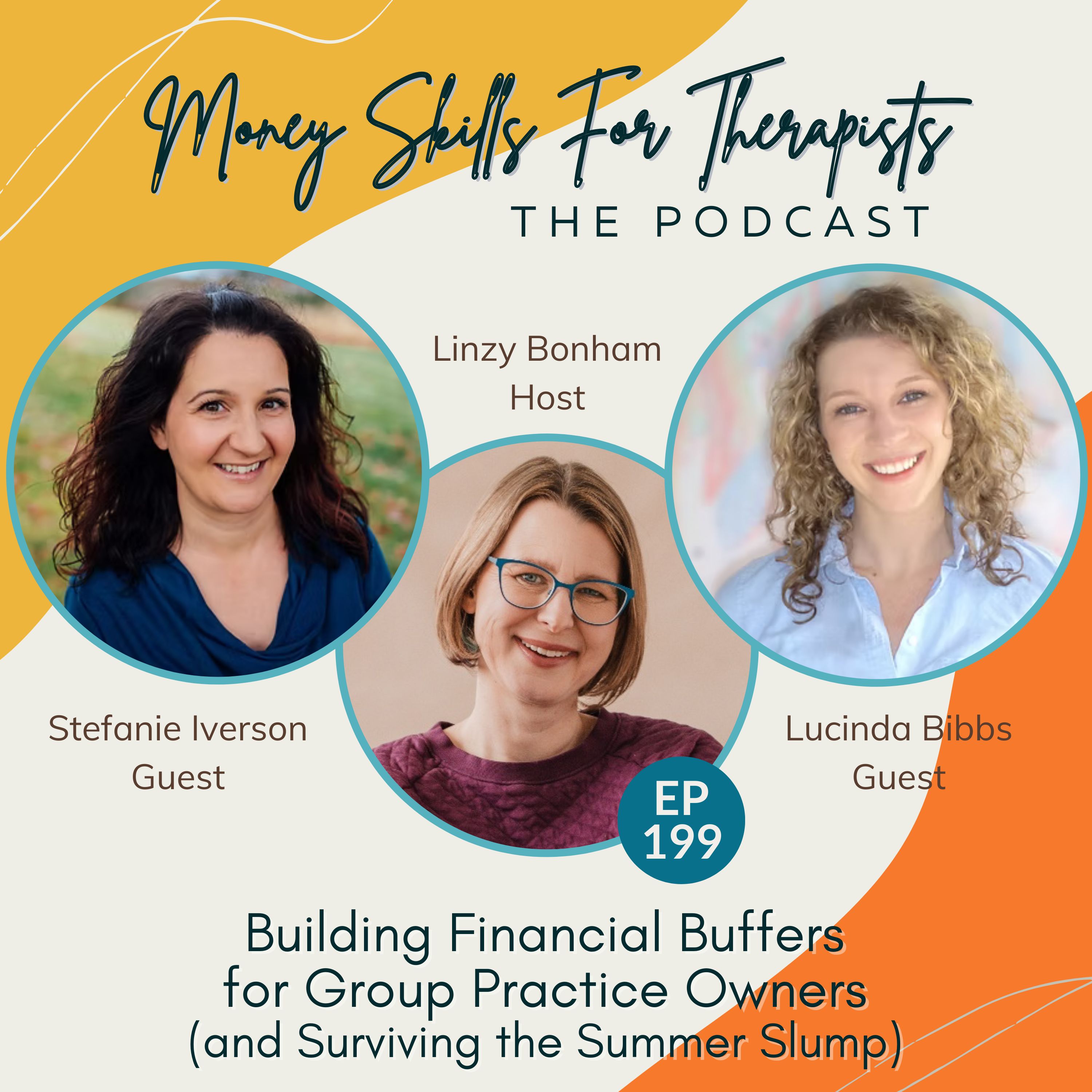
199: Building Financial Buffers for Group Practice Owners (and Surviving the Summer Slump)
Feb 1000:48:18Tap to summarizeSeasonal slowdowns can shake even the most well-run therapy practices—especially group practices navigating payroll, profit, and growth at the same time. This week, I sat down with Stef Iverson and Lucinda Bibbs, business partners and recent graduates of Money Skills for Group Practice Owners, to talk through what it really looks like to manage cash flow during a summer slump while still honoring long-term vision, wellness, and expansion.“I think it's just that the clarity and the reassurance, right? That we're on the right track...knowing the numbers has really helped us make non-emotional decisions. And just having clarity on what's actually on the paper and what are those numbers actually telling us? They're telling us a story and they're holding up a mirror and they're allowing us to make changes and pivots as we, as we need to." - Stefanie IversonStef and Lucinda came into this conversation fresh off their first slower season since implementing Profit First—and instead of panic, they brought curiosity. We talked through how their profit account temporarily buffered operating expenses, what that revealed about their numbers, and how to proactively plan for next summer so slow seasons don’t feel scary or reactive.Using Financial Clarity to Stay Grounded During Seasonal Revenue DipsWhat stood out most to me was how empowering it can be to replace “scrambling” with structure. When you know your numbers and intentionally build safety into your business, you give yourself permission to rest, plan, and make thoughtful decisions—even when revenue temporarily dips.(00:03:34) Navigating Profit Slumps & Business Growth Effectively(00:07:12) Savings Buffer Analysis to Prevent Pulling from Profit(00:12:29) Consistent Owner Draws and Keeping Profit Separate(00:16:06) Preparing for Economic Uncertainty and Anticipated Slow Seasons(00:20:58) Balancing Leadership and Growth with Work, Delegation, and Passions(00:26:45) Prioritizing Your Energy and Your Relationships(00:30:54) A Successful Partnership Built on Transparency(00:34:10) Evaluating and Expanding Services Offered(00:38:18) Tree Metaphor for Growth - With a Stable Trunk, Your Branches Can ReachStability First, Then Innovation: Growing Without Undermining the FoundationWe talked through how to experiment with offering new wellness services without neglecting the “main ship” of the group practice—and how to tell the difference between an idea that needs more time versus one that isn’t financially aligned right now.Key Takeaways for Therapists Navigating Slow Seasons or Growth Build buffers before you need them. Aim to have 2–3 months of operating expenses in your account so seasonal dips don’t trigger panic.Let stability lead. It’s okay to temporarily prioritize cash reserves over profit distributions.Test new offerings slowly. Pilot, track results, and adjust before fully committing.Protect the core practice. New ideas are exciting, but the existing business needs consistent care.Communicate clearly with partners. Transparency reduces emotional decision-making and strengthens trust.Slow seasons don’t mean you’re doing something wrong—they’re part of running a real business. With clear numbers, intentional buffers, and honest conversations, you can build a practice that feels both secure and flexible enough to grow in the directions that matter most to you.Ready to Improve your Business Money Skills?Are you a Solo Private Practice Owner? I made this course just for you: Money Skills for Therapists. My signature course has been carefully designed to take therapists from money confusion, shame, and uncertainty – to calm and confidence. In this course I give you everything you need to create financial peace of mind as a therapist in solo private practice.Want to learn more? Click here to register for my free masterclass, “The 4 Step Framework to Get Your Business Finances Totally in Order.”This masterclass is your way to get a feel for my approach, learn exactly what I teach inside Money Skills for Therapists, and get your invite to join us in the course.Are you a Group Practice Owner? Join the waitlist for Money Skills for Group Practice Owners. This course takes you from feeling like an overworked, stressed and underpaid group practice owner, to being the confident and empowered financial leader of your group practice.Get to know Stefanie Iverson & Lucinda Bibbs: Stefanie Iverson and Lucinda Bibbs are the co-owners of New Ground Wellness Collective (formerly South Okanagan Counselling), a group therapy practice based in Penticton, British Columbia, which they founded in 2022. As their practice grew, they recognized that strong clinical care alone wasn’t enough—they needed a deeper, more confident understanding of the financial side of group practice ownership.After completing Money Skills for Group Practice Owners, they began implementing clearer financial systems, Profit First principles, and more intentional decision-making across their business. Stefanie and Lucinda are now focused on systemization, metrics tracking, and exploring a potential shift from an independent contractor model to an employee-based structure, including future leadership roles within the practice. Their work reflects a thoughtful, values-driven approach to growth—balancing sustainability, collaboration, and long-term stability for both their team and community.Follow New Ground Wellness (formerly South Okanagan Counselling):https://www.newgroundwellness.ca/ hello@newgroundwellness.cahttps://www.instagram.com/newgroundwellnesscollectiveMentioned in this episode:Want to work with Linzy?Check out the FREE masterclass, The 4 Step Framework to Getting Your Business Finances Totally in Order, where you'll learn the framework that has helped hundreds of therapists go from money confusion and shame to calm and confidence, as well as the three biggest financial mistakes that therapists make. At the end, you'll be invited to join Money Skills for Therapists and get Linzy's support in getting your finances finally working for you. Click on the link to find a masterclass time that works for you! Register for Linzy's Free Masterclass
Transcribe →
198: Parenting With Purpose: Passing on Healthy Beliefs About Money
Feb 300:14:52Tap to summarizeOne of the most powerful (and often unspoken) ways we shape our kids’ relationship with money is through our own financial values and beliefs. The way we talk about money, how we feel about money and the habits we build around money ultimately become inherited by our children.In this solo episode, I reflect on the big hand we play as parents in creating our kids' money stories. I also explore what it looks like to model healthier financial skills with intention, clarity, and compassion—and why this work is as much a gift to ourselves as it is to the next generation.Modeling Healthy Money Skills for the Next GenerationOur kids look to us for guidance. They’re always watching us, listening to us and absorbing everything we say and do, and it’s no different when it comes to money. We’re the ones teaching them and planting those seeds—whether we mean to be or not.The way we talk about money, react to stress, or make everyday decisions becomes the foundation of their financial narrative, shaping what they believe is normal, possible, or scary. That’s why it’s really important to stop and think about what we want to be modeling to our kids about money.Start by getting clear on your own values around money, including:What you want your kids to emotionally associate with money (stress, confidence, neutrality, joy).The beliefs you want to model around responsibility, self-sufficiency, generosity, and justice.When you become more intentional with both your beliefs and your emotions, you create space for open conversations, skill-building, and confidence—helping your children develop a relationship with money that feels grounded, empowered, and aligned with the life you want for them.Raising Money-Aware Kids in an Intentional WayLook for moments where everyday language and emotional reactions become powerful teaching tools. You’ll notice how small shifts in awareness can transform money from a source of stress or silence into something you and your kids can talk about with honesty, clarity, and care.(00:06:45) Modeling Healthy Money Habits(00:08:01) Teaching Kids to Talk About Money(00:11:16) Navigating Emotional Reactions Around FinancesBuilding a Healthier Money Story at HomeYour words, reactions, and everyday habits quietly shape the money stories your kids carry into adulthood. By getting honest with your own values around money, you can model what you actually want to pass on to them, instead of defaulting to inherited beliefs or unconscious patterns. You’ll also start to notice how emotional responses like stress, avoidance, or openness become powerful teachers, often more impactful than any formal lesson.This creates space to rethink money as a tool and a form of power that can be used responsibly and in alignment with your values. Ultimately, it’s about giving your kids practical skills, emotional confidence, and a healthier relationship with money than many of us were ever taught.Ready to Improve your Business Money Skills?Are you a Solo Private Practice Owner? I made this course just for you: Money Skills for Therapists. My signature course has been carefully designed to take therapists from money confusion, shame, and uncertainty – to calm and confidence. In this course I give you everything you need to create financial peace of mind as a therapist in solo private practice.Want to learn more? Click here to register for my free masterclass, “The 4 Step Framework to Get Your Business Finances Totally in Order.”This masterclass is your way to get a feel for my approach, learn exactly what I teach inside Money Skills for Therapists, and get your invite to join us in the course.Are you a Group Practice Owner? Money Skills for Group Practice Owners is a six-month course that takes you from feeling like an overworked, stressed and underpaid group practice owner, to being the confident and empowered financial leader of your group practice. Click here to learn more and join the waitlist.Get to Know Linzy Bonham:Linzy Bonham is a private practice therapist turned money coach who helps private practice owners and health professionals feel calm and in control of their finances through her coaching at Money Nuts & Bolts and her podcast Money Skills for Therapists.It all started when she saw her extremely skilled colleagues struggle with the money side of business. Some had even left private practice, or were avoiding starting one, because the financial side was too stressful.So Linzy decided to help therapists and health professionals develop peace of mind about their money. Since so many were never taught these skills, she focuses on the “how” of making the business side of private practice doable, and even super satisfying.Follow Linzy Bonham:About Page: https://moneynutsandbolts.com/about/LinkedIn: https://www.linkedin.com/in/linzybonham/Instagram: https://www.instagram.com/moneynutsandbolts/Mentioned in this episode:Want to work with Linzy?Check out the FREE masterclass, The 4 Step Framework to Getting Your Business Finances Totally in Order, where you'll learn the framework that has helped hundreds of therapists go from money confusion and shame to calm and confidence, as well as the three biggest financial mistakes that therapists make. At the end, you'll be invited to join Money Skills for Therapists and get Linzy's support in getting your finances finally working for you. Click on the link to find a masterclass time that works for you! Register for Linzy's Free Masterclass
Transcribe →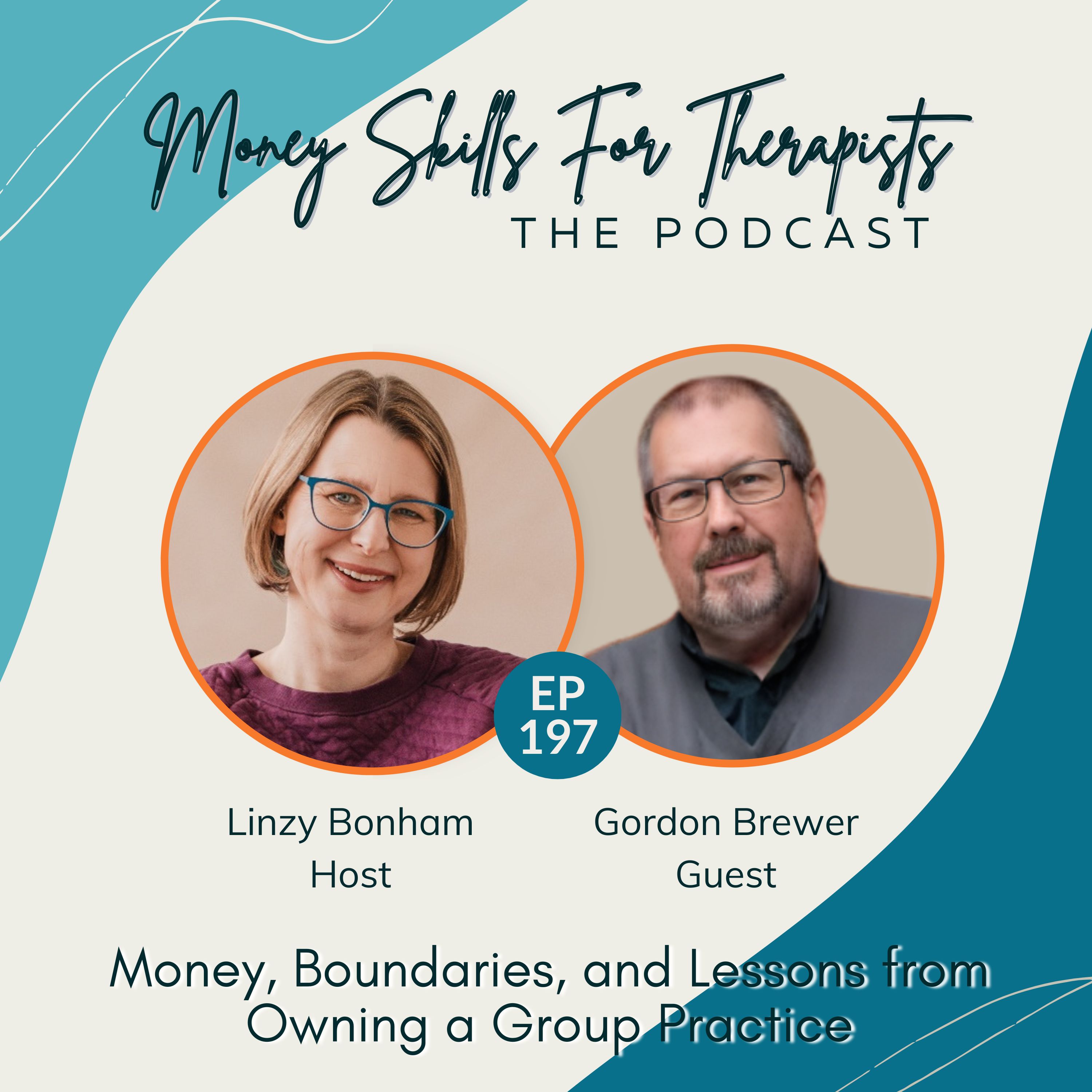
197: Money, Boundaries, and Lessons from Group Practice Ownership
Jan 2700:42:40Tap to summarizeAs therapists, most of us were never taught how to run a business—let alone how to manage money, payroll, hiring, or leadership in a way that’s both ethical and sustainable.Licensed therapist and group practice owner Gordon Brewer and I talk openly about money mindset, generosity, boundaries, hiring mistakes, and what it really takes to create a financially sustainable group practice without burning yourself out or sacrificing quality of care.If you identify as a people-pleaser, an over-giver, or a “nice” leader who are quietly paying the price for unclear boundaries, this episode is for you.Gordon opens up about what didn’t work when building his group practice, what had to change, and how learning to lead with clarity—rather than guilt—ultimately benefited both his team and his business.“Being kind means setting expectations and boundaries, so people know what to expect. Being nice often means avoiding those conversations—and that’s where things fall apart.” — Gordon BrewerMistakes Made and Lessons Learned: Building a Sustainable Group PracticeGordon shares how over-giving with compensation, avoiding hard conversations, and underestimating the importance of clear financial systems led to stress and instability in his practice. Through hiring missteps, money mindset work, and implementing Profit First, he learned that sustainable leadership requires clarity, boundaries, and a willingness to course-correct.(00:04:16) Gordon’s Journey to Owning a Group Practice and Hosting a Podcast(00:09:37) Sustainability Over Generosity: Lessons in Business(00:13:08) Navigating Money Stigma in Group Practice Ownership(00:17:51) Money Management and Hiring Lessons(00:20:05) How Boundaries and Values Shape Your Success with Finances(00:23:39) Parenting: Commands Disguised as Questions(00:27:03) Employee Benefits vs. Contracting(00:31:07) Planning for Financial Stability and Rebuilding a Sustainable Practice(00:36:43) How to Avoid Over-Giving in Your Private PracticeBuilding a Practice That’s Generous and SustainableGordon’s reflections highlight a truth I see again and again in my work with therapists: sustainability doesn’t come from good intentions alone. It comes from aligning your values with clear business decisions, financial transparency, and leadership that supports everyone involved—including you.Key takeaways you can apply right now: Run the numbers before calling something “generous.”High splits, low fees, or extra perks aren’t generous if they put your practice at risk. Sustainability is what allows generosity to continue.Being “nice” can quietly lead to burnout.Avoiding boundaries and hard conversations may feel compassionate in the moment, but it often creates resentment and instability over time.Kind leadership is clear leadership.Setting expectations upfront—and holding people to them—is one of the most respectful things you can do for your team.Money stories shape business decisions more than we realize.Beliefs about greed, selfishness, or worthiness often come from family or faith backgrounds and deserve to be examined—not blindly obeyed.It’s never too late to course correct.Gordon’s willingness to rebrand, rebuild systems, and restructure his business model created a healthier practice that better served everyone involved.If you’re noticing patterns of over-giving, financial stress, or people-pleasing in your practice, I hope this episode helps you feel less alone—and more empowered to lead with clarity and confidence. Sustainable, ethical business decisions aren’t a betrayal of your values. They’re how you protect them.Ready to Improve your Business Money Skills?Are you a Solo Private Practice Owner? I made this course just for you: Money Skills for Therapists. My signature course has been carefully designed to take therapists from money confusion, shame, and uncertainty – to calm and confidence. In this course I give you everything you need to create financial peace of mind as a therapist in solo private practice.Want to learn more? Click here to register for my free masterclass, “The 4 Step Framework to Get Your Business Finances Totally in Order.”This masterclass is your way to get a feel for my approach, learn exactly what I teach inside Money Skills for Therapists, and get your invite to join us in the course.Are you a Group Practice Owner? Join the waitlist for Money Skills for Group Practice Owners. This course takes you from feeling like an overworked, stressed and underpaid group practice owner, to being the confident and empowered financial leader of your group practice.Get to know Gordon Brewer:Gordon Brewer, MEd, LMFT is a licensed marriage and family therapist, group practice owner, and host of The Practice of Therapy podcast, where he supports clinicians in building sustainable, values-aligned private practices. With decades of experience in the mental health field, Gordon brings a grounded, real-world perspective to leadership, money mindset, hiring, and financial systems in group practice ownership. He is also an AAMFT Approved Supervisor and consultant, known for sharing both his successes and hard-earned lessons with honesty and generosity.Follow Gordon Brewer:LinkedIn: https://www.linkedin.com/in/psychcraftllc/Website: https://practiceoftherapy.com/Email: gordon@practiceoftherapy.comMentioned in this episode:Want to work with Linzy?Check out the FREE masterclass, The 4 Step Framework to Getting Your Business Finances Totally in Order, where you'll learn the framework that has helped hundreds of therapists go from money confusion and shame to calm and confidence, as well as the three biggest financial mistakes that therapists make. At the end, you'll be invited to join Money Skills for Therapists and get Linzy's support in getting your finances finally working for you. Click on the link to find a masterclass time that works for you! Register for Linzy's Free Masterclass
Transcribe →
196: Pricing Group Therapy Offers Without Guilt
Jan 2000:41:35Tap to summarizeAs therapists, many of us feel a deep tension when it comes to pricing—especially when we’re creating group offers, workshops, or professional-facing experiences during uncertain social, political, and economic times.In this coaching episode, I sit down with trauma therapist Kim Torrence to explore what really comes up when we try to assign value to our work: fears about accessibility, old beliefs about service and self-sacrifice, money shame, and the pressure to “get it right” before we ever put an offer out into the world.This conversation goes far beyond the math of pricing. Together, we unpack the emotional and mindset barriers that often keep therapists stuck offering their most meaningful work for free or far below what’s sustainable.If you’re navigating private practice finances, pricing group offers, or wondering how to honor both your values and your own well-being, this episode is here to support you with clarity, reassurance, and grounded next steps.Charging for Group Work in Your Therapy PracticeWe talk about why pricing is deeply connected to mindset and visibility, not just numbers, and how perfectionism or overcomplicated tech can quietly keep meaningful offers stuck on the sidelines. Our conversation centers on starting simply, naming your value clearly, and allowing confidence to build through real-world action.(00:06:02) Helping Others Through Feelings of Loneliness(00:07:17) Operating Business as Usual During a Crisis(00:12:16) Valuing Self-Care for Therapists(00:14:50) Authentic Healing for Deep Thinkers(00:18:29) B2B Value and Pricing Insights(00:21:18) Valuing Group Offerings Effectively(00:24:52) Self-Worth and Vulnerability(00:26:36) Creating a Supportive Success Container(00:31:57) Gather Feedback, Build Testimonials(00:33:42) Stop Overcomplicating Your Work(00:36:24) Owning Your Value in PracticeFrom Free to Paid: Navigating Pricing, Visibility, and Worth as a TherapistIf Kim’s experience feels familiar, you’re not alone. Here are a few reflections and actions I invite you to consider as you navigate pricing, worthiness, and financial sustainability in your own practice:Give your offer the credit it deserves.Even a lunch-hour workshop or short group can be deeply transformational. Duration and ease do not determine impact.Price for the right people, not everyone.Instead of focusing on who can’t afford your offer, get clear on who it’s truly for—especially when your work supports other professionals who carry that value forward into their own communities.Separate worth from accessibility narratives.Pricing your work sustainably doesn’t make you selfish or out of touch. It allows you to keep showing up, serving, and caring for yourself long-term.Keep it simple and start anyway.You don’t need a perfect website, branding, or tech stack. A clear Google Doc explaining who the offer is for, why it matters, and how to join is more than enough to begin.Your skills, knowledge, and presence—yes, even in a modest group format—are valuable. Pricing them too low doesn’t make your work more accessible; it often just makes it harder to keep going. When you name the real impact of what you offer, you give others permission to invest in themselves, too.Ready to Improve your Business Money Skills?Are you a Solo Private Practice Owner? I made this course just for you: Money Skills for Therapists. My signature course has been carefully designed to take therapists from money confusion, shame, and uncertainty – to calm and confidence. In this course I give you everything you need to create financial peace of mind as a therapist in solo private practice.Want to learn more? Click here to register for my free masterclass, “The 4 Step Framework to Get Your Business Finances Totally in Order.”This masterclass is your way to get a feel for my approach, learn exactly what I teach inside Money Skills for Therapists, and get your invite to join us in the course.Are you a Group Practice Owner?Money Skills for Group Practice Owners is a six-month course that takes you from feeling like an overworked, stressed and underpaid group practice owner, to being the confident and empowered financial leader of your group practice.Click here to learn more and register for Money Skills for Group Practice Owners.Get to Know Kim Torrence: Kim Torrence is a trauma therapist specializing in burnout prevention and perfectionism recovery for high-achieving women professionals who are exhausted from trying to do it all. She integrates Somatic Experiencing and Internal Family Systems (IFS) to help clients experience greater peace, confidence, and connection with their authentic selves. After transitioning fully off insurance panels, Kim is now exploring creative group offers as a way to support her community while building a financially sustainable, values-aligned private practice.Follow Kim Torrence:Website: https://kimtorrence.com/Free Offer: Free group healing movement session for listeners!Email: kim@kimtorrence.comMentioned in this episode:Want to work with Linzy?Check out the FREE masterclass, The 4 Step Framework to Getting Your Business Finances Totally in Order, where you'll learn the framework that has helped hundreds of therapists go from money confusion and shame to calm and confidence, as well as the three biggest financial mistakes that therapists make. At the end, you'll be invited to join Money Skills for Therapists and get Linzy's support in getting your finances finally working for you. Click on the link to find a masterclass time that works for you! Register for Linzy's Free Masterclass
Transcribe →
195: When Valuing Yourself Changes Your Circle: Money, Friendship & the Grief of Growth
Jan 1300:17:52Tap to summarizeAs we begin to take our financial needs seriously—raising fees, setting boundaries, and valuing our work—those shifts don’t stay contained to our businesses. They often ripple into our personal lives, especially our friendships. In this episode, I talk about what can happen when we move from self-sacrifice to self-advocacy, and how that transition can quietly (or painfully) change the dynamics of the relationships we’ve built.I explore why some friendships feel strained when old patterns of caretaking and over-giving no longer fit, and I name the very real grief that can come with outgrowing relationships that once felt safe or familiar. This isn’t about blame or “doing friendships wrong.” It’s about understanding that growth—especially financial and personal growth—can be both liberating and tender at the same time.If you’ve ever felt conflicted between honoring your own needs and preserving friendships you care about, this episode is for you. I offer a compassionate lens for making sense of these changes and reassurance that while some connections may fall away, others—often deeper and more mutual—can emerge in their place.When Taking Your Financial Needs Seriously Changes Your Friendships(00:01:45) Noticing Your Personal Needs as Your Practice (and Life) Evolves(00:05:18) Boundaries, Self-Worth, and Shifting Toward Mutual Relationships(00:08:37) How Changing Beliefs About Money and Systems Can Create Distance(00:12:49) Grieving Friendships That No Longer Fit Who You’re Becoming(00:13:59) Making Space for New or Deepened ConnectionsFrom Self-Sacrifice to Self-Worth: Redefining Friendships as Your Relationship with Money ChangesAs I’ve grown in my own relationship with money and self-worth—and as I’ve supported hundreds of therapists in growing their practices, earning more, and redefining what success looks like—I’ve seen this pattern again and again. When we stop undercharging, over-giving, or minimizing ourselves, our internal shifts often ripple outward into our friendships and relationships. As our values around money, time, and worth evolve, the relational landscape can change in ways that feel confusing, tender, or even unsettling at first.Here are a few reflections to hold as you navigate this season:Valuing your time changes relational expectations When your time and energy matter more to you, friendships rooted in imbalance may feel harder to sustain.Honoring your needs can reveal misalignment Some relationships deepen when both people embrace self-advocacy; others struggle when old roles no longer apply.Growth often brings both grief and renewal It’s normal to mourn what’s changing—and also to make room for friendships that align with who you’re becoming.Financial self-care doesn’t just affect your business—it shapes how you show up in relationships. If you’re feeling sadness, confusion, or even relief as friendships evolve, you’re not doing anything wrong. You’re growing. And on the other side of that growth, there is space for connection that feels more mutual, supportive, and true to you.Ready to Improve your Business Money Skills?Are you a Solo Private Practice Owner? I made this course just for you: Money Skills for Therapists. My signature course has been carefully designed to take therapists from money confusion, shame, and uncertainty – to calm and confidence. In this course I give you everything you need to create financial peace of mind as a therapist in solo private practice.Want to learn more? Click here to register for my free masterclass, “The 4 Step Framework to Get Your Business Finances Totally in Order.”This masterclass is your way to get a feel for my approach, learn exactly what I teach inside Money Skills for Therapists, and get your invite to join us in the course.Are you a Group Practice Owner? Money Skills for Group Practice Owners is a six-month course that takes you from feeling like an overworked, stressed and underpaid group practice owner, to being the confident and empowered financial leader of your group practice. Click here to learn more and register for the January 2026 cohort.Get to Know Linzy Bonham: Linzy Bonham is a private practice therapist turned money coach who helps private practice owners and health professionals feel calm and in control of their finances through her coaching at Money Nuts & Bolts and her podcast Money Skills for Therapists.It all started when she saw her extremely skilled colleagues struggle with the money side of business. Some had even left private practice, or were avoiding starting one, because the financial side was too stressful.So Linzy decided to help therapists and health professionals develop peace of mind about their money. Since so many were never taught these skills, she focuses on the “how” of making the business side of private practice doable, and even super satisfying.Follow Linzy Bonham:About Page: https://moneynutsandbolts.com/about/LinkedIn: https://www.linkedin.com/in/linzybonham/Instagram: https://www.instagram.com/moneynutsandbolts/Mentioned in this episode:Want to work with Linzy?Check out the FREE masterclass, The 4 Step Framework to Getting Your Business Finances Totally in Order, where you'll learn the framework that has helped hundreds of therapists go from money confusion and shame to calm and confidence, as well as the three biggest financial mistakes that therapists make. At the end, you'll be invited to join Money Skills for Therapists and get Linzy's support in getting your finances finally working for you. Click on the link to find a masterclass time that works for you! Register for Linzy's Free Masterclass
Transcribe →
194: Being the Breadwinning Therapist While Raising Young Kids
Jan 600:36:33Tap to summarizeIf you’re a therapist who carries the weight of being the primary breadwinner while also wanting more presence, more ease, and more time with your family, this episode is for you. This isn’t a conversation about hustling harder or squeezing more productivity out of already-full days. It’s about slowing down enough to make values-based decisions—so your money, time, and energy actually support the life you want to be living.In this coaching-style episode, I sit down with Colleen Barrows, a perinatal mental health therapist, mom of two young children, and graduate of Money Skills for Therapists. Together, we walk through the very real tension Colleen is feeling between maintaining financial stability as the primary breadwinner, managing most of the household responsibilities, and wanting more meaningful one-on-one time with her kids—while also nurturing a creative passion project, which will help therapists and postpartum women, that she hopes may one day provide her with passive income.Choosing Time, Family, and Financial Stability as a Breadwinning TherapistLike so many breadwinning therapist moms, Colleen’s “math brain” keeps telling her that the solution is to see more clients. She’s currently carrying a heavy client load while also functioning as the household manager and emotional anchor at home. In this conversation, I gently guide Colleen through a reflective exercise—imagining herself years from now, looking back on this fleeting season of early parenthood—and we explore what choices she would feel most proud of when it comes to time, money, and energy.A Coaching Conversation for Breadwinning Therapist Parents(00:03:39) Balancing Passion, Time, and Family(00:12:99) Juggling Work and Household Finances(00:16:57) Balancing Careers and Relationship Equity(00:22:41) Quality vs. Quantity in Parenting(00:24:20) Seeking Balance and Intentionality(00:27:08) Household Roles and Compatibility(00:31:52) Balancing Breadwinning and Family(00:33:21) Money Clarity for TherapistsExploring Choices Around Time, Energy, and IncomeThis episode offers an honest look at the tension many therapist parents feel—between financial responsibility, private practice demands, and the desire to be fully present during a fleeting season of early parenthood. If you’ve ever felt pulled between money decisions and your deeper values, this conversation is for you.Key takeaways to reflect on:Balance isn’t just math: Financial choices should support your well-being, not override it.Quality over quantity: Small, protected moments of connection matter more than constant presence.Revisit roles regularly: Sharing household labor and support can ease resentment and restore energy.Being the breadwinner often means carrying more than just the paycheck. This season of parenting young children is intense—but it’s not permanent. With thoughtful, values-led choices, you can build a life you’ll look back on with pride, not regret.Ready to Improve your Business Money Skills?Are you a Solo Private Practice Owner? I made this course just for you: Money Skills for Therapists. My signature course has been carefully designed to take therapists from money confusion, shame, and uncertainty – to calm and confidence. In this course I give you everything you need to create financial peace of mind as a therapist in solo private practice.Want to learn more? Click here to register for my free masterclass, “The 4 Step Framework to Get Your Business Finances Totally in Order.”This masterclass is your way to get a feel for my approach, learn exactly what I teach inside Money Skills for Therapists, and get your invite to join us in the course.Are you a Group Practice Owner?Money Skills for Group Practice Owners is a six-month course that takes you from feeling like an overworked, stressed and underpaid group practice owner, to being the confident and empowered financial leader of your group practice. Click here to learn more and register for the January 2026 cohort.Get to Know Colleen Barrows: Colleen Barrows is a therapist with over 15 years of experience, specializing in perinatal mental health and supporting moms through pregnancy, postpartum, and early parenthood. She lives in Ohio with her husband and two young children and brings a creative, human-centered lens to her work, shaped by her background as an artist and yoga instructor. Colleen is currently building a blog for postpartum moms that blends clinical insight with personal storytelling, and as a graduate of Money Skills for Therapists, she’s continuing to explore how to balance breadwinning, creativity, family life, and financial stability with more ease.Follow Colleen Barrows:Email: colleen@colleenbarrowscounseling.comWebsite & Free Guides: https://www.allthemamatherapy.com/Instagram: https://www.instagram.com/allthemamatherapyMentioned in this episode:Want to work with Linzy?Check out the FREE masterclass, The 4 Step Framework to Getting Your Business Finances Totally in Order, where you'll learn the framework that has helped hundreds of therapists go from money confusion and shame to calm and confidence, as well as the three biggest financial mistakes that therapists make. At the end, you'll be invited to join Money Skills for Therapists and get Linzy's support in getting your finances finally working for you. Click on the link to find a masterclass time that works for you! Register for Linzy's Free Masterclass
Transcribe →
EP 193: The Benefits of Sabbaticals for Therapists: Resistance, Recovery, and Renewal
Dec 1600:45:21Tap to summarizeHave you ever felt that deep longing to step away from your practice—not for a long weekend or a quick vacation, but for a real pause? A stretch of time where you can rest, reset, and reconnect with yourself outside of the constant giving that comes with this work? That’s exactly what Maegan Megginson and I explore in today’s episode. Why Sabbaticals Matter—Beyond “Time Off” Most of us only hear the word sabbatical in academic circles, but as Maegan reminds us, its root is “Sabbath”—rest. Somewhere along the way, rest became another productivity tool, something to “use well” rather than simply experience. As therapists and practice owners, we need something different. A true sabbatical isn’t for catching up on house projects or writing endless to-do lists—it’s about completely reimagining your relationship with time, worth, and spaciousness. Transforming Your Relationship with Time: The Power of Sabbaticals for Therapists (00:06:57) The 4 Types of Sabbaticals for Small Business Owners (00:12:12) Healing & Self-Discovery During Time Away (00:17:43) Productivity Culture and Its Roots (00:20:38) Business Challenges to Taking a Sabbatical (00:25:18) Adjusting Business Systems to Integrate a Transformative Experience (00:29:45) Modeling Self-Care for Others (00:35:24) Collective Sabbatical for Conscious Shifts (00:36:45) Sabbatical Journey and Integration (00:40:27) Sabbatical School & Financial Freedom Why This Feels So Hard—And So Important Why This Feels So Hard—And So Important I know the fears that come up, because I’ve had them too: “My practice will fall apart.” “Clients will leave.” “I can’t afford a break.” “People will judge me.” But Maegan and I both believe this wholeheartedly: your business can handle you stepping away for four weeks—and you can handle it too. Preparing your practice for your absence actually builds strength and resilience into your systems. And in truth, four weeks is a tiny blip in your clients’ lives. For many of them, it may even model something deeply healing. Sabbaticals as an Act of Rebellion Stepping back isn’t indulgent—it’s radical. It pushes against the cultural message that your worth depends on your output. It shows your clients, your colleagues, your kids, and the people who look up to you that it’s possible to reclaim time, energy, and humanity in a world that constantly asks for more. Your rest creates ripple effects. When you care for yourself, you give others permission to imagine a different way too. This conversation reminded me just how essential meaningful time away is—not only for our health and longevity, but for the stability of our businesses and the well-being of the communities we support. If you’re feeling stretched thin, burnt out, or disconnected from yourself, this might be the moment to gently ask: What do I truly need right now? And… What might become possible if I gave myself four full weeks to breathe? Ready to Improve your Business Money Skills? Are you a Solo Private Practice Owner? I made this course just for you: Money Skills for Therapists. My signature course has been carefully designed to take therapists from money confusion, shame, and uncertainty – to calm and confidence. In this course I give you everything you need to create financial peace of mind as a therapist in solo private practice. Want to learn more? Click here to register for my free masterclass, “The 4 Step Framework to Get Your Business Finances Totally in Order.” This masterclass is your way to get a feel for my approach, learn exactly what I teach inside Money Skills for Therapists, and get your invite to join us in the course. Are you a Group Practice Owner? The doors to join the January 2026 cohort of Money Skills for Group Practice Owners are now open! This course takes you from feeling like an overworked, stressed and underpaid group practice owner, to being the confident and empowered financial leader of your group practice. Want to learn more? Click here to learn more and register for Money Skills for Group Practice Owners. Get to Know Maegan Megginson: Maegan Megginson is a licensed therapist, business mentor, and rest advocate who helps mission-driven professionals build sustainable work without burning themselves out. She is the host of the Deeply Rested Podcast and the creator of Sabbatical School, where she teaches therapists and business owners how to step away from their practices for meaningful time off—without fear around finances, client retention, or everything falling apart. Drawing from her own experience with burnout and recovery, Maegan brings a compassionate, practical approach to redefining success beyond constant productivity. Her work supports therapists in creating businesses that honor rest, financial sustainability, and long-term well-being.If you’re wondering whether you could actually take a month off—without abandoning clients or destabilizing your practice—this free Sabbatical Toolkit is for you. It walks you through how to plan a month-long sabbatical in 2026 with care, clarity, and realistic preparation. Inside, you’ll find a 10-part audio training, a month-by-month planning roadmap, a financial worksheet to explore creative funding options, and sabbatical blueprints to help you design time off that’s genuinely restorative. It’s thoughtful, practical, and designed for clinicians who hold a lot—and need real support stepping away.Get the free Sabbatical Toolkit at www.YouNeedASabbatical.com/toolkit Follow Maegan Megginson: Website: https://maeganmegginson.com/ Podcast: https://maeganmegginson.com/deeply-rested-podcast/ LinkedIn: https://www.linkedin.com/in/maegan-megginson/ Mentioned in this episode:Start Feeling Calm and Confident About Your Group Practice FinancesFeeling overworked and underpaid in your group practice? You’re not alone. Running a group practice can feel like carrying the weight of everyone’s paychecks — including your own — and wondering if it’s all really worth it. That’s why I created a free guide called “How to Stop Feeling Overworked and Underpaid in Your Group Practice.” Inside, I’ll walk you through the four keys to becoming the confident financial leader your practice needs — so you can start feeling calm and in control of your money again. This guide is the first step toward the same kind of financial clarity and confidence I teach inside my deeper program, Money Skills for Group Practice Owners. 🙌 Download your free copy today — and let’s start building a group practice that supports you, not just everyone else.Get the Free Guide: How to Stop Feeling Overworked & Underpaid in Your Group PracticeWant to work with Linzy?Check out the FREE masterclass, The 4 Step Framework to Getting Your Business Finances Totally in Order, where you'll learn the framework that has helped hundreds of therapists go from money confusion and shame to calm and confidence, as well as the three biggest financial mistakes that therapists make. At the end, you'll be invited to join Money Skills for Therapists and get Linzy's support in getting your finances finally working for you. Click on the link to find a masterclass time that works for you! Register for Linzy's Free Masterclass
Transcribe →
187: Building a Sustainable Private Practice During Perimenopause: Scheduling, Systems, and Self-Compassion
Oct 2800:20:25Tap to summarizeWhat happens to your private practice—and your finances—when perimenopause hits and you just don’t feel like you used to?As therapists and health practitioners, we’re used to holding space for others—even when our own capacity is changing. If you’re noticing changes in your energy, focus, or mood and wondering how to keep your practice (and your finances) healthy, this episode might be just what you need.In this episode, I break down the real impact of perimenopause on therapists, from brain fog and fatigue to the tough decisions about reducing your caseload or raising your fees.I share some practical ways to adjust your schedule, automate your money systems, and, most importantly, ask for support so your business and finances work with your new reality. Remember—your practice can and should support you through every season of life!Supporting Yourself Financially and Professionally Through Perimenopause in Private Practice(00:04:14) Perimenopause's Impact on Therapists(00:07:59) Align Business with Current Reality(00:12:15) Prioritize Time, Health, and Money(00:15:11) Streamline Finances, Seek Support(00:18:33) Money Clarity for TherapistsPrivate Practice Finances for Therapists Experiencing PerimenopauseIf you’ve been noticing a shift in your health, energy, or focus as you move through your late 30s or 40s—especially the ups and downs of perimenopause—you’re not alone.Let’s be honest: perimenopause comes with a “whole list of not fun”—from hot flashes and brain fog to headaches, irritability, and unrelenting fatigue. If your capacity isn’t what itused to be, please know that adjusting your expectations and routines isn’t just okay—it’s necessary.Listen in for practical steps to create more ease in your schedule, value your expertise as your career progresses, and make sure your money truly supports you through this transitional season. I encourage you to create a clear system and habits for yourself, so you don't have to think fresh every time you sit down to work on your money. Having a nice, clear checklist of the tasks that you do whenever you do money time will help clear mental barriers and make the best use of the energy you have in that moment.(00:15:37) "Let's reduce the cognitive load associated with your finances when that cognitive energy right now would probably better serve you somewhere else because it might be in more limited supply than it used to be." - Linzy BonhamFinancial Self-Care for Therapists Navigating Perimenopause ChallengesHere are 3 key takeaways for therapists in private practice:· Accept Your New Reality: Your energy and focus may look different than they used to. Instead of holding yourself to past standards, adapt your schedule and expectations—this is about working with your reality, not against it.· Let Your Business & Money Support You: Adjust your caseload, consider increasing your fees, and schedule self-care. Your financial decisions now can directly support your health and quality of life.· Simplify Your Systems—And Ask for Help: Clear routines, automation, and seeking support (like hiring a bookkeeper) can help lighten your mental load, freeing up energy for both your work and your wellness.Ready to feel confident with your money?Are you a Solo Private Practice Owner?I made this course just for you: Money Skills for Therapists. My signature course has been carefully designed to take therapists from money confusion, shame, and uncertainty – to calm and confidence. In this course I give you everything you need to create financial peace of mind as a therapist in solo private practice. Want to learn more? Click here to register for my free masterclass, “The 4 Step Framework to Get Your Business Finances Totally in Order.”This masterclass is your way to get a feel for my approach, learn exactly what I teach inside Money Skills for Therapists, and get your invite to join us in the course.Are you a Group Practice Owner? Join the waitlist for Money Skills for Group Practice Owners. This course takes you from feeling like an overworked, stressed and underpaid group practice owner, to being the confident and empowered financial leader of your group practice.Get to Know Linzy Bonham:Linzy Bonham is a private practice therapist turned money coach who helps private practice owners and health professionals feel calm and in control of their finances through her coaching at Money Nuts & Bolts and her podcast Money Skills for Therapists.It all started when she saw her extremely skilled colleagues struggle with the money side of business. Some had even left private practice, or were avoiding starting one, because the financial side was too stressful.So Linzy decided to help therapists and health professionals develop peace of mind about their money. Since so many were never taught these skills, she focuses on the “how” of making the business side of private practice doable, and even super satisfying.Follow Linzy Bonham: About Page: https://moneynutsandbolts.com/about/ LinkedIn: https://www.linkedin.com/in/linzybonham/ Instagram: https://www.instagram.com/moneynutsandbolts/Mentioned in this episode:Start Feeling Calm and Confident About Your Group Practice FinancesFeeling overworked and underpaid in your group practice? You’re not alone. Running a group practice can feel like carrying the weight of everyone’s paychecks — including your own — and wondering if it’s all really worth it. That’s why I created a free guide called “How to Stop Feeling Overworked and Underpaid in Your Group Practice.” Inside, I’ll walk you through the four keys to becoming the confident financial leader your practice needs — so you can start feeling calm and in control of your money again. This guide is the first step toward the same kind of financial clarity and confidence I teach inside my deeper program, Money Skills for Group Practice Owners. 🙌 Download your free copy today — and let’s start building a group practice that supports you, not just everyone else.Get the Free Guide: How to Stop Feeling Overworked & Underpaid in Your Group Practice
Transcribe →