Podcast
POAAS
Hosted by H.E. Negash · EN
-self-published short and longform conversations on art and science
-book and film reviews
-homilies
aksum.substack.com
aksum.substack.com
13episodes
Episodes
Newest firstAll episodes
On Intercession
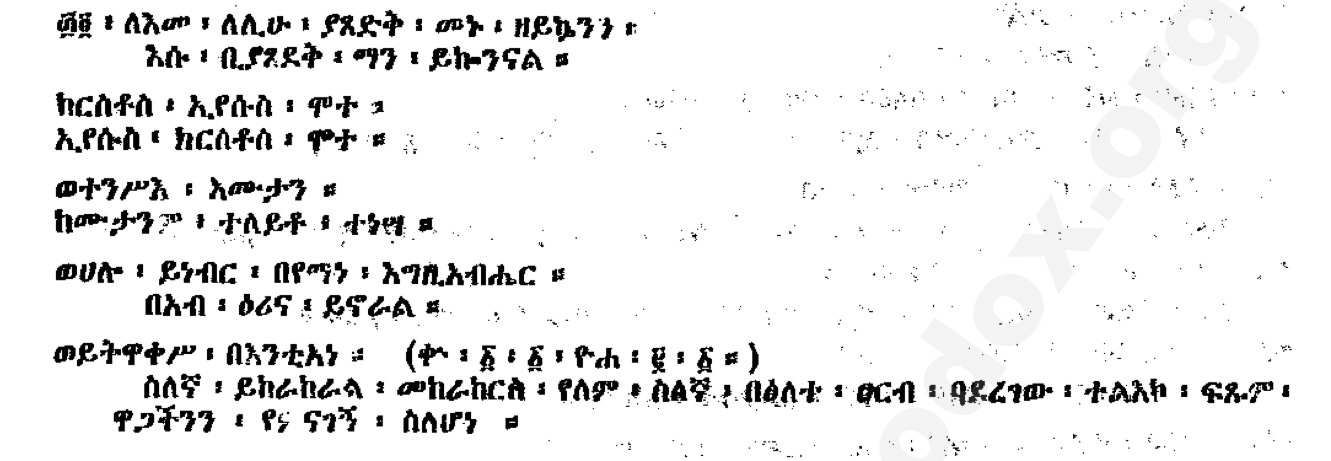
Jun 19, 202500:17:57Tap to summarizeThere are bishops in the Ethiopian synod right now that should immediately repent or be defrocked for denying the intercession and mediation of Christ (Romans 8:34; 1 Timothy 2:5; Hebrews 9:15). They tried to excommunicate my beloved former bishop his beatitude Abune Barnabas. They failed again. Their last attempt was in 2018 when there were two competing synods and he was vindicated then on both sides. This time they took advantage of ethnic strife and separatist sectarianism exasperated by government foment. Instead, he won. Kinda. Three bishops were accused of heresy. Initially, it was Abune Gabriel, who was unceremoniously appointed to his position to fulfill a racial quota in the minds of the separatists, as if the apostles being super-majority Galileans is damning, who was formally accused of false teaching regarding the application of the term redeemer/redemptrix. The merits of his case get bogged down in linguistic games that I am not addressing here. The second accused was Abune Philip, dean of Holy Trinity Theological College in the capital city Adees Abeba, who is accused of saying that without our lady the Holy Virgin Mary there is no Holy Trinity…The three bishops were said on EOTC TV’s youtube channel to have all asked for forgiveness and that they would correct their false teaching publicly on camera. Abune Gabriel and Abune Philip, as far as I know, have asked for forgiveness. It was alleged that Abune Barnabas had as well. I asked him in person, and he said that he never asked for forgiveness for teaching what is the universal dogma of the Orthodox Church, but for any who may have misinterpreted him as commanding the laity to eat asses or confused the intercession of the Lord Jesus with the intercession of the saints. He has never taught that the Lord is now at the right hand of the Father bowing and praying. Rather, the whole of his efficacious and salvific intercession is from his precious blood spilled at the place of the skull which even now speaks and cries aloud louder than the blood of Abel. I have begun reaching out to the metropolitans of the Syriac Orthodox and Coptic Orthodox in the metropolis of Los Angeles. I know that what I teach and what Abune Barnabas teaches aligns with them. On all matters of dogma (unchanging teachings), there can be no differences amongst the Afroasiatic Orthodox. There can only be difference in cultural expression and local canons (i.e. what time to start the liturgy on Sunday, how long a given fast is, the vestments of the clergy).Aksum Review of Books (ARB) is a reader-supported publication. Free subscribers help amplify this project by liking, commenting, and sharing. Paid subscribers keep ARB’s incandescent lights bright, for the price of one cup of buna a month. በእንተ : ስማ : ለማርያምNotes:-in my homily this passed Sunday I used the Catena app to source quotes on Romans 8:34 from St. Irenaeus of Lyons, St. John Chrysostom, and St. Severian of Gabala (foil and antagonist of the man with a golden mouth).-His Holiness Pope Shenouda of blessed memory says, "Christ is higher than the heavens and He is in heaven interceding for us. St. Paul the Apostle says that "He ever lives to make intercession for them. For such a High Priest was fitting for us, who is holy, harmless, undefiled, separate from sinners, and has become higher than the heavens" (Heb. 7:25,26)-Though he was not in communion with us, it is helpful to see what the late great Greek Orthodox (of slavic persuasion) Protopresbyter Thomas Hopko of blessed memory had to say on this matter in his Names of Jesus podcast:Holy Scripture tells us there is "One Mediator between God and men" (I Timothy 2:5). Fr. Tom Hopko teaches on Christ as our Mediator and Intercessor.TranscriptAug. 18, 2011, 3:11 a.m.In the New Testament Scriptures, our Lord Jesus Christ in several places is called the Mediator. In Greek that would be mesitēs, the mediator. And he’s called Mediator in several different ways: as a noun. The term “intercessor” as a noun does not exist, at least, I could not find it, but the fact that Jesus, as Mediator, lives eternally to make intercession, to intercede or to plead or to appeal or to turn to on behalf of us as Intercessor, that is definitely a teaching in the Holy Scripture. Although the noun “intercessor” is not used, the expression “to make intercession” is used, and the verb there would be “entynchanein, to make intercession, to act as an inter-mediator.”When we think of Jesus as Mediator, probably, for most Christians, most people who are familiar with the Holy Scripture, the text that would immediately come to mind would be the text in I Timothy, and it’s a text often quoted, and sometimes it’s a text quoted to perhaps by those who do not want to affirm the divinity of Christ, because the text in Timothy says this (I Timothy 2:5):For there is one God, and one Mediator between God and human beings (and men): the man, Christ Jesus.You see? So this is the text: “There is one God.” You see? One God: heis gar theos (one God) kai eis mesitēs theou (and one mediator of God) and anthrōpōn (human beings): one mediator of God and humans, or we might say in English: one mediator between God and human beings. Then it says, “anthrōpos Christos Iēsous”: “eis gar theos eis kai mesitēs thou kai anthrōpos Christos Iēsous.” Now, “anthrōpos” means “human being,” so it says, “There is one mediator between God and human beings, the human being (anthrōpos), Christ Jesus, Christos Iēsous.”Here we want to say, first of all, very important: Jesus Christ, Jesus the Messiah, Jesus of Nazareth is anthrōpos. He is definitely a human being. The Nicene Creed will sum this up when it says that “who for us and for our salvation came from heaven, was incarnate of the holy Theotokos and Ever-virgin Mary, kai enanthrōpēsanta—and became human, and was humanized, became human.” So of course it’s the Logos, the divine Son of God who becomes human, but he becomes a human being, a first-century Jew, Mary’s child, Joseph’s child by the Law: a man. And this is a dogma of ancient Christianity.And I will stress again: it was a dogma that was hard-won, because every heresy about Jesus, practically, in the first thousand years of Christian history was somehow—I can never find the verb here—somehow—what do I want?—not really insisting on the full humanity. Compromising. That’s it. Somehow compromising the humanity of Jesus. They’ll say, “Oh yeah, he was human, but not really human, not human like the rest of us. He’s God. He’s God. He acts like a human. He took a human body. He was in a human form. But he wasn’t really human.” Well, by the time you get to the fifth century in ancient Christianity, at least for some of us, there is no doubt whatsoever but that he is human. The Council of Chalcedon in 451 will say he is theos (divine, God), with the same divinity as God the Father, being of one essence with the Father, but he is anthrōpos with exactly the same human nature as all anthrōpoi, as all human beings. He is truly God and truly man; really God and really man; really divine, really human.As Mediator, as mesitēs, the one and only Mediator, this is the man, Jesus, because the Mediator has to be a mediator for us, and therefore he has to be what we are. If Jesus were not really and truly human, he could not function as a Mediator for us with God, because in that case he would just be God. He would just be God himself, only, the one with whom we have to have the mediation, the one with whom we need an intermediary, the one that we need to make intercession on our behalf, being one of us. He has to be one of us. It’s the man, Jesus, here, who is the mesitēs according to the Scriptures, certainly according to the I Timothy 2:5.In the Letter to [the] Galatians, that same word, “mesitēs,” is also used for Jesus, and this is what it says in Galatians 3:20. It says, “Now a mediator is not a mediator of one, but God is one.” Or, if you put it another way: “ho de mesitēs enos ouk estin.” In other ways, a mediator that’s only one cannot be a mediator, because to have mediation, you have to have two parties. But then he says, “God is one,” so the other party has to be what is not God. You see? So he says, “ho de mesitēs enos ouk estin,” now the mediator of one is not one, but God is one, therefore, the mediator has to be another one.As introducing this particular sentence, the 19th verse, would say this: If the inheritance were of the Old Testament law, it could not be because of the law because it would not be applicable. Therefore, it says, “it was added because of transgression.” The law is added because of transgression, “until the seed should come”: to sperma. And that means the seed of Abraham that was promised [to] be the one in whom all the people of the earth would be blessed. That’s what St. Paul is writing about, both in [the] Galatian letter and [the] Romans letter. In other words, God made a promise to Abraham—that’s in the Letter to [the] Hebrews, too; in fact, that’s in the New Testament generally, but especially Galatians, Romans, and Hebrews—God made a promise to Abraham that in his seed—and that seed would have to be a human seed because he’s got to be the son of Abraham, this child of Abraham—that all the people, all the human beings of the earth would be blessed.And then in Galatians, St. Paul [says] that seed is one. There’s only one seed, and that seed, according to St. Paul in Galatians, ...
Transcribe →
Scott Horton
Nov 29, 2024Tap to summarizeDespite being besieged by technical difficulties (my sincere apologies for the abrupt end) that I can only spiritually attribute to Our Enemy, The State, I had a blast conversing again with Scott Horton. This is why I sent you our conversation from three years ago, which if you have not seen and heard you should go do so in advance of this one.His latest book Provoked: How Washington Started the New Cold War with Russia and the Catastrophe in Ukraine (690 pages. The Libertarian Institute. November 16, 2024.), dispels the favorite spell and incantation of the legacy media, ‘unprovoked’. He traces the receipts of provocation in the Eurasian continent from every U.S. president in my lifetime: George Bush I, Bill Clinton, Barack Obama, George Bush II, Donald Trump, and Joe Biden.Free subscribers help amplify by liking and sharing. Paid subscribers keep ARB’s incandescent lights on, for the price of one cup of buna a month. በእንተ : ስማ : ለማርያም This is a public episode. If you'd like to discuss this with other subscribers or get access to bonus episodes, visit aksum.substack.com/subscribe
Transcribe →
Scott Horton
Nov 28, 2024Tap to summarizeThis is a Throwback Thursday on this lovely Thanksgiving Day to the great and powerful Scott Horton’s first appearance on the Philosophy of Art and Science broadcast. I have been following him for at least twelve years (I reference his conversation with Wendy McElroy here and Jeremy Scahill here), and he is the most consistent voice critiquing the actions of USFG across multiple White House occupants.Learn about North Hollywood (where I went to middle school) based KPFK 90.7 FM, a listener-sponsored radio station. And The John Birch Society, whom the twat William F. Buckley Jr. tried to expunge from the right for their consistent critiques of American foreign policy. And the inestimable multi-partisan Antiwar.com. And Afghanistan and the 60 words of the Authorization of the Use of Military Force (AUMF). And the great and powerful Dr. Ron Paul (adviser to the Department of Government Efficiency). And the gold-standard. And the 28 pages of THE JOINT INQUIRY INTO THE TERRORIST ATTACKS OF SEPTEMBER 11, 2001 – BY THE HOUSE PERMANENT SELECT COMMITTEE ON INTELLIGENCE AND THE SENATE SELECT COMMITTEE ON INTELLIGENCE. And more. This is a public episode. If you'd like to discuss this with other subscribers or get access to bonus episodes, visit aksum.substack.com/subscribe
Transcribe →