Podcast
Systematic Selling Podcast
Hosted by Sean M. Lyden · EN
A podcast for founders and owners ready to squeeze the stress out of sales and build a business they love.
www.systematicselling.co
www.systematicselling.co
11episodes
Episodes
Newest firstAll episodes
🎙️E31—14 Things to Do the Moment You Win the Work (Or Lose It)
4w ago00:52:26Tap to summarizeToday’s episode is for you if:* Your sales pipeline depends too much on finding the next customer.* You aren’t getting as many referrals or repeat sales as you should.* You've been blindsided by losing a customer you thought would never leave.Most sales conversations obsess over how to get the deal. Fewer talk about what happens the day after you sign it.That’s a problem, because that’s the part that determines whether you keep the client for one project or for ten years.David Roy and I spent our Substack Live conversation today on exactly that gap. We didn’t focus on theory but on the actual mechanics of what to do once you’re in the door...or when the door closes.Here are the most actionable moves we covered.Onboarding & Kickoff* Run a “Pre-Kick-Off Huddle” 3–7 days before any engagement starts. Walk through logistics and other action items to set up the Kick-Off—and the entire project—for success.* Get an introduction to the AP/accounts payable contact during onboarding. Don’t wait until an invoice is late to meet them. It builds a second relationship and takes payment friction off your primary contact’s plate.Proving Value On a Cadence* Set a recurring check-in cadence (weekly, biweekly, or monthly) specifically to show the customer what’s improved. Don’t assume they’re tracking it themselves.* Measure a baseline before you start (revenue, cost, whatever the relevant KPI is) so improvement is a number you can show, not a feeling you’re hoping they share.Protecting the Account* Build a simple color-coded budget/risk sheet for high-value clients. (This is especially valuable for commercial service companies.) Flag what needs attention soon (yellow) vs. now (red), with rough budget ranges. It positions you as protecting their blind side, not being pushy.* Learn each client’s budget cycle (not everyone runs January–December) so you’re recommending replacements or upgrades when there’s actually money to spend.* Build relationships with multiple people inside the account…not just the decision-maker, but the day-to-day user, the influencer, the assistant. This way, if your main contact leaves, you’re not starting from zero.Getting In / Staying In* Offer to be the “911 provider” for accounts that already have an incumbent. Even if you never win the whole account, being the emergency backup gets your foot in the door.* Keep a prospecting pipeline going even when you’re slammed. Never let your business development activity hit zero. Consistent BD protects you when an account changes hands or disappears overnight.* “Win” even with 2nd/3rd place finishes in RFPs. Staying visible and top-of-mind after a loss is often how you win the account later.Drawing Out Honest Feedback* Let upset customers vent without getting defensive. Resolving a real complaint well often builds more trust than if nothing had gone wrong.* Reframe feedback requests as aspirational. Ask: “How can we take this to the next level?” Not: “What needs improvement?” You’re asking the same question, but people open up more when they don’t feel like they’re being negative.Long-Term Account Health* Classify every account using the 4-Farmland Matrix (4FM)—new (farmland), underdeveloped, neglected, or lost. Each type calls for a different next move, whether that’s pursue, expand, staff up, or re-engage.* Don’t give up on lost accounts. Stay visible enough that when the new provider drops the ball, you’re the obvious call back.If you want the full context behind each of these — the stories, the numbers, and a couple we didn’t have room for here — the full Live conversation is where we actually walk through it. Get full access to Systematic Selling Newsletter at www.systematicselling.co/subscribe
Transcribe →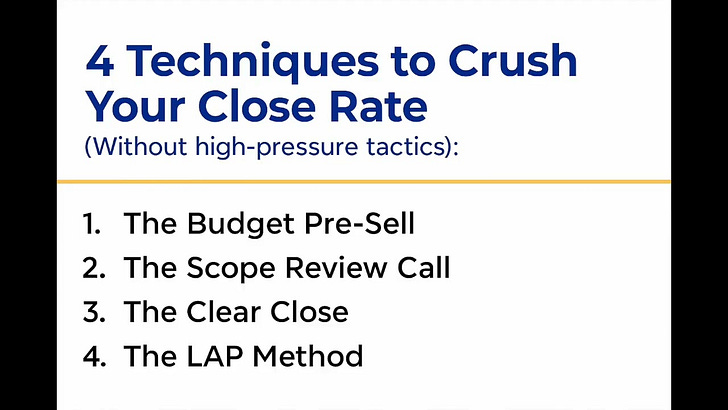
🎙️E30: 4 Techniques to Crush Your Close Rate (Without High-Pressure Tactics)
Oct 1700:33:19Tap to summarizeTired of getting ghosted after sending a proposal? In this live talk from the East Orlando Chamber’s Merchant Monday, Sean Lyden breaks down his four-part framework for closing more sales the systematic way. Learn how to pre-sell the budget, review scope live, create clear next steps, and use the L-A-P Method to clarify objections—all while keeping pressure low and trust high.By the end of this episode, you’ll know how to:- Handle pricing conversations early without losing credibility- Set clear next steps that prevent prospects from ghosting- Build buyer confidence without coming across as pushy- Use the L-A-P Method (Label, Ask, Propose) to clarify objections- Create alignment between your solution and the buyer’s problem.Episode Timestamps00:00 — Intro & why prospects ghost05:45 — The 4 techniques that reduce ghosting07:00 — The Budget Pre-Sale09:00 — The Scope Review Call11:00 — The Clear Close15:00 — The L-A-P Method for Objections19:00 — Sales as alignment, not persuasion20:30 — Q&A: handling pricing pushback24:00 — Q&A: how to balance giving clients space without losing momentum26:00 — Q&A: dealing with tech overwhelm and customer resistance29:00 — Q&A: reading body language and addressing hidden hesitation31:00 — Q&A: re-engaging ghosted prospects33:00 — The importance of tone, confidence, and terminology34:00 — “Never awaken the lizard brain” — how language affects buying behavior.Get bite-sized, high-impact sales systems training delivered to your inbox: SystematicSelling.co Get full access to Systematic Selling Newsletter at www.systematicselling.co/subscribe
Transcribe →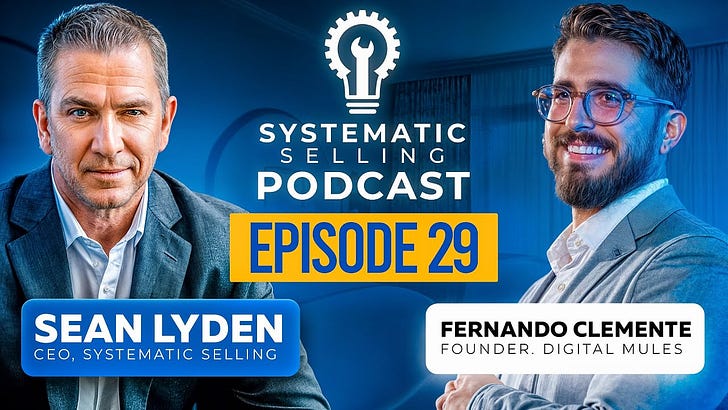
🎙️E29: Mastering High-Ticket B2B Sales
May 23, 202500:57:42Tap to summarizeIn Episode 29 of the Systematic Selling Podcast, Sean Lyden interviews Fernando Clemente, founder of Digital Mules, a South Florida-based digital marketing agency. Learn how Fernando grew his agency from a side hustle to a multimillion-dollar business, mastering high-ticket B2B sales and fostering a transparent, people-first culture. Discover actionable strategies for building a sales team, leveraging transparency for growth, and selling intangible services. Perfect for founders, sales leaders, and reps looking to scale their businesses.This episode dives deep into:* Fernando’s unconventional path to entrepreneurship, including failed businesses and pivotal life moments like a car accident that reshaped his trajectory.* The importance of transparency in leadership and how opening the books to his team doubled Digital Mules’ growth.* Strategies for selling intangible, high-ticket services by focusing on client value and problem-solving.* The role of patience in building a sales team and the key performance indicators (KPIs) that fuel long-term success.So, without further ado, get ready for Episode 29 of the Systematic Selling Podcast!Connect with Fernando: DigitalMules.comLearn more about Systematic Selling: SystematicSelling.co #Entrepreneurship #SalesStrategies #B2BSales #DigitalMarketing #CompanyCulture Get full access to Systematic Selling Newsletter at www.systematicselling.co/subscribe
Transcribe →
🎙️E28: How to Scale a Home Services Business with Partnerships & Service | Shea Sen
May 9, 202501:09:36Tap to summarizeToday, we have Shea Sen on the Systematic Selling Podcast.He is the founder and chief service officer of Silver Lining Home Services, based in Orlando, Florida. Founded in 2020, Silver Linings provides comprehensive moving, junk removal, move-out cleaning, and senior move management services, with a focus on easing real estate transitions for homeowners and seniors. Shea, a former Air Force pilot with decades of experience in sales, business development, and entrepreneurship, shares his journey from launching a lawn care business in high school to building a high-end audio retail empire and eventually founding Silver Lining.Shea’s business philosophy centers on serving clients by solving their problems through strategic partnerships and a servant-leadership mindset. He discusses how he leverages relationships with realtors, property managers, and senior living communities to drive referrals, the importance of emotional intelligence in serving senior clients, and how he fosters a culture that encourages team members to grow—even if it means starting their own businesses. This episode is packed with insights for entrepreneurs, sales professionals, and home service business owners looking to scale through partnerships, prioritize service, and build a lasting legacy.So, without further ado, get ready for Episode 28 of the Systematic Selling Podcast!Subscribe for more insights 👉 https://www.systematicselling.co/podcast This episode is a must-listen for entrepreneurs and sales professionals in the home services industry or any sector reliant on trust and relationships. Shea Sen’s story illustrates how a service-first mindset, strategic partnerships, and a commitment to team development can transform a business. Whether you’re looking to scale through referrals, serve a niche market, or build a culture that inspires growth, Shea’s insights provide a roadmap for success. Tune in to learn how to sell by serving and create a lasting impact in your industry. Get full access to Systematic Selling Newsletter at www.systematicselling.co/subscribe
Transcribe →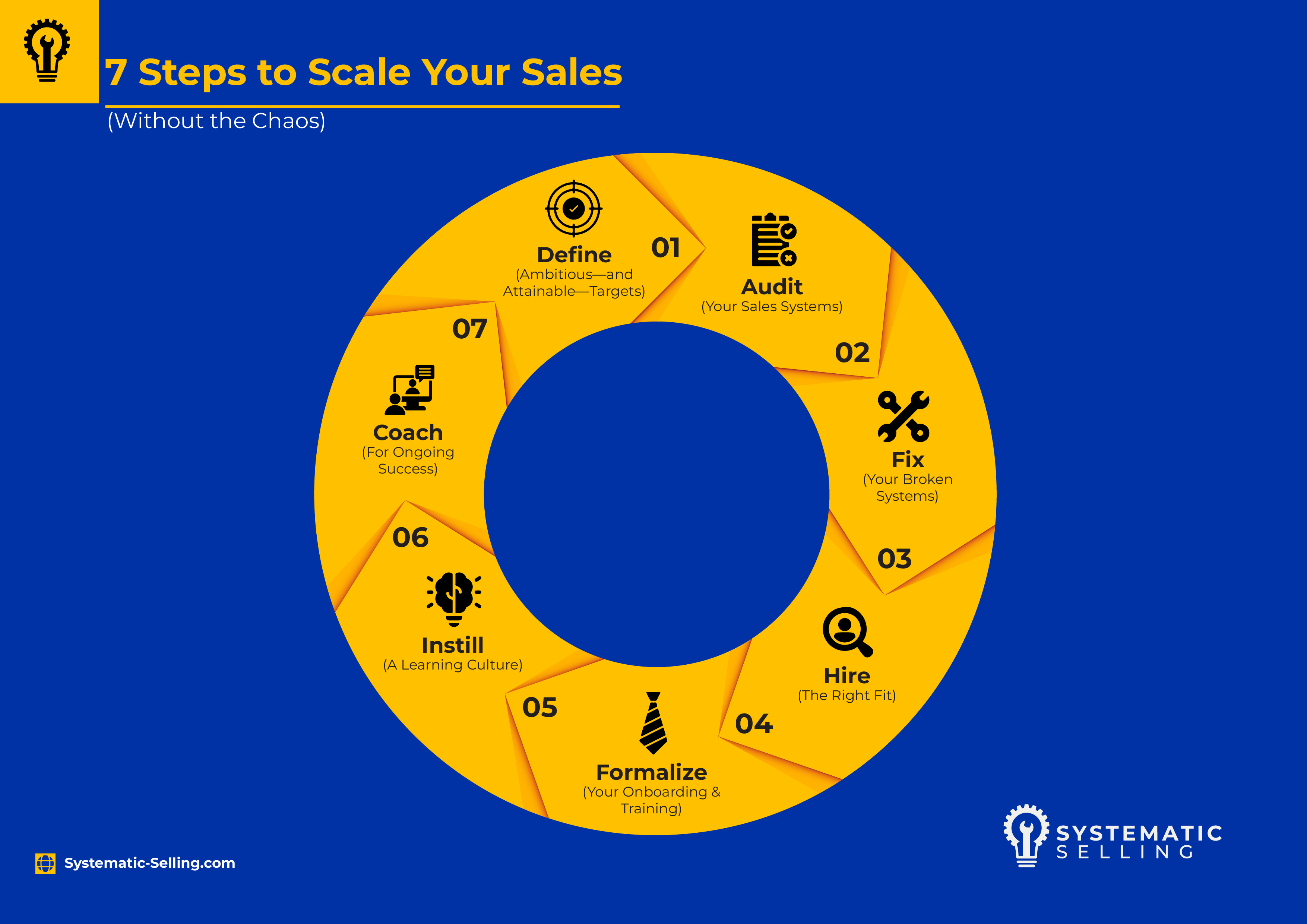
🎙️E27: 'Sink or Swim' is Not a Strategy
Mar 7, 202500:31:39Tap to summarizeToday’s episode is for you if you’re experiencing these problems:* New sales hires take too long to ramp up—or don’t stick around.* Your onboarding process is a mess—or nonexistent.* Your sales culture isn’t inspiring loyalty.New to Systematic Selling?* Subscribe for free to receive bite-sized, high-impact sales systems training delivered to your inbox each week.* Upgrade to Paid for the full experience, including access to the entire archives and premium-only sales training content, for a Venti Latte ☕️ per month.Today, on Episode 27 of the Systematic Selling Podcast…My talk on “‘Sink or Swim’ is Not a Strategy: 7 Steps to Set Up Your Reps for Success”Sales turnover is brutal—especially for small businesses.It’s expensive, disruptive, and demoralizing. And if you’ve ever felt the pain of losing a key sales rep, struggling to fill the role, and dealing with a drop in revenue in the meantime, you’re not alone.Consider these statistics:* 35% - Average sales turnover rate—more than twice as high as any other role* 47% - Sales reps who leave citing poor onboarding and training * 200% - Estimated percentage of a sales rep's salary it costs to replace them * 44% - Sales reps planning to leave their job within two years * 10+ months - Time it typically takes for a new sales rep to become fully productive * 18 months - Average tenure of a sales rep.I've seen this play out countless times with companies. They invest considerable time and resources to hire a sales representative, only to see that person walk out the door within 18 months. This means you might only get eight months of true productivity after all that investment.So how do we break this cycle? I've developed a seven-step cycle to slow the churn and accelerate your organization’s transformation into an elite sales team. Let me walk you through it.Step 1: Define Ambitious and Attainable Targets (00:02:44)How many of you have left a strategic planning meeting thinking, "They're smoking crack—there's no way we're hitting those numbers"? The problem is that goals are often disconnected from reality, specifically from the true price tag of the strategy and resources needed to achieve them.This disconnect creates unrealistic targets that demoralize your sales team, leading to burnout, resentment, and eventually turnover. The key is to ground your goals in reality.Try this strategic planning agenda for sales:* Debrief: Determine your current state—revenue, gross profit, and margin. How do these numbers stack up historically? Any records set? How do revenue streams rank by percentage? Who are your top clients?* Forecast: What are your projected revenue, gross profit, and gross margin targets? What assumptions underlie these numbers? What quarterly milestones should you establish to track progress?* Strategy: Ask this money question: "Imagine 12 months from now, we've hit our forecast. What will we have done to make that happen?" This question taps into the persuasion principle of thinking past the sale, helping everyone visualize success.* Team: Assess your current sales team size and composition. What's your sales turnover rate? What are your team's most notable strengths? What skill gaps need to be filled to hit your forecast? Are you ready to hire more reps?* Resources: Does your team have the tools they need to succeed? Consider technology, marketing support, industry events, training, and coaching investments. Ask, “What haven't we considered that we should?”* Action: Define immediate steps, responsibilities, and deadlines. Schedule a follow-up meeting to maintain momentum—what I call the "this meeting, next meeting" principle. Never break the chain.The goal isn't ironclad targets but getting initial targets out of your head and into a discussion with your team to sanity-check them.Step 2: Audit Your Sales Systems (00:10:45)Once you've defined targets and set your strategy, identify vulnerabilities in your sales systems that could hinder you from hitting your mark. There are 10 integrated systems that drive sales success, and if any of them slow down or grind to a halt, your entire operation suffers.Step 3: Fix Your Broken Systems (00:12:22)After your systems audit, prioritize which issues would make the biggest immediate impact if addressed. You can't tackle everything at once, so focus on the critical few that will move the needle. Test the fix and then document it in your sales playbook.One of the biggest mistakes I see owners make is hiring a rep and expecting that person to solve all their sales problems. That's not how it works. Fix your sales systems first. Then hire more new reps to help you run and optimize those systems. Step 4: Hire the Right Fit (00:12:48)I recommend evaluating sales candidates through three lenses:Lens 1: Company Stage* Stage One: Founder-led sales* Stage Two: Founder-managed sales* Stage Three: Specialized roles (VP Sales, Sales Manager, SDR)Lens 2: Candidate Profile* Rookie: No bad habits, relatively inexpensive, but lacks experience* Emerging Star: Some experience but hasn't hit their prime* All-Star: Making bank where they are, which means you'll need to pay top dollar* Sunsetter: Looking for higher base compensation rather than commission upside (a red flag)Lens 3: CharacterThe mantra I drill into my clients: Hire for character, train for success. If you get the character right—grit, emotional intelligence, work ethic—you can mold and shape them.But how do you get at the truth in interviews? Avoid standard questions like "What's your greatest weakness?" Instead, draw candidates out with scenario-based questions. For example, to assess integrity, ask: "Describe a situation where you had to deliver bad news to a customer. How did you handle it? What guided your approach?" Step 5: Formalize Your Onboarding and Training (00:18:00)Consider these statistics: * 10 weeks is the average training requirement for a newly hired sales rep. * Teams that invest in sales training are 57% more effective than those that don't. * And 94% of reps would stay longer if the business invested in their careers.Proper onboarding starts before day one. Prepare everything in advance and contact the new hire a day or two before they start with a warm welcome. This small act of kindness goes a long way. Then, make those sales reps feel like kings and queens in public. Announce them to your customer lists and on LinkedIn. Encourage team members to welcome them in the comments. This doesn't take much time but sets a powerful tone that says, "We value you." For training, I've identified 17 areas crucial for B2B sales reps, starting with your company's vision, mission, and values—why you exist, what's important to you as a company. Think of training delivery on three levels:* Classroom: Learn the concept* Application: Put the concept into action* Debrief: Provide feedback to make adjustmentsFor rookies, think about where you can slot them in immediately to bring value. Could they start as sales support or an SDR, freeing up experienced reps to focus on closing? This approach allows them to bring immediate value while developing their skills. Step 6: Instill a Learning Culture (00:26:00)Create an environment of continuous improvement through:* Weekly tactical meetings* Book discussions* An on-site library* Access to online training* Reading trade media covering your customers' industries.Step 7: Coach for Ongoing Success (00:26:29)Training is not a set-it-and-forget-it program. Meet with your reps regularly and coach effectively during one-on-ones.I recommend a Socratic approach rather than being prescriptive. For example:When a rep asks, "What should I do about X?" resist the temptation to immediately say, "You should do Y and Z." Instead, ask, "What does your gut instinct tell you?"If their answer makes sense, say, "Sounds like you have your answer. What's holding you back?" If their answer is off course, don't say, "That's a stupid idea." Ask, "How do you see that playing out?" The Socratic approach guides them to discovery so they own the action they need to take.A typical coaching agenda I follow includes:* End Zone: Wins (debrief successes)* Red Zone: Pending proposals (getting deals over the line)* Pipeline: Prospects and discovery meetings* Prospecting: Lead generation* Conflict Resolution: Mismatched expectations, invoice disputes (00:28:00)The Vince Lombardi ExampleVince Lombardi was hired by the Green Bay Packers in 1959 after they had suffered 10 straight losing seasons. In his first team meeting, he said, "I have never been on a losing team, gentlemen, and I do not intend to start now." Unlike today's NFL, Lombardi couldn...
Transcribe →
🎙️E26: To Sell is to SERVE
Feb 21, 202500:17:21Tap to summarizeIn this episode of the Systematic Selling Podcast, Sean Lyden breaks down a powerful 5-point framework for sales success that allows you to sell without being pushy or “salesy.” The framework, SERVE, helps sales professionals and business owners create alignment between a prospect’s needs and their solution, build trust, and develop long-lasting relationships that lead to sustainable growth.Whether you're in B2B sales, own a business, or are looking to improve your networking and customer relationships, this episode provides actionable insights to help you sell more effectively—without the pressure or drama.Key Takeaways & Timestamps[00:00:00] Sales is About Alignment, Not ConvincingSales isn’t about persuading someone to buy—it’s about aligning their problem with your solution.The best sales professionals focus on serving rather than selling.[00:01:00] The SERVE Framework for Selling Without PressureThe SERVE acronym represents five key principles:S – Set One-on-OnesE – Earn TrustR – Relate Benefits to GoalsV – Value EveryoneE – Engage Consistently[00:01:49] S – Set One-on-OnesOne-on-one meetings are where strong relationships are built.There’s a direct correlation between the number of one-on-ones and the number of qualified prospects you generate.Pro tip: Let the other person talk 70% of the time—the more they talk, the more they trust and like you.[00:04:00] E – Earn TrustTrust exists on a continuum from 0 (no trust) to 10 (impeccable trust)—your goal is to move prospects along this spectrum.Ways to earn trust:Be authentic—be yourself.Do what you say you’re going to do—follow through on commitments.Set expectations clearly, especially when making introductions or referrals.[00:07:36] R – Relate Benefits to GoalsThe best salespeople match what they offer to what the prospect truly needs.People resist making decisions when faced with too many options (ambiguity effect). Keep it simple.Instead of prescribing, use a Socratic approach—ask questions to help the prospect discover value on their own.[00:10:50] V – Value EveryoneTreat every person—prospects, clients, team members—as valuable.Simple actions, like introducing a new contact to the right people, can have a long-term impact on their success (and yours).A real-world example: How a simple introduction at a networking event led to multiple new business opportunities.[00:14:10] E – Engage ConsistentlyBuilding relationships doesn’t end after the first meeting.Follow up through LinkedIn, emails, and direct messages to stay top-of-mind.Engage with their content (likes, comments, shares) to help elevate their visibility—it’s a free way to add value.A personalized touch—such as sending a message on birthdays or holidays—strengthens connections.[00:16:40] Final Takeaway: Commit to SERVESelling the right way—through service, not pressure—helps you attract more business naturally.When you apply the SERVE framework, you’ll build trust, uncover new opportunities, and grow your sales in a way that feels natural and sustainable.Resources & Next Steps🔹 Learn more about Systematic Selling: https://www.systematicselling.co/🔹 Connect with Sean Lyden on LinkedIn: https://www.linkedin.com/in/seanlyden/🔹 Subscribe for future episodes: https://www.systematicselling.co/podcast🎙 Liked this episode? Leave a review and share it with someone who would benefit from these insights! Get full access to Systematic Selling Newsletter at www.systematicselling.co/subscribe
Transcribe →
🎙️E25: Three Digital Marketing Strategies To Scale B2B Sales
Feb 7, 202501:15:40Tap to summarizeToday, we have Tamara Mon Louis on the Systematic Selling Podcast.Tamara is the founder of Monivan Digital Marketing Solutions, launched in 2018.She has over two decades of digital marketing experience across several key sectors, including hospitality, travel, healthcare, and education, helping brands grow revenue online.An amazing fact: Tamara was selected from over 3000 candidates to be the E-commerce Manager at Hilton Worldwide. There, she developed and executed digital strategies that reclaimed the Hilton brand’s search engine market share.She’s also host of the popular Your Business in Digital podcast.I’ve gotten to know Tamara through the East Orlando Chamber of Commerce here in Orlando, Fla. She’s the real deal when it comes to digital marketing, and I’ve spoken with several of her clients here in Orlando who sing her praises.That’s why I invited her to join us—to talk about how we can integrate digital marketing strategies and best practices into our B2B sales processes.So, without further adieu, let’s get ready for Episode 25 of the Systematic Selling Podcast!Connect with Tamara Mon Louis Website: monovandigital.com Podcast: "Your Business and Digital" on YouTube Book a consultation through her websiteSean M. Lyden is the founder and CEO of Systematic Selling, a sales systems and coaching company for growth-minded SMB founders and owners looking to scale their sales (without the chaos). Get full access to Systematic Selling Newsletter at www.systematicselling.co/subscribe
Transcribe →
🎙️E24: The 3 Pillars of B2B Sales | The Hole in the Wall Podcast
Jan 24, 202500:37:12Tap to summarizeToday's podcast episode is for you if you're experiencing these problems:* You keep losing deals on price and don't know why.* Your proposals aren't getting the conversion rate you want.* You find yourself making reactive decisions about pricing and proposals.Last year, I joined James Groves and Bill DeMent, owners of the Hole in the Wall Drywall Repair, on the Hole in the Wall Podcast.We covered a wide range of topics, including my personal story, which I haven’t shared much before in the Systematic Selling Newsletter. And we really dug into a lot of the nuts and bolts of Systematic Selling, with practical sales advice you can apply immediately to your business.So, I asked James and Bill for their permission to share this episode with you.We talked about:* How the right systems can transform chaotic sales processes into predictable results.* The crucial difference between 'incumbent' and 'discretionary' businesses and how it affects your sales strategy.* Strategic ways to use LinkedIn beyond just posting content, including an intentional and systematic approach to DMs and relationship-building.* The importance of presenting budgets during Discovery rather than waiting for the Proposal stage.* Why networking serves different purposes for different industries and how to use it effectively.* A systematic approach to cold emails that focuses on helping rather than selling.* How to establish long-term B2B relationships through strategic trust-building.Here’s the episode with Bill and James!Sean M. Lyden is the founder and CEO of Systematic Selling, a sales systems and coaching company for growth-minded SMB founders and owners looking to scale their sales (without the chaos). Get full access to Systematic Selling Newsletter at www.systematicselling.co/subscribe
Transcribe →
🎙️E23: Building High-Performance Sales Teams
Dec 6, 202401:10:19Tap to summarizeToday's podcast episode is for you if you're experiencing these problems:* You’re dealing with high sales turnover rates.* You’ve hired reps who interview well but fail to deliver results.* You don’t have a dependable process for vetting candidates thoroughly.* You’re uncertain about how to train and develop your sales team, especially those without prior sales experience.* You’re struggling to find the right balance between trusting your sales team and maintaining control over your business.Episode 23: Julio MelaraToday, we have Julio Melara on the Systematic Selling Podcast.Julio is the founder and CEO of Melara Enterprises and several other brands.He’s the publisher of the Baton Rouge Business Report, a leading business news publication that serves the Greater Baton Rouge area in Louisiana, providing in-depth coverage of local business trends, economic development, entrepreneurship, and government policy affecting the business community.Julio is the consummate salesman, and I’ve seen firsthand how he knows how to build a successful sales team.So, without further adieu, let’s get ready for Episode 23 of the Systematic Selling Podcast👇Key TakeawaysEarly Career Lessons [00:01:30]- Mother's wisdom: "Don't let anyone outwork you or outlearn you"- Put himself through college while working 40-50 hours per week- Began in sales during senior year, attending college in a suit dailySales Philosophy [00:11:30]- "Serving is the gateway to success"- Sales philosophy should align with life philosophy- Focus on building long-term relationships over transactions- Sales is "the highest paying hardest work and lowest paying easiest work"Three Essential Mindsets [00:15:00]- Growth mindset vs. fixed mindset- Positive mindset vs. negative mindset- Abundance mindset vs. lack mindsetHiring Process - The Rule of Three [00:40:45]- First Interview: Sales skills and experience assessment- Second Interview: Sales presentation and technical evaluation- Final Interview with CEO: Culture fit and character assessmentCultural Values [00:52:24]- Company Vision: "Excellence, innovation, and impact every day"- Five Core Non-Negotiables:- Integrity and honesty- Commitment to excellence- Giving back to the community- Innovation- People focusLeadership Philosophy [01:08:23]Four daily priorities as a leader:- Lead with purpose- Solve problems- Serve people- Bring the energyNotable Quotes"Money is the goal, but it's not our purpose." [00:46:14]"What determines our success is what goes out of here - the quality of our service, the quality of our products, the quality of our relationships." [00:47:00]"Fear and faith have two things in common: they both start with the letter F and they both believe in the future that hasn't happened." [01:02:31]Practical Tips for Sales LeadersHiring Best Practices- Maintain a "talent pool" of potential candidates- Conduct thorough social media screening- Prefer hiring people without previous sales experience to avoid bad habits- Use a guarantee period (6-12 months) for new sales reps to remove financial pressureTeam Development- Focus on serving customers rather than meeting quotas- Invest in continuous training and development- Build a culture that embraces change and innovation- Create clear systems and processes for accountabilityCommon Mistakes to Avoid- Rushing the hiring process- Focusing solely on sales experience- Neglecting cultural fit- Leading from fear instead of faith Get full access to Systematic Selling Newsletter at www.systematicselling.co/subscribe
Transcribe →
🎙️E22: Selling Without 'Selling'
Oct 18, 202401:14:56Tap to summarizeToday, we have Scott Janney on the pod. Scott is the CEO and co-founder of Magazine Jukebox, a venture-backed startup in Norfolk, Va., that has built an online entertainment platform—think digital magazines, games, and trivia—that enhances the customer experience wherever there are waiting areas, like healthcare facilities, hair salons, and automotive service centers. Scott is a 10th-grade dropout turned successful entrepreneur. And today, Scott and I talk about his go-to-market strategy with Magazine Jukebox, his approach to sales, and his experiences building a sales team.His stories will entertain you—and fire you up 🔥 So, let's get ready for Episode 22 of the Systematic Selling Podcast 👇Our Book is Now on Audible👇Today’s episode is brought to you by our new book, Collaboration Effect on Profit: Overcoming Founder’s Syndrome to Achieve Sustainable Success—now available on Audible.About the host:Sean M. Lyden is the co-founder and CEO of Systematic Selling, a sales systems and coaching company for growth-minded SMB founders and owners looking to scale their sales (without the chaos). Get full access to Systematic Selling Newsletter at www.systematicselling.co/subscribe
Transcribe →