← The Jimmy Dore Show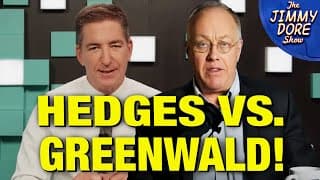
The Jimmy Dore Show
Chris Hedges REACTS To Glenn Greenwald Criticism!
00:58:28
Glenn Greenwald recently responded to an article by Chris Hedges titled “The Purge of the Deep State and the Road to Dictatorship” describing Donald Trump’s dismantling of longstanding government institutions as a portent of worse to come....
Loading summary
Transcript98 lines
- [00:00]
Instacart Advertiser
You may want to consider shopping through Instacart this winter if you like watching snow more than walking in it. Celebrate soup season or own several pairs of fuzzy socks. Because staying home means staying warm and some days just scream delivery. So this season, get everything you need right from the comfort of your robe. Download the Instacart app and get delivery in as fast as 30 minutes. Plus enjoy. $0 delivery fees on your first three orders. Service fees, exclusions and terms apply.
- [00:32]
Jimmy Dore
Come see us on tour. We're going to be in Baltimore, Hartford, Connecticut, Syracuse, Atlantic City, Levittown, New York, co host, New York and Providence, Rhode Island. Go to Jimmy Dore.com for a link for tickets. Establishment media sucks August light and so.
- [00:49]
Glenn Greenwald
Good luck bullshit we can't afford why.
- [00:52]
Jimmy Dore
Fomenting this watch and see as his jack golf the medium speeds and jumps the medium hit some head on it's the chimney door show. I try not to have heroes because your heroes will always let you down, right? And then that hurts. That's. But I did it with Bernie Sanders and. But so Glenn Greenwald's always been, you know, you and Glenn have always been in that realm for me. And I saw, I was watching Glenn, he, he did this segment in response to something that you had written and I wanted to show it to you because, you know, here are, you know, my two people. I admire greatly having different opinions on this and I want to get your opinion on what he had to say. So it's about, it's about four minutes and we'll be, we'll listen to it.
- [01:46]
Chris Hedges
Okay.
- [01:47]
Unknown Speaker
Hi Glenn. It's fascinating to watch the success of Doge, what's being exposed with US aid, etc. And two of Trump's most controversial picks, Tulsi and RFK, being confirmed. It does seem like we're headed for some sort of renaissance or course correction long overdue. I'm curious about your take on Chris Hedges, his recent remarks about the empire self destructing, which is the alternate way of viewing these events. Here is his first paragraph. Quote, the billionaires, Christian fascist, grifters, psychopaths, imbeciles, narcissists and deviants who have seized control of Congress, the White House and the courts are cannibalizing the machinery of the state. These are self inflicted wounds characteristic of all eight empires which will cripple and destroy the tentacles of power. And then like a house of cards, the empire will collapse. I do without all that invective that he put there and I'm not sure why that's there. Just leave that question to the side for the moment. I do think that a lot of what's happening is through necessity. The reality is that this American empire is unsustainable. I'm not somebody who thinks admitted the United States government as a deficit or even debt, that that's kind of apocalyptic. It is not the same. And I've never accepted the analogy that just like a family has to balance their budget, so too do governments. Governments can use debt financing and have for lots of different reasons, but that doesn't mean there aren't limits on them. And if you look at the debt of the United States and what is required to be serviced, just the interest payments alone, and you lay on top of that the trillions and trillions of dollars that we've spent on foreign wars all over the place, it is obvious that that needs to be reined in. Even if you're morally supportive of it, even if you think it's strategically advantageous, it's simply not sustainable. United States cannot continue to endure, sustain the level of debt that it has and the policies that generate that. So I think a lot of what Trump is reacting to and a lot of what Elon Musk is doing is almost an inevitable recognition that there has to be a radical course correction. But at the same time, I think it's an important course correction. I do not think that American empire has been good for the world. And often the argument is, well, even if it wasn't good for the world, the alternatives would be worse. We don't have to live under a single superpower or a single empire. In fact, most of world history has not been a unipolar world. There is a benefit from balancing powers. And yes, that was tried in the 18th and 19th century and it often produced wars. This idea that we were going to have a balance of powers and no one would be dominant. But it just simply is the fact that if you look at how many wars the United States has started, how many of the wars the United States has fueled, how many of the wars of wars the United States has fought, how many of the proxy wars the United States fuels, so much of the world's violence emanates from the United States. And there have been empires in the past that would use wars to use, use it as conquest. Take land, take assets, and for a while that can be fed. But ultimately even those empires collapse because it just becomes so sprawling and so unmanageable. And so I think that part of what is happening is this late stage empire that Trump is reacting to and the recognition that most people in Washington can have, but have been unwilling or afraid to, to express that this cannot be sustained for much longer, that this needs to all be reined in. But I also think in the case of Trump, there is a real ideological conviction that most of what the United States does in the world, when it comes to interfering in foreign countries, trying to control foreign countries, trying to start wars, is very bad for the United States, very bad for American citizens. I believe there's an ideological conviction there. And if you're on the left and you believe that that impulse comes from a more paleoconservative or right wing or isolationist impulse, maybe you can find it disturbing, even if you think a left wing version of that would be good. I guess if you're really intent on not just demanding radical change, but demanding it in exactly the way that you want it, based on the exact premises that you want it. I don't really have that demand. I want to see the National Endowment for Democracy defunded and shut down. I want to see the CIA and the NSA and the FBI severely limited in the role that they play in the world. I want to see US Foreign policy far more oriented toward getting along with other countries, rather than dominating them and manipulating them and exploiting them. I want to see the military industrial complex radically reduced so that it doesn't have an incentive, as its only profit and power mechanism, to constantly start and fuel wars. And whether this comes from this kind of an ideological perspective or that is far less important to me than the fact that it happened. And so when I see it happening, I'm going to be encouraged by it. I'm going to applaud it. I don't have any to call the people doing it deviants or psychopaths or whatever. In fact, the first thing that we saw from Donald Trump was the imposition of a ceasefire that ended, at least for some time, the single worst expression of state violence I've seen in my lifetime, which is the absolutely nauseating, complete destruction of the society of Gaza and the lives of 2.2 million people by Israel, funded by the United States, that came to an end because of Donald Trump. You want to call people psychopaths and deviants and monsters, Call the people who funded that those things which are Democrats in the Biden administration. And certainly they didn't have opposition from the Republicans, but they were still the ones who did it and who stood up every day and defended it and financed it. And to me, the way that you judge a person is by the outcomes they produce. And so far, the primary outcome that Donald Trump has produced is, has been that ceasefire in Gaza, along with a serious attempt to end the war in Ukraine. What has put the United States on a path to clearly resolving that war sooner rather than later, and then at the same time, expressing a worldview that I think is very healthy and long overdue about the way in which the United States has tried to bully the world. Elon Musk said that the United States has been bullying the world, has been interfering in other countries, and we should start minding our own business. So whatever you think of the people who are doing it and whatever you think of their motives or whatever you think of the impulses that are driving it, seeing these things being done and hearing these things being said are things that I regard as extremely positive. And all along, from the very beginning, when I was far less negative about Trump and the emergence of Trump and the Trump movement than most people were who had been associated with the left. The reason for that is that I could hear and see this realignment and so could neocons. Neocons left, the Trump movement were petrified. It did everything to sabotage it because they understood what I understood as well, which is that their project was endangered by a Trump led Republican Party. And it was for exactly that reason, the reason that neocons hated him, that I found potential value in Trump and in the Trump movement and in the realignment that he could usher in. Knowing that the Democratic Party would never deliver any of those things, that reforming the Democratic Party or trying to work within it or whatever was a fool's game. That was something I believed for a while and then saw the futility of it for so many reasons. And then with the emergence of Trump, it got even worse because they became defenders of establishment dogma and institutions of authority. And so all the things that made the Democratic Party irrevocably rotted intensified a great deal. And I think you're seeing the wisdom of that view being vindicated in just the first weeks of the Trump administration.
- [07:26]
Jimmy Dore
So go ahead. I mean, that's. I share a lot of what he said. The fact that the neocons were against Trump made me pique my interest. And they're against Tulsi, they're against Cash, they're against rfk. And so what would you like to say?
- [07:43]
Chris Hedges
I mean, first of all, I know Glenn and have deep respect for him and have for a long time. I think he just read the first paragraph of my article that he kind of misrepresented what that article was about and what it was about was in late Empire, those who assume power essentially cannibalized the empire for their own benefit and essentially destroy the mechanism of empire. But everything about empire that he said, I agree with and have said and written for many, many years. I worked on the outer reaches of empire, many of its wars, and understand its viciousness and its cruelty and its racism. Empire, the outer reaches of empire. Empire itself is the external expression of white supremacy. It's always racist. Iraq, I mean, I was in Iraq. I mean, the way that US soldiers referred to Iraqi sand and the N word and Haji, I mean, it was. So I don't disagree, but I think he missed the point. And I talked specifically about aid. Aid, like many NGOs, became weaponized by the empire. And so the National Endowment of Democracy became a way. You know, one of the interesting things is that these tools were used to bring down Jeremy Corbyn. If you look closely, they fund any group that is against a government that expresses any kind of autonomy. They use aid as a weapon. So, for instance, in Haiti, they helped rebuild the airport in Port au Prince. But the quid pro quo was Haiti would vote to keep Cuba out of the Organization of American States. I mean, it's always weaponized. I saw it overseas. Groups like AID essentially do in a. In a public way what the CIA used to do in a covert way. And by destroying aid, they don't actually understand one of the fundamental tools that Empire uses. So you use AID as a way to reward people and support people who are compliant and surrender to the dictates of empire and punish people who oppose it. That's why Evo Morales threw aid out of Bolivia. So the point was that these people, like Musk, they don't actually understand how Empire works. I hate Empire. And, you know, to the core, I covered the wars in Salvador and Guatemala and Nicaragua. I've seen it up close. And I think Glenn just misrepresented. I mean, I'm going to hold with the fact that they're deviants and all that kind of stuff. I think the moral rod is pretty high as it is in the Democratic Party, you know, Hunter Biden. And I just. I think everybody is essentially morally bankrupt on both sides. So, yeah, that was the point that I was trying to make, that they don't know how to manage because are they going to close the 800 military bases? TRUMP loves power. I doubt it. And the Republicans right now are trying to push through a bill where we'll increase military spending by $100 billion over the next 10 years. So the point is they don't know how to manage Empire. It's not that. And I would disagree on this one point with Glenn in terms of intent. I don't, I mean, Glenn's position, your position. My position is, you know, let's bring, let's bring the empire down. It's no good for anyone else, it's no good for us. I don't think that's, that's their position. I don't think so. And, you know, you know, there are all these reports now. B52 is being flown over towards the Middle East. I don't know what they're there for. I don't know what are we going to do, which is Netanyahu's wet dream of bombing Iran. I mean, and look at his fantasy about Gaza. I mean, I will give Trump this. I mean, Biden administration blink and they all knew what the end game was for the genocide in Gaza. It was not a secret. But they just lied about him. I mean, Trump, I mean, Trump was completely. I mean, that's like, you know, you gotta hand it to him that way. He's more honest in that sense, kind of in spite of himself, you know. And then there was just this little thing he sent out. I don't know if you saw Jimmy, where he was like, it's a cartoon of like the Riviera. And then he begins by showing pictures of like, Gaza all bombed out. And next thing you know, it looks like Dubai and there's a golden statue of Trump. And. Okay, I mean, so, yeah, I think Glenn probably didn't do a close read of what I was saying, but everything he said about Empire, of course I agree with and have been saying for a really long time. I just don't think the intent, I don't think the intent of the Trump administration aligns with what he wants, what I want, and what you want. I hope I'm wrong. I hope I'm proved wrong, but I don't think so.
- [12:56]
Jimmy Dore
Do you think there is an ideological commitment or an ideology that Trump has of non, non interventionists? I think he's a puppet of Israel. Yeah, but, you know, he's, he's made. Well, he's ending the Ukraine war, which is going to really hurt me because I have a big bit about the Ukraine war in my special, which I just taped last weekend. So that's horrible. But I, I wish he could keep that war going at least until July. But. But I'll take it, I'll take it on the chin for. I'll take One for the team. But he is ending that war. And he has talked, at least he's given lip service to being friends with Russia and China. And he. Did you hear when he said he wanted to get together so we could all reduce our military spending by 50%?
- [13:43]
Chris Hedges
Yeah, I. I mean, you know, we spend more money than the next 10 nations combined, including Russia and China. So it's disproportionately right. I mean, he want. I mean, look, you and I have long opposed the proxy war in Ukraine and been very vocal about it. And I think that ending the war is a positive. It's an unwinnable war. It was designed primarily to degrade the Russian military at the expense of Ukraine and Ukrainians and isolate Putin. That's what it was always about. Any war of attrition. I mean, the odious Henry Kissinger even said at the beginning of the war, it should be stopped and there should be land for peace. And we won't get into the history of Ukraine and the real, very real campaign against ethnic Russians. That's all real. Not to mention the promise of not expanding NATO beyond the borders of a unified Germany. I was actually there. I heard Hans Dietrich Genscher, then German foreign minister, and James Baker say it, so. Yeah, but of course, what he wants is to align himself with Putin, because I think that that, you know, authoritarian model is one that he admires and wants to emulate. I mean, Trump is just transactional, transactional. You know, he wants the rare earth minerals. Now Putin's offered him more rare earth minerals. We've got Jeff Bezos paid $40 million for a puff piece on Melania Trump, of which she gets, I think, 26 million. And now that's not enough, so she's getting corporate sponsors. I mean, it's just completely transactional. He's just a grifter. I don't think he has an ideology particularly. But Project 2025, I mean, they can't put an executive order in front of him fast enough and hand him his Sharpie to sign it. I think he probably has only a vague notion of what he's doing. There are very nefarious ideological elements behind this. And, look, I'm trying to get my way through the Project 2025. It's a tough read. I don't know if you've tried to read it, but it's important because in there, they talk about expanding, essentially destroying any kind of diplomatic at the State Department and any kind of diplomacy, and it's just all about the hammer and expanding the military budget. And military presence globally. That's all 2025.
- [16:14]
Jimmy Dore
I mean if that. But if that was Donald Trump's real agenda, why would Dick Cheney oppose him? Why would the neocons oppose him? Why would most of the establishment Republican Party be never Trumpers? If that was really his agenda, why would they, they would exalt him?
- [16:29]
Chris Hedges
Well, I think on that aspect, you know, people like Dick Cheney in terms of expanding the military footprint, they don't oppose it, but they oppose it on everything else. That essentially that, you know, we didn't get into the deep state. The deep state is real. The deep state is a hostile force towards Trump. Without question. We saw the heads of all of the intelligence communities once they left office essentially seek to discredit and destroy Trump in terms of this whole fictitious Russian asset stuff and Russia.
- [17:05]
Jimmy Dore
So why are they doing so? That I still don't understand. I think it's because he is, he ran as a non interventionist. He ran on getting us out. That's why they opposed him in 2016, because he said we'll get out of the Middle east. And now he wants to end the Ukraine war and have peace with Russia. I think that's why the neocon.
- [17:24]
Chris Hedges
So that seems like, I think what the election, when you define the election that took place, it was between corporatists and oligarchs and they're different. So corporatists want stability because they make long term investments. They want stable trade deals so they can get all their tax money out of here and import goods without paying tariffs. They want the decorum of an Obama or Biden. I don't know how much decorum he had, but I mean, so oligarchs are different. Oligarchs want chaos. Oligarchs want to rip down the superstructure. And because it's pure rentier economics, they want to create toll booths. That's what the cloud capital. It's what Yanis Verflakis calls techno fascism. So that's how Jeff Bezos, he doesn't really make anything, but if you want to get anything, you got to pay him to get it. And so that oligarchic control is different from capitalist corporate control. The corporatists backed Harris, the Democratic Party, the oligarchs backed Trump. And they want different things. So as we began the show, we talked about private equity firms like kkr. They want to harvest, I mean Musk wants to all of these. So they've just fired what, 5,000 civilian employees and work for the Pentagon. Right. I think there's a Million civilian employees that work. They want to get rid of all of them and just outsource. Everything gets outsourced. They make money off of.
- [18:52]
Jimmy Dore
So that's a no oligarch agenda.
- [18:54]
Chris Hedges
Yeah, they want to destroy the Department of Education so everything gets privatized. Everything is going to be privatized.
- [19:01]
Jimmy Dore
So that's not. So getting rid of the federal Department of Education, that's not about putting the money back into the states and having them do it.
- [19:12]
Chris Hedges
No, it's about funding charter schools, quote, unquote, Christian schools.
- [19:17]
Jimmy Dore
But that's what Obama was for, too. I mean, no, I'm not saying.
- [19:20]
Chris Hedges
Jimmy, don't get me. I don't like Obama.
- [19:22]
Jimmy Dore
No, I'm just saying. But that's a corporatist. I always thought I saw that as a corporatist agenda.
- [19:27]
Chris Hedges
Well, it was all online education. Yeah, but they didn't go to the extreme of wanting to close the Department of Education. I mean, what we're talking about is a kind of. Yes, the irony is that the corporatists created the oligarchs. They created these figures by essentially through unregulated capitalism. But there is that tension within capitalism, as there always has been, between corporatists and oligarchs. And now the oligarchs run the show. I mean, you can see they're all Thiel and Musk and they're having a field day and they're going to make money that we can't even dream of. But what they're doing is weakening. They're harvesting the government. You know who wrote about this was Karl Marx. He said in the late stage of capitalism, when they can't extract wealth from an immiserated population, they actually extract wealth from the very structures that made them wealthy and destroy it. That's Karl Marx. That's what's happening.
- [20:26]
Jimmy Dore
So who, who is the. So the oligarchs would be people like Jeff Bezos, Zuckerberg, Musk, Larry Fink from Blackwater, and Peter Thiel. Those would be the oligarchs. And who would be the corporatists?
- [20:41]
Chris Hedges
But they'd be the people who run gm. They'd be people who make things. You know, the people who actually make things in sweatshops in Monterey, Mexico. I mean, gm, which moved its plans from Anderson, Indiana to Monterey, so all the union jobs are gone. They pay workers in Monterey $3 an hour. They get to drive the trucks back into the United States and sell them to us at the same price, and they make a lot more money. So those are people who Deal in physical products. Physical goods. Think of oligarchs primarily as people who set up toll booths between you and services you need. That's what the for profit healthcare industry is. They set up toll booths and they extract massive amounts of profit. They own your utility, they own anything that you need. They, which should be a public, you know, part of the public infrastructure. They, they take over. And of course, what they really love to take over is things we can't live without, which is like healthcare. Nobody chooses to get, you know, cancer or something.
- [21:44]
Jimmy Dore
I mean, so, but I get. Yeah, so like, so Jeff Bezos basically created a platform. He didn't create the products that are sold on his platform, he just created that thing and now he's, he's like a toll booth for you. Every time you buy something, you have to pay a toll. But, but Musk actually makes things. He made the electric car, which Tesla made him most of his money. And now he makes satellites and he's a contractor.
- [22:10]
Chris Hedges
But where does Tusk, where does he get, you know, huge proportion of his money from the government?
- [22:15]
Jimmy Dore
Yeah, yeah.
- [22:16]
Chris Hedges
He's the biggest parasite there is.
- [22:18]
Jimmy Dore
Yeah.
- [22:19]
Chris Hedges
I mean, what does he own? 60% of the satellites? I think that's right.
- [22:22]
Jimmy Dore
Yes, yes, 60%.
- [22:24]
Chris Hedges
And how many of those work for our essentially is the US government paying him to use?
- [22:30]
Jimmy Dore
Right, that's right.
- [22:32]
Chris Hedges
And then AI, don't forget AI. So you know, those Tesla cars are just iPads on wheels. You know, everything that you say, every music that you, everywhere you go, all that information is, is captured and sold, you know, so Musk is in this kind of what Giannis calls techno fascism is in deep.
- [23:01]
Jimmy Dore
Okay. Do you have any more time? I have one more thing I'd like to talk to you about.
- [23:06]
Chris Hedges
Yeah, sure.
- [23:07]
Jimmy Dore
So I had. So I was very happy. I was, I was one of those people. I was happy about Cash Patel taking over the FBI, even though he's a horrible Zionist. That seems to be the price of admission into any administration. You have to become a horrible Zionist. Hey, you know, here's another great way you can help support the show is you become a premium member. We give you a couple of hours of premium bonus content every week. And it's a great way to help support the show. You can do it by going to jimmy door comedy.com, clicking on join premium. It's the most affordable premium program in the business. And it's a great way to help put your thumb back in the eye of the bastards. Thanks for everybody who was already a premium member. And if you haven't you're missing out. We give you lots of bonus content. Thanks for your support.
- [23:59]
Chris Gethard
Hi, I'm Chris Gethard and I'm very excited to tell you about Beautiful Anonymous, a podcast where I talk to random people on the phone. I tweet out a phone number. Thousands of people try to call. Talk to one of them. They stay anonymous. I can't hang up. That's all the rules. I never know what's gonna happen. We get serious ones. I've talked with meth dealers on their way to prison. I've talked to people who survived mass shootings. Crazy funny ones. I talked to a guy, guy with a goose laugh. Somebody who dresses up as a pirate on the weekends. I never know what's going to happen. It's a great show. Subscribe today.
- [24:27]
Jimmy Dore
Beautiful Anonymous so we have special guests with us today. Edward Dowd, founding partner with the Global Macro Alternative investment firm Finance Technologies with a PH in his Wall street career he's worked as both credit markets and equity markets for firms including hsbc, Donaldson, Lufkin and Genret Independence Investments and most notably at BlackRock as a portfolio manager. We spent 10 years managing 14 billion growth equity portfolio. 2022 saw the release of his book Cause Unknown the Epidemic of sudden death in 2021 and 2022. Welcome back to the show. Ed Doubt. Hey Ed, how are you?
- [25:07]
Edward Dowd
I'm great. Thanks for having me on again, Jimmy.
- [25:09]
Jimmy Dore
Good to see you. Also Paul Stone, co founder and CEO of Colonial Metals Group advertiser on this show, a Florida based precious metal supplier that helps clients leverage gold and silver to develop secure retirement plans. His writings appear at a substack thepaulstone.substack.com Great to see you Paul.
- [25:27]
Glenn Greenwald
Great to see you Jimmy. Great to see you Ed.
- [25:29]
Jimmy Dore
Okay, good to see you Paul. Now I'm going to throw you both a little curve ball. I didn't tell you we were going to talk about this today, but real quick I want to go over this because this just happened. Yesterday the House passed a budget bill, Trumptow's first big step for Mike Johnson. It's likely extending Trump's 2017 tax cuts and boosting defense spending in exchange for trillions in spending curbs after Republicans divisions threatened to imperil the bill, which marked the first major test of the new Congress. Trump said the bill's passage is a big first step win for Speaker Mike Johnson in America and it's time to start to balance the budget while insisting it can be done. It passed 2017 to 2015. So if one more Republican. Only one Republican voted against it, Thomas Massie. That's the good. That's the good guy. He voted against it. So if one more would have joined, it wouldn't have passed. Isn't that something? The Plan calls for 2 trillion in overall spending cuts over the next decade to help pay for the 4.5 trillion in tax cuts as an extension of Trump's 2017 tax cut set to expire this year, along with increases to defense and border spending, addressing concerns that the budget would force Medicare. So let me just stop there. Let me throw it to you, Ed. Now, whenever you see something that's going to take 10 years, doesn't that mean it's not going to happen?
- [26:59]
Edward Dowd
Yeah, generally speaking, it's not going to happen. The thing I'm focused on are two things, the growth rate of the deficit. And as long as that starts to moderate, the second derivative starts to change. That would be a win. But they have to offset it with these savings they claim to be finding with DOGE and other avenues. If they don't get that, the bond market will revolt and go the other way. Right now, the bond market is indicating it likes what it's seeing. And also the economy slowing super fast. So the bond market is responding to these Doge effects and the current budget pass, the long bond treasures are telling you there's not a problem yet.
- [27:41]
Jimmy Dore
So when you say that the bond market's responding positively, that means that they're investing in United States bonds.
- [27:48]
Edward Dowd
No, what it means is two things. It's responding to the slowdown and the growth of the deficit, as the Trump policy will do. And it's also starting to factor in a serious slowing up the economic growth. The last two years have been fiscal dominance and a lot of legal immigration. That really juiced the economy, plus government payroll jobs. The real economy is not growing well at all. Scott Betts and talked about that we should have been in a recession at the end of 23, beginning of 24, but the Biden administration really pumped up the government spending to bring in illegals and government employees. So the bond market, that's all going the other way. Jimmy. So the bond market is anticipating a slowing economy and it's starting to price that in. Bond yields peaked recently in July 10th or 11th, and they've been going straight down ever since. So yields down, bond prices up, that's not good. That's not a sign of economic health. That's a sign of investors are getting skittish and going to safety.
- [28:50]
Jimmy Dore
And where do they go when they go to safety.
- [28:53]
Edward Dowd
Generally speaking, they go to 3 month T bills, shorter end of the curve. Some more bold risk participants will go to long bonds if they're more speculative. But generally speaking, people are going into US T bills. Warren Buffett's already there. He's raised the largest cash hoard. He's not completely out of stocks. He won't go to zero, but he's got a huge cash hoard to take advantage of what he probably sees likely as a recession and lower stock prices.
- [29:21]
Jimmy Dore
And so before we get into the specifics, do you have a take on the budget? Paul I know I'm throwing you a curve ball. I didn't tell you we're going to talk about this.
- [29:29]
Glenn Greenwald
Oh, I'm always ready to talk about this. Always. This is part of my religion is understanding and beautiful and technical analysis and illumination by Ed from what I've seen of him and I do cue in sometimes Ed to some of the stuff you cover so I can get that technical rich understanding of how all the gears are turning in the watch. Tom but you know me just maybe a bit more of a like I've said, take a farmer's approach to economics. I borrowed my little Karl Rove whiteboard here just real quick to kind of show here's where my questions come from. If in 2021 GDP was 19.4 trillion, in 2024 it was 23.4 trillion, we got $4 trillion worth of growth, but we printed 8.8 trillion in deficit, so I guess we didn't get any growth. And if we look at the year before that factored into 2021's numbers, we had a $3 trillion deficit in 2020. So I understand that money printing is the only thing that's keeping this thing working. And I laugh every time I see the money managers on CNBC and Fox Business talking about GDP growth for the year. And I think how can they consider an output measurement of our country's economy at the end of an annual analysis and call it GDP without including where a lot of that revenue came from? And to me, since 2008, GDP growth has been a negative number. If you back out all of the printed money, which means we've been in a depression. It's just that in every other country on earth we're be experiencing that and the full force of it all. But the United States has a very unique situation with its financial might, reserve currency status and the ability to print ungodly sums of money until the resource of the dollar is exhausted. And the last thing I would Mention is nominal GDP is adjusted for inflation. So if you've heard numbers like $21 trillion GDP in 2021, you might be hearing that our current gdp output is 28 trillion. But to me, that's just more gamification in the numbers. And when we're talking to Harry homeowner and Susan Homeowner, you know, I just want to be a voice that tries to either call out questions. Economists at the Federal Reserve never come to the podium and answer for us by pointing out that we don't have a positive GDP number. And whatever Trump is doing right now with the idea of cutting $200 billion a year for 10 years in a row, but wanting to raise the debt ceiling by 4 trillion is. Is just someone's battle plan, like Colin Powell says, doesn't survive contact with the enemy. And there's a lot of pivoting going on.
- [32:31]
Jimmy Dore
So.
- [32:31]
Glenn Greenwald
So there's nothing real going on because real cuts, Jimmy, I'll finish with this. Yeah, real cuts mean you aren't printing another dollar. If the government gets a bill it can't pay, it isn't paying it. And that's how I live. That's how everyone else under the gravity of the planet earth would be living. If we literally don't have the money, the checkbook says zero and I get a bill, I don't have the resource to pay it. The only difference between Bernie Madoff and the Federal Reserve is Bernie couldn't print.
- [33:07]
Jimmy Dore
All right, okay, so let me just see. This is where they're going to make the cuts. This is where people are afraid of actually addressing concerns that the budget would force Medicaid cuts. House Speaker Mike Johnson suggested Medicaid spending would be reduced by rooting out fraud, waste and abuse, including making sure that illegal aliens who do not qualify are not on the rolls. House Minority Leader Hakeem Jeffries said Democrats will oppose the budget resolution alleging it represents the largest Medicaid cut in American history, although the resolution doesn't specify where the spending will be cut and instead establishes top line numbers that House committees would be required to adhere to in writing legislation to lay the spending framework for Trump's agenda for the various areas. So they're not actually. Those cuts aren't in there. They have to now go send them to committee, and then the committee has to decide it's going to go to. The Energy and Commerce Committee, which handles Medicaid policy, for example, is tasked with finding $880 billion in cuts, leading some Republicans to raise concerns that the cuts are only achievable by significantly slashing Medicaid spending. Trump endorsed the House plan over the Senate plan, writing on Truth Social last week. He favors one big, beautiful bill that implements my full American first agenda. Everything, not just parts of it, urging both chambers to pass the resolution. The Senate passed its own spending plan last week. That omits the tax policy, leaving it for a later date. Musk appeared to side with the hardliners on Monday, replying, that sounds bad. When Massie Thomas Massie argued in a tweet that the deficit gets worse, not better, if the bill passes. It's still, right now, $300 billion more. Well, here's one more point. We knew it, but seeing the data laid out, it's still shocking. Higher taxes for most, deep cuts to Medicaid and snap all to fund tax breaks for the top 1%. It's difficult to fully grasp the scale of the con being perpetrated on Americans right now by the Trump administration. And what he shows is that the top percent of people, so if you make the richest people, top 5% are going to get a tax cut. Everybody else doesn't. Everybody else is going to be paying higher taxes under this budget proposal. Now, Ed, where do you fall on this? Do you think that it's good to keep extending those tax cuts? 4.5 trillion, is that a good idea? Should we stop doing that and then try to balance the budget, or do you think that the tax cuts actually increase tax revenue somehow?
- [35:58]
Edward Dowd
There's a lot of speculation about what the tax cuts actually do to the economy. What's the multiplier on that? I think regulations need to go the way of the dodo bird. Cause a lot of business, you can't to build a home. There's a lot of, there's like 30 to $40,000 of permitting costs and regulatory costs before you even break ground. So there's more innovative ways to free up the animal spirits if the tax cuts don't go to the middle class. This is a waste, in my humble opinion. And if that chart is correct, it's a waste.
- [36:30]
Jimmy Dore
Okay. And of course, Paul, you don't think we should cut taxes until the balance, the budget's balance.
- [36:40]
Glenn Greenwald
So that would require something that would require a miracle to actually have those two things coexist at the same time, balancing a budget. So if the government got $7 trillion worth of bills last year and it got $5 trillion in revenue, where do you want to make $2 trillion in cuts a year? Do you want to just stop paying the interest on the national debt? That's a trillion. And maybe we could just jettison the military. There's another trillion because you know, we got to keep the retirees going. And that is the problem that no one's actually talking about. And I'm willing to mention it. The planet Earth has 917 million people above the age of 70 on it. The Earth has never had this cost saddled upon its economies before. The reason for our black hole and our economy that so many people in power could have seen coming from decades away was the baby boomers retiring in 97. All you had were workers mostly up until 1997. That's even when they adjusted how they were going to account for unemployment and inflation. They watered the number down again in 1997. So when 98 rolled around, you wouldn't see the product of money printing but inflation since the year 2000 as an average, as far as, as as far as commodity prices go, no fluff, no hooey, me and you consumers buying stuff that are agricultural and petroleum energy related. Average inflation since the year 2000 is 8% a year. Unemployment today is 27%. Automation has a factor in reducing the potency of our economy by permanently retiring jobs that automation replaces. So when you look at balancing a budget, that is laughable. It is little. I don't even know how anyone could utter that, utter that phrase that we're going to balance a budget. How you would have to spark up revenue in such in the most mighty way, which maybe drill baby drill could be a part of. But guess what you're up against there. The oil industry loves $85 a barrel of oil. That's its sweet spot. That's the sweet spot. So if you want them to overproduce and the price comes down, they're not game for that. They've already said in America they don't want to reproduce more oil. And Saudi what? What entity homing holding oil wants to burn through it faster at a cheaper price? No one. That's a limited set of circumstances. They want to produce oil for as long as they can at a price that doesn't crush the economy. Where are you going? To get the congressmen. Remember base closures. And I'll shut up with this, but base closures, right, let's shut them all down. Those Cold War bases don't need them anymore. You know, at one point we had a million servicemen and women stationed in Europe to be a speed bump in case the Soviet Union started coming west. We didn't need that anymore. So when they started closing the bases all the Congress folks were saying, sure, yeah, absolutely. Just not in my state. You can close them in Tennessee, but not Kentucky. So how are you going to get these Congress people to actually, actually face the mathematical fact that we're headed for extinction if they don't stop spending money they don't have, regardless of where the bills are coming from, from?
- [40:12]
Jimmy Dore
So, Ed, do you think we're in an existential crisis right now? If we don't, if this doesn't work and if Doge doesn't cut enough, I mean, can we keep adding, how, how much longer do you think we can keep adding to our $36 trillion debt, printing a trillion dollars every couple of.
- [40:28]
Edward Dowd
Months, eventually the bond market will revolt. And what I think's going to happen is as we roll into this, we're forecasting a recession. The tax receipts will, the stock market will go down. A lot of tax receipts come from the stock market. Tax receipts will go down, the deficit will explode. The Trump administration will be faced with an economic crisis, and they'll probably do what every administration does and throw money at it. And then we go back, and then we'll go from a brief period of deflation. Oil prices are going nowhere but lower because drill, baby, drill isn't like Paul said, it's not going to work. In fact, a little known fact, under the Biden administration, net oil production crept up every year he was in office. They didn't advertise this, but we export 3 million net barrels a day and we're at $69 oil. And if that's going lower, they're going to stop producing. So I think we're going to see the deficit explode in the next year or two, and there'll be a policy response by the Federal Reserve, quantitative easing and throwing more fiscal emergency deficit spending, and then we'll have another period of inflation. We're in a deflation inflation rollercoaster until we have a period of austerity and tighten the belt. Which no one's willing to do.
- [41:46]
Glenn Greenwald
Exactly. And Ed, could I ask you about this, and I haven't gotten to ask many highly credible folks like you this direct question before, but I know modern, and I'm sorry, Jimmy, but this is such a good one because it ties off the visual and what you're touching on here. Modern monetary theory believes, and mathematically, you can. I could eat half of a Snickers bar today, half tomorrow, half the next day, and never run out of Snickers bar. So modern monetary theory knows that mathematically, it can print. It could print Hundreds of trillions of dollars, not a problem. Just how many zeros can you fit in an Excel spreadsheet? Right? But as I look at buying power of the dollar, obviously backed by gold up till 1912, it's worth a hundred cents. The Federal Reserve's created in 1913 in the year two, Nixon ends the gold standard 71. The dollar has a buying power of 56 cents in the year 2000, right around the time the baby boomers are leaving. And today it's worth $0.03. 2.7 cents is the buying power of the dollar. So modern monetary theory would say you'll never run out of dollars. But can't we run out of enough power in the dollar to actually, literally take my paycheck and buy groceries with? Can the dollar resource actually end up fully exhausted at one point?
- [43:01]
Edward Dowd
That and you're going to get societal shift and revolution in the Arab states. During the Arab uprisings, the Arab Spring, so called Arab Spring, what happened there was inflation. Got to 50% of essential needs. 50% of all your essential needs or just eating your income. And when you get to that, you have a tip. The CIA knows this. Everybody knows this. When you get to the 50% mark, you have a revolution. And they're desperately trying to avoid a revolution here because that either you do MMT ad infinitum or you get a revolution. There's no path out. There's no path out.
- [43:48]
Jimmy Dore
So all this hubaloo about Doge and Elon Musk making all these cuts, the deficit's gonna explode anyways, that's what you're saying, right, Ed?
- [43:59]
Edward Dowd
Yeah, that's what I'm saying. And the good news for Scott Bestin, who needs to term out the treasury bills that Janet Yellen left him with, she front loaded the short end of the treasury market with T bills. And it's like a third world country banana republic borrowing. In the recession, long bonds will be lower in yield because of the economic growth slowing and the deflationary scare. Scott Pessim will be able to term out some of that debt to reduce interest costs somewhat, but that's not going to be enough to offset the amount of deficit spending that's going to have to occur. And there'll be another round of inflation. So we're going to get a brief period of deflation policy response because it's the definition of insanity. Keep doing the same thing over and over again. I'm hoping for a different result. And then we're off to the inflationary races again. I can already see it. So There'll be a deflationary scare, print spend, boom, inflation again, and then we'll see what happens in the 26 midterms. And this is where we are. And the only way out is fireside chats and national austerity. But no one's willing to do it because the boomers are voters and we have demographics or destiny. And right now we have, like Paul said, we have an aging population that's getting all their goodies now and we don't have enough workers to feed the system. That's it. Bottom line.
- [45:19]
Glenn Greenwald
Bottom line, 44 workers when Social Security was created in the 40s to every retiree 44 to one today there's three, three workers to a retiree. And this is, this problem was solvable. But let's, you know, Jimmy, can we go one more on this topic?
- [45:36]
Jimmy Dore
Sure.
- [45:38]
Glenn Greenwald
So what would they do? And Ed would agree, probably don't mean to speak for you sir, but what would they do? Rather than have 50% inflation, they would dump the debt and change the currency. And oh my God, how scary is it to think it wouldn't just be the Amero that they were talking about in the 80s and 90s with some Mexican, Canadian, American, United States dollar, it would be a crypto issued dollar. And I'm here to tell you right now, man, those are the plans. We don't have literally completely abject, you know, blank minded people running the helm. We just have folks that don't have the guts to come to the podium a long time ago would have been easier and tell us the damn truth. Fed now, in my estimation, why would the Federal Reserve create a system that does commerce and transactions 247 when it already has the Swift system? And I could be wrong about this, but to me, Fed now is a system that interacts with individual Americans. And so to me that's the system, or the rail system, if you will, that eventually and probably during this presidency behind the idea of public safety, the federally issued crypto dollar rides on those rails called Feddao. And that comes much sooner than anyone's willing to talk about or think about. But it does make sense, and I'll end with this, that they're floating the. But they're floating into our minds. This constant hearing of Bitcoin, Treasury, Bitcoin reserve getting us kind of comfortable or familiar with the idea of the US shifting to a crypto dollar. Ed, wouldn't that head off this 50% inflation?
- [47:21]
Edward Dowd
It might. But look, my problem with the crypto dollar and any kind of digital currency is I know how bankers think. And right now, the transmission system is indirect and they control it with a blunt force instrument called interest rates. And they hope to create credit. Either the government borrows more or private industry creates the credit. Since the great financial crisis, the only credit creation has been mostly in the government. Mostly in the government. And so that's a problem because those closest to the printing presses are the ones who benefited since the great financial crisis. Owners of assets, hedge fund managers, private equity guys, real estate people, and government NGO employees. Those are the only ones. The rest of us have been struggling. So this cryptocurrency. I know how they think. The velocity of money is the thing that really no one understands. And it's very mysterious. When the velocity of money goes up, inflation goes up. When the velocity of money goes down, you have a deflationary problem. It's been going down since 2000. These guys would love nothing more than to tie us to the Fed directly and then they could modify our behavior and change the money supply through control. And I don't like control. I like my independence. And this is a control system. Right?
- [48:42]
Glenn Greenwald
Right. And Jimmy, maybe you asked a long time ago, and I said, velocity of money. It's like if you rolled up for a moonlight kiss with your significant other at the edge of a lake, right? You missed the brakes and you rolled right into the lake and ruined the night. But if you hit the lake at 600 miles an hour, you wouldn't be there long enough to get trapped in the lake. You're already gone. The wheels barely touched. And that's, that's like an illumina, a visual on what velocity of money could mean.
- [49:11]
Jimmy Dore
So here's some crazy news. This is. Trump has posted a sinister AI video of his future for the Riviera Gaza. So this is what the plan, Biden and Blinken's plan and Netanyahu's plan has been all along. Flatten Gaza, get the Palestinians out of there, and turn it into Riviera. That's. And plus, there's all the gas underneath there. There's all the. And so they could be an export border of energy. And they want to. They want to have a canal. They want to build a canal that is a competitor to the Suez Canal. They have all these ideas, Trump, just like when they said, hey, Trump, why are you leaving those troops in Syria? In his first administration, he said, for the oil. And they're like, no, you're not supposed to say that. You're supposed to say, for liberty and freedom. No, it's the oil. It's ours and we're taking it. Well, that's been our foreign policy forever, just like this has been the foreign policy forever of Benjamin Netanyahu and the United States and most recently Joe Biden and Kamala Harris. And Trump just comes out and says it. So he just retweets this video. This is the video. Watch this. So this is the, this is an AI video. This is how it starts. This is Donald Trump tweeting it out. Watch this. What's next? Tunnel is coming to set you free Bringing the light for all to see no more tunnels, no more fear Trump gods are finally here Trump gods are shining bright golden future A brand new life Feast and dance the deal is done Trump gods are number one Trump Godza Shining bright golden future A brand new light Feast and dance the deal is done Trump gods number one.
- [51:04]
Kurt Metzger
He didn't make that. Someone made that.
- [51:06]
Jimmy Dore
No, someone made that. Someone made that and he retweeted it.
- [51:10]
Kurt Metzger
Oh, good.
- [51:11]
Jimmy Dore
So that's just, that's just Trump. That's the equivalent of him saying, I'm in Syria for the oil. That's him saying, hey, look what we're doing. We're going to turn it into our playground.
- [51:19]
Kurt Metzger
Well, they haven't said where their natural gas is going to go yet. I haven't really think about that.
- [51:23]
Jimmy Dore
So. Well, they want to become an energy exporter and so that's what that's about. And that's why. That's another reason why they wanted to blow up the Nord Stream pipeline so Israel could export natural gas. That's another reason we don't own the.
- [51:37]
Kurt Metzger
Natural gas when we own Gaza.
- [51:40]
Jimmy Dore
No, no, that is that part that is going to be owned by the Israel. So, so he's just coming out and saying it. So Trump is just, he's again, he doesn't sugarcoat it. He's just taking the oil. Oh, we're going to take it and turn it into Trump Gaza. So that's a play on words. Trump Plaza. Trump Gaza, Trump. So that's what that is. So. Yeah, that's what he just says it.
- [52:00]
Kurt Metzger
Where's the goddamn. Epstein files in.
- [52:03]
Jimmy Dore
And that's, that's the next story. Kurt. Trump Gaza Post is some nasty, nasty shite. Like IOF celebrating murder on their ig. Nasty. Trump's taunting clarity also may have just doubled resistance around the globe. So I, I don't, I don't think Trump is taunting. I just think Trump thinks this is a good idea. I think that he's a developer. Hey, the place is flattened. Let's turn it into a. A Shangri La and everybody will be happy. That's what he. That's what I honestly think. That's what he thinks. But it's ethnic cleansing. I think he has to know that. He has to know it's ethnic cleansing.
- [52:48]
Kurt Metzger
Well, it's good to be clean, but.
- [52:50]
Jimmy Dore
It'S like, hey, if I clean. Yeah. But hey, if I'm not doing it, somebody else will do it. I think that's how he looks at it. Here is Trump faces Truth Social. But they people. Again, Trumpers. There's lots of Trumpers who are not pro Israel as far as how they're. What they're doing with Palestine. Trump faces true social backlash over AI video of Gaza with topless Netanyahu. Topless. Topless. They call him topless. That's a funny thing to call a guy. And bearded belly dancers. By the way, did you see the bearded belly dancers? Let me, let me, let me, let me. Let's let me. I'll stop it on the bearded belly dancers. No more tunnels. No more fear. So they got beards. Are those dudes? What is that?
- [53:54]
Kurt Metzger
There's only two genders and they're both of them.
- [53:59]
Jimmy Dore
I don't know what that is. That looks like that. That, that. That looks like your sexy belly dancer with a beard. Legit. That looks like a legit dude's face.
- [54:11]
Unknown Speaker
Yeah.
- [54:12]
Kurt Metzger
Legitimately thinks that's what they're gonna do.
- [54:15]
Jimmy Dore
Okay, so he's facing backlash. Oh, I thought I switched this. Okay. Trump says he wants the US to own Gaza. Is presented as a revered icon in the footage. A boy walks along hole. Okay, we already saw this. Flat Branch, 78 year old. The video might have gone down particularly badly with Trump's Christian supporters, with several comments referencing the idolatry of the golden statue and others lamenting a scene showing Trump in a nightclub alone with a woman dressed as a belly dancer as a crowd looks on. I did. I did notice that part. Here's some of from Truth Social. This is terrible. Says Joey Tinfoil. Hey, Joey Tinfoil. Terrible idea. Hate this. You have done many great things, but this, this is not one of them. Please. No. I have the utmost respect for you, sir, but this video is wrong. We are better than this, America. Yeah, it is.
- [55:21]
Kurt Metzger
AI was made in China.
- [55:27]
Jimmy Dore
I'm sorry, but this is really in poor taste. Lives were lost and innocents are still buried in that rubble. Please take this down immediately. I hope your account was hacked, because this is just flat out poor judgment. How horrible. The golden statue is frightening. Reminds me of the Antichrist. Please don't forget that this is not pleasing to God. I could not be a bigger supporter of President Trump, but this particular video is in very poor taste. Very poor taste indeed. Sounds like Trump even wrote that.
- [55:59]
Kurt Metzger
My favorite book of The Bible is 2 Corinthians.
- [56:07]
Jimmy Dore
Bearded, bearded belly dancers. You dancing with someone other than your wife. This was weird for me and I love you, Trump. This should be deleted. Not good. Not good. Not good, not good. Something does not add up here. Really does not feel that this is something Trump would post. Wonder if someone is messing with his account. I surely hope so. Very creepy. Who? Whoever on your communications team approved this to be released tonight should be strongly reevaluated for their skills and strategy and approach. I am a true fan of Donald, but I find this very insensitive to be released on a very sad day like today. The funeral for the beautiful Beavis family. Mom and two children who were killed in Gaza. Oh, my God. Is this for real? This is not what we voted for. This video is evil. Well, it certainly isn't America First. It certainly isn't America First. It was not immediately clear who had made the video, although it had been shared online previously by other accounts unrelated to the White House. Trump shared it without comment. What appeared to be AI generated lyrics accompanied the image. Donald's coming to set you free. Bringing light for all to see. No more tunnels, no more fear. Trump's Gaza finally here.
- [57:32]
Kurt Metzger
Oh, my God. No more teachers, dirty looks, no more books.
- [57:38]
Jimmy Dore
Anyway, so I think that was a big misstep by Donald Trump. That was certainly. But that's been the plan all along. That was the plan of the Biden administration. And here that was the plan of Benjamin. Not you all Benjamin Netanyahu. All along, this has been the Zionist plan. This is the Greater Israel plan. So they're now in Syria. They ain't leaving. Believe me, Israel's not leaving Syria. So maybe, maybe finally we'll see Al Qaeda and. And Israel fight each other.
- [58:11]
Kurt Metzger
Yeah, I was going to say, is there any worries that Al Qaeda will attack a precious Israel? Precious, precious Israel.
- [58:19]
Jimmy Dore
Precious Israel. So we'll see. Hey, become a premium member. Go to jimmy door comedy.com sign up. It's the most affordable premium program in the business. All the voices performed today are by the one and only, the inimitable Mike McRae. He can be found@mikemcrae.com you. That's it for this week. You be the best you can be and I'll keep being me. Don't freak out. Don't freak out. Don't freak out.
- [59:11]
Chris Hedges
Don't.
- [59:12]
Jimmy Dore
Do not freak out.
- [59:14]
Edward Dowd
I'm not kidding. Do not. Do not.
- [59:17]
Glenn Greenwald
I'm not. I'm not. I'm not.
- [59:18]
Jimmy Dore
I'm not. I'm not. I'm not. Freak out. Do not freak out.