← The Jimmy Dore Show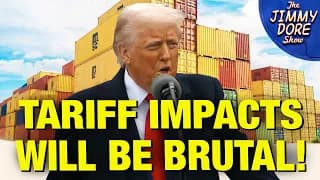
The Jimmy Dore Show
Trump’s “Liberation Day” Tariffs Are An Economic Disaster! – Dennis Kucinich
00:59:38
President Donald Trump on Wednesday announced far-reaching new tariffs on nearly all U.S. trading partners — a 34% tax on imports from China and 20% on the European Union, among others — that threaten to dismantle much of the architecture of the...
Loading summary
Transcript99 lines
- [00:01]
Jimmy Dore
Hey prime members, are you tired of ads interfering with your favorite podcasts? Good news, with Amazon Music, you have access to the largest catalog of ad free top podcasts included with your prime membership. To start listening, download the Amazon Music app for free or go to Amazon.com ADFreePodcasts that's Amazon.com ADFreeP Podcasts to catch up on the latest episodes without the ads.
- [00:28]
Mike McRae
Come see us on tour in Levittown, New York, Co host, New York, Providence, Rhode Island, Los Angeles, Bakersfield, San Jose, Toledo, Ohio and Toronto, Ontario. Go to jimmy dore.com for a link for tickets.
- [00:42]
Aaron Maté
Establishment media sucks August lighting, so good luck. Bullshit we can't afford why he's fomenting this. Watch and see as his jack off the medium speeds and jumps the medium and hits them head on.
- [00:57]
Jimmy Dore
It's the ch.
- [01:00]
Aaron Maté
We just had Liberation Day in America. That is what Trump is calling his unveiling of some of the most sweeping tariffs that the US has imposed on foreign countries in many decades. Here is Trump at the White House.
- [01:14]
Donald Trump
My fellow Americans, this is Liberation Day waiting for a long time. April 2, 2025 will forever be remembered as the day American industry was reborn, the day America's destiny was reclaimed, and the day that we began to make America wealthy again. Going to make it wealthy, good and wealthy. For decades, our country has been looted, pillaged, raped and plundered by nations near and far, both friend and foe alike. American steelworkers, auto workers, farmers and skilled craftsmen. We have a lot of them here with us today. They really suffered gravely. They watched in anguish as foreign leaders have stolen our jobs, foreign cheaters have ransacked our factories, and foreign scavengers have torn apart our once beautiful American dream. We had an American dream that you don't hear so much about. You did four years ago.
- [02:19]
Aaron Maté
That's Donald Trump unveiling his new tariffs. Some of the most sweeping tariffs this country has ever seen. Let me bring in Congressmember Dennis Kucinich, former Member of Congress representing Ohio. Congressmember, you saw firsthand the impact of these so called free trade deals, how they hurt workers in the rust belt in your state, Ohio. And some people argue that these tariffs are the way to bring manufacturing back. That's Trump's case. That's what he's making. What do you make of it?
- [02:51]
Dennis Kucinich
We need to break this down in several different places. One, President Trump said he was talking 40 years ago about the impact of our deteriorating industrial base. And as a matter of fact, I was writing over 40 years ago that America has To protect that, we need an American industrial policy which protects our steel, automotive, aerospace and shipping industries as being vital to our economic security in America. The trade deals, nafta, the General Agreement on Tariffs and Trade, the Uruguay Round, all of these trade deals contributed to the destructive undermining of our industrial base. You know, when I campaigned for president 20 years ago, I saw grass growing in parking lots, Aaron, where they used to make washing machines, they used to make cars, they used to make steel, they used to make aircraft parts and their grass grown in the parking lot. So cars used to be there. People, men and women, went in, they worked, they put in their time, they worked hard, their skilled labor, they had a decent living for their family. Business districts and areas and small towns were supported by having those industries. And all of a sudden, little by little, America's offshores, its industrial base. So President Trump's very election this time could be attributed in part to, to the erosion of support among workers who felt, and have felt for quite a while, that the Democratic Party betrayed them. Now, let's look at what's actually happening here. America has $4.1 trillion every year in imports. If we put across the board 10%, but various levels, anywhere from looking at the chart that he presented, 10% to 49% tariffs, that's going to bring in about. It could bring in $500 billion at least in added fees from these tariffs. Well, what's interesting is it approximates the amount of money that President Trump has to find to cover the continuation of his tax cuts. Okay. The Congressional Budget Office said that the tax cuts that President Trump is proposing, if they're enacted in 2025 over a period of 10 years, will cost the Treasury $4.6 trillion. That's $460 billion a year, covers, at least theoretically, the amount of increased revenue coming from the tariffs. But what isn't being looked at here is the countervailing effect. What's going to happen when the cost of goods go up? Americans will pay more with the tariffs, no question about it. But they'll also pay more for goods that are brought, that are brought in. In addition to that are exports, which are $3.2 trillion. And you know, we're exporting all kinds of goods, agricultural commodities, automotive parts, electronics, all kinds of American made goods. We're exporting them. There'll be countervailing tariffs, actually. Tariffs and reprisal you could expect from various countries. So here's the, here's the problem with all this. The President says we're going to have $5 trillion or more of investment. We're going to build new facilities. Great. However, the time lag five years takes to build a factory, to train workers, to build supply lines, you can't do that overnight. But the impact of the tariffs will be immediate. And with the underlying inflation rate on top of the hundreds of thousands of workers who are losing their jobs in Washington with the tax cuts and these tariffs, I think we're looking at an economic circumstance that could push us towards a recession. And if the United States does attack Iran, the price of oil absolutely is going to go up to $150 a barrel. It could go up to $200 a barrel. And gasoline will go from $3 and change that it is now to six and seven dollars a gallon. In some states with high taxes, it could be $10 a gallon. You want to talk about the makings of an extraordinary economic situation that that could plunge us into conditions that are not unlike what the Smoot Hawley tariffs did. Same kind of dynamics. Plus, you had war on top of that. And it's like, oh, my God. So I applaud President Trump for wanting to rebuild America industry. Oh, my gosh, that's long overdue. But the economics behind this, look out, because if you do try to use this to finance the tax cuts, over half of the tax cuts go to people making over $450,000 a year. Since consumer spending is about 68% of the economy here, and the tax cuts are going to people in the upper bracket, we're looking at poor, you know, the least fortunate Americans and whatever's left of our middle class taking it right in the neck with higher prices, lower buying capacity. So, you know, we're going to hear more and more as this thing unfolds about how it's going to work out country to country. But like President Trump, I'm concerned about America first. And the way I look at it, I don't know how this is going to work out for Americans or Americans in the short run. And think about this, Aaron. If you're in another country running a business and there's a lot of American multinationals that are involved in this because they were the ones who were pushing for nafta. If you're in another country and you're told, okay, we want you to build in America, okay, if you're paying tariffs and you got to put together the capital to build in America, how does that work? I mean, there's something about this that doesn't jibe. And I think at the core of it Is the desire to be able to get money in to justify a continuation of the 2017 tax cuts?
- [10:13]
Aaron Maté
Well, on the point about the tax cuts, I want to get your response to a historical argument that Trump made where he seemed to suggest that a century ago, basically the US Cutting tariffs and also imposing an income tax, a progressive income tax, that that helped lead to the Great Depression. This is what Trump said.
- [10:33]
Donald Trump
Big price. From 1789 to 1913, we were a tariff backed nation and the United States was proportionately the wealthiest it has ever been. So wealthy, in fact, that in the 1880s, they established a commission to decide what they were going to do with the vast sums of money they were collecting. We were collecting so much money so fast, we didn't know what to do with it. Isn't that a nice problem to have? What do you think, Marco? Good problem? Marco would love that problem. But we don't have that problem anymore. But we're not going to have it very much longer, I will tell you. But they collected so much money, they actually formed a commission to determine what they were going to do with the money, who they were going to give it to and how much they were. Then in 1913, for reasons unknown to mankind, they established the income tax so that citizens rather than foreign countries would start paying the money necessary to run our government.
- [11:32]
Aaron Maté
So he's saying there, for reasons unknown, we establish an income tax. I mean, I'm not a big history buff, but as I understand it, we introduced an income tax because that was a populist demand. There was a demand that the wealthy especially pay their fair share. But you weigh in here.
- [11:50]
Dennis Kucinich
Time out. I wish I had a chance to talk to President Trump because I would share with him an elaboration of 1913 when he said, for reasons unknown to man, now the money that was available, that was considered the expanding wealth of America, was stolen by the banks in 2000. In 1913, the Federal Reserve was created where America, instead of being able to create its own money and meet its own needs, had to borrow money from the banks. And that's why they instituted the income tax, to be able to pay off the banks for the money that we were borrowing from them. Instead of looking at our constitutional privilege to coin money to create our own money, this is a fundamental moment in American history. I'm glad that President Trump has put his finger on it because for the first time, it opens up a broader discussion. Aaron. I introduced a bill called the National Emergency Employment Defense act, which would have changed the role of the Fed, made it a Bureau under the treasury, given government the ability to be able to meet its own needs and spend money into circulation to meet the health care, education, defense needs of the country and at the same time use taxation only to cool off an overheated economy. We didn't have to have an income tax. It was done so that the government could pay the banks off for the money it was borrowing. The whole equation flipped. So I wish I had a chance to talk to the President because I don't know, he may be inclined to consider that the Federal Reserve is something that doesn't serve our country and hasn't from its inception. It's really there for the banks and they stick it to the American people every time.
- [13:50]
Aaron Maté
This is the reaction from Wall street so far to Trump's tariffs as reported on cnbc.
- [13:57]
CNBC Analyst
Market reaction after hours. I've never seen anything like it. This I think fair to say is worse than the worst case scenario of the tariffs that many in the market expected the president to impose. You laid out a number of the percentages there and there's some question of how the administration calculated the percentages that they're responding to in each of these cases. Are they adding in value added taxes? He talked about, you know, non tariff barriers as well. So I think while many were hoping that this would eliminate uncertainty, there's going to be more uncertainty in the market. And from those watching policy tomorrow on, well, you know, if, if countries push back on how these non tariff barriers were calculated, will there be wiggle room here? Exactly when do these go into effect? How quickly are companies going to have to adjust their pricing? So many questions.
- [14:58]
Aaron Maté
That's cnbc. What do you make of that, Dennis Kucinich, that according to, you know, this analyst of Wall street that from the perspective of the stock market, this is a worst case scenario?
- [15:08]
Dennis Kucinich
Well, there's a couple different things here. Wall street doesn't serve the interest of Main street, hasn't for years. However, pension funds are involved in those investments. I mean people do have some impact, people's retirement securities in there. So you have to parse Wall Street's reaction. But I'll tell you this, the President can't ignore it because the signal that it sends, you know, the president has criticized major media as being fake news. But the signal that Wall street sends to average Americans, whether they're in the market or not, is that, wait a minute, we're going, we're in trouble here. That will have the effect of reducing consumer spending, guaranteed. People are already tightening up, right? This is happening now. Wall Street Will the reaction will cause people to tighten up even more in a, as I mentioned, an economy driven close to 70% by consumer spending, that's a problem. So let's look at the knock on effect Trump tax cuts that go to the top half. Half of the tax cuts go to the top brackets underlying inflation. Hundreds of thousands of federal jobs lost, maybe more by the Doge group, the tariffs military and the tariffs which also will hit people hardest who are least able to pay. There's an immediate benefit that is to people in the upper income brackets, but a, a negative impact on people in the lower brackets with the tax cuts. So what do I think about it? I understand what the president's trying to do. I understand his advisors want him to get that money and prove to the members of Congress that we can afford a $460 billion a year tax cut. But if this whole thing about the tariffs is about creating a kitty to be able to give money to people that already have it, whoa, I think we could be headed into some tough times. But again, look, rebuild America's industrial base. Absolutely, let's do it. But we are going to need to change our monetary system if we're going to make work what President Trump is advocating today. And I hope to, you know, based on your questions, Aaron, I may for the first time call the White House and say I'd like to talk to the President about how to make this work, because we need to if we're going to make it work. Get rid of the Federal Reserve's power over the economy and then we start to see things change. Meanwhile, hey, I want our country to succeed no matter who the president is. I'm not into this partisan ripping and tearing and saying, you know, Republican bad, Trump worse. Nah, I don't buy that. You cannot have a nation and hold it together if you don't find and identify the commonalities that make us who we are as Americans. Things are changing, but I think we can get back to that. And so I don't think he's going to be able to make this work in the short, long and short of it.
- [19:15]
Mike McRae
Hey, you know, here's another great way you can help support the show is you become a Premium member. We give you a couple of hours of premium bonus content every week and it's a great way to help support the show. You can do it by going to jimmy door comedy.com Clicking on join Premium. It's the most affordable premium program in the business and it's a great way to help put your thumb Back in the eye of the bastards. Thanks for everybody who was already a premium member. And if you haven't, you're missing out. We give you lots of bonus content. Thanks for your support.
- [19:49]
Aaron Maté
Hey, everybody. Welcome to the Jimmy Dore Show. I'm Aaron Mate, sitting in for Jimmy Dore. We're going to turn to our top story, which is the ongoing crackdown on free speech when it comes to the issue of Palestine. So let's begin. Here is the footage of the latest arrest of a student in this country here on a foreign visa, simply for exercising the right to free speech and criticizing Israel and calling for an end to its mass murder campaign in Gaza. Her name is Ramesa Oster. She is from Turkey and last week in Massachusetts. This is what happened to her. You can see there, some masked agents have stopped her in the middle of the street. This was during Ramadan dawn, so she was coming on her way back from Ramadan gathering.
- [20:56]
Dennis Kucinich
You want to take those masks off?
- [21:05]
Aaron Maté
Is this a kidnapping? Please. Yeah, you don't look like it.
- [21:17]
Dennis Kucinich
Why are you hiding your faces? Why are you hiding your faces?
- [21:35]
Aaron Maté
Can I see some faces here? How do I know this is the police? Seems like to me. That's right, it was. This wasn't the police. This was ICE just carrying out a kidnapping of a foreign student simply because the Trump administration didn't like that. She criticized Israel. In her case, she co wrote an op ed at her school, Tufts University, calling for the school to respect a vote for divestment from businesses dealing with Israel and criticizing Israel for carrying out mass murder in Gaza. And according to Marco Rubio, the Secretary of State, this is grounds for her removal from the United States. Here was Marco Rubio being asked about this.
- [22:14]
Jimmy Dore
A Turkish student in Boston was detained and handcuffed on the street by plainclothes agents. A year ago, she wrote an opinion piece about the Gaza war. Could you help us understand what the specific action she took led to her visa being revoked? And what was your State Department's role in that process?
- [22:35]
Marco Rubio
Oh, we revoked her visa. She said it's an F1 visa. I believe we revoked it, and here's why. And I'll say it again, I said it everywhere. Let me be abundantly clear, okay? If you go apply for a visa right now, anywhere in the world, let me just send this message out. If you apply for a visa to enter the United States and be a student, and you tell us that the reason why you're coming to the United States is not just because you want to write op eds, but because you want to participate, participate in movements that are involved in doing things like vandalizing universities, harassing students, taking over buildings, creating a ruckus. We're not going to give you a visa. If you lie to us and get a visa and then enter the United States and with that visa, participate in that sort of activity, we're going to take away your visa. And once you've lost your visa, you're no longer legally in the United States. And we have a right, like every country in the world has a right to remove you from our country.
- [23:23]
Aaron Maté
So there's Marco Rubio explaining why he thinks it's his prerogative, within his purview, to revoke the visa of a foreign student if he doesn't like what they say about Israel. Not even about the US but about Israel. And again, in the case of this student, Ramessa Usturk, and as was the case with Mahmun Khalil and others, there's no charge against them for any kind of anything, any crime, whether it's vandalism or terrorism. It's just Marco Rubio simply saying that their free speech goes against the interests of US Foreign policy and therefore they can be deported. So to discuss all this, let's bring in our guest. Janine Yunus is a litigation counsel for the New Civil Liberties alliance at the NCLA. She's litigated against COVID 19 vaccine mandates and challenged the government in censorship of social media. And she also is of Palestinian background. Janine, welcome to the Jimmy Dore Show.
- [24:17]
Jimmy Dore
Oh, thank you so much for having me. And just to be clear, I'm speaking in my personal capacity here. My organization hasn't taken a position on this issue. So these are my views, not necessarily NCLA's.
- [24:28]
Aaron Maté
Okay, well, listen, before I ask you about your response to Marco Rubio, tell us a bit about your background, because, I mean, yes, you are of Palestinian descent, but you also have a long record of fighting for free speech. So talk to us about, you know, the cases that you've taken on just recently.
- [24:46]
Jimmy Dore
Yeah, so my father is Palestinian. I grew up entirely in the United States. But I have defended mainly what I would call conservative speech, especially people who dissented on issues related to Covid, including the new NIH director. J. Bhattacharya was one of my clients. He actually still is. But we've got to get him out of the lawsuit because he can't be a. You can't be a plaintiff and defendant in the same lawsuit, but that's another story. So I, even though I'M not a conservative myself. I'm a big believer in free speech and the notion that the government cannot involve itself in censorship or the suppression of certain ideas that it finds inconvenient or antithetical to its policies. And it became clear to me during the Biden administration's, during Biden's time in office that his administration was involved in influencing social media companies using various forms of, using various types of influence, coercion, threats, pressure, and also cooperation, which I also contended was a First Amendment issue in order to silence viewpoints I didn't like with respect to Covid, with respect to the 2020 election. And that's a First Amendment problem because the government cannot co opt third parties, private companies in order to do what it can't do directly. And since the government cannot suppress viewpoints it doesn't like, it also can't use third parties to do that. So we ended up going to the Supreme Court on that case. And I consider myself very, very principled on this issue. I'll defend conservative or liberal speech or any kind really, but I consider what we're seeing now probably the most concerning escalation in censorship in modern history, maybe even before that.
- [26:21]
Aaron Maté
Well, talk to us about that, especially given your background defending people in the MAGA movement from attacks on their free speech. How do you feel now to see, you know, the head of the MAGA movement, the Trump administration, turning around and overseeing this crackdown on free speech simply because they don't like what foreign students are saying about Israel, Palestine?
- [26:39]
Jimmy Dore
Well, look, I'm, I'm used to people being hypocritical, so nothing like surprises me all that much. I think it's absolutely almost hilarious that he has an executive order entitled restoring free speech and entering federals Federal censorship in America while he's throw it literally throwing people in ice attention for writing op EDS that express the wrong views. I can't. And a lot of people I worked with on free speech issues during the COVID era are now defending this and saying, well, these people are guests in our country. They don't have any first amendment rights. This isn't even a constitutional issue. They're, you know, their right to be in this country is completely contingent on whatever the president decides. And so they can be be kicked out for any or no reason. This is completely incorrect reading of the law. It's an incorrect reading of immigration law. It's more importantly an incorrect reading of constitutional law. And it's also very unprincipled because true believers in free speech don't when the moment someone says something they don't like, they don't find reasons to try to circumvent free speech issues or, sorry, free speech principles and say, well, you know what? Actually, there's this little out because they're not a citizen, so actually we can, can kick them out for their speech.
- [27:47]
Aaron Maté
Well, talk to us about that, because this is the argument that we're not talking about citizens, we're talking about guests in our country. So why should they have the same protections as citizens do when it comes to free speech, especially if they don't plan on living here and they plan on going back to their home country? So why give them the full protections of free speech?
- [28:04]
Jimmy Dore
Well, there are. So there are legal reasons and then there are philosophical reasons. I'll start with the legal. The First Amendment is a constraint on government. It doesn't, it doesn't differentiate depending on the citizenship status of the speaker. It reads, congress shall make no law abridging the freedom of speech. To the extent Congress enacts a statute that is penalizing people for their speech, including removal from this country, it is unconstitutional Statute, obviously, that conflicts with the Constitution falls because the Constitution is superior to any statute. So to the extent that Secretary Rubio is claiming, claiming that people may be thrown out of the country, whether they're on green cards or visas for their speech, the statute, if the statute may be read that way, it is unconstitutional. Another option courts have is to recognize that Congress probably didn't. In fact, I would say that the legislative history shows that Congress did not intend to allow people to be kicked out of the country based on their speech, and so read the statute consistent with the Constitution and the legislative history and say, no, no, no, this is not an acceptable reading of this statute. And so the statute that they're utilizing says that it allows the Secretary of State to remove people from the country if he deems them a threat to our foreign policy, that their presence in the United States will have adverse foreign policy consequences, and to sort of do so unilaterally. It's a very obscure provision and has not been invoked very much. There is only one court decision on it, which incidentally, was written by Trump's sister. She's a, she was a district court judge in New Jersey. And she said that that provision was unconstitutionally vague, that it didn't give adequate notice to people about what it intended to punish. And to the extent it punished speech, it appeared to conflict with the First Amendment. Now, I was criticized on social media for not acknowledging that that Statute, Sorry. That decision was reversed by the third SO Circuit, which is the appellate court. However, it was reversed on completely unrelated grounds on jurisdictional grounds. The appellate court did not address this issue. So her reasoning still is valid reasoning. It's obviously not binding on any court other than in that jurisdiction, but it's persuasive reasoning. I find her reasoning very persuasive. So in any event, to sort of boil it down, the First Amendment is a protection for people in this country. It's not. It doesn't matter what the citizenship status of the speaker is. And then you also have philosophical arguments which I think are very strong here. The purpose of the First Amendment, the reason the framers included it in the Bill of Rights, was that we understand that government should not be in charge of deciding what's true and what's false. There are not these all knowing people in government who get to decide what the truth is and punish people accordingly. The best way to reach good ideas is to debate and discuss them, not to censor people. And so those ideas all hold true whether or not someone is a citizen or not. So I find these arguments really hypocritical and cynical, frankly. And I think a lot of it has to do with the fact that people just don't want brown people in the country who disagree with them.
- [31:13]
Aaron Maté
Well, as we've discussed, you've defended conservatives from attacks on their free speech rights. And for Trump, this was a major selling point in his campaign that, that he was going to restore free speech after so many assaults on it led by Democrats. And let's go back to 2022, when Marco Rubio, who's now presiding over this crackdown on students who are critical of Israel, when he made a campaign against censorship, a centerpiece of a speech that he gave at cpac, the annual major Conservative gathering. This is some of what Marco Rubio said.
- [31:46]
Marco Rubio
We have witnessed things that we had never seen in this country before for the first time now, we started to see the building momentum behind. First of all, like there's now a speech code, right? Every single person in this room and the overwhelming majority of people that you know are one word away. It doesn't matter if you're 13 years old when you said it. You're one word, you're one statement, you're one retweet your one, like, away from destroying your life. There are kids in America. There are kids in America that have been had their admissions to a college revoked because of something they said or did or liked on social media when they were 14 when they were 14. But it goes beyond that.
- [32:30]
Aaron Maté
It does go beyond that. Now there are kids in college who right now are having their admission revoked because they criticize Israel and Marco Rubio is presiding over it.
- [32:41]
Jimmy Dore
That's. That's absolutely true. And okay, part of the way they're trying to get away with this is by saying it's not about speech, it's about behavior. But all of the people that they have put in detention have only engaged in speech. And also there are a few people who are not citizens who've been expelled. And that's through a different kind of coercion where the administration is withdrawing funding from universities, federal funding from universities, if they don't crack down on so called anti Semitic speech, which presumably most people understand at this point is actually just pro Palestine speech. So these are several different ways they're getting at. They're trying to silence pro Palestine speech and doing so pretty successfully. So they're conflating some behavioral issues that probably did take place at Columbia and other place and other universities, although I think it was actually more from the pro Israel side than the pro Palestine side. But never mind that, because the people in detention, Mahmoud Khalil Azturk, Ms. Chung Yun SEO Chung, who is not in detention, but the administration has been trying to deport her. And thankfully a judge issued a temporary restraining order saying that they couldn't. All of these people only engaged in political speech. And there's this attempt to sort of conflate the actions of the possible actions of other people with what they've done and say, well, these protests were violent, These people took over, they made encampments, they took over Hamilton Hall. Well, that's the way that criminal law works, and frankly, classical liberal principles in general work, is that you don't punish people for the behavior of others. And protests are massive. You can't hold one person responsible for the behavior of thousands of other people at these protests. And I'll point to the fact that conservatives made exactly this argument about January 6th and about some of the trucker protests in Canada that actually did get kind of sometimes violent. And they rightfully made the point that people who are peacefully protesting on January 6th or people who are peacefully protesting the vaccine mandates in Canada were not responsible for the unruly or unlawful behavior of other people. And so there's this conflation of these notions, and that's part of what they're doing here. I mean, you notice it in Rubio, the way Rubio uses his language. He says, well, it's not, you know, we thought she was. If you say that you're coming into the country to study and then you participate in violent protests and. Well, there's Austerk. There's no evidence that she participated in any protests. And in any event, she has a right to participate in protests. There's nothing unlawful about that. And she's not responsible for the behavior of other people who may have done unlawful or unruly things.
- [35:10]
Aaron Maté
And there are very few people, and you're one of them, who can claim to be consistent on all these issues. You know, who criticized the crackdown on free speech when it was done by Democrats, the excessive sentencing that was handed down to people who were there on January 6th but didn't take part in any violence or destruction, and who now can criticize the Trump administration's crackdown on free speech for some reason, it's very hard to find consistency across the political spectrum.
- [35:36]
Jimmy Dore
Yeah, there aren't a lot of people, and I'll say Glenn Green. No one says it better than Glenn Greenwald. I mean, nobody thinks that their own speech should be censored and their own ideas should be censored. There isn't anybody. So lots of people claim to believe in free speech when it's their speech that's under attack. But then the minute that that's ideas they don't like, that's under attack. They're the first to embrace it. And what they do is they use these other, no, oh, this is anti. This is hate speech. Oh, this speech is killing people. This is dangerous. Nobody says, oh, we embrace censorship. We just, we just don't like ideas that are different than ours. So they come up with ways to try to justify it that sound like something other than censor censorship, but it's censorship.
- [36:15]
Aaron Maté
One more legal question, and then we'll take a break. A immigration court is much different than a criminal court or a civil court. So do you think these students have an uphill battle here? Because the same protections that they might get if they were being charged with something in a criminal court might not apply inside the immigration system.
- [36:36]
Jimmy Dore
So I'm not an immigration law expert. I'll say that as a caveat. I believe that what most of them are doing is they're filing petitions in federal court, not immigration court, based on their First Amendment rights. So they're sort of proactively saying that their First Amendment rights are being violated by these immigration proceedings. So as the. As far as I understand it, these will mostly be. The First Amendment decisions will take place in federal, regular, federal Court, not immigration court. To the extent that they may sort of end up juxtaposing with immigration issues, I would hope that immigration judges understand the First Amendment principle. It's actually really pretty simple. The First Amendment, again, it's a restraint on government. It's not about the speaker. To the extent of statute restricts speech, it is unconstitutional. So hopefully, even if these are decided in immigration court, it will, it'll come out positively. But I'm, I'm nervous because judges aren't always the best.
- [37:41]
Aaron Maté
Remember all that fear mongering about Russian interference? Russia was brainwashing Americans into not voting for Hillary Clinton because they allegedly hacked some emails and put out some social media posts, which was a lie, by the way. But that aside, this was the dominant story for so long that Russia was basically controlling our democracy and there was so much outrage about a foreign country daring to interfere in our democracy. Well, as we covered a lot on the Jimmy Dore show, that Russiagate was a complete scam, but there is some foreign interference going on and the government doing the interfering is openly bragging about it. The government is Israel. And here is Israeli Prime Minister Benjamin Netanyahu, followed by the former US Ambassador to Israel, David Freeman, openly bragging about the fact that Israel is helping to censor people inside the US for their free speech in support of Palestinian rights and criticizing the Israeli mass murder campaign in Gaza.
- [38:38]
Benjamin Netanyahu
These ignorant demonstrators, who are they demonstrating for? For these murderers, these rapists, these mass killers? This is a reflection of a deep rot that has pervaded the intellectual hub of free societies. And this vilification of Israel, the Jewish people and Western values has been propagated by a systemic alliance between the ultra progressive left and radical Islam. It must be resolutely fought by civilized societies to safeguard their future. This is why we must all come in President Trump's decisive actions against anti Semitism and we must pressure other governments to do the same. A government can do in two months more than any organization can do in its lifetime. And so when we talk about the importance of a bipartisan fight against anti Semitism, which of course I endorse and I, as my predecessor said, I condemn anti Semitism on the right and on the left. Left. I'm an equal opportunity condemner of anti Semitism.
- [39:50]
Jimmy Dore
You are, you are alluding to Candace Owens and Tucker Kelson. Tucker Carlson.
- [39:55]
Benjamin Netanyahu
Yeah, none of them are any good. On the right, on the left. I don't like any of these anti Semites and I'm not shy about it. But the government, a government, the United States government or the government of France or the government of any other country has the power to rein in anti Semitism in a much more effective way. And, you know, people say, well, you know, the governments are not in the business of changing the way people think. That's true. But, you know, to my thinking, most people who are, you know, anti Semites, most of these people running around, we're not going to win their hearts and minds because they don't have hearts and they don't have minds. So, you know, how are we going to, there's no reason to think we're ever going to convince them, but we can deport them, we can put them in jail, we can make their lives miserable, we can cut off their funding. And that that's what the Trump administration is doing for the first time.
- [40:41]
Aaron Maté
And that last speaker is David Friedman, who is Trump's former ambassador to Israel. And note there how he just smears Tucker Carlson and Kenneth Owens as anti Semite simply because they've been critical of Israel carrying out mass murder in Gaza. And he talks about openly how, how great it is now that the government can ruin people's lives if they criticize Israel. And he's appearing alongside Benjamin Netanyahu, who's also cheering this on. And so, Janine, I, I guess some, my thought here is where are all the Democrats who spent years fear mongering about Russian interference? This was like the biggest intrusion possible in our democracy. That again, it was a fake claim, but they really believed it, or they said they believed it, that Russia hacked some emails and put out some social media posts in support of Trump. And this was like a new Pearl Harbor. That's who we're constantly told. Well, here we have a foreign government openly bragging about how they can censor people and ruin people's lives. And that's just treated as totally normal, not just by the White House, but by many Democratic politicians as well.
- [41:45]
Jimmy Dore
Well, the Democrats are completely pathetic on this issue and lots of others, too. Which is why even though I naturally, you know, sort of think of myself as tending to have more in common with them, I guess, in an ideal sense, or maybe the, the party of the 1970s that I don't support, support them at all because they're just, it's the UNI Party when it comes to Israel, frankly. I mean, they're all owned by the same people. They all take APAC money. And the Democrats have just been shockingly silent about this. There have been a few who've spoken up in a kind of tepid way and like 14 of them signed on to a letter saying Mahmoud Khalil shouldn't be in detention. But if they actually wanted to be an opposition party, they would be up in arms. They this is the biggest threat to free speech in modern history. I think it's probably some people have drawn comparisons to the Red Scare. I think it's probably worse. I do not think that people were put in immigration detention or any other kind of detention for writing op eds. I don't think we had the President of the United States and people in very high offices talking about how they were going to try to use various laws in order to come after US citizens for voicing dissent on US Foreign policy. So I think this is the greatest threat to free speech in modern history. Probably since the Alien Sedition act, which was in the late 1700s. I don't think we've seen anything like it. And these people are just pathetic. And they're not, you know, they're not even an opposition party. They're just, they're just part of the unit party.
- [43:04]
Aaron Maté
Well, to show how bipartisan this is, let's look at Tick Tock. Now, Tick Tock is up against a deadline pretty soon to basically change its ownership to satisfy the US Government or else it's going to be shut down. And why did all this happen? Well, those behind the TikTok ban openly said this is because TikTok was allowing young people to see the truth about Gaza. They were getting the wrong message. They were seeing all the images of massacred civilians inside Gaza and that was building support for Palestinian rights. And both parties, Democrats and Republicans, joined hands to push through this TikTok ban. So to illustrate this, here is Mitt Romney, a Republican, and Anthony Blinken back when he was a Democratic Party president, Secretary of State under Joe Biden, talking about how they both agreed that TikTok needed to be censored because it was letting young people see the truth about Palestine.
- [43:55]
Mitt Romney
I, I, I, I mean, typically the Israelis are good at pr. What's happened here? How have they, how have they and we been so ineffective at communicating the, the realities there and our, our point of view? Well, look, I think there are two things. One is that, look, there is an inescapable reality and that is the inescapable reality of people who have, have and continue to suffer previously in Gaza. And that's real. And we have to have to be focused on that and attend to that at the same time. How this narrative has evolved. Yeah, it's a, it's a great Question, I don't have a good answer to that there. One can speculate about what some of the causes might be. I don't know. I can tell you this. We were talking about this a little bit over dinner with Cindy. I think in my time in Washington, which is a little bit over 30 years, the single biggest change has been in the information environment. And when I started out in the early 1990s, everyone did the same, same thing. You woke up in the morning, you opened the door of your apartment, your house, you picked up a hard copy of the New York Times, the Washington Post, the Wall Street Journal, and then if you had a television in your office, you turned it on at 6:30 or 7:00 and watched the national network news. Now of course, we are on an intravenous feed of information with new impulses, inputs every millisecond. And of course the way this has played out on social media has dominated the narrative. And you have a social media ecosystem environment in which context history, facts get lost and the emotion, the impact of images dominates. And we can't discount that. But I think it also has a very, very, very challenging effect on the narrative. Yeah, a small parenthetical point which is some wonder why there was such overwhelming support for us to shut down potentially TikTok or other entities of that nature. If you look at the postings on TikTok and the number of mentions of Palestinians relative to other social media sites, it's overwhelmingly so among TikTok broadcast. So I, I know that's of of real interest and the President will get the chance to, to make action in that regard.
- [46:36]
Aaron Maté
So there you go, there's Mitt Romney admitting that the reason why they got momentum to shut down TikTok was because young people were seeing the truth about Palestine. And note also how he says that our point of view is equal to Israel's point of view. That's how he starts off saying, you know, how, how come we're not getting out our point of view? And he says Israel's not so good at getting out their pr. So now the US is synonymous with Israel right now, a foreign country. That sounds like foreign interference to me, but yet nobody will call it out. And in fact, as we see there, Democrats will take part in it.
- [47:08]
Jimmy Dore
Absolutely, it is foreign interference. But I mean from the perspective of a First Amendment lawyer, the things that they were saying are just completely anathema to the sort of principle underlying the First Amendment, which is that government is not that government are not these all knowing superior beings who get to decide for us what's true and false. What they were basically saying was, we know what's true, we know what's right. And these silly people, they might succumb to their emotions seeing photos of dead Palestinian children. First of all, the argument could be made in the other direction, right? Where after October 7th, a lot of people got very emotional about, frankly, fake stories coming out of there about beheaded babies and, and mass rapes. But so a lot of people succumb to their emotions on that subject, even though there weren't actually accompanying photos because it didn't happen, but people made that up. But this idea that like these, these government people like Mitt Romney, they're so superior to us and they're in the position to tell us what we should think. And, you know, we're just, we, we just are overcome by emotion and we don't have the right ideas. They need to, they need to send censor things in order to let us know what the truth is. This is exactly what the framers issued when they included the First Amendment in the Bill of Rights. They said every man and woman has the ability to decide for him and herself what to believe, what's true, what's false, to sort through it all. And we have a sort of God given. I'm not a religious person, but the framers were, I think you can view it as sort of a natural right to speak and to receive information. We, we, the government is not our daddy. We don't need them to tell us what to believe. And in a way, the First Amendment is really one of the most democratic, humanistic statements ever to be made. And that's one reason I really believe in it. And I think if we had a real First Amendment in this country anymore, it's one of the things that does make our country special. There is not any other country in the world that has this guarantee to free speech and to receive ideas. Unfortunately, it's being controlled, completely trampled on by the Israel lobby right now.
- [49:14]
Aaron Maté
And going back to how we started off this segment, this group Baytar, threatening people with deportation, harassing people like you, Janine, at the State Department, spokesperson Tammy Bruce was asked, can you confirm or deny that Baytar is involved in providing lists of people to deport? And she would not give an answer either way.
- [49:35]
Jimmy Dore
The visa revocations. There's a group called Batar that has told CBS that they have provided thousands of names to the Trump administration of visa holders and naturalized foreigners who, quote, come to the west to rage against America and support U.S. designated terrorist organizations. Can you confirm whether that organization is providing lists to the Trump administration and whether those lists are being taken by the State Department and DHS to do any of this work? You know, I, the Trump administration, I'm don't, I'm not involved in those decisions, and I certainly can't speak on them. Certainly in general, not for the State Department. That goes through the framework of the work that we're doing. Whether it exists or not, I won't confirm. It's a matter of, you know, we've got broad authority, certainly, but how they're coming to those decisions for the, for the consular offices and, and visas, we will not discuss not only individual visas, but the process of what goes through in determining what happens with individuals and visas and whether they're issued or if they're revoked. So I won't be talking about that today.
- [50:45]
Aaron Maté
So, again, you know, we don't know how the Trump administration is devising the, these lists to deport. We don't know if they're being supplied by Zionist groups. But given the fact that Trump got a lot of money from major Zionist donors and these, some of these same groups that Zionist donors fund are bragging about going after people, getting them targeted for deportation, it's totally fair to assume. And again, Trump was not always so in the pocket of major pro Israel donors. This is Trump back in 2015 talking about Marco Rubio. Sheldon Adelson is looking to give big dollars to Rubio because he feels he can mold him into his perfect little puppet. I agree. And he's talking about a guy who turned out to be Trump's biggest donor, Sheldon Adelson, who now continues to give Trump money through his widow, Miriam Adelson. And they are fanatic supporters of the Israeli government. So Trump has turned out to be exactly what he once criticized Marco Rubio being, which is a little puppet of big donors who support Israel's occupation of Palestinians and now the deportation of people who speak up for Palestinian rights. We will leave it here. Janine, any last comments for us?
- [52:08]
Jimmy Dore
Well, I'll just say, I mean, I really consider this the most shocking affront to free speech in the First Amendment, really, in our lifetime is probably much longer than that. And Americans really need to stand up and make, make it clear that we don't accept this, all of us, because otherwise, you know, the, you know, the poem first they came for the whatever, they're coming for you next. Really. I mean, that's what this is about.
- [52:31]
Aaron Maté
Jeanine Yunus, civil liberties attorney litigated against COVID Vaccine mandates, challenged the government's involvement and censorship of social media. Also served as a senior Special counsel on the House Judiciary Committee's weaponization of government subcommittees investigation into the government's role in censoring speech on social media. So you're very well versed in the government censoring social media, and now it just happens to be some of the people who are once targeted by social media in the Trump camp wielding it for their own interests. In this case, going after people critical of the Israeli government. So, thank you so much for your time, and thank you so much for being a rare person who is consistent on this issue. We really appreciate it.
- [53:10]
Jimmy Dore
Thank you so much much for having me.
- [53:15]
Aaron Maté
Remember when the White House meeting between zelensky, Trump and J.D. vance went sideways? This was the moment when it happened when Zelensky decided to challenge J.D. vance because J.D. vance advocated something as crazy as diplomacy with Russia to end the war. This is what happened.
- [53:33]
Dennis Kucinich
Prisoners.
- [53:34]
Jimmy Dore
We signed the exchange of prisoners, but.
- [53:36]
Aaron Maté
He didn't do it.
- [53:38]
Jimmy Dore
What kind of diplomacy?
- [53:40]
Dennis Kucinich
J.D.
- [53:40]
Aaron Maté
You are speaking about what. What. What do you.
- [53:42]
Dennis Kucinich
What do you mean?
- [53:43]
Aaron Maté
I'm talking about the kind of diplomacy that's going to end the destruction of your country. Yes, but he feels. Mr. President, Mr. President, with respect, I.
- [53:50]
Mitt Romney
Think it's disrespectful for you to come.
- [53:51]
Aaron Maté
Into the Oval Office and try to litigate this in front of the American media. So that's Zelensky challenging J.D. vance because J.D. vance advocated diplomacy with Russia. And what Zelensky is arguing there is that. Listen, I already tried diplomacy with Putin. We signed this deal back in December 2019 that included an exchange of prisoners, but Putin didn't live up to it. Well, Zelensky has been contradicted by a pretty unlikely source, and that is actually his biggest foreign cheerleader, Boris Johnson, the guy who sabotaged Zelensky's peace deal with Russia in the spring of 2022 and told them to keep fighting and then got the US And NATO to supply Zelensky with tens of billions of dollars worth of weapons. So. And Boris Johnson has always been singing Zelensky's praises because Zelensky followed his orders. Yes. And now Boris Johnson recently gave an interview where he admitted that actually, Zelensky's peace deal with Putin that he signed back in December 2019, it wasn't undermined by Russia. It was undermined by Ukrainian extremists, including neo Nazis.
- [54:53]
Boris Johnson
And I believe that Boris Johnson, you'll notice his hair looks like Kirkusk or whatever. Besieged, ravaged land. Look at this guy's haircut.
- [55:04]
Benjamin Netanyahu
You got to remember that Vladimir Zelensky is not, you know, he's not an unreasonable guy. He's, you know, he got elected really in as a peacenik. You know, he was out that, you know, 2019, he tried to do a deal with Putin. I, as far as I can remember, his. His basic problem was, was that, you know, Ukrainian nationalists couldn't accept the compromise.
- [55:33]
Aaron Maté
And so you hear that Ukrainian nationalists couldn't accept the compromise. He's referring to groups like the Azov Battalion. Yeah, the neo Nazi militia which marched in the streets, you know, carrying torches against Zelensky when he tried to implement the peace deal that he signed.
- [55:49]
Boris Johnson
Yeah, they said that hang him. They said that if you stop bombing Donbas and if you don't shut up, we're going to kill you. And then this, Chris, Prime Minister Farley here, he's the one that really killed that peace deal. That was specifically him. Yes, he's a snake, this dude.
- [56:06]
Aaron Maté
But what he's doing here is he's undermining Zelensky's talking. Point to J.D. vance and Trump at the White House that Putin can't be trusted. What kind of diplomacy are you talking about? Because Boris Johnson is admitting the problem wasn't Russia. It was that Ukrainian nationalists, by which he means Nazis, could be compromised. Exactly.
- [56:23]
Boris Johnson
Trigonometry. So he's talking to Francis and the other guy that I call a silly goose all the time, Francis, I'm friends with, I'm going to send tomorrow. I cannot wait to ask him about meeting Bojo.
- [56:33]
Aaron Maté
It's a really important admission here. Let's. Let's finish this clip and, you know.
- [56:37]
Benjamin Netanyahu
You can see why not.
- [56:38]
Aaron Maté
So Boris Johnson endorses the Ukrainian extremists sabotaging the peace deal that Zelensky made with. With Russia. But that's an admission right there. The contrary to what Zelensky said. It wasn't Russia that sabotaged the peace deal that they reached back in 2019. It was Ukrainian nationalists. And just to show you whose side Boris Johnson is on, here he is greeting members of the Azov Battalion in London not too long ago.
- [57:02]
Benjamin Netanyahu
Very simple. Thank you to the heroes from the.
- [57:08]
Aaron Maté
AS Brigade, their presence tonight. Give the Ukrainians what they need. Give them the weapons.
- [57:15]
Benjamin Netanyahu
Give them the authorization to use those weapons outside their own borders. Oh, man.
- [57:25]
Boris Johnson
I like Winston Churchill, but I like a big scoop of Farley on it.
- [57:31]
Aaron Maté
This is Boris Johnson praising a group that before Russia invaded, was banned by the US Congress from receiving US Assistance because they're Officially neo Nazi.
- [57:42]
Boris Johnson
So this is after Charlottesville, but before the ADL announcing the AOL are not Nazis anymore. It's cool, you guys.
- [57:50]
Aaron Maté
Yeah, something like that. And that's Boris Johnson. So basically he says there that it was Ukrainian nationalists who couldn't accept the compromise. That's true. But he joined them as well. And that's why he was welcoming them in in London and cheering them on and advocating that they be armed by.
- [58:06]
Boris Johnson
In charge of Syria because they couldn't accept the Alawite. They always called the Alawite minority, even though all the ethnic groups were a minority until we flooded them with Sunni Islamist, as Tulsi calls them, on purpose. We do the same thing everywhere. I don't know how anybody even disputes this. We find some scumbag terrorist maniacs, we arm them. The out of them, we have them destroy whatever's going on. And then we go, oh, they didn't. They couldn't do jumping jacks, these guys. That's how.
- [58:35]
Aaron Maté
Yeah, they.
- [58:35]
Boris Johnson
Afghanistan, hey, they weren't good at jumping jacks. That's why they lost.
- [58:39]
Aaron Maté
And now we have a rare case where someone at the very top of the proxy war coalition, Boris Johnson, admits that it was our guys, the people we were arming, the extremists in Ukraine, who sabotaged peace that could have prevented all this bloodshed that's happened ever since.
- [58:53]
Boris Johnson
Slick way to do it. In a way that no one would notice unless they're in. Buz, mate.
- [59:03]
Mike McRae
Hey. Become a premium member. Go to jimmy door comedy.com sign up. It's the most affordable premium program in the business. All the voices performed today are by the one and only, the inimitable Mike McRae. He can be found at mikemcrae.com.
- [59:24]
Aaron Maté
That'S.
- [59:24]
Mike McRae
It for this week. You be the best you can be and I'll keep being me.
- [59:43]
Jimmy Dore
Don't freak out, don't freak out.
- [59:45]
Mike McRae
Don't freak out. Not freak out.
- [59:50]
Aaron Maté
Do not get it. Do not. Do not.
- [59:53]
Boris Johnson
I'm not.
- [59:53]
Jimmy Dore
I'm not, I'm not.
- [59:54]
Benjamin Netanyahu
I'm not, I'm not, I'm not.
- [59:58]
Aaron Maté
Don't freak out.
- [60:00]
Mike McRae
Do not freak out, freak out, freak out, freak out.