Podcast
Choiceology with Katy Milkman
Hosted by Charles Schwab · EN
Can we learn to make smarter choices? Listen in as host Katy Milkman--behavioral scientist, Wharton professor, and author of How to Change--shares stories of high-stakes decisions and what research reveals they can teach us. Choiceology, an original podcast from Charles Schwab, explores the lessons of behavioral economics to help you improve your judgment and change for good.
Season 1 of Choiceology was hosted by Dan Heath, bestselling author of Made to Stick and Switch.
Podcasts are for informational purposes only. This channel is not monitored by Charles Schwab. Please visit schwab.com/contactus for contact options. (0321-1S88)
35episodes
Episodes
Newest firstAll episodes
Coming Soon: A New Season of Choiceology
3d ago00:01:55Summary readyWhat happens to our judgment when we measure our success against others? How might the language we speak shape the way we save money and make health decisions? And why are our expectations about connecting with other people so often wrong? In the new season of Choiceology, host Katy Milkman explores the psychological forces that shape our decisions, relationships, and behavior. We'll relive a high-octane Formula 1 rivalry that threatened a championship, travel to an Alpine region where centuries of linguistic history still shape financial decisions today, and discover how much joy and insight can come from striking up a conversation with a stranger. Featuring insights from top behavioral scientists – including George Loewenstein, Angela Duckworth, Nick Epley, Keith Chen, Nir Halevy, and Leslie John—Choiceology turns cutting-edge behavioral science research into practical ideas you can use to make better decisions about money, work, relationships, and everyday life. New episodes begin in two weeks. Catch up on past episodes now, and follow the show so you never miss an episode. Choiceology is an original podcast from Charles Schwab. Important Disclosures The comments, views, and opinions expressed in the presentation are those of the speakers and do not necessarily represent the views of Charles Schwab. Data contained herein from third party providers is obtained from what are considered reliable sources. However, its accuracy, completeness or reliability cannot be guaranteed. All corporate names and market data shown above are for illustrative purposes only and are not a recommendation, offer to sell, or a solicitation of an offer to buy any security. 0826-SH2R Hosted by Simplecast, an AdsWizz company. See pcm.adswizz.com for information about our collection and use of personal data for advertising.
Summary
A Depth of Trust
Jun 100:36:27Summary readyTeamwork is an essential part of everyday life, at work, school, and home. But what allows some teams to thrive under intense pressure while others buckle? In this episode of Choiceology with Katy Milkman, we explore how candid cultures that invite ideas from every level of an organization can be the difference between failure and a miracle. Jonathan Franklin, an award-winning journalist based in Chile, tells the remarkable story of the 2010 San José mine collapse and rescue mission. Franklin's book 33 Men: Inside the Miraculous Survival and Dramatic Rescue of the Chilean Miners details key moments of candor and collaboration—and winning ideas that came from unlikely places. Next, Katy speaks with Amy Edmondson, the Novartis Professor of Leadership and Management at the Harvard Business School. Edmondson shares her pioneering research on psychological safety and why it's so essential to build cultures that invite candor. Edmondson's foundational book on the topic, The Fearless Organization: Creating Psychological Safety in the Workplace for Learning, Innovation and Growth, has been translated into 15 languages. Choiceology is an original podcast from Charles Schwab. For more on the show, visit schwab.com/podcast. If you enjoy the show, please leave a rating or review on Apple Podcasts. 01:10 The Organizational Failure Behind Space Shuttle Columbia 03:03 This Is Choiceology 03:38 World-Class Collaboration That Saved 33 Lives in Chile 18:21 The Power of Ideas Over Hierarchy 19:15 How to Create Cultures That Empower Teams With Amy Edmondson 34:37 The Value of Psychological Safety Everywhere Important Disclosures The comments, views, and opinions expressed in the presentation are those of the speakers and do not necessarily represent the views of Charles Schwab. Data contained herein from third party providers is obtained from what are considered reliable sources. However, its accuracy, completeness or reliability cannot be guaranteed. All corporate names and market data shown above are for illustrative purposes only and are not a recommendation, offer to sell, or a solicitation of an offer to buy any security. Past performance is no guarantee of future results. Investing involves risk including loss of principal. The books How to Change: The Science of Getting from Where You Are to Where You Want to Be, 33 Men: Inside the Miraculous Survival and Dramatic Rescue of the Chilean Miners, and The Fearless Organization: Creating Psychological Safety in the Workplace for Learning, Innovation, and Growth are not affiliated with, sponsored by, or endorsed by Charles Schwab & Co., Inc. (CS&Co.). Charles Schwab & Co., Inc. (CS&Co.) has not reviewed the books and makes no representations about its content. 0626-P47L Hosted by Simplecast, an AdsWizz company. See pcm.adswizz.com for information about our collection and use of personal data for advertising.
Summary
Death by Dashboard
May 1800:25:50Summary readyFrom stocks to fitness to video games, real-time performance data is available everywhere these days. Seeing desirable upward trends feels amazing. But when there's a drop, it can feel like the world is ending. In this episode of Choiceology with Katy Milkman, we explore what happens when we judge performance too much in the short term. Cora Kennedy takes us inside the world of collegiate esports, where constant performance data shapes how players think and compete—including Cora herself. We also hear from Dan Ginn, who was a smartwatch devotee who checked his fitness data morning, noon, and night—until a serious illness forced him to rethink his habits. Lastly, Katy speaks with Shlomo Benartzi, professor emeritus, behavioral decision-making, at UCLA Anderson School of Management. Shlomo shares his research on why we tend to overreact to short-term losses—and how this tendency helps explain a puzzle that has long stumped economists. Choiceology is an original podcast from Charles Schwab. If you enjoy the show, please leave a rating or review on Apple Podcasts. 00:00 Introduction 00:50 The Competitive World of Esports Stats 03:42 This Is Choiceology 04:15 Smartwatch Data Obsession Gone Awry 10:55 Checking Immediate Data Can Sabotage Long-Term Goals 11:46 The Equity Premium Puzzle and Myopic Loss Aversion With Shlomo Benartzi 23:27 Katy Milkman Reflects on Managing Myopia Important Disclosures The comments, views, and opinions expressed in the presentation are those of the speakers and do not necessarily represent the views of Charles Schwab. This material is intended for general, informational and educational purposes only. This should not be considered an individualized recommendation or personalized investment advice. Each investor needs to review an investment strategy for his or her own particular situation before making any investment decisions.> Data contained herein from third party providers is obtained from what are considered reliable sources. However, its accuracy, completeness or reliability cannot be guaranteed. All corporate names and market data shown above are for illustrative purposes only and are not a recommendation, offer to sell, or a solicitation of an offer to buy any security. The policy analysis provided by the Charles Schwab & Co., Inc., does not constitute and should not be interpreted as an endorsement of any political party. Past performance is no guarantee of future results. Investing involves risk including loss of principal. Fixed income securities are subject to increased loss of principal during periods of rising interest rates. Fixed income investments are subject to various other risks including changes in credit quality, market valuations, liquidity, prepayments, early redemption, corporate events, tax ramifications, and other factors. Lower rated securities are subject to greater credit risk, default risk, and liquidity risk. There are risks associated with investing in dividend paying stocks, including but not limited to the risk that stocks may reduce or stop paying dividends. The books How to Change: The Science of Getting from Where You Are to Where You Want to Be , Save More Tomorrow and The Smarter Screen are not affiliated with, sponsored by, or endorsed by Charles Schwab & Co., Inc. (CS&Co.). Charles Schwab & Co., Inc. (CS&Co.) has not reviewed the books and makes no representations about their content. (0526-GE5U) Hosted by Simplecast, an AdsWizz company. See pcm.adswizz.com for information about our collection and use of personal data for advertising.
Summary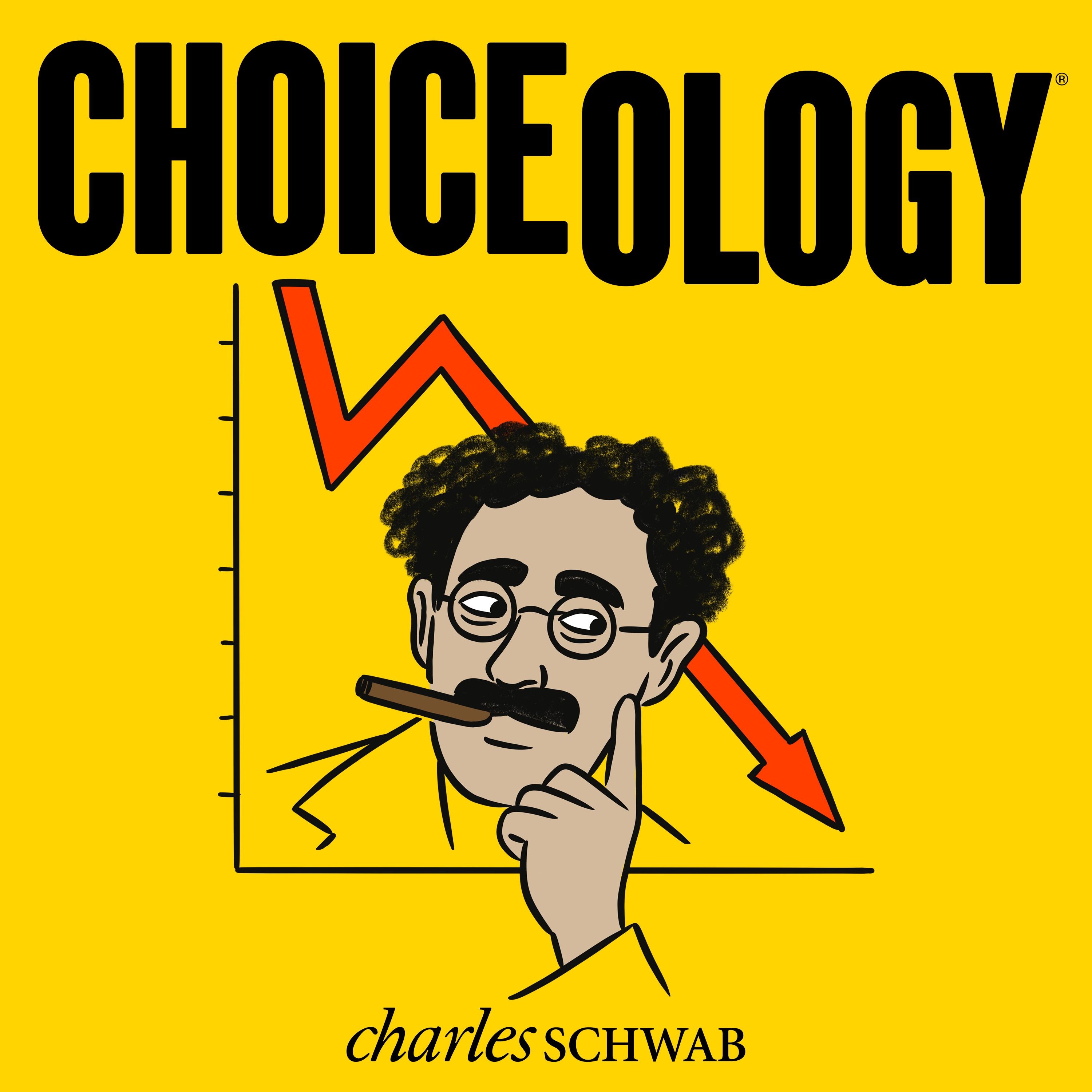
A Comedy of Economic Errors
May 400:31:20Summary readyImagine you're cleaning out your grandmother's attic when you notice a floorboard that doesn't quite sit right. You pry it up—and find $10,000 hidden beneath it. It's a startling discovery, but also a window into another way of thinking about money. Your grandmother was likely part of a generation that lived through hard financial times—a depression, unemployment—and saved for a rainy day, even when times became good. In this episode of Choiceology with Katy Milkman, we're looking at how major economic events impact us and influence how much risk we're comfortable taking. Frank Ferrante shares the story of legendary comedian Groucho Marx and how Groucho fared during and after the stock market crash of 1929. Next, Katy speaks with Ulrike Malmendier, the Cora Jane Flood Professor of Finance at UC Berkeley's Haas School of Business. Ulrike's research reveals how major economic events can reshape our instincts about risk in ways that can last a lifetime, long after the circumstances that caused them have changed. Choiceology is an original podcast from Charles Schwab. If you enjoy the show, please leave a rating or review on Apple Podcasts. 0:00 Introduction 0:54 Hurricane Katrina's Lasting Mark 3:14 This is Choiceology 3:52 Groucho Marx After the 1929 Stock Market Crash 15:22 Why You Can Lose Out When Remaining Too Risk-Adverse 16:08 How Macroeconomic Experiences Shape Us With Ulrike Malmendier 29:07 Katy Milkman Reflects on Risk Preferences 31:09 Final Thoughts & Next Time Important Disclosures The comments, views, and opinions expressed in the presentation are those of the speakers and do not necessarily represent the views of Charles Schwab. Data contained herein from third party providers is obtained from what are considered reliable sources. However, its accuracy, completeness or reliability cannot be guaranteed. Fixed income securities are subject to increased loss of principal during periods of rising interest rates. Fixed income investments are subject to various other risks including changes in credit quality, market valuations, liquidity, prepayments, early redemption, corporate events, tax ramifications, and other factors. All corporate names and market data shown above are for illustrative purposes only and are not a recommendation, offer to sell, or a solicitation of an offer to buy any security. The policy analysis provided by the Charles Schwab & Co., Inc., does not constitute and should not be interpreted as an endorsement of any political party. Investing involves risk including loss of principal. The book How to Change: The Science of Getting from Where You Are to Where You Want to Be is not affiliated with, sponsored by, or endorsed by Charles Schwab & Co., Inc. (CS&Co.). Charles Schwab & Co., Inc. (CS&Co.) has not reviewed the books and makes no representations about its content. 0526-ABDP Hosted by Simplecast, an AdsWizz company. See pcm.adswizz.com for information about our collection and use of personal data for advertising.
Summary
The Illusion of Number One
Apr 2000:33:06Summary readyRanked lists are everywhere—top hospitals, best colleges, must-visit cities. A single number can influence what we notice, what we value, and the decisions we make. Yet behind these rankings are hidden assumptions, and they don't always reflect what matters most to you. In this episode of Choiceology with Katy Milkman, we explore how rankings shape attention, guide choices, and subtly steer behavior. Shriya Boppana shares how rankings shaped one of the biggest decisions of her life—and, years later, what she gained and what she missed by chasing prestige. Next, Katy speaks with Rick Larrick, the Hanes Corporation Foundation Professor of Management and Organizations at Duke University's Fuqua School of Business. His research reveals how rank labels simplify complex choices and influence everything from restaurant reservations to career moves—often without us even noticing. Choiceology is an original podcast from Charles Schwab. For more on the show, visit schwab.com/choiceology. If you enjoy the show, please leave a rating or review on Apple Podcasts. Important Disclosures This material is intended for general informational and educational purposes only. This should not be considered an individualized recommendation or personalized investment advice. The securities, investment products and investment strategies mentioned are not suitable for everyone. Each investor needs to review an investment strategy for his or her own particular situation before making any investment decisions. The comments, views, and opinions expressed in the presentation are those of the speakers and do not necessarily represent the views of Charles Schwab. Data contained herein from third party providers is obtained from what are considered reliable sources. However, its accuracy, completeness or reliability cannot be guaranteed. All names and market data shown are for illustrative purposes only and are not a recommendation, offer to sell, or a solicitation of an offer to buy any security. Any investments reflected are for illustrative purposes only and are no guarantee of future performance or success. Investing involves risk, including loss of principal. The book How to Change: The Science of Getting from Where You Are to Where You Want to Be is not affiliated with, sponsored by, or endorsed by Charles Schwab & Co., Inc. (CS&Co.). Charles Schwab & Co., Inc. (CS&Co.) has not reviewed the books and makes no representations about its content. (0426-4ZN0) Hosted by Simplecast, an AdsWizz company. See pcm.adswizz.com for information about our collection and use of personal data for advertising.
Summary
When Sunk Costs Take Flight
Apr 600:35:30Summary readyHave you ever bought a pair of shoes that never really fit, but you kept wearing them in hopes you’d break them in? All because you didn’t want to feel your money had gone to waste—even as you felt blisters forming? In this episode of Choiceology with Katy Milkman, we explore how focusing on past, irrecoverable costs can skew our judgment and future commitments. Bill Kolb takes us inside the Evergreen Aviation & Space Museum in McMinnville, Oregon. He shares the story of “The Spruce Goose” seaplane and why its creator, Howard Hughes, was so committed to the project despite many challenges and several opportunities to back out. Next, Katy speaks with Richard Thaler, economics Nobel laureate and Charles R. Walgreen Distinguished Service Professor of Behavioral Science and Economics at the University of Chicago Booth School of Business. Thaler reveals why we tend to dwell on sunk costs that cannot be recovered and shares insights from his updated book The Winner’s Curse: Behavioral Economics Anomalies, Then and Now. Check out the additional papers mentioned in this episode: “Paying Not to Go to the Gym” by Ulrike Malmendier and Stefano DellaVigna and “The Realization Effect: Risk-Taking After Realized Versus Paper Losses” by Alex Imas. Choiceology is an original podcast from Charles Schwab. For more on the show, visit schwab.com/choiceology. If you enjoy the show, please leave a rating or review on Apple Podcasts. Important Disclosures The comments, views, and opinions expressed in the presentation are those of the speakers and do not necessarily represent the views of Charles Schwab. Data contained herein from third party providers is obtained from what are considered reliable sources. However, its accuracy, completeness or reliability cannot be guaranteed. All corporate names and market data shown above are for illustrative purposes only and are not a recommendation, offer to sell, or a solicitation of an offer to buy any security. The policy analysis provided by the Charles Schwab & Co., Inc., does not constitute and should not be interpreted as an endorsement of any political party. Investing involves risk including loss of principal. The books How to Change: The Science of Getting from Where You Are to Where You Want to Be and The Winner's Curse not affiliated with, sponsored by, or endorsed by Charles Schwab & Co., Inc. (CS&Co.). Charles Schwab & Co., Inc. (CS&Co.) has not reviewed the books and makes no representations about its content. (0426-XMGE) Hosted by Simplecast, an AdsWizz company. See pcm.adswizz.com for information about our collection and use of personal data for advertising.
Summary
The Algorithm Advantage
Mar 2300:35:57Summary readyEvery day, we face choices that could change outcomes in business, health, or life itself. Increasingly, computers are offering guidance. What happens when that advice clashes with human intuition? In this episode of Choiceology with Katy Milkman, we explore the high-stakes friction between human intuition and algorithmic guidance. Dean Oliver, a data scientist at ESPN and author of Basketball on Paperand Basketball Beyond Paper, tells the story of the 2008 Boston Celtics. Facing a crossroads on roster moves and trades, the team made a radical gamble: They relied heavily on advanced analytics to reveal what traditional scouting missed. This choice ignited a data revolution that changed professional basketball forever. Next, Katy speaks with Jennifer Logg, an assistant professor of management at Georgetown University's McDonough School of Business. Logg shares her research on how people respond to computer-generated predictions. She reveals the specific moments when machine advice consistently outperforms human judgment—and the hidden dangers that emerge when those systems are built on flawed or biased data. Choiceology is an original podcast from Charles Schwab. For more on the show, visit schwab.com/choiceology. If you enjoy the show, please leave a rating or review on Apple Podcasts. 0:00 Introduction 1:00 Would You Trust an Algorithm Over a Friend for Cooking Advice? 2:36 This is Choiceology 3:11 The Boston Celtics’ Rebuild Meets Analytics 17:13 The Rise of Algorithm Trust 18:56 Why We Prefer Algorithms to People with Jennifer Logg 32:37 Trust Algorithms With Care 35:31 Final Thoughts & Next Time Important Disclosures The comments, views, and opinions expressed in the presentation are those of the speakers and do not necessarily represent the views of Charles Schwab. Data contained herein from third party providers is obtained from what are considered reliable sources. However, its accuracy, completeness or reliability cannot be guaranteed. All corporate names and market data shown above are for illustrative purposes only and are not a recommendation, offer to sell, or a solicitation of an offer to buy any security. Investing involves risk including loss of principal. The book How to Change: The Science of Getting from Where You Are to Where You Want to Be is not affiliated with, sponsored by, or endorsed by Charles Schwab & Co., Inc. (CS&Co.). Charles Schwab & Co., Inc. (CS&Co.) has not reviewed the books and makes no representations about its content. 0326-SA3N Hosted by Simplecast, an AdsWizz company. See pcm.adswizz.com for information about our collection and use of personal data for advertising.
SummaryComing Soon: A New Season of Choiceology
Mar 900:01:46Summary readyIt's a new season of Choiceology, an original podcast from Charles Schwab. Each episode tells true stories involving high-stakes moments and explores the latest research to help you make better judgments and avoid costly mistakes. This season, we go underground to one of the most dramatic mining rescues in history and step onto the court during a pivotal Boston Celtics roster shakeup. We hear from leading researchers in psychology and behavioral economics, such as Richard Thaler, Amy Edmondson, and more. New episodes arrive every two weeks. Follow now in your favorite podcasting app. Choiceology is an original podcast from Charles Schwab. For more on the show, visit schwab.com/podcast. Important Disclosures The comments, views, and opinions expressed in the presentation are those of the speakers and do not necessarily represent the views of Charles Schwab. Data contained herein from third party providers is obtained from what are considered reliable sources. However, its accuracy, completeness or reliability cannot be guaranteed. All corporate names and market data shown above are for illustrative purposes only and are not a recommendation, offer to sell, or a solicitation of an offer to buy any security. Investing involves risk including loss of principal. The book How to Change: The Science of Getting from Where You Are to Where You Want to Be is not affiliated with, sponsored by, or endorsed by Charles Schwab & Co., Inc. (CS&Co.). Charles Schwab & Co., Inc. (CS&Co.) has not reviewed the books and makes no representations about its content. 0326-G3CV Hosted by Simplecast, an AdsWizz company. See pcm.adswizz.com for information about our collection and use of personal data for advertising.
Summary
Playing the Long Game: The Power of Self-Control
Oct 2000:34:23Summary readyAs a special addition to this week's episode, you can see Katy's full sit-down interview with Angela Duckworth, where they also explore the relationship between self-control and grit.Watch or listen to their conversation on YouTube or Spotify.When your emotions flare or temptation calls, what does it take to hold back? Whether it’s resisting the urge to lash out or the pull of short-term pleasure in favor of long-term goals, self-control can be one of the hardest—and most important—skills we ever learn.In this episode of Choiceology with Katy Milkman, we explore the power and limits of self-control. You'll hear how legendary baseball player Jackie Robinson changed the course of history not just with his athletic talent, but through extraordinary composure in the face of hatred. Dr. Yohuru Williams is a professor of history and the founding director of the Racial Justice Initiative at the University of St. Thomas. He is also the co-author of Call Him Jack: The Story of Jackie Robinson, Black Freedom Fighter. He explains how Jackie Robinson's restraint and strategic discipline helped dismantle racial barriers in Major League Baseball—and why his quiet strength was anything but passive.Then, Katy sits down with psychologist and Grit author Dr. Angela Duckworth, a leading expert on self-control. She breaks down what science tells us about managing impulses, why willpower by itself falls short, and how simple environmental tweaks and practical strategies can help anyone delay gratification and make smarter choices.Choiceology is an original podcast from Charles Schwab. For more on the show, visit schwab.com/Choiceology.If you enjoy the show, please leave a rating or review on Apple Podcasts.Important DisclosuresThe comments, views, and opinions expressed in the presentation are those of the speakers and do not necessarily represent the views of Charles Schwab.This material is intended for general, informational and educational purposes only. Data contained herein from third party providers is obtained from what are considered reliable sources. However, its accuracy, completeness or reliability cannot be guaranteed.All corporate names and market data shown above are for illustrative purposes only and are not a recommendation, offer to sell, or a solicitation of an offer to buy any security. Investing involves risk including loss of principal.This material contains links to content that is available on third-party websites. Schwab is not responsible for the content and does not provide, edit, or endorse any of the content.The books How to Change: The Science of Getting from Where You Are to Where You Want to Be, Call Him Jack: The Story of Jackie Robinson, Black Freedom Fighter, and Grit are not affiliated with, sponsored by, or endorsed by Charles Schwab & Co., Inc. (CS&Co.). Charles Schwab & Co., Inc. (CS&Co.) has not reviewed the books and makes no representations about its content.© 2025 Charles Schwab & Co., Inc. All rights reserved. Member SIPC1025-XWCS Hosted by Simplecast, an AdsWizz company. See pcm.adswizz.com for information about our collection and use of personal data for advertising.
SummaryBonus: A Sit Down With Katy Milkman & Angela Duckworth
Oct 2000:33:36Summary readyIn this bonus addition of Choiceology, Katy Milkman sits down with psychologist and Grit author Dr. Angela Duckworth, a leading expert on self-control. She breaks down what science tells us about managing impulses, why willpower by itself falls short, and how simple environmental tweaks and practical strategies can help anyone delay gratification and make smarter choices.Katy and Angela's conversation is featured in the Choiceology episode "Playing the Long Game: The Power of Self-Control," now available in your favorite podcast app. Choiceology is an original podcast from Charles Schwab. For more on the show, visit schwab.com/Choiceology.If you enjoy the show, please leave a rating or review on Apple Podcasts.Important DisclosuresThe comments, views, and opinions expressed in the presentation are those of the speakers and do not necessarily represent the views of Charles Schwab.This material is intended for general, informational and educational purposes only. Data contained herein from third party providers is obtained from what are considered reliable sources. However, its accuracy, completeness or reliability cannot be guaranteed.All corporate names and market data shown above are for illustrative purposes only and are not a recommendation, offer to sell, or a solicitation of an offer to buy any security. Investing involves risk including loss of principal.This material contains links to content that is available on third-party websites. Schwab is not responsible for the content and does not provide, edit, or endorse any of the content.The book Grit is not affiliated with, sponsored by, or endorsed by Charles Schwab & Co., Inc. (CS&Co.). Charles Schwab & Co., Inc. (CS&Co.) has not reviewed the books and makes no representations about its content.1025-XWCS Hosted by Simplecast, an AdsWizz company. See pcm.adswizz.com for information about our collection and use of personal data for advertising.
Summary