Podcast
The Clay Travis and Buck Sexton Show
Hosted by iHeartPodcasts · EN
The Clay Travis and Buck Sexton Show. Clay Travis and Buck Sexton tackle the biggest stories in news, politics and current events with intelligence and humor. From the border crisis, to the madness of cancel culture and far-left missteps, Clay and Buck guide listeners through the latest headlines and hot topics with fun and entertaining conversations and opinions.
3,574episodes
Episodes
Newest firstAll episodes

Daily Review with Clay and Buck - Aug 4 2026
4d ago01:04:39Summary readyClay Travis and Buck Sexton talk about the Democratic Senate contest featuring Abdul El-Sayed and examining how the outcome could provide insight into the national appeal of progressive and socialist candidates beyond deeply blue cities such as New York and Los Angeles. They argue that Michigan and Wisconsin serve as political testing grounds for whether increasingly far-left Democratic candidates can succeed in competitive swing states. They also talk about how the Democratic Party is moving further toward socialist and identity-based politics. Clay and Buck analyzed several emerging Democratic candidates, including Michigan Senate hopeful Abdul El-Sayed and Wisconsin gubernatorial hopeful Francesca Hong, framing both as representative of the party’s progressive wing. They debated whether these candidates would strengthen Republican chances in key battleground states or whether they reflect a broader ideological shift within the Democratic electorate. The conversation repeatedly returned to the question of whether ideas that resonate in major urban centers can translate into statewide success in politically divided states. Clay and Buck discussed the ongoing controversy surrounding the WNBA, Sophie Cunningham, and transgender participation policies in women’s sports. Clay discussed growing attention surrounding his satirical proposal to launch the fictional “Nashville Balls” WNBA franchise, a team composed entirely of biological males identifying as women. The concept was referenced by multiple commentators and media personalities, including Megyn Kelly and others, who argued that the hypothetical scenario highlights concerns about fairness and competitive balance in women’s athletics. Clay and Buck described the proposal as a form of political and cultural satire designed to underscore what they view as contradictions in current sports policies. An extended interview featuring Texas Attorney General Ken Paxton, who discussed his Senate campaign, the state of the race, and his Democratic opponent, Texas State Representative James Talarico. Paxton addressed polling that suggests a competitive contest, argued that many Texans are still unfamiliar with Talarico’s policy positions, and contended that Democratic fundraising networks and out-of-state donors are heavily investing in the race in hopes of flipping a traditionally Republican Senate seat. Clay and Buck described what they called “race communism” as a driving force behind many modern progressive policy proposals. Throughout the hour, Clay and Buck discussed concepts such as systemic racism, criminal justice disparities, racial identity, and social justice activism, arguing that contemporary progressives increasingly analyze virtually every policy issue through race-based frameworks. Francesca Hong’s references to “proximity to whiteness” and racial identity politics received particular attention, with the hosts debating how those ideas resonate with voters in political battleground states such as Wisconsin. Make sure you never miss a second of the show by subscribing to the Clay Travis & Buck Sexton show podcast wherever you get your podcasts! ihr.fm/3InlkL8 For the latest updates from Clay & Buck, visit our website https://www.clayandbuck.com/ Connect with Clay Travis and Buck Sexton: X - https://x.com/clayandbuck FB - https://www.facebook.com/ClayandBuck/ IG - https://www.instagram.com/clayandbuck/ YouTube - https://www.youtube.com/c/clayandbuck Rumble - https://rumble.com/c/ClayandBuck TikTok - https://www.tiktok.com/@clayandbuckFollow Clay & Buck on YouTube: https://www.youtube.com/c/clayandbuckSee omnystudio.com/listener for privacy information.
Summary
Hour 1 - Bet on America
4d ago00:36:15Summary readyHour 1 of the Clay Travis and Buck Sexton Show focused on the political implications of key races in the Midwest, the strength of the U.S. economy, the growing influence of far-left candidates within the Democratic Party, and broader debates surrounding identity politics, race, and the future direction of American politics. Clay Travis and Buck Sexton opened the hour by discussing Michigan’s primary election, highlighting the Democratic Senate contest featuring Abdul El-Sayed and examining how the outcome could provide insight into the national appeal of progressive and socialist candidates beyond deeply blue cities such as New York and Los Angeles. The hosts argued that Michigan and Wisconsin serve as political testing grounds for whether increasingly far-left Democratic candidates can succeed in competitive swing states. A major theme throughout Hour 1 was the hosts’ contention that the Democratic Party is moving further toward socialist and identity-based politics. Clay and Buck analyzed several emerging Democratic candidates, including Michigan Senate hopeful Abdul El-Sayed and Wisconsin gubernatorial hopeful Francesca Hong, framing both as representative of the party’s progressive wing. They debated whether these candidates would strengthen Republican chances in key battleground states or whether they reflect a broader ideological shift within the Democratic electorate. The conversation repeatedly returned to the question of whether ideas that resonate in major urban centers can translate into statewide success in politically divided states. The hosts also spent considerable time discussing the economy and financial markets. They pointed to record highs in the S&P 500 and Dow Jones Industrial Average as evidence of economic resilience and argued that pessimistic forecasts issued by many economic commentators during previous market downturns had proven incorrect. Clay emphasized long-term investing, retirement accounts, and confidence in American economic growth, while Buck argued that investing in the United States remains a powerful wealth-building strategy because of the country’s historical record of innovation, productivity, and economic expansion. The discussion also briefly touched on Bitcoin, cryptocurrency investing, artificial intelligence, and broader investment trends. Another significant segment examined comments made by Wisconsin Democratic candidate Francesca Hong regarding Thanksgiving. Clay and Buck criticized her previous statements questioning the holiday and played a CNN interview in which Hong addressed the controversy. The hosts argued that her response reflected what they view as the growing influence of progressive identity politics and historical grievance narratives within Democratic politics. They connected the controversy to wider debates about American history, patriotism, race, and the cultural issues that increasingly dominate political discourse. The conversation then expanded into an extended discussion of race, identity politics, and what the hosts described as “race communism,” a worldview they argued increasingly influences left-wing activism and political messaging. Using Abdul El-Sayed’s comments about America’s founding as a springboard, Clay and Buck examined how modern progressive politics often interprets events through frameworks of race, oppression, and historical injustice. They questioned why some children of immigrant families adopt narratives emphasizing America’s flaws rather than its opportunities and debated how identity-based political arguments affect voter coalitions and public policy. Michigan’s unique demographics also played a central role in the hour. Clay discussed the state’s large Arab-American population, particularly around Dearborn and Detroit, as well as its significant Jewish population and diverse voting blocs. The hosts explored how these communities could shape the Michigan Senate race and examined whether El-Sayed could successfully unite disparate Democratic constituencies in a statewide election. They argued that voter turnout, demographic shifts, and reactions to progressive candidates may ultimately determine the outcome of one of the nation’s most closely watched Senate contests. The hosts also reflected on broader political realignments involving Jewish voters, racial identity politics, and reactions to the aftermath of October 7 and related Middle East debates. Clay and Buck argued that many traditional Democratic constituencies are reassessing their political alliances as identity politics increasingly becomes a dominant framework within portions of the modern left. Make sure you never miss a second of the show by subscribing to the Clay Travis & Buck Sexton show podcast wherever you get your podcasts! ihr.fm/3InlkL8 For the latest updates from Clay & Buck, visit our website https://www.clayandbuck.com/ Connect with Clay Travis and Buck Sexton: X - https://x.com/clayandbuck FB - https://www.facebook.com/ClayandBuck/ IG - https://www.instagram.com/clayandbuck/ YouTube - https://www.youtube.com/c/clayandbuck Rumble - https://rumble.com/c/ClayandBuck TikTok - https://www.tiktok.com/@clayandbuckFollow Clay & Buck on YouTube: https://www.youtube.com/c/clayandbuckSee omnystudio.com/listener for privacy information.
Summary
Hour 2 - Illustrating Absurdity by Being Absurd
4d ago00:36:56Summary readyHour 2 of the Clay Travis and Buck Sexton Show focused primarily on the 2026 Texas Senate race, the national battle over transgender participation in women’s sports, Republican midterm strategy, and the growing cultural and political divide over gender issues in athletics. The hour opened with an extended interview featuring Texas Attorney General Ken Paxton, who discussed his Senate campaign, the state of the race, and his Democratic opponent, Texas State Representative James Talarico. Paxton addressed polling that suggests a competitive contest, argued that many Texans are still unfamiliar with Talarico’s policy positions, and contended that Democratic fundraising networks and out-of-state donors are heavily investing in the race in hopes of flipping a traditionally Republican Senate seat. A major portion of the Paxton interview centered on border security, immigration policy, and national political priorities. Paxton contrasted his legal battles against the Biden administration’s immigration policies with Talarico’s voting record in the Texas legislature, arguing that the two candidates represent fundamentally different visions for the future of Texas. The discussion also touched on campaign fundraising, the role of President Donald Trump in the race, and the significance of maintaining Republican control in Texas as Democrats continue targeting the state as a long-term electoral opportunity. Another major theme of Hour 2 involved the increasingly prominent debate over transgender athletes competing in women’s sports. Clay and Buck questioned Talarico’s comments on the issue and continued their broader discussion about biological males participating in women’s athletic competitions. Paxton argued that the issue is not complicated and framed it as a matter of fairness and protecting opportunities for female athletes. The hosts used the exchange to broaden the conversation into national debates involving Title IX, women’s athletics, locker rooms, and the role of elected officials in setting policies that affect youth and professional sports. The hosts also examined economic conditions and voter sentiment heading into the 2026 midterms. Paxton acknowledged that many voters continue to face economic challenges despite positive market indicators and cited concerns about inflation, housing costs, grocery prices, and energy expenses. The conversation explored how economic perceptions may influence voting behavior, while emphasizing Republican efforts to make economic growth and affordability key election issues. A significant portion of the hour returned to the ongoing controversy surrounding the WNBA, Sophie Cunningham, and transgender participation policies in women’s sports. Clay discussed growing attention surrounding his satirical proposal to launch the fictional “Nashville Balls” WNBA franchise, a team composed entirely of biological males identifying as women. The concept was referenced by multiple commentators and media personalities, including Megyn Kelly and others, who argued that the hypothetical scenario highlights concerns about fairness and competitive balance in women’s athletics. Clay and Buck described the proposal as a form of political and cultural satire designed to underscore what they view as contradictions in current sports policies. The hosts later discussed reactions from major sports figures and organizations, including comments from world No. 1 tennis player Aryna Sabalenka, who supported maintaining sex-based categories in women’s tennis. Clay and Buck contrasted tennis organizations that have adopted biological-sex eligibility standards with the WNBA’s reluctance to make an explicit declaration that women’s leagues should be reserved for biological women. The discussion broadened into questions about sports governance, league leadership, biological differences between men and women, and how governing bodies are responding to the issue worldwide. Throughout Hour 2, the hosts argued that public opinion increasingly favors protecting women’s sports and suggested that sports leagues, educational institutions, and governing bodies are being pressured to address the issue more directly. They debated whether highly visible athletic competitions involving biological males and female athletes could ultimately force more organizations to draw clear eligibility boundaries. The hour also featured lighter moments involving college football, as Ken Paxton discussed preseason rankings for Texas programs including Texas, Texas A&M, Texas Tech, SMU, and Houston. The hosts closed the hour with audience calls, humorous sports commentary, continued references to the fictional Nashville Balls franchise, and discussion about how political extremism among Democratic candidates may affect gubernatorial and Senate races in swing states. Make sure you never miss a second of the show by subscribing to the Clay Travis & Buck Sexton show podcast wherever you get your podcasts! ihr.fm/3InlkL8 For the latest updates from Clay & Buck, visit our website https://www.clayandbuck.com/ Connect with Clay Travis and Buck Sexton: X - https://x.com/clayandbuck FB - https://www.facebook.com/ClayandBuck/ IG - https://www.instagram.com/clayandbuck/ YouTube - https://www.youtube.com/c/clayandbuck Rumble - https://rumble.com/c/ClayandBuck TikTok - https://www.tiktok.com/@clayandbuckFollow Clay & Buck on YouTube: https://www.youtube.com/c/clayandbuckSee omnystudio.com/listener for privacy information.
Summary
Hour 3 - Everything is Racist
4d ago00:36:40Summary readyHour 3 of the Clay Travis and Buck Sexton Show focused on the growing influence of progressive Democratic candidates, identity politics, criminal justice debates, COVID-era accountability, media narratives, and the ongoing national conversation surrounding transgender participation in women’s sports. The hour opened with discussion of key Midwest races, including Michigan’s Democratic Senate primary and Wisconsin’s gubernatorial contest, before shifting heavily toward what the hosts described as the increasingly radical positions of Wisconsin Democratic candidate Francesca Hong. Clay Travis and Buck Sexton examined several of Hong’s past comments involving prisons, race, the Supreme Court, tipping culture, and American society, arguing that she represents a broader ideological movement within modern progressive politics. A major segment centered on Hong’s comments regarding criminal justice reform and prison abolition. The hosts criticized what they viewed as evasive answers regarding incarceration and public safety while discussing broader issues of crime, race, and policing. Clay and Buck argued that many contemporary progressive activists frame criminal justice debates primarily through racial lenses and suggested that this approach increasingly dominates Democratic Party messaging. The conversation expanded into a broader critique of identity politics, race-based political frameworks, and academic theories that the hosts believe have moved from universities into mainstream political discourse. The hosts repeatedly described what they called “race communism” as a driving force behind many modern progressive policy proposals. Throughout the hour, Clay and Buck discussed concepts such as systemic racism, criminal justice disparities, racial identity, and social justice activism, arguing that contemporary progressives increasingly analyze virtually every policy issue through race-based frameworks. Francesca Hong’s references to “proximity to whiteness” and racial identity politics received particular attention, with the hosts debating how those ideas resonate with voters in political battleground states such as Wisconsin. Another significant topic involved progressive efforts to reform American political institutions. Clay and Buck highlighted Hong’s support for expanding the Supreme Court and discussed what they viewed as broader Democratic efforts to reshape constitutional institutions when electoral outcomes do not align with progressive goals. The hosts framed these positions as examples of a larger ideological shift that could influence future state and national elections. The conversation also touched on cultural issues and economic narratives after the hosts examined comments Hong made about tipping culture and its historical origins. The discussion broadened into a wider debate about whether modern progressive politics tends to interpret ordinary aspects of daily life through race and power dynamics. Clay and Buck argued that many traditional American customs and institutions are increasingly subjected to ideological criticism under these frameworks. Later in the hour, the hosts revisited New York City mayoral candidate Zohran Mamdani’s proposed government grocery store program, discussing reports that identification requirements tied to the initiative had been revised following public criticism. Clay argued that taxpayer-subsidized grocery pricing would inevitably create shortages, secondary markets, and other unintended consequences, while Buck suggested the proposal reflected broader tensions between government intervention and market economics. The final portion of Hour 3 turned toward COVID-19 accountability, public trust, and Anthony Fauci’s legacy, sparked by an appearance from Pittsburgh Steelers quarterback Aaron Rodgers on ESPN’s Pat McAfee Show. Rodgers sharply criticized Dr. Anthony Fauci and the government’s handling of COVID-era messaging, mandates, and public health policies. Clay and Buck argued that public opinion has shifted significantly since the height of the pandemic and suggested many media, government, and public health figures have avoided accountability for inaccurate statements regarding COVID origins, vaccine effectiveness, masking, lockdowns, and related policies. The hosts discussed how athletes such as Aaron Rodgers, Novak Djokovic, and Kyrie Irving became flashpoints in those debates because of their opposition to vaccine mandates and restrictions. The program also explored how media coverage has evolved since the pandemic, with Clay and Buck arguing that narratives once dismissed as fringe, including the possibility of a laboratory origin for COVID-19, now receive mainstream consideration. They contrasted today’s environment with the intense criticism directed toward individuals who questioned official guidance during the pandemic years. Throughout the hour, the hosts continued their recurring discussion of transgender participation in women’s sports and the satirical “Nashville Balls” concept, a fictional WNBA franchise composed entirely of biological males identifying as women. Clay referenced examples from international women’s basketball and continued arguing that athletic performance differences between men and women make sex-based categories necessary in sports. The discussion remained a recurring theme as the hosts connected sports controversies to larger cultural and political debates. The hour concluded with lighter topics, including commentary on sports media, conservative media personalities, audience engagement through YouTube, and the growing popularity of the show’s digital platforms. Clay and Buck also encouraged listeners to watch their extended interview with comedian and commentator Arynne Wexler, while previewing additional cultural and political discussions scheduled for future programs. Make sure you never miss a second of the show by subscribing to the Clay Travis & Buck Sexton show podcast wherever you get your podcasts! ihr.fm/3InlkL8 For the latest updates from Clay & Buck, visit our website https://www.clayandbuck.com/ Connect with Clay Travis and Buck Sexton: X - https://x.com/clayandbuck FB - https://www.facebook.com/ClayandBuck/ IG - https://www.instagram.com/clayandbuck/ YouTube - https://www.youtube.com/c/clayandbuck Rumble - https://rumble.com/c/ClayandBuck TikTok - https://www.tiktok.com/@clayandbuckFollow Clay & Buck on YouTube: https://www.youtube.com/c/clayandbuckSee omnystudio.com/listener for privacy information.
Summary
Normally Podcast: Fauci Exposed? Florida Proven Right, RFK Jr. Fires Back & GOP Faces Max Miller Scandal
5d ago00:34:23Summary readyOn this episode of Normally, Mary Katharine Ham and Karol Markowicz react to the latest revelations surrounding Dr. Anthony Fauci, including newly uncovered diary entries, renewed scrutiny over COVID-era policies, and why they believe Florida—and Gov. Ron DeSantis—got it right when much of the country did not. MK & Karol discuss RFK Jr.'s fiery exchange with CNN's Dana Bash over free speech, public health, and media accountability, while revisiting the treatment of scientists like Dr. Jay Bhattacharya during the pandemic. They also examine why many Americans voted with their feet by leaving states with prolonged lockdowns and school closures. Later, they turn to the growing controversy surrounding Rep. Max Miller, as serious domestic abuse allegations spark calls for his resignation and raise difficult questions for Republicans. Finally, they unpack OpenAI CEO Sam Altman's latest AI parenting proposal—and explain why technology should help families spend more time together, not replace real conversations between parents and children.Follow Clay & Buck on YouTube: https://www.youtube.com/c/clayandbuckSee omnystudio.com/listener for privacy information.
Summary
Daily Review with Clay and Buck - Aug 3 2026
5d ago01:04:15Summary readyClay Travis and Buck Sexton discuss the growing resistance within women’s sports to transgender participation policies. They repeatedly referenced Sophie Cunningham’s comments and the reaction they generated across the WNBA and sports media. Clay argued that allowing biological males to compete in women’s leagues undermines competitive fairness and opportunities for female athletes, while Buck suggested that many athletes and coaches privately agree but are hesitant to speak publicly due to fear of professional consequences. The hosts also examined comments from Caitlin Clark, interpreting her response as an attempt to avoid becoming embroiled in a politically charged controversy. An extended interview with former NFL sideline reporter and Minnesota U.S. Senate candidate Michele Tafoya, who described attending a Minneapolis rally supporting women’s sports and protecting female athletic opportunities. Tafoya detailed clashes between supporters of women’s sports and transgender activists, arguing that the debate centers on fairness, biology, Title IX protections, and preserving opportunities for female athletes. Clay and Buck have an extended discussion of New York City mayoral candidate Zohran Mamdani’s proposal for government-run grocery stores, which the hosts criticized as an example of socialist economic planning. Clay Travis and Buck Sexton focused on reports that shoppers would need identification to access discounted groceries at city-operated stores, arguing that the policy highlighted what they viewed as contradictions within Democratic positions on voter ID laws. The hosts examined the economics of taxpayer-subsidized grocery programs, debating whether such stores could function sustainably and suggesting that government-funded discounts would ultimately shift costs onto taxpayers while distorting normal market incentives. The program transitioned into a cultural and media-focused conversation with conservative comedian and commentator Arynne Wexler, who joined the show in studio. Wexler discussed her rise in conservative comedy, the challenges of performing politically themed stand-up in liberal entertainment environments, and her experiences building an audience through social media. She reflected on leaving New York City, described frustrations with how COVID-era policies were implemented, and argued that many Americans remain dissatisfied with how pandemic restrictions, messaging, and public health guidance were handled. Make sure you never miss a second of the show by subscribing to the Clay Travis & Buck Sexton show podcast wherever you get your podcasts! ihr.fm/3InlkL8 For the latest updates from Clay & Buck, visit our website https://www.clayandbuck.com/ Connect with Clay Travis and Buck Sexton: X - https://x.com/clayandbuck FB - https://www.facebook.com/ClayandBuck/ IG - https://www.instagram.com/clayandbuck/ YouTube - https://www.youtube.com/c/clayandbuck Rumble - https://rumble.com/c/ClayandBuck TikTok - https://www.tiktok.com/@clayandbuckFollow Clay & Buck on YouTube: https://www.youtube.com/c/clayandbuckSee omnystudio.com/listener for privacy information.
Summary
Hour 1 - Clay's Double WNBA Challenge
5d ago00:36:49Summary readyHour 1 of the Clay Travis and Buck Sexton Show focused heavily on the growing national debate over transgender participation in women’s sports, particularly following comments from Indiana Fever player Sophie Cunningham regarding biological males competing in the WNBA. Clay Travis and Buck Sexton analyzed the widespread reaction from WNBA coaches, players, media figures, and activists, arguing that women’s sports, gender identity, biological sex, fairness in athletics, and free speech have become major cultural and political flashpoints. The hosts discussed statements from several WNBA coaches who emphasized inclusion and support for transgender athletes, while Clay and Buck criticized what they viewed as reluctance among sports figures to clearly address biological differences between men and women. The conversation expanded into broader discussions about political correctness, gender ideology, cultural pressure within professional sports, and the impact of the transgender sports debate on public opinion and national politics. A major segment centered on what the hosts characterized as growing resistance within women’s sports to transgender participation policies. They repeatedly referenced Sophie Cunningham’s comments and the reaction they generated across the WNBA and sports media. Clay argued that allowing biological males to compete in women’s leagues undermines competitive fairness and opportunities for female athletes, while Buck suggested that many athletes and coaches privately agree but are hesitant to speak publicly due to fear of professional consequences. The hosts also examined comments from Caitlin Clark, interpreting her response as an attempt to avoid becoming embroiled in a politically charged controversy. The hour featured extensive discussion of the WNBA itself, with Clay contending that the league increasingly operates as a political and cultural advocacy platform rather than solely as a professional sports organization. The hosts debated whether league leadership should establish definitive policies regarding eligibility and participation in women’s basketball. Clay further proposed a high-profile challenge involving elite boys’ basketball teams competing against WNBA players as a way to illustrate physical differences between male and female athletes, framing the proposal as both a sports and public-policy discussion. Throughout the hour, Clay and Buck connected the sports controversy to broader societal questions involving identity politics, inclusion, free expression, social conformity, and public trust in institutions. They argued that debates surrounding transgender athletes have become symbolic of larger disagreements about science, culture, and truth in public discourse. Several caller interactions reinforced these themes, with listeners discussing the future of women’s sports, competitive equity, and potential implications if transgender participation expands within professional leagues. The program also briefly previewed other major topics expected later in the show, including New York City mayoral candidate Zohran Mamdani, President Donald Trump’s remarks aboard Air Force One, reactions involving Robert F. Kennedy Jr. and CNN’s Dana Bash, and broader political developments. Additionally, the hosts promoted the show’s growing YouTube audience and announced a special post-show online discussion featuring conservative comedian and commentator Erin Wexler. Make sure you never miss a second of the show by subscribing to the Clay Travis & Buck Sexton show podcast wherever you get your podcasts! ihr.fm/3InlkL8 For the latest updates from Clay & Buck, visit our website https://www.clayandbuck.com/ Connect with Clay Travis and Buck Sexton: X - https://x.com/clayandbuck FB - https://www.facebook.com/ClayandBuck/ IG - https://www.instagram.com/clayandbuck/ YouTube - https://www.youtube.com/c/clayandbuck Rumble - https://rumble.com/c/ClayandBuck TikTok - https://www.tiktok.com/@clayandbuckFollow Clay & Buck on YouTube: https://www.youtube.com/c/clayandbuckSee omnystudio.com/listener for privacy information.
Summary
Hour 2 - Illustrating Absurdity
5d ago00:36:48Summary readyHour 2 of the Clay Travis and Buck Sexton Show continued the program’s deep dive into the controversy surrounding transgender participation in women’s sports, with a particular focus on the ongoing fallout from WNBA player Sophie Cunningham’s comments opposing biological males competing in women’s athletics. The hour featured an extended interview with former NFL sideline reporter and Minnesota U.S. Senate candidate Michele Tafoya, who described attending a Minneapolis rally supporting women’s sports and protecting female athletic opportunities. Tafoya detailed clashes between supporters of women’s sports and transgender activists, arguing that the debate centers on fairness, biology, Title IX protections, and preserving opportunities for female athletes. Tafoya and the hosts discussed the cultural and political pressures facing athletes, coaches, and media personalities who may privately oppose transgender participation policies but remain reluctant to speak publicly. According to Tafoya, concerns about corporate sponsorships, endorsements, and professional backlash have created a climate in which many athletes avoid addressing the issue. Sophie Cunningham was repeatedly highlighted as an example of an active professional athlete willing to publicly state her position despite criticism. The discussion also explored what the hosts described as growing tension between traditional women’s rights advocacy and modern progressive identity politics. A significant portion of Hour 2 examined the historical purpose of women’s sports and the legacy of Title IX. Tafoya reflected on the opportunities expanded by Title IX and argued that women’s athletic divisions exist precisely because biological differences between men and women create competitive distinctions. Clay and Buck emphasized themes of meritocracy, competitive fairness, athletic opportunity, and the role of sex-based categories in sports. They questioned how public opinion shifted so dramatically over the past two decades, noting that ideas now being promoted by some sports organizations would have been widely ridiculed in earlier eras. The conversation also broadened into Minnesota politics, where Tafoya discussed her Republican Senate campaign and connected the women’s sports debate to larger concerns about public trust and government credibility. The hosts argued that cultural issues such as transgender participation in women’s athletics resonate politically because they serve as broader tests of honesty, institutional trust, and whether elected officials are willing to challenge unpopular narratives. Tafoya suggested that opposition to biological males competing in girls’ and women’s sports enjoys significant bipartisan support among Minnesota voters. Following the interview, Clay and Buck shifted into a listener-driven segment featuring calls and talkbacks reacting to the transgender sports controversy. Numerous callers argued that physical differences between male and female athletes make direct competition unfair, while others discussed the financial structure of the WNBA, the league’s visibility, and Caitlin Clark’s impact on women’s basketball. The hosts repeatedly returned to comparisons between elite women’s teams and boys’ high school or youth teams, arguing that biological differences in size, speed, strength, and athletic performance are obvious and measurable. Another major theme during Hour 2 involved the political significance of the transgender sports debate heading into future elections. Clay and Buck argued that many Democratic politicians continue to strongly defend transgender participation in women’s sports despite polling that they believe favors restrictions. The hosts suggested that the issue remains a major cultural dividing line and predicted it will continue to influence national political campaigns, particularly around education, athletics, parental rights, and gender identity policies. The hour also featured ongoing humorous discussion of Clay’s fictional “Nashville Balls” WNBA expansion franchise, a recurring satirical concept introduced to illustrate the hosts’ views on transgender athlete participation. The running joke generated extensive listener feedback, talkback responses, YouTube engagement, and discussion about what such a scenario might reveal about competitive dynamics in women’s professional basketball. As the hour concluded, Clay and Buck previewed upcoming topics for later in the program, including developments surrounding New York City mayoral candidate Zohran Mamdani, while continuing to take audience reactions on the sports controversy that dominated Hour 2. Make sure you never miss a second of the show by subscribing to the Clay Travis & Buck Sexton show podcast wherever you get your podcasts! ihr.fm/3InlkL8 For the latest updates from Clay & Buck, visit our website https://www.clayandbuck.com/ Connect with Clay Travis and Buck Sexton: X - https://x.com/clayandbuck FB - https://www.facebook.com/ClayandBuck/ IG - https://www.instagram.com/clayandbuck/ YouTube - https://www.youtube.com/c/clayandbuck Rumble - https://rumble.com/c/ClayandBuck TikTok - https://www.tiktok.com/@clayandbuckFollow Clay & Buck on YouTube: https://www.youtube.com/c/clayandbuckSee omnystudio.com/listener for privacy information.
Summary
Hour 3 - Conservative Comedian Arynne Wexler
5d ago00:36:56Summary readyHour 3 of the Clay Travis and Buck Sexton Show shifted heavily into politics, culture, media accountability, and comedy, while continuing themes of government overreach, progressive policies, and public trust. The hour opened with an extended discussion of New York City mayoral candidate Zohran Mamdani’s proposal for government-run grocery stores, which the hosts criticized as an example of socialist economic planning. Clay Travis and Buck Sexton focused on reports that shoppers would need identification to access discounted groceries at city-operated stores, arguing that the policy highlighted what they viewed as contradictions within Democratic positions on voter ID laws. The hosts examined the economics of taxpayer-subsidized grocery programs, debating whether such stores could function sustainably and suggesting that government-funded discounts would ultimately shift costs onto taxpayers while distorting normal market incentives. The conversation expanded into a broader critique of government intervention in markets, with Clay and Buck arguing that Mamdani’s grocery proposal could create shortages, resale schemes, bureaucracy, and inefficiencies. They discussed the practical challenges of regulating customer eligibility, limiting purchases, and preventing arbitrage if groceries are sold below market rates. The hosts framed the issue as part of a larger national debate over capitalism, socialism, public subsidies, and economic policy, repeatedly suggesting that government-run retail operations historically struggle to compete with private-sector efficiency. Another major segment centered on prominent Democratic commentator and entrepreneur Scott Galloway, who expressed concern about proposals associated with Mamdani involving taxation and the public identification of property owners. Clay and Buck highlighted Galloway’s criticism, arguing that some political and media figures are only now recognizing the potential consequences of policies they previously supported. The hosts discussed wealth taxes, privacy concerns, public disclosure of property ownership, and the broader rise of anti-wealth rhetoric within portions of the Democratic Party. They connected these debates to concerns about political extremism, public safety, and what they view as growing hostility toward successful individuals and business owners. The hour also featured live reaction to comments from President Donald Trump, who criticized Mamdani’s grocery-store identification proposal while arguing in favor of voter ID requirements and proof-of-citizenship measures for elections. Clay and Buck discussed Trump’s remarks and tied them into ongoing national debates over election security, voting regulations, immigration, and government services. Later in Hour 3, the program transitioned into a cultural and media-focused conversation with conservative comedian and commentator Arynne Wexler, who joined the show in studio. Wexler discussed her rise in conservative comedy, the challenges of performing politically themed stand-up in liberal entertainment environments, and her experiences building an audience through social media. She reflected on leaving New York City, described frustrations with how COVID-era policies were implemented, and argued that many Americans remain dissatisfied with how pandemic restrictions, messaging, and public health guidance were handled. A significant portion of the interview focused on media trust and the legacy of the COVID-19 pandemic. Clay, Buck, and Wexler reacted to a tense exchange between Health and Human Services Secretary Robert F. Kennedy Jr. and CNN anchor Dana Bash, using the discussion as a springboard for broader critiques of pandemic-era journalism, expert authority, censorship concerns, and public skepticism toward institutions. The hosts argued that many Americans continue to question how COVID policies were justified and communicated. The conversation with Wexler then expanded into the state of modern comedy, cancel culture, audience behavior, and ideological conformity within entertainment. Wexler described obstacles she faces in the comedy industry due to her political views and discussed performing for audiences across the political spectrum. She argued that many individuals who identify as politically moderate or center-left still respond positively to comedy that challenges progressive orthodoxy, suggesting there is a growing appetite for comedians willing to address controversial cultural topics. The hour concluded with a broader discussion about the future of entertainment, political comedy, and cultural trends. Clay and Buck asked Wexler whether American comedy is moving beyond the era of identity politics and excessive political sensitivity. The hosts also previewed a special post-show YouTube discussion with Wexler, encouraging listeners to continue the conversation online. Make sure you never miss a second of the show by subscribing to the Clay Travis & Buck Sexton show podcast wherever you get your podcasts! ihr.fm/3InlkL8 For the latest updates from Clay & Buck, visit our website https://www.clayandbuck.com/ Connect with Clay Travis and Buck Sexton: X - https://x.com/clayandbuck FB - https://www.facebook.com/ClayandBuck/ IG - https://www.instagram.com/clayandbuck/ YouTube - https://www.youtube.com/c/clayandbuck Rumble - https://rumble.com/c/ClayandBuck TikTok - https://www.tiktok.com/@clayandbuckFollow Clay & Buck on YouTube: https://www.youtube.com/c/clayandbuckSee omnystudio.com/listener for privacy information.
Summary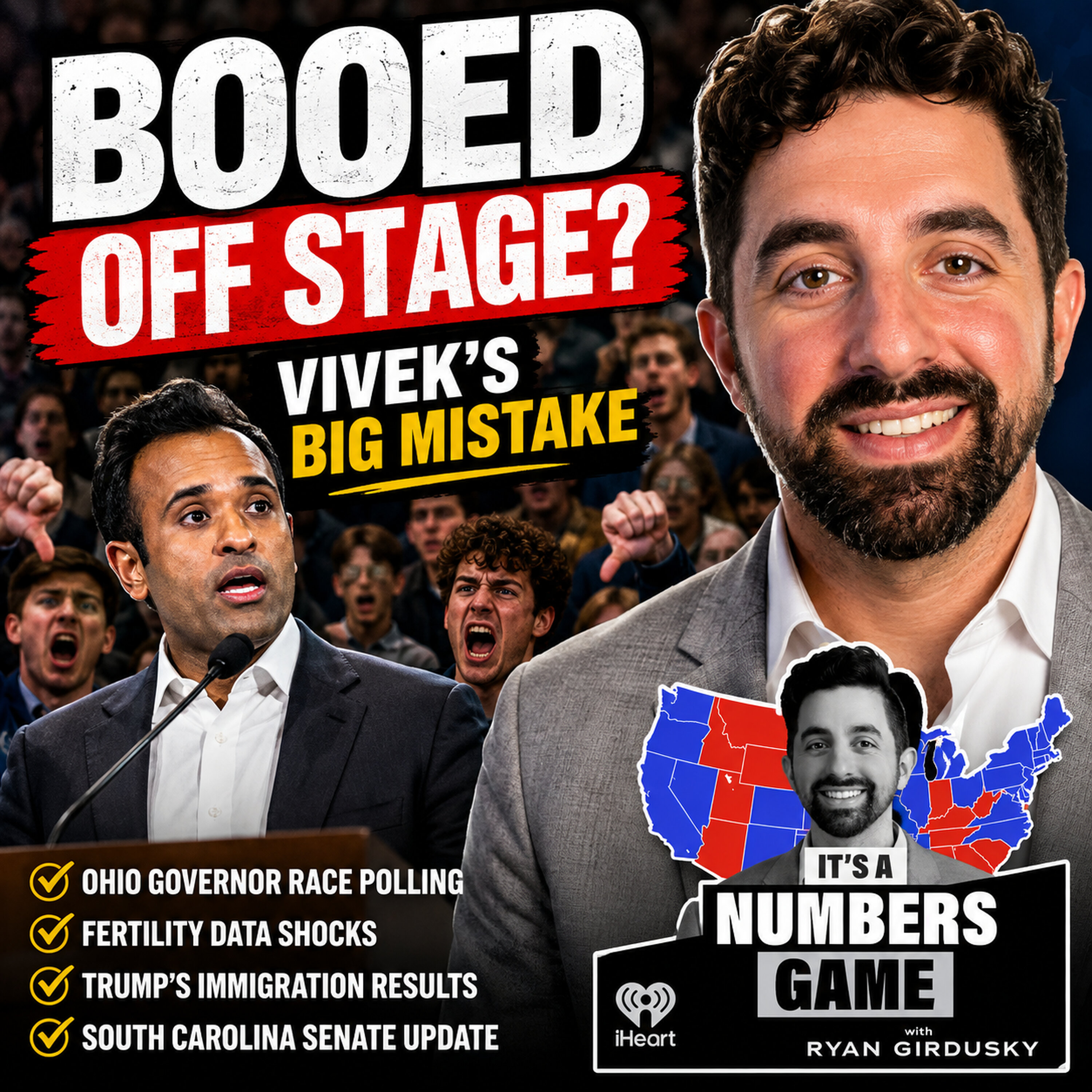
It's a Numbers Game: Vivek's Ohio Disaster, Fertility Data Surprise & 2026 Election Breakdown
5d ago00:42:34Summary readyIn this episode of It's a Numbers Game, Ryan analyzes Vivek Ramaswamy's appearance before Young Americans for Liberty, explaining why his message failed to connect with younger conservative and libertarian voters. Ryan also examines the latest polling in Ohio and discusses how campaign strategy, messaging, and voter concerns could shape one of the country's biggest gubernatorial races. Ryan also dives into newly released fertility data, arguing that President Trump's immigration enforcement is already showing measurable demographic effects. He explores declining births among foreign-born populations, stable birth rates among American-born women, and what those trends could mean for the future of the country. EMAIL RYANFollow Clay & Buck on YouTube: https://www.youtube.com/c/clayandbuckSee omnystudio.com/listener for privacy information.
Summary