Podcast
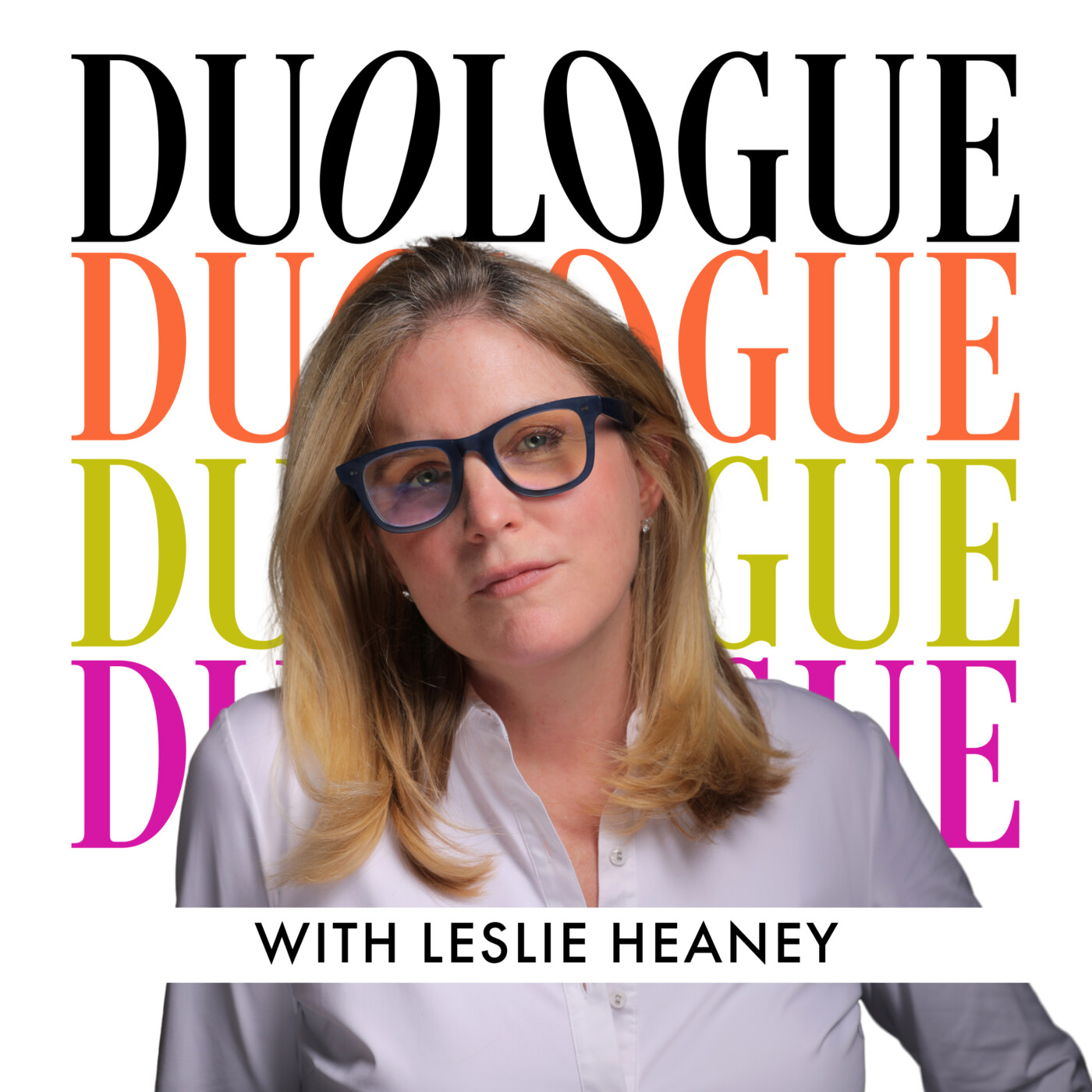
Duologue with Leslie Heaney
Hosted by Leslie Heaney · EN
A duologue is a conversation between two people and Duologue with Leslie (formerly The Interview with Leslie Heaney) is just that - a great insightful conversation between dynamic host Leslie Heaney and one (sometimes more than one, oops) expert and thought leaders on every relevant and inspiring topic of the day from health and wellness, to fashion, art and policy, to entertainment and science.
Leslie is so excited to share her amazing guests and their compelling stories with you - you’ll leave feeling inspired, having learned something new, and having shared a few laughs along the way!
Hosted on Ausha. See ausha.co/privacy-policy for more information.
88episodes
Episodes
Newest firstAll episodes
U.S. Immigration Explained: What the Line Actually Looks Like | Bo Cooper & Austin Fragomen
Apr 2901:09:12Summary readyLeslie sits down with two of the country's most respected immigration attorneys — Bo Cooper, former General Counsel of the U.S. Immigration and Naturalization Service, and Austin Fragomen, of the global immigration law firm Fragomen — to walk through what the U.S. immigration system actually looks like from the inside.Right now, there are roughly 4 million people waiting in various visa categories for a path to permanent residence in the United States. In this conversation, Leslie, Bo, and Austin break down exactly how that line works: the three legal pathways to permanent residence (family, employment, and humanitarian), why some people wait months while others wait over two decades depending on country of origin and family relationship, how the asylum system was designed in the aftermath of World War II and whether it fits the crises of today, and what is actually happening with deportation, birthright citizenship, and student visas.They also discuss what Congress could do — and why comprehensive reform has remained out of reach for decades.Whether you have been following immigration in the news and want to understand the underlying system, or you are simply curious about how this process works for real people — this is a clear, factual, and genuinely clarifying conversation.Follow Duologue on Instagram @duologuepod and subscribe so you never miss an episode.00:00:03 Introduction 00:02:33 The Three Pathways to a Green Card 00:07:20 Family-Based Immigration Explained 00:12:09 Why the Post-WWII Refugee Definition Is Outdated 00:14:32 How Long Is the Line? The 4 Million Figure 00:16:56 Employment Visas: H-1B, L Visas, and the Skills Gap 00:21:43 The Afghan Translator Story and the Refugee System 00:24:08 Asylum vs. Refugee: What's the Difference 00:38:12 Student Visas and the China Security Concern 00:45:25 Birthright Citizenship Around the World 00:50:10 Deportation, Enforcement, and What's Actually Possible 01:01:57 What Congress Could Do — and Why It Hasn'tHosted on Ausha. See ausha.co/privacy-policy for more information.
Summary
Why Testosterone Levels Are at an All-Time Low with Shalin Shah
Apr 2200:41:58Summary readyTestosterone levels in men have declined more than 25% over the last two decades. And most people — men and women alike — have no idea why, what it means, or what to do about it.In this episode, Leslie sits down with Shalin Shah, CEO of Marius Pharmaceuticals and one of the leading voices in the testosterone therapy space, to have the conversation that a lot of doctors still aren't having. Leslie brings her own experience — she's been on topical testosterone as part of her HRT protocol — and together they go deep on why T levels are dropping, how to know if yours are low, and what the treatment landscape actually looks like in 2026.They cover the difference between total and free testosterone and why the number your doctor shows you may be almost meaningless. They talk about the FDA panel that convened in December 2025, what was asked of regulators, and why the outcome could change how millions of people access care. They discuss why testosterone got classified as a controlled substance in 1990, the faulty studies that put cardiovascular and prostate cancer warnings on labels for decades, and what the landmark 2023 Traverse Study finally put to rest.They also talk about women — because testosterone is a female hormone too, and the gap between how men and women access treatment is still significant.If you've been curious about this subject — whether for yourself, your partner, your father, or your sons — this is the conversation to start with.Follow Duologue on Instagram @duologuepod and subscribe so you never miss an episode.00:00:00 Introduction & Leslie's Personal Story 00:02:18 The State of Testosterone Today 00:05:57 What's Causing the Decline 00:08:00 Symptoms of Low T & Why You Should Get Tested 00:10:10 Why Your Doctor Probably Isn't Testing You 00:12:24 What's a Normal Testosterone Level? 00:16:20 Testosterone and Women 00:20:00 Leslie's HRT Journey & Treatment Options 00:25:20 Natural Ways to Boost Your Levels 00:30:03 The FDA Panel — What Was Discussed 00:33:20 The Prostate Cancer Study — 3 People, 80 Years of Policy 00:36:30 What Needs to Change & What's Next 00:40:34 OutroHosted on Ausha. See ausha.co/privacy-policy for more information.
Summary
Inside a Rare Matisse Exhibition with Eleanor Acquavella
Apr 1600:42:48Summary readyWhen Acquavella Galleries first mounted a Matisse exhibition in 1973, the lines stretched down the block. Now, more than fifty years later, the gallery has done it again — and the wait was worth it.Leslie sits down with Eleanor Acquavella, Director at Acquavella Galleries, to go inside Matisse: The Pursuit of Harmony — a once-in-a-generation exhibition on view free to the public at their East 79th Street townhouse through May 22nd. Over 50 works borrowed from private collections, many unseen publicly, brought together by a family that has spent six decades knowing exactly where the best Matisse works live.In this conversation, Leslie and Eleanor explore how Matisse used sculpture to unlock his painting, his rivalry with Picasso, the odalisque and what it reveals about his relationship to color and form, and why top-quality Matisse works almost never come up for sale. They also discuss why and how the world is having a "Matisse moment" right now — with major shows opening simultaneously in Paris, Chicago, San Francisco, and Baltimore — and why New York has not seen anything like this in years.Whether you're an art lover, a curious visitor to New York before May 22nd, or someone who wants to understand how the private art world really works — this one is for you.Follow Duologue on Instagram @duologuepod and subscribe so you never miss an episode.00:00:03 Introduction 00:01:30 About the Exhibition 00:03:51 The 1973 Show and 50 Years Later 00:06:08 Borrowing from Private Collectors 00:08:25 How Sculpture Unlocked Matisse's Painting 00:10:40 The Odalisque Explained 00:15:31 Matisse vs. Picasso 00:29:54 The Global Matisse Moment 00:32:17 The Matisse Art Market 00:37:04 What's Next for Acquavella 00:41:54 OutroHosted on Ausha. See ausha.co/privacy-policy for more information.
Summary
Exploring the Hudson Valley with Lidey Heuck | Antiques, Swimming Holes & Local Favorites
Apr 800:44:23Summary readyWe're kicking off the Duologue Summer Travel Series with one of the most beautiful and beloved corners of the country — the Hudson Valley.Leslie sits down with Lidey Heuck, cookbook author, New York Times recipe contributor, and the voice behind Lidey Likes and the Lidey Letter Substack. Lidey lives in the Hudson Valley with her family and knows the region the way only a local can — the antique shops worth the detour, the farmers markets, the swimming holes, the restaurants, and yes, a few cautionary foraging tales.Lidey's culinary journey began with none other than Ina Garten (yes, they talk about Jeffrey), and her debut cookbook Cooking in Real Life has become one of Leslie's all-time favorites.In this episode: favorite antique stores, must-visit restaurants, hidden gems in the Hudson Valley, Litchfield County, and the Berkshires — plus what makes this region so worth falling in love with.Whether you're planning a trip or just love dreaming about charming getaways, this one's for you.Follow Duologue on Instagram @duologuepod and subscribe so you never miss an episode.Hosted on Ausha. See ausha.co/privacy-policy for more information.
Summary
Cracking the Code: Test Prep Expert Bryan Bibler Explains the SAT and ACT
Apr 101:16:13Summary readyConfused about the SAT vs ACT? In this episode, Leslie sits down with Bryan Bibler, CEO of Thirty-Six Education, to break down everything parents and high school students need to know about standardized testing, college admissions, and test prep strategies for 2025.They cover the key differences between the ACT and SAT, how to choose the right test, when to start preparing, and how recent test-optional college admissions policies—including at Ivy League schools—are changing the landscape. Bryan also shares proven methods to improve SAT and ACT scores, realistic prep timelines, and affordable test prep resources for families without access to private tutoring.Perfect for high school students, parents, and college applicants, this episode delivers actionable insights on SAT prep, ACT prep, college application strategy, and maximizing test scores.Hosted on Ausha. See ausha.co/privacy-policy for more information.
Summary
Beyond Blue and White: The Untold Story of Delftware with Genevieve Wheeler Brown
Mar 2500:59:34Summary readyFive years ago, Genevieve "Veve" Wheeler Brown flipped over a jug and found a woman's signature. What followed was a five-year quest across three continents — and a book. In this episode, Leslie sits down with her longtime friend and author of Beyond Blue and White to trace the hidden history of Delftware: from Dutch Golden Age workshop owners who built trade empires, to the Gilded Age women who founded their own museums when no one would let them in. Four centuries. One ceramic. Countless women history forgot to credit. The perfect listen to close out Women's History Month.Hosted on Ausha. See ausha.co/privacy-policy for more information.
Summary
[REVISIT] The Women Who Created A President - with Ed O'Keefe
Mar 1801:10:31Summary readyIn honor of Women’s History Month, we’re revisiting a powerful conversation from The Interview vault with author and journalist Ed O’Keefe.In this episode, Ed shares the remarkable story behind his book The Loves of Theodore Roosevelt: The Women Who Created a President. What began as a fellowship at the Harvard Kennedy School led to an unexpected discovery: unpublished letters between Theodore Roosevelt and the women who shaped his life. Those letters uncovered a deeper, more nuanced history... one where Roosevelt’s rise was not his alone, but profoundly influenced by the extraordinary women around him.As we reflect this Women’s History Month, this re-release feels especially meaningful. It’s a reminder that behind some of history’s most influential leaders are stories that deserve to be told.If you missed this episode the first time, it’s one you won’t want to skip.Hosted on Ausha. See ausha.co/privacy-policy for more information.
Summary
Color, Creativity, and the Power of Jewelry with Nicholas Varney
Mar 501:01:35Summary readyIn this episode of Duologue, Leslie sits down with Nicholas Varney. Nick is the founder and designer behind Nicholas Varney Jewels. His work has earned him widespread recognition—from appearances in Vogue, Town & Country, and W Magazine, to being named by Forbes as one of the “Five Jewelers Working Today That You Will Be Collecting Tomorrow.” In their conversation, Leslie and Nick discuss his creative inspirations, his design process, and what it was like growing up as the son of the legendary interior designer, the late Carleton Varney. They also explore where the world’s most extraordinary gemstones come from, the global journey they take before becoming jewelry, and how Nick approaches his work not just as a designer, but as a true artist.Hosted on Ausha. See ausha.co/privacy-policy for more information.
Summary
Thinking With Machines: AI, Human Judgment, and the Future of Intelligence with Vasant Dhar
Feb 2500:59:34Summary readyIn this week’s episode, Leslie Heaney sits down with Vasant Dhar—professor at NYU Stern School of Business and the Center for Data Science at New York University, founder of SCT Capital, and author of Thinking with Machines: The Brave New World of AI.Together, they explore how artificial intelligence evolved, why language prediction changed everything, and what it means now that machines can think alongside humans. The conversation examines the growing divide between those who use AI to sharpen judgment and those who rely on it to think for them, as well as the broader implications for work, education, power, and responsibility.This is a grounded, honest conversation about the power of AI—and how we choose to live with it.Hosted on Ausha. See ausha.co/privacy-policy for more information.
Summary
The Environment Shaping Your Health - Pt. 2 with Tapp Francke
Feb 1800:40:54Summary readyI am very excited to bring you Part 2 of my conversation with clinical nutritionist and co-founder of Hamptons BioMed, Tapp Francke. In last week’s episode, we talked about learning about your own body’s “terrain,” focusing on vitamins, nutrients, the gut biome, genetics, and how testing can guide smarter supplement choices and better overall health. In Part 2, we explore the environmental factors that quietly shape our health. Everyday exposures — including plastic, fragrance, EMFs, blue light, mold, and processed foods — can influence hormones, immune function, biological aging, and long-term resilience. Tapp explains why what we absorb through our skin and environment matters just as much as what we eat, and how small, practical changes can reduce ongoing stress on the body. This episode completely changed how I think about food, fragrance, water, and the environment I move through every day. It’s not about eliminating everything or doing it “perfectly,” but about becoming more aware of what our bodies are constantly absorbing — and how small changes can add up to meaningful long-term impact.Hosted on Ausha. See ausha.co/privacy-policy for more information.
Summary