
Podcast
Statecraft
Hosted by Santi Ruiz · EN
51episodes
Episodes
Newest firstAll episodes
What’s Wrong with NIH Grants?
Jan 901:11:27Summary readyMike Lauer is the former Deputy Director for Extramural Research at the National Institutes of Health. A cardiologist and researcher, he joined the NIH’s National Heart, Lung, and Blood Institute in 2007 as the Director of the Division of Prevention and Population Science. From 2015, he oversaw the NIH’s $32 billion funding program for external research. Since leaving NIH in 2025, he has become an outspoken advocate for fundamental reform in how the federal government supports biomedical research.We discuss:* Why the NIH used to fund 60% of grant applications — and now funds just 10%* How “soft money” forces researchers to fund their own salaries* How distributing lots of small grants wastes everyone’s time* How block grants could fund more breakthrough science* Why researchers don’t get their first independent award until their mid-40sThe full transcript for this conversation is at www.statecraft.pub This is a public episode. If you would like to discuss this with other subscribers or get access to bonus episodes, visit www.statecraft.pub
Summary
99.8% of Federal Employees Get Good Performance Reviews. Why?
Dec 1601:02:18Summary readyToday we’re joined by Scott Kupor, Director of the Office of Personnel Management. I think of it as the federal HR department — he makes a compelling case that it’s really the government’s talent management organization.Scott manages talent for an organization of 2+ million people with a $7 trillion budget. We discuss:* How DOGE cut federal headcount — and what comes next?* Why agencies rehired employees they had just laid off* How few federal employees get fired for poor performance* What OPM can do without congressional helpFor the full transcript of this conversation, go to www.statecraft.pub. This is a public episode. If you would like to discuss this with other subscribers or get access to bonus episodes, visit www.statecraft.pub
Summary
Did the CHIPS "Everything Bagel"...Work?
Dec 1201:35:35Summary readyCHIPS, the Creating Helpful Incentives to Produce Semiconductors Act, is another. It spurred a massive investment boom in semiconductors on American soil, led by the CHIPS Program Office (CPO) at the Department of Commerce. The CPO had to decide how to allocate $39 billion in manufacturing incentives—and then negotiate the details with some of the world's biggest companies.Today, I’m lucky to have on three of the founding members of the CHIPS Program Office team:* Mike Schmidt, the inaugural Director,* Todd Fisher, the Chief Investment Officer, and* Sara Meyers, Chief of Staff and Chief Operating Officer.Mike, Todd, and Sara have a clear sense of what went right for them, what went wrong, and what they’d do differently the next time. In a new project for IFP called Factory Settings, they describe what they learned.The full transcript for this conversation is at www.statecraft.pub. This is a public episode. If you would like to discuss this with other subscribers or get access to bonus episodes, visit www.statecraft.pub
Summary
How to Save Science Funding
Dec 401:00:50Summary readyIf you’re a scientist, and you apply for federal research funding, you’ll ask for a specific dollar amount. Let’s say you’re asking for a million-dollar grant. Your grant covers the direct costs, things like the salaries of the researchers that you’re paying. If you get that grant, your university might get an extra $500,000. That money is called “indirect costs,” but think of it as overhead: that money goes to lab space, to shared equipment, and so on.This is the system we’ve used to fund American research infrastructure for more than 60 years. But earlier this year, the Trump administration proposed capping these payments at just 15% of direct costs, way lower than current indirect cost rates. There are legal questions about whether the admin can do that. But if it does, it would force universities to fundamentally rethink how they do science.The indirect costs system is pretty opaque from the outside. Is the admin right to try and slash these indirect costs? Where does all that money go? And if we want to change how we fund research overhead, what are the alternatives? How do you design a research system to incentivize the research you actually wanna see in the world?I’m joined today by Pierre Azoulay from MIT Sloan and Dan Gross from Duke’s Fuqua School of Business. Together with Bhaven Sampat at Johns Hopkins, they conducted the first comprehensive empirical study of how indirect costs actually work. Earlier this year, I worked with them to write up that study as a more accessible policy brief for IFP. They’ve assembled data on over 350 research institutions, and they found some striking results. While negotiated rates often exceed 50-60%, universities actually receive much less, due to built-in caps and exclusions.Moreover, the institutions that would be hit hardest by proposed cuts are those whose research most often leads to new drugs and commercial breakthroughs.Thanks to Katerina Barton, Harry Fletcher-Wood, and Inder Lohla for their help with this episode, to Matt Esche and Caleb Watney for their work on the graphs, and to Beez for her help translating this topic to a general audience.For a printable PDF of this interview, click here:Let’s say I’m a researcher at a university and I apply for a federal grant. I’m looking at cancer cells in mice. It will cost me $1 million to do that research — to pay grad students, to buy mice and test tubes. I apply for a grant from the National Institutes of Health, or NIH. Where do indirect costs come in?Dan Gross: Research generally incurs two categories of costs, much as business operations do.* Direct or variable costs are typically project-specific; they include salaries and consumable supplies.* Indirect or fixed costs are not as easily assigned to any particular project. [They include] things like lab space, data and computing resources, biosecurity, keeping the lights on and the buildings cooled and heated — even complying with the regulatory requirements the federal government imposes on researchers. They are the overhead costs of doing research.Pierre Azoulay: You will use those grad students, mice, and test tubes, the direct costs. But you’re also using the lab space. You may be using a shared facility where the mice are kept and fed. Pieces of large equipment are shared by many other people to conduct experiments. So those are fixed costs from the standpoint of your research project.Dan: Indirect Cost Recovery (ICR) is how the federal government has been paying for the fixed cost of research for the past 60 years. This has been done by paying universities institution-specific fixed percentages on top of the direct cost of the research. That’s the indirect cost rate. That rate is negotiated by institutions, typically every two to four years, supported by several hundred pages of documentation around its incurred costs over the recent funding cycle.The idea is to compensate federally funded researchers for the investments, infrastructure, and overhead expenses related to the research they perform for the government. Without that funding, universities would have to pay those costs out of pocket and, frankly, many would not be interested or able to do the science the government is funding them to do.Imagine I’m doing my mouse cancer science at MIT, Pierre’s parent institution. Some time in the last four years, MIT had this negotiation with the National Institutes of Health to figure out what the MIT reimbursable rate is. But as a researcher, I don’t have to worry about what indirect costs are reimbursable. I’m all mouse research, all day.Dan: These rates are as much of a mystery to the researchers as it is to the public. When I was junior faculty, I applied for an external grant from the National Science Foundation (NSF) — you can look up awards folks have won in the award search portal. It doesn’t break down indirect and direct cost shares of each grant. You see the total and say, “Wow, this person got $300,000.” Then you go to write your own grant and realize you can only budget about 60% of what you thought, because the rest goes to overhead. It comes as a bit of a shock the first time you apply for grant funding.What goes into the overhead rates? Most researchers and institutions don’t have clear visibility into that. The process is so complicated that it’s hard even for those who are experts to keep track of all the pieces.Pierre: As an individual researcher applying for a project, you think about the direct costs of your research projects. You’re not thinking about the indirect rate. When the research administration of your institution sends the application, it’s going to apply the right rates.So I’ve got this $1 million experiment I want to run on mouse cancer. If I get the grant, the total is $1.5 million. The university takes that .5 million for the indirect costs: the building, the massive microscope we bought last year, and a tiny bit for the janitor. Then I get my $1 million. Is that right?Dan: Duke University has a 61% indirect cost rate. If I propose a grant to the NSF for $100,000 of direct costs — it might be for data, OpenAI API credits, research staff salaries — I would need to budget an extra $61,000 on top for ICR, bringing the total grant to $161,000.My impression is that most federal support for research happens through project-specific grants. It’s not these massive institutional block grants. Is that right?Pierre: By and large, there aren’t infrastructure grants in the science funding system. There are other things, such as center grants that fund groups of investigators. Sometimes those can get pretty large — the NIH grant for a major cancer center like Dana-Farber could be tens of millions of dollars per year.Dan: In the past, US science funding agencies did provide more funding for infrastructure and the instrumentation that you need to perform research through block grants. In the 1960s, the NSF and the Department of Defense were kicking up major programs to establish new data collection efforts — observatories, radio astronomy, or the Deep Sea Drilling project the NSF ran, collecting core samples from the ocean floor around the world. The Defense Advanced Research Projects Agency (DARPA) — back then the Advanced Research Projects Agency (ARPA) — was investing in nuclear test detection to monitor adherence to nuclear test ban treaties. Some of these were satellite observation methods for atmospheric testing. Some were seismic measurement methods for underground testing. ARPA supported the installation of a network of seismic monitors around the world. Those monitors are responsible for validating tectonic plate theory. Over the next decade, their readings mapped the tectonic plates of the earth. That large-scale investment in research infrastructure is not as common in the US research policy enterprise today.That’s fascinating. I ...
Summary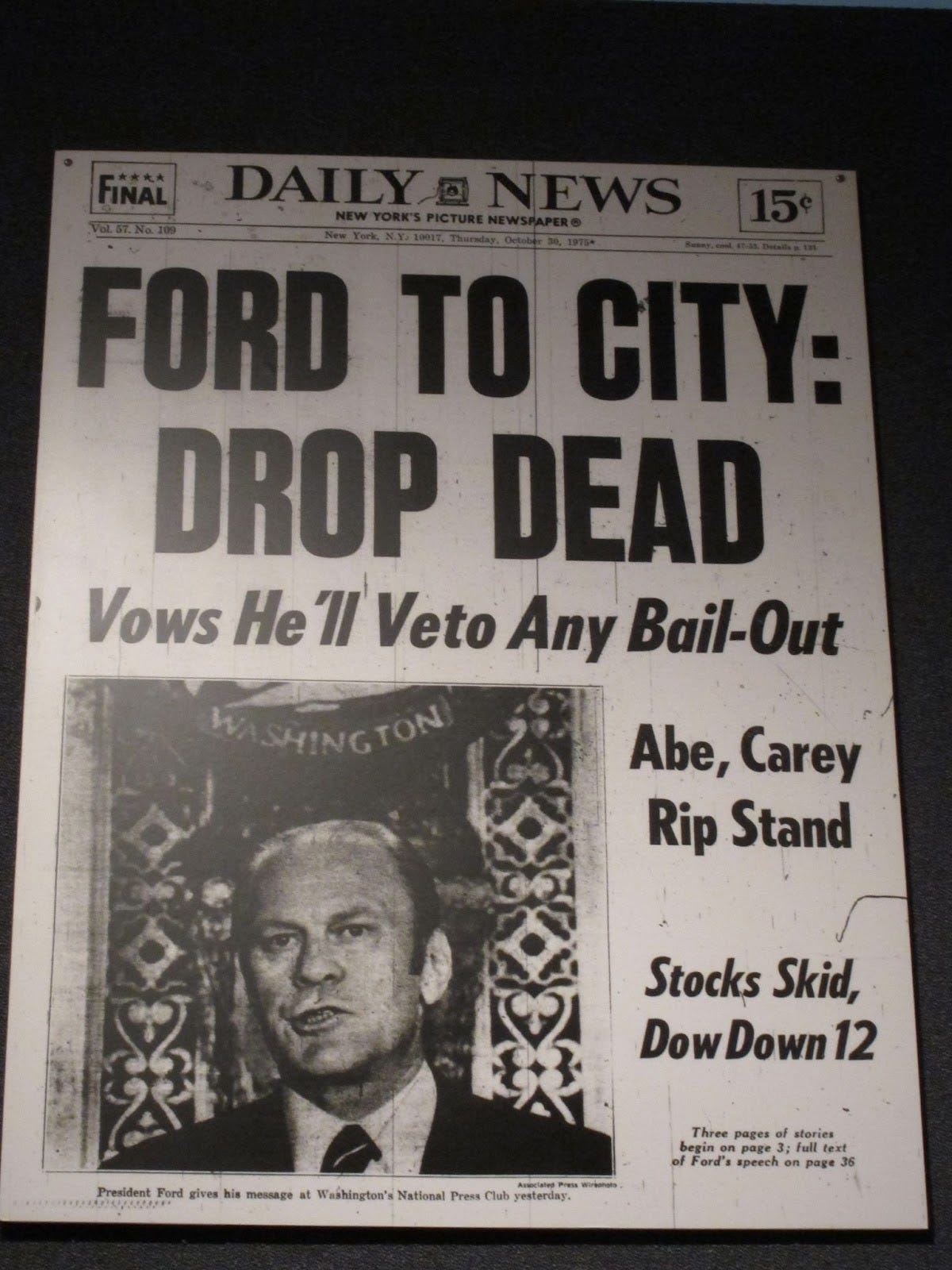
Should the Feds Bail Out Chicago?
Nov 2501:05:47Summary readyThe full transcript for this conversation and many others can be found at www.statecraft.pub.Today we’re joined by David Schleicher. David is Professor of Property and Urban Law at Yale Law School, and an expert in local government law, land use, finance, and urban development.I found David’s book, In a Bad State: Responding to State and Local Budget Crises, a fascinating and readable primer on municipal debt: what it is, how it grows, and how cities can face up to it.Municipal pension funding may not sound like the most fascinating topic. I hope this conversation illustrates two things. First, how our pension systems work matters to all of us — whether or not we are enrolled in a municipal pension. Second, these questions go to the heart of how our cities are run, why they fail, and how they can be improved.We discuss:* Why are so many municipal pension funds in debt?* Why New York City went bankrupt and Chicago didn’t* Moral hazard in municipal credit* The practice of "universal log rolls"* How the federal government should respond to local bankruptcies This is a public episode. If you would like to discuss this with other subscribers or get access to bonus episodes, visit www.statecraft.pub
Summary
How Diplomacy Works in Africa
Nov 1201:35:40Summary readyToday we’re joined by Judd Devermont, one of the most experienced Africa policy hands in Washington. He spent 16 years as an intelligence analyst, serving in both the Obama and Biden administrations. Most recently, he was Senior Director for African Affairs at the National Security Council. He authored the Biden administration’s Strategy Toward Sub-Saharan Africa. Since leaving government in early 2024, he writes a newsletter called Post Strategy, reflecting on what works and what doesn’t in US policy toward Africa.We discuss* What “care and feeding” means in diplomacy* What went wrong with the relationships with Niger* The problem with envoys* Whether the NSC has been neutered under Trump* Why most intelligence analysis doesn’t cut it anymoreThe full transcript for this conversation is at www.statecraft.pub. This is a public episode. If you would like to discuss this with other subscribers or get access to bonus episodes, visit www.statecraft.pub
Summary
How to Run New York City
Oct 3101:18:07Summary readyYou can find the full transcript of this conversation at www.statecraft.pub.The likely next mayor of New York City is Zohran Mamdani, if polling is anywhere close to being correct. Much of the conversation has revolved around the day-to-day administration of City Hall. If Mamdani wins, does he have what it takes to run the city’s government?Today’s guest is still active in NYC political life, and it was clear I would not get an answer to that particular question. Instead, I took this opportunity to investigate how City Hall actually runs, and how the past three mayors have structured their administrations. But if you read between the lines, you can treat this conversation as a guide about what has worked in New York’s governance over the last 20 years, and the likely stumbling blocks for an ambitious new administration.Maria Torres-Springer moved to New York City a week before 9/11, and spent most of the following 20 years in city government — first as a top appointee in the Bloomberg administration, then in several high-powered roles under Bill de Blasio, and eventually as second-in-command for Eric Adams. Her most recent role was as first deputy mayor: functionally the Chief Operating Officer of New York City. Torres-Springer resigned in February 2025 (she was not implicated in the overlapping Eric Adams corruption scandals).To put it lightly, Torres-Springer has fans. In November 2024, City & State New York wrote a cover story titled, “The Vibe at City Hall is Thank God for Maria Torres-Springer.” It quotes political figures from the far left, center left, and right, calling Torres-Springer “a phenomenal leader,” “a very classy, charismatic, knowledgeable individual,” and, “a serial overachiever in a good way.” When Adams appointed her as first deputy mayor, he said, “She has the ability of landing the plane.”Torres-Springer is widely described as one of the most effective political operators in New York City, and she’s been linked in media stories as a potential official in the next mayoral administration (although she recently took a role as President of the Revson Foundation, a NYC-based philanthropic organization). She’s maybe the best possible guest to talk about steering City Hall.Given constraints on what Torres-Springer could discuss, I wanted to get into two big topics. One is process. What does it take to run City Hall? How have different mayors done it differently? The other is outcomes. Torres-Springer was one of the champions of City of Yes, the Adams-backed initiative to build 500,000 new housing units in the city over the next 10 years. I wanted to better understand City of Yes, what she’s most excited about, what didn’t make the cut, and how it all came together politically.We discuss:* What it takes to succeed working for three very different mayors* How Bloomberg, de Blasio, and Adams governed differently* How to work effectively under constant pressure* The political coalitions that made City of Yes possible* Why it takes over a year to turn over a NYCHA apartment* How to fix the plumbing of government* What the next mayor should prioritize to keep New York thrivingThanks to Harry Fletcher-Wood, Eamonn Ives, and Katerina Barton for their judicious audio and transcript edits for length and clarity. This is a public episode. If you would like to discuss this with other subscribers or get access to bonus episodes, visit www.statecraft.pub
Summary
A Statecraft Fall Roundup
Oct 2300:36:48Summary readyThis episode was originally recorded on October 18th at the Progress Conference in Berkeley. Because of the federal shutdown, Director Kratsios called in virtually.Michael Kratsios is Director of the White House Office of Science and Technology Policy, and the president’s top science and technology advisor. In the first Trump administration, Kratsios was US Chief Technology Officer, and later acting Under Secretary of Defense for Research and Engineering, where he championed emerging tech like AI, quantum, and autonomous systems in defense.Given constraints in the topics Kratsios could speak on, my questions focused on understanding the administration’s AI and science policy. We talked about the recent AI Action Plan: what AI can do for America and the world, and how the administration plans to ensure US leadership. We discuss the administration’s vision for gold standard science, and whether the structures we use to fund science need to change. We also touched on how the second Trump administration differs from the first, and Kratsios’s take on AI safety.Thanks to Harry Fletcher-Wood and Katerina Barton for their light edits for length and clarity in the transcript and audio, respectively, and for a tight turnaround. The White House has not yet cleared the full video for publication, but we’ll share it here if it is cleared.The full transcript for this conversation and many others is available at www.statecraft.pub. This is a public episode. If you would like to discuss this with other subscribers or get access to bonus episodes, visit www.statecraft.pub
Summary
Is the Senate Fixing Housing Policy?
Oct 1601:08:48Summary readyToday we’re talking about housing. The ROAD to Housing Act passed the Senate Banking, Housing, and Urban Affairs Committee 24-0 in late July. Last week — despite the shutdown — it cleared the Senate. It’s a package of 27 pieces of legislation to boost housing supply, improve affordability, reduce regulatory roadblocks, and reduce homelessness.When you zoom out a bit, what’s happened here is pretty surprising. The chair of the committee, Republican Tim Scott, and the Ranking Member, Elizabeth Warren, a Democrat, co-sponsored the bill. The bill is the committee’s first bipartisan housing markup in over a decade. Passing through committee unanimously doesn’t happen often for serious bills of this sort. I wanted to understand how this bill happened, and came to have a serious shot at passing. And I also wanted to get a better sense of what’s actually in the bill, and why it matters for housing. If you’re like me, most of the debates you hear about housing policy focus on zoning, which is a local issue — very little federal say. So what are all these pieces of legislation? Do they matter?Joining me is an unorthodox trio:* Will Poff-Webster was legislative counsel for Senator Brian Schatz, a Democrat from Hawaii. He’s our inside guy today: he worked on the bill within the Senate. And today, he covers housing policy here at IFP.* Alex Armlovich is Senior Housing Policy Analyst at the Niskanen Center. He has been working on housing issues for a long time, and his fingerprints are on parts of this bill package. He’s my advocate from the outside.* Brian Potter is Senior Infrastructure Fellow at IFP and author of Construction Physics, which I very much enjoy editing. If I can make one newsletter recommendation to you besides Statecraft, it’s Construction Physics. He has a background in private-sector home building. And has written about several of the proposals in this package.Table of contents:* What’s the federal role in housing policy?* What’s in the bill?* Regulatory reform* Technical assistance plus incentives* Funding and financing reform* A brief sidebar on manufactured home chassis* Will the bill matter?* How did the bill happen, politically speaking?* The policy wonk success storyThank you to Harry Fletcher-Wood and Katerina Barton for their judicious transcript and audio edits.For the full transcript of this conversation, go to www.statecraft.pub. This is a public episode. If you would like to discuss this with other subscribers or get access to bonus episodes, visit www.statecraft.pub
Summary
Why We Don't Build Apartments for Families
Oct 800:57:34Summary readyToday, we’re joined by Bobby Fijan. He’s a co-founder of the American Housing Corporation, a startup building housing for families in cities. A burning question motivates his work: How do you make cities places where families can live and thrive? He has a new report out with the Institute of Family Studies looking at what families really want from their apartments.This is a pretty self-indulgent episode for me. I live in Brooklyn with my wife and two-year-old, and we’re expecting our second kid. We want to stay in the city — it’s where our life and community are, and where we’ve put down roots. But the classic route for people like us is to move out to the suburbs once the family grows. I hoped talking to Bobby would help me avoid that fate.Bobby argues that the best ideas for family-friendly housing aren’t new. Pre-war apartments in American cities look a lot like what he’s advocating for. We’ve done this before, and we could do it again.We discuss:* How the financial crisis fuelled a boom in studio apartments* Why did apartments get so much smaller after 2008?* Why are most two-bedroom apartments designed for roommates?* What do families actually want in a floor plan, and why don’t developers build it?* Whether upzoning can helpThanks to Harry Fletcher-Wood and Katerina Barton for their judicious transcript and audio edits.The full transcript to this conversation and many others is available at www.statecraft.pub. This is a public episode. If you would like to discuss this with other subscribers or get access to bonus episodes, visit www.statecraft.pub
Summary