
Podcast
ScreenStrong Families
Hosted by Melanie Hempe, BSN · EN
After her oldest son, Adam, dropped out of college due to his video game addiction, Melanie Hempe, BSN, put her nursing degree and training from Emory University to good use and founded ScreenStrong. It’s her mission to create educational programs for kids and parents so no one will experience the pain of screen addiction. Her ability to simplify medical science and provide practical solutions for families has allowed her to share her passion and bold screen solutions nationally. ScreenStrong has won the hearts of many families who are preventing and reversing childhood screen conflicts and addiction.
Host of the popular weekly ScreenStrong Families Podcast, Melanie has been featured in Psychology Today, Thrive-Global, The Wall Street Journal, A&E Network, CBS, CNN, NPR, the documentary Screened Out, and various news and television outlets. Her ScreenStrong Kids’ Brains and Screens Courses are available for parents and students. Her four books include, “Kids’ Brains & Screens: A ScreenStrong Student Course,” “Will Your Gamer Survive College?” “Can Your Teen Survive—and Thrive—Without a Smartphone?” and “The ScreenStrong Solution: How to Free Your Child from Addictive Screen Habits.”
50episodes
Episodes
Newest firstAll episodes

ENCORE: How Teachers and Parents Can Support Phone-Free Schools with Dr. Adriana Stacey (#214)
Today00:45:25Summary readyIn this episode, Melanie and Dr. Stacey explore how teachers and parents can collaborate to create a phone-free school environment. Teachers can support the policy by using research-backed education, setting an example with their own phone use, and staying alert to signs of phone overuse, like distracted behavior and declining grades. Parents play a crucial role by supporting the school’s efforts, limiting contact with kids during school hours, and encouraging phone-free days.For parents wanting to go further, we’ll also discuss becoming a Phone-Free Champion in your school, organizing fun, tech-free activities that encourage socializing and new hobbies.Tune in to learn how phone-free schools can help students stay focused, build friendships, and feel more connected.Download our Phone-Free School Resource Guide.Support the showDon't forget to subscribe, rate, and leave a review if you enjoy the episode. Your feedback helps us bring you more of the content you love. Stay Strong!Get your copy of the BRAND NEW Adventures of Super Brain book!Start your ScreenStrong Journey today!Check out our Kids' Brains & Screens products.Want to help spread the ScreenStrong message to your community? Consider becoming a ScreenStrong Ambassador!ScreenStrong Tech RecommendationsCanopy—Device Filter (use code STRONG for discount)Production Team:Host: Melanie HempeProducer & Audio Editor: Olivia Kernekin
Summary
ENCORE: A Smartphone-Free Adolescence: Melissa’s Story (#172)
2w ago01:07:51Summary readyOriginally aired November 8, 2023.In this episode, Melanie has a very special guest—her daughter, Melissa! In this episode, we will hear how Melissa feels about growing up without social media or a smartphone. They discuss an overview of teen brain science, what makes social media irresistible for teens, the risks for teen girls, and end with some practical tips for parents. You will enjoy the candid nature of this conversation and will be inspired to make some changes in your home!Support the showDon't forget to subscribe, rate, and leave a review if you enjoy the episode. Your feedback helps us bring you more of the content you love. Stay Strong!Get your copy of the BRAND NEW Adventures of Super Brain book!Start your ScreenStrong Journey today!Check out our Kids' Brains & Screens products.Want to help spread the ScreenStrong message to your community? Consider becoming a ScreenStrong Ambassador!ScreenStrong Tech RecommendationsCanopy—Device Filter (use code STRONG for discount)Production Team:Host: Melanie HempeProducer & Audio Editor: Olivia Kernekin
Summary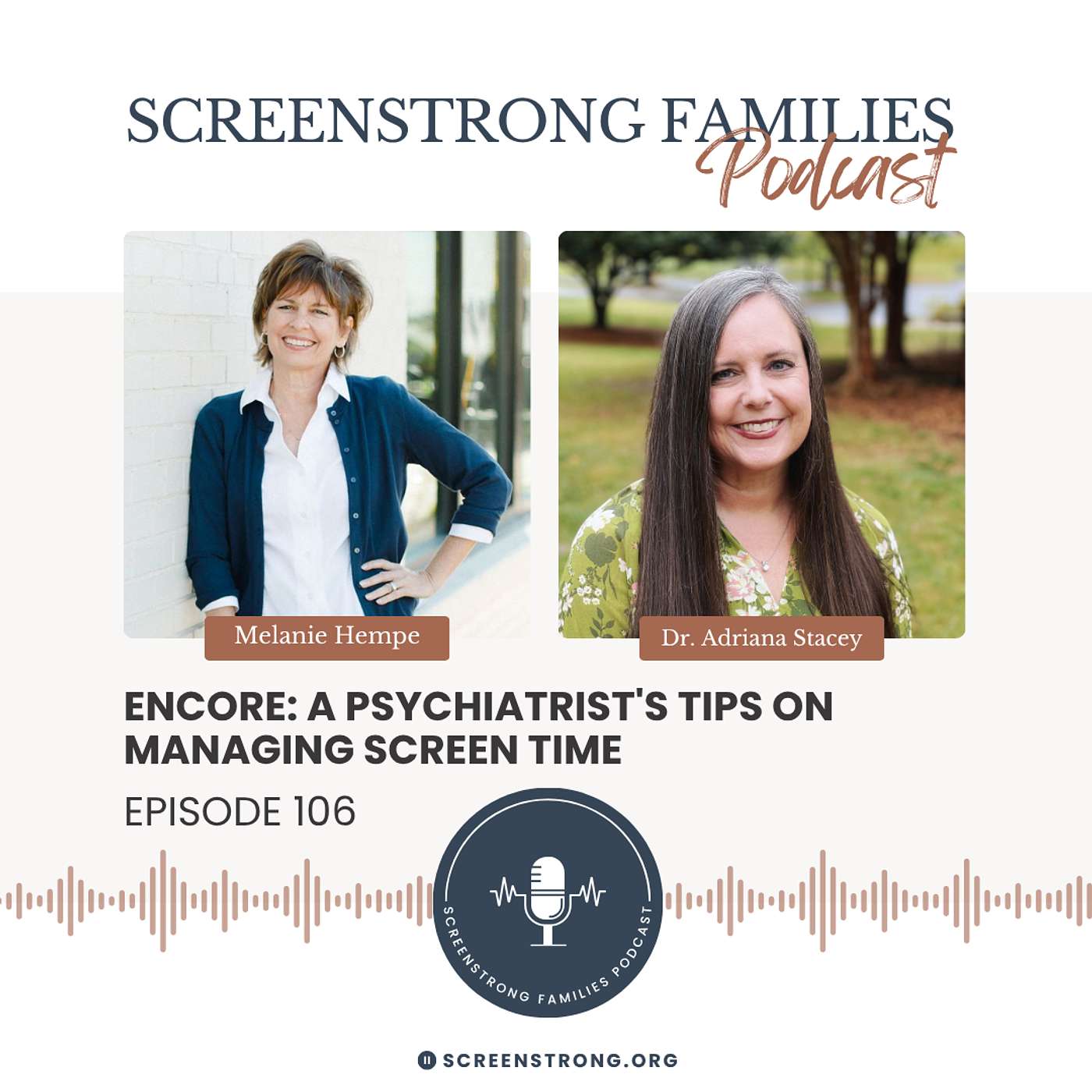
ENCORE: A Psychiatrist's Tips on Managing Screen Time with Dr. Adriana Stacey (#106)
Jul 801:19:54Summary readyToday we welcome back Dr. Adriana Stacey, a Board Certified Psychiatrist, for part two of her discussion with Melanie. In this episode they cover why going cold-turkey with screen removal may be the best option for your family and offer tips and tricks for handling addictive behavior.Dr. Stacey's areas of specialty include female mental health treatment, including treatment of depression, anxiety, adult ADHD, insomnia, and sports psychiatry. Support the showDon't forget to subscribe, rate, and leave a review if you enjoy the episode. Your feedback helps us bring you more of the content you love. Stay Strong!Get your copy of the BRAND NEW Adventures of Super Brain book!Start your ScreenStrong Journey today!Check out our Kids' Brains & Screens products.Want to help spread the ScreenStrong message to your community? Consider becoming a ScreenStrong Ambassador!ScreenStrong Tech RecommendationsCanopy—Device Filter (use code STRONG for discount)Production Team:Host: Melanie HempeProducer & Audio Editor: Olivia Kernekin
Summary
ENCORE: Summer Strategies: Keeping Middle Schoolers ScreenStrong This Summer (#190)
Jul 100:57:26Summary readyDo you want to prevent your middle Schooler from becoming dependent on screen time this summer? Join Melanie as she offers practical strategies to Emily, a ScreenStrong Ambassador and concerned middle school mom, to keep tweens engaged and social without resorting to video games or social media. Get inspired and discover how to make this summer a ScreenStrong success for your family!Support the showDon't forget to subscribe, rate, and leave a review if you enjoy the episode. Your feedback helps us bring you more of the content you love. Stay Strong!Get your copy of the BRAND NEW Adventures of Super Brain book!Start your ScreenStrong Journey today!Check out our Kids' Brains & Screens products.Want to help spread the ScreenStrong message to your community? Consider becoming a ScreenStrong Ambassador!ScreenStrong Tech RecommendationsCanopy—Device Filter (use code STRONG for discount)Production Team:Host: Melanie HempeProducer & Audio Editor: Olivia Kernekin
Summary
10 Things Your 14-Year-Old Boy Can Do This Summer with Evan Hempe (#265)
Jun 2400:53:26Summary readyFourteen-year-old boys face a tricky gap every June—too old for camp, too young for a job, and just bored enough to default to hours of gaming. Evan Hempe knows the feeling firsthand: he grew up without video games or a smartphone, and in this episode he shares the real list of what filled his summers instead. Funny, candid, and packed with stories from his own backyard, Evan makes the case that a great summer isn't about avoiding screens, it's about going toward something better.In this episode, Evan covers:Why a skill you can never "finish" (music, woodworking, cooking) beats a game that never endsHow starting a small business at 14 builds confidence adults can't teachThe difference between consuming and creating and why people respect bothWhy his most vivid memories are from creeks, ballfields, and rained-out camping trips, not screensWhether you're a parent looking for ideas or a teen wondering what to do with three open months, this episode is the blueprint for a summer worth remembering.Support the showDon't forget to subscribe, rate, and leave a review if you enjoy the episode. Your feedback helps us bring you more of the content you love. Stay Strong!Get your copy of the BRAND NEW Adventures of Super Brain book!Start your ScreenStrong Journey today!Check out our Kids' Brains & Screens products.Want to help spread the ScreenStrong message to your community? Consider becoming a ScreenStrong Ambassador!ScreenStrong Tech RecommendationsCanopy—Device Filter (use code STRONG for discount)Production Team:Host: Melanie HempeProducer & Audio Editor: Olivia Kernekin
Summary
Why Screens Are Changing the Classroom: What Parents Need to Know About Kids, Schools & Attention (Part 2) (#264)
Jun 1500:43:08Summary readyIn Part 2 of Melanie Hempe’s conversation with educator and Screen Schooled co-author Joe Clement, they continue unpacking the hidden impact of screens on today’s children and classrooms.Building on their previous discussion, Joe shares more insights from his 30+ years as an educator, explaining how constant screen exposure is changing the way kids think, learn, socialize, and engage with the world around them. Together, Melanie and Joe explore why many students struggle with focus, emotional resilience, and meaningful connection—and what parents and educators can do to help.They also discuss the growing momentum behind phone-free schools, the unintended consequences of educational technology, and why understanding the neuroscience of screens is one of the most powerful tools parents can give their children.In this episode, you'll learn:• Why screen-related challenges continue long after the school day ends• How digital distractions impact memory, focus, and academic performance• The connection between excessive screen use and emotional well-being• Why face-to-face interaction is essential for healthy child development• What teachers are seeing firsthand in today’s classrooms• How phone-free environments are helping students reconnect and thrive• Why educating kids about their brains can lead to healthier screen habits• Practical ways parents can lead their families toward lasting changeIf you’re looking for practical insight, encouragement, and a deeper understanding of how screens are shaping childhood, Part 2 offers valuable perspective—and hope—for families navigating the digital age.Support the showDon't forget to subscribe, rate, and leave a review if you enjoy the episode. Your feedback helps us bring you more of the content you love. Stay Strong!Get your copy of the BRAND NEW Adventures of Super Brain book!Start your ScreenStrong Journey today!Check out our Kids' Brains & Screens products.Want to help spread the ScreenStrong message to your community? Consider becoming a ScreenStrong Ambassador!ScreenStrong Tech RecommendationsCanopy—Device Filter (use code STRONG for discount)Production Team:Host: Melanie HempeProducer & Audio Editor: Olivia Kernekin
Summary
Why Screens Are Changing the Classroom: What Parents Need to Know About Kids, Schools & Attention (Part 1) (#263)
May 2800:31:24Summary readyIn today’s episode, Melanie Hempe sits down with educator and co-author of Screen Schooled, Joe Clement, to unpack what’s really happening to kids in today’s screen-saturated classrooms—and why so many parents and teachers feel like something has fundamentally changed.Drawing from more than 30 years in the classroom, Joe shares what he began noticing as smartphones and one-to-one devices became common in schools: declining attention spans, weaker social skills, emotional disconnection, and classrooms that grew strangely quiet. Together, Melanie and Joe explore how screens are reshaping childhood, replacing real-world interaction, and interfering with the deep learning and social development kids desperately need.They also dive into the growing movement of phone-free schools, why educational technology has failed to deliver on its promises, and how constant screen exposure is impacting kids academically, emotionally, and socially. Most importantly, this conversation reminds parents that they are not powerless—and that awareness is the first step toward change.In this episode, you’ll learn:• What teachers first noticed when smartphones entered the classroom• Why constant screen access destroys attention and deep learning• How screens are replacing real-life social development and connection• Why kids today are struggling more with anxiety, depression, and emotional resilience• The truth about multitasking and what it does to the brain• Why many educators now support phone-free schools• How ed-tech and one-to-one devices have negatively impacted learning outcomes• Why kids often don’t realize how screens are affecting their brains• How teaching kids the neuroscience behind screens can empower them• Why parents have more influence and leadership than they realizeIf you’ve ever felt like your child is distracted, disconnected, or struggling in ways you can’t quite explain, this episode will help you better understand what’s happening beneath the surface—and why there is still so much hope for change.Support the showDon't forget to subscribe, rate, and leave a review if you enjoy the episode. Your feedback helps us bring you more of the content you love. Stay Strong!Get your copy of the BRAND NEW Adventures of Super Brain book!Start your ScreenStrong Journey today!Check out our Kids' Brains & Screens products.Want to help spread the ScreenStrong message to your community? Consider becoming a ScreenStrong Ambassador!ScreenStrong Tech RecommendationsCanopy—Device Filter (use code STRONG for discount)Production Team:Host: Melanie HempeProducer & Audio Editor: Olivia Kernekin
Summary
What Happens When You Take Your Teen’s Phone Away: Understanding Screen Addiction & Withdrawal (#262)
Apr 2900:47:14Summary readyIn today’s episode, Mandee sits down with Kellyn Smythe from Pacific Quest to unpack a topic many families are quietly struggling with: screen addiction—and why it’s far more serious than we often assume.Drawing from his experience working in residential treatment with teens, Kellyn explains how screen use isn’t just a habit—it can become a powerful “process addiction” that impacts the brain in ways similar to substance dependency. Together, they explore how technology is reshaping childhood, replacing real-world connection, and making it harder for kids to develop resilience, identity, and meaningful relationships.From understanding the difference between normal screen use and true addiction, to what actually happens when you take devices away, this conversation gives parents both clarity and hope. You’ll also hear what withdrawal really looks like, how long it takes for kids to reset, and why boredom might be one of the best things for your child.You’ll learn:What “process addiction” is—and how screens affect the brain like substancesKey warning signs your child’s screen use may be a deeper issueWhy video games and social media create a false sense of connectionWhat to expect when you take screens away (including withdrawal symptoms)How long it takes for kids to begin resetting emotionally and mentallyThe different levels of support available if your child is strugglingWhy boredom, discomfort, and challenge are essential for developing joyPractical ways to replace screen time with meaningful connectionIf you’ve ever wondered whether your child’s screen use is becoming a problem—or how to actually help them break free—this episode will equip you with both insight and practical next steps.Support the showDon't forget to subscribe, rate, and leave a review if you enjoy the episode. Your feedback helps us bring you more of the content you love. Stay Strong!Get your copy of the BRAND NEW Adventures of Super Brain book!Start your ScreenStrong Journey today!Check out our Kids' Brains & Screens products.Want to help spread the ScreenStrong message to your community? Consider becoming a ScreenStrong Ambassador!ScreenStrong Tech RecommendationsCanopy—Device Filter (use code STRONG for discount)Production Team:Host: Melanie HempeProducer & Audio Editor: Olivia Kernekin
Summary
Why Kids Are Craving Disconnection: Helping Families Thrive Offline in a Screen-Filled World (#261)
Apr 1600:32:12Summary readyIn today’s episode, Mandee sits down with Gayle Cheatham, founder of Thrive Offline, to explore a growing reality many families are feeling—but don’t always know how to address: our kids are more connected than ever, yet feeling increasingly disconnected.Gayle shares her personal journey from the corporate world to leading a movement focused on helping families rediscover real-life connection. Together, they unpack how screens are quietly reshaping relationships in the home, crowding out critical life skills like resilience, creativity, and communication.From the powerful moment her child asked her to “get off your phone,” to eye-opening stories of teens willingly giving up their devices, this conversation will challenge the way you think about screen time—and what your kids actually need most.You’ll learn:Why presence—not just restrictions—is the real solutionHow screens are crowding out creativity, boredom, and growthWhy kids are often relieved to unplug (even if they won’t say it)Practical ways to build stronger family connection and digital habitsHow to shift your mindset if you feel late or overwhelmed as a parentIf you’ve ever wondered whether it’s too late to make a change—or how to raise kids who thrive in a digital world—this episode will leave you encouraged and equipped.Support the showDon't forget to subscribe, rate, and leave a review if you enjoy the episode. Your feedback helps us bring you more of the content you love. Stay Strong!Get your copy of the BRAND NEW Adventures of Super Brain book!Start your ScreenStrong Journey today!Check out our Kids' Brains & Screens products.Want to help spread the ScreenStrong message to your community? Consider becoming a ScreenStrong Ambassador!ScreenStrong Tech RecommendationsCanopy—Device Filter (use code STRONG for discount)Production Team:Host: Melanie HempeProducer & Audio Editor: Olivia Kernekin
Summary
The Courts Are Catching Up: What the Google & YouTube Verdicts Mean for Your Kids (#260)
Apr 700:27:10Summary readyWhat if your child’s struggle with screens isn’t a lack of discipline—but the result of how these platforms are built?In this episode, we unpack two major jury verdicts against Google, including YouTube, and what they reveal about the addictive design of digital platforms.You’ll learn why kids can’t “just use it in moderation,” what’s happening in the developing brain, and how you can step in with the guardrails your child needs to thrive.Support the showDon't forget to subscribe, rate, and leave a review if you enjoy the episode. Your feedback helps us bring you more of the content you love. Stay Strong!Get your copy of the BRAND NEW Adventures of Super Brain book!Start your ScreenStrong Journey today!Check out our Kids' Brains & Screens products.Want to help spread the ScreenStrong message to your community? Consider becoming a ScreenStrong Ambassador!ScreenStrong Tech RecommendationsCanopy—Device Filter (use code STRONG for discount)Production Team:Host: Melanie HempeProducer & Audio Editor: Olivia Kernekin
Summary